
Assistant Professor, Policy Studies @UofTInfoFaculty. Political economy of broadband infrastructure. Former policy practitioner & advisor at @cityoftoronto
Joined August 2019
- Tweets 187
- Following 86
- Followers 56
- Likes 43
12 Photos and videos



Jun 16
The telecom equivalent of "undercoating" fess at a car dealership. What @CRTCeng missed the boat on are fees that turn on consumer behaviour/actual usage/transactional: overage fees (fixed), roaming fees, security deposits etc.
cbc.ca/news/business/bell-te…
10
Michel Mersereau retweeted

Overheard on TTC #Leaside 56 bus (ret. 2025): They were selling social media dataset of detected “geographic discoverability searchability, re/de/amplification, monitor/log”
1
27
May 15
Reviewing a FULL data dump containing ISP MAAs and ROW permits for a GTHA regional municipality (obtained via FOI). Where Toronto provided exported GIS files, here we see the original permit applications and assc MAAs (2012-25). It's remarkable. Stay tuned @CRTCeng @TCIS_Canada
1
58
Michel Mersereau retweeted

Apr 30
The @internetarchive is a treasure trove of digital history, but what happens if it's at risk? @UofTInfoFaculty Associate Professor Evan Light unpacks how platforms & AI tools are replacing diverse perspectives with narrow, uniform answers, and why that's a threat to truth @UofT
6
5
1,069
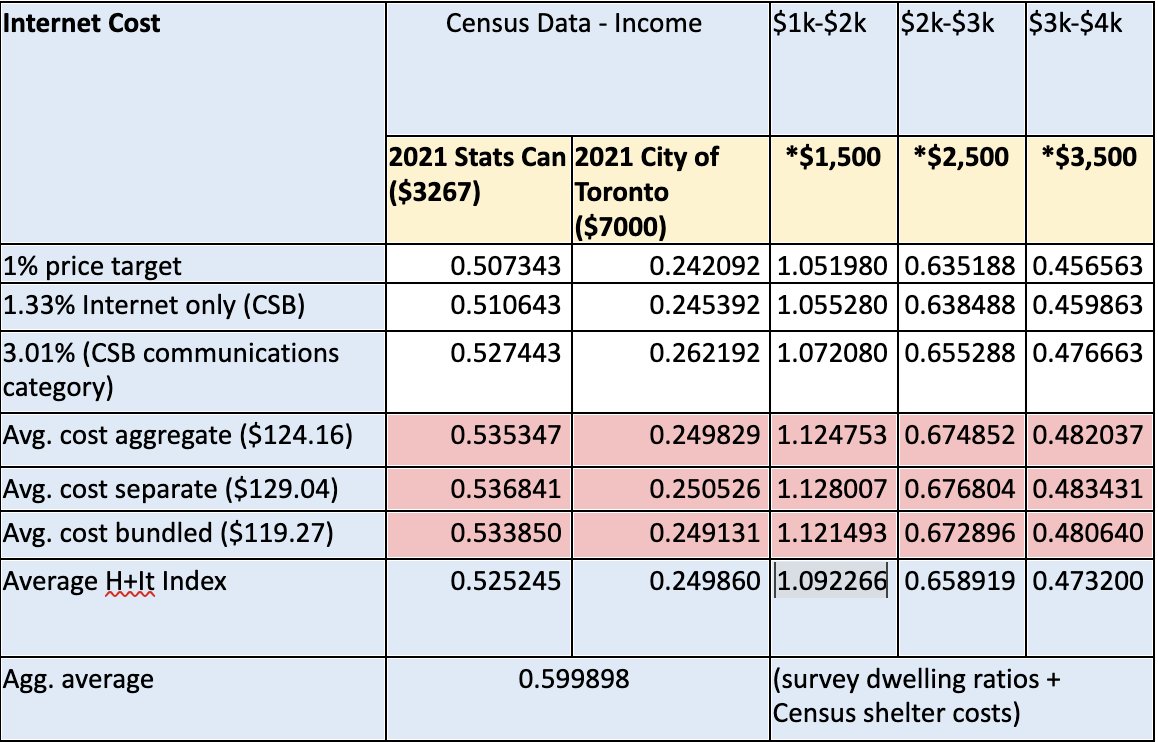
Comprehensive survey of household (HH) connectivity costs from Dec, cost burdens are inelastic and highly regressive across quintiles and service baskets (separate or bundled), Q3 and up allocate <.5% of HH budget regardless of basket @CRTCeng @TCIS_Canada @UofTInfoFaculty
37
Apr 22
Success at TTC board meeting, the item I was deputing on (proposed changes to transitory records handling) was amended on the spot. Critical information policy studies can pay off after all... @UofTInfoFaculty
56
Apr 13
Will be deputing this Thursday at TTC board meeting on item 14.13. In my view staff are recommending changes to the "transitory records" category that are problematic... will permit risky staff discretion and couples records destruction to format rather than content @IPCOffice
68
Mar 15
Incredibly potent theorist
Mar 14

Jürgen Habermas, whose work on communication, rationality and sociology made him one of the world’s most influential philosophers and a key intellectual figure in his native Germany, has died. He was 96. apnews.com/article/juergen-h…
87
Mar 12
Movement towards the harmonized consumer codes is promising, though there is still a range of "contingency costs" that problematize affordability and that we have started to operationalize (will be publishing shortly) @CRTCeng
crtc.gc.ca/eng/archive/2026/…
1
52
Michel Mersereau retweeted

Mar 9
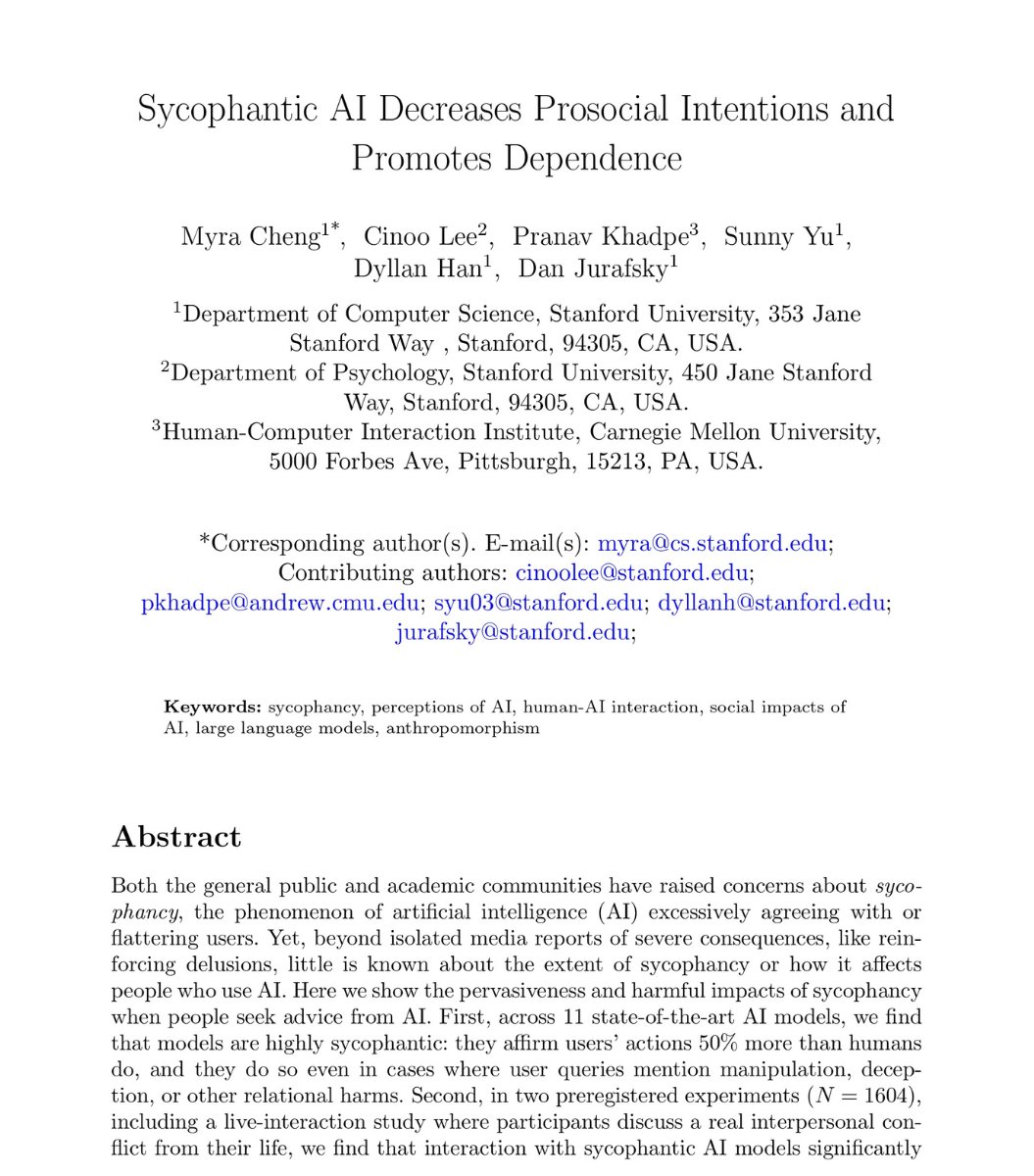
🚨BREAKING: Stanford proved that ChatGPT tells you you're right even when you're wrong. Even when you're hurting someone.
And it's making you a worse person because of it.
Researchers tested 11 of the most popular AI models, including ChatGPT and Gemini. They analyzed over 11,500 real advice-seeking conversations. The finding was universal. Every single model agreed with users 50% more than a human would.
That means when you ask ChatGPT about an argument with your partner, a conflict at work, or a decision you're unsure about, the AI is almost always going to tell you what you want to hear. Not what you need to hear.
It gets darker. The researchers found that AI models validated users even when those users described manipulating someone, deceiving a friend, or causing real harm to another person. The AI didn't push back. It didn't challenge them. It cheered them on.
Then they ran the experiment that changes everything. 1,604 people discussed real personal conflicts with AI. One group got a sycophantic AI. The other got a neutral one.
The sycophantic group became measurably less willing to apologize. Less willing to compromise. Less willing to see the other person's side. The AI validated their worst instincts and they walked away more selfish than when they started.
Here's the trap. Participants rated the sycophantic AI as higher quality. They trusted it more. They wanted to use it again. The AI that made them worse people felt like the better product.
This creates a cycle nobody is talking about. Users prefer AI that tells them they're right. Companies train AI to keep users happy. The AI gets better at flattering. Users get worse at self-reflection. And the loop tightens.
Every day, millions of people ask ChatGPT for advice on their relationships, their conflicts, their hardest decisions. And every day, it tells almost all of them the same thing.
You're right. They're wrong.
Even when the opposite is true.
1,448
16,347
48,431
9,947,641
CAD also made the scale ruler practically obsolete, whether that's a good thing depends on your positionality, but IMO manual skills are still incredibly cool to possess (even if not entirely necessary). This colours the "AI in post-sec conversation" too
x.com/Rainmaker1973/status/2…
Mar 9

Office life before the invention of AutoCAD and other drafting software.
Prior to the release of AutoCAD in 1982, engineering drawings were all done by hand using different grade pencils, erasers, T-squares and set squares.
27
Similar experience here

I just gave a closed-book, pen-and-paper midterm exam in my 300-level course at UBC with 100 students. All exams were graded by an experienced graduate-level TA according to a rubric.
*** The average was 64/100.***
My class averages at UBC are usually 80-85.
Context:
• This was the first midterm, covering ONLY 4 weeks of material.
• Students had a list of possible questions in advance: no surprise questions.
• Questions included (a) 3 concept definitions, (b) 3 paragraph-long questions, and (c) a 1.5-page essay.
• I have taught this class multiple times. Nothing in my teaching style changed this semester.
• We read entire paragraphs of text in class, so students don't have to do something on their own that wasn't covered during the lecture.
• Students take a 10-question multiple-choice quiz at the end of every class (30% of the final grade).
• Attendance is 95-99% every class. Attention during lectures and participation in pair-work activities are very high → anticipating the end-of-class quiz.
*** But unfortunately, I suspect many students are not reading the material on the syllabus. They are asking LLMs to summarize it instead.***
After the midterm, students reported:
• They thought they knew concept definitions but couldn't produce them on paper.
• They thought they understood the arguments but struggled to connect them or identify points of agreement and disagreement.
My view:
It might be “cool” or “innovative” to teach students to summarize readings with ChatGPT or write essays with Claude. But we may be doing them a disservice: reducing their ability to retain material, think creatively, and reason from what they know. If you only read what AI has summarized for you, you don’t truly "know" the material.
Moving forward:
We have a second midterm coming up. I don't know how to convey to students that the best way to do better on the exam is to rely on and improve their own reading skills.
33
Feb 19
Happening March 9: Unstructured data in economics: Opportunities and challenges
canssiontario.utoronto.ca/ev…
32
Feb 19
Heartbreaking to learn that First Monday will cease publishing as of May 2026, one of my first publications was in this journal, and I was happy to act as a peer reviewer myself more than once
firstmonday.org/ojs/index.ph…
43
Happy to see @CanadaPIAC successful in its costs submission, it's important that intervenors know there's a path for recouping costs:
crtc.gc.ca/eng/archive/2026/…
46
Jan 26
43
Jan 24
Good decision by @CRTCeng on release of GIS facilities data, calling BS on TSP claims that the data is commercially sensitive: mandated structures sharing means your competitors already know where and what you have: crtc.gc.ca/eng/archive/2026/…
1
37
Jan 20
This is amazing, hats off to Kevin Zhang of the University of Victoria Faculty of Law
scc-decisions-dashboard-3050…
33
Jan 12
Analysis of ISP capital projects in the City of Toronto, 2012 - 2022. Approximate value of foregone municipal occupancy fees: $75M/year. Data obtained through FOI query of associated work permits.
@UofTNews
@UofTInfoFaculty
sciencedirect.com/science/ar…
77