
Joined March 2012
- Tweets 3,111
- Following 701
- Followers 10,585
- Likes 935
492 Photos and videos






Pinned Tweet

2 Sep 2025
I got fired from 4 jobs, failed at 7 startups in a row, lost $40K of my own savings, and then built a $6M business.
These are the only 7 lessons I wish I had known earlier 👇
1. You're dumb until you're a genius
4
37
316
113,737
Jun 12
Did you know you can turn your closed-won CSV into a live cold campaign in one sitting?
Almost nobody uses their CRM this way. Here's how to:

3
5
21
6,295
Jun 11
pov: your new hire just asked what the company does. you replaced three people with them.
2
6
1,291
Jun 11
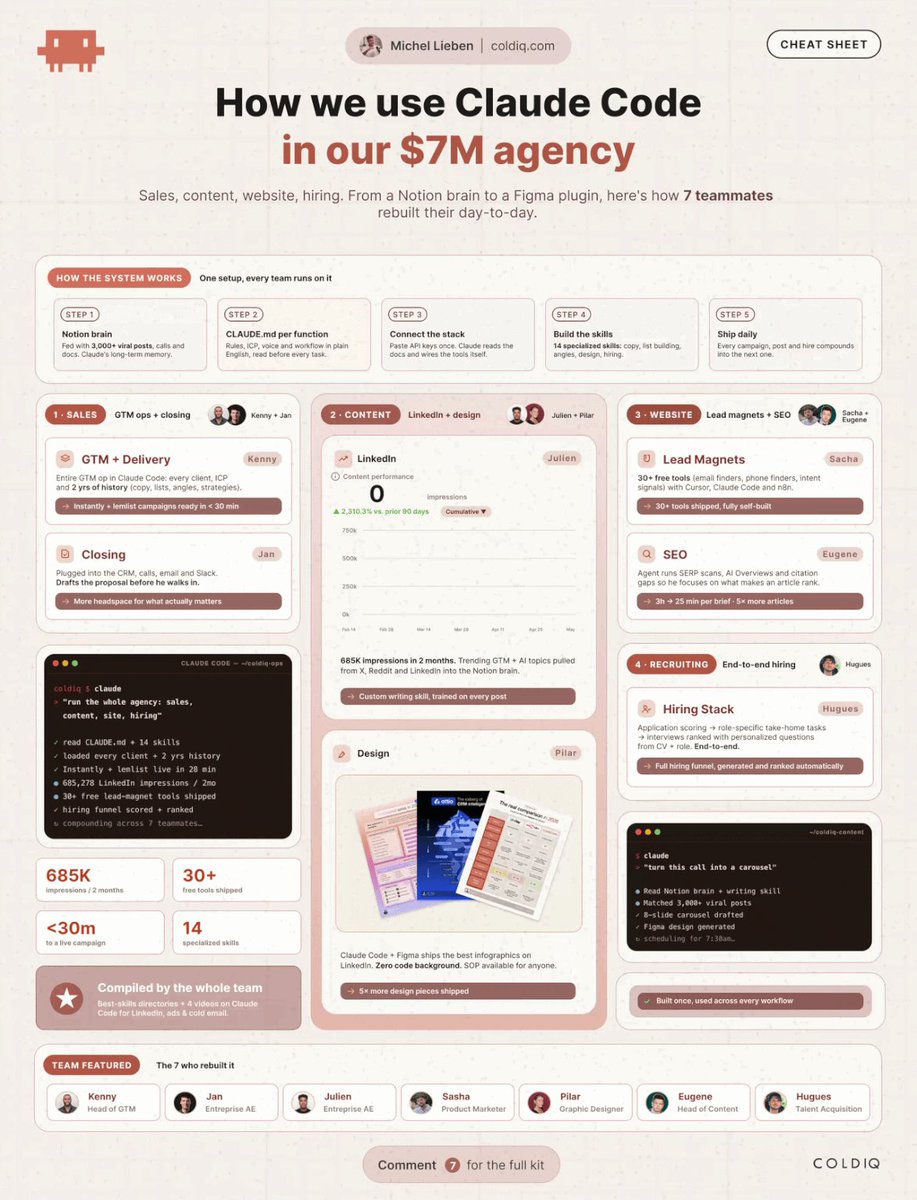
My team at ColdIQ ($7M ARR) rebuilt every function inside Claude Code.
Here's exactly what each one does now:
1. GTM
> Dump everything into Claude Code first.
> ICP, past campaign results, SOPs, call transcripts, Slack threads.
> Then build skills for the repetitive jobs: list building, enrichment, copy. > After enough reps your team ships campaigns in plain English.
→ Our Head of GTM now ships @lemlist and @InstantlyAI campaigns in under 30 minutes. Lists built, pain points mapped, copy written, all loaded into the sequencer.
2. Content
> Pull trending subtopics from X, Reddit, LinkedIn and YouTube into Notion.
>Feed Claude every post plus its performance so it learns what actually goes viral.
> Then build a writing skill trained on your voice.
→ One of our AEs did this and pulled 685K LinkedIn impressions in 2 months.
3. Recruitment
> Build a hiring OS that grabs the manager's spec, scours the web for the same role at top companies, writes the JD off the best ones, generates a custom assignment, then scores hundreds of applicants on CV plus assignment.
→ Our recruiter built this and cut his evaluation time by ~3x. He still runs every interview himself.
4. Design
> Feed your design system to Claude Code, pair it with @figma's MCP, and let it generate the infographics.
→ Our designer now ships 5x more design pieces than before. Some still clear 100k views on LinkedIn.
5. Sales
> Connect Claude to your CRM, call transcripts, email, DMs and Slack.
> Then have it research every prospect before the call, draft the proposal after, and cross-check your open deals.
→ One of our closers runs this and takes way more demos than before.
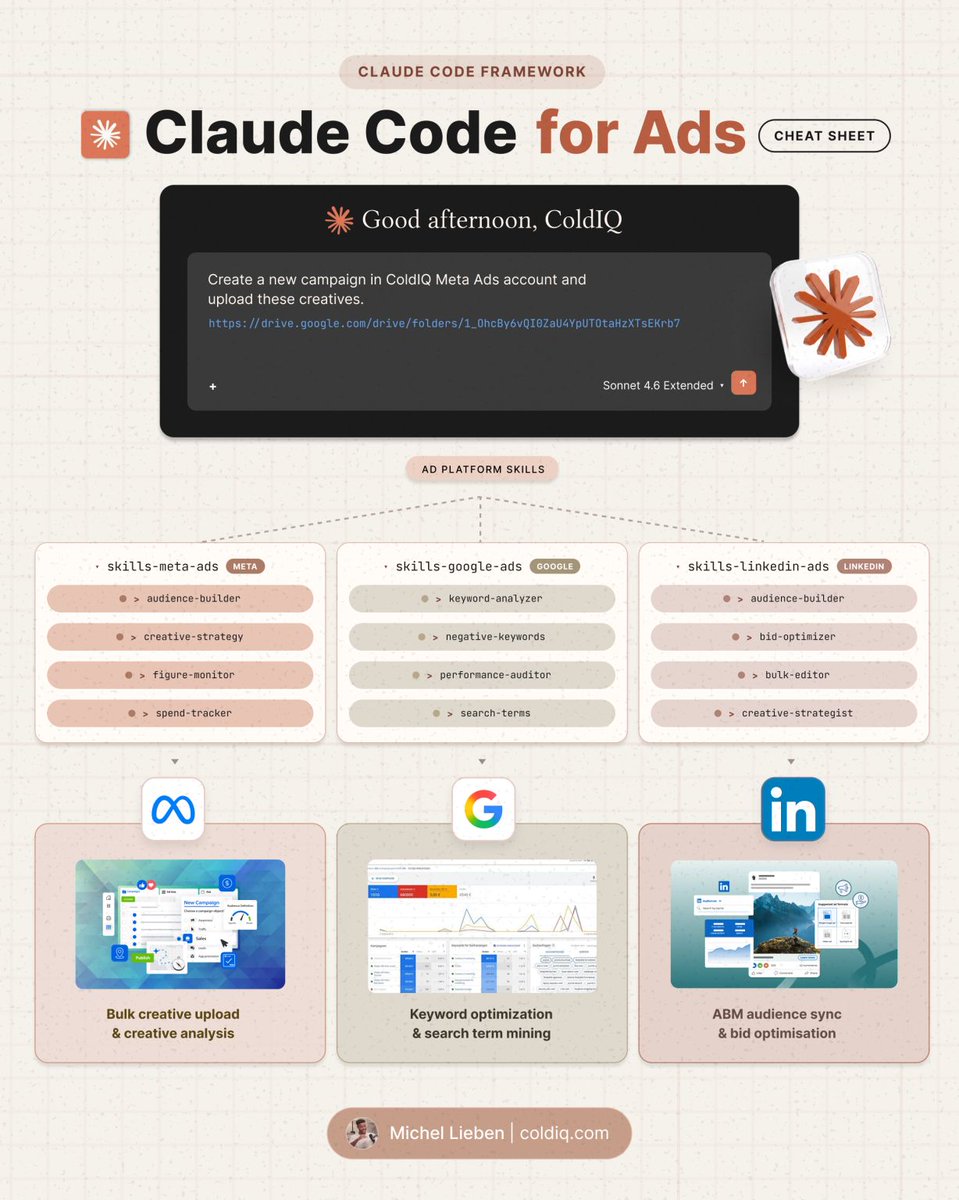
6. Ads
> Train Claude on your best-performing ads plus the best ones you see in the wild. Off past performance it spins up audiences, campaign angles, creative briefs and target lists.
→ We now manage $300k/mo across Meta, Google and LinkedIn, with ~80% of the work handled by Claude Code.
The full breakdown is in the graphic (bookmark it)
9
8
44
3,231
Jun 10
We built 12 Claude Code skills that run $300K/mo in ads across Google, Meta, and LinkedIn. I'm giving all 12 away, free.
4X ROAS on $1M spent. Ivan, our head of growth, built them over 200 hours running campaigns for our clients.
They work the ad platforms from the terminal in plain English:
> build custom audiences from your CRM lists
> catch creative fatigue before CTR drops
> bulk-edit campaigns, bids, and naming in seconds
> cut wasted spend on dead Google search terms
> audit quality scores and surface keyword gaps
Drop them into Claude Code, connect your ad accounts, tell it what you want. It reads the skills and executes.
You get all 12 ready to install, plus the 67-min video where Ivan and I walk through how we run them for clients.
Reply "ADS" and I'll DM you the repo the video. Repost to pass it on. Must be following.
1,376
261
1,038
109,243
Jun 9
a guy who ignores almost every cold pitch that hits his inbox just handed you the cheat code to get a reply from him, and every busy founder like him.
2
2
36
11,832
Jun 9
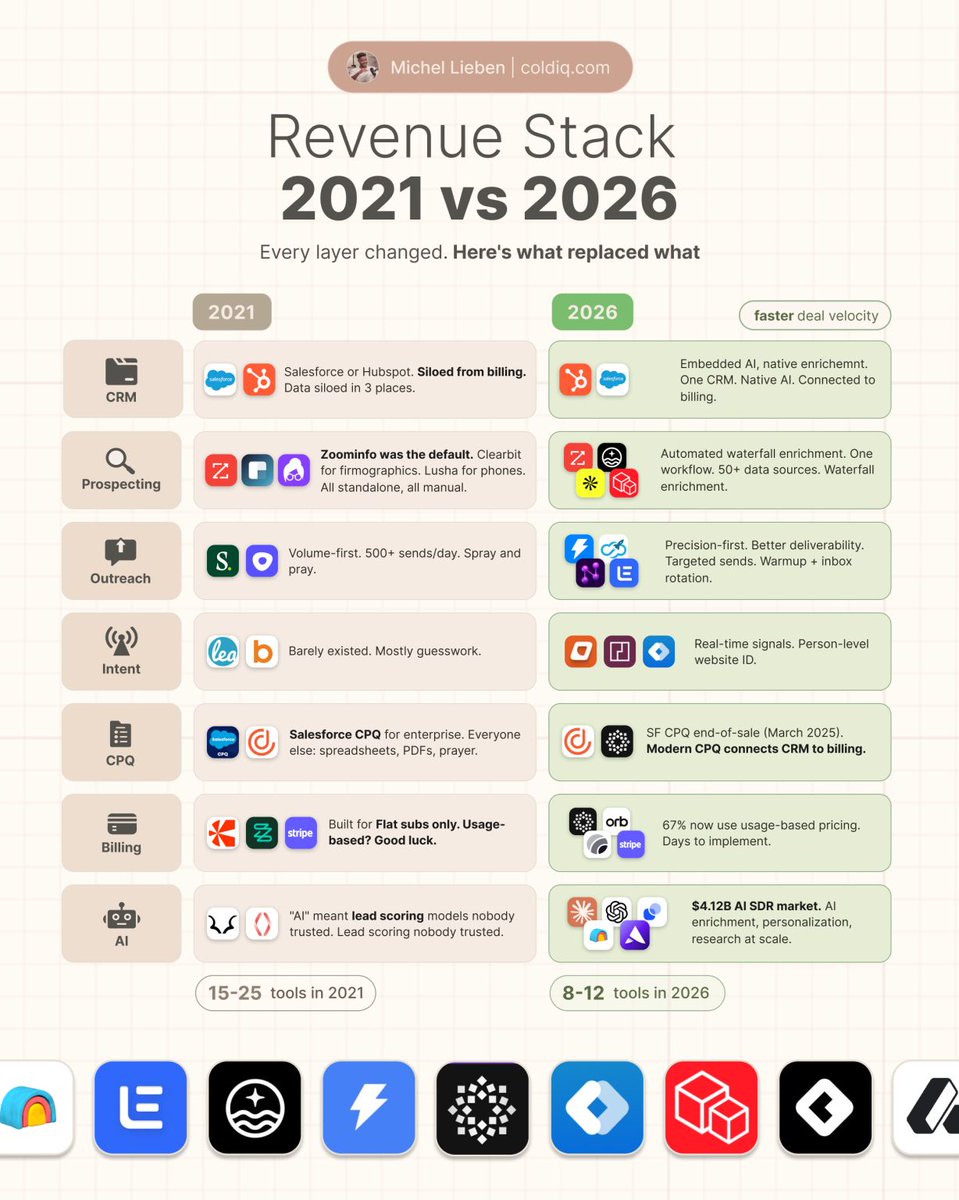
The B2B revenue stack dropped from 15-25 tools in 2021 to 8-12 in 2026, and almost nothing survived the jump. Every layer got replaced.
This is the stack we rebuild for B2B companies, so here's all seven: what each one was, what replaced it, and what to run now.
1. CRM
In 2021 it was Salesforce or HubSpot, cut off from billing, with the same data living in three different places. Now it's a single CRM with AI and enrichment built in, wired straight to billing.
→ Stop duct-taping tools around your CRM. Pick the one that owns enrichment and billing natively, because every integration you delete is one less place your data goes stale.
2. Prospecting
It used to be Zoominfo as the default, Clearbit for firmographics, and Lusha for phone numbers. Three standalone tools you worked by hand. Now it's one workflow running waterfall enrichment across 50 data sources.
→ Switch to waterfall enrichment: hit the cheapest data source first and only fall through to pricier ones when a field comes back empty. You cover more contacts for less than any single vendor charges.
3. Outreach
2021 was volume-first. 500 sends a day, spray and pray. 2026 is precision-first: fewer targeted sends, with warmup and inbox rotation protecting deliverability.
→ Drop your daily send volume and spread it across rotating, warmed-up inboxes. A small list that reaches the inbox beats a huge one rotting in spam.
4. Intent
Five years ago intent data barely existed, so targeting came down to guesswork. Now you get real-time buying signals and person-level website identification.
→ Build this week's list around who's actually showing intent, not a static ICP you exported once. Deanonymize your website traffic and reach out while the interest is still hot.
5. CPQ
In 2021 this meant Salesforce CPQ for enterprise, and spreadsheets, PDFs, and prayer for everyone else. Salesforce put CPQ end-of-sale in March 2025, and modern CPQ now connects your CRM directly to billing.
→ If you sell anything past a flat plan, run a CPQ that quotes and hands off to billing in one flow. Manual quotes in spreadsheets are where deals stall and margin quietly leaks.
6. Billing
Billing used to be built for flat subscriptions only, and usage-based pricing was a nightmare to wire up. Now 67% of companies run usage-based and stand it up in days.
→ Choose billing that meters usage out of the box. Pricing is turning into a real growth lever, and you don't want your billing system capping what you're allowed to charge.
7. AI
In 2021, "AI" meant lead-scoring models nobody trusted. In 2026 it's a $4.12B AI SDR market doing enrichment, personalization, and research at scale.
→ Use AI across all three: enrichment, personalization, and research. The leverage now is how much it can learn about each prospect before you ever reach out.
The pattern under all of it is consolidation. Fifteen to 25 tools became 8 to 12, and the ones that survived share a single trait: they connect to the layers around them instead of living in their own tab. That is where faster deal velocity comes from.
Full map is in the infographic. Bookmark it for your next stack audit.
4
9
21
1,452
Jun 8
"buy more leads"
"blast more volume"
"automate the outreach"
"just run ads"
or... build the one thing you get for free
1
18
2,924
Jun 8
A lead gen agency charges you to do 3 things: build the list, write the copy, run the campaign.
Here's how to do all 3 yourself inside Claude Code end to end.
> Start with the folder structure. The agent is really just a folder: one MD file that acts as the brain (your directions), plus separate files for your scoring criteria, copy frameworks, output templates, and API keys. Get this right first or you'll rebuild it later (we did).
> Feed it the docs once. Grab any tool's API docs page (@apolloio, @InstantlyAI, your ad platforms), paste the link, tell Claude to read it and write its own reference file. Now it never relearns the integration.
> Build your scoring from your own customers. Export your closed-won and current clients, have Claude find what they share: headcount, revenue, industry. That's your tier 1. Score them with a Python script instead of an AI prompt, so 10,000 companies get tiered on the raw numbers with nothing for the model to hallucinate.
> Pull and enrich the contacts. Point it at @apolloio (or Blitz, Crest, RKI) and ask in plain English for the sales leaders at your tier 1 and 2 accounts. 150 contacts in under two minutes, then one more prompt enriches the work emails. No filters, no formulas.
> Write copy off what already converts. Drop in the email frameworks working for you right now. Claude writes the sequence from those and maps the names and signatures itself. The trick we use: prospect one person by hand, write the perfect email, then have Claude reverse-engineer it across the whole list.
> Push the campaign to your sequencer. It builds the campaign in @InstantlyAI or Smartlead, loads every lead, drops in the copy. You never open the tool.
> Close the loop weekly. Let it run, then ask for the analytics. Claude pulls which copy and job titles actually replied, saves the winners, reuses them next time. Put it on Railway and it does this on its own, 24/7.
The same approach runs our LinkedIn, Meta and Google ad campaigns, and a separate agent pulls everyone who engages with our posts straight into outbound. The $300 a month we used to spend on scraping tools is gone.
You need a data provider, a sequencer, and Claude Code. The Claude part runs on the $20 plan, Max if you're pushing real volume. That's the whole stack.
I sat down with our head of GTM and our head of growth and recorded the full breakdown, every build, live, start to finish. (full video in replies)
6
1
27
3,525
Jun 8
Full breakdown of the entire system here, built live with my team:
youtube.com/watch?v=iTg-nXaq…
2
8
623
Michel Lieben retweeted
Jun 4
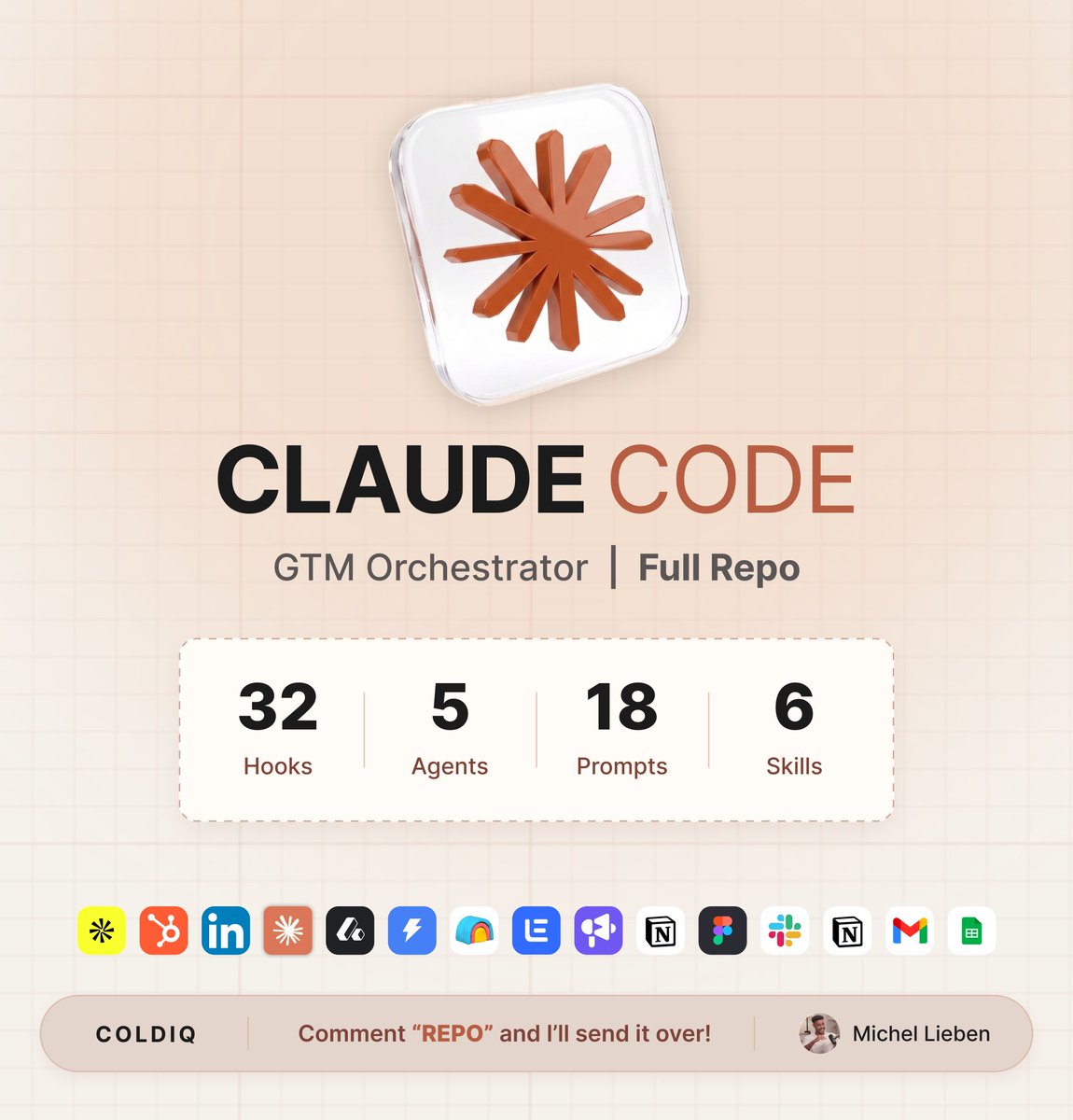
We run GTM at ColdIQ ($7M ARR) inside Claude Code. Today I'm giving away the full repo that makes it work. Free.
A prompt just answers you. These hooks make Claude act, across the tools you already pay for:
1. Finishes a task → Slack gets pinged
2. Enriches a lead → your CRM updates
3. Writes a sequence → loaded into Instantly
4. Generates content → caught in Gmail
That's the gap between Claude that talks and Claude that runs your stack. No Zapier in the middle, nothing to copy-paste between tools.
Inside the repo:
- 32 hooks
- 5 agents
- 18 prompts
- 6 skills
Plus the integrations to wire it into Apollo, Instantly, Gmail, Slack, and your CRM.
These are the same automations firing inside our agency right now. Clone it, drop in your API keys, and it goes.
Reply "repo" and I'll DM it. Must be following.
317
34
200
19,188
Jun 3
the 5 stages of posting on linkedin: denial, cringe, embarrassment, posting anyway, millions in pipeline

3
19
4,074
Jun 3
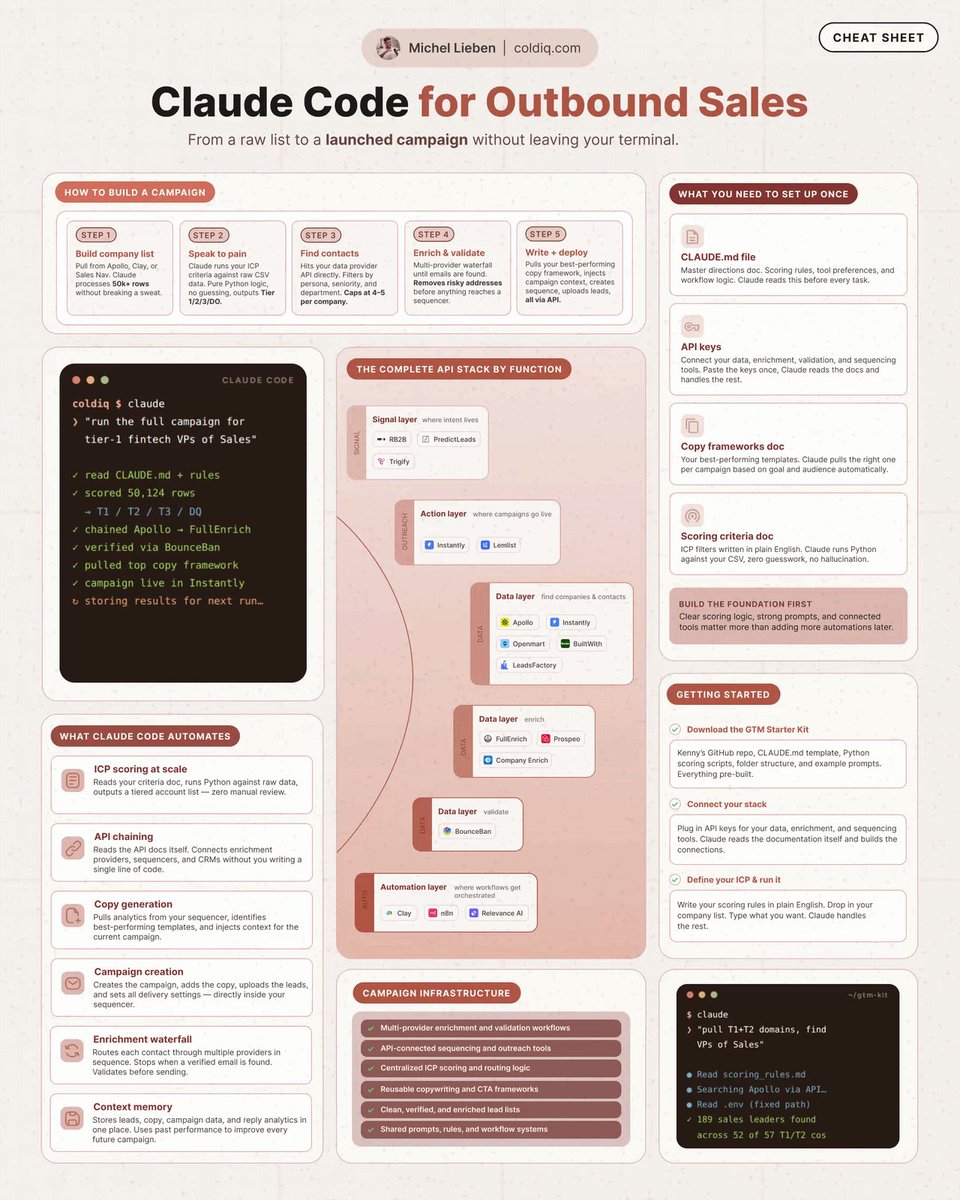
A cold outreach campaign was never one job. You build the list, score it against your ICP, layer in intent signals, find the right decision-makers, enrich and validate the data, write the copy, then push it live.
Every one of those steps usually has its own tool, and usually its own person.
We now run all of it inside Claude Code, start to finish, without leaving the terminal.
Here's every step Claude Code handles for us:
1. List building
A few ways to build the list:
→ lookalikes of the companies already paying you, pulled with PredictLeads
→ standard B2B databases like Apollo, CompanyEnrich, and Sales Navigator
Claude chews through 50k row CSVs without breaking a sweat.
2. Account scoring
We built custom GTM skills (lead-scoring is the big one) to run our ICP criteria against the raw list.
Every account gets sorted into Tier 1 (manual outreach), Tier 2 (multichannel), or Tier 3 (email only).
Claude does the scoring and filtering on its own.
3. Intent signals
APIs like PredictLeads and Trigify catch the signals that matter: hiring, press releases, product launches, social engagement.
Claude calls the right one and layers intent on top of the targeting.
4. Decision-maker filtering
LeadsFactory pulls multiple decision-makers per company, matched to our ICP: title, seniority, department.
So we reach the people who can actually say yes, not just one name per account.
5. Data enrichment & validation
Claude runs a waterfall across providers to find phones and emails: Apollo, FullEnrich, Prospeo, CompanyEnrich.
Then it scrubs the risky addresses before anything reaches a sequencer.
6. Copy generation & deployment
Claude pulls our best-performing copy straight out of lemlist or Instantly through their API.
Then it writes fresh copy around the signals, the company's current moves, and the persona we're after.
It works in batches of 100-200 leads at a time, so quality never slips.
7. Feedback & auto-improvement
After launch, Claude keeps reading the campaign metrics.
It finds the segments that are converting, pulls lookalikes off those winners, and feeds them straight into the next campaign.
The whole thing compounds on itself, the way a Meta ad pixel gets smarter the longer it runs.
What you need to set it up:
→ a CLAUDE.md file with your scoring rules, tool preferences, and workflow logic
→ your custom outbound skills
→ your API keys
The GTM stack we plug in, by layer:
> Data → Clay, Apollo, CompanyEnrich, Openmart
> Enrich → Prospeo, FullEnrich, CompanyEnrich, LeadsFactory
> Signals → PredictLeads, Trigify
> Orchestration → Clay, Relevance AI, n8n
> Action → Expandi, Instantly, lemlist
> Validation → BounceBan
11
8
84
19,077
Jun 2
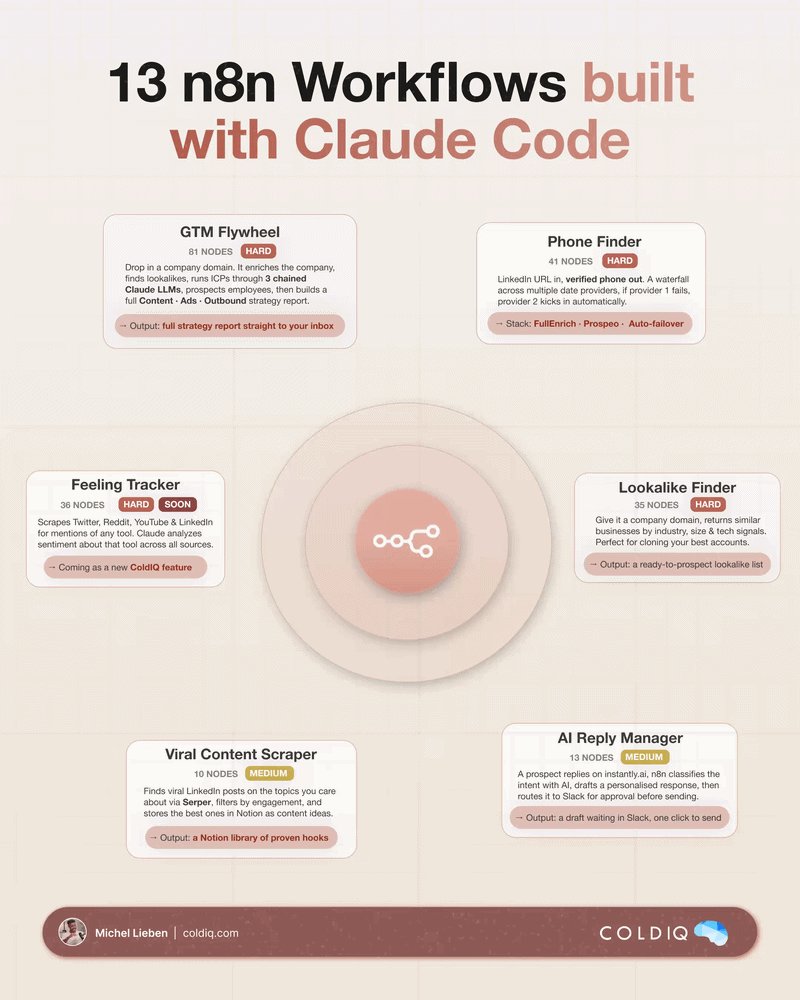
We built 13 n8n workflows with Claude Code to run GTM at our $7M ARR agency. I'm giving all 13 away, free.
Most of them run our own prospecting, enrichment, and reply handling across client campaigns. A couple, like the sentiment tracker, are brand new.
Here's 6 of them:
1. GTM Flywheel (81 nodes, hard)
Feed it one company domain. It enriches the company, finds lookalikes, generates ICPs through 3 chained Claude models, then prospects the right employees. Out comes a full strategy across content, ads, and outbound, sent straight to your inbox.
2. Phone Finder (41 nodes, hard)
LinkedIn URL in, verified phone number out. It waterfalls across @prospeo_io, FullEnrich and more. One provider misses, the next picks it up automatically.
3. AI Reply Manager (13 nodes, medium)
A prospect replies to a cold email in @InstantlyAI. n8n classifies the intent, drafts a personalized reply, and drops it in Slack for approval or edits before anything sends.
4. Lookalike Finder (35 nodes, hard)
Domain in, similar companies out, sorted by industry, size, and tech signals.
5. Viral Content Scraper (10 nodes, medium)
Finds viral LinkedIn posts on the topics you pick, filters by engagement, and files the best ones in Notion for content ideas.
6. Feeling Tracker (36 nodes, hard)
Give it any tool. It scrapes Twitter, Reddit, YouTube, and LinkedIn for mentions, then Claude reads the sentiment across every source.
7 more are in the doc, across content, GTM, and ops.
Comment "N8N" and I'll send you the full doc with all 13. Make sure you're following.
198
42
168
17,658