
Imagine if Vogue, National Geographic, Carl Jung, Swedish nature, philosophy, symbolism, and a touch of cosmic wonder decided to share the same campfire.🌿✨🐎📖
Joined January 2023
- Tweets 9,195
- Following 2,191
- Followers 414
- Likes 22,137
Photos and videos

MindConfetti retweeted
Don’t focus on marriage material. Sometimes solid, enduring friendships contribute much more. Marriage is not always a blessing, according to Paul. In his words it is territory for tribulation most of the time.
1
1
38
MindConfetti retweeted
It’s presence in the midst of pain. It’s saying I am staying while my entire being screams ‘run and hide’.
True presence moves with the messiness of relationships. It anchors the dynamic, no matter what that dynamic looks like.
I am reminded of the turbulence I went through with my horses as I decided to stay present instead of getting rid of them.
1
22
MindConfetti retweeted
Yes.
And talk about your dating experiences with people who are unapologetically honest with you. Not all flaws are fatal to a marriage, but people who are older and wiser and more experienced and who sincerely have your best interests at heart will certainly be able to advice if the match will endure.
1
1
27
MindConfetti retweeted

DELUSIONS VERSUS REALITY
Delusions are not usually stronger than reality. They are often stronger than perception.
👉🏻Reality has no need to convince you. It simply exists.
👉🏻A delusion, by contrast, is an active psychological structure. It recruits emotion, memory, fear, hope, identity, imagination, and selective attention into a self-reinforcing system. It is not merely an incorrect belief. It is a belief defended by an entire internal ecosystem.
From a consciousness-pattern perspective, reality is often quiet while delusions are loud.
Imagine two signals:
1️⃣Reality presents information.
2️⃣Delusion presents meaning.
The human nervous system is generally more responsive to meaning than information.
A person can ignore a hundred pieces of contradictory evidence if accepting them would threaten:
their identity,
their attachment bonds,
their status,
their worldview,
or their deepest hopes.
The delusion becomes psychologically necessary. This is why people sometimes remain inside obviously false narratives long after reality has delivered the verdict. The real battle is rarely about facts. It is about what the facts would require the person to become.
- A man may know his marriage is dead.
- A woman may know her lover will never commit.
- An investor may know the scheme is collapsing.
Yet the delusion persists because reality demands grief, accountability, surrender, or transformation. The nervous system often chooses fantasy over death of identity.
👉🏻 There is another layer.
Delusions are frequently reinforced by intermittent rewards. A gambler wins occasionally. An addict gets occasional relief. A person obsessed with an unavailable partner receives a rare text message. These small confirmations act like fuel pellets dropped into a reactor. The mind ignores ninety contradictions and worships the one confirming event.
👉🏻Reality is cumulative.
👉🏻Delusion is emotional.
👉🏻Emotion usually wins the short game.
👉🏻Reality wins the long game.
That is why the collapse of a delusion often feels less like “learning something new” and more like “surviving a demolition”. The person is not losing an idea. They are losing the structure that organized their perception of the world.
The interesting question is not “Why are delusions stronger than reality?”
It is:
What need is the delusion protecting that reality is asking to face?
That question tends to dissolve illusions faster than arguing about whether they are true. 🕯️
#ConsciousnessPatterns

1
25
One of the most underrated examples of presence under vulnerability comes from the film The Gathering Storm (2002).
In one scene, Winston Churchill casually dictates to his secretary while walking around partially undressed, completely unconcerned with managing impressions. The point is not the lack of clothing.
Most people spend enormous energy controlling how they appear. Churchill, in that moment, demonstrates something rarer: the ability to remain fully himself while exposed.
Presence is not confidence.
Presence is the capacity to remain unchanged by the fact that you are being seen.
Intimacy begins where impression management ends.
#Leadership

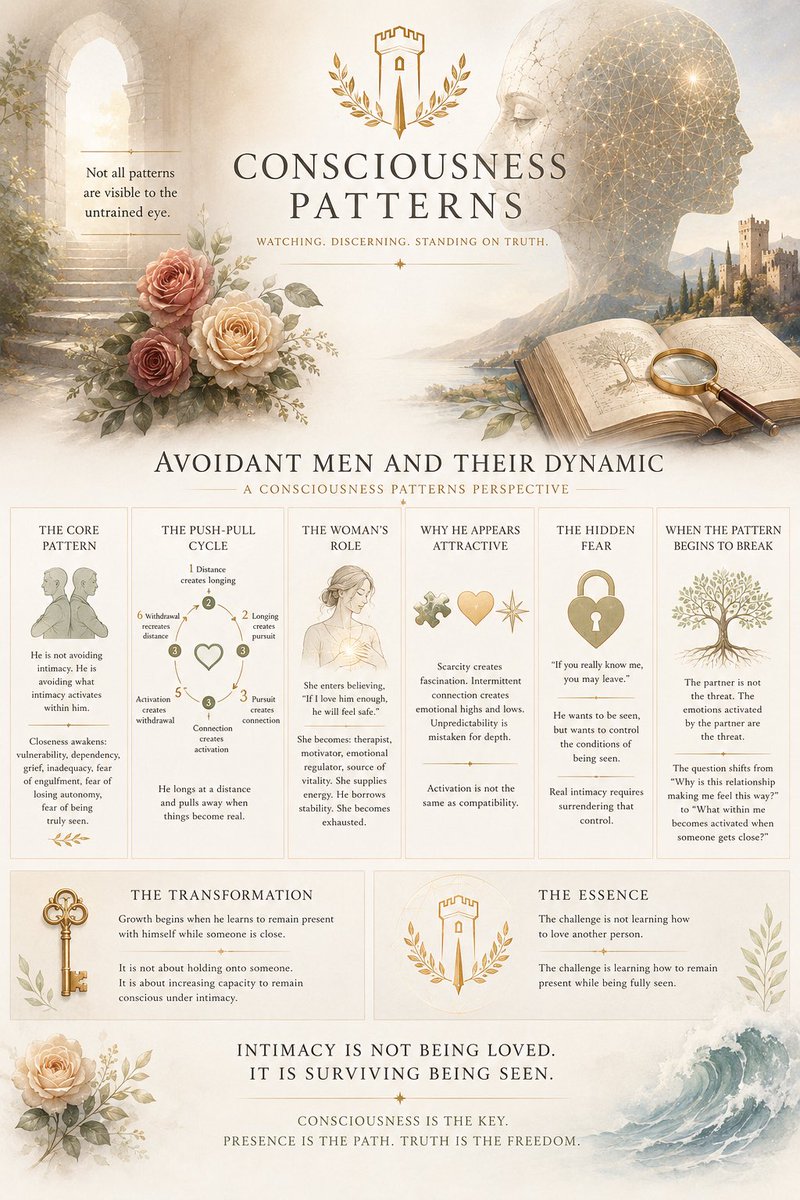
THE AVOIDANT MAN
- Through the Lens of Consciousness Patterns -
Most discussions about avoidant men focus on behavior. They describe
👉🏻emotional distance,
👉🏻fear of commitment,
👉🏻mixed signals, and
👉🏻a tendency to withdraw when relationships become serious.
While these observations are often accurate, they rarely address the deeper pattern operating beneath the surface.
From a Consciousness Patterns perspective, the avoidant man is not fundamentally avoiding intimacy. He is avoiding what intimacy awakens within him.
Human relationships function as mirrors. The closer another person comes, the more deeply hidden aspects of ourselves are illuminated.
👉🏻Vulnerability,
👉🏻dependency needs,
👉🏻unresolved grief,
👉🏻feelings of inadequacy,
👉🏻fear of rejection, and
👉🏻fear of losing autonomy
all begin to emerge. What appears to be a reaction to the other person is often a reaction to one’s own internal activation.
THE PARADOX
This creates a paradox. The avoidant man may genuinely desire connection, companionship, and love. Yet the very experience he longs for also confronts him with emotional realities he has learned to suppress. As intimacy deepens, the relationship becomes increasingly difficult to manage, not because of the partner, but because of the psychological material the partner unconsciously activates.
This is why avoidant dynamics frequently follow a predictable cycle.
1️⃣Distance creates longing.
2️⃣Longing motivates pursuit.
3️⃣Pursuit leads to connection.
4️⃣Connection generates emotional activation.
5️⃣Activation produces discomfort.
6️⃣Discomfort leads to withdrawal.
7️⃣The withdrawal recreates distance,
and the cycle begins again.
To the outside observer, this behavior can appear contradictory. The avoidant man often seems most interested when the relationship is uncertain and most distant when commitment becomes possible. However, the contradiction only exists on the surface.
👉🏻Distance allows desire to flourish without requiring vulnerability.
👉🏻Closeness requires vulnerability without the protection of distance.
The partner often becomes caught within a complementary pattern. Believing that greater love, patience, understanding, or sacrifice will eventually create safety, she gradually assumes the role of emotional regulator. She supplies reassurance, encouragement, emotional labor, and relational stability. Over time, the relationship can become an energetic imbalance in which one person generates vitality while the other unconsciously consumes it.
Eventually, exhaustion sets in. The woman withdraws her investment, not necessarily because she has stopped caring, but because she can no longer sustain the weight of carrying two nervous systems. At this point, the true structure of the relationship becomes visible. What once appeared to be a problem of communication is revealed as a problem of consciousness.
One reason avoidant individuals are often perceived as especially attractive is that avoidance creates scarcity. Human beings are naturally drawn toward what feels difficult to obtain. Intermittent availability can generate emotional intensity that is easily mistaken for depth. Yet activation and compatibility are not the same thing. A relationship can be highly activating while remaining fundamentally unstable.
At the core of many avoidant patterns lies a quiet and often unconscious belief: “If you truly know me, you may leave.” This fear creates an impossible dilemma. The person longs to be seen while simultaneously attempting to control the conditions under which they are seen. Genuine intimacy, however, requires surrendering that control.
The transformation begins when the avoidant individual recognizes that the partner is not the source of the discomfort. The discomfort originates from internal experiences that intimacy exposes. The question shifts from “Why is this relationship making me feel this way?” to “What within me becomes activated when someone gets close?”
1
54
From the entire movie, I remember that scene the most. That’s why I mention it.
21
MindConfetti retweeted
THE AVOIDANT MAN
- Through the Lens of Consciousness Patterns -
Most discussions about avoidant men focus on behavior. They describe
👉🏻emotional distance,
👉🏻fear of commitment,
👉🏻mixed signals, and
👉🏻a tendency to withdraw when relationships become serious.
While these observations are often accurate, they rarely address the deeper pattern operating beneath the surface.
From a Consciousness Patterns perspective, the avoidant man is not fundamentally avoiding intimacy. He is avoiding what intimacy awakens within him.
Human relationships function as mirrors. The closer another person comes, the more deeply hidden aspects of ourselves are illuminated.
👉🏻Vulnerability,
👉🏻dependency needs,
👉🏻unresolved grief,
👉🏻feelings of inadequacy,
👉🏻fear of rejection, and
👉🏻fear of losing autonomy
all begin to emerge. What appears to be a reaction to the other person is often a reaction to one’s own internal activation.
THE PARADOX
This creates a paradox. The avoidant man may genuinely desire connection, companionship, and love. Yet the very experience he longs for also confronts him with emotional realities he has learned to suppress. As intimacy deepens, the relationship becomes increasingly difficult to manage, not because of the partner, but because of the psychological material the partner unconsciously activates.
This is why avoidant dynamics frequently follow a predictable cycle.
1️⃣Distance creates longing.
2️⃣Longing motivates pursuit.
3️⃣Pursuit leads to connection.
4️⃣Connection generates emotional activation.
5️⃣Activation produces discomfort.
6️⃣Discomfort leads to withdrawal.
7️⃣The withdrawal recreates distance,
and the cycle begins again.
To the outside observer, this behavior can appear contradictory. The avoidant man often seems most interested when the relationship is uncertain and most distant when commitment becomes possible. However, the contradiction only exists on the surface.
👉🏻Distance allows desire to flourish without requiring vulnerability.
👉🏻Closeness requires vulnerability without the protection of distance.
The partner often becomes caught within a complementary pattern. Believing that greater love, patience, understanding, or sacrifice will eventually create safety, she gradually assumes the role of emotional regulator. She supplies reassurance, encouragement, emotional labor, and relational stability. Over time, the relationship can become an energetic imbalance in which one person generates vitality while the other unconsciously consumes it.
Eventually, exhaustion sets in. The woman withdraws her investment, not necessarily because she has stopped caring, but because she can no longer sustain the weight of carrying two nervous systems. At this point, the true structure of the relationship becomes visible. What once appeared to be a problem of communication is revealed as a problem of consciousness.
One reason avoidant individuals are often perceived as especially attractive is that avoidance creates scarcity. Human beings are naturally drawn toward what feels difficult to obtain. Intermittent availability can generate emotional intensity that is easily mistaken for depth. Yet activation and compatibility are not the same thing. A relationship can be highly activating while remaining fundamentally unstable.
At the core of many avoidant patterns lies a quiet and often unconscious belief: “If you truly know me, you may leave.” This fear creates an impossible dilemma. The person longs to be seen while simultaneously attempting to control the conditions under which they are seen. Genuine intimacy, however, requires surrendering that control.
The transformation begins when the avoidant individual recognizes that the partner is not the source of the discomfort. The discomfort originates from internal experiences that intimacy exposes. The question shifts from “Why is this relationship making me feel this way?” to “What within me becomes activated when someone gets close?”
1
1
93
MindConfetti retweeted

A great deal of disappointment comes from expecting conscience where only appetite exists. You meet someone, project depth onto them, assign nobility to their words, and then act shocked when self-interest makes the final decision. The wiser move is colder: assume nothing, observe everything, and let patterns teach you.
1
60
352
7,010
Best movement for guys when they know how to use their shoulders 😩😉

42
I am currently wearing ‘Invisalign’ braces for 12 months to help me get my front teeth straight again. I had an accident with one of my horses and my front teeth were kicked out, - displaced entirely when it happened. I put them back in and that saved my teeth. The roots were not damaged so they did not have to be replaced. But the straightness of my front teeth was gone and is now realigned again with these braces.
6-8 more months to go.

1
45
That is a story ❤️
23h

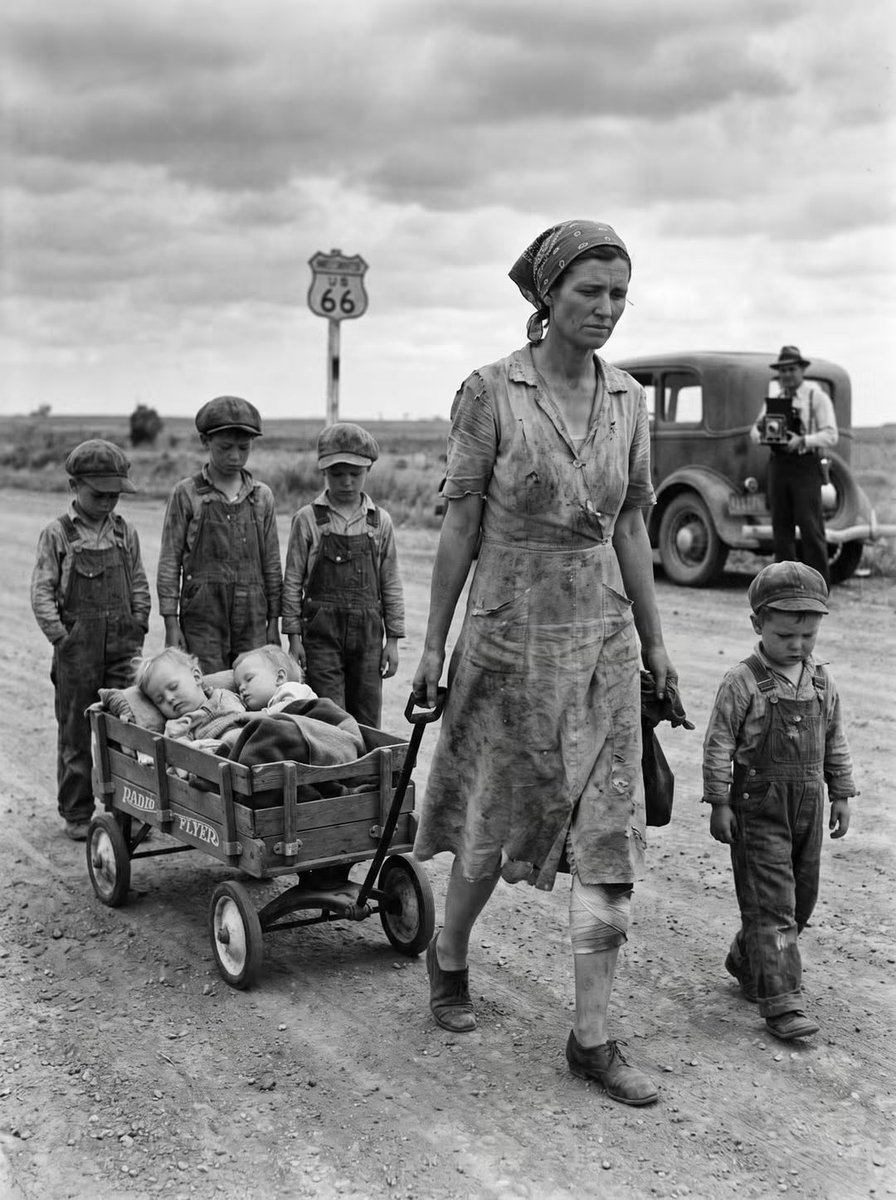
July 6, 1936, Route 66, New Mexico. This is Martha Evans, 32. She had been walking for three days. Her husband died of tuberculosis in Oklahoma in May. The farm was foreclosed. She took the six kids and a Radio Flyer wagon and started west for California. The twins in the wagon were 11 months old. The boys walking were 6, 5, 4, and 3. Her dress was torn on barbed wire. Her leg was cut and infected. She wrapped it with a feed sack. She had $1.60 in her pocket. A photographer from the Resettlement Administration saw them and pulled over. He offered her a ride. She said no. She said if she took a ride now, the kids would expect one every time they were tired. She gave him her name and kept walking. The photo ran in newspapers across the country. Donations came to a PO box in Barstow. She got $200 and a bus ticket. She made it to Bakersfield and picked grapes. All six kids lived. Three went to college. Martha died in 1978. The wagon is in the Smithsonian.
Community note
This story and image are fabricated. The image is AI-generated, and the story of "Martha Evans" is a fictional mashup of real Dust Bowl-era photographs, such as Dorothea Lange's "Migrant Mother" and Arthur Rothstein's photos of the Vernon Evans family. melpine.substack.com/p/the-fable-of…
1
47

MindConfetti retweeted

Stockholm, Sweden 🇸🇪

1
40
238
2,434

Jun 13
Horses sense everything. They are extremely sensitive to love. It is impossible to hide yourself from them. They will test you, they mostly test your fear level and your ability to lead.
If you can lead a herd of horses, you are aligned with yourself. They will trust you with their life. And that is the biggest compliment you can receive.

Natural Horsemanship and Personality Development
Basics Part I by Bianca Bell-Chambers
Natural Horsemanship (NH) describes the natural way of handling and a corresponding training with the horse.
Modern Natural Horsemanship can be traced back, among others, to the brothers Tom (1910–2003) and Bill (1906–1999) Dorrance. They grew up on a ranch in Oregon (USA) and trained their horses with empathetic methods.
They observed how horses interact with each other and with humans and adapted their training methods to be horse-friendly. Many world-famous horse trainers like Ray Hunt and Buck Brannaman built their methods on the origins of the Dorrance brothers.
Natural Horsemanship is primarily not work on the horse, but work on yourself. The horse reflects you and reacts to your actions. It is a mirror of your personality. To understand a horse's behaviour, you must first work on yourself.
Natural work with horses has less to do with "whispering" to them – as in the film "The Horse Whisperer" – but with listening to them.
From the horse's perspective, it is not natural for horses to be among humans or for a human to sit on a horse's back. From the horse's view, humans are predators.
It perceives our body odours and our posture. It senses our emotions. Therefore, it is important to neutralise negative feelings before working with the animal and to create a good atmosphere for human and horse.

2
1
1
123
Jun 13
I don’t wear perfume around my horses; they don’t like it. Our body odor tells them if we are fearful or not. Our heart beat tells them if we are relaxed or anxious. They can sense your heart beat from quite a distance. If you are anxious, they wonder where you have spotted danger.
Being calm around horses, calms them and that is what they seek in their human companion.
1
44
Jun 13
In a world that constantly pressures people to conform, the black sheep carries an important message: authenticity requires courage. It takes courage to follow a path that others do not understand. It takes courage to remain true to your convictions when approval is uncertain. It takes courage to trust that being different does not mean being wrong.
Perhaps that is why the black sheep has become such a powerful symbol. What some people see as a flaw may actually be a sign of a unique calling. What appears to be separation may be preparation. What feels like rejection may be redirection.
The black sheep’s journey begins when it stops asking, “How can I fit in?” and starts asking, “Who am I meant to become?”
Born for such a time as this.
- Ester 4:14
#MindConfetti

1
30
Jun 13
Ester was set apart by G-d. A huge task was ahead of her. People who feel different from the crowd, often separate themselves. First they try to fit in. After some time, the cost of sacrificing their authenticity to the crowd’s approval is simply too high and their self-abandonment catches up with them.
It’s important to follow your heart and to dare to be different. Find out who you are, live in alignment with your convictions. Despite of how others perceive you.
It’s what I teach my kids. It’s what I tell myself. It’s what I really, really appreciate in others. Authenticity has a price. But with it comes a life in alignment with truth. Even when our understanding of truth unfolds progressively.
1
1
39