
Kinda bored, thought I might debate theology.
Joined September 2015
- Tweets 25,331
- Following 234
- Followers 386
- Likes 38,334
2,366 Photos and videos















Pinned Tweet

2 Dec 2023
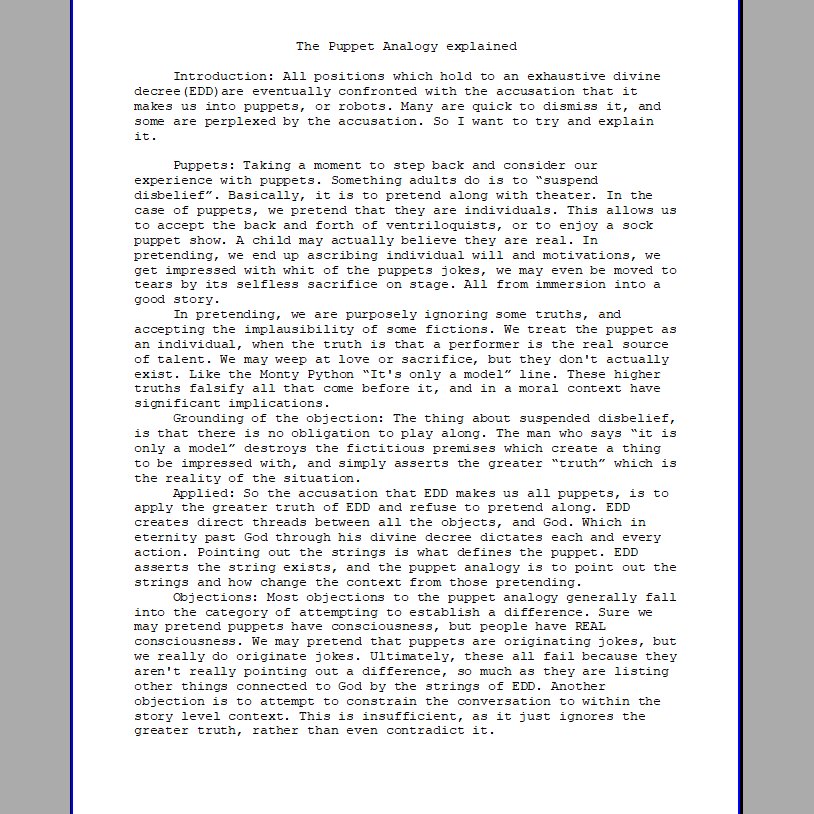
Some thoughts on explaining the Puppet objection to EDD (suggestions and edits welcome)
9
1
26
4,054
Jun 12
New argument dropped.. help me out.
Jun 12

As only LFW can preserve a world necessarily based in logic.
-Assuming determinism- argument following...
2/3
47
Mind Trap retweeted

Jun 10
Yes. Now image he made gravity such that no one could stand without his making it happen miraculously and then condemning people for not standing.
7
4
53
1,937
Mind Trap retweeted

Reformed theology hijacks every word we normally use for real human agency --'choose,' 'will,' 'desire,' 'responsibility,' 'accountability'-- then quietly redefines them so they still *sound* like normal English while meaning something completely different under the hood.
You 'choose'… but your choice was determined by every inclination and thought decreed from eternity.
You 'willingly' sin… but God ordained you to will that exact sin, at that exact moment, for His glory.
You're 'responsible'… because the system says so, even though the causal chain traces all the way back to a divine decree with zero wiggle room.
All of this linguistic overload exists to hide the central doctrine: 'God from all eternity did, by the most wise and holy counsel of His own will, freely and unchangeably ordain whatsoever comes to pass.'
They can't just say the plain version out loud without triggering your moral intuition--y'know, the thing Paul says is evidence for God. So they translate the determinism into umpteen familiar-sounding terms and phrases, redefine them into oblivion, and act shocked when people notice the shell game.
19
8
46
3,148
Mind Trap retweeted

“Jacob I have loved, Esau I have hated” was penned some 50 generations (1,400 years) after their deaths.
God loved Esau salvifically but he was passed over and not preferred for the covenant blessing (to bring the Messiah and bless all nations).
14
7
78
9,032
Jun 1
Did something change on X? I tried to post a response and the system told me it looked automated, and refused to post it. Am I a robot? Have I been lying to myself this whole time? Is X now Calvinist? No, it would have said the post looked ordained.
26
Mind Trap retweeted

May 30
If we break down all the causes of Uriah's murder, I'll bet the Calvinists would conclude Uriah was more at fault than God was.
Causes of death for Uriah;
Primary cause: sword
Secondary cause: enemy army using swords
Tertiary cause: David's army General Joab who sent Uriah to the front lines
Quaternary cause: letter to Joab to place Uriah at the front lines
Quinary cause: Uriah delivering letter to Joab
Senary cause: David writing letter
Septenary cause: Bathsheba telling
David she got pregnant
Octonary cause: David who slept with Bathsheba
Nonary cause: Messengers who found Bathsheba and brought her to David in the first place
Denary cause: God who imagined, designed, ordained, decreed, willed, and brought to pass the whole series of unfortunate events and sovereignly chose NOT to grant David the self-control which He allegedly granted to Joseph when Potiphar's wife made herself available to him. Because it brought God maximal glory to orchestrate David's adultery, and Uriah's murder and the death of Bathsheba's child.
And that's why God isn't responsible... somehow 🙆🤦
12
7
63
2,512
Mind Trap retweeted
May 30
But if permission is redefined to mean something we don’t believe it means then we are going to call that out too: read this for more…
soteriology101.com/2021/08/2…
3
4
15
969
Mind Trap retweeted

May 29
A Christian friend of mine called me last night to talk about the problem of animal suffering because of @CosmicSkeptic’s debate with @DrWilliamLCraig. He was concerned because he thinks that Alex made a good argument.
Before I give my thoughts let’s get one thing straight: This is not a logical argument, it’s an emotional argument. The atheist always taps into our emotions to when they talk about this. We’re asked to think of things like a Zebra getting his windpipe crushed by a lion so that as we deal with the argument we’re feeling, rather than thinking. So before I give a few brief remarks, let’s all turn our brains back on and the feelings off (if you can) and actually consider this rationally.
1. Alex and many other atheists bring up suffering as if it adds onto itself, so here’s one instance of suffering and that’s one, and here’s another instance in another animal so that’s two, three, etc… but why? Why are we adding up individual creature suffering and putting it all into the same bin of “suffering?” Every individual experiences its own local suffering, that’s it. There’s no aggregate. There’s no “pool of suffering.” The move to stack one animal’s suffering on top of another animal is silly. I don’t see any justification for it.
2. Suffering just means not getting what you want, that’s it, and it’s temporary. Yesterday at the pool my daughter stubbed her toe. She said “ow!” She hopped around, and then she forgot all about it and went back to playing. It wasn’t a big deal. Atheists act like suffering is just the end of the world and frankly it’s childish. We all suffer, we all don’t get what we want, so what? Why is God obligated to give us what we want all the time? He isn’t. Not only that but suffering can make people better, it helps you appreciate things, learn lessons, etc. There’s nothing about suffering that indicates it’s some kind of evil thing that God must stop and shouldn’t be allowing. To really make my point imagine a world without suffering and then someone gets a tummy ache. He’s now suffering. Should we now think God doesn’t exist because one man got an ache in his tum tum? I think not. What about two aches, in two tum tums? See where I’m going? There’s nothing incompatible with God and suffering. This is just emotional manipulation.
3. Suffering has a lot to do with frame of reference. If you turned a human into an ant, they’d probably suffer a lot, but that’s because they know what it is to not be an ant. Compared to a human, ants live very difficult lives. But does the ant know that? No, an ant is just an ant. That’s all it knows. It has no frame of reference and what we might find horrible, an ant finds mundane and normal. In other words, it’s entirely possible that animals don’t suffer nearly as much as we think they do, and the only reason we think they suffer is because we’re projecting ourselves onto them. If WE were them, we wouldn’t like it. But that doesn’t necessarily follow, I would hate to be a fly eating poop all day, but does a fly suffer when they eat poop? No, they love it. The other day I saw a video of a woman with no arms, just legs. She could do everything—drive, get dressed, etc. When we see a woman without arms we imagine they’re suffering because we love our arms, but she’s never had them. So is she suffering? Or is this just all she knows? So it’s not obvious that animals suffer anywhere near as much as we imagine they do.
4. Lastly, according to what worldview is suffering “bad?” When the atheist points at suffering as an evil/bad thing, are they doing that from their atheism, or from our worldview as Christians? Does the atheist need to borrow from our worldview to even make sense of the idea that there’s something wrong with suffering? Or are they able to conjure this metaphysical idea of “badness” up on atheism as well? This really needs to be pushed on. I don’t think for one second that atheism can account for something like “badness,” so the very thing they want to complain about is totally fine according to their own worldview. If that’s the case, which worldview is less likely to be true… the Christian worldview where we have sin and badness, or the atheist worldview where things just happen, events… and the moral dimension is nothing but a programmed illusion?
I think it goes without saying that the atheist worldview is far less likely to be true if that’s the case, and if it isn’t, the atheist has a lot of work to do in explaining how their absurd worldview can make sense of why wrongness exists.
We need to stop granting atheists access to metaphysics that make absolutely no sense on their own worldview.
90
13
151
12,453
Mind Trap retweeted
“Calvinists” ONLY:
“God’s decree is to a great extent only permissive and has no direct influence on anyone besides Himself”
29%
Agree
14%
Disagree
57%
Show Results
14 votes • Final results
5
2
6
885
Mind Trap retweeted

May 27
Questioning Calvinism is not the same thing as questioning the goodness of God.
We question Calvinism BECAUSE we believe in the goodness of God.
And we just don’t see Calvinism as scriptural of course.
12
6
81
2,943
Mind Trap retweeted
May 24
A or B?
A) It’s a mystery as to how our all-powerful, all-knowing, holy Creator is not implicated in the evil of the world He created, but we don’t believe He is.
B) It’s a mystery as to how our all-powerful, all-knowing, holy Creator *brings about every morally evil desire, thought and action* yet is not implicated in the evil of the world He created, but we don’t believe He is.
Do you see the major difference? The first appeals to mystery BEFORE claiming God brings about evil, while the other dogmatically and unnecessarily asserts He must have.
* the term “brings about” is sometimes substituted with “ordains” or “sovereignly and unchangeably decrees” depending on the theologian, but the point is the same.
13
6
40
2,167
Mind Trap retweeted
May 23
Calvinists only please:
True or False:
God decrees whatsoever comes to pass except the sinful desires of creatures.
0%
True
100%
False
14 votes • Final results
31
2
28
5,860
Mind Trap retweeted

May 23
The current state of online Christian apologetics sucks. Its not a battle of ideas, but egos. People care even less for their opponents than they care about truth, which is saying a lot.
35
14
142
3,262
Mind Trap retweeted

P1: Only God creates ex nihilo
P2: Man can’t have libertarian free will because this involves creation of thoughts ex nihilo
Conclusion: Therefore ___creates sinful thoughts ex nihilo
3
1
6
1,231
Mind Trap retweeted

May 20
Tony is spot on here! I never cease to marvel at how limitarian Calvinists cannot see or understand this point.
May 20

A quick note on the “all men” in Rom 5:18 (NAS): “So then as through one transgression there resulted condemnation to 𝐚𝐥𝐥 𝐦𝐞𝐧, even so through one act of righteousness there resulted justification of life to 𝐚𝐥𝐥 𝐦𝐞𝐧.”
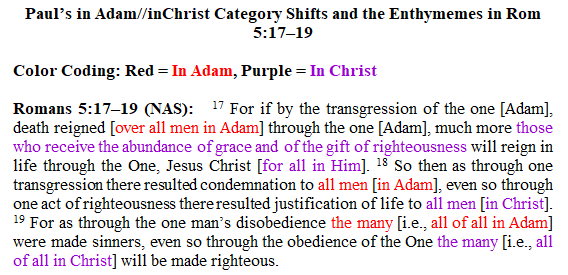
It is people who do not understand Pauline theology or biblical NT theology in general (or those regularly engaging in 𝘴𝘺𝘴𝘵𝘦𝘮𝘢𝘵𝘪𝘤, not 𝘦𝘹𝘦𝘨𝘦𝘵𝘪𝘤𝘢𝘭 theology, which you can tell by the books they buy and display) who are perplexed about who the “all men” are, as if it is difficult. It is not complicated. It is a regular Pauline pattern to switch between the category of all 𝘪𝘯 𝘈𝘥𝘢𝘮 and all 𝘪𝘯 𝘊𝘩𝘳𝘪𝘴𝘵, and to make various predications of all of all in each group. This happens frequently, not just in this passage. It is also common for Paul to use enthymemes, so that 𝘩𝘦 𝘭𝘦𝘢𝘷𝘦𝘴 𝘴𝘰𝘮𝘦 𝘱𝘳𝘦𝘮𝘪𝘴𝘦𝘴 𝘰𝘳 𝘪𝘥𝘦𝘢𝘴 𝘶𝘯𝘴𝘵𝘢𝘵𝘦𝘥, as he assumes his audience is reading his words in context (not bits and pieces broken up into verses) or following his flow of thought. Consequently, the first part in 5:18 really means “all men [in Adam],” with the bracketed idea being the enthymeme, and the second part really means “all men [in Christ],” with that bracketed part also being an enthymeme. This is not speculation either. Look at the color-coded picture below to see the pattern more clearly. One can see the same Pauline pattern in this verse:
NKJ 1 Cor 15:22: “For as in Adam all [who are in him] die, even so in Christ all [who are in him] shall be made alive.
The “made alive” is not talking about a general future resurrection (just because it is systematically true that it will be Christ who raises both the disobedient as well as the obedient), but about a glorious resurrection to eternal life for all who are in Christ by spiritual generation and faith, or “those who are Christ’s [or who belong to Him] at His coming” (15:23), as the context, again, indicates.
By “in Adam,” Paul means all who are naturally born from him, and who remain outside of Christ. They are conceived and participate in Adam’s fallen nature and still abide in him. By “in Christ,” Paul means all who are spiritually born in Him by the Spirit, and so share in Christ’s nature. This idea, again, is not difficult to understand. He is not talking about groups or categories that do not yet exist, but of concrete individuals sharing either nature, either by way of natural generation or by spiritual generation. Moreover, “the many” still means “all,” not “some of all.” It is either all of all in Adam, or all of all in Christ, not some of all who are in Adam, or some of all who are in Christ. Explaining this should be unnecessary, but it is the usually decretally-minded systematicians (i.e., those delving in systematic theology almost exclusively) who make it unnecessarily difficult, and so somewhat complicated to explain to them. Because they are system-brained, they often read “many” as if it means “some of all,” instead of “all of all” within various categories. If one looks at the color-coded picture, they can see that each instance of “the many” means “all of all,” but within groups: either all of all in Adam, or all of all in Christ. “Many” is a Hebraism that is often contrasted with “a few,” not “some” as opposed to “all.”
For a proper understanding of “many” as a Hebraism for “all,” see Jeremias, “Πολλοί,” in Theological Dictionary of the New Testament, 10 vols. (Eerdmans, 1964–), 6:536–545; Joachim Jeremias, The Eucharistic Words of Jesus (Oxford, 1955), 123–25; I. Howard Marshall, “Universal Grace and Atonement in the Pastoral Epistles,” in The Grace of God and the Will of Man, ed. Clark Pinnock (Bethany House Publishers, 1989), 59–61; Friedrich Graber, “All, Many,” in New International Dictionary of New Testament Theology, 4 vols., ed. Lothar Coenen, Erich Beyreuther, and Hans Bietenhard (Zondervan Publishing House, 1986) 1:94–97. See also Zwingli’s Annotations on Isa 24:22 in Jeff Fisher and Timothy George, eds., Isaiah 1–39, vol. Xa of Reformation Commentary on Scripture (IVP Academic, 2024), 230, and Martin Luther’s comments on Rom 5:15 in What Luther Says: A Practical In-Home Anthology for the Active Christian, ed. Ewald M. Plass (Concordia, 1959), 608 (#1857). Also, see David Ponter’s references in Calvin under the subheading “when ‘the many’ is all,” calvinandcalvinism.com/?p=23….
7
3
27
11,859
May 8
I recently received a depressing education in the corruption of local gov. I was able able to present for a private discussion with a gov a good person in gov. I walked away with several impressions.
1
65
May 8
Third, is that the local corruption is such that as a voter not being involved locally I think dulls the outrage for corruption at a national level. All this stuff trickles up hill.
1
22
May 8
Finally, local corruption translates directly into higher cost for the local population. Every exemption of the connected rich, causes your home owners insurance to go up, or you property tax etc. We all know the kind of people that power attracts, and these local tyrants ar bad
27