
Joined January 2025
- Tweets 144
- Following 39
- Followers 1,322
- Likes 73
2 Photos and videos


Jun 13
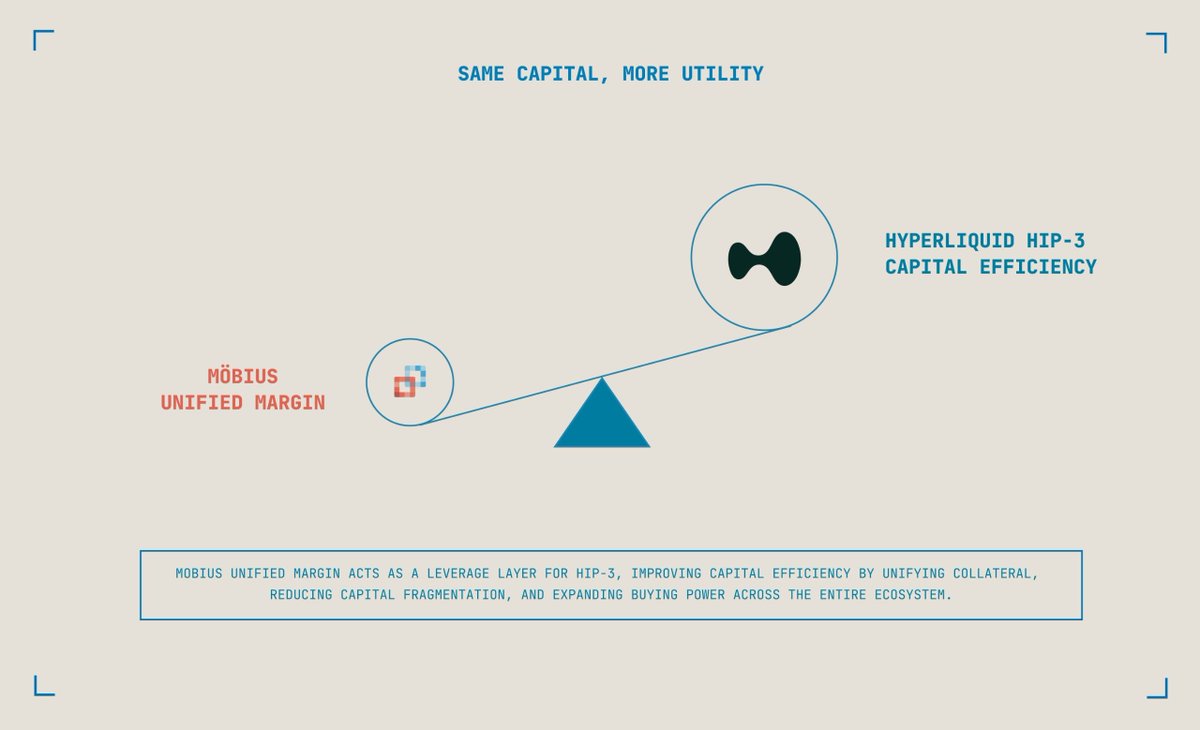
HIP-3 may need Unified Margin to truly scale
HIP-3 is quickly becoming one of the biggest growth stories on @HyperliquidX. HIP-3 markets now account for roughly 35–45% of total volume, with cumulative volume already surpassing $300B
More builders are launching new markets every month.
At first glance, this looks like a resounding success.
But success at this scale is creating a new, deeper challenge.
In TradFi, when financial products exploded through stock futures, index futures, commodities, and options, the industry did not solve the problem by building more exchanges.
It solved it through Prime Brokers, a unified layer that allowed traders to access hundreds of products through a single margin account.
It is the core thesis behind Mobius.
Hyperliquid's HIP-3 is beginning to follow a similar path.
7
7
19
2,166
Jun 13
3/ Ultimately, every deployer is competing for the same collateral.
As more deployers enter the ecosystem, acquiring and retaining volume becomes increasingly expensive. Market creation may become easier, while sustainable capital becomes harder to secure.
This is why HIP-3 will likely need a strong Unified Margin layer over time.
Not simply as a UX improvement, but as critical infrastructure for the next phase of growth.
One reason is that capital within the Hyperliquid ecosystem is becoming increasingly productive.
Today, many traders already hold assets such as kHYPE, BTC, yield-bearing stablecoins, and other positions on HyperEVM.
Most of this capital remains isolated from HIP-3 trading activity.
With a Unified Margin and Credit Layer, those assets can become buying power.
Rather than treating each market as a separate margin account, Mobius can evaluate a trader's entire portfolio as a single balance sheet.
A trader holding kHYPE, BTC, or yield-bearing assets could use that collateral to access multiple HIP-3 markets simultaneously without constantly moving capital between venues.
In other words, traders are not only reusing collateral across markets. They are also unlocking credit against assets that would otherwise remain idle.
In effect, Mobius expands the amount of tradable capital available to the ecosystem without requiring an equivalent amount of new deposits.
This matters for deployers as well.
Instead of competing exclusively for fresh deposits, deployers can tap into collateral that already exists within the Hyperliquid ecosystem.
As more assets become marginable and credit-enabled, the amount of accessible buying power can grow faster than raw deposits alone.
If HIP-3 enables anyone to create a market, Mobius enables traders to access all of them through a unified pool of collateral, cross-margining, and credit.
3
1
4
128
Jun 13
4/ Unified Margin benefits both sides of the marketplace.
- For traders, it delivers higher capital efficiency, stronger risk management, and greater flexibility to explore new opportunities.
- For deployers, it lowers the cost of acquiring volume, improves retention after incentives decline, and increases the probability of converting incentive-driven activity into sustainable trading behavior.
Deployers do not need more accounts opened, they need more positions opened.
Unified Margin helps bridge that gap.
HIP-3 has successfully solved market creation.
The next challenge is capital coordination.
And if Hyperliquid eventually wants to support hundreds of healthy markets rather than a handful of dominant winners, Unified Margin may become one of the key infrastructure layers that determines whether HIP-3 evolves from an impressive early success into a truly scalable, multi-market ecosystem.
1
1
2
123
Jun 13
Too many perp DEX?
Maybe, because everyone wants to build the next Hyperliquid, so seeing a new perp DEX every week is almost inevitable.
So, instead of trying to pick the right perp DEX, I'd rather have a single Credit Account that lets me trade across all perp venues from one account.
Jun 12

have you seen that we have so many perp dex right now:
ondo perps
varitional
risex
extended
cascade
dango
bulk
tradehotstuff
reya
standx
ostium
ethereal
nado
and others
too many perp dex, and i really believe that only 3 of them will give the really good tge to their community.
can you guess what perp dex i think?
4
2
17
1,143
Jun 11
Currently, DeFi does not have a liquidity problem. It has a self-inflicted liquidity fragmentation problem.
Everyone wants to build their own liquidity kingdom. Every chain wants liquidity. Every L2 wants liquidity. Every app wants liquidity.
For years, DeFi convinced itself that more chains meant more growth. In reality, we simply spread the same liquidity across more ecosystems.
Capital hops from chain to chain, TVL gets counted again, dashboards look great, and everyone celebrates "growth" when the same dollars are simply moving around the system.
The reality is that we took one large pool of liquidity and split it into hundreds of smaller ones.
LPs are spread thin. Traders face more slippage. Market makers are forced to manage inventory across multiple chains.
Everyone has liquidity, but nobody has enough liquidity.
The numbers make this even clearer.
DeFi liquidity is now spread across 70 rollups and dozens of major ecosystems, while estimates suggest more than $12B of liquidity sits dormant. Many lending markets and DEX pools utilize only 5-17% of available capital, meaning 83-95% of deposited capital is sitting idle instead of being used productively. On many DEXs, billions of dollars of stablecoin liquidity sit in ranges that generate little to no fees.
At some point, we need to admit that endlessly launching new chains, rollups, DEXs, and pools is not a growth strategy. It is a fragmentation strategy.
DeFi now has two choices.
• Keep creating more liquidity venues and continue dividing the same capital into smaller pieces.
• Or build intent layers, shared liquidity networks, unified margin systems, and cross-chain settlement infrastructure that make fragmented liquidity behave like one market.
The goal is to make 50 chains feel like one chain.
Because DeFi does not need more liquidity. It needs liquidity concentration.

10
6
25
2,050
Möbius retweeted

Jun 11
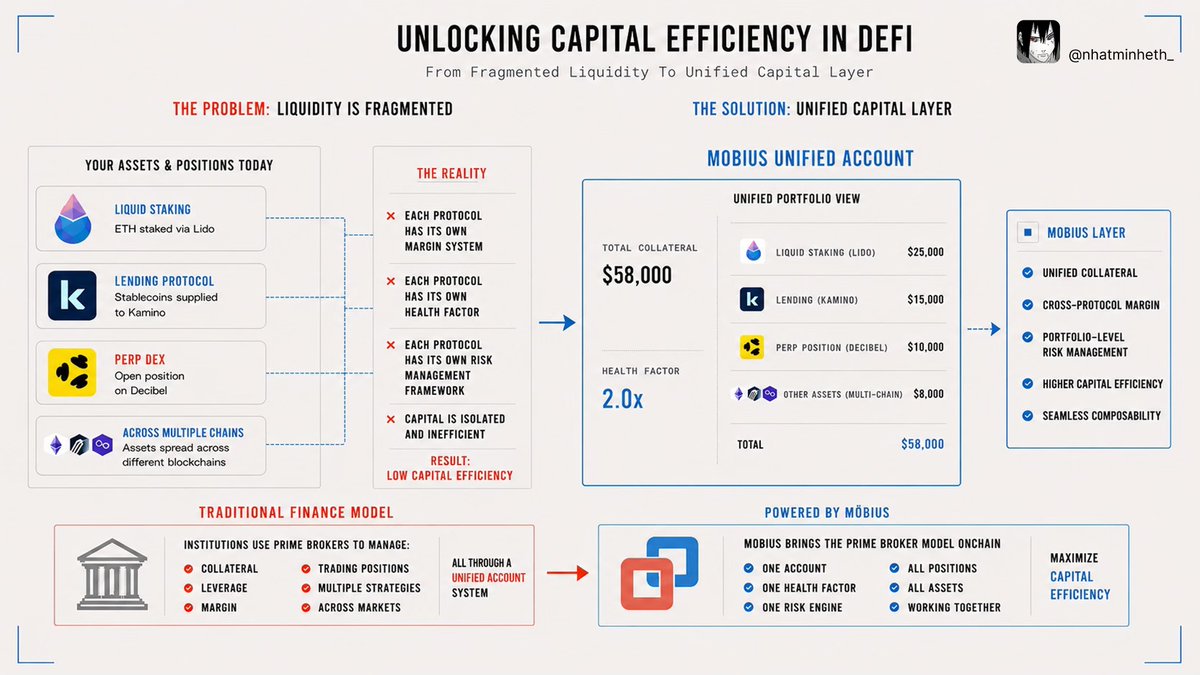
Unlocking Capital Efficiency In DeFi
DeFi has come a long way since DeFi Summer 2020
Today we have Lending Protocols, Perp DEX, Yield-Bearing Assets, Liquid Staking, Restaking and many other ways to generate returns
But despite all this innovation one major problem still remains:
➣ Liquidity is fragmented
You may have ↓
✦ ETH staked via Lido
✦ Stablecoins supplied to Kamino
✦ An open position on Decibel
✦ Assets spread across different blockchains
Yet most of the time these assets and positions cannot "see" each other
✦ Each protocol has its own margin system
✦ Each protocol has its own health factor
✦ Each protocol has its own risk management framework
Instead of working together capital is isolated across different platforms which leads to inefficient capital usage
This is one of the main reasons why capital efficiency in DeFi is still far below traditional finance
In traditional finance institutions do not manage every position separately
They use Prime Brokers to manage:
✦ Collateral
✦ Leverage
✦ Margin
✦ Trading positions
✦ Multiple investment strategies
All through a unified account system
This allows the entire portfolio to be managed as a single balance sheet instead of a collection of disconnected accounts
⤷ This is the model @MobiusExchange is bringing onchain
22
5
34
1,902
Möbius retweeted

Jun 6
YZi Labs 领投战略轮
统一的链上 Prime Brokerage
@MobiusExchange 三大核心模块:
▌聚合借贷池 Money Market
▌智能账户 Credit Account
▌连接信用账户与交易场所的模块化框架 Venue Account Model
智能账户的设计很容易让人联想到 Gearbox
不过最好的对标应该是 Synthetix V3
不同点是 Synthetix 聚焦流动性聚合,Möbius 聚焦信用/杠杆
个人印象中,Möbius 是第一个在链上构建组合级资产负债表的项目
已加入我的 Alpha Radar 追踪 - improve-project-tracking-sit…

Jun 4

1/ Mobius has raised a strategic round led by @yzilabs, with participation from @FinalityCap, @l2iterative, @therollupco, @snzholding, @_inceptioncap, @ContributionCap and others.
Unified margin trading across perp DEXs and chains, accessible to everyone.
46
2
29
12,372
Jun 4
1/ Mobius has raised a strategic round led by @yzilabs, with participation from @FinalityCap, @l2iterative, @therollupco, @snzholding, @_inceptioncap, @ContributionCap and others.
Unified margin trading across perp DEXs and chains, accessible to everyone.
30
6
82
15,623
Jun 4
5/ Launching on @HyperliquidX and @Aster_DEX in Q3. Stay tuned.
Read more: x.com/MobiusExchange/status/…
8
15
1,170
Jun 4
6/ Product walkthrough by @0xdabaojian and @StanleyHe17 at @EASYResidency demoday:
x.com/EASYResidency/status/2…
May 28

DeFi's biggest inefficiency: isolated capital.
Positions scatter across chains, capital sits idle, and a single localized price move can liquidate a user who is actually delta-neutral.
@MobiusExchange is the unified margin layer for on-chain finance. One credit account, every chain, every venue:
→ Borrow from a unified pool, deploy anywhere
→ Cross-venue margin that recognizes delta-neutrality → Works with crypto, tokenized gold, equities, and RWAs
Built by operators close to DeFi's biggest primitives to unlock thousands of permissionless strategies.
Catch Mobius at the EASY Residency S3 Demo Day.
1
2
10
1,258
Möbius retweeted

Jun 2
4 Things I'm seeing as the next PMF layers in DeFi ↓
1/ Pure Yield Stablecoins: sUSDS, sGHO → Stablecoins that return protocol revenue directly to holders.
2/ Digital Credit: @saturn_credit, @apyx_fi → On-chain credit products creating yield from tokenized corporate dividends
3/ Risk Tranching: @roycoprotocol , @strata_markets → Users can choose their own risk/return profile instead of one-size-fits-all yield.
4/ Cross-Chain Liquidity & Unified Layers: @aave V4, @MobiusExchange → Liquidity becomes chain-agnostic. Capital flows freely where it's needed most.
8
2
25
2,407
Möbius retweeted
May 28
not an exchange, instead we power all exchanges with unified margin
🫡
5
1
22
980
May 14
Möbius handbook by @Jonasoeth 👇🏻
May 13

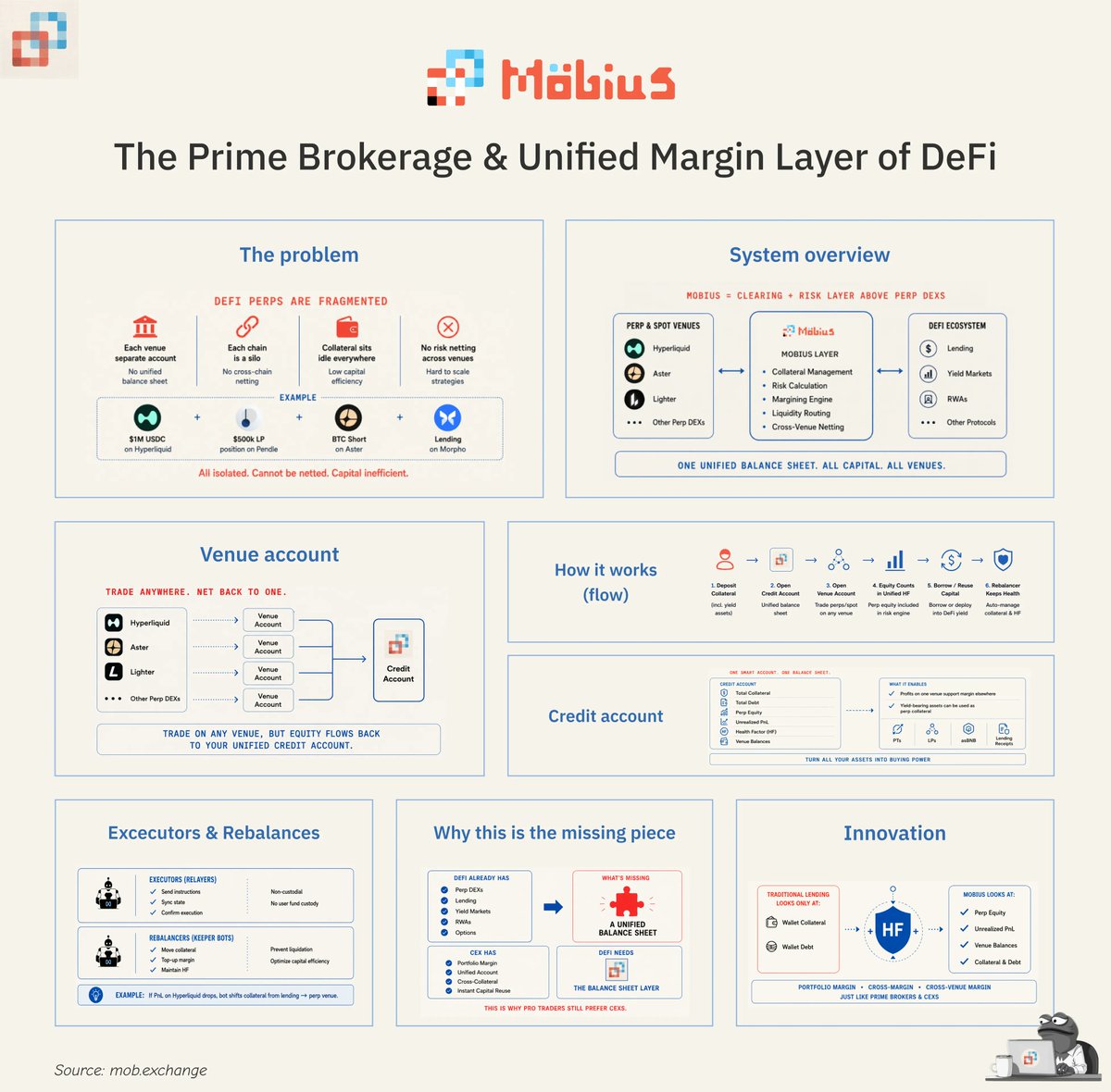
Mobius is essentially trying to build something DeFi has been missing for years:
A "prime brokerage unified margin layer" for the entire DeFi perpetual ecosystem.
DeFi perps are exploding right now (Hyperliquid, Aster, Lighter). are already processing tens of billions in daily volume), but the system is still heavily fragmented:
- each perp venue = separate account
- each chain = separate silo
- collateral sits idle across multiple places
- no unified risk netting
Meanwhile, professional traders and hedge funds need:
- one unified balance sheet
- one shared margin pool
- the ability to use all assets efficiently for leverage and liquidity optimization
⤷ That’s what @MobiusExchange is trying to build.
Let's dive in ↓
5
1
24
2,126