
Daily research on US stocks, HK equities, ETFs and options, with a focus on sector rotation, technical levels and portfolio risk.
Joined May 2012
- Tweets 5,471
- Following 1,000
- Followers 9,640
- Likes 11,235
420 Photos and videos







Pinned Tweet

🚨 We regularly share free stock trading signals and market watchlists, covering both U.S. and Hong Kong stock opportunities.
Earnings reveal what the market narrative often hides. 📑
I track:
Revenue growth
Margins
Free cash flow
Guidance
AI demand
Cloud growth
User growth
Management commentary
Charts show sentiment.
Earnings show business reality.
I cover U.S. tech, semiconductors, AI leaders, and major Hong Kong technology companies.
👉 WhatsApp:15572262769
Not financial advice.
184
$META isn’t just about social media anymore.
Current price: $593.00
Today: -$34.78
Market cap: ~$1.52T
P/E: ~21.6x.
People still think of Meta as Facebook Instagram ads.
But what’s really going on is way bigger:
Family of Apps = cash flow engine
Instagram / Facebook / WhatsApp = massive reach
AI ads = smarter targeting and more revenue
Reels / Threads = keeping people hooked
Meta AI = building a product ecosystem
Reality Labs = a big bet on the future
Q1 2026 revenue hit $56.31B, up 33% YoY. Family of Apps brought in $55.91B, while Reality Labs cost $4.03B in operating losses. CapEx was $19.84B, showing how hard Meta is pushing AI infrastructure.
My take:
$META is still one of the top AI ad platforms out there.
The upside is AI improving ads, engagement, recommendations, and business tools.
But there are clear risks:
AI spending is climbing fast.
Reality Labs keeps burning cash.
Regulation hangs over the long term.
My plan:
Don’t chase.
Wait for dips.
Watch ad growth and AI monetization.
Buy only if the stock holds key support.
Watchlist:
$META / $GOOG / $MSFT / $AMZN / $NVDA / $AVGO
Not financial advice. 🚀
28
21
32
331
$GOOG 's real business is way bigger than just ads.
The market still treats Google like it's only search and ads.
But the bigger picture is:
Search = huge cash flow
YouTube = global eyeballs
Google Cloud = enterprise AI demand
Gemini = AI product stack
Android / Chrome / Gmail / Maps = worldwide reach
Waymo = self-driving long-term play
That's why I see $GOOG as a major AI platform.
Downside is real too:
AI spending is going up.
Search has more rivals.
Regulators are watching.
My game plan:
Don't buy into hype.
Buy on dips.
Keep an eye on Cloud growth and Search revenue.
Add positions only when the chart holds support.
Watchlist:
$GOOG / $MSFT / $AMZN / $META / $NVDA / $AVGO / $TSM
Not financial advice. 🚀
20
19
39
245
FX_Holden-Stock Trading Analyst【Nasdaq S&P500】 retweeted

$MU is becoming one of the most important names in the AI infrastructure chain.
The core logic is simple:
AI models are getting larger.
Data centers are scaling faster.
Memory bandwidth is becoming a bottleneck.
That benefits Micron.
Micron is exposed to HBM, DRAM, NAND, and data-center storage, which are all critical for AI servers and cloud infrastructure.
This is why I don’t view $MU as a traditional memory cycle stock anymore.
I view it as an AI infrastructure supplier.
My current watchlist:
$MU — AI memory
$NVDA — AI compute
$AVGO — networking / custom chips
$TSM — advanced manufacturing
$ASML — lithography bottleneck
Strategy:
Do not chase strength blindly.
Wait for pullbacks.
Watch whether buyers defend key support.
Buy only when risk-reward improves.
Not financial advice.
45
23
48
3,568
🚨 $AVGO is taking a hit, but the AI infrastructure story is still intact.
Current price: $385.75
Today: -7.92%
The market’s reacting to expectations.
But the real business case is still obvious:
AI data centers don’t just need $NVDA GPUs.
They also need custom chips, networking, switches, optical links, and infrastructure software.
That’s exactly where Broadcom fits in.
$NVDA builds the AI engine.
$AVGO helps connect and scale the whole AI factory.
So I’m not seeing this as a broken company.
I’m seeing it as a stock that needs a better entry point.
My focus now:
$AVGO / $NVDA / $TSM / $ASML / $MU
Don’t chase.
Wait for support.
Let fear create the chance. 🚀
Not financial advice.
24
25
28
265
FX_Holden-Stock Trading Analyst【Nasdaq S&P500】 retweeted
🚨 $KLAC is not just a semiconductor equipment stock.
Current price: $1,929.20
Today: -$201.88 / -9.47%
Market cap: ~$254B
P/E: ~54.6x.
The market talks about $NVDA, $TSM, $ASML, $MU.
But few people understand KLA’s real role.
$KLAC is the process control and yield management leader.
In simple terms: it helps chipmakers find defects, improve yield, and manufacture advanced chips more efficiently.
That matters because AI chips are becoming harder to produce.
More advanced nodes.
More complex wafers.
More advanced packaging.
More need for inspection and metrology.
Latest quarter:
Revenue: $3.415B
Non-GAAP EPS: $9.40
Free cash flow: $622M
Q4 revenue guide: $3.575B ± $200M.
My view:
$NVDA creates AI compute demand.
$TSM manufactures advanced chips.
$ASML provides EUV tools.
$KLAC helps make sure those chips can actually be produced at high yield.
That is why $KLAC is not a normal equipment company.
But after a big run and with a high valuation, I would not chase.
I’m watching pullbacks in:
$KLAC / $ASML / $TSM / $NVDA / $AVGO / $MU
Best strategy:
Wait for support.
Wait for fear.
Buy the companies controlling the bottlenecks. 🚀
Not financial advice.
48
29
49
2,363
🚨 $TSLA isn't acting like your typical car company right now.
Current price: $391.00
Today: -6.61%
Market cap: ~$1.38T
People keep obsessing over Tesla's car sales numbers.
But that's just one piece of the puzzle.
The real $TSLA story goes deeper:
EV volume
Energy storage
FSD
Robotaxi
AI & robotics
Software ecosystem
If Tesla stays just an EV maker, yeah, the valuation looks steep.
But if it turns into an AI-powered mobility platform, that changes everything.
That's why $TSLA is always high-risk, high-reward.
My take:
I'm into the long-term vision.
But I'm not jumping in after huge runs.
What I'm watching:
$TSLA — wait for dips
$NVDA — AI computing
$GOOG / $MSFT — AI platforms
$AVGO / $TSM — AI infrastructure
Don't chase hype.
Wait for solid levels.
Only buy when the risk-reward makes sense. 🚀
Not financial advice.
27
23
31
293
🚨 $TSLA isn't acting like a typical car company right now.
Current price: $391.00
Today: -6.61%
Market cap: ~$1.38T
Everyone keeps focusing on Tesla's car sales numbers.
But that's only part of the picture.
The real $TSLA bet is much bigger:
EV scale
Energy storage
FSD
Robotaxi
AI robotics
Software ecosystem
If Tesla stays just an EV maker, the price looks high.
But if it turns into an AI-driven mobility platform, the whole game changes.
That's why $TSLA is always high-risk, high-upside.
My take:
I like the long-term vision.
But I wouldn't jump in after a big move.
I'm watching:
$TSLA — wait for dips
$NVDA — AI computing
$GOOG / $MSFT — AI platforms
$AVGO / $TSM — AI infrastructure
Don't chase hype.
Hold out for support.
Buy only when the risk-reward makes sense. 🚀
Not financial advice.
20
30
42
399
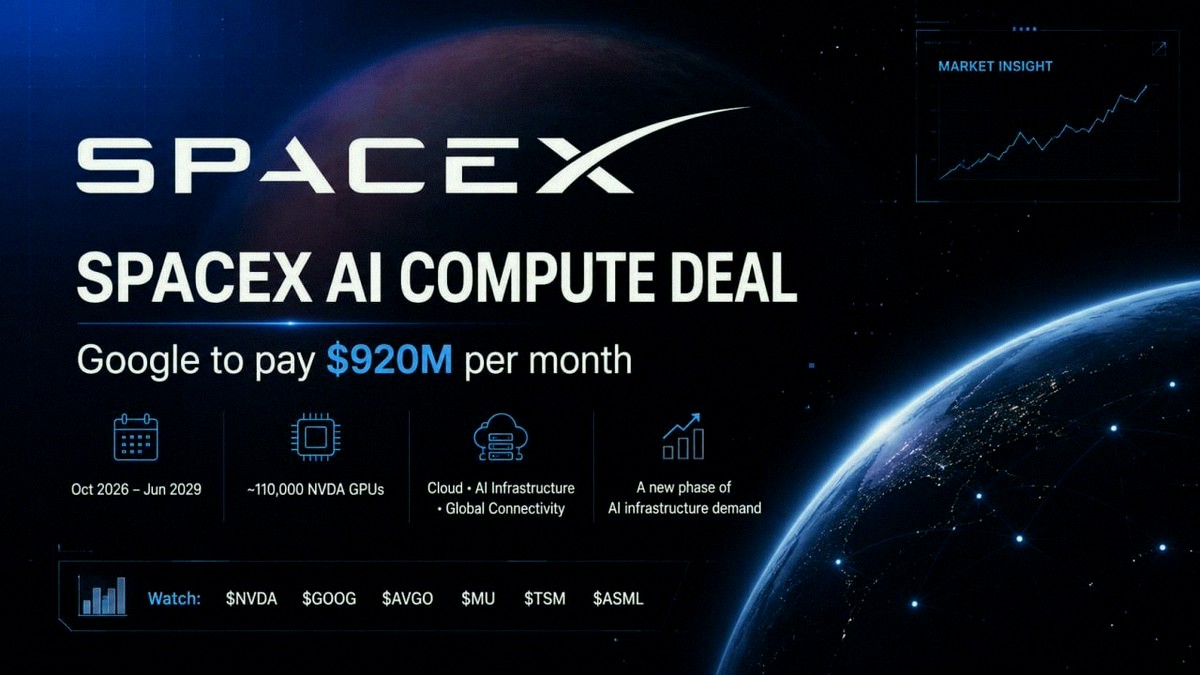
🚨 SPACEX just locked in a huge compute deal with Google.
SpaceX shared a cloud agreement where Google will pay $920M per month from Oct 2026 through June 2029.
That's no small contract.
That's roughly $11B a year in AI compute demand. 🔥
The setup reportedly includes about 110,000 $NVDA GPUs, plus CPUs, memory, and supporting gear.
People still look at SpaceX like it's just a rocket company.
Nope.
SpaceX is turning into:
space infrastructure
Starlink internet
AI compute demand
satellite data networks
next-gen cloud infrastructure
This deal also shows one thing:
AI demand isn't slowing down.
If Google needs that much compute, the real winners aren't just SpaceX.
Look at the full AI infrastructure chain:
$GOOG — cloud AI platform
$NVDA — GPU compute
$AVGO — networking custom chips
$MU — memory / HBM
$TSM / $ASML — chip manufacturing backbone
This isn't only about SpaceX.
It's another sign that AI infrastructure spending is moving into a much bigger stage. 🚀
Not financial advice.
26
20
31
293
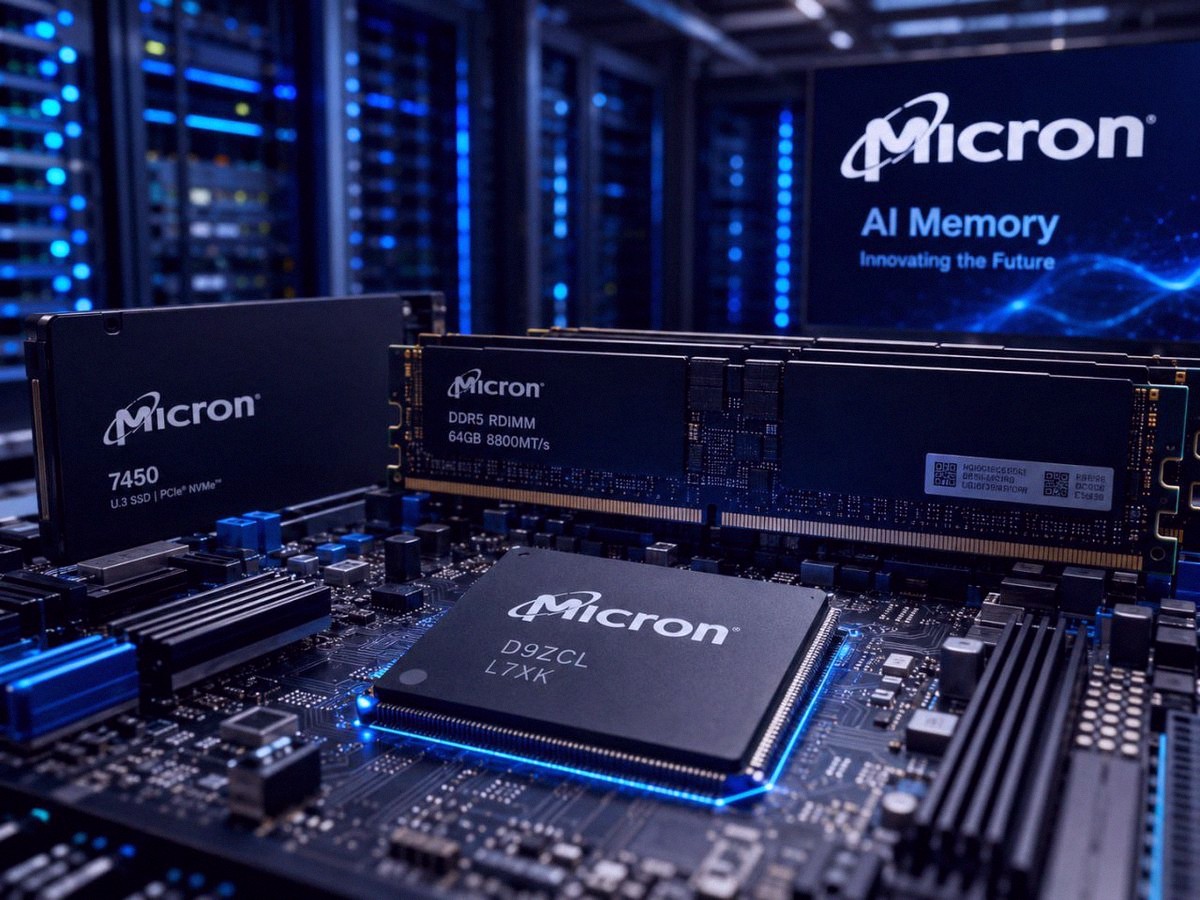
$MU volatility has gone wild over the last couple of days.
It shot up from around $820 to nearly $1,088—real strong short-term momentum. Shows the market still has high hopes for AI memory, HBM high-bandwidth memory, and the DRAM/NAND recovery.
But after that big spike, $MU dropped back hard, once hitting around $927. That doesn't mean the fundamental story is busted. It's more like the chart just needed a breather after moving too fast.
Right now, the move isn't to jump on a weak bounce. Wait for confirmation near the main support level.
Technically, the key support zone for $MU is around $857–$879.
If it pulls back into that area and holds steady, buyers might still be there. That could be a light entry spot to watch.
But if that support breaks, the short-term picture could get shaky. Given the strong run-up, a break might trigger more exits, lower support levels, and added pressure on market cap.
This pullback isn't just about $MU. The whole U.S. stock market is softening—$SPX, $NDX, and $QQQ are all feeling the pullback heat. Tech and semiconductor stocks are cooling together.
Also keep an eye on $SMH, the semiconductor ETF. If it keeps weakening, capital is still leaving the sector, which could pile more pressure on $MU short-term.
Long-term, $MU's core story is still solid. AI servers and data centers don't just need $NVDA GPUs. They need tons of fast memory and storage too.
HBM demand growth, DRAM/NAND price recovery, AI data center expansion, and the semiconductor cycle turnaround are still the big long-term drivers.
My take is simple:
Don't chase short-term.
Wait for support to confirm.
Watch the $857–$879 zone.
If it holds, a rebound might come.
If it breaks, short-term risk could grow.
$MU's fundamentals didn't just vanish. This is just a technical pullback and repair phase. Short-term, watch support. Long-term, keep an eye on AI memory demand and the semiconductor cycle.
⚠️ This is just market analysis, not financial advice. Do your own research.
24
24
37
411
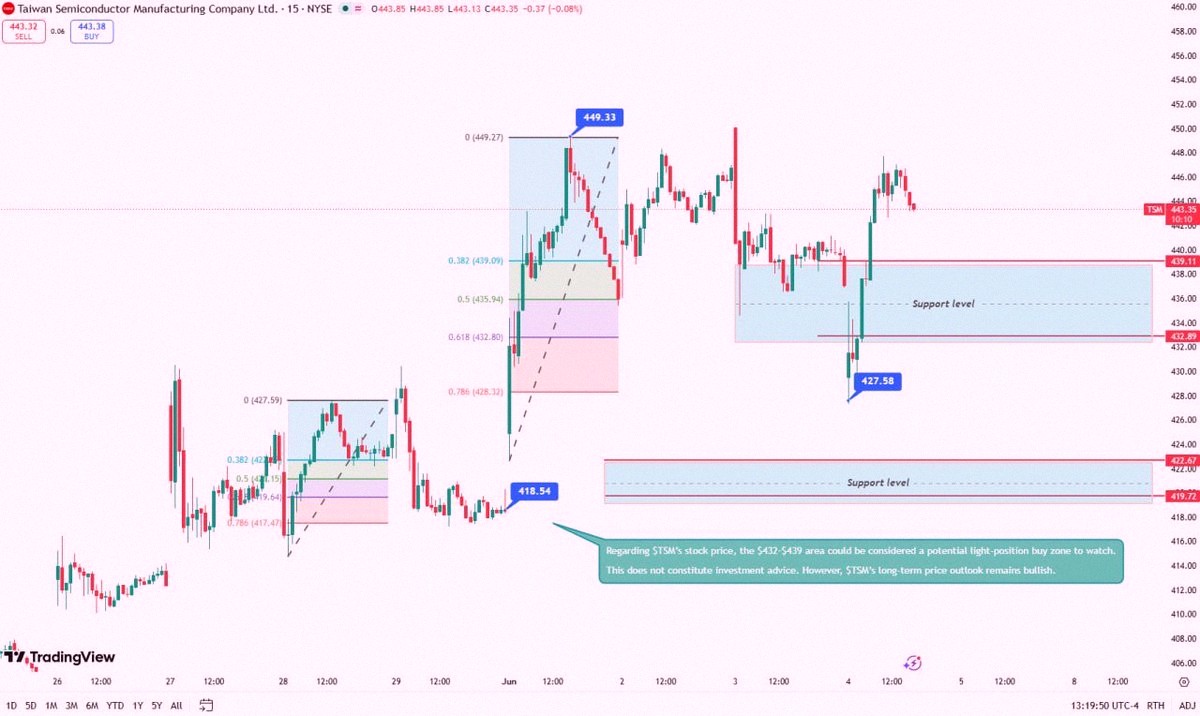
🚨 $TSM has been swinging wildly the last couple days.
TSMC shot up from around $417 to almost $449, showing some serious short-term momentum. That tells us people still believe in semiconductors, AI chips, and advanced manufacturing.
Then it dropped back to $427, but bounced right back to $447 territory. 📈
What this really means:
Buyers keep jumping in on dips, and the bullish vibe isn't fully gone yet.
From a chart standpoint, the first big support to watch is:
$432–$439
That's a key short-term zone. If $TSM dips there and holds steady, it could be a spot to keep an eye on for a small position. 🎯
If $432–$439 holds, the pullback might just be normal after a big rally, and $TSM could try to hit that $449 high again.
But if that support breaks, the short-term picture could get shaky.
Next stronger support would be around:
$419–$422
If it falls past the first zone to that area, selling pressure is stronger and a deeper correction might be coming. ⚠️ Given $TSM's huge size, more downside could mean more losses.
This isn't just about $TSM either.
The whole US market is feeling the heat. $SPX, $NDX, and $QQQ are all pulling back, and tech and semiconductor stocks are cooling off together.
Also, $SMH is still a key ETF to watch.
If $SMH keeps weakening, money is still leaving chips, which could drag $TSM down short-term.
If $QQQ and $SMH settle down, $TSM has a better shot at bringing capital back in. 📊
Long-term, $TSM's core story hasn't changed.
They're still the global leader in advanced chip manufacturing, deeply tied to $NVDA, $AAPL, $AMD, $AVGO, and $QCOM.
AI chips, data centers, high-performance computing, smartphones, and process upgrades are all still long-term drivers. 🚀
My take is simple:
Don't chase after a wild move.
Watch that $432–$439 support.
If it holds, it's a zone to watch for small positions.
If it breaks, next big support is $419–$422.
Also keep an eye on $SPX, $NDX, $QQQ, and $SMH to see if they stabilize.
$TSM's long-term story is still strong, but short-term price action has to deal with market pressure, chip sector cooling, and profit-taking after a big run.
⚠️ Just my analysis, not financial advice. Do your own homework.
16
16
16
294
$PLTR’s move in the last couple days isn’t just a normal pullback anymore.
It shot up from about $132 to nearly $163, showing crazy short-term strength.
But after that spike, it quickly fell back to around $140, which means people are taking profits at higher levels. 📉
Right now, the key level isn’t $163 or $140.
The real deal is the $136–$139 support zone. 🎯
This area will tell us if that rally was just hype or if the bullish trend can keep going.
If it holds at $136–$139, buyers are still in the game, and the faith in $PLTR’s AI software story is still strong. A bounce could happen again.
But if it breaks, the short-term setup gets weak. Late buyers might panic sell, and the stock could drop further. Market cap pressure could rise too.
This isn’t just about $PLTR though.
The whole U.S. market is under pressure:
$SPX is weakening.
$NDX / $QQQ are dropping.
AI growth stocks are cooling off.
High-valuation software names are getting repriced.
Short-term money is leaving high-beta stocks.
So this pullback is driven by two things:
First, the stock moved too fast and needs a rest.
Second, the broader market and tech sentiment are cooling.
Long-term, I still don’t see $PLTR as just another software firm.
Its real value lies in:
AI data analytics.
Government and defense systems.
Enterprise AI platforms.
Large-scale institutional decisions.
Sticky customer relationships.
In the AI era, whoever controls data controls decisions.
That’s the long-term upside story for $PLTR. 🚀
My take is simple:
Don’t chase it short-term.
Watch $136–$139 closely.
If support holds, there’s still a rebound chance.
If it breaks, short-term risk keeps rising.
Long-term story is strong, but price action needs to respect support and market pressure.
⚠️ This is just market analysis, not advice. Do your own research.
28
18
44
522
🚨 $MSFT just hit a key technical spot.
In the last 2 days, Microsoft jumped sharp from ~$412 to almost $466.
A solid rally.
But right after that fast move, it pulled back and now trades around $427. 📉
That tells you:
Long-term, the stock is still strong, but short-term, folks are taking profits.
I'm watching the $419–$423 support zone closely. 🎯
That's where buyers need to step in.
If $MSFT holds this area, the bullish setup stays alive, and we might see another bounce.
But if it breaks, the market could start pricing in more downside risk, especially with the broader market already cooling.
Right now, it's not just about Microsoft.
The whole U.S. market is slowing down.
$SPX is under pressure.
$NDX is pulling back.
$QQQ is losing steam.
Mega-cap tech isn't moving straight up anymore.
Why?
After the big AI and tech rally, the market needs time to digest valuations, earnings expectations, and risk appetite.
For $MSFT, the big picture is still super strong.
Azure cloud growth.
Enterprise AI.
Copilot.
Office ecosystem.
Windows.
LinkedIn.
Enterprise software.
These aren't hype—they're real business drivers behind Microsoft's long-term growth. 🚀
But even great companies pull back.
So I wouldn't blindly jump into $MSFT here.
My plan is simple:
Watch $419–$423.
Watch $SPX, $NDX, and $QQQ.
Watch if buyers defend support.
Watch for volume to return.
If support holds, it could be a great pullback entry.
If it breaks, short-term risk goes up.
Long-term, I'm still bullish on $MSFT.
Short-term, patience beats emotion.
⚠️ This is just market analysis, not financial advice. Do your own research.
31
28
34
263
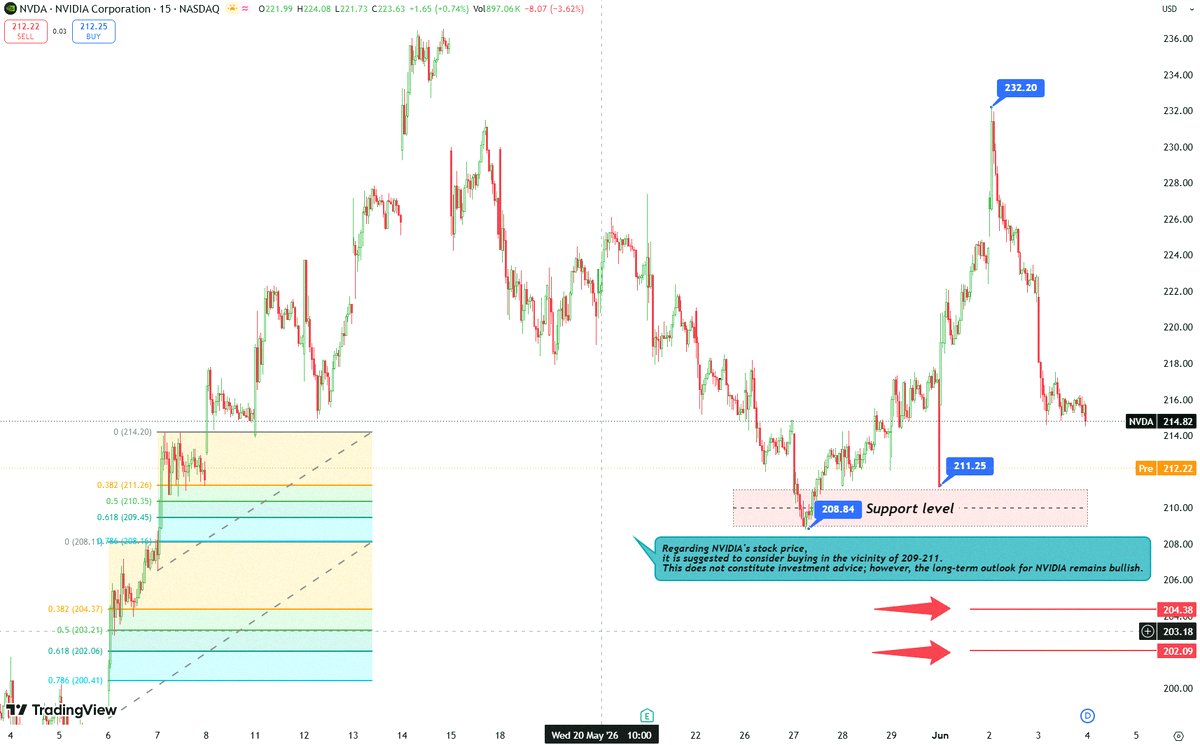
🚨 $NVDA has been swinging hard over the last couple of days.
It shot up from about $211 to nearly $232, showing some real short-term firepower. But after that rally, it dropped fast and is now hanging around $214. 📉
Looking at the charts, the key support to watch is between $209 and $211.
That zone is where the move started and a critical level bulls need to defend. 🎯
If $NVDA can steady itself around $209–$211 and buyers jump back in, the bullish setup stays intact, and we might see another bounce.
But if that support breaks, short-term vibes could sour, and the stock might search for lower ground. Given Nvidia’s huge market cap, any sharp drop also means big losses in value. ⚠️
This pullback isn't just about $NVDA.
The whole U.S. market is under pressure. Right now, $SPX, $NDX, and $QQQ are all pulling back, with tech and semiconductors sliding together.
Also, keep an eye on $SMH. If it keeps weakening, it signals money is still leaving the chip sector, which could add more near-term pain for $NVDA.
If $QQQ and $SMH can find their footing, $NVDA has a better shot at drawing capital back. 📊
This drop might be tied to several things:
• Broader $SPX weakness
• Pressure on $NDX / $QQQ
• Short-term cooling in $SMH
• Profit-taking after that big run
• Valuation adjustments in AI leaders
• Less risk appetite across the board
But long-term, Nvidia’s core story hasn’t changed. AI computing demand, data center expansion, tight GPU supply, enterprise AI adoption, and chip industry upgrades still back $NVDA. 🚀
My take is simple:
Don't chase short-term moves.
Watch $209–$211 support closely.
Also track if $SPX, $NDX, $QQQ, and $SMH can stabilize.
If support holds, a rebound is possible.
If it breaks, short-term risk climbs.
Long-term structure looks solid, but near-term action has to respect the broader market and sector pressures.
⚠️ Just market analysis, not financial advice. Do your own homework.
30
25
38
526
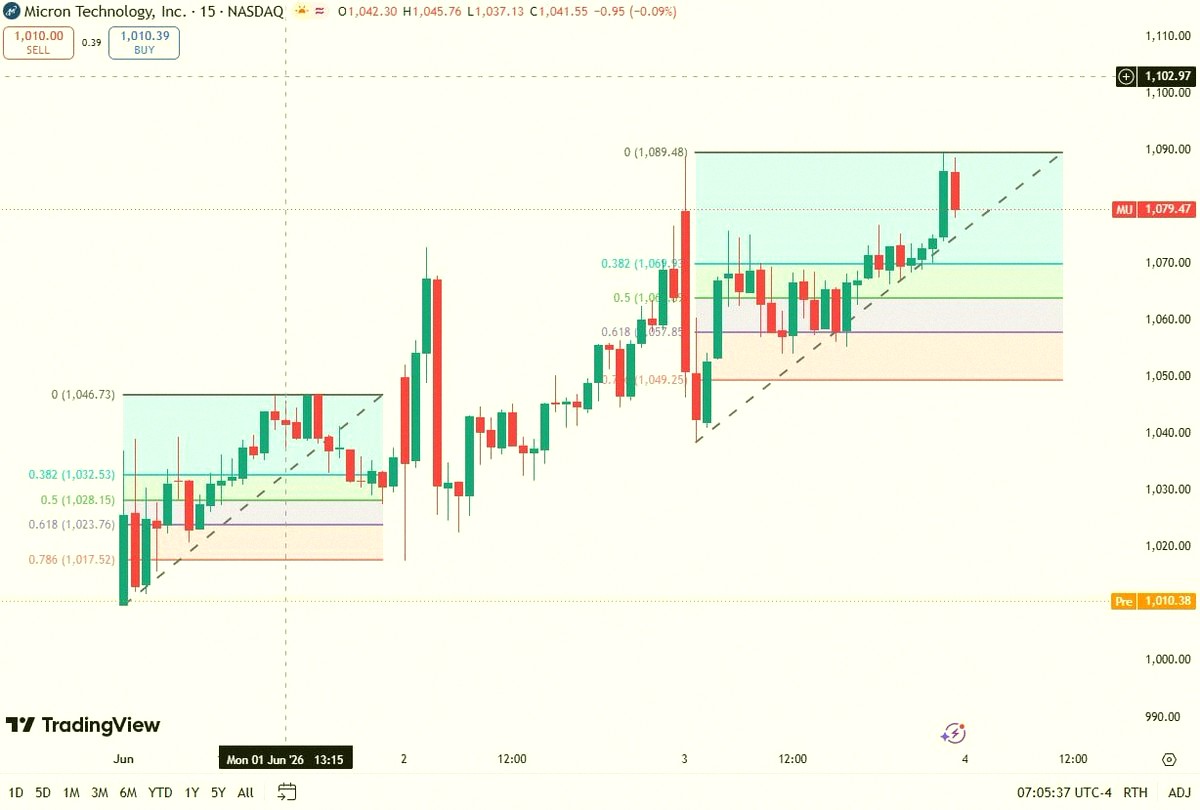
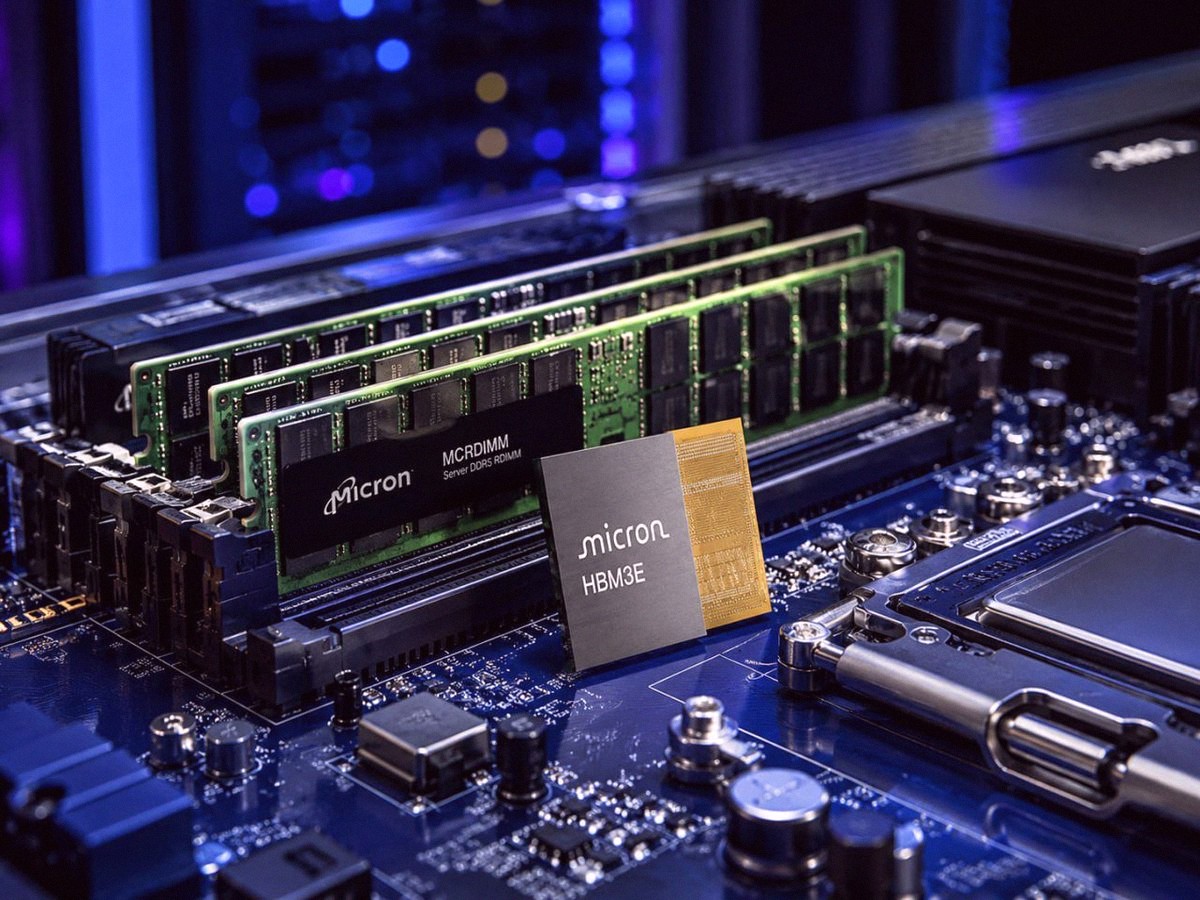
$MU is still trading like one of the strongest AI memory names. 🚨📊
On the 15-minute chart, Micron pushed from around 1,038 and ran all the way to about 1,089.
Now it's sitting near 1,079, which tells me buyers are still around, but the stock is in a high-level consolidation zone.
This isn't a weak chart.
It's a strong chart that just needs support to hold.
The first level I'm watching is 1,069–1,070.
If $MU pulls back and holds there, the short-term bull case stays solid.
Key support is 1,057–1,058.
As long as $MU stays above this zone, the trend is still in play.
If $MU can reclaim 1,089–1,090, the market might start eyeing the next big level near 1,100.
But this is bigger than just Micron.
When $MU moves, the whole AI memory and data center supply chain gets attention:
$NVDA — AI GPUs need HBM
$AMD — AI accelerators
$AVGO — custom AI chips networking
$MRVL — AI networking data movement
$TSM — advanced chip manufacturing
$WDC — NAND and storage
$STX — data storage demand
$DELL — AI servers
$SMCI — AI server infrastructure
$AMAT $LRCX $KLAC — semiconductor equipment
$SMH $SOXX — semiconductor ETFs
Here's my take:
AI isn't just about GPUs anymore.
AI needs memory.
AI needs HBM.
AI needs storage.
AI needs servers.
AI needs full data center infrastructure.
That's why $MU matters.
Strong chart.
Strong AI memory story.
Strong semiconductor read-through.
But after a big move, entry price still matters.
I want support confirmation, not emotional chasing. 📊🔥
Not financial advice.
20
21
30
429
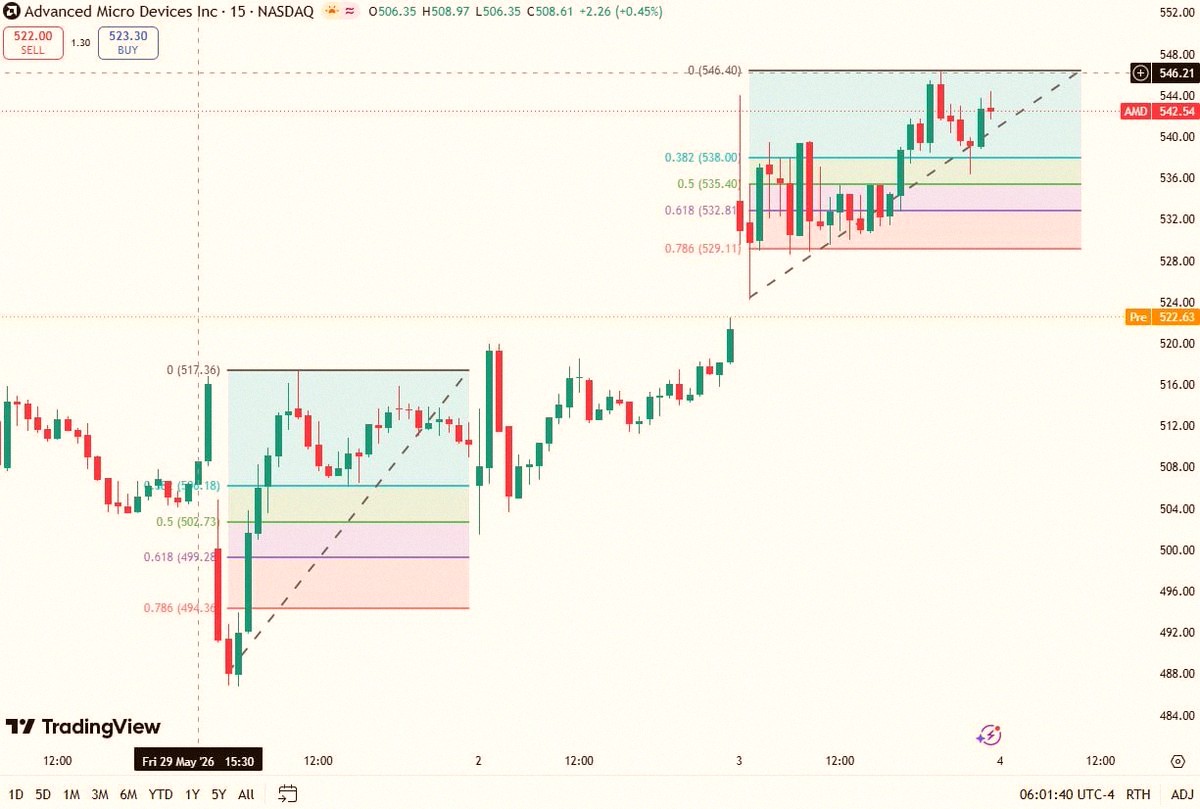
$AMD looks like it's building momentum for a recovery trade again. 🚨📊
On the 15-minute chart, AMD bounced hard off the 524 area and ran all the way up to 546.
That shows buyers are still in the game.
Right now it's trading near 542, close to the recent high, so I'm not chasing it aggressively.
The first level I'm watching is 538.
If $AMD pulls back and holds 538, the short-term bullish setup looks good.
Key support is 532–533.
As long as it stays above that, bulls are running things.
If it breaks above 546–547, momentum could keep going.
But it's not just AMD.
When $AMD moves, the whole AI chip and data center chain lights up:
$NVDA — AI GPU leader
$TSM — advanced chip manufacturing
$MU — AI memory and HBM
$AVGO — custom AI chips networking
$MRVL — AI networking custom silicon
$ARM — chip architecture
$DELL — AI servers
$SMCI — AI server infrastructure
$ASML $AMAT $LRCX $KLAC — semiconductor equipment
$SMH $SOXX — semiconductor ETFs
My take is simple:
AI demand won't stay with just one company.
$NVDA is still top dog, but hyperscalers need more supply, more competition, and better data center options.
That's where $AMD fits in.
EPYC CPUs.
Instinct AI GPUs.
Data center acceleration.
AI infrastructure demand.
The chart looks strong.
Buyers are active.
The AI chip story is still alive.
But after a fast move, entry price still matters.
I'd rather wait for support confirmation than buy near the high. 📊🔥
Not financial advice.

29
27
37
514
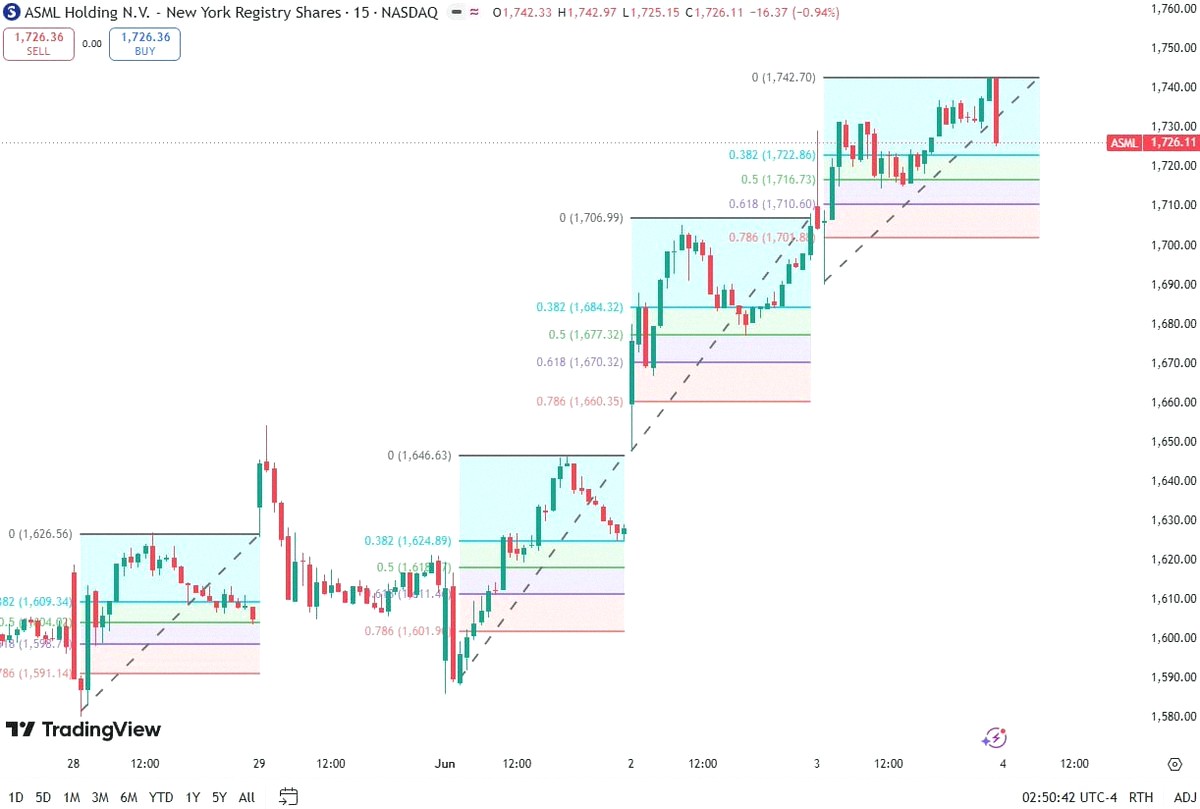
$ASML isn't broken yet—it's just testing a high-level pullback. 🚨📊
The 15-minute chart shows a solid jump from 1,588 up to 1,742.7.
That was a big semiconductor equipment momentum push.
But after hitting that high, $ASML dipped back to around 1,726, so buyers are being put to the test.
First level I'm watching is 1,722–1,723.
If it holds here, the short-term setup still looks good.
Real key support is 1,710–1,711.
As long as it stays above that zone, the broader bullish short-term trend is fine.
If price can get back to 1,732–1,735, momentum starts building again.
But it's not just about ASML.
When $ASML moves, the whole semiconductor equipment and AI chip supply chain usually gets attention:
$AMAT — semiconductor gear
$LRCX — etch and deposition tools
$KLAC — inspection and process control
$TSM — advanced chip manufacturing
$INTC — foundry expansion
$NVDA — AI GPU demand
$AMD — AI accelerators
$AVGO — custom AI chips and networking
$MRVL — AI networking and custom silicon
$MU — AI memory and HBM
$SMH $SOXX — semiconductor ETFs
Here's what I think:
AI isn't only about GPUs.
AI demand trickles into advanced nodes, EUV tools, fabs, wafers, inspection, memory, networking, and the whole semiconductor capex cycle.
That's why $ASML is a big deal.
It's one of the biggest bottlenecks in advanced chip making.
The chart still looks constructive.
The pullback is just testing support.
The semiconductor equipment theme is still alive.
But after a strong move, getting in at the right price matters.
I need confirmation, not emotional FOMO. 📊🔥
Not financial advice.
22
25
36
183
$AMAT is still one of the strongest players in the semiconductor equipment game. 🚨📊
The 15-minute chart tells a pretty clear story.
Applied Materials climbed from around 462, broke through 480, reclaimed 491, pushed past 500, and hit a short-term high near 508.31.
That was the momentum move.
Now it's pulled back and sitting around 499–500, so the market is seeing if buyers can hold that breakout level.
This isn't a bearish breakdown yet.
It's a high-level retest after a strong run.
The first level I'm watching is 500.
If $AMAT can get back above and hold 500, the short-term setup still looks solid.
Key support is at 495.
As long as $AMAT stays above 495, the bullish structure holds up.
But if it loses 495, I'd get more cautious because the pullback could stretch toward 491–492.
The bigger picture isn't just $AMAT.
When Applied Materials makes a move, the market tends to watch the whole semiconductor equipment and AI chip supply chain:
$ASML — EUV lithography
$LRCX — etch and deposition tools
$KLAC — inspection and process control
$TSM — advanced chip manufacturing
$INTC — foundry expansion
$NVDA — AI GPU demand
$AMD — AI accelerators
$AVGO — custom AI chips and networking
$MRVL — AI networking and custom silicon
$MU — AI memory and HBM
$SMH $SOXX — semiconductor ETFs
My take is simple:
AI demand doesn't stop at GPUs.
It spreads into fabs, wafers, tools, advanced processes, memory, networking, and the whole semiconductor infrastructure layer.
That's why $AMAT matters.
Strong chart.
Strong sector signal.
Strong AI supply-chain read-through.
But after a fast move, entry price still matters.
I want support confirmation, not emotional chasing. 📊🔥
Not financial advice.

20
25
35
239