
nothing outside, yet so much inside
Joined November 2025
- Tweets 575
- Following 101
- Followers 23
- Likes 95
37 Photos and videos















Pinned Tweet

11 Nov 2025
true spiritual people are rare these days - not fake saints, hippie posers, or stoner bros. genuinely honest, kind, and happy souls are magnets. some hate, some envy, but everyone wants to be with them. they’re the ones offsetting the negativity in us.
1
1
11
1,282

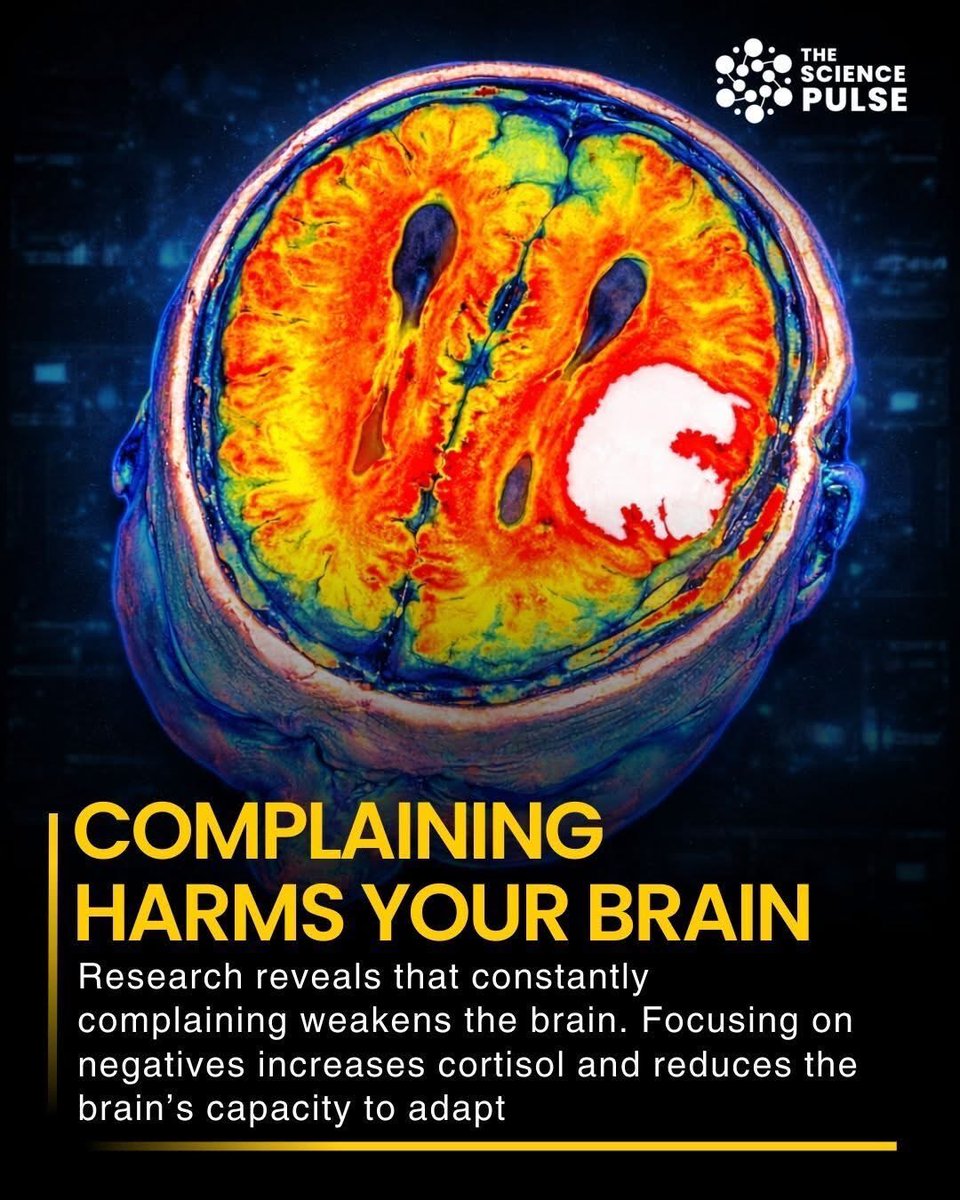
New research reveals that constant complaining does more than annoy those around you—it can actually weaken your brain.
Every time you focus on what’s wrong, your body releases stress hormones like cortisol, which interfere with neural function and reduce the brain’s ability to adapt and learn.
The impact is not just mental. Elevated cortisol levels can impair memory, decision-making, and problem-solving skills.
Over time, a habit of negativity can make your brain less resilient, affecting emotional regulation and overall cognitive performance. Essentially, the more you complain, the harder it becomes for your brain to handle challenges effectively.
Shifting your focus from problems to solutions isn’t just good advice—it’s backed by science.
Practising gratitude, positive thinking, and constructive problem-solving can lower stress hormones, strengthen neural pathways, and help your brain remain agile and adaptable throughout life.
#TheSciencePulse
#BrainHealth #PositiveMindset
392
3,693
18,849
4,458,847
Nada2Post retweeted

Feb 13
The average person complains 15 to 30 times per day. Each one is a rep training your brain to stay in threat detection mode.
Here’s the mechanism. When you complain, your hypothalamus activates the HPA axis, flooding your system with cortisol. Cortisol in short bursts is fine. Cortisol as a chronic baseline state is neurotoxic.
Stanford research found that repeated complaining physically shrinks the hippocampus, the region responsible for memory consolidation and spatial reasoning. Even listening to someone complain for 30 minutes is enough to damage neurons there. The hippocampus has one of the highest concentrations of cortisol receptors in the entire brain, which means it takes the hit first and hardest.
But the deeper problem is Hebbian. Neurons that fire together wire together. Every complaint shortens the synaptic gap between your negativity-associated neurons, making that circuit the path of least resistance. Your amygdala becomes hyperactive. Your prefrontal cortex, the part responsible for rational decision making and impulse control, goes quiet. You are literally building hardware for anxiety while dismantling hardware for problem solving.
The loop looks like this: complaint → cortisol spike → amygdala activation → prefrontal suppression → reduced ability to reframe → more complaints.
The intervention point is at the front of that loop. Gratitude journaling, deliberate reframing, and novel skill acquisition all stimulate new dendritic growth in the hippocampus and restore prefrontal activity. Physical exercise, specifically zone 2 cardio, lowers baseline cortisol more reliably than any cognitive technique alone.
Your brain wires around what you repeat. Choose the reps carefully.

New research reveals that constant complaining does more than annoy those around you—it can actually weaken your brain.
Every time you focus on what’s wrong, your body releases stress hormones like cortisol, which interfere with neural function and reduce the brain’s ability to adapt and learn.
The impact is not just mental. Elevated cortisol levels can impair memory, decision-making, and problem-solving skills.
Over time, a habit of negativity can make your brain less resilient, affecting emotional regulation and overall cognitive performance. Essentially, the more you complain, the harder it becomes for your brain to handle challenges effectively.
Shifting your focus from problems to solutions isn’t just good advice—it’s backed by science.
Practising gratitude, positive thinking, and constructive problem-solving can lower stress hormones, strengthen neural pathways, and help your brain remain agile and adaptable throughout life.
#TheSciencePulse
#BrainHealth #PositiveMindset
59
813
4,833
1,201,876

If you ended a relationship and realized they didn't go looking for another person, didn't go out partying, but instead started running, training, taking care of themselves, and distancing themselves from everyone so they could overcome themselves... I'm sorry to tell you that they truly did love you.
And I'm sorry to say you let a very good person slip away, one you won't find again... not even in another lifetime.
362
4,723
39,409
2,717,477
Nada2Post retweeted

7 Dec 2025
"For thousands of years, babies slept with their mothers, and when they cried, they were attended to."
"Until two men came along. Dr. Holt and John B. Watson."
"They basically said babies should be trained, isolated, and controlled. That babies had to fit the assembly line and office schedules of their parents."
210
2,155
7,995
2,190,309
Nada2Post retweeted

7 Dec 2025
The #1 parenting mistake that dramatically increases stress (and even the risk of emotional escalation) in your home?
World-famous brain specialist Dr. Daniel Amen just dropped a truth bomb:
If you have to tell your kid the same thing 5 times, you’ve already lost the battle—and the relationship is paying the price.
His simple, science-backed fix that works like magic:
1. Say it ONCE, calmly, with a clear timeframe
2. If nothing happens → give a calm choice consequence
3. Follow through 100% of the time, no anger needed
Watch the 40-second clip that’s changing thousands of families right now
Parents: drop your favorite “one-and-done” phrase that actually gets your kids to listen the first time.
61
479
3,582
402,714
Nada2Post retweeted

7 Dec 2025
Easiest ways to get rich:
1. Sell men lust
2. Sell women beauty
3. Sell parents peace
4. Sell kids dreams
5. Sell the rich safety
6. Sell the broke hope
Same game. Different packaging.
379
8,293
57,210
2,381,239
3 Dec 2025
i hope i can do this one day

42
1 Dec 2025
great reading
30 Nov 2025

I just turned 46.
If you're in your 40s, do this:
1
77