Joined November 2022
- Tweets 9,997
- Following 843
- Followers 10,752
- Likes 17,925
1,206 Photos and videos









NetzFamily 🌐 retweeted
Enterprise-grade blockchain security & reliability is being diligenced closely by large asset managers planning to tokenize 10s or 100s of billions onchain. They won’t move customer assets fully onchain without it.
Move is a higher level of abstraction than the EVM.
Aptos Move verifies ownership, resource safety, references, abilities, and type constraints before code is deployed. That’s incredibly powerful. Entire categories of exploits aren’t possible. Development is quicker and specialized for asset exchange.
This design intentionally pushes more responsibility into the Aptos VM itself. A verifier sophisticated enough to prove all of those properties is itself a highly complex piece of software.
And every sufficiently complex software system eventually contains bugs. What happens then?
Most blockchains effectively trust a single layer of validation.
As an institutional-ready technology, the Aptos VM takes a different approach: Critical invariants are independently enforced at runtime, creating a second line of defense if a verifier bug ever slips through. And it has caught issues, this defense isn’t just theory.
That’s effectively the difference between a typical software deployment and financial-grade engineering.
When trillions of dollars move onchain, “the verifier looked correct” won’t be an acceptable postmortem for customer losses for what could have been prevented from the right design.

9
28
47
1,864

The neofinance app for the onchain economy. The onchain trading engine. The full stack for markets and machines.
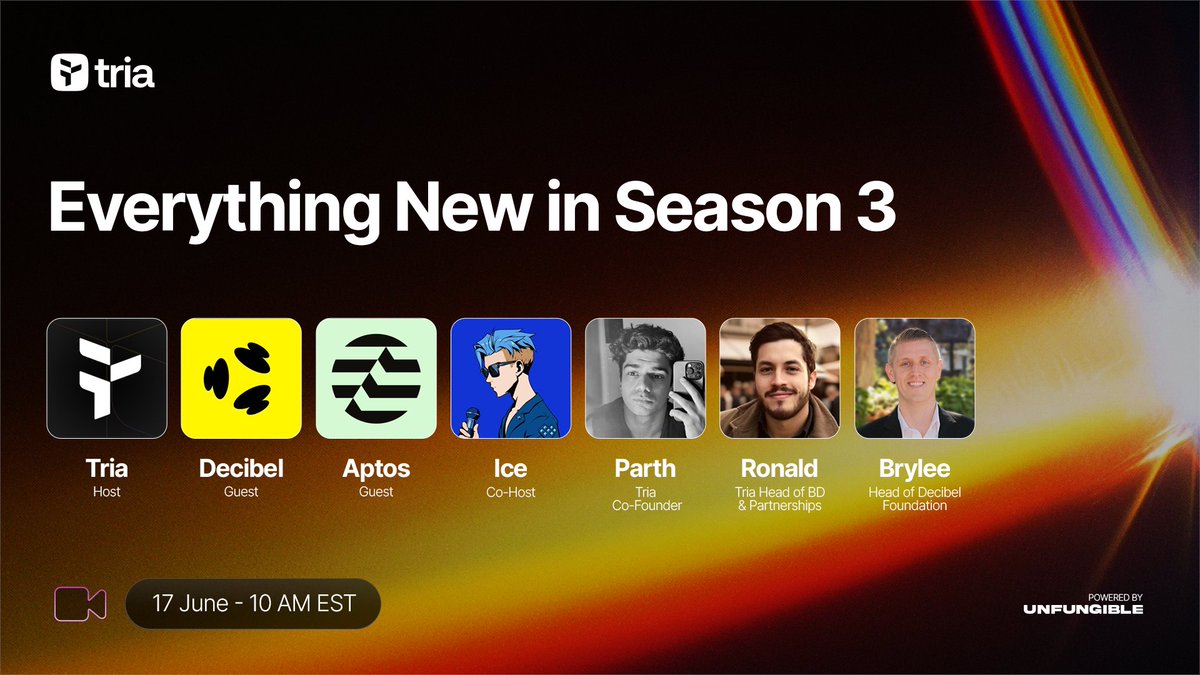
@useTria x @DecibelTrade x Aptos. Tune in tomorrow, June 17, at 10 AM ET as we break down what happens when all three come together, LIVE on 𝕏.

Season 3 is here, and it’s packed with new updates.
Join @useTria, @DecibelTrade, @Aptos, @ice_nfts, @parthbl, @RonaldTato, and @borntobry as we break down everything new in Season 3.
June 17, 10 AM EST. Set a reminder and tune in.
243
87
502
20,218

Confidential APT. Now on Aptos mainnet.
Access it today via @PetraWallet on Android and iOS, and Confidential Assets Web by @AptosLabs.
304
56
581
25,680
NetzFamily 🌐 retweeted
GM Aptos Fam
Day 2 live for LandBit🚀
Every coordinate has a story.
Every owner helps shape the future.
🗺️ LandBit Labs
🌐 LandBit Social
🏪 Genesis Marketplace
Built on @AptosLabs , @Aptos
👇 Join us:
landbitlabs.xyz
landbitsocial.xyz
#Aptos #BuildOnAptos
1
3
2
33
NetzFamily 🌐 retweeted

Jun 16
🧵 Today is the day.
⬛ LandBit is officially LIVE on @Aptos
Two things. Both live. Right now. 👇
1
3
2
114
NetzFamily 🌐 retweeted
Decentralization exchanges are incredibly powerful for global customers and global assets. But they must actually be decentralized for lasting impact.
@DecibelTrade is live today with this exact implementation. Fully onchain, fully user controlled, fully auditable. Onboard with USDC and trade immediately. Stocks. ETFs. Crypto. RWAs coming. Spot coming. Built on the fastest and safest crypt rails in the world. Everything decentralized exchanges are the future.
Jun 16

CZ on Hyperliquid:
“I think the Hyperliquid invention is actually awesome. They occupy a niche that Binance.. cannot compete. They don’t have KYC. They claim they’re decentralized… I would never do what they do, given what I’ve experienced… I assume they have good lawyers.”
12
8
61
4,197
NetzFamily 🌐 retweeted

Jun 14
New art by me ❤️ I am open for commissions. No scammers please. #art #acrylicmarker #flowers #drawing #timelapse #commissionㅤㅤㅤ

1
1
4
141
NetzFamily 🌐 retweeted

Jun 9
Moving for CLARITY!
Jun 9

Clear rules for developers aren't a concession. They're how you keep innovation in the U.S.
Aptos Labs Co-Founder & CEO @AveryChing joined 60 crypto CEOs—@coinbase, @Aave, @HyperliquidX, @Uniswap, & more—urging the Senate to preserve developer protections in the Clarity Act.
8
6
72
3,230

NetzFamily 🌐 retweeted
Feb 5
I got into crypto because I believe it has the potential to be one of the most equalizing technologies in the world.
Progress isn’t a straight line.
The internet gave us information.
AI gives us reasoning.
Blockchains will give us fair access to global markets.
This part of the cycle is painful. But it doesn’t change the need for a global trading engine.
34
16
136
5,424
NetzFamily 🌐 retweeted
13 Sep 2025
"Serene Forest #2"
is now open for bidding until September 20, 8am EST.
Click the Link below to place your bids.
Minimum Bid is 25 apt.
Shipping cost will be discussed.
8" x 10" with frame
Acrylic on Canvas
Check the youtube video here showing the process with already 1k views.
Pls support my yt channel also:
youtube.com/shorts/f3RJQkVT8…
Bid Here:
tradeport.xyz/aptos/0x489be7…

9
10
35
3,923
NetzFamily 🌐 retweeted
18 Sep 2025
Aptos is the biggest innovator in the crypto technology space.
Aptos is (soon to be) the biggest innovator in the token space.
128
57
341
26,898

NetzFamily 🌐 retweeted

5 Sep 2025
2
2
4
97
NetzFamily 🌐 retweeted

9 Sep 2025
3
2
6
90
NetzFamily 🌐 retweeted
9 Sep 2025
you sent me my first Apt gas
1
1
4
58