
#NeuroTracker - discover your path to improvement with NeuroTracker's revolutionary assessment and enhancement of human performance
Joined November 2011
- Tweets 7,562
- Following 660
- Followers 1,417
- Likes 4,933
2,613 Photos and videos






Pinned Tweet

3 Feb 2025
⚽ Golden Boot winner Pierre-Emerick Aubameyang giving testimonial to Canal on his experience using NeuroTracker.
#Soccer #Neuroscience #NeuroTracker #OpenBrain
3
402
Jun 12
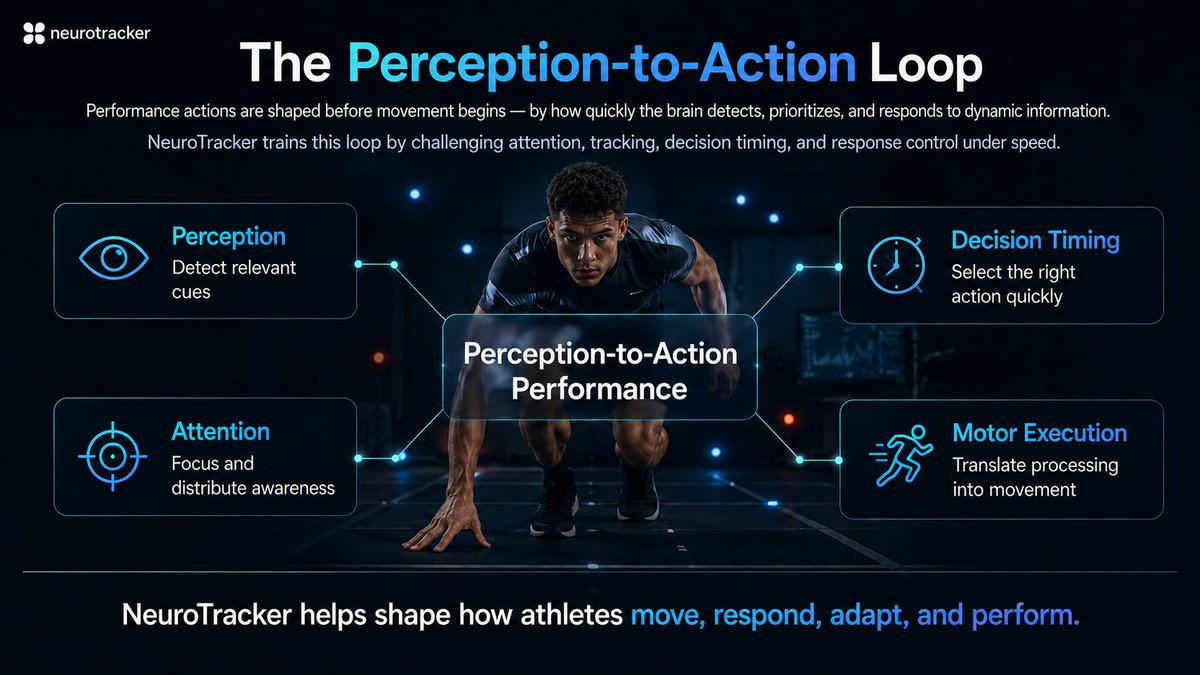
In sport, the decisive moment rarely begins with movement.
It begins earlier — with perception.
Before an athlete moves, the brain is already detecting cues, filtering distractions, distributing attention, timing decisions, and preparing the right response. This is the perception-to-action loop.
In real-world performance, small differences in this loop can shape how quickly an athlete reads the play, adapts to changing information, selects the right option, and executes under speed.
The physical action is what we see. But the quality of that action is often determined by the perceptual-cognitive processing that happens just before it.
This is where NeuroTracker fits naturally - as a way to challenge and train the underlying attention, tracking, decision timing, and response-control demands that support high-performance execution.
#Perception #CognitivePerformance #SportsPerformance
25
Jun 11
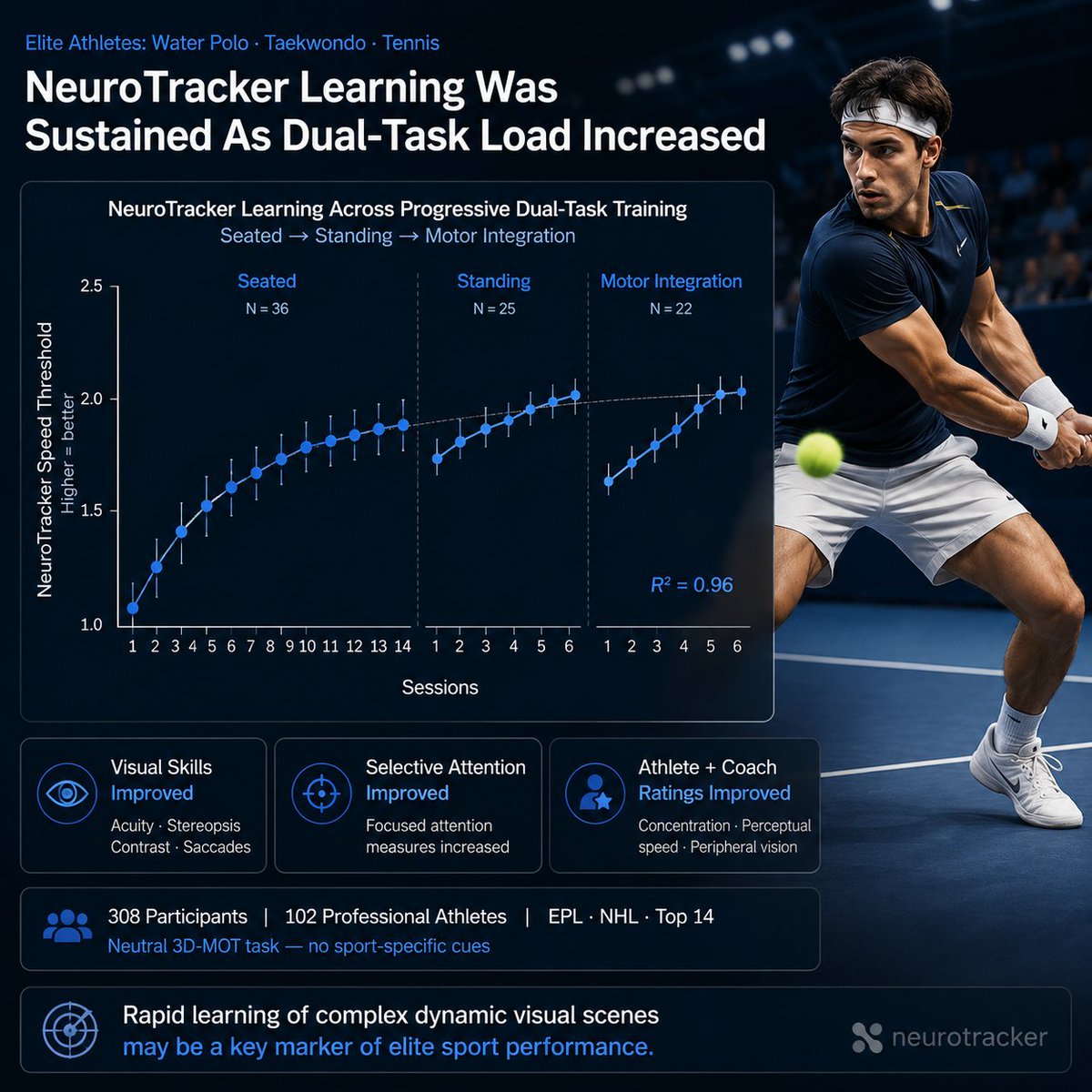
This NeuroTracker study helped establish a key principle in perceptual-cognitive training: progressive overload can apply to cognition, as well as physical training.
Spanish Olympic athletes from water polo, taekwondo, and tennis completed 26 NeuroTracker sessions across three phases:
- seated training
- standing training
- motor-integrated training involving balance or sport-relevant movement
The most important finding was not just that scores improved.
When task complexity increased, performance briefly dipped — then recovered quickly as athletes adapted to the new dual-task demand.
The findings corroborate other NeuroTracker research, that this type of training can be used progressively:
- first building core perceptual-cognitive capacity
- then layer on motor demands
- maintain overall learning progression
The study reported statistically significant improvements from this dual-task training across several visual and attentional measures:
- static visual acuity
- stereopsis
- contrast sensitivity
- saccadic eye movements
- selective focused attention.
Athlete and coach ratings also improved across visual concentration, perceptual speed, and peripheral vision.
This was a quasi-experimental study and did not have a control group. However, it helped lay the foundation for NeuroTracker dual-task research.
Study: “Perceptual-Cognitive Training with the Neurotracker 3D-MOT to Improve Performance in Three Different Sports.”
neurotrackerx.com/science/pe…
#SportsScience #CognitiveTraining #NeuroTracker
2
31
Jun 10
What separates professional athletes from other high performers?
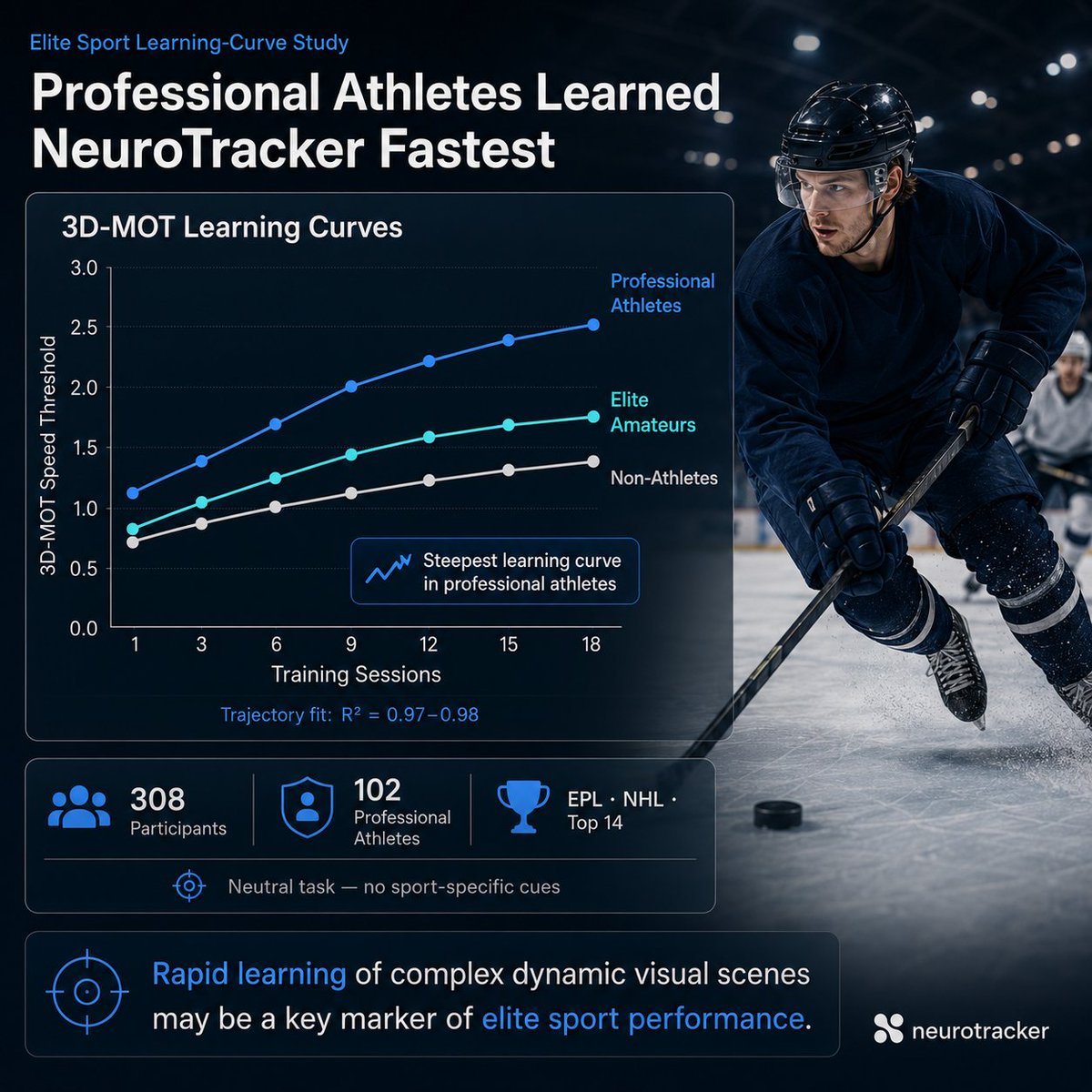
This landmark Nature Scientific Reports study tested whether elite sport expertise is reflected in NeuroTracker performance - a neutral perceptual-cognitive task with no sport-specific cues.
A total of 308 participants completed repeated NeuroTracker 3D-MOT sessions:
- 102 professional athletes from the EPL, NHL, and French Top 14 rugby
- 173 elite amateur athletes from NCAA and Olympic training environments
- 33 non-athlete university students
The key finding was not just that professional athletes performed better.
Professional athletes showed the fastest learning curves, reaching higher NeuroTracker speed thresholds and improving more rapidly across sessions than both elite amateurs and non-athletes.
Elite amateurs also separated from non-athletes over time, suggesting that the ability to learn complex dynamic visual scenes may scale with sport performance level.
This is important because the task did not rely on reading a soccer play, reacting to a hockey sequence, or recognizing sport-specific patterns.
Instead, it tested fundamental perceptual-cognitive abilities: distributed attention, dynamic visual tracking, sustained focus, and rapid adaptation to unpredictable motion.
The study does not show whether these abilities are developed through years of elite sport, reflect pre-existing talent, or both. But it provides a powerful signal that world-class athletes may differ not only in physical ability or sport-specific knowledge, but in how quickly they learn to process complex dynamic information.
Study: “Professional Athletes Have Extraordinary Skills for Rapidly Learning Complex and Neutral Dynamic Visual Scenes.”
neurotrackerx.com/science/pr…
#SportsScience #CognitivePerformance #NeuroTracker
1
35
Jun 9
How does cognitive performance behave during high-intensity intermittent exercise?
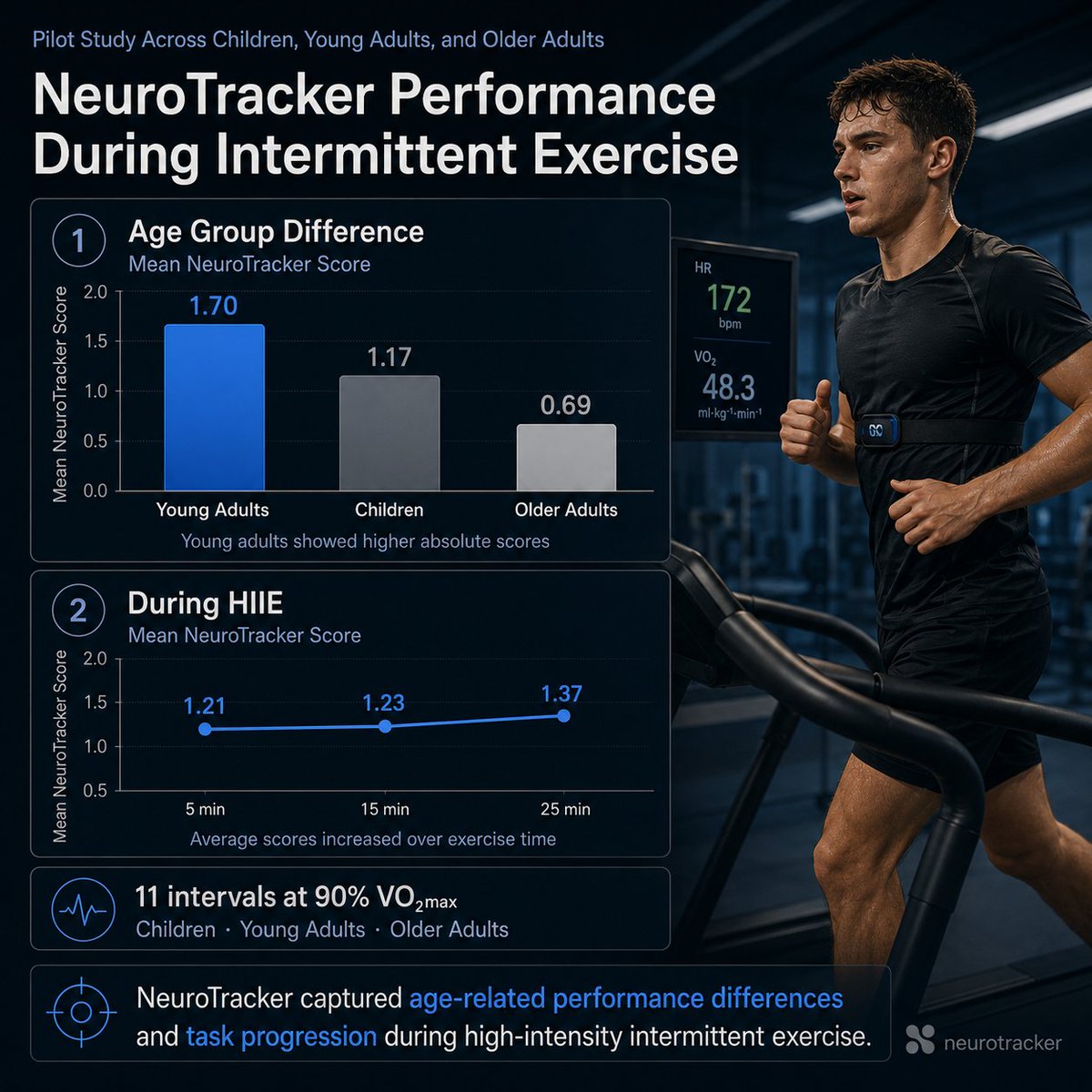
This pilot study tested NeuroTracker performance in children, young adults, and older adults during an interval treadmill protocol.
Participants completed NeuroTracker while exercising through repeated high-intensity intervals: 30 seconds at 90% VO₂max, separated by active recovery periods.
Key findings:
- Young adults showed the highest absolute NeuroTracker scores
- NeuroTracker performance increased over exercise time across the protocol
- Young adults showed the clearest absolute progression during exercise
- Older adults showed meaningful progression from their own baseline
These findings are interesting because they place cognitive performance in a physical-load context.
In sport, driving, military, and daily movement environments, cognition rarely happens at rest. People often need to track dynamic information while the body is already under physical demand.
The study was exploratory with small groups, but it provides a useful research signal: NeuroTracker can capture age-related performance differences under intermittent physical load.
Study: “Effect of Intermittent Exercise on Performance in 3D Multiple Objects Tracking in Children, Young and Older Adults — A Pilot Study.”
neurotrackerx.com/science/ef…
#ExerciseScience #CognitivePerformance #NeuroTracker
1
18
Jun 8
A single cognitive score can be useful.
But sometimes the more revealing signal is the shape of the learning curve.
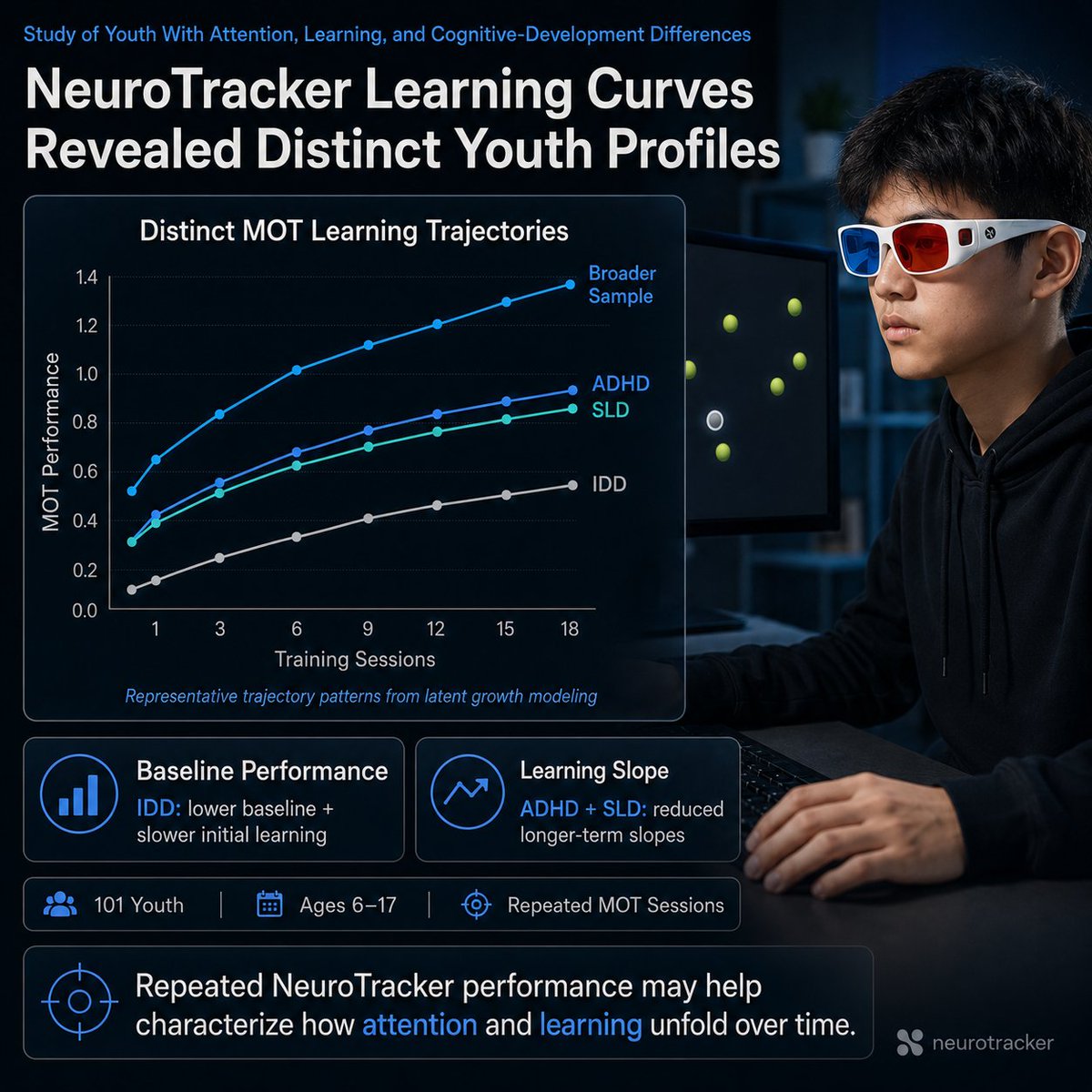
This study examined NeuroTracker performance trajectories in 101 children and adolescents with neurodevelopmental profiles involving attention, learning, and intellectual-development differences.
Rather than focusing only on baseline performance, researchers analyzed how NeuroTracker scores changed across repeated sessions using latent growth curve modeling.
Key findings:
- Youth with intellectual developmental disorder showed lower baseline performance and slower initial learning
- Youth with ADHD and specific learning disorder showed reduced longer-term learning rates
This research provides some insights for understanding attention and learning profiles, highlighting how performance can adapt differently over time.
Study: “Distinctive Patterns of Multiple Object-Tracking Performance Trajectories in Youth With Deficits in Attention, Learning, and Intelligence.”
neurotrackerx.com/science/di…
#LearningScience #Neurodevelopment #NeuroTracker
3
27
Jun 5
Air traffic control depends on the ability to monitor multiple moving aircraft, anticipate conflicts, and act quickly without overreacting.
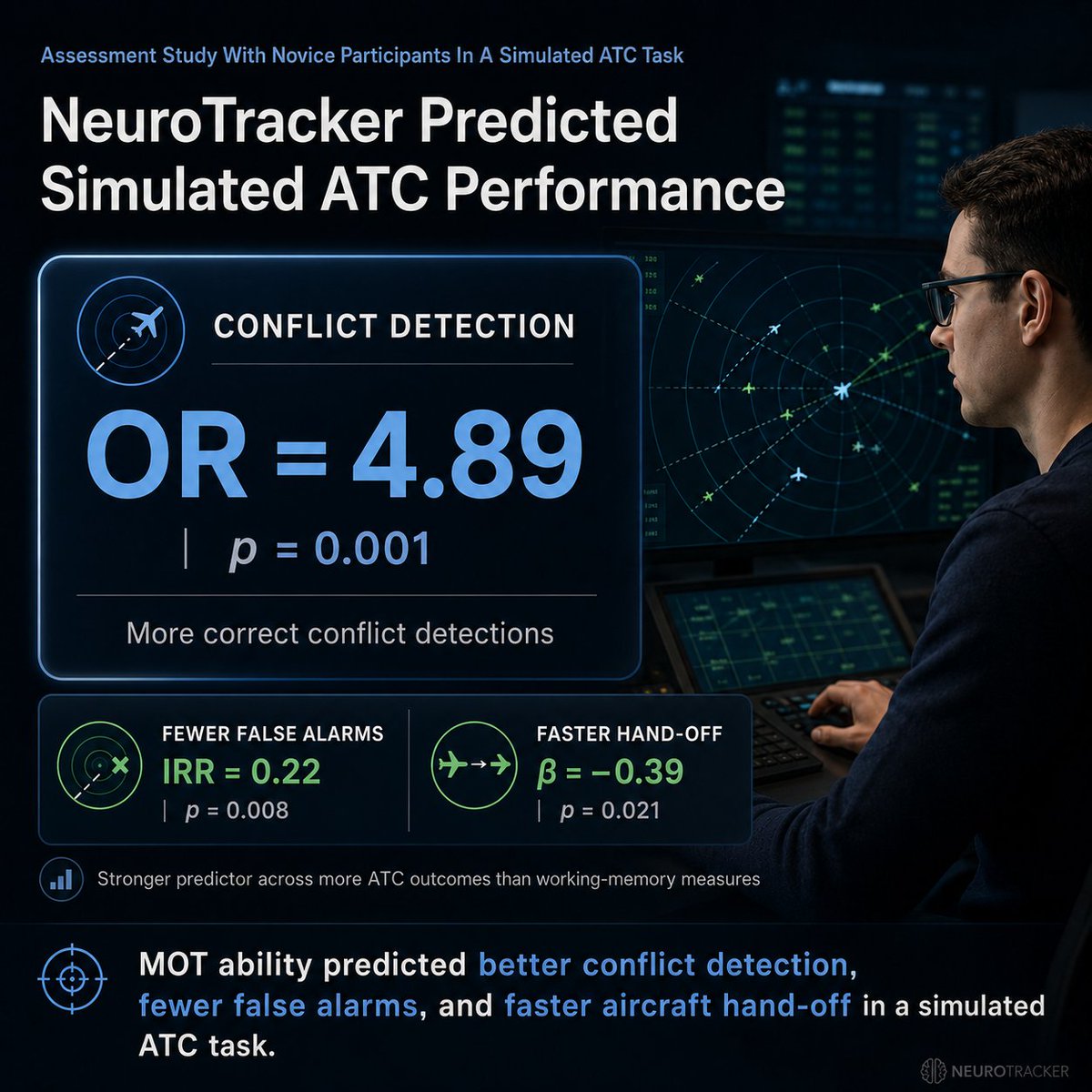
This study tested whether NeuroTracker multiple object tracking ability could help predict performance on a simulated air traffic control task.
Forty-six novice participants completed NeuroTracker, two working-memory tests, and a 30-minute ATC simulation involving aircraft acceptance, conflict detection, and hand-off.
Key findings:
- Higher NeuroTracker scores predicted more correct aircraft conflict detections
- Higher scores predicted fewer false alarm responses
- NeuroTracker also predicted faster aircraft hand-off performance
- NeuroTracker remained significant across more ATC outcomes than the working-memory measures
This is a useful applied finding because ATC performance relies on more than isolated working memory. It requires distributed attention, dynamic tracking, visual prediction, and rapid decision-making under continuous monitoring demands.
Although the task was simulated with novice participants, it supports the idea that NeuroTracker ability may capture cognitive skills relevant to aviation screening, training, and high-reliability operator roles.
Study: “NeuroTracker Multiple Object Tracking Ability Predicts Novice Performance on a Simulated Air Traffic Control Task.”
neurotrackerx.com/science/ne…
#AviationTraining #HumanPerformance #NeuroTracker
1
26
Jun 4
How much spare cognitive capacity does a pilot have left during demanding flight maneuvers?
This I/ITSEC Best Paper award-winning study explored that question using NeuroTracker in an aviation training context.
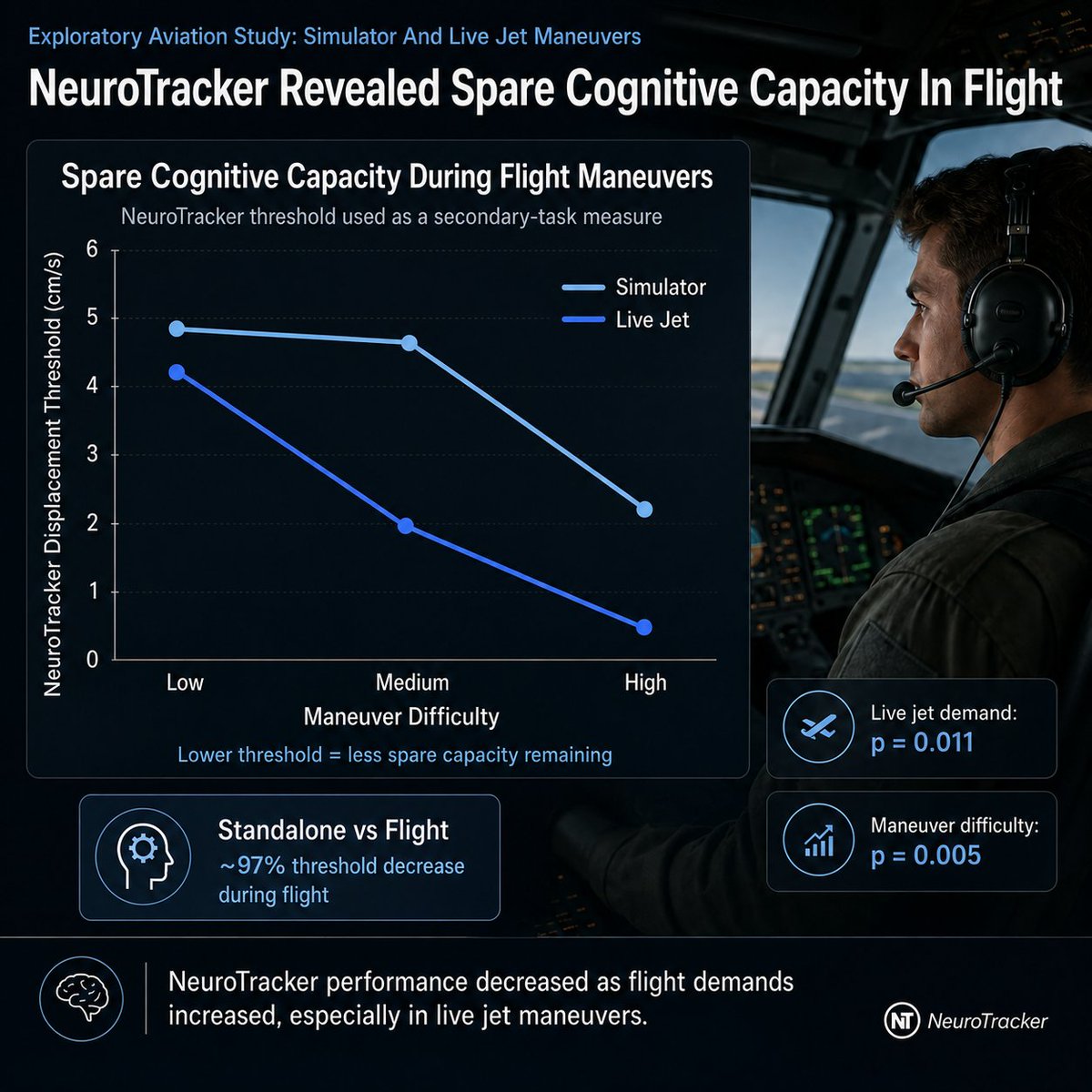
Ten pilots performed flight maneuvers in both an advanced aircraft simulator and a live L-29 jet.
During the maneuvers, they also performed NeuroTracker as a peripheral dual-task, allowing researchers to measure how much perceptual-cognitive capacity remained while flying.
Key findings:
- NeuroTracker performance was significantly lower in live jet maneuvers than in the simulator
- Higher-difficulty maneuvers left pilots with less spare cognitive capacity, particularly during live flight
This shows how NeuroTracker can be used not only as a training task, but also as an objective assessment layer.
In aviation, simulator fidelity is not only about whether the controls and visuals look realistic. It is also about whether the training environment places comparable cognitive demands on the operator.
By measuring spare cognitive capacity during flight tasks, NeuroTracker helped differentiate simulator and live flight demands, especially during difficult maneuvers.
The study was exploratory, but it provides a useful applied example of how perceptual-cognitive assessment assess the efficacy of simulated training methods versus real-world performance.
Study: “Perceptual-Cognitive & Physiological Assessment of Training Effectiveness.”
neurotrackerx.com/science/pe…
#AviationTraining #HumanPerformance #NeuroTracker
2
62
Jun 3
Mick Clegg giving insights on optimizing football training through a methodology of progressive transitions - consolidating one skill, to build the next on top of it.
Full webinar available here: linkedin.com/event/manage/74…
#Football #Soccer #CognitivePerformance #SportsPerformance
1
38
Jun 2
𝗪𝗵𝗮𝘁 𝗡𝗲𝘂𝗿𝗼𝗧𝗿𝗮𝗰𝗸𝗲𝗿 𝗥𝗲𝘀𝗲𝗮𝗿𝗰𝗵 𝗥𝗲𝘃𝗲𝗮𝗹𝘀 𝗔𝗯𝗼𝘂𝘁 𝘁𝗵𝗲 𝗕𝗿𝗮𝗶𝗻-𝗕𝗼𝗱𝘆 𝗖𝗼𝗻𝗻𝗲𝗰𝘁𝗶𝗼𝗻
The brain and body are often treated as separate systems, but NeuroTracker research suggests they are deeply connected.
This review explores how perception, decision-making, attention, and movement interact across sport, driving, aging, fatigue, and motor performance.
neurotrackerx.com/post/what-…
#NeuroTracker
#Neuroscience
#HumanPerformance
2
29
Jun 1
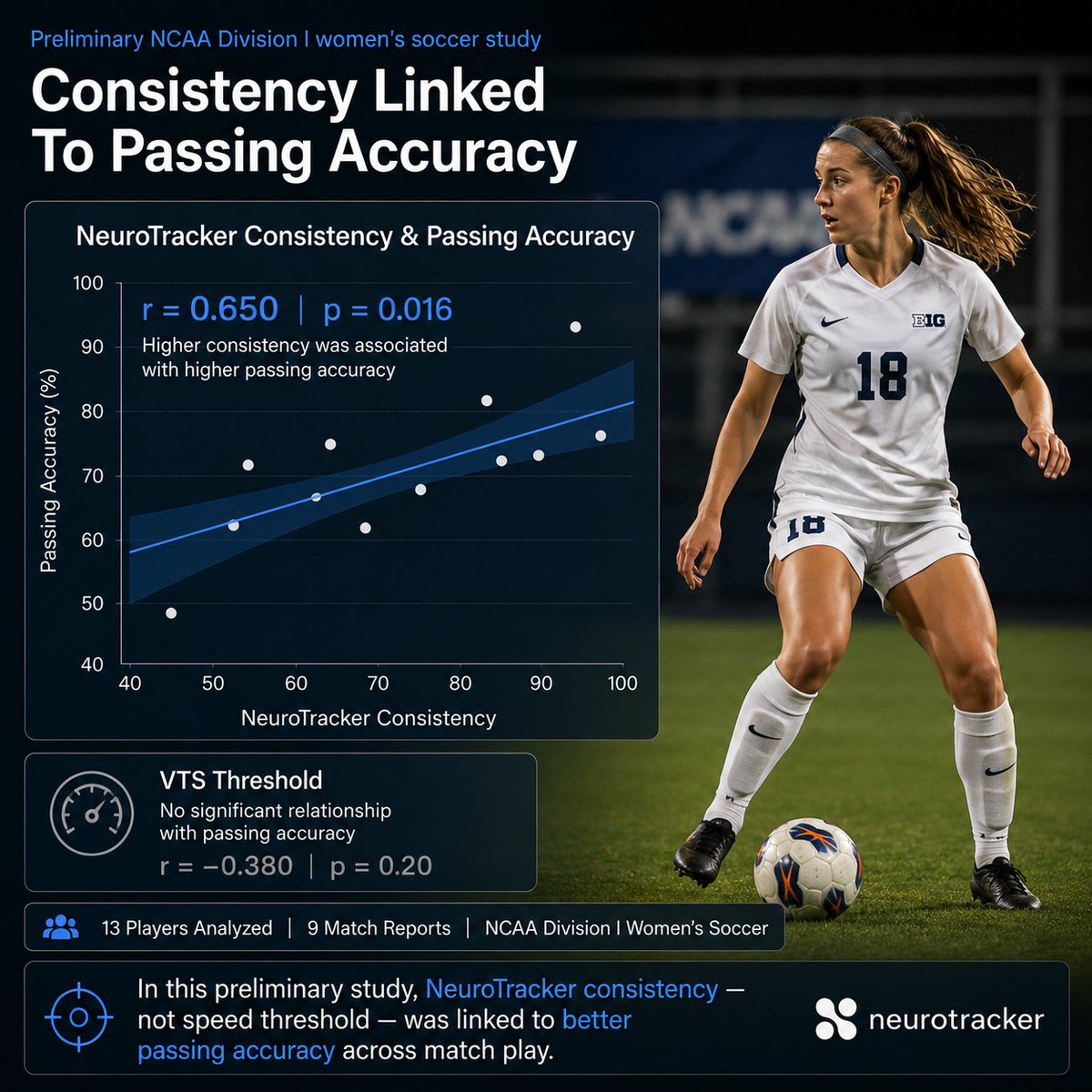
An NCAA Division I women’s soccer study NeuroTracker's consistency metric correlated with match performance.
Consistency is a session-level measure of how stable a player’s tracking performance remains across the 20 trials of a CORE session.
High NeuroTracker consistency = steady tracking performance across a session.
Low NeuroTracker consistency = many fast trial successes in combination with low speed fails.
In this study, 13 players completed a single NeuroTracker CORE assessment (6-mins), and their results were compared with season match metrics from WyScout.
Key findings:
- Visual tracking speed from a single session itself was not significantly associated with passing accuracy
- NeuroTracker consistency was significantly associated with passing accuracy: r = 0.650, p = 0.016
This is the first study NeuroTracker study to analyze the consistency metric, with results suggesting that tracking speed stability during the assessment may provide additional sports performance insights.
Consistency in human performance is often overlooked, and may capture something relevant to how reliably an athlete processes information and executes decisions over time.
As this was a small preliminary study, it would be interesting to see future NeuroTracker research make use of the consistency metric.
Study: “Visual Tracking Speed Threshold in NCAA Division I Women’s Soccer Predicting Match Performance: A Preliminary Study.”
neurotrackerx.com/science/vi…
#SportsScience #DecisionMaking #NeuroTracker
1
22
May 29
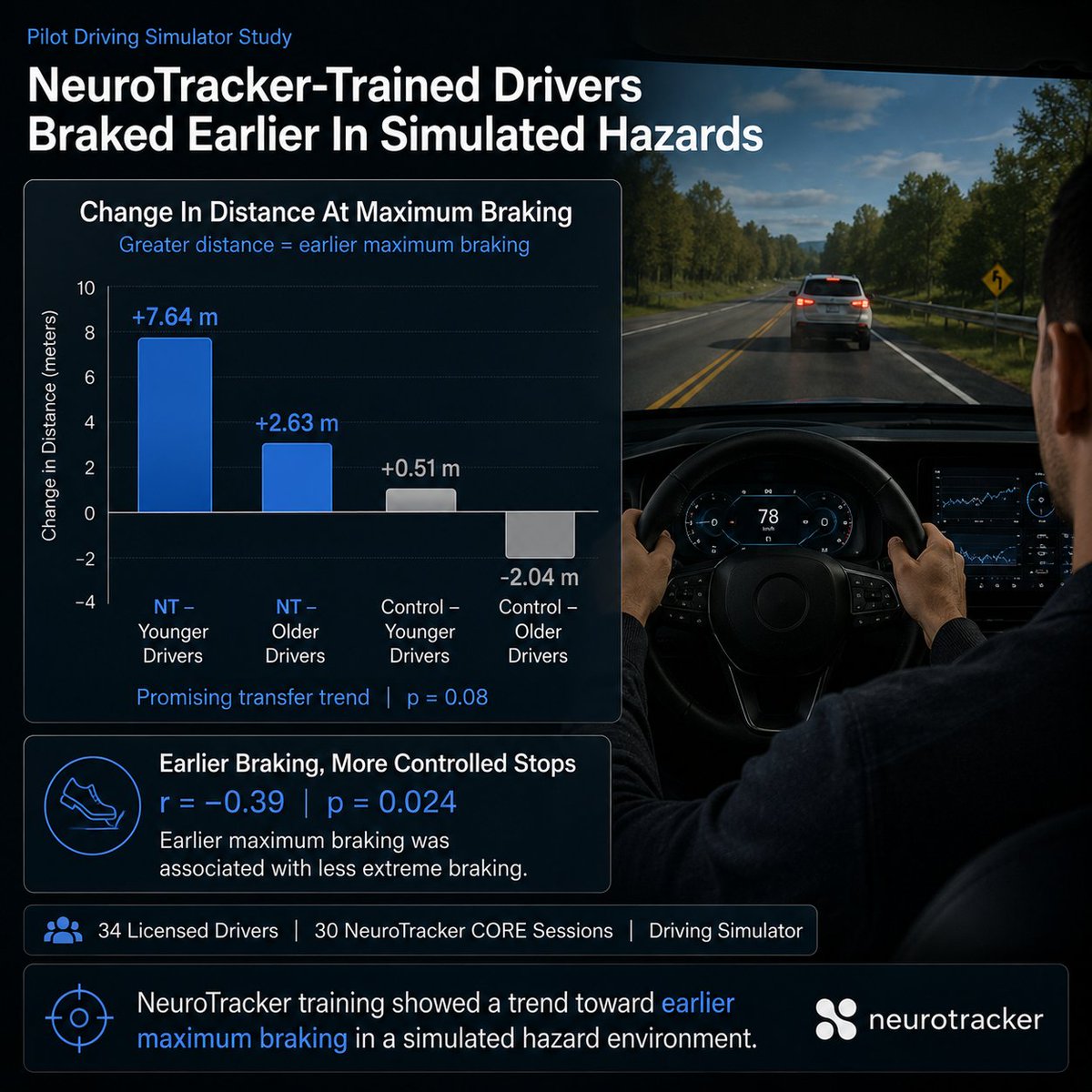
Can cognitive training help drivers respond earlier when a hazard emerges?
Previous NeuroTracker studies found that baseline performance was significantly associated with driving behaviours in both younger and older drivers.
This pilot study explored the next question: whether training could transfer to simulated driving performance.
Young and older licensed drivers completed either 30 NeuroTracker CORE sessions or active control training, then responded to hazardous events in a high-fidelity driving simulator.
Key findings:
- NeuroTracker-trained younger drivers applied maximum braking 7.64 metres earlier after training
- NeuroTracker-trained older drivers also showed a smaller positive shift of 2.63 metres
- Earlier maximum braking was associated with less extreme braking responses
The result represents a promising transfer signal rather than definitive evidence. The primary training effect was trend-level, and the study measured simulated rather than on-road driving.
Still, it provides an interesting extension of earlier assessment findings: NeuroTracker may not only help characterize cognitive abilities relevant to driving, but could potentially support earlier, more controlled responses to emerging hazards.
Study: “Can Three-Dimensional Multiple Object Tracking Training Be Used to Improve Simulated Driving Performance? A Pilot Study in Young and Older Adults.”
neurotrackerx.com/science/ca…
#CognitivePerformance #DrivingResearch #NeuroTracker
1
32
May 28
Mick Clegg explains how power development differs from traditional strength & conditioning approaches, and why speed of execution places different demands on the brain.
The full webinar is available here:
linkedin.com/event/manage/74…
#Soccer #Football #SportsPerformance #CognitivePerformance
1
49
May 27
𝗪𝗵𝗮𝘁 𝗛𝗮𝗽𝗽𝗲𝗻𝘀 𝗪𝗵𝗲𝗻 𝗧𝗼𝗼 𝗠𝗮𝗻𝘆 𝗦𝗺𝗮𝗹𝗹 𝗗𝗲𝗰𝗶𝘀𝗶𝗼𝗻𝘀 𝗦𝘁𝗮𝗰𝗸 𝗨𝗽
Small decisions rarely stay isolated for long.
This article explores how many low-level choices gradually stack together, reshaping attention, priorities, and the structure of decision-making itself.
neurotrackerx.com/post/what-…
#CognitiveLoad
#DecisionMaking
#HumanPerformance
1
33
May 26
Mick Clegg on how Ruud van Nistelrooy's incredible brain helped him score goals prolifically within the 18 yards box.
Full webinar available to watch here:
linkedin.com/event/manage/74…
#Soccer #Football #CognitivePeformance
1
96
May 25
Could a brief cognitive assessment help explain performance variability in high-pressure decision environments?
A NeuroTracker study examined this question in 29 retail traders, comparing daily NeuroTracker scores with trading outcomes across 624 observations.
Key findings:
- Higher NeuroTracker scores were strongly associated with higher total net profit.
- A significant relationship was also reported lower NeuroTracker scores and maximum drawdown (biggest losses).
Trading requires sustained attention, rapid information processing, and effective decision-making under uncertainty. These are the kinds of demands that can fluctuate with fatigue, stress, and cognitive readiness.
The study suggests that a brief 6-minute cognitive assessment may provide a useful signal of daily performance readiness in trading — and potentially in other cognitively demanding professional roles.
This was a preliminary correlational study, conducted with both real and simulated trading. It doesn't suggest that NeuroTracker training improves profits, but it offers an unusual real-world example of cognitive assessment being linked to workplace-performance metrics.
Study: “Cognitive Assessment and Trading Performance Correlations.”
neurotrackerx.com/science/co…
#CognitivePerformance #WorkplacePerformance #NeuroTracker
1
27
May 22
What might help young athletes enter the focused, fully engaged state associated with peak performance?
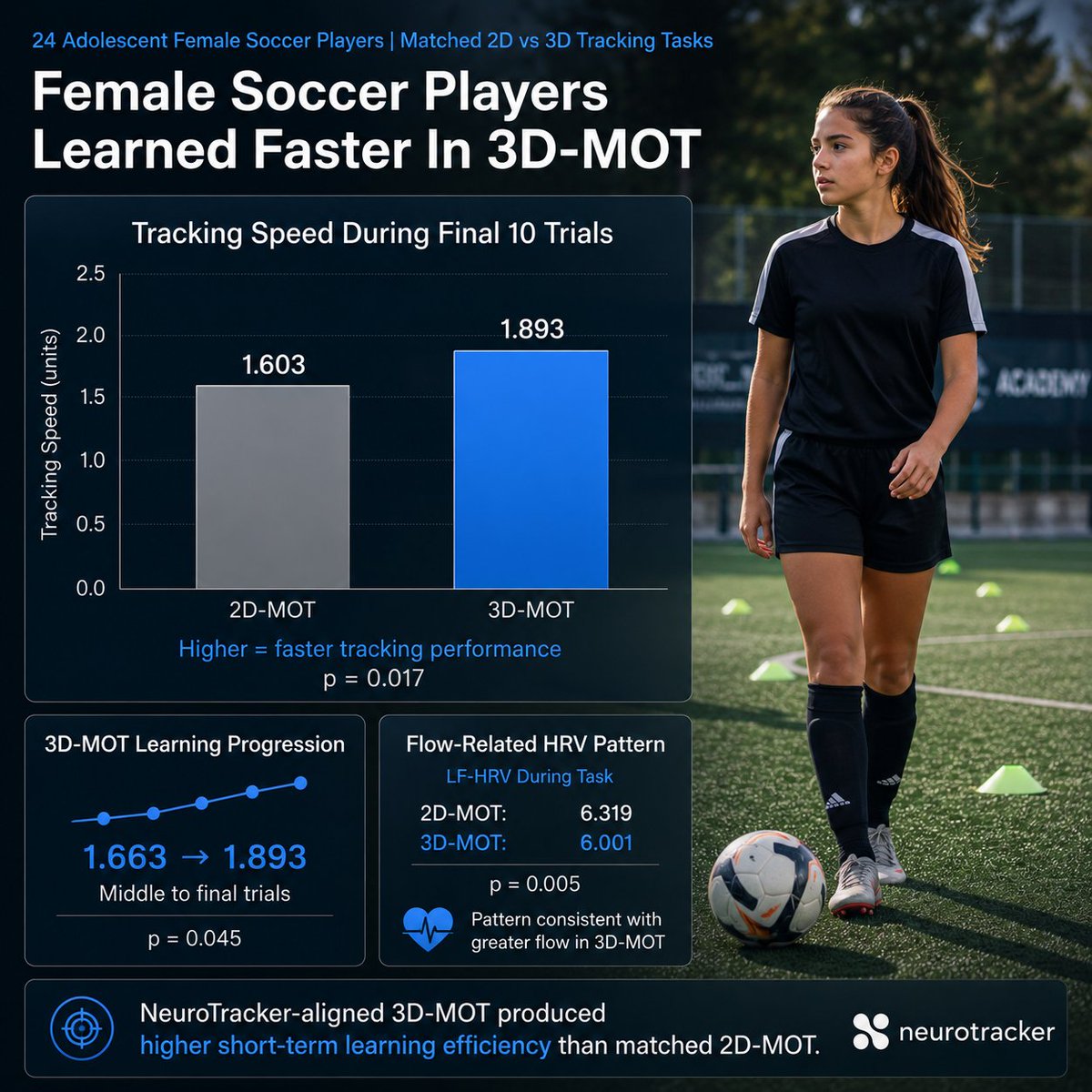
A 3D-MOT NeuroTracker study compared immersive 3D tracking with a matched 2D task in 24 youth female soccer players.
Key findings:
- Players reached higher tracking-speed thresholds in 3D-MOT than 2D-MOT: 1.893 in 3D versus 1.603 in 2D
- This revealed not just higher baselines in 3D (as established in other studies), but also a more efficient learning response to this type of cognitive training.
- HRV patterns specific to 3D-MOT training were consistent with greater peak performance flow states.
This is especially interesting for sport because flow states are often associated with the ability to remain deeply engaged, process dynamic information efficiently, and respond naturally under pressure.
The study did not measure on-field soccer performance directly, and flow was inferred through physiological signals. But it provides a useful insight into why immersive 3D perceptual-cognitive training may be especially engaging and responsive for developing athletes.
Study: “Two-Dimensional and Three-Dimensional Multiple Object Tracking Learning Performance in Adolescent Female Soccer Players: The Role of Flow Experience Reflected by Heart Rate Variability.”
neurotrackerx.com/science/tw…
#SportsScience #FlowState #NeuroTracker
1
39
May 21
Mick Clegg on Cristiano Ronaldo forging his path to success by working on everything possible.
This was to reach his original goal of becoming the world's best football player.
#CristianoRonaldo #Football #SoccerPerformance
neurotrackerx.com/post/webin…
2
40
May 20
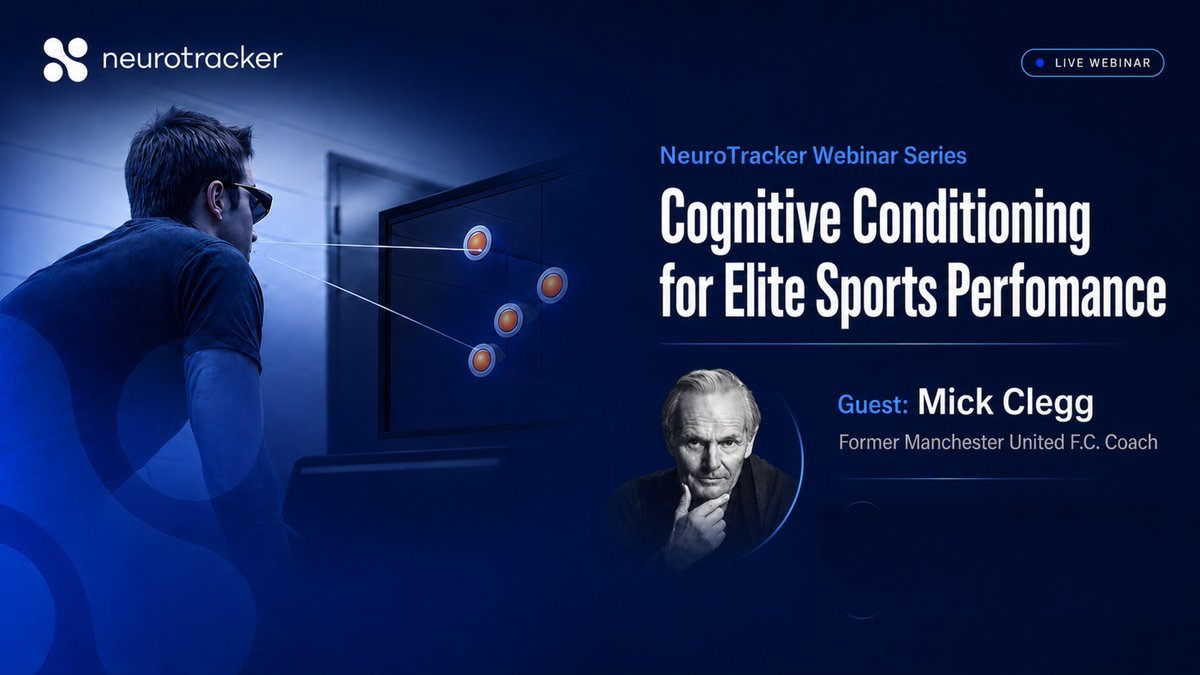
Read highlights of Mick Clegg's fascinating insights on sports performance development and watch his webinar recording here: neurotrackerx.com/post/webin…
Mick Clegg was power development coach for Manchester United FC for 11 years, contributing directly to Cristiano Ronaldo's development from EPL rookie to FIFA player of the year.
#Football #Soccer #SportsPerformance
2
292
May 19
𝗪𝗵𝘆 𝗬𝗼𝘂 𝗖𝗮𝗻 𝗞𝗻𝗼𝘄 𝗘𝘅𝗮𝗰𝘁𝗹𝘆 𝗪𝗵𝗮𝘁 𝘁𝗼 𝗗𝗼 𝗮𝗻𝗱 𝗦𝘁𝗶𝗹𝗹 𝗛𝗲𝘀𝗶𝘁𝗮𝘁𝗲
Sometimes the action is clear, but the consequences are not.
This article explores how hesitation often comes from uncertainty about what happens next—rather than uncertainty about the action itself.
neurotrackerx.com/post/why-y…
#DecisionMaking
#Uncertainty
#HumanPerformance

1
21
May 18
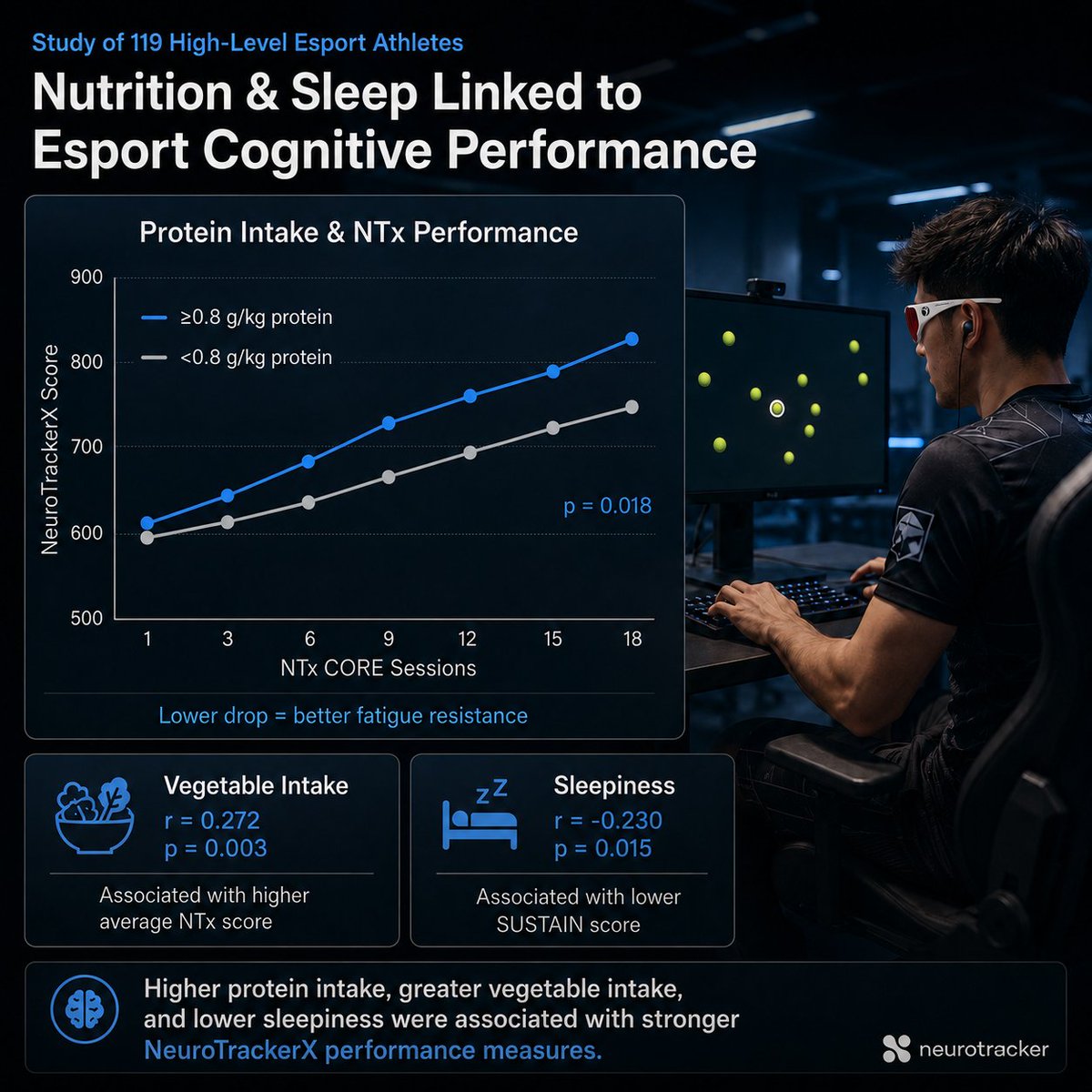
Nutrition and sleep patterns were associated with cognitive performance in a study of 119 high-level esport athletes.
Key findings:
Participants who consumed at least 0.8 g/kg of protein performed significantly better across 18 NeuroTrackerX Core sessions.
Vegetable intake was positively associated with average NTx score, while greater sleepiness was associated with lower NeuroTrackerX Sustain session performance.
The protein result suggests that intake may relate not only to cognitive performance level, but also to learning responsiveness across repeated training sessions.
In other words, nutrition may influence how well athletes perform and how effectively they adapt over time — potentially pointing toward a role in training and neuroplasticity responsiveness.
This was an observational study, so it does not show causation. But it is still notable because it connects everyday lifestyle factors with measurable perceptual-cognitive performance in a real esports population.
Study: “Nutrition, Lifestyle, and Cognitive Performance in Esport Athletes.”
neurotrackerx.com/science/nu…
#EsportsScience #CognitivePerformance #NeuroTracker
1
37