
Account run by the founder of Boldin (formerly NewRetirement), which offers Financial Planning and Management as a Service ☁️😊
Joined April 2009
- Tweets 10,798
- Following 1,131
- Followers 3,832
- Likes 21,123
932 Photos and videos


Pinned Tweet

27 Jul 2021
In 1949 an epidemiologist, made the first correlations between cardiovascular health and exercise.
Jogging didn’t become normalized until Bill Bowerman from @Nike wrote a book about it.
I hope we look back at planning and financial maintenance the same way.
6
3
44
6 Aug 2025
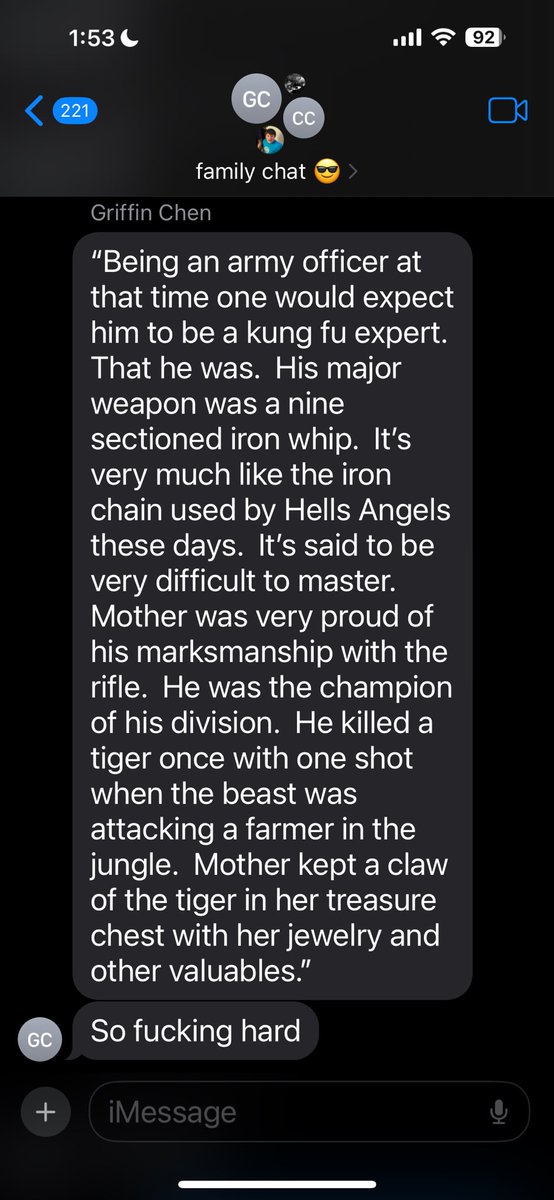
When your 24 yo son starts reading the Chinese family history and realizes his ancestors were bad af 😂
1
3
361
Steve Chen 🇺🇸 🚀 retweeted

23 Jul 2025
Anthropic co-founder Ben Mann on why he chose Montessori for his daughter:
"If this were 10-20 years ago, I'd be lining her up for top-tier schools and extracurriculars. But now I don't think any of it's going to matter. Learning facts is going to fade into the background. What matters is that she's happy, thoughtful, curious, and kind."
20 Jul 2025

Ben Mann (@8enmann) left @OpenAI in 2020 with the entire safety team to co-found @AnthropicAI (now reportedly valued at over $100B).
In a rare interview, Ben opens up about:
🔸 What he saw at OpenAI that convinced him to leave
🔸 The AI nightmare scenarios that concern him most
🔸 His take on Meta’s $100M talent wars
🔸 Why he believes 20% unemployment is inevitable
🔸 His “economic Turing test” for knowing when we’ve achieved AGI—and why it’s likely coming by 2027-2028
🔸 How focusing on AI safety created Claude’s beloved personality
🔸 What three skills he’s teaching his kids to thrive in an AI future
🔸 So much more
Listen now 👇
• YouTube: youtu.be/WWoyWNhx2XU
• Spotify: open.spotify.com/episode/2dh…
• Apple: podcasts.apple.com/us/podcas…
Thank you to our wonderful sponsors for supporting the podcast:
🏆 Sauce.app —Turn customer pain into product revenue: sauce.app/lenny
🏆 @Lucid_Link—Real-time cloud storage for teams: lucidlink.com/lenny
🏆 @Fin_ai—The #1 AI agent for customer service: fin.ai/lenny
120
198
3,215
1,229,009
14 Jul 2025
Worth reading - messing with universities, discouraging the best and brightest from wanting to build in the US, breaking down partnerships with our allies is making us weaker not stronger.
nytimes.com/2025/07/14/opini…
3
274
Steve Chen 🇺🇸 🚀 retweeted

1 Jul 2025
It’s easy to spot other people’s bullshit and nearly impossible to recognize your own.
137
234
1,991
136,530
18 Jun 2025
Was discussing this with a bunch of fintech founders yesterday at the Fiat Growth fintech meetup in SF
thefintechsummit.com/
18 Jun 2025

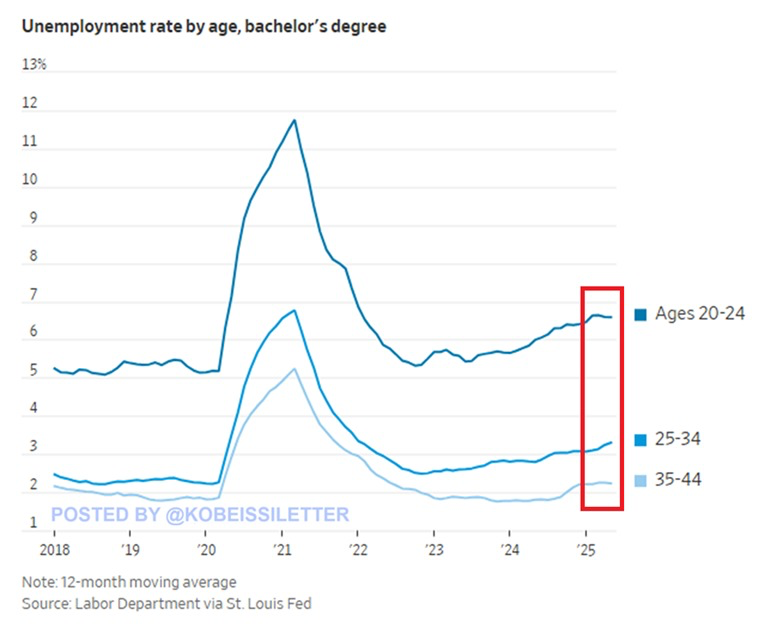
US graduates are struggling to find a job:
The unemployment rate among new college graduates has averaged 6.6% over the last 12 months, the highest in a decade, outside of 2020.
The jobless rate for people aged 20 to 24 who are looking for work and have at least a bachelor’s degree has risen by ~1.3 percentage points in 3 years.
By comparison, the nationwide unemployment rate stands much lower, at 4.2%.
Furthermore, the unemployment among college grads aged 22 to 27 averaged 5.8% in Q1 2025, according to the NY Fed.
As a result, the unemployment gap between young graduates and the general population is now the largest in ~35 years.
Graduates are facing an unemployment crisis.
2
1
416
16 Jun 2025
Facts aka not chopped 😉
15 Jun 2025

Some AI industry leaders are predicting white-collar bloodbaths.
Even the most inspirational advice to new graduates lands like a Band-Aid on a bullet wound.
Some thoughts on new grads, and finding a job in the AI wave:
1
518
Steve Chen 🇺🇸 🚀 retweeted

12 Jun 2025
This is so fucked up. A sitting US senator being handcuffed for trying to ask a question at a DHS news conference? No matter what your political party, you can't think this is a good thing.
12 Jun 2025

Despicable. Trump’s goons are roughing up and handcuffing @SenAlexPadilla as he tries to ask a simple question.
This is what dictatorship looks like. Watch:
1,065
891
11,711
1,230,323
11 Jun 2025
Great take.
LLMs today are great at doing what they are told vs inventing and innovating.
Hopefully good for productivity and a better world, since it will shift people into innovation since doing rote work will get less valuable.
6 Mar 2025

I shared a controversial take the other day at an event and I decided to write it down in a longer format: I’m afraid AI won't give us a "compressed 21st century".
The "compressed 21st century" comes from Dario's "Machine of Loving Grace" and if you haven’t read it, you probably should, it’s a noteworthy essay. In a nutshell the paper claims that, over a year or two, we’ll have a "country of Einsteins sitting in a data center”, and it will result in a compressed 21st century during which all the scientific discoveries of the 21st century will happen in the span of only 5-10 years.
I read this essay twice. The first time I was totally amazed: AI will change everything in science in 5 years, I thought! A few days later I came back to it and, re-reading it, I realized that much of it seemed like wishful thinking at best.
What we'll actually get, in my opinion, is “a country of yes-men on servers” (if we just continue on current trends). Let me explain the difference with a small part of my personal story.
I’ve always been a straight-A student. Coming from a small village, I joined the top French engineering school before getting accepted to MIT for PhD. School was always quite easy for me. I could just get where the professor was going, where the exam's creators were taking us and could predict the test questions beforehand.
That’s why, when I eventually became a researcher (more specifically a PhD student), I was completely shocked to discover that I was a pretty average, underwhelming, mediocre researcher. While many colleagues around me had interesting ideas, I was constantly hitting a wall. If something was not written in a book I could not invent it unless it was a rather useless variation of a known theory. More annoyingly, I found it very hard to challenge the status-quo, to question what I had learned. I was no Einstein, I was just very good at school. Or maybe even: I was no Einstein in part *because* I was good at school.
History is filled with geniuses struggling during their studies. Edison was called "addled" by his teacher. Barbara McClintock got criticized for "weird thinking" before winning a Nobel Prize. Einstein failed his first attempt at the ETH Zurich entrance exam. And the list goes on.
The main mistake people usually make is thinking Newton or Einstein were just scaled-up good students, that a genius comes to life when you linearly extrapolate a top-10% student.
This perspective misses the most crucial aspect of science: the skill to ask the right questions and to challenge even what one has learned. A real science breakthrough is Copernicus proposing, against all the knowledge of his days -in ML terms we would say “despite all his training dataset”-, that the earth may orbit the sun rather than the other way around.
To create an Einstein in a data center, we don't just need a system that knows all the answers, but rather one that can ask questions nobody else has thought of or dared to ask. One that writes 'What if everyone is wrong about this?' when all textbooks, experts, and common knowledge suggest otherwise.
Just consider the crazy paradigm shift of special relativity and the guts it took to formulate a first axiom like “let’s assume the speed of light is constant in all frames of reference” defying the common sense of these days (and even of today…)
Or take CRISPR, generally considered to be an adaptive bacterial immune system since the 80s until, 25 years after its discovery, Jennifer Doudna and Emmanuelle Charpentier proposed to use it for something much broader and general: gene editing, leading to a Nobel prize. This type of realization –"we've known XX does YY for years, but what if we've been wrong about it all along? Or what if we could apply it to the entirely different concept of ZZ instead?” is an example of out-side-of-knowledge thinking –or paradigm shift– which is essentially making the progress of science.
Such paradigm shifts happen rarely, maybe 1-2 times a year and are usually awarded Nobel prizes once everybody has taken stock of the impact. However rare they are, I agree with Dario in saying that they take the lion’s share in defining scientific progress over a given century while the rest is mostly noise.
Now let’s consider what we’re currently using to benchmark recent AI model intelligence improvement. Some of the most recent AI tests are for instance the grandiosely named "Humanity's Last Exam" or "Frontier Math". They consist of very difficult questions –usually written by PhDs– but with clear, closed-end, answers.
These are exactly the kinds of exams where I excelled in my field. These benchmarks test if AI models can find the right answers to a set of questions we already know the answer to.
However, real scientific breakthroughs will come not from answering known questions, but from asking challenging new questions and questioning common conceptions and previous ideas.
Remember Douglas Adams' Hitchhiker's Guide? The answer is apparently 42, but nobody knows the right question. That's research in a nutshell.
In my opinion this is one of the reasons LLMs, while they already have all of humanity's knowledge in memory, haven't generated any new knowledge by connecting previously unrelated facts. They're mostly doing "manifold filling" at the moment - filling in the interpolation gaps between what humans already know, somehow treating knowledge as an intangible fabric of reality.
We're currently building very obedient students, not revolutionaries. This is perfect for today’s main goal in the field of creating great assistants and overly compliant helpers. But until we find a way to incentivize them to question their knowledge and propose ideas that potentially go against past training data, they won't give us scientific revolutions yet.
If we want scientific breakthroughs, we should probably explore how we’re currently measuring the performance of AI models and move to a measure of knowledge and reasoning able to test if scientific AI models can for instance:
- Challenge their own training data knowledge
- Take bold counterfactual approaches
- Make general proposals based on tiny hints
- Ask non-obvious questions that lead to new research paths
We don't need an A student who can answer every question with general knowledge. We need a B student who sees and questions what everyone else missed.
---
PS: You might be wondering what such a benchmark could look like. Evaluating it could involve testing a model on some recent discovery it should not know yet (a modern equivalent of special relativity) and explore how the model might start asking the right questions on a topic it has no exposure to the answers or conceptual framework of. This is challenging because most models are trained on virtually all human knowledge available today but it seems essential if we want to benchmark these behaviors. Overall this is really an open question and I’ll be happy to hear your insightful thoughts.
1
241
11 Jun 2025
The median tax savings for our users is > $100,00
Roth IRA conversions are a big part of this.
help.boldin.com/en/articles/…
Boldin's Roth Conversion Explorer | Boldin Help Center
Roth Conversion Explorer FAQs
help.boldin.com 2
207
8 Jun 2025
Fascinating to read about how our first GUI environments and tools that we all use today were invented.
nytimes.com/2025/06/07/techn…
1
241
8 Jun 2025
QuickDraw was built with Assembly at the hardware level with APIs for Pascal.
perplexity.ai/search/37e9404…
189
4 Jun 2025
Just gave my 24 yo some good career advice.
“Grab your smartest entrepreneurial friends and move to south SF and start building”
Note - he’s already boot strapped a company and bought a YC company 💪
3
245
30 May 2025
Shout out to @Ritholtz for coming on the pod 🙏
@morganhousel lmk if your ears were burning
youtu.be/6qvXftR_-jo?si=pr0W…
podcasts.apple.com/us/podcas…
8
269
18 May 2025
Science FTW - we’re starting to unlock some incredible advances
nytimes.com/2025/05/15/healt…
1
243
Steve Chen 🇺🇸 🚀 retweeted

16 May 2025
Why Retirement Calculators Suck (and How to Make Them Your Superpower) @NewRetirement
x.com/i/broadcasts/1gqxvjbEk…
1
2
5
442
15 May 2025
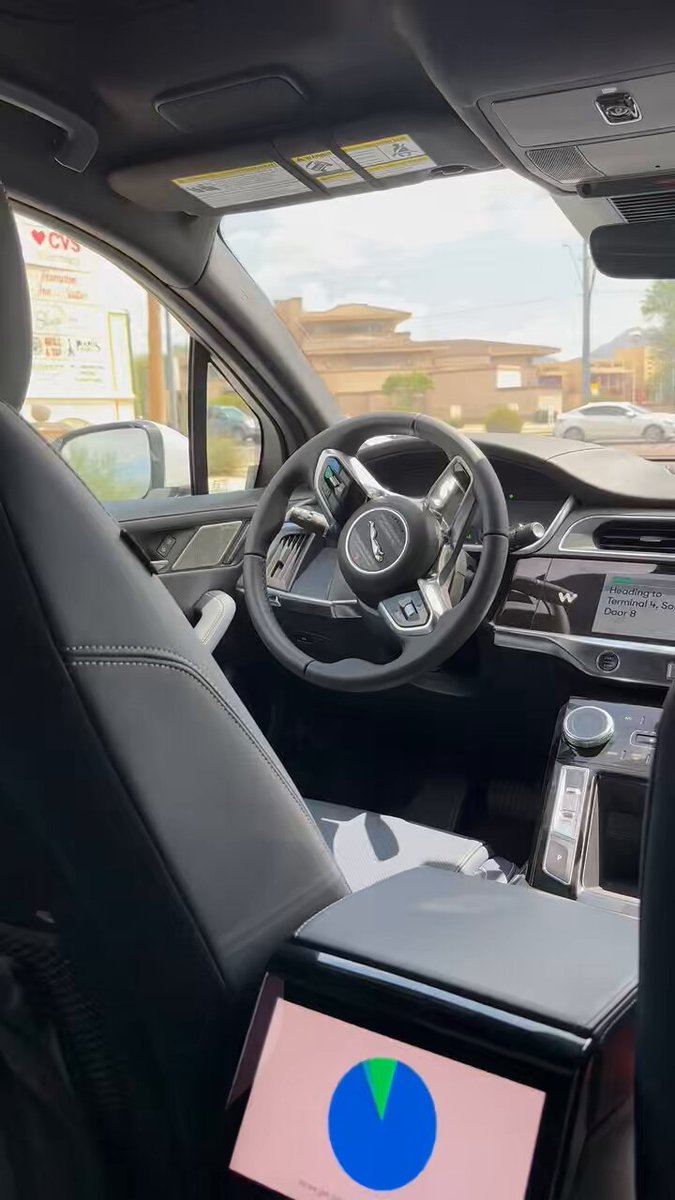
We’re rapidly getting to the point where humans should only be innovating, creating and interfacing with other humans.
Any repeatable work that can be done by a computer will be automated.
As we build robots the same will come for repeatable manual labor. (Waymo)
172
Steve Chen 🇺🇸 🚀 retweeted

13 May 2025
Bless my colleague for capturing this.
14
7
184
13,253
12 May 2025
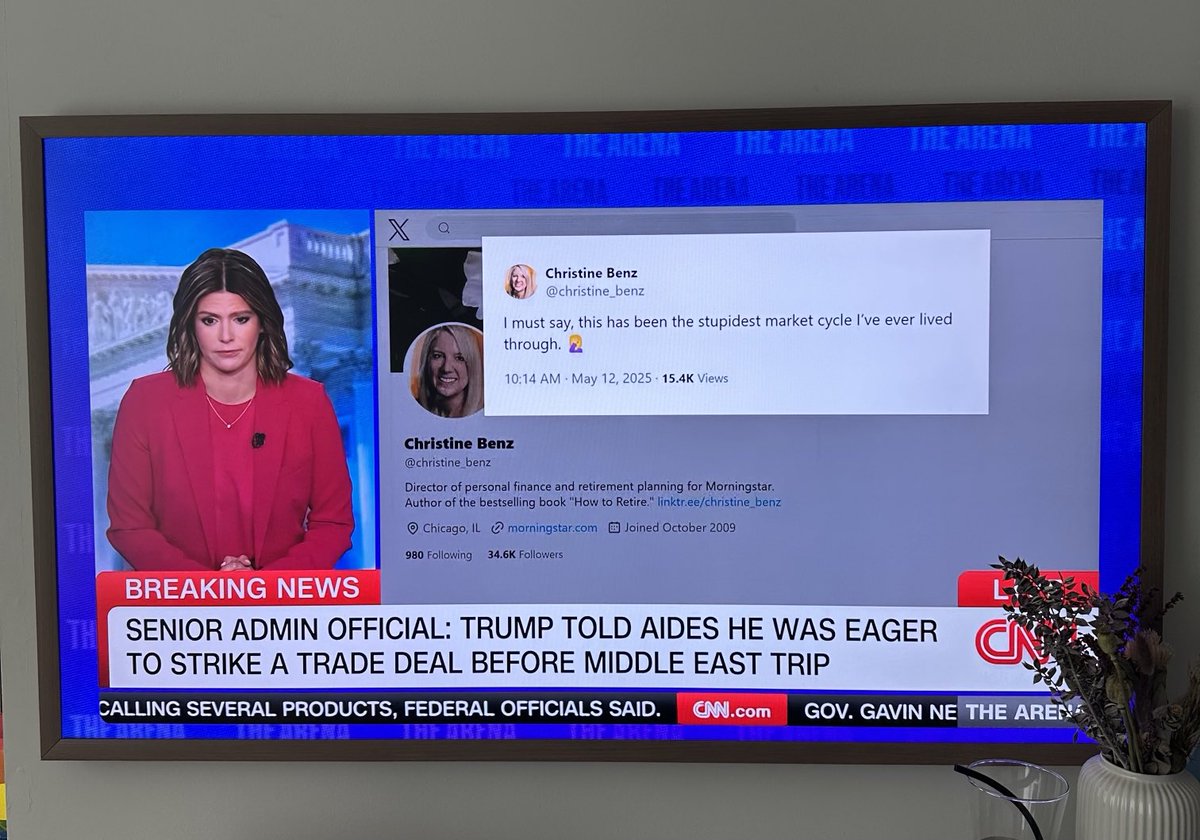
But this time it’s different 😊
12 May 2025

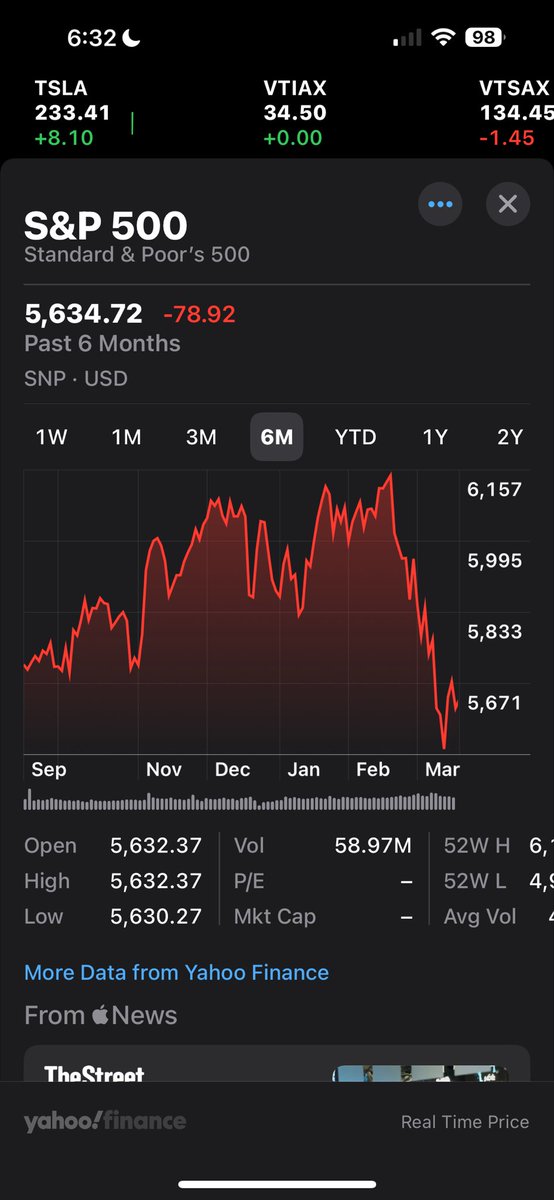
S&P 500 at the start of the year: 5,881
Now: 5,811
10 year treasury yield at the start of the year: 4.6%
Now: 4.5%
Boring year
305
Steve Chen 🇺🇸 🚀 retweeted

4 May 2025
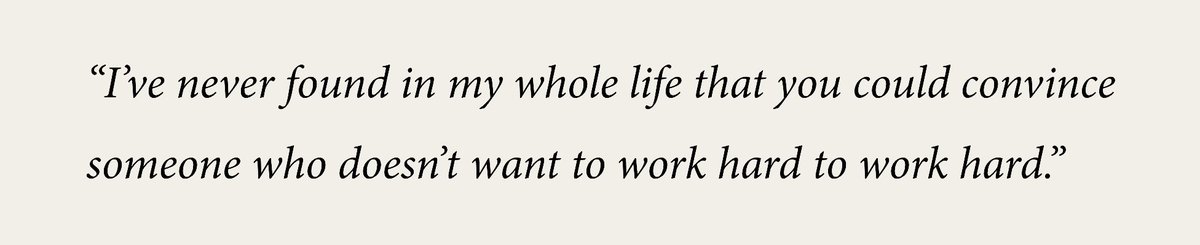
Steve Jobs explains why motivation can't be forced:
74
1,754
18,255
1,100,501
4 May 2025
So fewer job, shortages and higher prices - gonna be great 😁😬
3 May 2025

Listen to the head of the Port of Los Angeles.
No single person is getting more real time data about the economy than this guy.
He says we are fucked.
1
352