
Proud American. Jew. Happily married conservative leaning mom. Interested in politics, culture, & other stuff.
Joined November 2023
- Tweets 34,384
- Following 4,805
- Followers 16,685
- Likes 26,837
1,974 Photos and videos










Pinned Tweet
If you don’t think radical ideology can threaten this country, you weren’t watching the transgender movement.
In barely a decade we went from biology being a settled fact to being told gender identity overrides it, that kids can decide their own sex, and that anyone who hesitated was a bigot. It started as a fringe academic idea. Then it was in the schools, the hospitals, the boardrooms, and the government.
It didn’t take a majority. It took a small, disciplined movement that knew which buttons to push, compassion, victimhood, the fear of being called cruel. And it worked.
That’s the part to sit with. It was never about one issue. It’s proof that a determined movement can rewrite an entire society faster than anyone thinks possible. If it happened once, it can happen again.
Pay attention….
10
73
274
3,483
lol. Some people are never wrong. They just update the reason Trump is bad.

The ceasefire agreement with Iran with the opening of the Strait of Hormuz is welcome news. Democrats should support it. I am glad it includes a provision for mutual respect of the US & Iran's sovereignty so we do not launch a dumb war of choice again.
The war was a costly lesson for the US. As expected, Trump failed to bring about regime change. The terms seem no better than what Obama secured under the JCPOA nearly a decade ago. America lost 14 precious service members and wasted billions of dollars on this foolish endeavor.
But today, we can be relieved that gas and food costs will start coming down for Americans. And that no more American or civilian lives will be lost.
It also shows that when the Congress votes to end war --as we did last week -- it can be a wake up call for the President to listen to the anti-war sentiments of the American people.
2
248
The Undercurrent retweeted

This is happening in Florida!
Muslims attack a Christian pastor for citing the Bible.
More of this will happen because Islamic Centers and mosques have increased by ~ 60 percent over the last 15 years in Florida.
The Islamists are not only taking over Texas but targeting Florida as well. Since I’ve moved here more Islamic Centers have been approved for construction.
Where is DeSantis and the presumed next Republican gubernatorial candidate Donald’s on the growing threat in Florida? x.com/realMaalouf/status/206…
8
46
77
1,310
The Undercurrent retweeted
Yeah. I don’t take words from people who believe men can be pregnant seriously.
2
24
346
The Undercurrent retweeted

"Why are you Jews criticizing a guy just because he said he didn't want to work for Jews?"
Sorry, you've reached the wrong Jews. The "shut up and take it" Jews are down the hall keeping their mouths shut about a candidate with a Nazi tattoo on his chest.
249
191
1,992
163,523
The Undercurrent retweeted

Jun 14
Designate the Taliban as terrorists and being American hostage Mahmood Shah Habibi home from Afghanistan!
Jun 13

The Taliban are terrorists, and any effort to legitimize them is reckless and dangerous.
We introduced the Preventing the Recognition of Terrorist States Act which would formally designate the Taliban as a foreign terrorist organization, designate the Taliban-led government of Afghanistan as a State Sponsor of Terrorism, and prohibit federal agencies from recognizing the Islamic Emirate of Afghanistan.
This legislation draws a bright line in the sand and makes clear, now and forever, the Taliban will never be treated as a legitimate government by the United States.

21
118
550
17,511
The Undercurrent retweeted

I feel very sad for the protestors in Iran who lost their lives.
Nearly 100,000 innocent people slaughtered this year in Iran by the Iranian regime and IRGC.
4,329
5,208
24,698
720,431
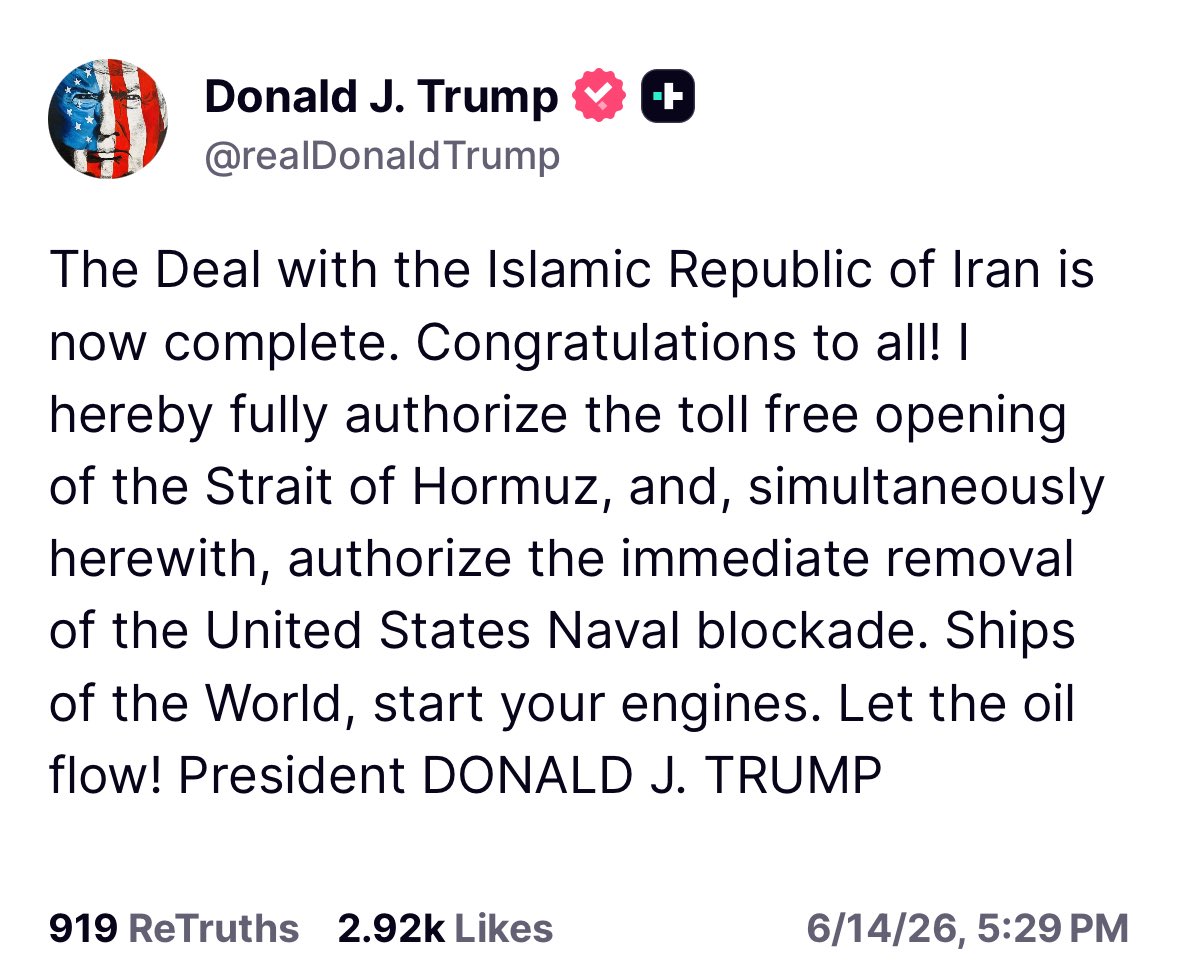
When the man who turned leaking and podcasting into a career says “great news,” my default setting is: ok, so what’s the catch for America and Israel.

1
7
165
The Undercurrent retweeted

Communism isn't a Jewish value.
20
9
90
1,496
The Undercurrent retweeted
Jun 13
Saturday Preparedness Challenge
Set a timer for 10 minutes.
That's it.
Try to knock out a few of these tasks:
✓ Charge your power banks.
✓ Update your emergency contacts.
✓ Take photos of any new insurance cards or documents.
✓ Confirm your family's meeting location if phones fail.
✓ Check the batteries in your flashlight.
✓ Make sure your vehicle has at least half a tank of gas.
✓ Review your evacuation route and an alternate route.
✓ Identify one neighbor you could help and one neighbor who could help you.
✓ Save an out-of-state contact who can serve as a family check-in point during an emergency.
✓ Make a list to restock any medications, pet supplies, or other essentials you rely on regularly.
Ten minutes today can save you hours of stress later. Preparedness isn't built in a day. It's built in small decisions made before they become urgent. The goal is never perfection. The goal is being a little more ready tomorrow than you were yesterday. Easy peasy!
57
342
1,804
51,266
The Undercurrent retweeted

Jun 11
Check out the incredible action our @CivilRights Division delivered this week!
@theJusticeDept continues working tirelessly to protect and serve ALL Americans, EVERY day!
286
917
5,449
126,638

Jun 11
Can someone tell me what is going on with Duluth High School? This person is supposed to teach English Language Arts? Isn’t this a safety issue Georgia?!
2
5
12
162
Jun 10
Tucker Carlson, Candace Owens, Hasan Piker discovering that authoritarian countries roll out the red carpet for useful idiots with podcasts, then running home to sell the experience to Americans dumber and broker than them, will never stop being my favorite genre of delusion.
You got the press-junket version, sis. The locals got the gulag tab.
Jun 9

🔥🔥 JUST IN:
Candace Owens is encouraging people to visit Russia, saying everything Americans have been told about the country is “a lie.”
She says the streets are cleaner, the food is better, and after visiting, she came away believing it’s OUR society that’s in decline — not theirs. 👀
4
13
268
The Undercurrent retweeted
Jun 10
Leaders: mass migration is a moral duty. Also leaders: we have no idea who half these men are, and no plan when one of them tries to butcher someone in public.
1
8
27
513
Jun 10
The idea that criticizing Vance “hurts the Israeli cause” is backwards. What actually hurts Israel is normalizing a Republican leadership that thinks antisemitism is just another faction to manage instead of a line you don’t cros

The pro-Israel “influencers” who have spent the past few days aggressively attacking President Trump & Vice President @JDVance are hurting the Israeli cause far more than they’re helping it.
This behavior is a major reason why their approval ratings in America keep plunging.
They should demand a full refund from the geniuses they hired to run their U.S. influencer operation.
1
9
295
Jun 10
You’ve had decades of dialogue. The only people who seem to benefit are dictators, NGOs, and the Geneva hotel industry.
Jun 10

At a time when the international system is being tested, dialogue has the power to re-unite us for a more just & peaceful world.
On this International Day for Dialogue among Civilizations, we recognize the power of open communication to solve even the most intractable global challenges.
1
1
7
227
Jun 10
If this was your child, you wouldn’t be posting about “making an example.”
You’d be praying the judge remembered your kid’s name.
Jun 10

Wow! Just freakin wow! DISGUSTING… This is not justice, this is trying to make an example!!!
1
9
512
May 22
There’s a version of this disagreement that’s honest. “I wish Erika had spoken up for Massie” is a sentence Carrie could have written. She chose a different one. The one she chose is the entire problem.

Why didn’t you say the same thing about your late husband’s favorite congressman? I’m starting to see now why they took Charlie out. They wanted to take out his voice and his influence. Charlie would have undoubtedly campaigned alongside Thomas Massie publicly and unapologetically. Your silence speaks volumes Erika. The more people watch this, the more obvious it becomes why Charlie had to be removed from the equation. Charlie would have been boldly campaigning alongside @RepThomasMassie against billionaire donor Miriam Adelson.
2
5
6
340
The Undercurrent retweeted
May 21
Teaching Moment: How Rhetoric Creates Pathways to Violence
This is how radicalization language works online, and people need to start recognizing it before it escalates further. Those who liked a post like this may want to take a hard look inward and ask themselves whether they are allowing themselves to be manipulated into normalizing extremist rhetoric and becoming useful idiots for it.
Nobody has to say “go hurt someone” directly for rhetoric to become dangerous. Modern extremist-style agitation often works through implication, emotional conditioning, moral justification, and repetition. The goal is to make harassment, intimidation, or even violence feel understandable or deserved in the minds of unstable people consuming the content.
When someone says things like:
“Now I understand why they took him out.” OR
“He had to be removed from the equation.” OR
“Your silence speaks volumes.”
…they are doing more than criticizing someone politically. They are framing violence as rational, justified, or inevitable while psychologically isolating and targeting a specific person. In this case, the widow of a man who was himself a victim of the same kind of radicalizing rhetoric, @MrsErikaKirk.
That matters because this is how stochastic radicalization spreads online. You create an atmosphere where followers begin viewing a target not as a human being, but as an obstacle, traitor, or symbol that “deserves” consequences. The speaker keeps plausible deniability because they never explicitly call for harm and at times even hide behind religion in this case Catholicism, but the audience still absorbs the message.
This is the same reason threat analysts and law enforcement pay close attention to rhetoric that implies violence was justified, promotes martyrdom narratives, suggests someone “had to be removed,” encourages targeted pile-ons, morally licenses aggression against an individual, or selectively excuses terrorism and extremist violence while condemning any effort to confront or stop those responsible. This type of language can condition audiences to view hostility, intimidation, or violence as understandable, justified, or even deserved, which is why it is recognized as part of broader pathway to violence.
People should learn to identify this behavior early instead of pretending it only counts when someone explicitly says “attack them.” This post goes beyond just jealously or bullying. By the time rhetoric reaches the stage we are seeing below with the language so perfectly crafted to manipulate, the radicalization process is usually already well underway.
Why didn’t you say the same thing about your late husband’s favorite congressman? I’m starting to see now why they took Charlie out. They wanted to take out his voice and his influence. Charlie would have undoubtedly campaigned alongside Thomas Massie publicly and unapologetically. Your silence speaks volumes Erika. The more people watch this, the more obvious it becomes why Charlie had to be removed from the equation. Charlie would have been boldly campaigning alongside @RepThomasMassie against billionaire donor Miriam Adelson.
72
274
1,072
71,638