
gutter kludge
Joined November 2009
- Tweets 53
- Following 440
- Followers 175
- Likes 437
12 Photos and videos

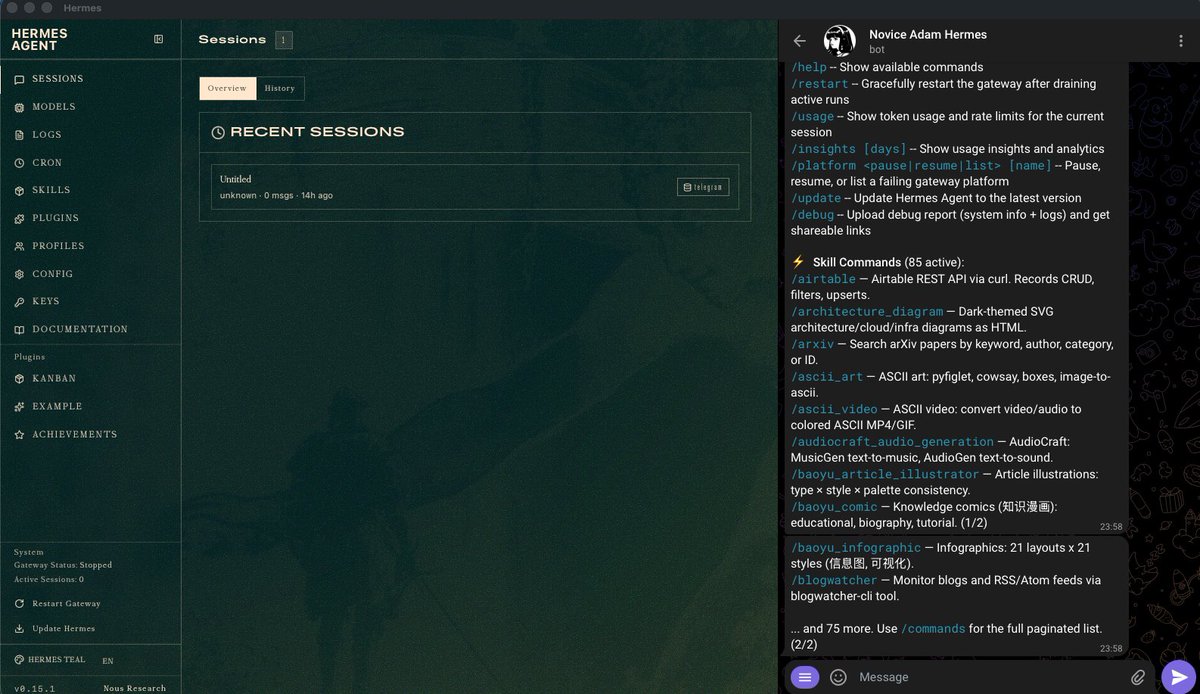









Jun 10
Learning very quickly that the focus is not agents or tools. It’s the knowledge base. Extreme diligence in the metadata tagging and harness structure let you fly
1
11

The problem with this, and why I think people are frustrated:
Nobody has taught folks how to do this
It feels both evidently the future and also somehow gatekept
98
17
488
311,406
Jun 4
Mid 90s, my father purchases a used hot tub.
Problem - How do we get this across the yard?
Solution - pipe rolling: roll it forward, grab the pipes from the back, and repeat.
It worked!
He was beaming,
‘This is how the Egyptians built the pyramids!’
That’s agentic workflow
Don’t brute-force the heavy lift. Set your stack, manage your harness and deploy your agents like those pipes. Let them handle the load, cycle the tools forward as you progress, iterate relentlessly.
Build pyramids, not hernias
Side note - The Egyptians had interdimensional help. 😜
16
May 22
What I’m learning about Git Proficiency
Basic/Junior (many vibe coders lack)
Init repo, add/commit/push/pull
Create/switch branches (main vs feature branches)
Resolve simple merge conflicts
Decent commit messages
Clone set up remotes
Intermediate (what companies expect)
Branching strategies (Git Flow, trunk-based)
Atomic commits (no giant “WIP”)
Comfy merge conflicts
Intentional rebase vs merge (rebase -i to clean history)
stash, cherry-pick, reset (soft/hard/mixed)
.gitignore, hooks, basic CI/CD
Effective PRs/MRs reviews
bisect to find when a bug was introduced
Advanced/Senior
Git internals (objects, refs, index, packfiles)
Adv rebasing, reflog recovery, history rewriting
Submodules or monorepo management
Git hooks for enforcing standards
Optimizing large repos, LFS, partial clones Designing team workflows & Git policies
May 21

HARVARD RELEASED A 65-MIN MASTERCLASS ON GIT & GITHUB BECAUSE VIBE-CODERS STILL DON'T KNOW HOW TO COMMIT
1 hour and 5 minutes of raw, no-nonsense version control architecture from the creators of CS50.
-> The moment you watch it, you realize why most modern developers are breaking their production branches.
Every tier-1 tech company is now filtering candidates who can't handle basic merge conflicts.
Git isn't a "nice-to-know" anymore -> it's compliance.
Your AI can write the code.
That wasn't the problem.
The problem is you don't know how to merge it without breaking the repo.
Don’t forget to bookmark it.
1
102
May 21
Same ol same ol making the act of reducing headcount look like visionary leadership rather than operational cleanup
May 21

Today we reduced headcount by 22%. The business is the strongest it's ever been. So I think it's important to be direct about what I'm seeing and why.
First, I made this decision and I own it. I did it because the way to operate at the highest level of productivity is changing, and to win the future, ClickUp needs to change with it.
Second, this wasn't about cutting costs. Most savings from this change will flow directly back into the people who stay. We'll be introducing million-dollar salary bands. If you create outsized impact using AI, you'll be paid outside of traditional bands.
Most importantly, I have the deepest gratitude for those affected. We're doing this from a position of strength specifically so we can take care of people properly. Everyone affected receives a package aimed at honoring their contributions and easing the transition.
I only see two options: wait for this to play out gradually in the market or be honest about what I'm seeing and act proactively.
THE 100X ORGANIZATION
The primary change is that we're restructuring around what I call 100x org. The goal is 100x output. The roles required to build at the highest level are fundamentally different than they were a year ago.
Incremental improvements to existing systems won't get us there. We need new ones. That means creating enough disruption to rebuild rather than iterate on what's already broken.
The common narrative is that AI makes everyone more productive. It doesn't. Many of the workflows of today, if left unchanged, create bottlenecks in AI systems.
These roles will evolve. But waiting for that to happen naturally means falling behind now.
The 100x org is actually heavily dependent on people - infinitely more than today. This is only possible with 10x people that have embraced and adopted new ways of working.
THE BUILDERS, AGENT MANAGERS, AND FRONT-LINERS
— THE BUILDERS: 10X ENGINEERS
I don't think most companies have internalized what's actually happening with AI in engineering. The common narrative is that AI makes all engineers more productive. That may be true in isolation, but at an organization level - that is the farthest thing from reality.
Here's what we've validated recently at ClickUp: the great engineers, the ones who can orchestrate, architect, and review, are becoming 100x engineers. They're not writing code. They're directing agents that write code. The skill is judgment.
AI makes the best engineers wildly more productive, and everyone else using AI slows these engineers down.
Think about it - the bottlenecks are (1) orchestration - telling AI what to do, and (2) reviewing - what AI did. Everything is leapfrogged and no longer needed.
So who do you want orchestrating and reviewing code?
And how do you want your best engineers to spend their time?
If your best engineers are spending time reviewing other people's code, then this is inherently an inefficient bottleneck. These engineers can review their agent's code much faster than reviewing human code.
The new world is about enabling your 10x engineers to become 100x.
The wrong strategy is to push every engineer to use infinite tokens. Companies doing this are celebrating 500% more pull requests. But customer outcomes don't match the volume of code being generated.
I call this the great reckoning of AI coding, and every company will face this soon if not already.
More code is just another bottleneck to the best engineers, and ultimately to your company's impact as well.
— THE BUILDERS: 10X PRODUCT MANAGERS
Product management and design roles are merging.
Designers that have customer focus, become more like product managers.
And product managers that have intuition for UX become more like designers.
The bottleneck of user research is gone. It takes us just one mention of an agent to kickoff research and analyze results.
The bottleneck of product <> design iteration is also gone. The product builder iterates on their own, along with agents and skills that ensure alignment with quality and strategy.
Also controversial today - I believe that the wrong strategy is to have your PMs shipping code - that just introduces another bottleneck that the best engineers will waste their time on.
To be clear, PMs should be coding but they should do this in a playground to iterate, validate, and scope. That code should not go to production.
Everything outside of managing systems, orchestrating AI, and reviewing output becomes a bottleneck.
That's why the other roles that are critical along with these are the systems managers (to reduce bottlenecks) along with a bottleneck you can't replace - customer meeting time.
— THE SYSTEM MANAGERS
Ironically, the people that automate their jobs with AI will always have a job. They become owners of the AI systems - agent managers. We have many examples of these people at ClickUp.
The underlying systems in which we operate are absolutely critical to get right. I think most companies are delusional to think they can iterate on existing systems and compete in this new world.
You must create enough disruption so that old systems are deprecated entirely. If there's any definition for 'AI native' that's what it is.
— THE FRONT-LINERS
In a world that will become saturated with AI communication, the human touch will matter more than anything to customers.
This is a bottleneck that you shouldn't replace - even when agents are high enough quality to do video meetings.
One-on-one meeting time with customers is something that shouldn't be automated. The systems around the meetings should be - so that front-liners spend nearly 100% of their time with customers.
REWARDING 100X IMPACT
In a world where companies are able to do so much more with less, where does that excess money go?
In our case, much of the savings in this new operating model will flow directly back to those that enabled it.
We must reward people that create productivity accordingly. This aligns incentives on both sides. Plus, in a world where your best people create 100x impact, you can't afford to lose them.
You should aim to retain these employees for decades. The context they have and their ability to efficiently orchestrate and review will be nearly impossible to replace.
Compensation bands of today should be thrown out the door. We're introducing $1 million cash/year salary bands with a path available to nearly everyone in the company if they produce 100x impact by creating or managing AI systems.
THE FUTURE
Nearly every company will make changes like these. The ones that do it proactively will define what comes next.
The future is not fewer people. It's different work, new roles, and better rewards for those who embrace it. We're already seeing entirely new roles emerge, like Agent Managers, that didn't exist a year ago.
ClickUp is positioning to lead this shift, not just internally, but for our customers too. I've never been more certain about where we're headed.
46
May 20
There’s been great discussion about agents, skills, and goals in AI projects. I’ve learned a lot on here in the past few months. Lately I’ve been testing something I’m calling “deliverables”—clear outputs required at each stage gate, like proper project management. That’s what actually gets you to a finished product. Thoughts?
18
Novice Adam retweeted

May 14
30
102
994
97,562
Novice Adam retweeted

May 13
This is the most concrete thing I read today on why agent architecture matters in production, and the framing belongs in the harness debate alongside Anthropic's and Glean's.
The frame: agent codebases that survive past six months don't survive because the team has more discipline. They survive because the architecture made the bad shape harder to write than the right one.
That's a sharper claim than the "harness is the backend" version. It says the production failures are reproducible across teams because the abstractions allow them.
The four canonical month-six failures Mike lists are worth memorizing:
→ Class-level mutable defaults shared between agents the moment a second user shows up
→ Tool functions that accept any string and return None on every kind of failure
→ Session memory mutated by an LLM-extracted string, silently poisoning every subsequent action
→ Multi-agent setups passing the parent's full conversation history to a sub-agent because it was the easiest wire-up
Every team I've talked to in the last year has shipped at least two of these to production. The fix posts always say the same thing: validate inputs, isolate state, propagate spans, and bound your loops. Discipline. It gets forgotten in approximately every codebase.
What Mike's arguing is the React-of-2013 move. jQuery apps scattered DOM state across whichever closure was handy. The discipline of "keep state in one place" was well understood and ignored everywhere. React made the discipline structural: the bug class went away because the framework stopped allowing the bad shape.
Worker / Function / Trigger does the same thing one layer up.
Class-level mutable state stops being expressible because worker invocations are stateless and persistent state lives in a memory worker addressed by namespace. Two agents in two processes can't share Python state because there is no shared Python state.
Tool functions returning None on every failure stop being expressible because every function has a typed input/output schema the engine validates at the boundary. Wrong-shaped input gets rejected before the worker code runs. Failures return typed events with status and error type.
Cross-agent history leakage stops being expressible because sub-agents are workers with their own context, called by function ID. The orchestrator passes a payload, not a conversation buffer.
Agent Loops without step bounds stop being expressible because step bounds and timeouts are engine-level config, not something the agent author remembers to wrap.
The Claude Code April 2026 postmortem is the cleanest evidence anyone's produced for why this matters. Three runtime changes, no model change, dropped median thinking length 73% and pushed retry rates up 80x. The community had to surface this from sampled session logs because most production systems don't ship that level of runtime telemetry by default.
Making it default is the lever.

5
10
103
17,649
May 12
Cool!
May 11

Ask Claude to document and describe the main flows in your app and output in a single page html json data file.
Incredibly useful for humans and the JSON file is very useful for explaining the flow to the LLM when working on new features/bugfixes.
25
May 8
The Terminator did not have a personality, and your agents don’t need one either.
Stop wasting your time and compute constructing one.
Personality scaffolding is pure overhead.
Focus on objective specification, tool / skill definition, and knowledge retrieval / archiving.
22
May 6
3 separate cron loops running all day
- One that babysits his PRs (pull requests) and auto-fixes CI (continuous integration) failure
- Another that keeps the overall CI pipeline healthy
- A third that pulls Twitter / X feedback every 30 minutes and clusters / groups it

Boris Cherny says internally Anthropic uses the same models as everyone else, with some Mythos, which will eventually ship as a descendant to the public
"there's no manually written code anywhere at the company"
Internally, Claudes talk to each other all day over Slack, coding in loops, resolving unknowns across teams
64
Novice Adam retweeted

May 4
10 things I'm seeing on the frontlines of AI adoption in the enterprise:
1. Chat is where 90% of employees still live. It's the gateway drug. Everything else is downstream of getting people comfortable here first.
2. Power users discover Cowork and lose their minds. It's the "wait, it can actually do the work?" moment.
3. Claude Code has very little penetration with non-technical users in the enterprise still.
4. Microsoft being the "approved" tool doesn't matter. Employees route around Copilot and pitch their managers for Claude access on their own.
5. Artifacts in Claude are a breakout feature. People don't want to view them — they want to deploy them, connect them to Snowflake, etc., ship them as internal MVPs for their org to actually use.
6. Cowork is crossing the line from "demo" to "real work." Legal teams redlining contracts. Ops teams running workflows. Then immediately asking: how do I automate this for production?
7. The next unlock → automated cloud workflows that leverage an agent like Claude while keeping non-technical users within the tools they're already using and in a chat interface. The demand is screaming.
8. Terminology is major blocker. Projects vs. skills vs. plugins vs. agents. I've explained "what is a skill" 200 times. The moment it clicks, people get excited — but the path there is too long.
9. Enterprise IT restrictions (locked connectors, no browser access) quietly strip Cowork of its superpowers. The features that make it magical are the first ones IT disables.
10. There is a high level of "AI insecurity". For the first time in a long time, people at all levels (even C-Suite) need to signifcantly upskill in order to stay world class in their positions, and this is causing people to be insecure about their skill set across the org.
General note on Microsoft: I spent a lot of this past week deep in Power Automate and Copilot Studio trying to build an automated solution in the cloud — given it's the native tool with sanctioned access to their org's data.
It's ~90% there. But the final 10% is riddled with terrible UX, inconsistent behavior, and a generally poor experience.
Honestly feels like Microsoft is fumbling the biggest moment in their company's history with software that has all the features on paper but lacks the magical "just works" moment for non-technical team members. The gap is wide open and they're letting others
"eat their lunch" right now.
72
61
706
89,506
May 4
AI Builders - You’re not just coding - you’re running a full project. You are the project manager.
Communication, Strategy, Leadership, Adaptability, Problem-solving, Execution, Learning… these are all top PM skills
Sounds a lot like AI orchestration. 🤔
#AIEngineering #AIOrchestration #ai
30
May 4
AI Engineering folk 👋
I’m using VS Code. Any benefits to switching over to Cursor?
Let me know.🙏
Switched yet?
Still loyal to VS Code?
What’s your real experience?
Other options?
#CursorAI #AIEngineering #VSCode #DevTools #AIDev
33
May 3
I had a vehicle battery die today. I was able to use a car charger from the mid-60s to fix the issue. Hooked it up and plugged it in.
The tools we build today must be built for efficiency and longevity - capable of surviving through the relentless, compounding waves of hyper-iteration.
This battery charger was manufactured in the mid-60s, it still does its job.
6
8
148
47,768