1,238 Photos and videos








Open Tech Talks retweeted

2 May 2025
Things to Know...
Autonomous agents that plan, execute, and learn from multi-step tasks are moving from lab demos into real-world pilots. Keep an eye on tools that let you orchestrate chains of AI agents in workflows.
RAG architectures are becoming the default for organizational chatbots. Expect more turnkey RAG platforms and best practices, including indexing, vector stores, prompt templates, an example OCI Gen AI Agent, and many more, to emerge this quarter.
Beyond text, leading models now handle vision, audio, and code in a single API call. Embed4 (Cohere), GPT-4o, and Meta’s multimodal Llama 4 are worth tracking.
Techniques like QAT are lowering resource barriers. Models such as Google’s Gemma 3 and Meta’s QLoRA-fine-tuned variants run premium AI on desktop GPUs.
New enterprise standards (NIST’s AI Risk Management Framework 2.0, ISO/IEC 42001) are coming. Early adopters will embed policy-as-code and audit trails directly into their ML pipelines.
The debate continues about end-task fine-tuning versus relying on retrieval and prompting. Hybrid approaches, which combine small-scale fine-tuning with RAG, are gaining traction as the sweet spot for cost and performance.
TinyML and on-device inference frameworks (TensorFlow Lite, OpenAI’s Whisper on mobile) enable low-latency, offline AI features in customer apps; look for more SDKs this year.
AI code assistants (Copilot, Tabnine) and AI IDEs (Cursor, Windsurf) are evolving into full dev-ops copilots that automate testing, documentation, and deployment. Early pilots report 2× faster release cycles.
Tools for bias detection, fairness dashboards, and synthetic data generation (Mostly AI, Hazy) are maturing. Organizations that adopt these proactively will mitigate risk and build trust.
1
41

5 May 2025
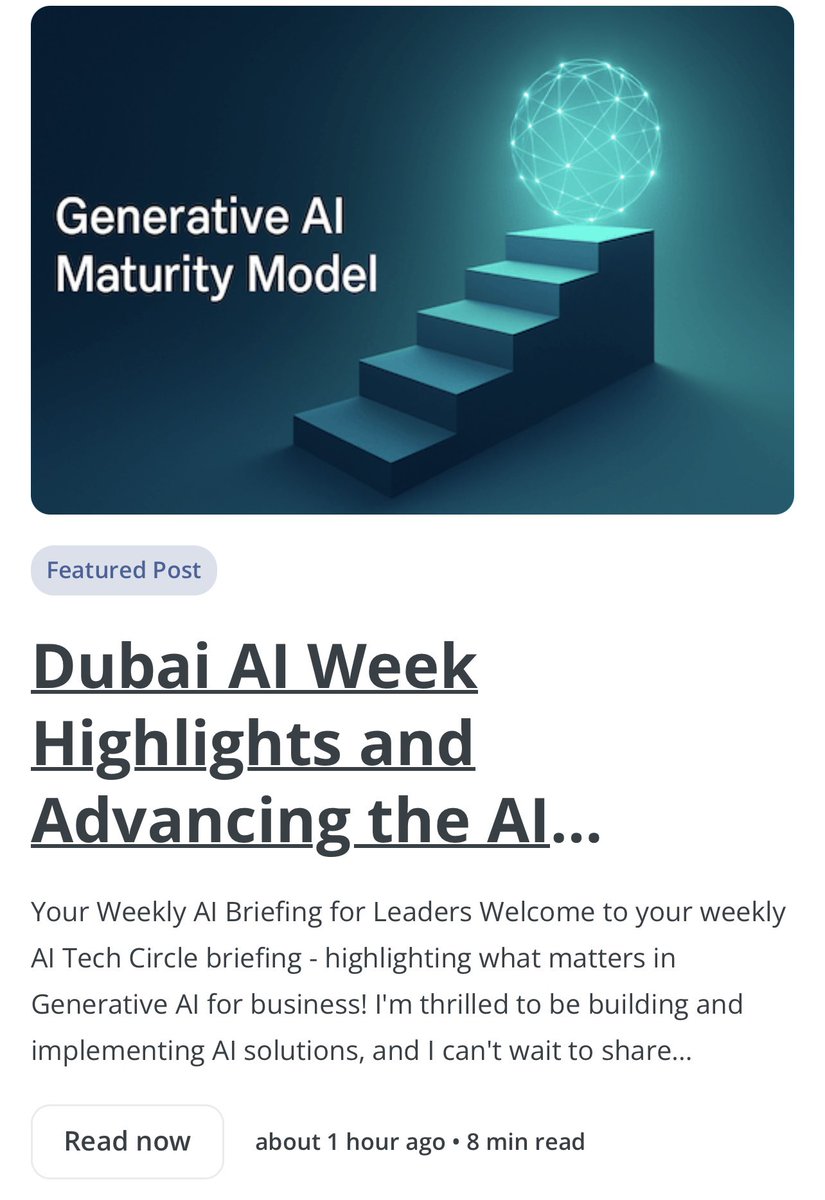
Mapping Your Generative AI Maturity From Aware to Transformative Part 1
open.substack.com/pub/aitech…
13
Open Tech Talks retweeted
29 Mar 2025
Welcome to your weekly AI Newsletter from AITechCircle! I'm building and implementing AI solutions and sharing everything I learn along the way...
This week was loaded with many new LLM releases and breakthroughs in imag

1
188
Open Tech Talks retweeted
11 Jul 2024
There is no single view of what is responsible AI; therefore, every organization comes with its own principles and tries to pass on the same narrative to others, which is understandable.
While these principles are unique to every organization if you look for common themes...
1
1
64
14 Jun 2024
Collect Diverse Data for machine learning
• Action: Aggregate diverse and representative datasets from various sources, ensuring the inclusion of different demographics and contexts.
• Goal: Ensure the model learns from various inputs to avoid biased outputs.
27
28 Apr 2024
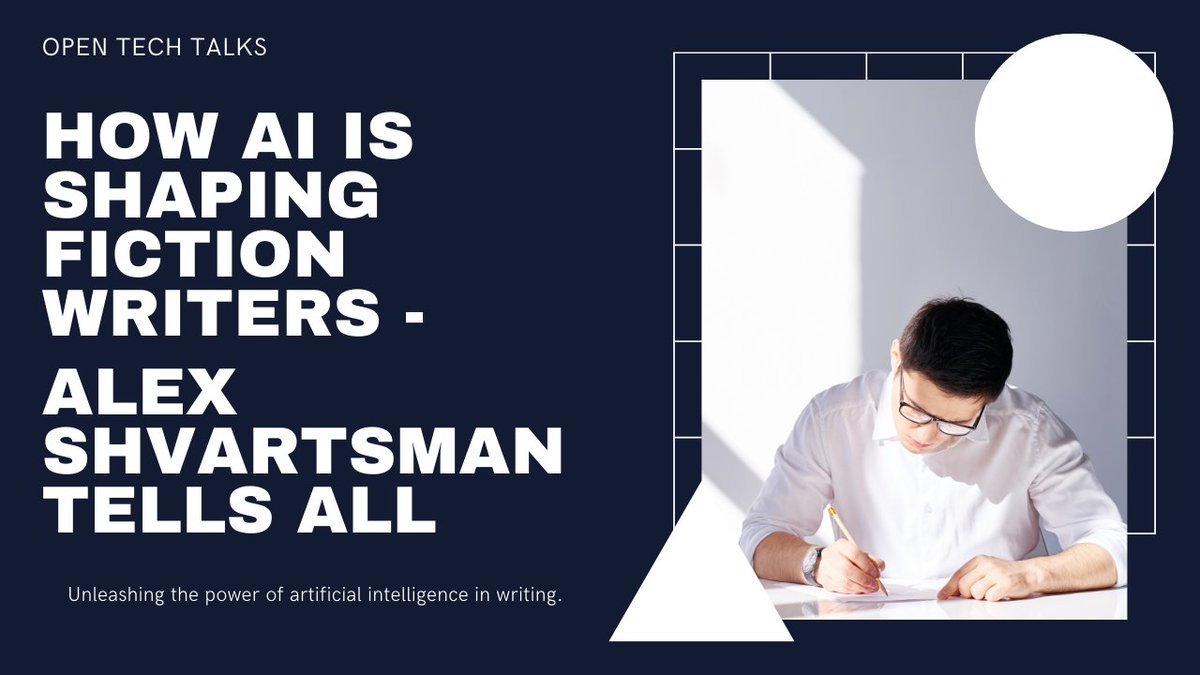
AI in Creative Writing: Its Impact and Potential with Alex Shvartsman
A new podcast has just been published
1
31
5 Apr 2023
Download free Dataset: The 20 newsgroups collection has become a popular data set for experiments in text applications of machine learning techniques, such as text classification and text clustering. cstu.io/ddf574
1
62
5 Apr 2023
Meet Magic Leap's almost-human AI assistant Augmented-reality startup Magic Leap has unveiled Mica, its highly realistic AI assistant. cstu.io/7ad325 #Innovation #Tech #Digital #EmergingTechnologies #Technology #digitaltransformation #MachineLearning
1
2
70
5 Apr 2023
Keep ideas simple: If an idea can’t fit on one sticky note, it’s probably too complex.
1
51
4 Apr 2023
Why I Signed the “Pause Giant AI Experiments” Petition | by Rafe Brena, PhD | Apr, 2023 | Towards Data Science cstu.io/33ad79 via @tdatascience
1
61
4 Apr 2023
How AI is changing the way we work, Artificial intelligence has the potential to revolutionize many parts of business, from marketing to supply chain. The number of companies using AI is still relatively low, but early adopters will have the most to gain. cstu.io/cb5665
2
31
4 Apr 2023
Word-sense disambiguation (WSD) is an open problem in computational linguistics concerned with identifying which sense of a word is used in a sentence. The solution to this issue impacts other computer-related writing, such as discourse
34
4 Apr 2023
Vacuum cleaner, this boat is sucking plastic out of rivers #innovation #technology #tech #EmergingTechnologies
29