
Joined December 2018
- Tweets 860
- Following 11
- Followers 1,069
- Likes 691
91 Photos and videos











Pinned Tweet
@Atomicwallet hacked ... Millions lost, and more are losing .... the best practice is to remove the funds out of atomic wallet ASAP without using the atomic wallet app. Let us know if you need help, our support is open for Atomic wallet users via HELLO@OPOLO.io.
1
580
OPOLO Hardware Wallet (www.OPOLO.io) retweeted

7 Aug 2024
The problem isn’t that the update was malformed.
The problem isn’t that the validator they wrote didn’t catch the error before it was deployed.
The real problem is that they didn’t have any canary system to which they deployed the update before rolling it out to millions of endpoints all at once.
Since no external factors — like the driver of another vendor (see the Kaspersky issue with Intel drivers years ago) — were involved, a single $400 canary machine could have prevented this disaster. The absence of such a machine and a staged rollout could be interpreted as gross negligence in court, and that’s why everyone at CrowdStrike is worried.
Mistakes and slips are human. No one would be angry about that. But having only a simple and possibly flawed validator between an analyst and a kernel driver on millions of systems worldwide could be seen as grossly negligent.
It’s the only thing that matters. Everything else they describe, added to their testing, and improved processes is just filler, possibly to distract from the one relevant fact.
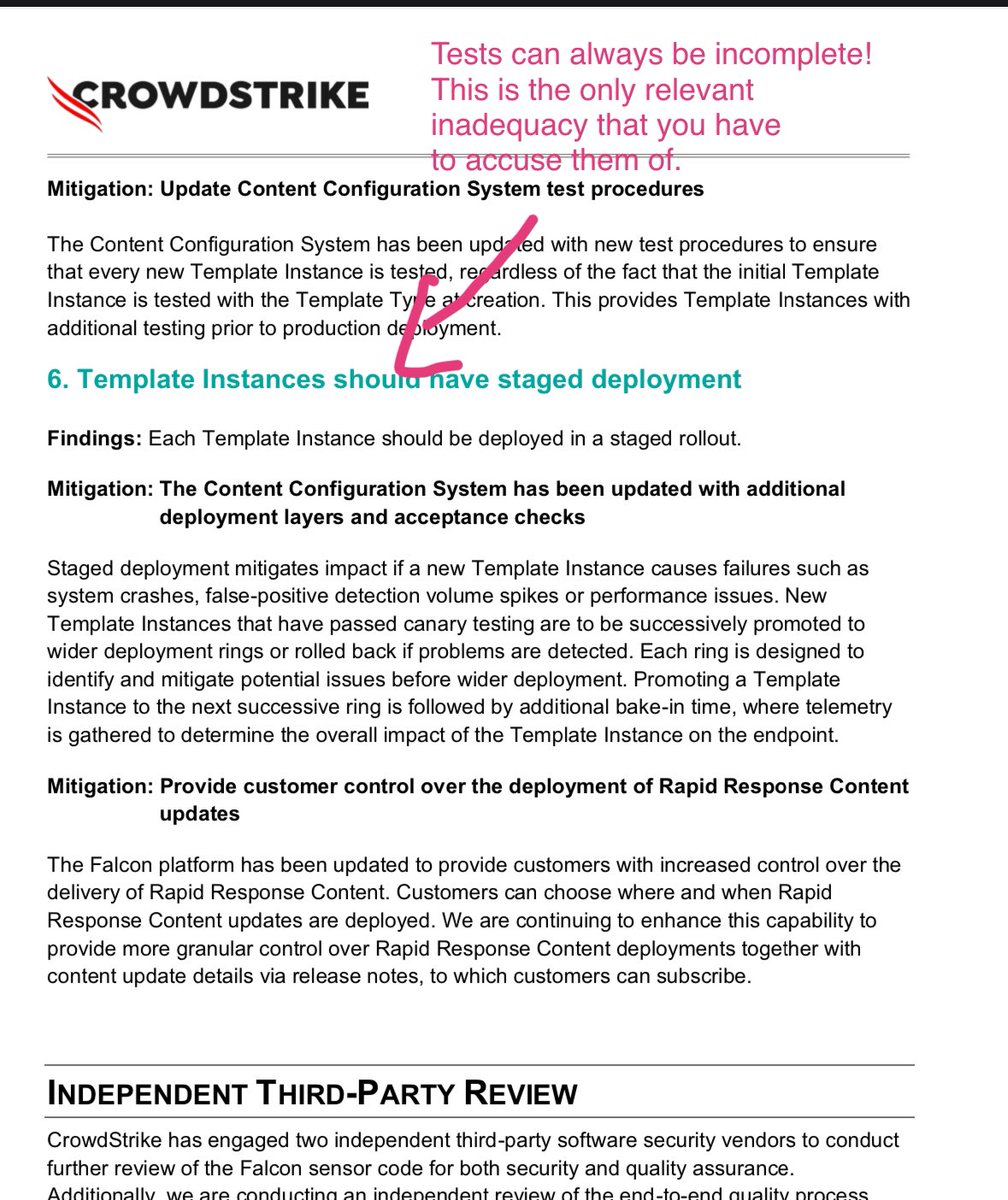
52
315
1,620
267,324
OPOLO Hardware Wallet (www.OPOLO.io) retweeted

13 May 2024
5,032
11,711
61,939
9,327,000
OPOLO Hardware Wallet (www.OPOLO.io) retweeted
13 May 2024

11,218
22,046
125,644
30,860,463

11 Jan 2024
Congrats for the Bitcoin ETF approval.
We are celebrating this great event with a big flat 50% OFF on all OPOLO products. This offer is valid for next 3 days.
Go and get your OPOLO wallet.
shop.opolo.io
2
2
3
259
21 Nov 2023
OPOLO Desktop version 1.4.1 is released. Update your app to get the latest bug fixes. The app can be downloaded from opolo.io/downloads
1
1
169
31 Oct 2023
Happy 15th Birthday Bitcoin Whitepaper!
On this occasion we will be giving a free OPOLO.io wallet.
To win the OPOLO do this:
1. Tell us why a hardware wallet is better than a hot wallet?
2. Like, & share
#bitcoin #btc #happybirthdaybitcoin #coldwallet
1
1
3
194
25 Oct 2023
1/ Congrats to all bitcoiners for $35K rally. Bulls are getting ready.
To celebrate this rally, we have given a special massive discount of 42% OFF on OPOLO Security Pack.
Go get the discount before its over, dont miss the opportunity!
$btc #bitcoin #coldwallet $eth
3
2
2
408
25 Oct 2023
May be we shall say congrats to all crypto users :) not only to bitcoiners :) Because its a good news for all of us.
125
25 Oct 2023
Feel free to share and spread this massive discount with your network!
PS: OPOLO is looking for partners (financial institutions and crypto related companies) and investors, feel free to reach me out.
#btc #btcbulls #btcbullrun
1
115
OPOLO Hardware Wallet (www.OPOLO.io) retweeted

23 Jul 2023
Since the number of Bitcoins stolen remains uncertain, the figures may be even higher. cointelegraph.com/news/alpha…
13
17
32
18,832
27 Jul 2023
Hotwallets are not HOT if we talk about security. Go for a cold wallet to get unbreakable security for your crypto assets.
23 Jul 2023

Since the number of Bitcoins stolen remains uncertain, the figures may be even higher. cointelegraph.com/news/alpha…
1
1
1
219
15 Apr 2023
We are excited to announce that @OPOLOWallet is partnering with @ElastosInfo
More exciting news coming soon..
13 Apr 2023

Elastos is partnering with Web3 security tool @OpoloWallet who will deploy our open-source Web3 solutions to develop enhanced #security and #identity mechanisms for the Opolo ecosystem.
Read more here: 👇
elastos.info/announcement/op…
#DigitalDestiny #Web3 #Crypto

3
9
38
1,586
Whats up Crypto world??
Lets have a poll, shall we?
What is the current state of Crypto market?
100%
We are in bull market
0%
We are in bear market
3 votes • Final results
1
1
273

The Federal Reserve signals it might pause interest rate hikes amid recent turmoil in financial markets spurred by the collapse of two US banks reut.rs/40a87ge
10
17
65
67,888
22 Mar 2023
So the verdict is clear!
22 Mar 2023

What are you expecting from todays FOMC meeeting?
1
201
22 Mar 2023
What are you expecting from todays FOMC meeeting?
71%
Rate hike 0.25% - 0.75%
29%
No hikes
0%
Reduce rate
7 votes • Final results
3
1
1
619
21 Mar 2023
💯
20 Mar 2023

Remember: it is always better to be out of the market wanting to enter, than to be inside wanting to exit.
Patience is the key to success.
1
169
21 Mar 2023
We are looking for more partnerships. Please reach us out if you are developing a web3 project.
1
126
21 Mar 2023
True beauty!
1
162