
Accelerating the future: Photonic compute in transit
Joined July 2013
- Tweets 998
- Following 515
- Followers 1,361
- Likes 320
254 Photos and videos



Pinned Tweet

Apr 11
❯❯❯ 𝘁𝗵𝗲 𝗾𝘂𝗮𝗻𝘁𝘂𝗺 𝗲𝗿𝗮 𝗶𝘀 𝗮𝗰𝗰𝗲𝗹𝗲𝗿𝗮𝘁𝗶𝗻𝗴 — 𝗮𝗻𝗱 𝗶𝘁’𝘀 𝗮𝗯𝗼𝘂𝘁 𝘁𝗼 𝗿𝗲𝘄𝗿𝗶𝘁𝗲 𝘁𝗵𝗲 𝗿𝘂𝗹𝗲𝘀 𝗼𝗳 𝘀𝗲𝗰𝘂𝗿𝗶𝘁𝘆
today’s post breaks down how post‑quantum cryptography ⚛️ photonic compute 💡 unlock a defence model built for a world where classical encryption won’t survive
quantum‑vulnerable chains, HNDL attacks, silicon photonics… this is what orgs need to understand now to stay ahead of Q‑Day
full deep dive: eu1.hubs.ly/H0tm_vB0
1
3
222
Jun 9
Last week, CEO @NNOPT joined leaders from across business, technology and government at the Business and Trade Dinner at Mansion House to discuss how the UK can strengthen its position as a global AI leader.
Those discussions feel especially timely following this week's AI Hardware Plan announcement. Leadership in AI depends not only on models and software, but also on the advanced computing infrastructure that powers them.
As the UK invests in sovereign AI capability, deep-tech innovation and next-generation compute will be critical to unlocking future growth.
#AI #DeepTech #AIInfrastructure #AdvancedComputing #UKInnovation

1
1
38
Jun 8
The UK's new £1.1bn AI Hardware Plan announced today during #LondonTechWeek recognises a critical reality: AI leadership depends on hardware as much as software. Investment in compute, chips and skills is essential if Britain is to become an AI leader, not just an AI user.
At Optalysys, we believe the next wave of AI innovation will come from radically more efficient computing technologies. Building sovereign AI capability means backing breakthrough UK hardware innovation alongside infrastructure investment.
What are your thoughts? Share in the comments below!
#AI #Semiconductors #Photonics #UKTech
1
2
76
Jun 5
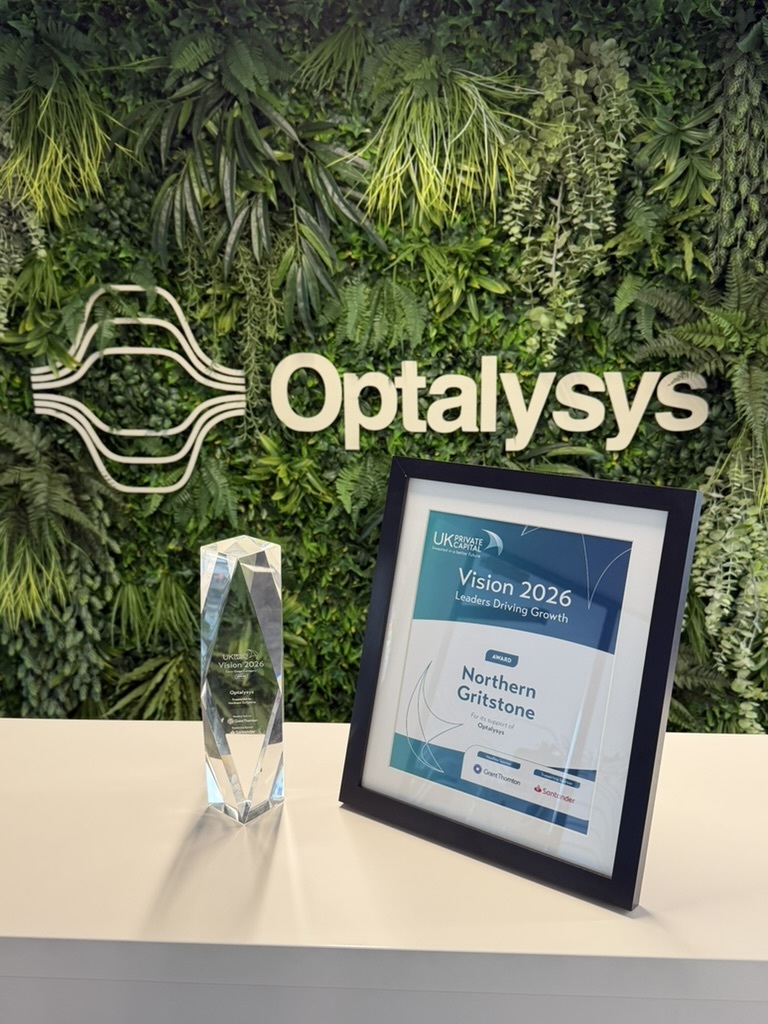
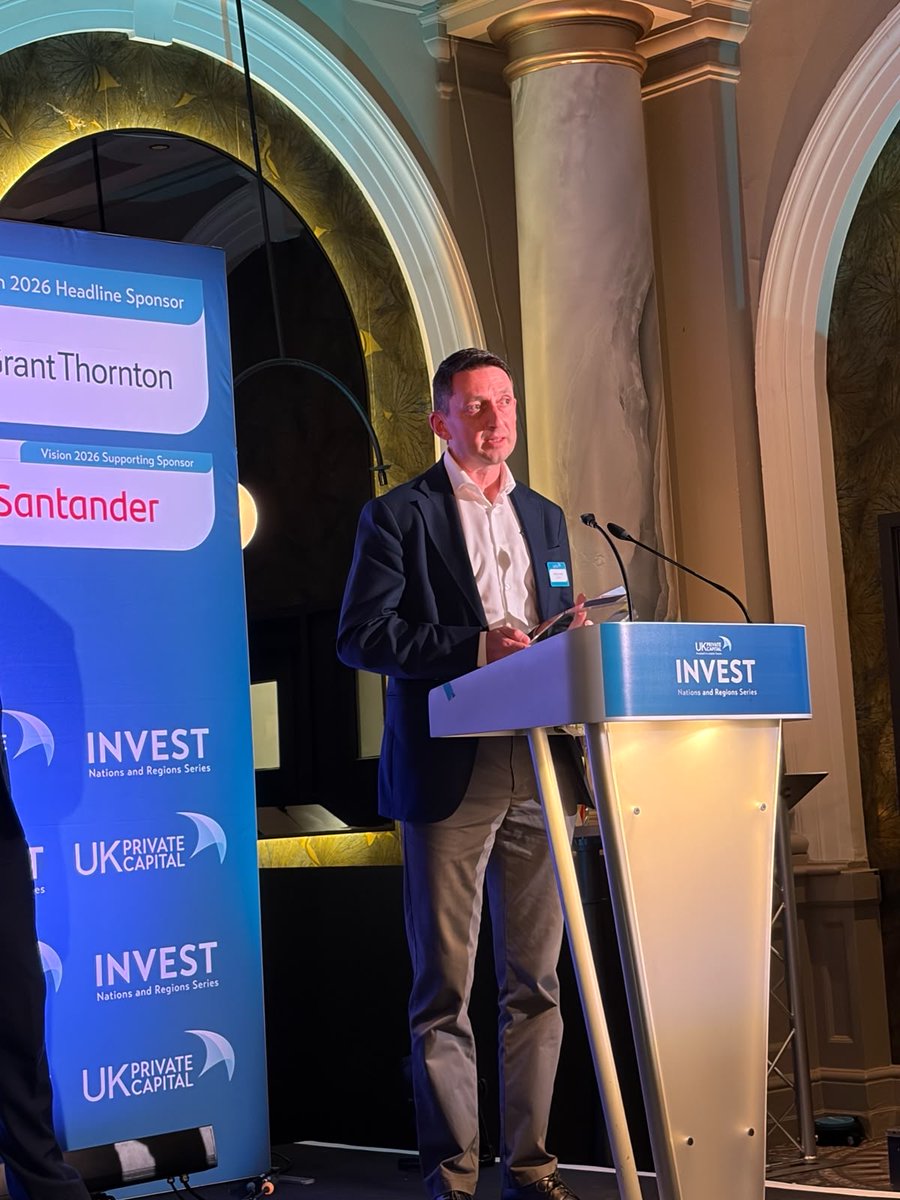
🏆 Proud to be recognised as the Early Stage Winner at the @UKPrivateCap #VisionAwards2026 for the North East, Yorkshire & the Humber
CEO Nick New collected the award and joined Northern Gritstone's Kate Spencer for a Vision Spotlight discussion on how private capital has helped accelerate Optalysys' growth.
Thank you to @NorthernGritstone for your invaluable support over the past three years as we've advanced our photonic core technology and reached key milestones. Excited for what's next.
#DeepTech #Innovation #PrivateCapital #Optalysys
1
2
48
Jun 4
1/ As the UK gears up for the Government’s launch of its AI Hardware Plan, AI sovereignty is taking centre stage.
AI sovereignty depends on more than model development or access to GPUs – it depends on whether the UK can build the infrastructure layers that make AI scalable, efficient and secure.
1
1
108
Jun 4
3/ But photonics in the UK is at an inflection point: we have the science, clusters and talent underpinning an impressive photonics offering, but are lacking the industrial coordination to convert this into global leadership.
1
1
43
Jun 4
4/ We’re looking forward to seeing the extent to which photonics is a key pillar in the AI Hardware Plan at its launch at #LondonTechWeek – what’s one critical thing you’d like to see in the plan?
1
31
Jun 3
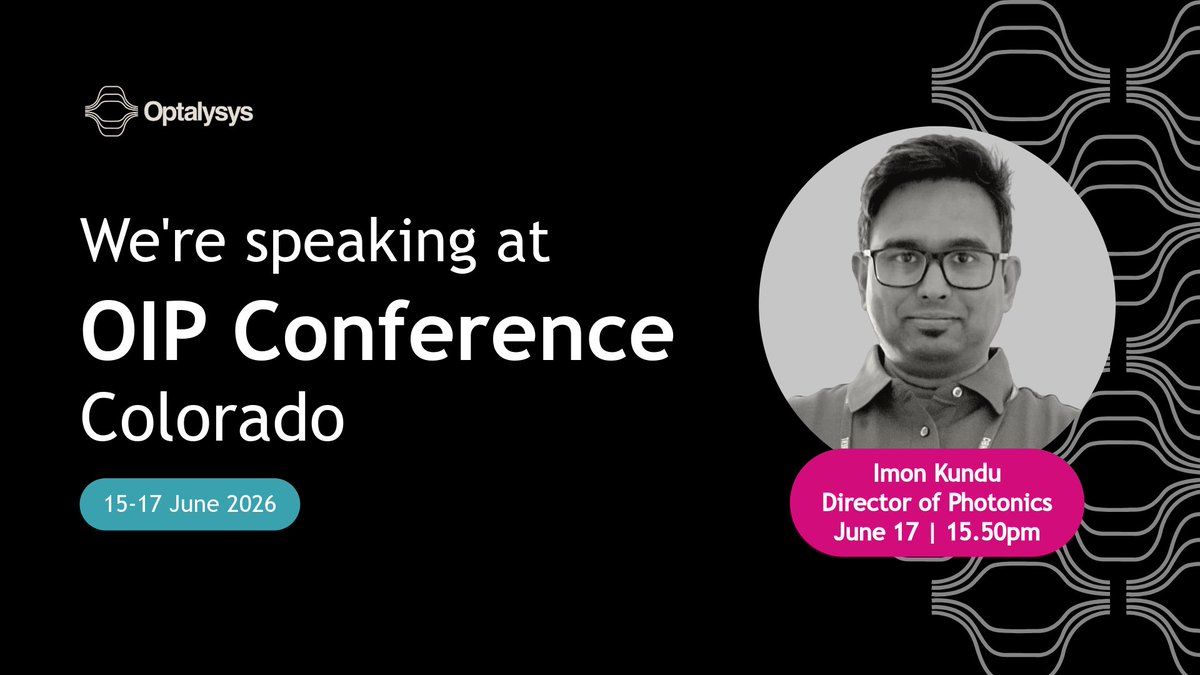
We're heading out to Colorado in a couple of weeks for the Optical Interconnects and Packaging (OIP) Conference 2026 ✈️
You can catch our Director of Photonics Imon Kundu on stage on the Wednesday (17th June) afternoon for his session 'Programmable Compute-in-Transit using Integrated Photonics', while CTO Robert Todd and CEO @NNOPT will be manning our exhibition stand.
If you'll be there and want to find out more about Compute-in-Transit, or just say hello to the team, drop us a message to schedule a meeting ✉️
Full event details & agenda ➡️ eu1.hubs.ly/H0vTQ4d0
1
55
Jun 2
How can the UK cement itself as a leader in the future of photonics? Our CEO @NNOPT explores for @UKTNofficial ⬇️
eu1.hubs.ly/H0vRlYk0
2
37
May 28
We're thrilled to be named in @ProlificNorth's 2026 Tech Companies to Watch: Scale-up Edition list 🎉
The list "shines a light on ambitious companies that are not just building big ideas, but turning them into impact with real-world growth, funding success, and market traction whether that be through customers or subscriptions"
Thank you @ProlificNorth and congratulations to all other companies named!
1
2
70
May 26
If FHE is to work at scale, the question won’t be:
“How fast can we compute?”
It'll be:
“How efficiently can encrypted data move?”
Find out why photonic compute-in-transit is the critical enabler → eu1.hubs.ly/H0vxPXW0
1
1
56
May 21
PQC is a rapidly rising priority in cybersecurity strategies, but it can only be effective against quantum threats if it’s scalable and usable at a global scale.
That is where silicon photonics comes in.
Read our latest piece for @ITSecurityWire → eu1.hubs.ly/H0vxJbk0
1
2
84
May 19
1/ Modern workloads are facing a new compute challenge.
Across AI, FHE and post-quantum cryptography, performance is increasingly constrained by data movement, not just arithmetic.
This is known as the data movement bottleneck.
1
104
May 19
4/ Photonics offers an ideal route to realising this model.
Optical systems can apply transformations directly to signals in transit, aligning computation with dataflow
1
74
May 19
5/ From moving data to compute
to computing as data moves.
Read the paper → eprint.iacr.org/2026/807
228
May 15
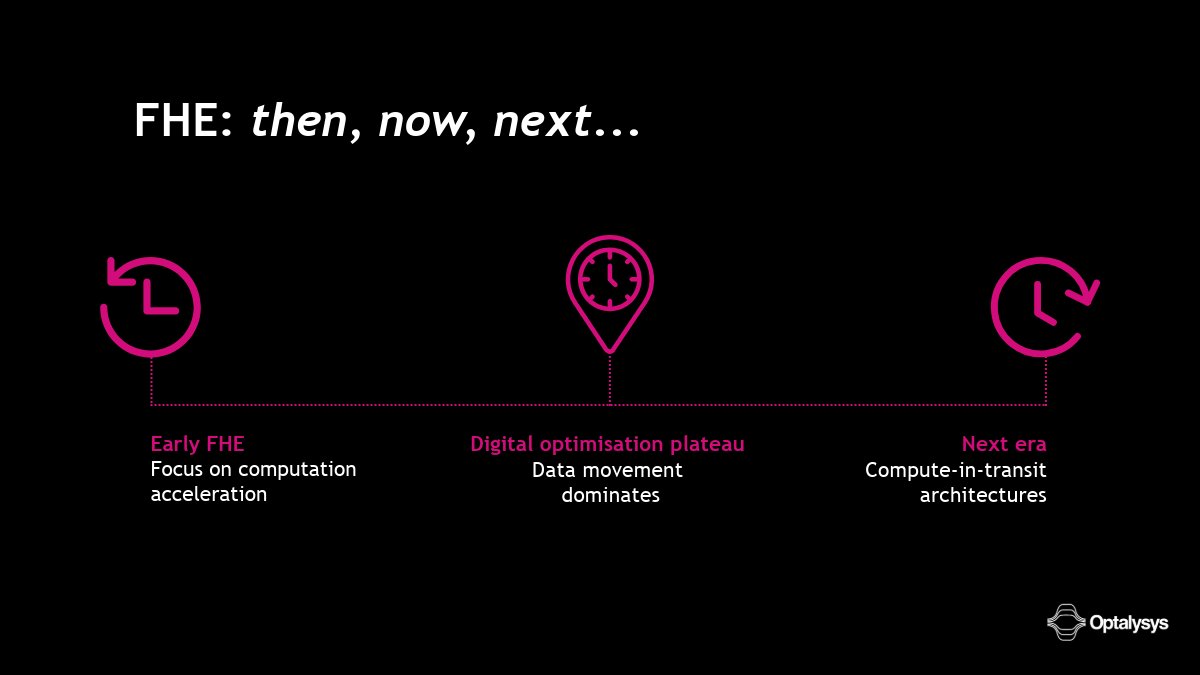
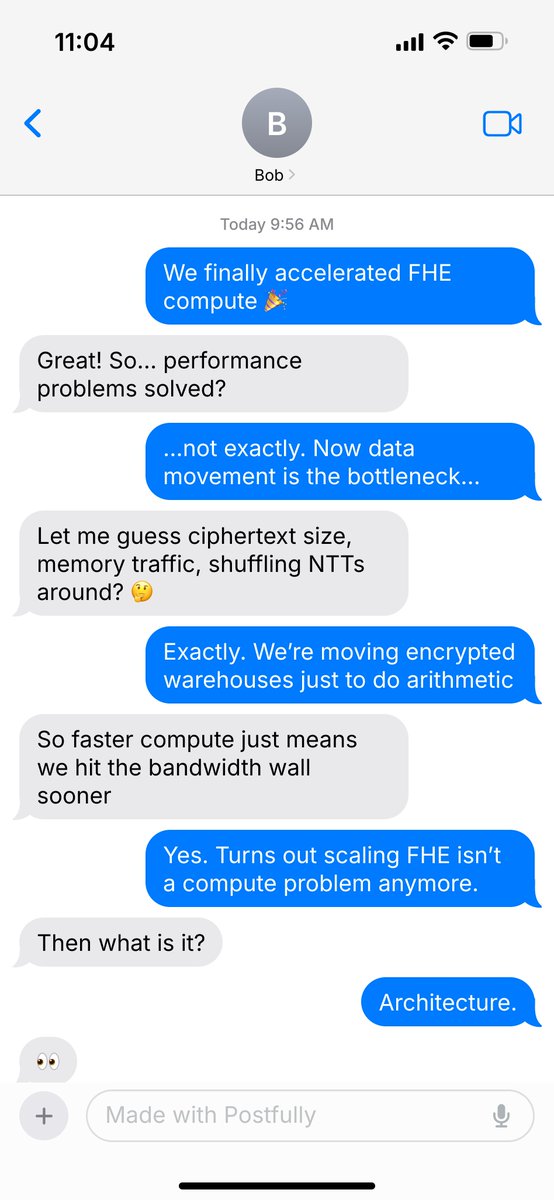
FHE is famously compute-intensive, but it’s also incredibly data-movement intensive.
As encrypted workloads scale, moving large ciphertexts through digital systems becomes a major bottleneck.
Photonics offers a new path: compute while data moves. eu1.hubs.ly/H0v8BTg0
1
1
163
May 13
Q-Day isn’t just a cryptography problem...
It’s an infrastructure problem.
PQC must be secure, scalable and efficient enough for real-world deployment.
That is where silicon photonics comes in.
Read our latest piece for @ITSecurityWire → eu1.hubs.ly/H0v8qzx0
1
1
84
May 11
FHE, PQC and AI may look like different workloads, but they share a common constraint:
Large intermediate representations are repeatedly transformed and moved. This results in the data movement bottleneck – where systems are limited by the cost of moving data, rather than computing on it.
Our latest paper explores compute-in-transit as a revolutionary architectural solution enabled by photonics.
eu1.hubs.ly/H0v8lHB0
2
2
170