
Web3 Storyteller & Technical Content Specialist | Helping projects simplify complex ideas into high engaging content.
Joined August 2023
- Tweets 10,722
- Following 560
- Followers 1,133
- Likes 16,642
Photos and videos
Pinned Tweet

May 9
Some mornings, you don’t need answers.
You just need reassurance that God is still with you. 🕊️
“I have made you. I will carry you; I will sustain you, and I will rescue you.”
Isaiah 46:4
Read that again slowly.
Not maybe.
Not sometimes.
He said I WILL.
Have a wonderful day!

May 5

Sometimes you have to lose something that means something so that you make room for something much better. There is grief involved but there is eventual joy too. You will look back one day and realise why it happened the way it did. For now trust the process.
Good morning y'all
19
2
21
140
E_PRIME™⚡ retweeted
May 9
Some mornings, you don’t need answers.
You just need reassurance that God is still with you. 🕊️
“I have made you. I will carry you; I will sustain you, and I will rescue you.”
Isaiah 46:4
Read that again slowly.
Not maybe.
Not sometimes.
He said I WILL.
Have a wonderful day!
May 5
Sometimes you have to lose something that means something so that you make room for something much better. There is grief involved but there is eventual joy too. You will look back one day and realise why it happened the way it did. For now trust the process.
Good morning y'all
19
2
21
140
E_PRIME™⚡ retweeted
May 5
Sometimes you have to lose something that means something so that you make room for something much better. There is grief involved but there is eventual joy too. You will look back one day and realise why it happened the way it did. For now trust the process.
Good morning y'all
21
3
28
361
E_PRIME™⚡ retweeted

May 5
Quick one:
Do you think being early in crypto is about
• luck
• timing
• pattern recognition
• or conviction?
Because most people only figure this out after missing a few opportunities.
88
10
171
1,851
E_PRIME™⚡ retweeted
20 Dec 2025
Gm builders,
It's no more news that most systems reward noise,
bots win,
Real humans get buried. 😢
But what if identity actually meant something again?
That’s why the @billions_ntwk × @gateway_eth integration caught my eye.
For some time, @billions_ntwk has been building CBUID, a privacy-by-default identity layer with zero-knowledge proofs, local proof generation, and identity without tracking so humans and AI agents can prove who they are without giving up data sovereignty.
@gateway_eth, on the other hand, is shipping infrastructure enterprises can really use compliant, scalable, and designed for how institutions actually operate.
Put them together and you get:
Verify once, reuse everywhere
No central databases
Decentralized reputation as a real reputation layer
Compliance that doesn’t kill speed
A mobile-first trust stack ready for billions
2.3M users already live tells you this isn’t a theory.
This is trust as infrastructure, not a slogan.
If you’ve watched bots win and real contributors lose,
this is the kind of shift that starts correcting that imbalance.
👉 Builders, this is the direction:
ZK-powered identity. Privacy by default. Infrastructure that actually ships.
gBillions joor 🫡
10
3
16
188
E_PRIME™⚡ retweeted
Jan 1
Happy New year.
May this new year bring you clarity, strength, and quiet wins.
May every effort you make count.
May doors open where patience has been tested.
May peace find you even in busy moments.
May growth come without pressure, and success come with gratitude.
Happy New Year, once again ❤️
*** E_Prime⚡**
10
2
14
291
Jan 1
Happy New year.
May this new year bring you clarity, strength, and quiet wins.
May every effort you make count.
May doors open where patience has been tested.
May peace find you even in busy moments.
May growth come without pressure, and success come with gratitude.
Happy New Year, once again ❤️
*** E_Prime⚡**
10
2
14
291

E_PRIME™⚡ retweeted
30 Dec 2025
Gm Billions ✌️
AI can fake faces.
Fake voices.
Fake entire accounts.
So “trust me bro” verification is officially dead.
This is why @billions_ntwk hits for me.
In a world full of bots and synthetic humans, Billions verifies you’re real: your age, your uniqueness , without taking your data hostage.
No passport uploads.
No selfie farms.
No creepy databases waiting to leak.
Just zero-knowledge proofs:
Platforms get a simple yes or no.
You keep your privacy.
Everyone wins (except scammers).
AI isn’t the enemy.
Unverified AI is.
@billions_ntwk isn’t chasing trends ; it’s quietly building the trust layer the internet should’ve had from day one.
gm to privacy by default ☕
@davidsrz @provenauthority @jgonzalezferrer thank you.
25 Dec 2025
Growing up in Nigeria, Santa was always “there”...
but never seen. 😆
You’d sleep, wake up, and boom gifts. 🎁
No proof.
No photos.
Just trust.
But as we grew older, we learned:
It was never really Santa.
It was someone we knew, hidden behind the suit.
That’s where @billions_ntwk flips the script.
In Web3 today, everyone wants to know:
“Who is this?”
“Can I trust this wallet?”
“Is this human or bot?”
Billions says:
👉 You don’t need the face.
You just need the proof.
With zk-powered identity, reputation layers, and privacy-first design:
You can prove you’re real.
Prove you’re unique.
Prove your reputation.
Without revealing your name, data, or life story.
So this time, unlike Santa:
You stay hidden…
but your credibility shows up. 🎄
That’s identity without tracking.
Trust without exposure.
Humans at internet scale.
Billions isn’t bringing gifts.
It’s bringing verifiable humans to Web3. ⚡
Merry Christmas y'all 🎉🥳

20
4
23
178
E_PRIME™⚡ retweeted
29 Dec 2025
gm builders ☀️
New week. New proofs. New momentum.
Most people think ZK is magic.
But magic doesn’t scale.
Markets do.
That’s why @brevis_zk ProverNet matters.
ProverNet turns ZK proving into a real marketplace:
🧠 Provers compete on speed & cost
💰 Jobs flow to the best performers
🔐 Stake = credibility
⚡ Proofs become on-demand infrastructure
Not "trust me, bro."
But: "Here’s the proof. Verify it."
This is how ZK grows from:
a research tool → to cloud compute for proofs.
Just like AWS made servers accessible,
ProverNet is making ZK computation composable for every builder.
Build apps.
Call proofs.
Pay for results.
No need to run your own proving farm.
No need to be a ZK wizard.
That’s Monday energy.
Less friction. More building.
If ZK is the backbone of the next wave of Web3,
then ProverNet is shaping how that backbone gets powered.
gm to the future of verifiable compute ⚡️
gm @brevis_zk 🐱
What are you building this week? 👇

27 Dec 2025
What if your private data could train AI... without ever being exposed?
A few years ago, “data is the new oil” sounded smart.
Today? It sounds dangerous.
Because oil gets drilled.
And data?
It gets scraped.
Your trades.
Your habits.
Your usage patterns.
Your digital life.
All feeding models you don’t control,
for value you never see.
But what if the future of AI isn’t about scraping more…
What if it’s about proving more, while revealing less?
That’s exactly what @brevis_zk × @vana are building. ⚡️
The real problem nobody talks about
AI is hungry.
But public data is running out.
The next leap in intelligence needs:
✔ private data
✔ high-quality signals
✔ real human behavior
But here’s the catch:
No one wants to hand over raw data.
And no developer wants to train models on unverifiable inputs.
So we’re stuck between:
privacy vs progress.
Until now.
Brevis × Vana: ZK-powered data sovereignty
Vana is building data collectives — markets where users can contribute data by choice and get rewarded.
Brevis brings the missing layer:
Zero-knowledge trust.
Together, they unlock something powerful:
Users keep their raw data.
Developers get verified signals.
AI gets better inputs.
Everyone wins.
No scraping.
No blind trust.
No data leaks.
How it actually works (simple version)
1️⃣ zkTLS proves data origin
“Yes, this really came from Coinbase / Binance / an app / an API.”
2️⃣ You compute locally
On your own device. Your rules. Your data.
3️⃣ Pico zkVM proves correctness
Brevis generates a ZK proof that the computation followed the rules — without exposing inputs.
4️⃣ Only the result proof go on-chain
Not your raw history. Not your private logs.
5️⃣ Vana coordinates consent & rewards
You get paid for verified contributions.
So instead of sharing everything,
you share provable outcomes.
That’s a massive shift.
Why this changes ZK’s role completely
ZK used to mean:
✔ privacy
✔ scaling
✔ transaction proofs
Now it means something bigger:
Verifying real-world data workflows.
Not just “this tx is valid.”
But:
✔ this data is authentic
✔ this computation is correct
✔ this result can be trusted
All without revealing what shouldn’t be revealed.
ZK becomes infrastructure for AI trust.
A simple example
An AI wants to know:
“Has this user traded over $100k in ETH pairs?”
You don’t want to show your full trade history.
With @brevis_zk × @vana:
→ zkTLS proves the source
→ Pico zkVM proves the calculation
→ AI gets a verified “yes/no”
→ Your raw data stays private
→ You get rewarded
That’s privacy and utility.
Not vibes.
Math.
Zoom out: why this matters
This isn’t just about AI training.
It’s about data sovereignty.
A future where:
🔐 Users own their data
🧾 Proof replaces trust
🤖 AI learns from verified signals
💰 Value flows back to contributors
No more “give us your data and hope for the best.”
Instead:
Prove what matters. Keep the rest.
That’s a new internet contract.
The bigger Brevis picture
This fits perfectly with @brevis_zk’s vision:
Off-chain compute.
On-chain verification.
Zero-knowledge as infrastructure.
From:
zkVM → ProverNet → InfoFi → AI workflows
@brevis_zk isn’t just proving blocks.
It’s proving behavior, data, and outcomes in the real world.
And this Vana partnership shows just how far that can go.
CTA
If AI is going to shape the future,
then trust can’t be optional.
It has to be native.
And if data is going to power that future,
then ownership can’t be symbolic.
It has to be real.
That’s what Brevis × Vana are pointing toward.
Not louder data.
Smarter proofs.
Not blind sharing.
Verifiable sovereignty.
The ZK era isn’t just scaling chains anymore.
It’s redefining how value, privacy, and intelligence meet. ⚡️
What kind of AI future do you want to live in? 👇
8
2
12
197
30 Dec 2025
GM GM Cee Tee
Arise and shine

29 Dec 2025
gm builders ☀️
New week. New proofs. New momentum.
Most people think ZK is magic.
But magic doesn’t scale.
Markets do.
That’s why @brevis_zk ProverNet matters.
ProverNet turns ZK proving into a real marketplace:
🧠 Provers compete on speed & cost
💰 Jobs flow to the best performers
🔐 Stake = credibility
⚡ Proofs become on-demand infrastructure
Not "trust me, bro."
But: "Here’s the proof. Verify it."
This is how ZK grows from:
a research tool → to cloud compute for proofs.
Just like AWS made servers accessible,
ProverNet is making ZK computation composable for every builder.
Build apps.
Call proofs.
Pay for results.
No need to run your own proving farm.
No need to be a ZK wizard.
That’s Monday energy.
Less friction. More building.
If ZK is the backbone of the next wave of Web3,
then ProverNet is shaping how that backbone gets powered.
gm to the future of verifiable compute ⚡️
gm @brevis_zk 🐱
What are you building this week? 👇
1
6
43
E_PRIME™⚡ retweeted

27 Dec 2025
happy sunday builders
gm.
woke up thinking about that TrustWallet Chrome extension hack from a few days ago.
$7M gone… not because people were careless, but because a trusted update shipped malicious code. unlock wallet → seed exposed → funds drained. just like that.
that’s the scary part. not phishing. not obvious scams. but infrastructure we assume is safe.
this is exactly why the conversation around identity trust is shifting.
most systems today rely on full access: see everything, store everything, hope nothing breaks.
Billions Network is pushing the opposite default.
prove you’re real without exposing your life. verify uniqueness, eligibility, or accountability using ZK proofs. no seed phrases floating around. no central honeypots full of sensitive data.
less data collected = less data to leak. less surface area = less damage when something goes wrong.
security isn’t just better wallets. it’s better primitives.
trust that’s cryptographically enforced, not socially assumed.
gm to building an internet where “trusted” doesn’t mean “fragile.” and where being human doesn’t mean being exposed.

24 Dec 2025

Merry Christmas to the @billions_ntwk family 🎄
this year has been a reminder that communities aren’t built by noise… they’re built by people who show up, share ideas, challenge each other, and keep building even when no one’s watching.
being part of the Billions community has genuinely shaped how I think, how I write, and how I show up on CT. from the team pushing privacy-first identity forward, to builders exploring zero-knowledge and trust infrastructure, to the friends I’ve met along the way… this network has felt real in a space that often isn’t.
what stands out most is the values.
Human-first. Privacy by default. Accountability without overexposure.
those ideas matter far beyond crypto, and it’s inspiring to see them turned into real infrastructure.
grateful for the Billions team for building with intention.
grateful for the community for making it welcoming, curious, and sharp.
grateful for the conversations, the learning, and the quiet growth.
wishing everyone a peaceful Christmas with the people who matter most.
here’s to more trust, more clarity, and more meaningful building in the year ahead.
🎄🤍
54
4
93
4,614
E_PRIME™⚡ retweeted
27 Dec 2025
What if your private data could train AI... without ever being exposed?
A few years ago, “data is the new oil” sounded smart.
Today? It sounds dangerous.
Because oil gets drilled.
And data?
It gets scraped.
Your trades.
Your habits.
Your usage patterns.
Your digital life.
All feeding models you don’t control,
for value you never see.
But what if the future of AI isn’t about scraping more…
What if it’s about proving more, while revealing less?
That’s exactly what @brevis_zk × @vana are building. ⚡️
The real problem nobody talks about
AI is hungry.
But public data is running out.
The next leap in intelligence needs:
✔ private data
✔ high-quality signals
✔ real human behavior
But here’s the catch:
No one wants to hand over raw data.
And no developer wants to train models on unverifiable inputs.
So we’re stuck between:
privacy vs progress.
Until now.
Brevis × Vana: ZK-powered data sovereignty
Vana is building data collectives — markets where users can contribute data by choice and get rewarded.
Brevis brings the missing layer:
Zero-knowledge trust.
Together, they unlock something powerful:
Users keep their raw data.
Developers get verified signals.
AI gets better inputs.
Everyone wins.
No scraping.
No blind trust.
No data leaks.
How it actually works (simple version)
1️⃣ zkTLS proves data origin
“Yes, this really came from Coinbase / Binance / an app / an API.”
2️⃣ You compute locally
On your own device. Your rules. Your data.
3️⃣ Pico zkVM proves correctness
Brevis generates a ZK proof that the computation followed the rules — without exposing inputs.
4️⃣ Only the result proof go on-chain
Not your raw history. Not your private logs.
5️⃣ Vana coordinates consent & rewards
You get paid for verified contributions.
So instead of sharing everything,
you share provable outcomes.
That’s a massive shift.
Why this changes ZK’s role completely
ZK used to mean:
✔ privacy
✔ scaling
✔ transaction proofs
Now it means something bigger:
Verifying real-world data workflows.
Not just “this tx is valid.”
But:
✔ this data is authentic
✔ this computation is correct
✔ this result can be trusted
All without revealing what shouldn’t be revealed.
ZK becomes infrastructure for AI trust.
A simple example
An AI wants to know:
“Has this user traded over $100k in ETH pairs?”
You don’t want to show your full trade history.
With @brevis_zk × @vana:
→ zkTLS proves the source
→ Pico zkVM proves the calculation
→ AI gets a verified “yes/no”
→ Your raw data stays private
→ You get rewarded
That’s privacy and utility.
Not vibes.
Math.
Zoom out: why this matters
This isn’t just about AI training.
It’s about data sovereignty.
A future where:
🔐 Users own their data
🧾 Proof replaces trust
🤖 AI learns from verified signals
💰 Value flows back to contributors
No more “give us your data and hope for the best.”
Instead:
Prove what matters. Keep the rest.
That’s a new internet contract.
The bigger Brevis picture
This fits perfectly with @brevis_zk’s vision:
Off-chain compute.
On-chain verification.
Zero-knowledge as infrastructure.
From:
zkVM → ProverNet → InfoFi → AI workflows
@brevis_zk isn’t just proving blocks.
It’s proving behavior, data, and outcomes in the real world.
And this Vana partnership shows just how far that can go.
CTA
If AI is going to shape the future,
then trust can’t be optional.
It has to be native.
And if data is going to power that future,
then ownership can’t be symbolic.
It has to be real.
That’s what Brevis × Vana are pointing toward.
Not louder data.
Smarter proofs.
Not blind sharing.
Verifiable sovereignty.
The ZK era isn’t just scaling chains anymore.
It’s redefining how value, privacy, and intelligence meet. ⚡️
What kind of AI future do you want to live in? 👇
26 Dec 2025
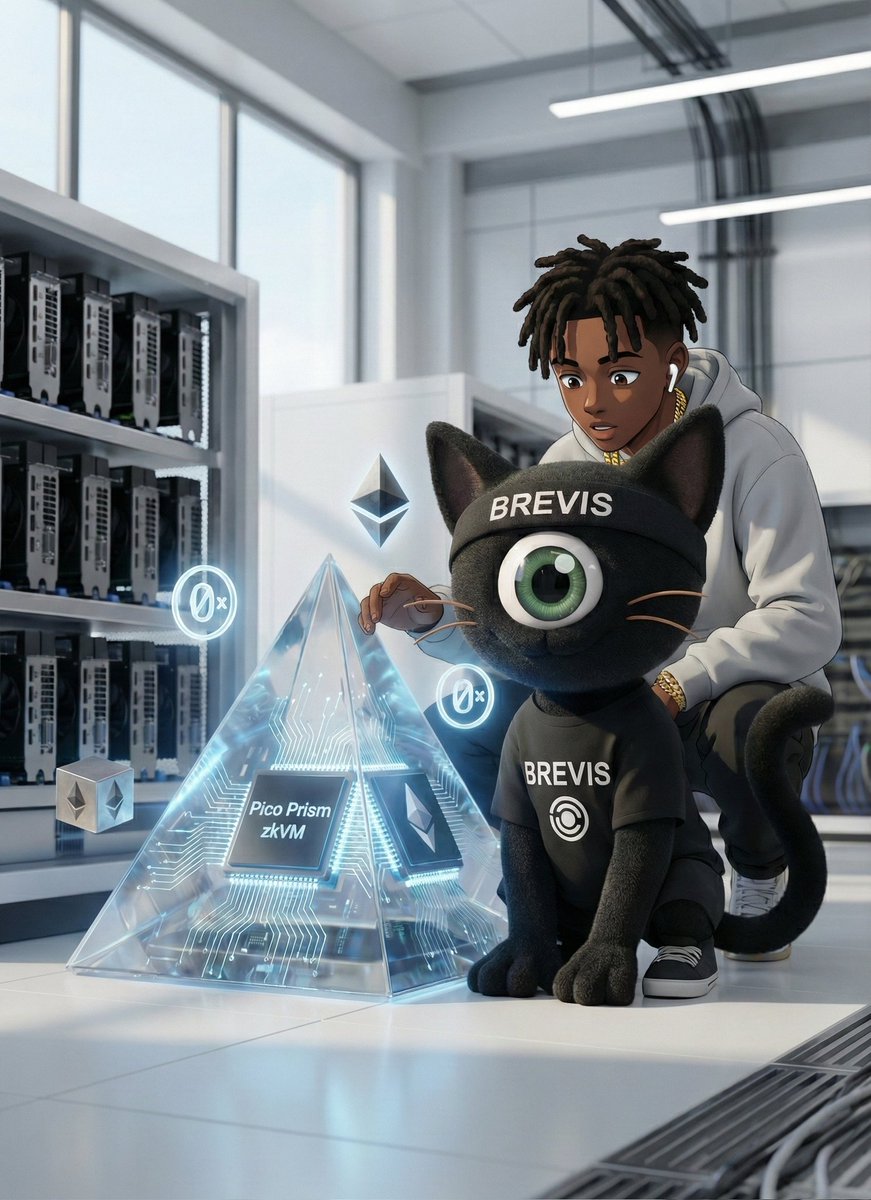
Brevis boxing morning Zkats
It's funny how most people think scaling Ethereum means more hardware.
More nodes.
More re-execution.
More noise. 🤔
But what if the future isn’t doing more work…
What if it’s proving the work once?
That’s exactly what @brevis_zk’s Pico Prism zkVM is about. ⚡️
Pico Prism isn’t just another zkVM.
It’s a statement:
“Stop redoing everything. Start verifying.”
Today, every validator re-executes every transaction in a block.
Same math.
Same results.
Over and over again.
Redundant.
Expensive.
And honestly… outdated.
Pico Prism flips that model.
One powerful prover generates a zero-knowledge proof that an Ethereum block is valid.
Everyone else?
They just verify the proof.
Seconds.
Not minutes.
No heavy compute.
No trust.
Just math.
And the numbers?
They’re wild.
• ~99.6% of Ethereum blocks proven under 12s
• ~96.8% under 10s (real-time territory)
• ~6.9s average proof time
• ~50% lower GPU cost than previous systems
That’s not a lab demo.
That’s real Ethereum blocks at real gas limits.
How?
Pico Prism is built like a modern data center, not a toy zk setup:
→ Distributed multi-GPU clusters
→ Deep parallelization pipelines
→ Async execution recursion
→ Modular backends for future upgrades
Add more machines → get more throughput.
Simple. Scalable. Brutal.
What this unlocks is bigger than benchmarks:
⚡ Faster block validation
💸 Cheaper verification
📉 Less hardware pressure on nodes
📱 Path to lighter clients
📈 A network that can actually scale without burning itself out.
This is how you move from: “Trust every validator to redo the math”
to: “Verify one proof and move on.”
From redundancy…
to efficiency by design.
And zoom out a bit 👇
Pico Prism isn’t isolated.
It fits perfectly into Brevis’s bigger vision:
Off-chain compute.
On-chain verification.
Zero-knowledge as infrastructure.
The same philosophy that powers Brevis’s zk data coprocessor, ProverNet, and privacy stack is alive here:
Unlimited computation.
Minimal trust.
Verifiable by anyone.
If Ethereum’s future is modular, scalable, and proof-driven,
then Pico Prism feels less like an experiment…
and more like a preview.
Not louder blocks.
Smarter ones.
Not more work.
Better proofs.
The zk era isn’t coming.
With Pico Prism, it’s already clocking in. ⚡️
Any questions?
5
1
7
266