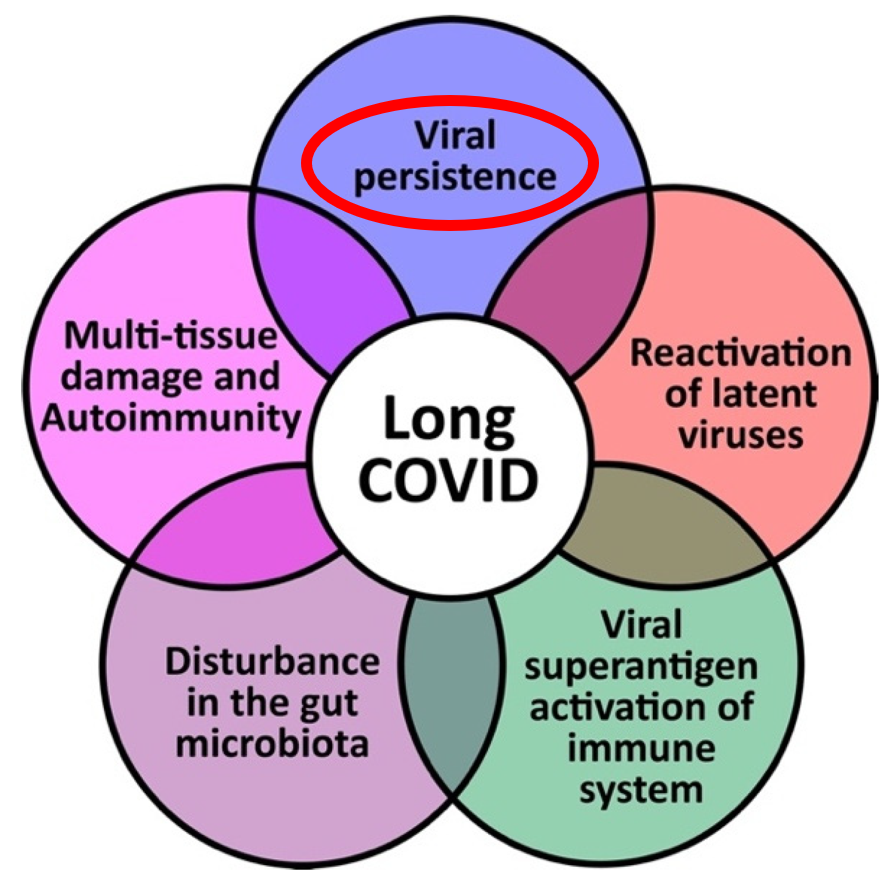
“If the cells are frequently turning over and they are still detecting viral persistence, what other plausible explanations are there for this other than replication?”
That's a very good question, and it's one of the central puzzles in the field of viral persistence. Let’s see why:
If a tissue contains cells that turn over relatively quickly (intestinal epithelium, immune cells, etc.), and viral RNA or proteins are still being detected months or years after an infection, then ongoing replication is the most intuitive explanation, but it is not the only one. Other reasonable options are:
1. Persistence in long-lived reservoir cells.
The tissue as a whole may turn over, but a subset of cells may not. We know this happens for neurons, some endothelial cells, tissue macrophages, lymphocytes, and others. In this case, the virus isn't replicating continuously, but instead, a long-lived infected cell survives for months or years and continues to produce low levels of viral RNA or protein. This is essentially how the HIV reservoir works, for example.
2. Defective viral genomes.
A cell can also contain incomplete viral genomes incapable of producing infectious viruses, so the genome may still produce RNA transcripts and some proteins. While this stimulates innate immunity (so enough to cause symptoms and pathology), it doesn’t generate new infectious virions.
3. Protein persistence without viral persistence.
The virus itself may be gone but you can have lingering viral remnants like spike protein and nucleocapsid fragments that can persist inside phagocytic cells or in extracellular compartments. In this case, what is being detected is essentially debris rather than an active infection, but their presence is enough to induce immunological responses (and again, enough to produce symptoms/pathology).
4. Continuous release from another hidden reservoir.
The tissue where detection occurs may not be the reservoir. Hidden reservoir can include gut, bone marrow and lymphoid tissue, while the released is being detected in blood or peripheral immune cells. In this model, the virus replicates (or persists) in one location, while viral products continually seed other compartments.
5. Cell-to-cell transfer without productive infection.
Macrophages and other immune cells can acquire viral material from neighboring cells. These cells may test positive for viral RNA or viral proteins like spike, despite never being truly infected. So a positive signal does not necessarily mean productive viral replication.
From a scientific perspective, the most reasonable model may actually be a combination of different situations, like a small reservoir that exists in a long-lived cell, which can induce low-level or intermittent replication. This can induce viral proteins and RNA to be continuously released. These products can then be captured by immune cells and distributed through the body.
That model can explain why viral material remains detectable despite turnover, and why it is so hard for scientists to recover large amounts of infectious virus years later.
One of the key unresolved question is whether the reservoir is producing new virus, or merely old viral products that are being recycled and retained. That's one of the areas where the field is still struggling to obtain definitive evidence.
#LongCovid #MECFS
If the cells are frequently turning over and they are still detecting viral persistence, what other plausible explanations are there for this other than replication? (genuinely curious, have been wondering about this for a while)