
Joined August 2008
- Tweets 12,354
- Following 81
- Followers 171
- Likes 21,829
196 Photos and videos











In 1979, when he was just 16 years old, Indian environmentalist Jadav Payeng began planting trees on a barren sandbar along the Brahmaputra River in Assam.
What started as the effort of one teenager grew into a remarkable lifelong mission.
Over the decades, Payeng transformed the once-barren landscape into the Molai Forest, a thriving ecosystem covering roughly 1,300 to 1,360 acres.
The forest now supports a rich variety of wildlife, including Indian rhinoceroses, Bengal tigers, elephants, deer, monkeys, birds, and countless other species.
Known around the world as “The Forest Man of India,” Payeng dedicated much of his life to nurturing the forest he created, proving how one person's commitment can restore nature on an extraordinary scale.
His story remains one of the most inspiring examples of environmental conservation and reforestation in modern history.

6
75
323
8,558
PaganTech retweeted

Jun 2
2,700 calories of rice vs 2,700 calories of whole foods.
Really makes you think.
Community note
The amount of rice shown is much less than 2700 calories; 1 cup of cooked long-grain white rice has 205 calories (USDA), requiring about 13 cups for 2700 calories. tools.myfooddata.com/nutrition-fact…
437
207
2,786
1,205,393
PaganTech retweeted

Jun 14
🐘 In Zimbabwe, the Akashinga Rangers an all-women anti-poaching unit help protect elephants and other wildlife 24/7


79
1,869
11,560
325,407
PaganTech retweeted

Jun 14
This is Chinese madness… they are creative in making everything!
156
1,565
6,935
382,653
PaganTech retweeted

Jun 11
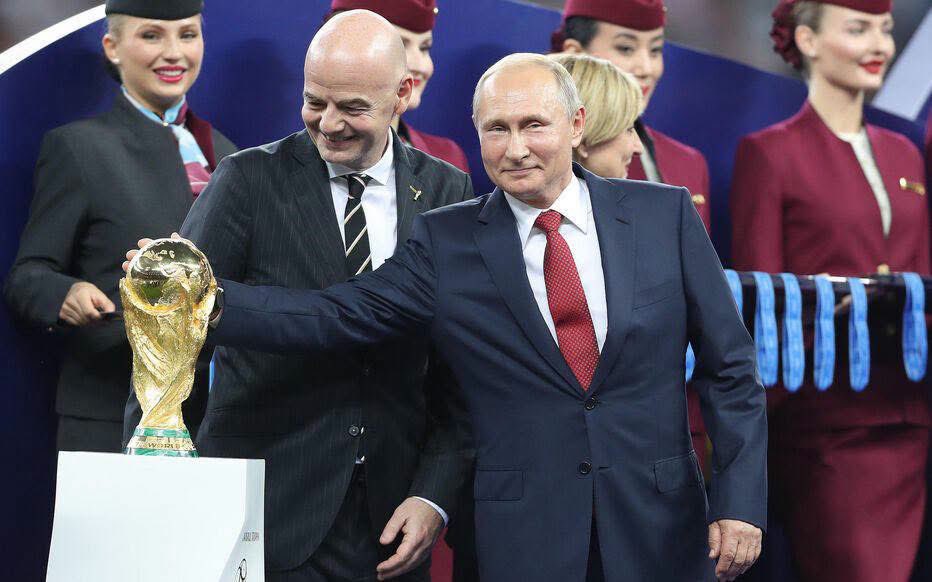
La Russie du grand méchant Vladimir Poutine pendant la Coupe du monde 2018 :
- entrée gratuite sans visa pour tous les supporters
- trains gratuits pour se déplacer entre les 11 villes hôtes
- transports locaux gratuits (bus, métro, navettes)
- pas de tarification dynamique pour les billets
- contrôles administratifs simplifiés
- aucune interdiction de séjour discriminatoire
- aucune place destiné aux supporters supprimés
- pas de fouille humiliante à l’arrivée des joueurs comme si c’était des criminels
711
20,792
116,916
2,417,654
PaganTech retweeted

Jun 12
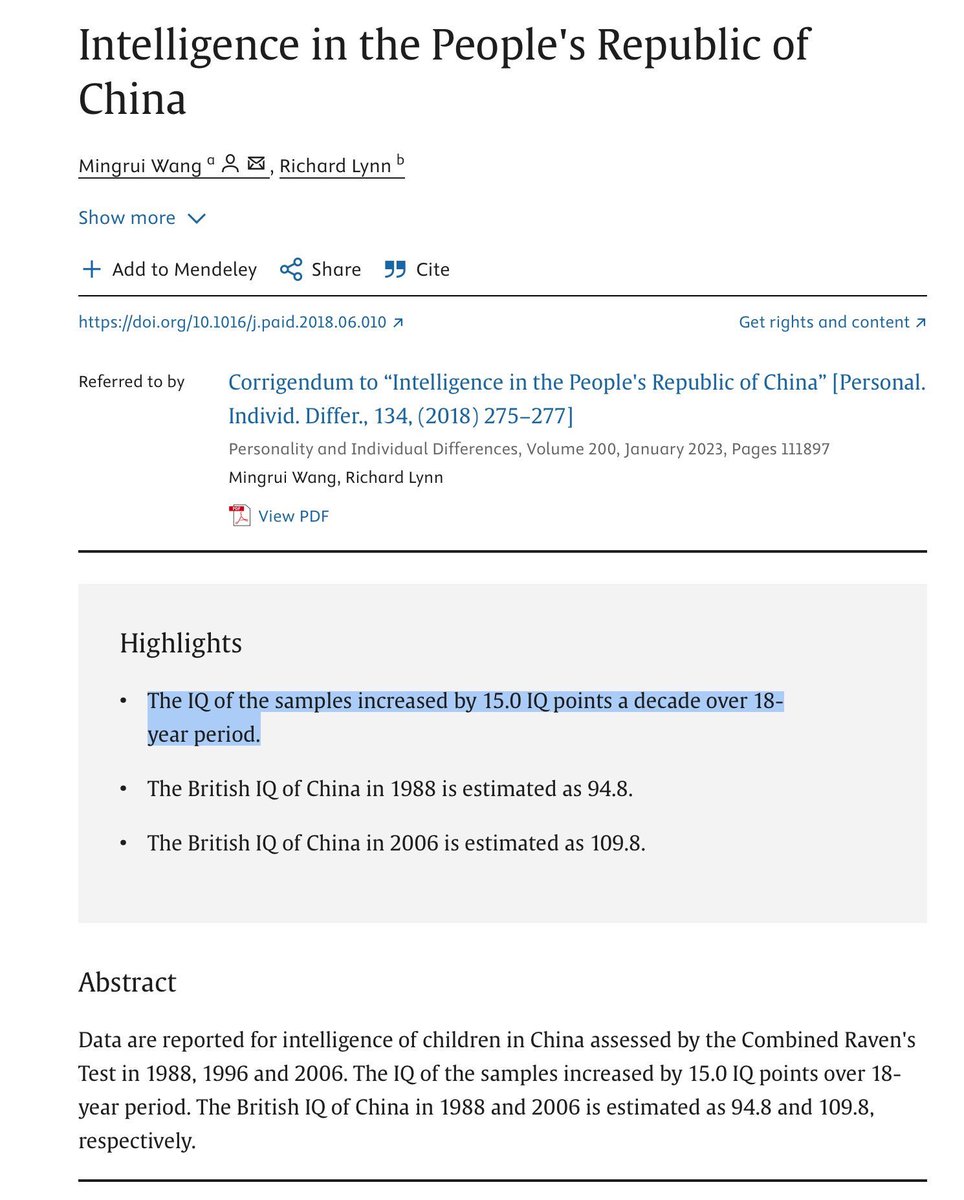
This is a really fascinating paper that everyone interested in China's industrial policy should read.
It destroys so many myths (see below), and is written by deeply credible people who conducted over three years of fieldwork in China and interviewed 60 Chinese officials, entrepreneurs, and engineers. When it comes to China studies, it literally doesn't get more rigorous than this.
First myth it destroys: contrary to popular belief, Beijing's industrial policy didn't build the companies that became China's EV champions. They rose largely **despite** it, through its cracks.
For sure, Beijing did favor EVs as an industry and pushed hard for it but their big bet was SOEs (State Owned Enterprises): research grants, pilot programs, licenses, cheap credit - virtually all of it flowed to state firms.
The result? China's actual EV champions - BYD, Geely, NIO, XPeng, Li Auto, etc. - are overwhelmingly private firms that succeeded despite Beijing favoring their SOE competitors.
How so? Because, when favoring SOEs, the central government didn't just pick winning companies, it picked winning cities, each SOE being anchored in a specific city: Shanghai (SAIC), Changchun (FAW), Wuhan-Shiyan (Dongfeng), etc.
Which means that every city not on the list, that wanted a piece of the auto boom, had only one option left: team up with private entrepreneurs who were equally excluded from central government favor.
That's what truly fueled China's EV miracle: an alliance of the excluded, between local private entrepreneurs and local mayors.
This is the biggest misconception this paper destroys: the reality is that the "Chinese state capitalism" that many in the West think powered the EV boom actually tried to block many of these companies from existing. In effect, it was closer to an obstacle course that local actors (mayors and provinces) learned to game.
Geely - now the third largest automaker in China - is a fantastic example of this.
First of all, it started off illegal since, to build passenger cars, you had to have a central government license and they couldn't get one. Zhejiang Province told them to go ahead regardless because the province had hundreds of auto parts suppliers but no carmaker of its own.
It's only a couple of years later, recognizing the fait-accompli that Geely was producing cars and was competitive, that the central government admitted them to the National Sedan Catalog - effectively legalizing them retroactively because there were facts on the ground.
Then there was the Volvo acquisition in 2010, which is fair to say - looking back - proved to be the most strategically valuable acquisition in Chinese automotive history. Despite it being presented at the time (and still described this way today) as "China buying Volvo", all 3 major state-backed banks in China (Export-Import Bank, China Development Bank, Bank of China) refused to finance the deal. The only state-bank money Geely managed to get was a $200 million loan from a provincial branch of China Construction Bank - a tiny fraction of what the deal required.
Geely actually did the deal with Goldman Sachs money via Hong Kong plus loans and equity from four local governments (Chengdu, Zhangjiakou, Daqing, Shanghai's Jiading district), each of which bought in by securing a Volvo plant or headquarters for itself.
In effect, the doors that Beijing controlled were largely closed to Geely, but it made it because the doors subnational actors controlled were opened.
Which all means this paper destroys another very common myth: the big merit of the central government in all this was to be relatively chill about it, to NOT be dictatorial.
I just imagine if that had happened in France and you had - say - the mayor of Lyon or Marseilles open, fund and promote an unlicensed carmaker against Renault: the préfet would shut it down within weeks, and the mayor would be lucky to escape prosecution.
That's the irony: on industrial policy, the supposedly "totalitarian" Chinese state proved more tolerant of local defiance than most Western liberal democracies would be. Beijing's greatest contribution to the EV miracle wasn't the plan - it was looking the other way while the plan was being violated.
To be sure, the paper doesn't hide the costs of this system: ferocious local competition also produced what's known today in China as "involution" (内卷-Neijuan, basically a hypercompetitive price war), as well as some spectacular failures. For instance one county lost 6.6 billion yuan on a carmaker that never really made cars.
But that's precisely the point: this is a high-risk, high-reward model of decentralized experimentation, the very opposite of the careful central planning Westerners imagine.
I've repeated this countless times but it bears repeating again: the single greatest misconception people have about China is - probably because we wrongly associate communism with centralized control - that it is a monolith run from Beijing. Some even say it's run by "one man."
The reality is the exact opposite: China is, in practice, one of the most decentralized countries on earth. Roughly 85% of government spending in China happens at the subnational level - against about 30% in the average OECD country (and even less in France, which is actually one of the most centrally controlled countries on earth). A Chinese mayor commands fiscal resources, land, investment funds and policy latitude that virtually no Western mayor could dream of.
Last but not least, I'd be remiss not to mention what the paper has to say on the positive legacy of Mao and its role in the rise of EVs (given I myself wrote an article titled "Mao's economic record wasn't bad, actually": arnaudbertrand.substack.com/…).
When it comes to China myths, none is more entrenched than the idea that Mao left behind nothing but ruins.
This paper confirms a key argument of my article: Mao's deliberate dispersal of industry across China (during the Great Leap Forward and Cultural Revolution decentralizations) left dozens of cities with their own small auto works. Inefficient, yes - but these scattered factories survived into the 1990s and became the seed stock of everything that followed: the industrial base, the engineers, and the production licenses that EV startups would use to enter the market.
The paper even says it outright: the fragmentation that industrial policy "sought to eradicate" is "precisely" what "ironically enabled" the EV sector's rapid rise.
This is exactly the mechanism I described in my Mao article: structures built in the Mao era - communes becoming township governments, commune enterprises becoming TVEs, Third Front factories seeding interior industrialization - became load-bearing foundations of the reform miracle.
Fittingly, the spark for China's first municipal carmaker adventure was literally a TVE (Township and Village Enterprise), the institutional descendants of Mao's commune enterprises: Tongbao, a kit-car maker in Wuhu whose success stunned local officials into building what became Chery (one of China's biggest carmakers today). You can't tell the story of China's EV miracle without crediting the legacy of Mao.
What's the biggest lesson in all this for Western policymakers?
The obvious one is that the part of industrial policy that most people assume China does and that they sometimes want to copy - i.e. the state picking winners - is actually the part that failed.
The part that did succeed is the China nobody in the West believes exists: a radically decentralized system with a high degree of tolerance for disobedience and experimentation.
We imagine China as a country where nothing happens without Beijing's approval when the reality is closer to the opposite: China's EV miracle happened precisely because localities asked for forgiveness rather than permission.
All in all, and this is the lesson I often come back to, this is yet another illustration of the importance of understanding China for what it is as opposed to the caricature we've built of it. This matters whichever "camp" you're in. If you see China as a rival, you can't compete with someone you don't understand. If you see them as a source of lessons, you can't emulate what you've misunderstood. Whatever you want from China - to compete with it or learn from it - the entry fee is the same: genuinely understanding it.
Jun 10

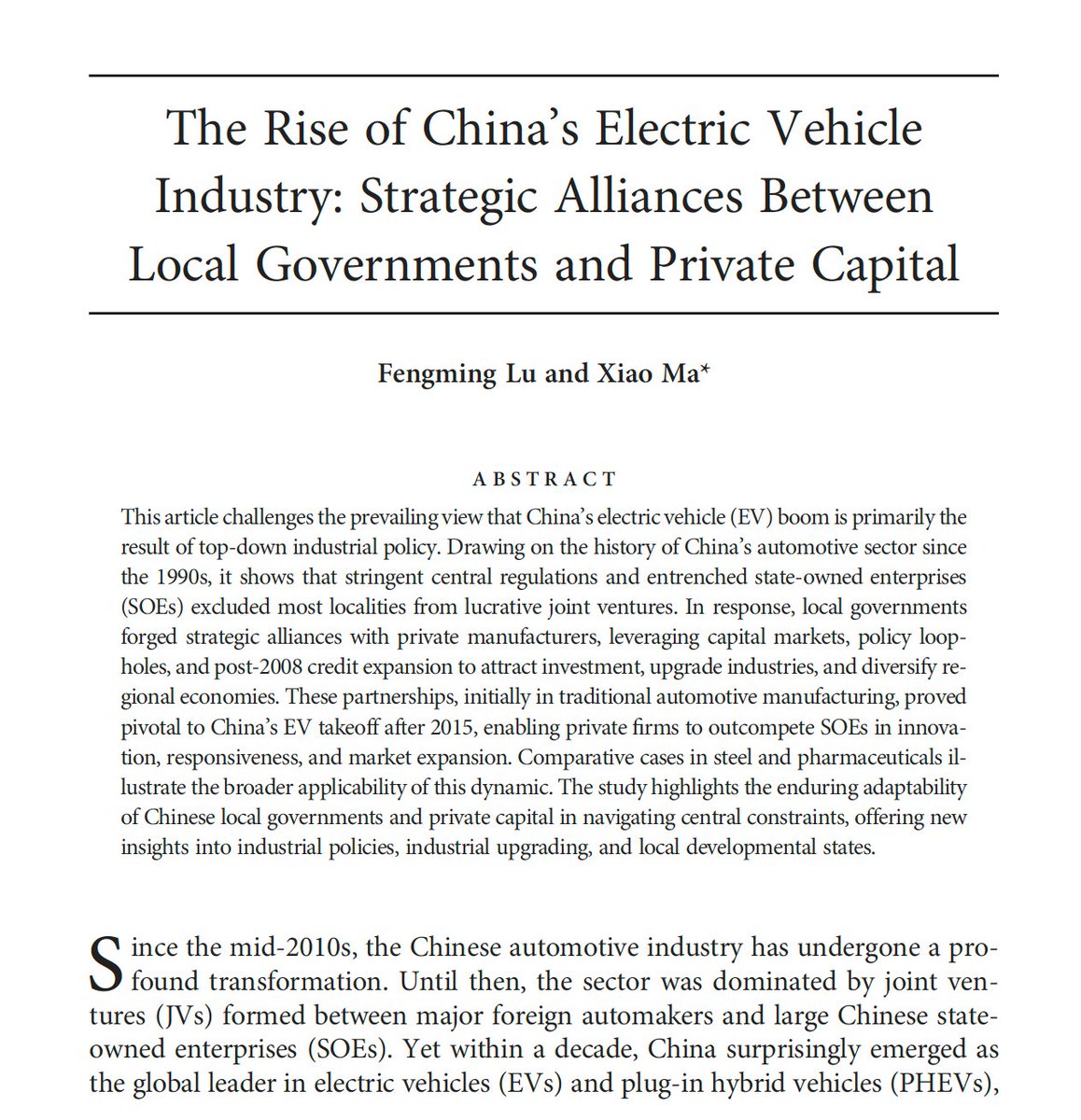
Why did private firms, not state-owned enterprises (SOEs), come to dominate China’s EV sector?
My new @ChinaJournal article (co-authored with Xiao Ma @maxiaoalex) challenge the "top-down industrial policy" narrative.
The real engine? Strategic alliances between local governments and private capital. 🧵
Based on 3 years of fieldwork, 60 interviews (with officials, entrepreneurs, and engineers), and rich first-hand accounts, we show how strict central regulations inadvertently drove local states to bet big on private EV players.
Here is the story: (1/15)
73
570
1,945
191,275
PaganTech retweeted

In simple English: What Musk and Bass said vs what the data actually shows
They said: "Blacks are not the ones being victimized. Whites are".
The data: Black Americans are victimised at 23.4 per 1,000. White Americans at 22.1. Nearly identical. Black Americans are murdered at 29.0 per 100,000. White Americans at 4.2. Seven times higher. In 2024, the FBI recorded more Black murder victims (8,158) than white (6,753) in a population that is 13% Black. The group they call the threat is the group being killed.
They said: Black people attack white people at 45 times the rate of the reverse.
The data: Same table, measured by your actual risk: a white person is 3.2 times more likely to be attacked by another white person than by a Black person. There were 1.7 million White-on-White violent incidents. Over three times the Black-on-White figure. They did not mention this.
They implied: White people are at greater interracial risk than Black people.
The data: FBI police-reported murder data, per 100,000 of the victim's population: a white person's risk of being murdered by a Black person is 0.26. A Black person's risk of being murdered by a white person is 0.56. A Black person is twice as likely to be murdered by a white person as the reverse. Same data. Bass's own method. Opposite conclusion.
They said: This is "not remotely debatable".
The data: Their own source flags cells with an exclamation mark for small samples or high uncertainty. The key denominator figure has a confidence interval ranging from 19,000 to 96,000. Their ratio could be anywhere from 3.9 to 36.7. The BJS warned the 2024 split-sample design reduces estimate precision. 19% of all violent incidents had unknown offender race, over a million cases excluded. All offender data is victim perception, not arrests or convictions.
They said: This proves Black people are a violent threat to white people.
The data: For rape, sexual assault, simple assault, and aggravated assault, Black offenders account for 10.5% to 15.6% of incidents with white victims. The Black population share is 12%. Barely above proportional. Robbery drives nearly the entire interracial disparity. Robbery is an economic crime concentrated in high-poverty areas. Strip it out and the gap largely disappears.
Musk said: There are "vastly more hate crimes" by Black people against white people.
The data: The NCVS measures general violent crime based on victim perceptions. It is not the FBI hate crime dataset. FBI hate crime statistics show anti-Black incidents dominate race-based hate crimes. Most violence is intraracial. 84% of white murder victims are killed by white offenders. 88% of Black murder victims are killed by Black offenders.
They left out: Per-victim rates. 1.7 million White-on-White incidents. The interracial murder reversal. The standard errors and confidence intervals. The BJS caution flags. The split-sample precision warning. The 19% unknown offender race. The crime-type breakdown showing robbery drives the disparity. The FBI homicide data showing Black people are seven times more likely to be murdered. The fact that violent crime has fallen over 70% since 1993.
Bass concluded: "Western civilisation has been successful because whites created systems that are impartial and fair".
The data: ABSOLUTE BOLLOCKS

.@elonmusk @kevinnbass
You amplified a claim that Black people commit violent crime against white people at 45 times the rate of the reverse, and that this is "not remotely debatable".
ABSOLUTE BOLLOCKS.
I used every source Bass cited, plus the ones he left out. Every number below has a URL.
Same table, same data. Per 1,000 of the victim's population.
(bjs.ojp.gov/document/cv24.pd…, Table 13 and Appendix Table 19)
If you are white:
From a white person: 10.0
From a Black person: 3.1
You are 3.2 times more likely to be attacked by a white person.
If you are Black:
From a Black person: 11.5
From a white person: 1.6
You are 7 times more likely to be attacked by a Black person.
1,706,750 White-on-White violent incidents. Over three times the Black-on-White figure. Bass did not mention this.
Bass wrote: "Blacks are not the ones being victimized. Whites are".
2024 NCVS Table 3: victimisation rates of 23.4 per 1,000 for Black Americans, 22.1 for white Americans.
(bjs.ojp.gov/document/cv24.pd…, Table 3)
FBI 2024: 8,158 Black murder victims, 6,753 white. Black Americans are 13% of the population.
(statista.com/statistics/2518…)
Black homicide rate: 29.0 per 100,000. White: 4.2. Seven times more likely to be murdered.
(vpc.org/studies/blackhomicid…)
The group Bass calls the threat is the group being killed.
For rape, sexual assault, simple assault, and aggravated assault, Black offenders account for 10.5% to 15.6% of incidents with white victims. Black population share: 12%. Barely above proportional.
(nationalacademies.org/read/2…)
Intraracial victimisation exceeds interracial for all violent crime types except robbery.
(bjs.ojp.gov/library/publicat…)
Robbery drives the entire disparity. Strip it out and the gap for rape, sexual assault, and assault largely disappears.
FBI murder data, 2018 (most recent full cross-tabulation; NIBRS transition disrupted subsequent years):
(ucr.fbi.gov/crime-in-the-u.s…)
Per 100,000 of the victim's population:
White murdered by white: 1.36
White murdered by Black: 0.26
5.2 times more likely to be murdered by a white person.
Black murdered by Black: 6.19
Black murdered by white: 0.56
A Black person is twice as likely to be murdered by a white person as the reverse.
84% of white murder victims killed by white offenders. 88% of Black victims by Black offenders.
(opencrime.us/analysis/crime-…)
Bass's own source warns: "Splitting the sample in half results in a decrease in estimate precision".
(bjs.ojp.gov/document/cv24.pd…, page 4)
Standard error on his key figure (536,120): 81,462. CI: 376,000 to 696,000. Denominator figure (57,370): SE 19,748. CI: 19,000 to 96,000. His ratio could be anywhere from 3.9 to 36.7.
(bjs.ojp.gov/document/cv24.pd…, Appendix Table 14)
Two cells flagged: "Interpret with caution. Based on 10 or fewer sample cases, or CV greater than 50%".
(bjs.ojp.gov/document/cv24.pd…, Table 13)
19% of all 2024 violent incidents had unknown offender race. Over 1.15 million excluded. More than the Black-on-White figure itself.
(bjs.ojp.gov/document/cv24.pd…, Table 11)
All offender race data is victim perception, not arrests or convictions. 42% of wrongful convictions from misidentifications are cross-racial.
(innocenceproject.org/race-an…)
109,341 respondents weighted to represent 286 million people.
Violent crime down over 70% since 1993. From 79.8 to 23.3 per 1,000.
(bjs.ojp.gov/document/cv24.pd…, Appendix Tables 1 and 19)

3
12
36
1,727
PaganTech retweeted
It is not just the far right. It is the media themselves, including the so-called progressive ones.
Violence in Britain has fallen 83% since the mid-1990s. Burglary 86.6%. Vehicle theft 86.4%. ONS, Crime Survey for England and Wales, forty years of data.
89.5% of prisoners serving for violence against the person are British nationals. 89.4% for sexual offences. 73% of the prison population is white.
Convictions by ethnicity are 84% white, matching population share almost exactly. Violence is the largest arrest category at 47%, and the MOJ confirms this is "broadly consistent across ethnic groups".
The disproportionality is in drug offences and weapons possession, not violent crime.
The Oxford Migration Observatory found that controlling for age and sex, foreign nationals are underrepresented in prison: 3,193 fewer than demographics predict.
The LSE found "the increase over time in offending is much stronger among the British than the Foreigners. Indeed there is essentially no change in the violent incarceration rate of foreigners over the whole period in spite of the two large immigrant waves that occurred".
A study of 55 countries over three decades (Journal of Economic Perspectives) found no correlation between immigration and crime. Homicide fell by a third globally from 1990 to 2019 while the immigrant population grew by two thirds. A separate analysis of 216 regions across 23 European countries found "no significant link between immigration levels and crime rates".
Yet the public believes the opposite. A MORI survey found the British public believed 23% of the population was foreign born. At the time, the actual figure was around one in nine. The public perceives the most negative impact of immigration to be crime. The data says foreign nationals are underrepresented in violent crime. That gap is not an accident. It is a product.
Violent crime is over 60% of tabloid crime coverage despite being 20% of reported crime. An analysis of 402,819 articles found the immigration-crime link in public perception exists because of selective coverage and breaks when native criminality is given equivalent prominence.
Arendt (2010) found over-representation of "foreign crime" articles directly led to readers overestimating foreign offenders.
Blinder and Jeannet (2017, British Journal of Political Science) showed media depictions directly affect the accuracy of British public perceptions.
The Erasmus study found coverage "disproportionately focused on crimes involving immigrants, fueling misconceptions even when data showed no substantial increase". A CEPR study found this coverage directly increased populist voting by 5%.
And it is not just the tabloids. Conservative papers focus on immigrant crime. Liberal and progressive papers focus on "group-related problems". Both frame immigration through threat.
A study of 40,000 articles found systematic bias against Muslims across UK media. The BBC, Sky, ITV, the Times, the Guardian: they all amplify crime when the perpetrator is an immigrant or non-white, not because it is more common, but because it is more engaging.
A domestic murder in Sunderland does not get 3.4 million views. A white British man who commits one of the nine out of ten violent offences in this country does not trend.
The result: a population that believes crime is rising when it has collapsed, believes immigrants are dangerous when they are statistically less so, and believes the country was safer decades ago when every dataset says the opposite.
The far right did not build this machine. The media did. The far right just learned how to drive it.
Jun 9

The big change in Britain isn't rising violence.
All statistics show that violence has fallen steeply.
It's that the far-right uses social media to selectively weaponise crimes if they can stoke division, fear and indeed violence.
42
428
1,226
96,354

Jun 9
What a bunch of idiots. They don’t want to properly tax expensive mansions, then they get upset when councils don’t have enough money to do stuff.
Jun 9

If you drive around Britain on ‘A’ and ‘B’ roads you will see that a lot of the direction signage is obscured by foliage. In the old days the trees and bushes round road signs would be cut back so drivers could actually see the signs. No one seems to bother doing it these days. Another sign of decline & the powers-that-be simply not caring.
24
PaganTech retweeted
Call you old fashioned? Alright, old-fashioned, @PatrickChristys, let us go through the decades you prefer.
The 1960s: Ian Brady and Myra Hindley tortured and murdered five children, buried them on Saddleworth Moor, and recorded their screams on tape.
The 1970s: Peter Sutcliffe murdered 13 women with hammers and screwdrivers across Yorkshire.
Dennis Nilsen began strangling young men in his London flat, dismembering them, boiling their skulls on his stove, and flushing the remains down the drains.
The 1980s: Michael Ryan shot 16 people dead in Hungerford. Fred and Rose West were raping, torturing, and dismembering women and girls and burying them under their house in Gloucester. Their own daughter among them.
The 1990s: Two 10-year-old boys abducted a toddler from a shopping centre in Liverpool, tortured him, and bludgeoned him to death with bricks and an iron bar.
Thomas Hamilton walked into a primary school in Dunblane and shot 16 five-year-olds and their teacher. Harold Shipman was murdering his patients by the hundred.
The 2000s: James Watt and his family enslaved a man for a decade, tortured him with baseball bats, air pistols, boiling water, and pit bull attacks, then decapitated him and dumped his body in a lake.
Mathew Hardman, 17, murdered a 90-year-old woman, cut out her heart, placed it on a silver platter, and drank her blood.
The 2010s: Derrick Bird shot 12 people dead across Cumbria.
Thomas Mair shot and stabbed an MP in the street while shouting "Britain first".
The 2020s: Jemma Mitchell decapitated her friend, stored the body for two weeks, and drove 200 miles to dump it.
Those are the decades you prefer. And for each decade there are 20 other equally horrific incidents.
And here is the thing, old fashioned Patrick. According to the Crime Survey for England and Wales, violence, burglary, and car crime have fallen by close to 90% since the mid-1990s. The ONS confirms that violent crime is two-thirds lower now than in the 1990s.
The country you live in today is measurably, statistically, dramatically safer than the one you are nostalgic for. That's not an opinion, it's a fact.
And I am not even touching Glasgow and its past knife crime epidemic.
So, which decade was better, Patrick? Tell us.

Call me old fashioned but I preferred our country before Somalians started trying to behead people in the street.
647
993
3,755
185,340
PaganTech retweeted

Expansion has nothing to do with it. Germans did the same way more often (and tried to genocide them along the way) yet none of these nations harbor even 1% of hatred for Germany than they have for Russia.
The difference is that due to their slavic inferiority complex, they consider Germans and western Europe as a superior civilization, so being conquered and even slaughtered by them is not a big deal, not a big offense.
But due to this complex they've come to see everything eastern, orthodox and genuinely Slavic as backwards, inferior, subhuman. So when the supposed backwards inferior Eastern Slavic Russia conquers them, it's a major slight to their worldview, to their national consciousness. Cuz now youre being ruled by inferior people, not those übermensch Germans you aspire to be. And that creates GENERATIONAL, GENOCIDAL hatred that will for centuries. The worst thing you can do to a western/catholic Slav is remove German heel from his face.
Same thing with Finland really. They've been nothing but cumbuckets and Canon fodder for centuries under Sweden. Their first true autonomy and dignity came under Russia. But that doesn't matter. Swedes are master race, they bring civilization, Ruskis are Mongolian orcs. So we're mad they ruled us.

And funny who hates Russia the most? Poles, Czechs, Ukrainians, Balts... In essence, those who suffered under its attempt to expand for last 8 centuries.
52
64
671
27,827
PaganTech retweeted

I’m beginning to wonder whether the central mistake of 20th century feminism was that it embraced the entire toxic mess that was upper middle class male culture circa 1960 — corporate careers, constant alpha behavior, compulsive sexuality, emotional starvation, and the rest of it — as its model of what empowerment is like.
15
33
348
12,045
PaganTech retweeted
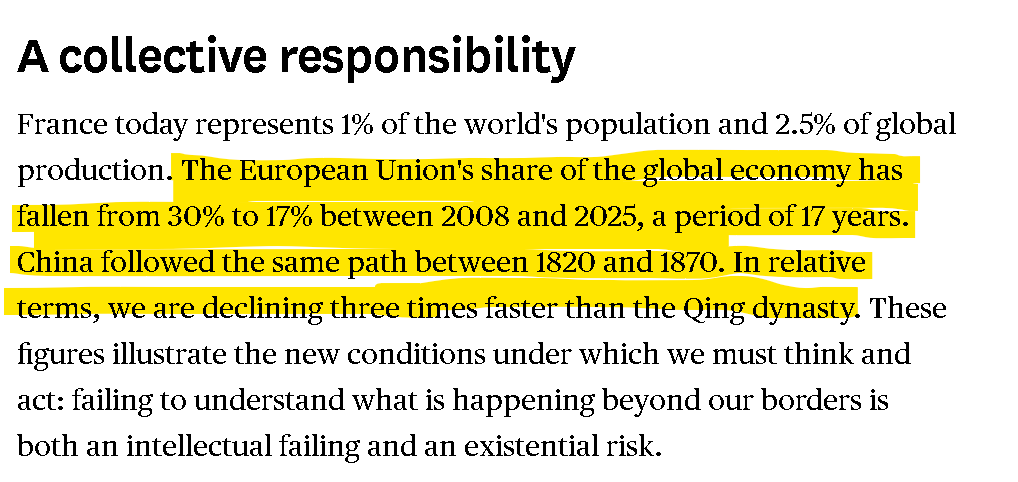
People don't grasp the sheer speed and scale of Europe's decline.
This 👇 is an extraordinary number shared by Luis Vassy, director of Sciences Po (one of France's most famous schools) in this article: legrandcontinent.eu/fr/2026/…
He calculated that the EU is declining 3 times faster than the Qing dynasty at the height of China's century of humiliation.
Back then, it took China 50 years to drop from 30% of world GDP to 17%, whereas it took the EU just 17 years (from 2008 to 2025).
Insane 😢 And, sadly, given the current direction and the EU's systematically suicidal policy choices (latest example: x.com/RnaudBertrand/status/2…), it's just the beginning...

It always astonishes me how there is virtually ZERO public debate - or even public awareness - in Europe about the decisions that will most shape ordinary people's lives.
These days, the EU is drafting a new anti-China legal framework where - quite literally - the more affordable and competitive Chinese products are, the more illegal they'd become.
You'd think EU citizens would want to be informed about such things - as it couldn't be more consequential for their prosperity.
Yet I bet virtually no EU citizen is even aware of it, beyond a vague sense that there is some sort of trade dispute going on.
So what's going on exactly? It all centers around a new legal instrument the EU is drafting called the "overcapacity instrument" (euobserver.com/218003/china-…).
First of all, the very notion of "overcapacity" is pretty ridiculous to begin with, especially the way it's being defined by the EU, as it basically means being competitive enough to export.
By this definition of "overcapacity," pretty much every European industry that's ever run a trade surplus - German cars, French wine, Italian fashion - has been guilty of "overcapacity."
I'm not even exaggerating: if you read this study by the EU Parliament on "Industrial overcapacities, with a focus on China" (europarl.europa.eu/RegData/e…), they define "overcapacity" as building more capacity than your domestic market can absorb. So the moment you build capacity to export abroad, you're in "overcapacity."
Utterly ridiculous.
And what this "overcapacity instrument" is about is creating a permanent legal mechanism for the EU to block Chinese competition across whole sectors of the economy, if they happen to be in "overcapacity."
In effect, this means that if China is competitive globally in a given sector in such a way that it exports a lot, that's proof of overcapacity, and legally it'd mean that the entire sector can be restricted from the EU market.
Which means it really, factually, is a legal framework where the more affordable and competitive your products are, the more illegal they become.
Which is a CRAZY economic concept! 🤦♂️
Please note that it's different from the anti-subsidy legal instrument, which the EU has already put in place in 2023 (the "Foreign Subsidies Regulation": competition-policy.ec.europa…).
This "overcapacity instrument" would be above and beyond this: it wouldn't even matter if a particular sector was subsidized by the Chinese government or not, the mere fact of its competitiveness in exports would be grounds for restrictions in the EU.
It doesn't take a genius to understand how badly this could impact everyday people: this is European consumers being forced to pay more for worse products by law, so that uncompetitive European firms don't have to improve.
Politicians frame it as avoiding a "China shock 2.0" but really this is choosing an even steeper self-inflicted decline than is already the case, where EU citizens would subsidize mediocre EU companies that would have even less pressure to catch up. It's a hidden tax: subsidies for uncompetitive firms paid by consumers instead of governments, which in turn makes them less incentivized to become competitive.
The first "China shock" did de-industrialize Europe somewhat, but at least it made things cheaper for European consumers. If this becomes Europe's response to a second "China shock" not only it'd make everything more expensive but it'd do nothing for EU industry: you don't become competitive by banning the competition...
Look at China itself: the way it industrialized was NOT by banning Western firms but on the contrary by welcoming them strategically and learning from them. You learn to compete by... competing, duh!
What I find most shocking in all of this isn't even the policy itself - you can make arguments for and against protectionism, and reasonable people can disagree.
What's shocking is that virtually no European media outlet is explaining any of this to the public. This is unarguably one of the single most consequential economic decisions the EU will make this decade, affecting the price of everything, and it's being drafted in near-total silence.
No newspaper is running the headline "EU plans to make Chinese goods illegal if they're too affordable" - even though that's essentially what's happening.
But that's what you call a "democracy" with "freedom of expression" these days apparently...
227
1,555
4,272
221,654
PaganTech retweeted

People who haven't been to China may not know. Spaces under viaducts are often the most vibrant.
Table tennis courts, dirt bike tracks, basketball courts, people singing and dancing. You almost never see homeless people, druggies, abandoned needles or graffiti.
In a high trust society, the darkest places can be the safest. If criminals are not glorified or in charge of the government.
37
121
1,002
194,209
PaganTech retweeted

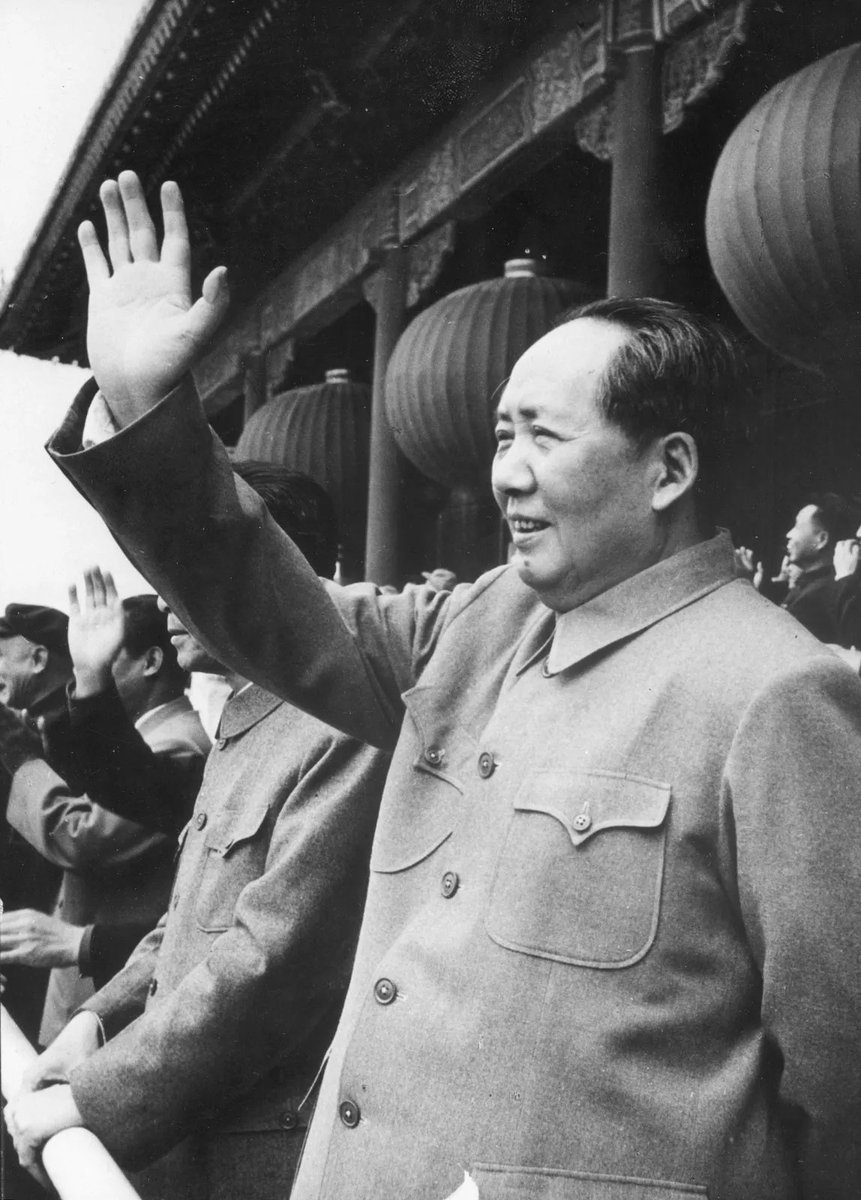
Mao Zedong is not just one of the greatest heroes of China's history, but one of the greatest heroes of world history.
A wise Chinese woman told me that “China was a light that guided the people out of darkness at critical time.”
Help me add to this list of his achievements.
1. Founded modern China.
2. Ending warlord fragmentation and the "century of humiliation."
3. Restored sovereignty and ended colonial foreign domination and unequal treaties
4. Implemented nationwide land reform (early 1950s), redistributing land from landlords to peasants and breaking feudal structures.
5. Promoted women's rights via the 1950 Marriage Law, banning forced marriages, concubinage, and foot-binding.
6. Ended historic illiteracy through mass education campaigns.
7. Increased primary school enrollment and access for the masses.
8. Improved public health with "barefoot doctors," sanitation drives, and disease eradication efforts.
9. Raised life expectancy from 38 years in 1949 72 years.
10. Led the development of heavy industry with Soviet aid, despite brutal sanctions from the USA.
11. Established state-owned industrial base, laying groundwork for later development in steel, coal, machinery.
12. Developed nuclear weapons which protect the nation today from imperialism powers.
13. Stop the imperialists from taking all of Korea.
14. Built extensive irrigation and infrastructure through mass mobilization (dams, canals, etc).
15. Opened diplomatic relations with the U.S. via Nixon's 1972 visit, shifting global geopolitics.
16. Unified written language efforts and simplified Chinese characters for broader literacy.
17. Fought the Fascist Japanese occupation effectively in base areas during WWII.
18. Inspired global anti-colonial movements as a symbol of Third World revolution.
19. Achieved early economic growth in the 1950s, despite brutal US sanctions on farming equipment and machinery.
20. Built foundational transportation infrastructure (railways, roads).
21. Elevated China's status as a major world power despite US attacks, counterintelligence, and sanctions.
344
516
2,120
92,327
May 27
RT @BrianJBerletic: US-Iran "Negotiations"
I warned that the US objective is not necessarily toppling Iran immediately, and certainly not…
469
PaganTech retweeted

May 26
You can just tell they’re several tax brackets above you.
142
580
8,611
827,071
PaganTech retweeted

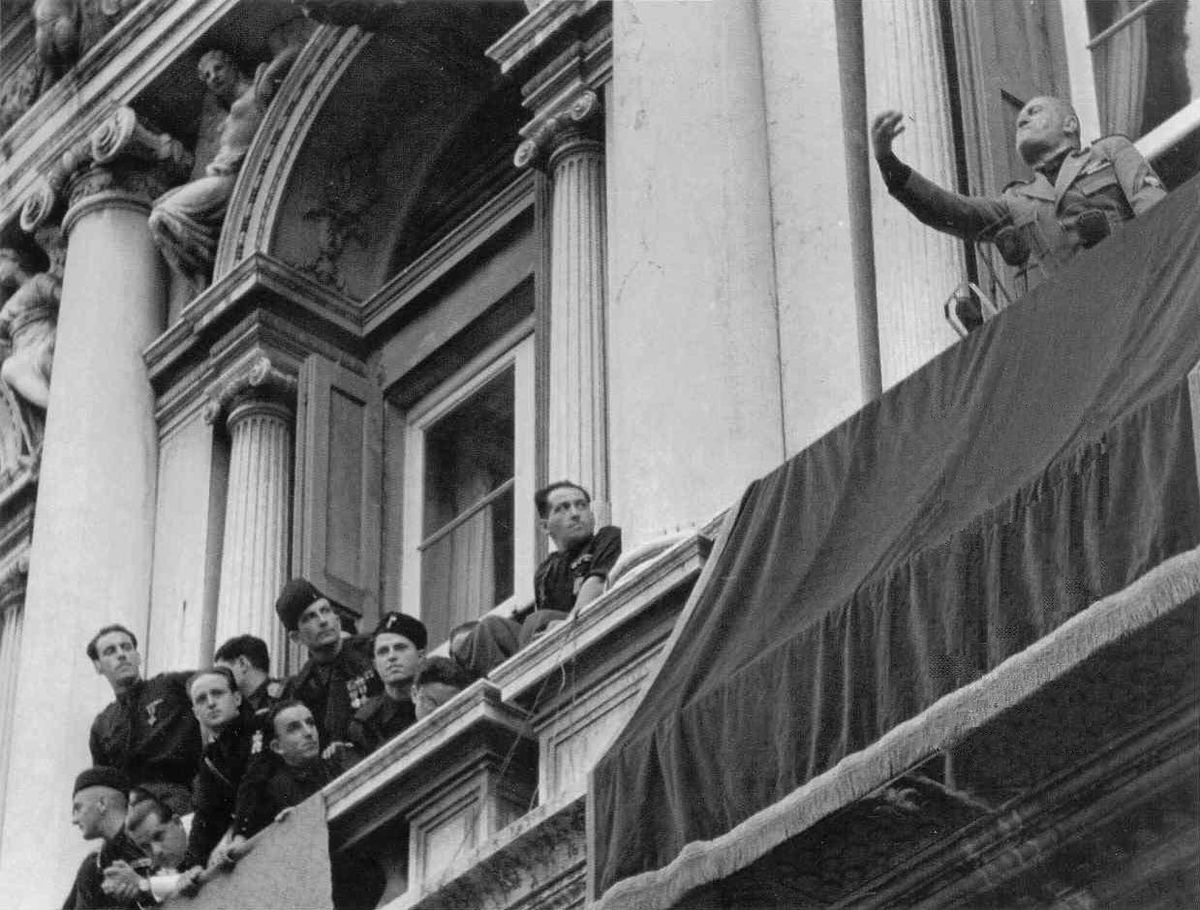
"The Nordicists should explain to us why the Nords have not created in their places of origin any civilization on the level of Greece, Rome or the Spanish Empire."
- Benito Mussolini, 1934
149
248
2,288
132,538

