@C_A_Palma Laboratory for Atomic-scale Quantum Matter #HUBerlin #Beijing IOP CAS #Berlin @IRISAdlershof @CSMB_HU @PalmaLab@mastodon.social @PalmaLab@bsky.social
- Tweets 316
- Following 1,654
- Followers 1,350
- Likes 31,221

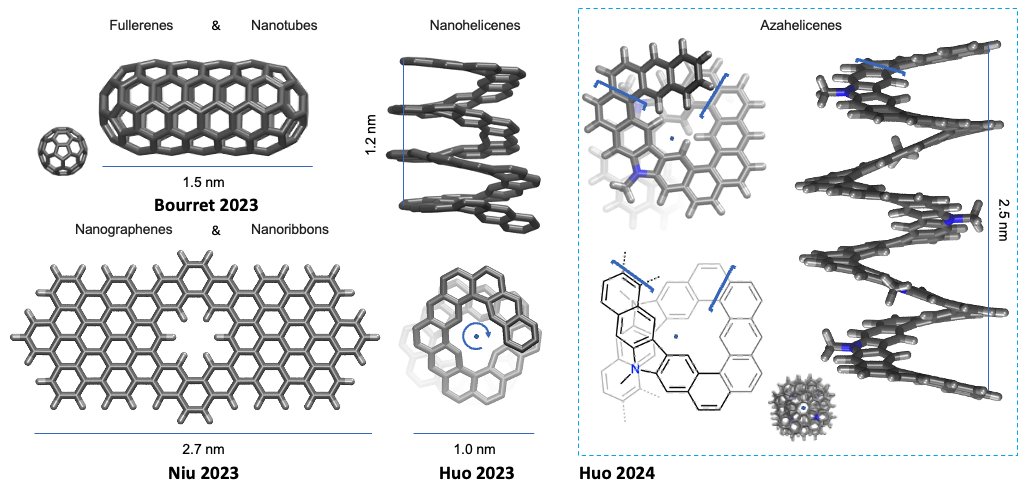

ALT The figure compares nanohelicene, nanotube and nanoribbon work by, respectively: Huo, G.-F., Xu, W.-T., Han, Y., Zhu, J., Hou, X., Fan, W., Ni, Y., Wu, S., Yang, H.-B., and Wu, J. (2024). Expanded Azahelicenes with Large Dissymmetry Factors. Angew. Chem. Int. Ed. 63, e202403149. https://doi.org/10.1002/anie.202403149; Bourret, E., Liu, X., Noble, C.A., Cover, K., Davidson, T.P., Huang, R., Koenig, R.M., Reeves, K.S., Vlassiouk, I.V., Cote, M., et al. (2023). Colossal C130 Fullertubes: Soluble [5,5] C130-D5h(1) Pristine Molecules with 70 Nanotube Carbons and Two 30-Atom Hemifullerene End-caps. J. Am. Chem. Soc. 145, 25942–25947. https://doi.org/10.1021/jacs. 3c09082; Niu, W., Fu, Y., Serra, G., Liu, K., Droste, J., Lee, Y., Ling, Z., Xu, F., Cojal Gonzalez, J.D., Lucotti, A., et al. (2023). Bottom-up Solution Synthesis of Graphene Nanoribbons with Precisely Engineered Nanopores. Angew. Chem. Intl. Ed. 62, e202305737. https://doi. org/10.1002/anie.202305737.



ALT Credit: HHU/Paul Schwaderer