
Empowering: Tech, Real Estate, Investing. Bio at rex.com/pete
Joined November 2016
- Tweets 4,297
- Following 159
- Followers 100,377
- Likes 1,899
1,073 Photos and videos




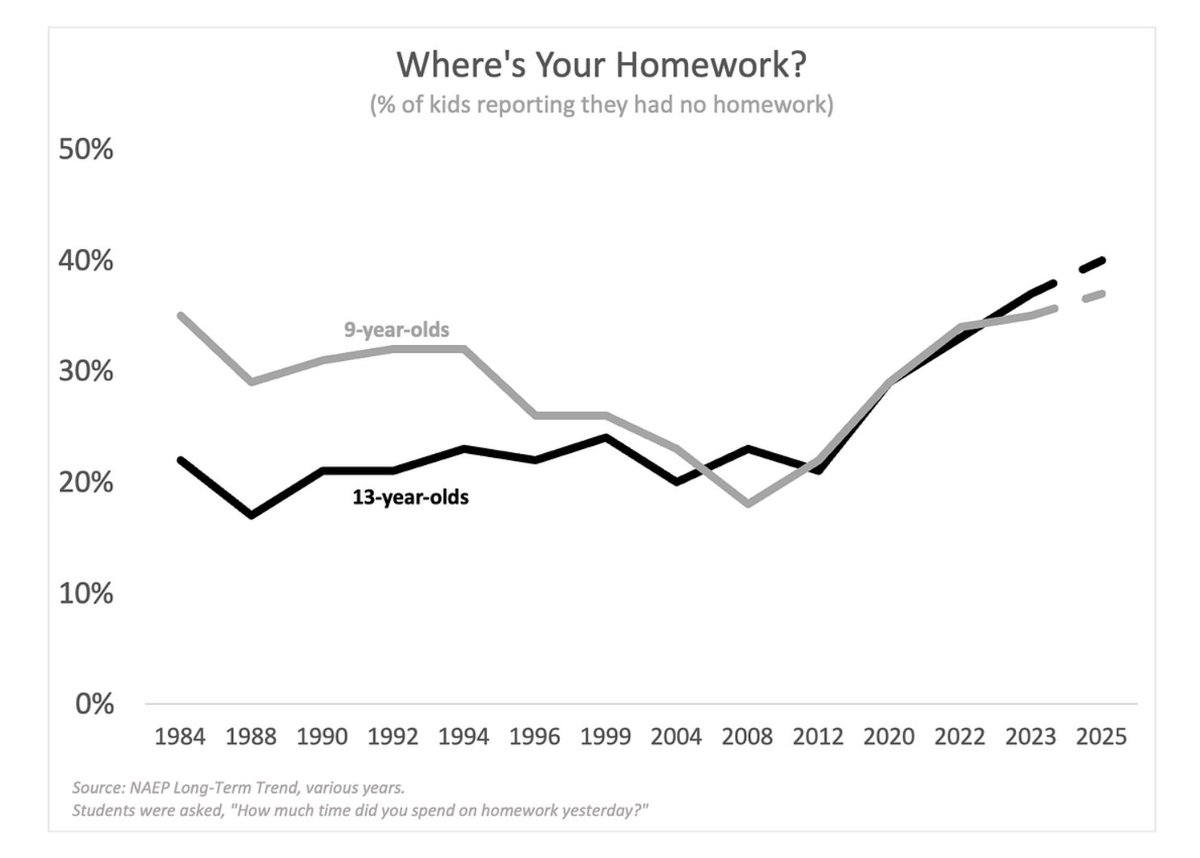
Reading and homework are down for kids, among other things. System keeps lowering rigor and then wondering why kids end up less prepared.
Productive habits, real work, good stress, none of that happens by accident. Kids develop into capable adults by doing hard things and being held to a standard.
Whole reason we homeschool. Wont be the last family making this call either…
Jun 12

We are witnessing a drop in pleasure reading and a rise in the share of kids reporting no homework.
Also, the share of students taking Algebra in 8th grade has dropped from 34% to 23% since 2012.
This can’t end well.
@ChadAldeman reports:
"A small amount of homework that specifically reinforces what kids are learning in school can produce learning gains. It can also help students form productive habits and routines."
2
331
As a Christian in business, you should be working for the lord.
Secular business people will always work incredibly hard purely for money reasons.
But if you view your business as a vocation and you are working for the Lord, you have infinitely bigger reasons to be diligent.
Christians in business should have the hardest work ethic out there because our work is tied to higher ideals and enduring, lasting value that goes beyond this life. Working solely for money is entirely pointless.
Historically, enduring civilizations never respected people who were purely driven by cash. They were viewed as shallow/greedy, and for good reason.
Money is necessary and has its purpose, but it must always be subordinated to higher orders like family, relationships, serving others, and God.
1
84
Texas is THE place to be.
No state income tax, real energy, real builders, business friendly start to finish.
Why we moved Rex to Texas back in 2020. Migration was barely getting started then, gap only widens from here...
Jun 11

Texas has replaced California as the state with the most Fortune 500 capital. 💰
Texas’ 57 Fortune 500 companies made roughly $2.8 trillion in revenue last year, compared to California’s 56 companies and roughly $2.7 trillion revenue.
New York comes in third with 53 companies and $2.2 trillion.
fortune.com/2026/06/03/which…
2
1
21
2,820
Running a large property management operation spread across the United States is an incredibly difficult business to manage.
But, it gives you an undeniable competitive advantage:
It is rich with indirect benefits and information.
Operating thousands of units gives you real-time business insights and data that are highly valuable for trading assets. It informs your decisions on when to buy, when to sell, and when to refinance properties.
On top of that, the scale gives you massive bulk buying power that lets you optimize procurement for goods and services, driving direct cost savings straight to the properties.
1
133
Inflation drives up the replacement costs of goods, properties, and everything else being insured.
Naturally, insurance premium costs are going to go up as a result. But inflation won't change the baseline demand for insurance.
Why?
Because insurance demand isn't elastic, it’s largely driven by regulation and required risk mitigation. Property owners and businesses require the people they do business with to carry insurance. The demand is going to continue on its way, steady and consistent, regardless of how much the underlying costs rise.
111
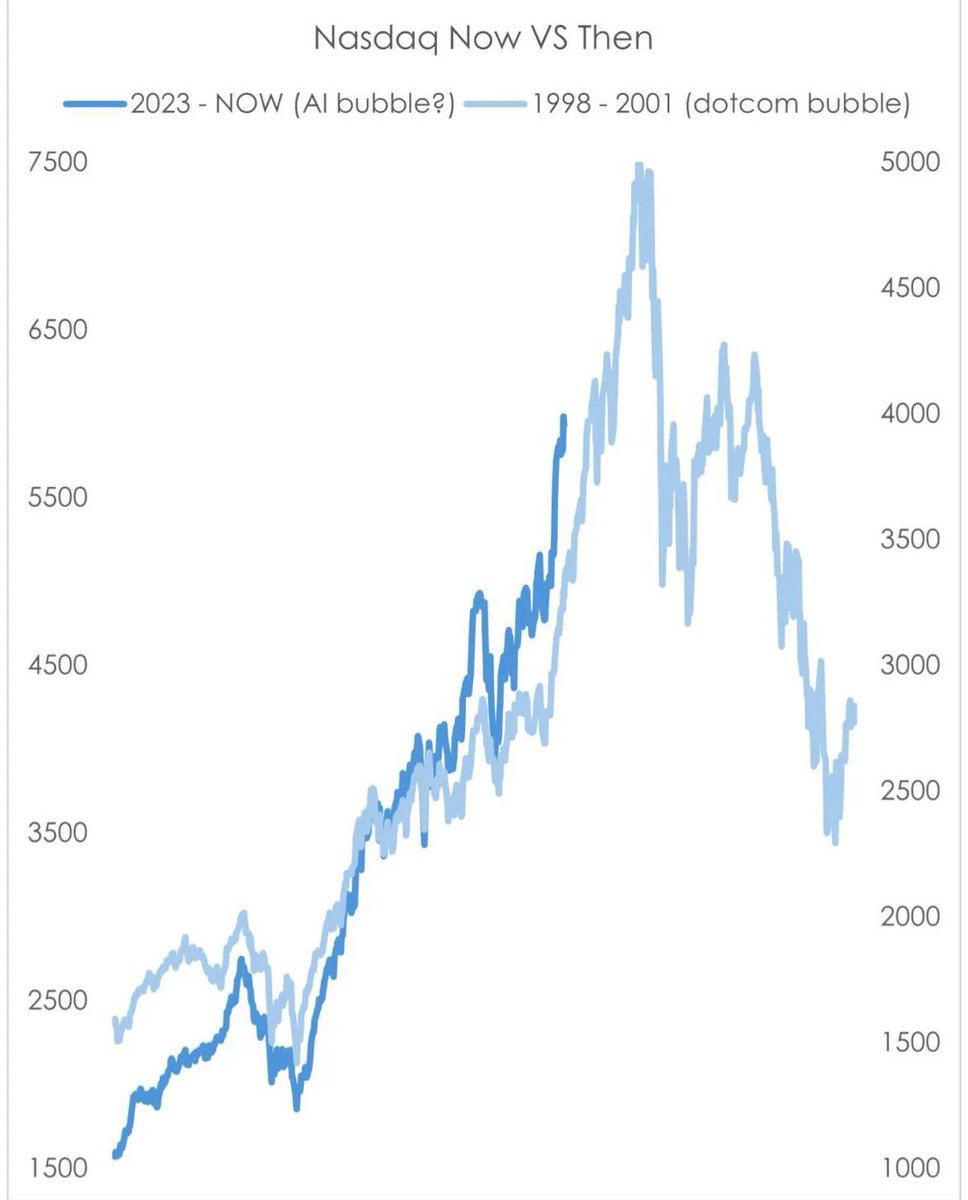
So many people want to say there isnt a bubble because AI is real/good tech, they're wrong, as both can be true at the same time.
Bubbles are about investor behavior, and not the tech itself.
Look back at the internet in 99, even when the bubble popped, the internet didnt go anywhere & kept getting better.
Jun 10

Some considerations that many folks seem not to get:
1. It can be a bubble even if the tech works. (For instance, if the tech doesn't have a high-demand use case.)
2. It can be a bubble even if the tech works and has strong product-market fit. (For instance, if the tech cannot be economically viable.)
3. It can be a bubble even if the tech works, has strong product-market fit, and has a path to eventual economic viability. (For instance, if profitability takes too long to achieve or makes margin/competition assumptions that fail to materialize.)
4. It can be a bubble even if the tech works, has strong product-market fit, and is currently highly profitable. (For instance, if demand has a hard ceiling and growth stops once the ceiling is reached.)
5. It can be a bubble even if the tech works, has strong product-market fit, is currently highly profitable, and has unlimited future demand.
Literally all it takes for something to be a bubble is for lots of people to over-enthusiastically bet their money on it, and subsequently get panicky.
Importantly, bubbles can be attached both to things that are completely hogwash, like the Metaverse, and to world-changing developments like the Internet or railways. Bubbles don't care. They're brought into existence by the thoughts and feelings of investors, not by actual tech or products.
"The bubble has burst" doesn't mean "the tech didn't work" or "people stopped using the tech." It only means that people got panicky, investor money dried up, and valuations collapsed. Internet adoption didn't stop in 2000.
3
193
We at Rex went remote. It's not for everyone, but it is best for us.
In our world, we compete against Silicon Valley on the tech side and Wall Street on the private equity side.
Being that we were not located in the San Francisco Bay area or in New York, we had to find a way to level playing field on talent because those two areas are by far the most dense in terms of talent locally available in tech for SF and PE in NY.
No other city can properly compete as a homebase in terms of talent.
We thus chose to change how we play, opening up the global talent pool of remote workers to hire, and now we're competing in a fair game and arguable have access to an even deeper bench.
Are y'all remote, in person, or hybrid?
2
128
Proptech has primarily gone after the leasing side of the equation of real estate, or the sales side.
Why?
Because that's the side of the pain most engineers and product people understand.
The other side, the rough and tumble operating side, has been left as greenfield mostly and we at Rex Tech are happy for it. We're from the operations side, so solving this pain is self-medicating.
Tech solving for operational weakness has a number of great attributes we love. The mission helps working people, to do their jobs better and provide a better home for people.
The pain being addressed is not going away, ever, as far as we can see. Robots may one day do some of the work (although not in our lifetimes), but the work will nonetheless need to be done.
The last great thing about the operations side of proptech is that the data is a treasure trove, turning what otherwise is a blackhole of information, into actionable insights to inform what parts to order and when, how worker productivity is really doing, what service volume to expect generally for staffing purposes, and so much more.
134
How do bubbles happen?
You can never underestimate the irrationality of humans when money is involved.
A guy buys something at a price that makes no sense. Everyone says he’s dumb. Then he sells it for 5X. Then the guys who called him dumb start to think they are the ones who are dumb. It’s social confirmation bias. Everyone starts walking down the street together, even if they’re walking off a cliff.
For example: in real estate in 2019, the values didn’t make any sense. I stopped buying. We sold our last asset in June 2022 for $95M when I thought it was worth $75M.
When you see people leaving PE jobs to start AI startups because they see one colleague make money in 2 years, that’s the imitation game. Mimetic desire. That’s what drives up value in a bubble.
127
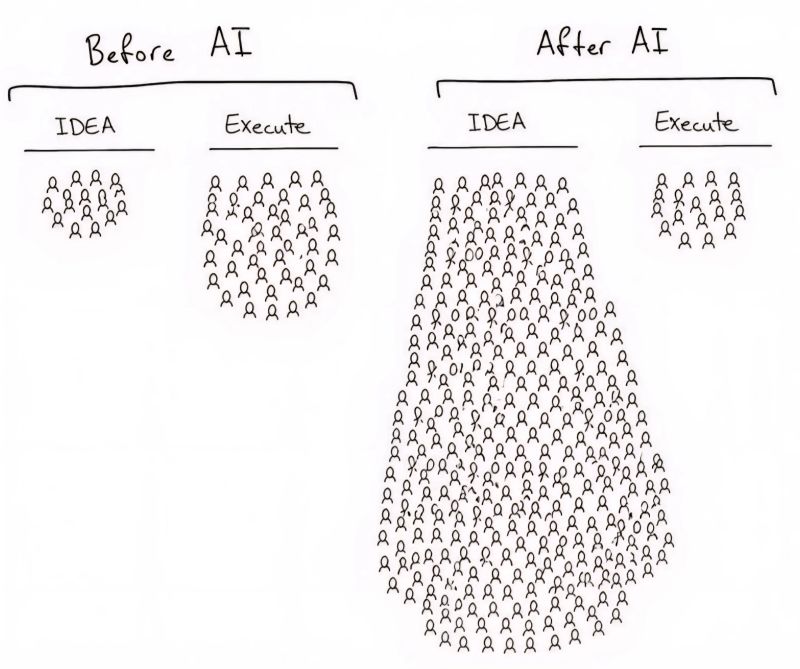
AI makes it easier to “do things” but it does not necessarily make it easier to do them well.
Anyone can now take an idea straight to product in sometimes as fast as a couple hours.
This results in lots of mediocre products, but the really good ones that had a lot of thought and expertise put into them still stand out.
Judgement is at an all time premium

200
Edge computing / on-device AI is going to be a substantial benefit to running AI/data on workers' phones.
There's not only a latency issue for on-site workers at properties, there's a meaningful connectivity issue where certain parts of a large property lack wi-fi connectivity or cell phone reception.
Being able to execute compute on-device will be a game changer.
98
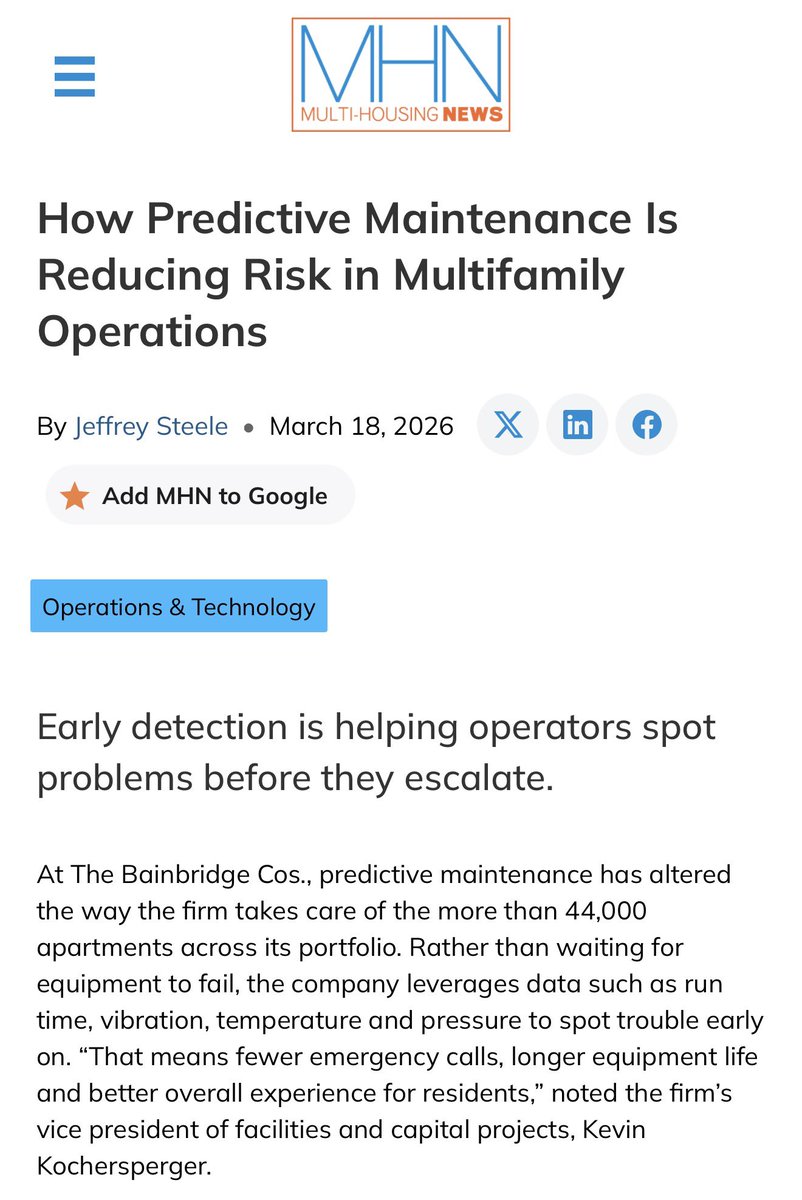
IoT sensors, with AI, enable predictive maintenance.
We can now more precisely get ahead of an issue, like a failing HVAC system, leveraging real-time data made actionable by AI.
The maintenance industry across the world is taking care of hundreds of trillions in property assets.
This is a game changer for their effectiveness, will boost investment performance for owners, and most importantly improve quality of life for all of us humans everywhere who live, work, and play in and around real estate all day, every day.
126
We are just at the beginning of the AI age.
Adoption of AI is barely starting outside the tech bubble.
Way earlier in this cycle than most folks think, and folks wielding it now have a real head start
Jun 4

It’s funny when you step outside the tech and online bubble… most CFOs still aren’t really doing anything with AI.
I asked one about controlling token spend earlier in the week, he said “what’s a token?”
This was a serious finance leader in at a big consumer brand. Was far more concerned about margin pressure from inflation risk, supply chain fractures, a big CapEx program, refi risks / credit markets.
Do remember that this is where most businesses are at still with AI… they’ve got a heap of shit on their desk to work through.
It’s still very very early.
1
2
9
1,666
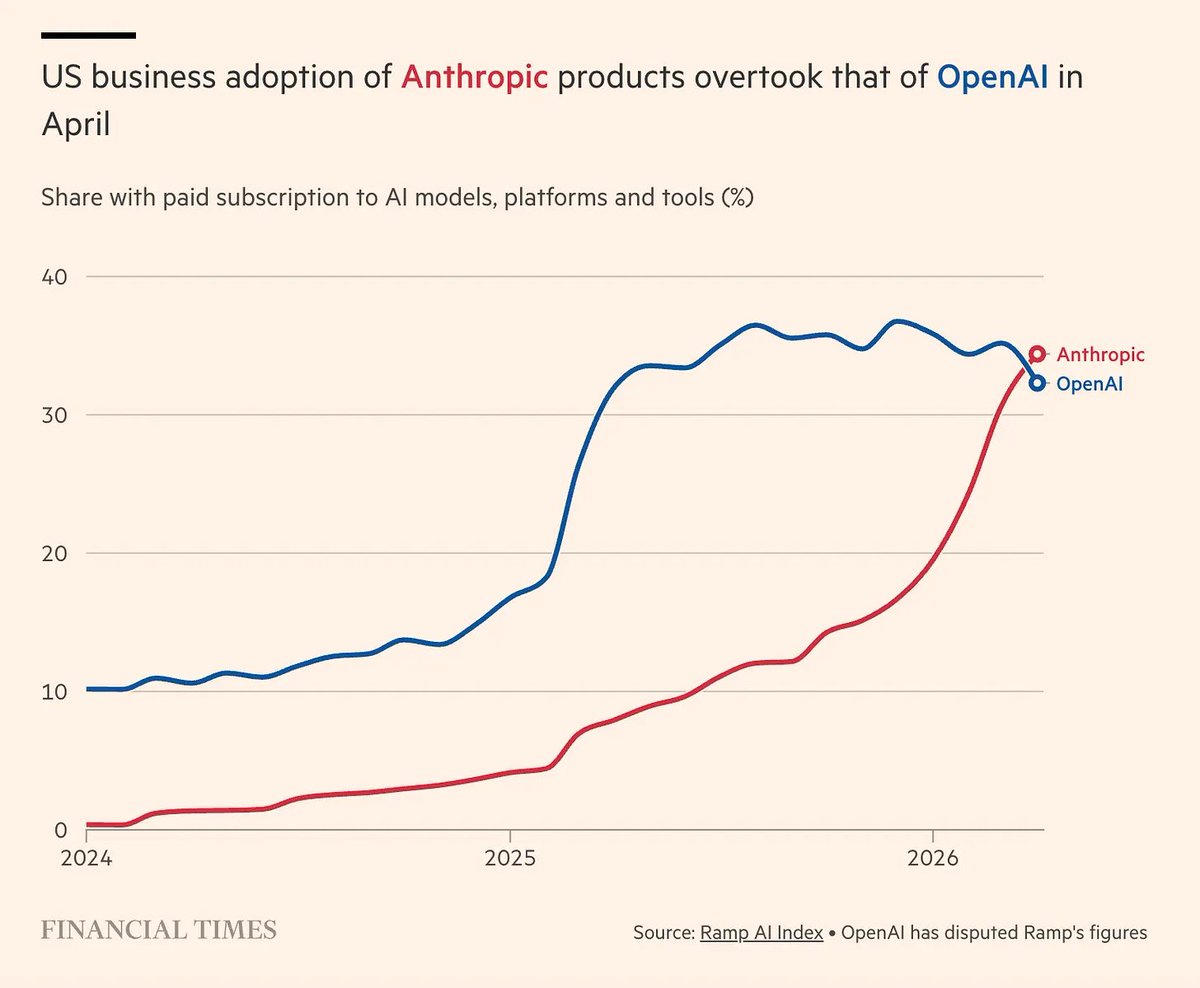
AI race is tightening, but it seems enterprise AI use is going to be v important.
Anthropic was smart to focus heavily on enterprise, as there is prob much more upside there than consumer use, esp as token costs rise...
Jun 4

Anthropic adoption has overtaken OpenAI adoption among US businesses in the US! More at today's Chartbook Top Links:
1
196
The AI boom is different than when the internet blew up.
Lots like to make this comparison, but here's why they're different:
The internet democratized distribution.
AI is different, it’s transforming everyone's intellectual firepower. It’s basically steroids for the brain. It distributes tooling that used to be esoteric, like law, healthcare, or software engineering.
Before, you had to learn a specific language to build. Now you don’t.
We hit a crescendo of demand for engineering that we couldn't meet with supply in the USA.
Now that’s gone the other way. Anyone can engineer something very quickly now.
The old world persists, but this new way of doing things creates massive competition for the old way over the next 20 years.
1
1
120