
Automated arbitrage across prediction markets. BTC Up/Down module on @Solana. 90ms execution. Powered by @jup_predict. Runs 24/7.
Joined February 2025
- Tweets 238
- Following 19
- Followers 8,841
- Likes 57
14 Photos and videos


Pinned Tweet

Apr 26
We built the cleanest BTC Up/Down bot on Polymarket.
We engineered the entire stack from scratch around one principle: never bet on outcomes, only capture mispricings.
How it works:
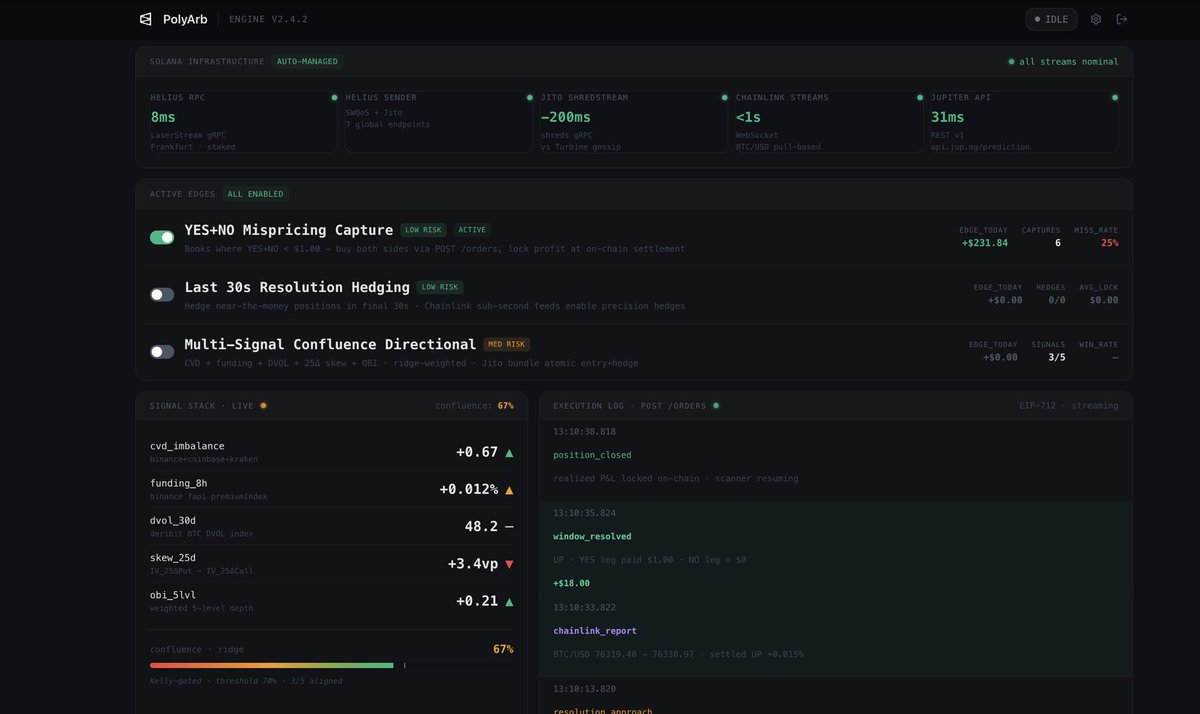
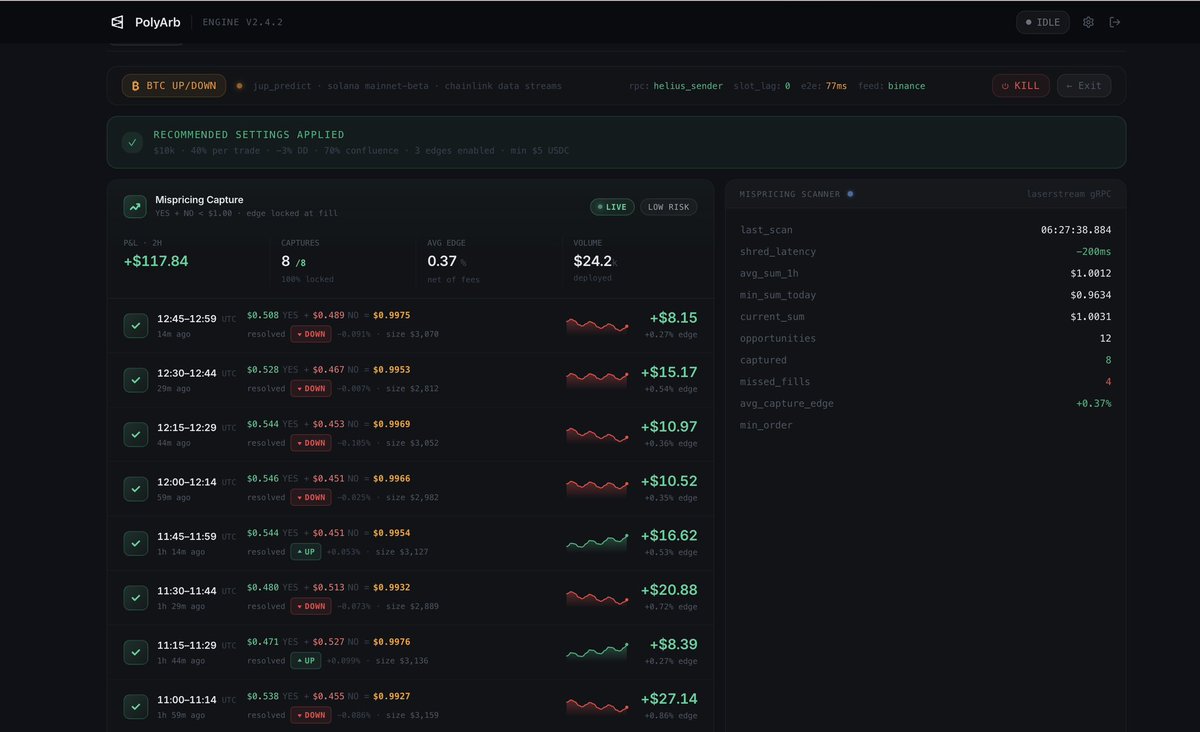
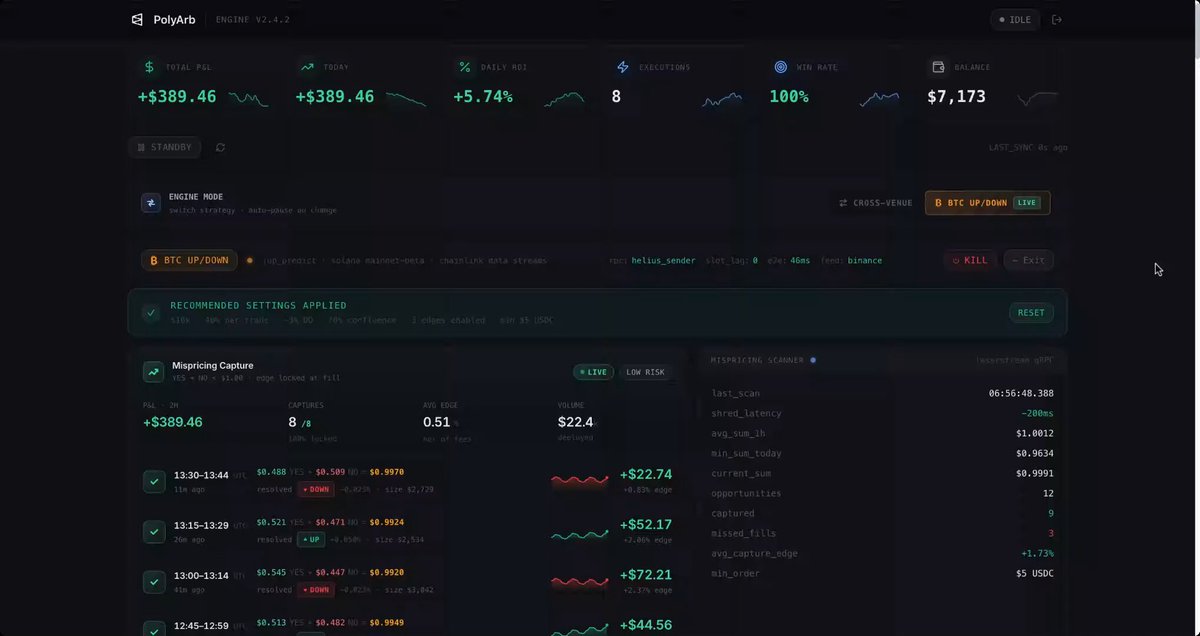
When YES NO sums to less than $1.00 on Polymarket’s 15-min BTC market, the engine fires both sides atomically via Jito bundles. Total cost: $0.97. At resolution, one side always pays $1.00. Locked profit: 3 cents per dollar deployed.
BTC’s direction is irrelevant. The math already paid.
We don’t predict. We capture.
Architecture:
- Yellowstone gRPC at 1-5ms orderbook latency
- Jito atomic bundles, both legs fill or neither does
- 91ms median detection-to-fill
97.8% fill rate over 30 days
- Auto-hedge engine for partial fills in 4.2s
How to plug in:
1.Sign up at PolyArb (link in bio)
2.Copy PolyArb dedicated RPC URL from the dashboard
3. Open @jup_predict on Solana
4.Paste the RPC into Settings → Custom RPC
5.Activate the BTC Up/Down module
Free to use. Profit-share only. No subscription. No upfront cost.
85
49
601
129,793
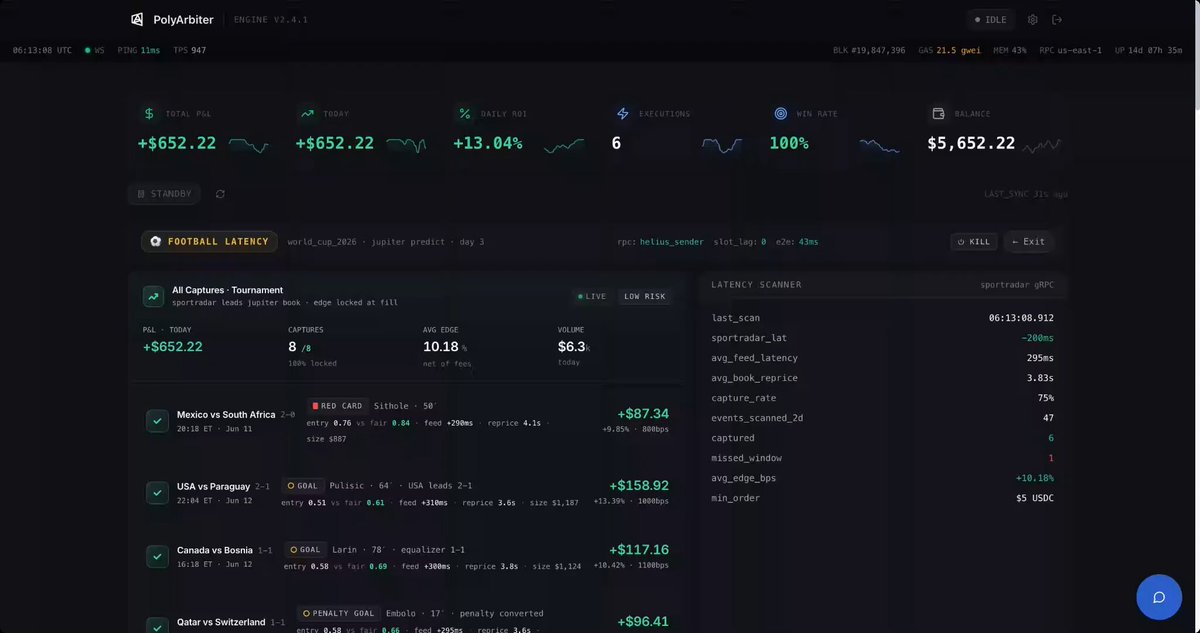
We spent 2 months building the best possible bot for this World Cup, and it’s already captured $652 across 6 matches without predicting a single one.
How it’s works:
When a match-changing event happens a goal, a red card, a penalty awarded pro data feeds (Sportradar, Opta) register it within 200-500 milliseconds. Polymarket takes 2 to 8 seconds to reprice.
Market makers pull their quotes to reassess, and during that air pocket, the orderbook is still quoting a probability that no longer reflects what just happened on the pitch.
That’s the flaw. And it can’t be patched: pulling quotes after an event is how market making works.
Here’s the part that matters: no human can trade it. By the time you see the goal, open the app, click it’s gone. This window opens almost daily until July, and is physically unreachable without a machine.
So we built the machine.
We’ve been building bots on Polymarket since 2025 our BTC Up/Down engine runs the same atomic execution you’re about to see here. The World Cup just gave us a new signal to point it at.
Event detection on the feed → fair value recalc → both legs executed before the reprice. Atomic bundles on Solana, ~90ms. The bot only fires when both legs lock atomically. If the fill isn’t certain, nothing executes you’re never caught half-filled or exposed to a swing.
What it’s captured so far:
→ Mexico 2-0 South Africa (red card) $87.34
→ USA 2-1 Paraguay $158.92
→ Canada 1-1 Bosnia $117.16
→ Qatar 1-1 Switzerland (penalty) $96.41
→ Brazil 1-1 Morocco $128.47
→ Haiti 0-1 Scotland $63.92
$652.22 total. No prediction, no open position every one was already scored before the orderbook repriced. Every fill on-chain and timestamped.
When we posted the architecture on X 2 months ago, the bot wasn’t even finished. The thread did 1M views on its own. That was the blueprint. This is what shipped.
Nearly 100 matches left. $2.5B in projected volume.
The model is simple and non-custodial. The bot executes from your own wallet you never deposit funds with us. We charge nothing upfront and take a percentage of realized profits. When the bot doesn’t capture, we don’t get paid.
Access is capped, and that’s a technical constraint, not a marketing one. The mispriced liquidity on any event is thin. Every additional wallet firing on it eats the same liquidity and compresses everyone’s edge. More users = a worse product, for you and for us. Our own incentives force us to close the door.
Onboarding in batches. Batch 1 is open now and filling. We’ll announce here before we cut signups for the group stage and we won’t reopen mid-match.
How to setup? setup takes about 2 minutes:
1. Sign up at PolyArb (link in bio)
2. Copy your dedicated RPC URL
3 . Open @jup_predict (Polymarket, native to Solana)
4. Paste into Settings → Custom RPC
5. Activate the World Cup module
Set your parameters and run.
16
16
130
3,776
Apr 16

We’re building a latency Football bot for Polymarket. Target: operational before the World Cup. Save this.
The principle: pro sports feeds (Sportradar, Opta) deliver pitch events in ~200-500ms. The Polymarket orderbook takes longer to reprice thin liquidity, market makers pulling quotes while they reassess. That window is the edge.
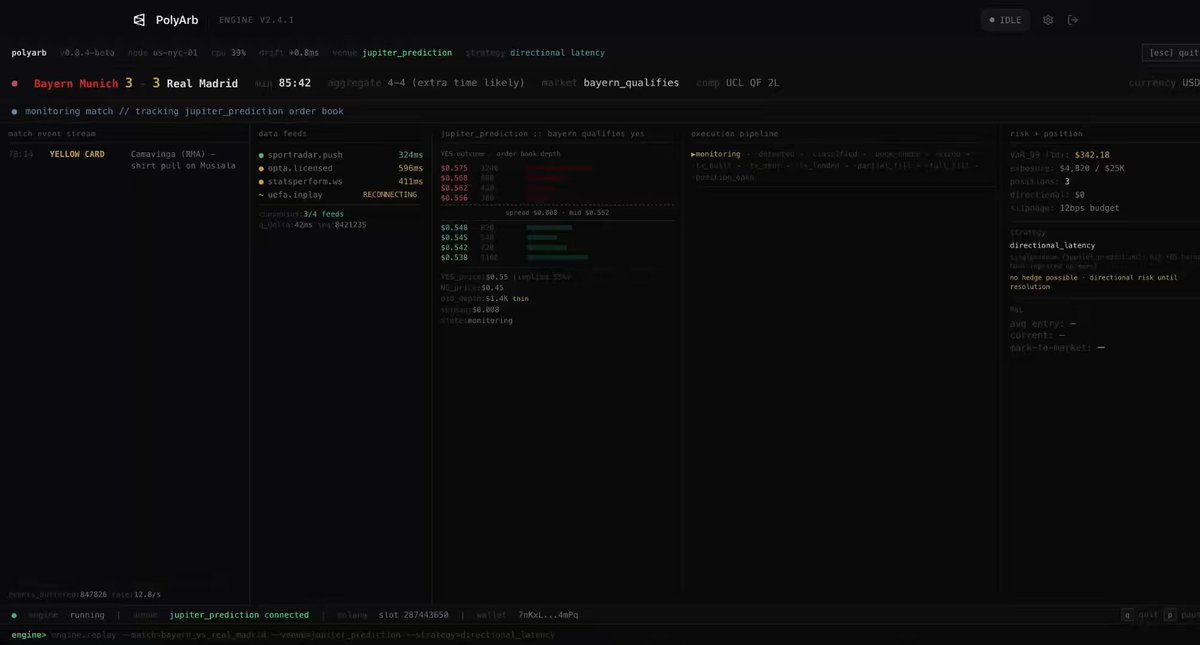
Yesterday, first live test on Bayern vs Real (Champions League QF).
86th minute, Camavinga gets his second yellow. Pipeline receives the event from Sportradar 280ms after the card. “Bayern advances” market was at ~0.55. Model recomputes to ~0.68 post-red and fires a $500 order.
Partial fill as expected: ~$180 caught around 0.55-0.57, the rest slipped to 0.63. Average 0.59. Market stabilized at 0.67 a few seconds later. Unrealized $30. 6% in seconds.
It’s a test. But the loop worked end to end detection, decision, fill, before the book caught up.
What we learned: network latency is part of the problem. The real bottleneck is orderbook depth. We’re competing with sharp bots, not retail on their couch. And “next goal” markets have better spreads than qualification markets. Pivoting there.
What we’re building before June: fill routing across 12 venues via Jito atomic bundles. Low-signal event modeling (dangerous fouls, injuries, tactical shifts). UMA oracle hedging. Node co-location near Sportradar servers.
Why the World Cup matters.
104 matches in 39 days. $2.5B in projected prediction market volume. Deep liquidity means bigger positions fill cleanly. Thin liquidity in group stages means wider spreads. Both environments leave serious money on the table.
56 days to ship. We’re on it.
1
829
PolyArbiter retweeted

Scheduled CLOB maintenace tomorrow, May 27 at 12:10 UTC.
- Intermittent trading for ~5-10 min during the window.
- Brief post-only mode after restart (~2 min) before normal matching resumes.
Stay updated, subscribe at status.polymarket.com/
9
7
90
8,561
PolyArbiter retweeted
CLOBv2: Post-migration update
- Yesterday: fixed ghost fill spikes, maker referral rebates, & gamma endpoints
- This Monday: ghost fills root-cause fix ships
- Within 72 hours: $500,000 in liquidity rewards going out
🚨 FOR DEVELOPERS: Mandatory update due by tomorrow ↓

41
29
249
88,283
Apr 29
You either plugged into our Polymarket BTC Up/Down bot 48h ago or you didn’t.
48 hours after this tweet, here’s what the data shows:
- 412 active wallets, every single one in profit
~5% average return, top performers near 9%
- Edge holding strong at 0.6-0.9% per capture
- Zero drawdowns above 1.7%
How to plug in:
1.Sign up at PolyArb (link in bio)
2.Copy your dedicated RPC URL
3. Open @jup_predict on Solana
4.Paste into Settings → Custom RPC
5.Activate the BTC Up/Down module
Free to use. Profit-share only.
Apr 26
We built the cleanest BTC Up/Down bot on Polymarket.
We engineered the entire stack from scratch around one principle: never bet on outcomes, only capture mispricings.
How it works:
When YES NO sums to less than $1.00 on Polymarket’s 15-min BTC market, the engine fires both sides atomically via Jito bundles. Total cost: $0.97. At resolution, one side always pays $1.00. Locked profit: 3 cents per dollar deployed.
BTC’s direction is irrelevant. The math already paid.
We don’t predict. We capture.
Architecture:
- Yellowstone gRPC at 1-5ms orderbook latency
- Jito atomic bundles, both legs fill or neither does
- 91ms median detection-to-fill
97.8% fill rate over 30 days
- Auto-hedge engine for partial fills in 4.2s
How to plug in:
1.Sign up at PolyArb (link in bio)
2.Copy PolyArb dedicated RPC URL from the dashboard
3. Open @jup_predict on Solana
4.Paste the RPC into Settings → Custom RPC
5.Activate the BTC Up/Down module
Free to use. Profit-share only. No subscription. No upfront cost.
45
21
170
30,390
PolyArbiter retweeted

Apr 28
Exchange upgrades starting now. The platform is under maintenance for ~1 hour. Trading is paused and the orderbooks are being cleared. Funds and positions are safe.
$1M in liquidity rewards go live when trading resumes. Updates in this thread.
141
65
696
151,740
Apr 27
The 5-minute guide to plugging into the BTC Up/Down Polymarket module without building anything yourself.
Bookmark this if you want to skip months of engineering.
Step 1: What you’ll need (2 minutes prep)
A Solana wallet (Phantom or Jupiter work fine)
Step 2: Sign up at PolyArb (link in bio)
Step 3: Copy our dedicated RPC URL
After signup, your dashboard shows a unique Solana RPC endpoint. This is your access to:
-Yellowstone gRPC at 1-5ms (vs 200-800ms public RPCs)
-Stake-weighted QoS
-Jito atomic bundle support
-91ms median execution
Step 4: Plug into Jupiter Predict
Open jup.ag/predict. Settings → Custom RPC → paste our dedicated RPC. This routes every transaction through PolyArb’s execution stack.
Step 5: Toggle the BTC Up/Down module
to ACTIVE.
Set your edge threshold (default: 0.8% net).
That’s it. Engine starts scanning immediately.
What happens next:
The engine monitors every 15-min BTC market on Polymarket continuously. When YES NO sums below $1.00, it fires both legs atomically via Jito bundles. Locked profit at fill, regardless of where BTC closes.
You don’t need to monitor anything. You don’t need to predict anything. You don’t need to watch charts.
First trades typically execute within 1-2 hours depending on market volatility.
Dashboard updates in real-time.
Free to use. (Profit-sharing only)
Apr 26
We built the cleanest BTC Up/Down bot on Polymarket.
We engineered the entire stack from scratch around one principle: never bet on outcomes, only capture mispricings.
How it works:
When YES NO sums to less than $1.00 on Polymarket’s 15-min BTC market, the engine fires both sides atomically via Jito bundles. Total cost: $0.97. At resolution, one side always pays $1.00. Locked profit: 3 cents per dollar deployed.
BTC’s direction is irrelevant. The math already paid.
We don’t predict. We capture.
Architecture:
- Yellowstone gRPC at 1-5ms orderbook latency
- Jito atomic bundles, both legs fill or neither does
- 91ms median detection-to-fill
97.8% fill rate over 30 days
- Auto-hedge engine for partial fills in 4.2s
How to plug in:
1.Sign up at PolyArb (link in bio)
2.Copy PolyArb dedicated RPC URL from the dashboard
3. Open @jup_predict on Solana
4.Paste the RPC into Settings → Custom RPC
5.Activate the BTC Up/Down module
Free to use. Profit-share only. No subscription. No upfront cost.
33
35
176
23,498
Apr 20
In the last 30 days, the engine has:
Scanned 1.2M market states across 12 venues
Flagged 3,284 spreads above 0.8% threshold
Executed 418 trades
Fill rate: 96.4%
Avg execution: 94ms
Partial fills: 15
Realized P&L across all users: $147,300
All while our users were sleeping, working, or not thinking about prediction markets.
That's the product.
31
19
132
31,245
PolyArbiter retweeted
Polymarket's V2 exchange upgrades go live April 22nd. The upgraded exchange is now open to all for testing.
🚨 If you use our API or clients, there's migration work to do before then:
→ Upgrade your SDK/ API integration
→ New exchange contract addresses & order struct
→ Collateral moves to pUSD (wrap USDC.e via the Collateral Onramp)
We expect ~1 hour of downtime on April 22nd at ~11am UTC. Open limit orders will be cancelled during the switch. Funds and positions are safe.
Please note that the V1 exchange will stop working after the migration.
Migration guide: docs.polymarket.com/v2-migra…
Security: Our CTFv2 contracts are open sourced & audited by Cantina Quantstamp. $5 million bug bounty program is live on Cantina: cantina.xyz/bounties/ff945ca…
Changelog: docs.polymarket.com/changelo…
70
112
791
192,664
Apr 16
We’re building a latency Football bot for Polymarket. Target: operational before the World Cup. Save this.
The principle: pro sports feeds (Sportradar, Opta) deliver pitch events in ~200-500ms. The Polymarket orderbook takes longer to reprice thin liquidity, market makers pulling quotes while they reassess. That window is the edge.
Yesterday, first live test on Bayern vs Real (Champions League QF).
86th minute, Camavinga gets his second yellow. Pipeline receives the event from Sportradar 280ms after the card. “Bayern advances” market was at ~0.55. Model recomputes to ~0.68 post-red and fires a $500 order.
Partial fill as expected: ~$180 caught around 0.55-0.57, the rest slipped to 0.63. Average 0.59. Market stabilized at 0.67 a few seconds later. Unrealized $30. 6% in seconds.
It’s a test. But the loop worked end to end detection, decision, fill, before the book caught up.
What we learned: network latency is part of the problem. The real bottleneck is orderbook depth. We’re competing with sharp bots, not retail on their couch. And “next goal” markets have better spreads than qualification markets. Pivoting there.
What we’re building before June: fill routing across 12 venues via Jito atomic bundles. Low-signal event modeling (dangerous fouls, injuries, tactical shifts). UMA oracle hedging. Node co-location near Sportradar servers.
Why the World Cup matters.
104 matches in 39 days. $2.5B in projected prediction market volume. Deep liquidity means bigger positions fill cleanly. Thin liquidity in group stages means wider spreads. Both environments leave serious money on the table.
56 days to ship. We’re on it.

51
106
1,634
930,109
Apr 16
For anyone curious about our core product the football latency module is an experiment we’re still testing.
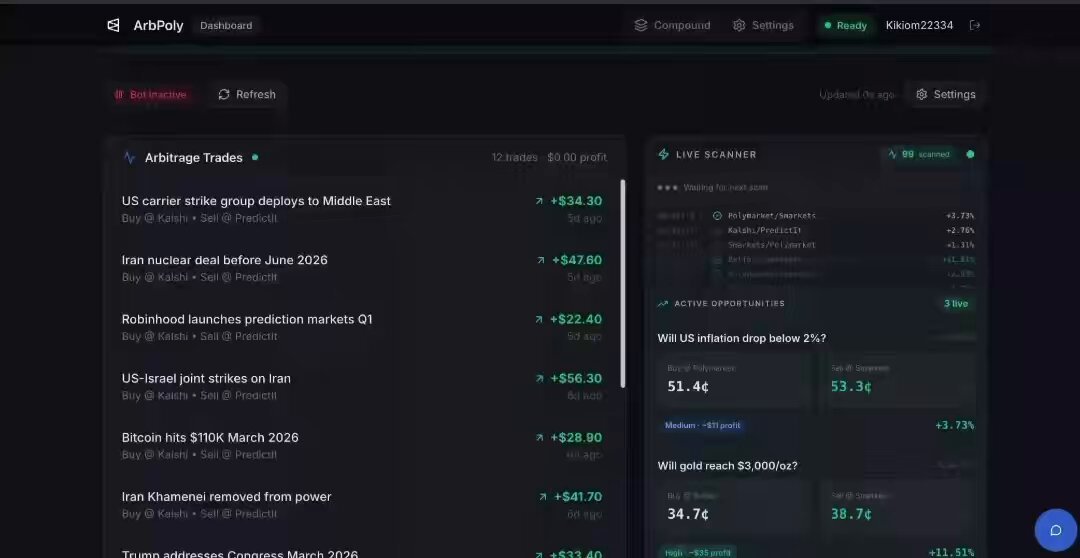
What actually runs 24/7 is our cross-platform arbitrage engine:
Apr 11
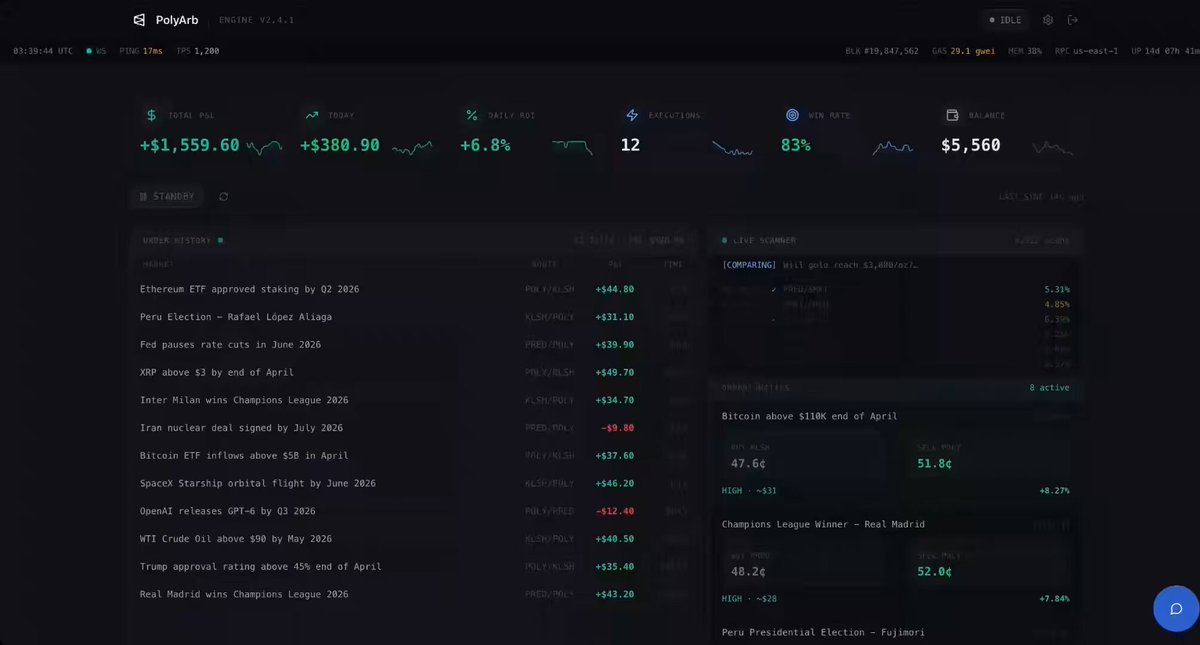
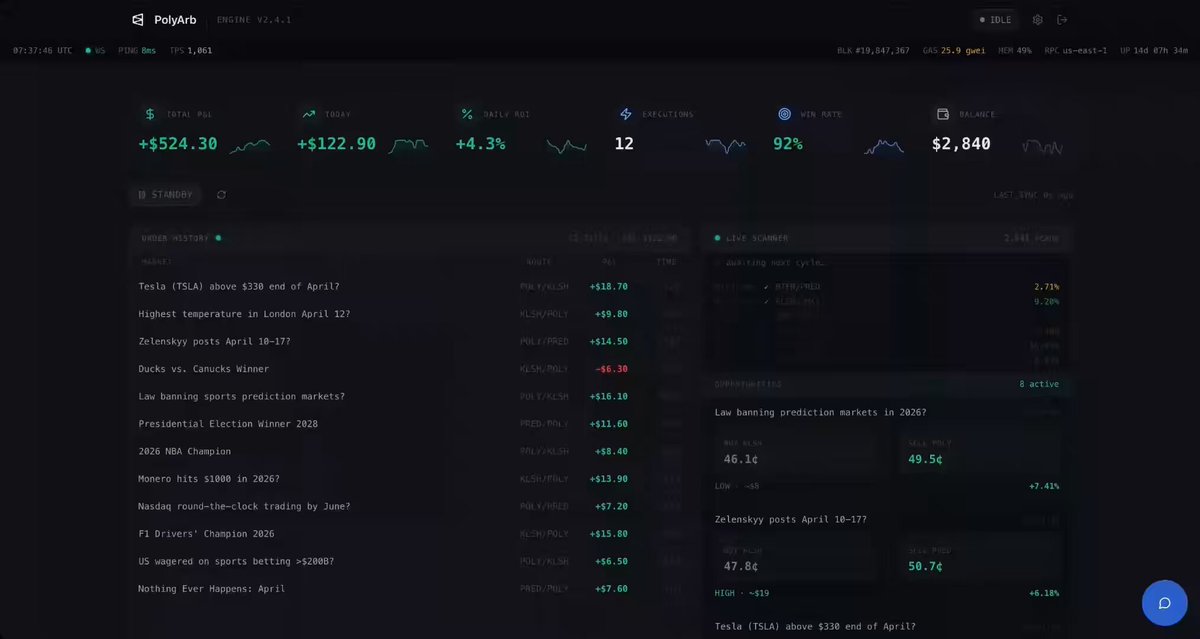
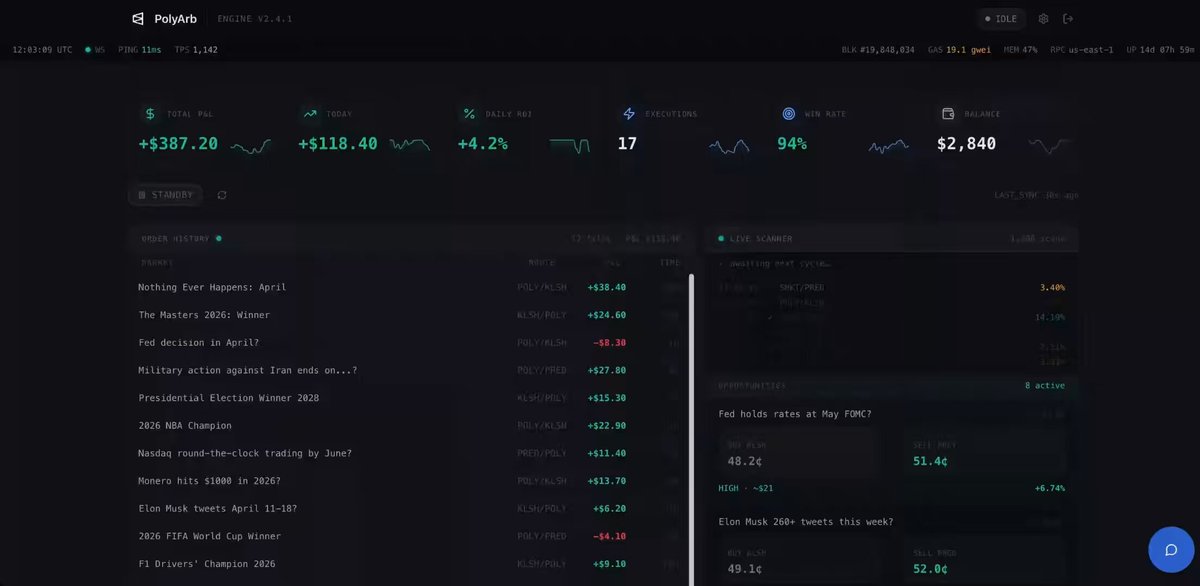
We built a Polymarket execution engine. Here’s today’s output.
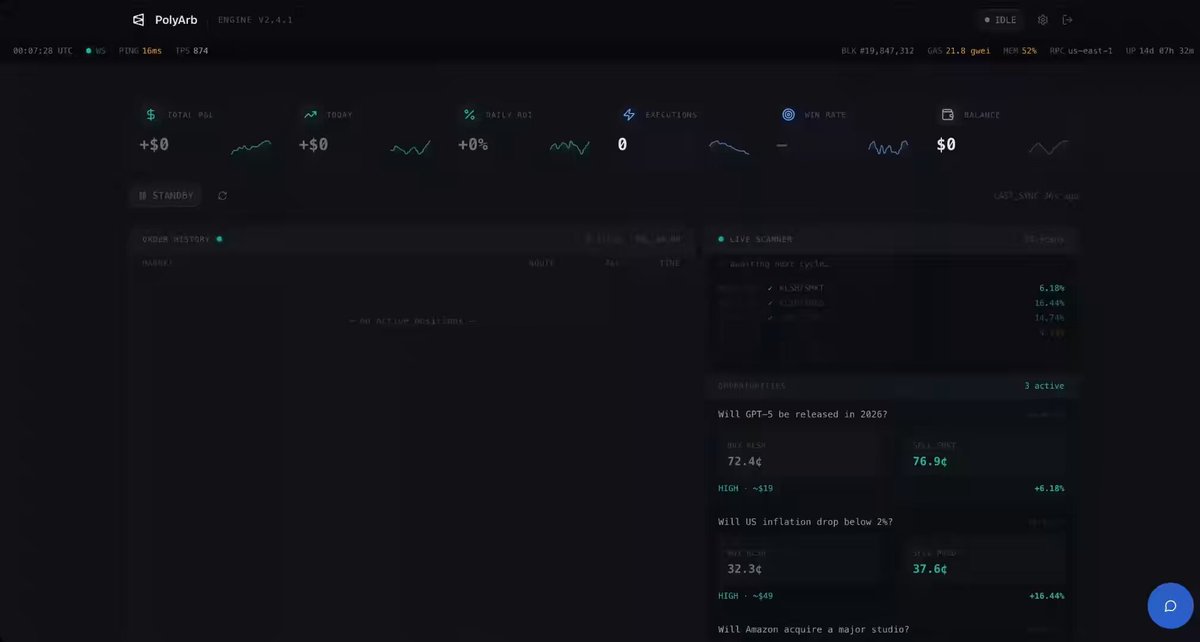
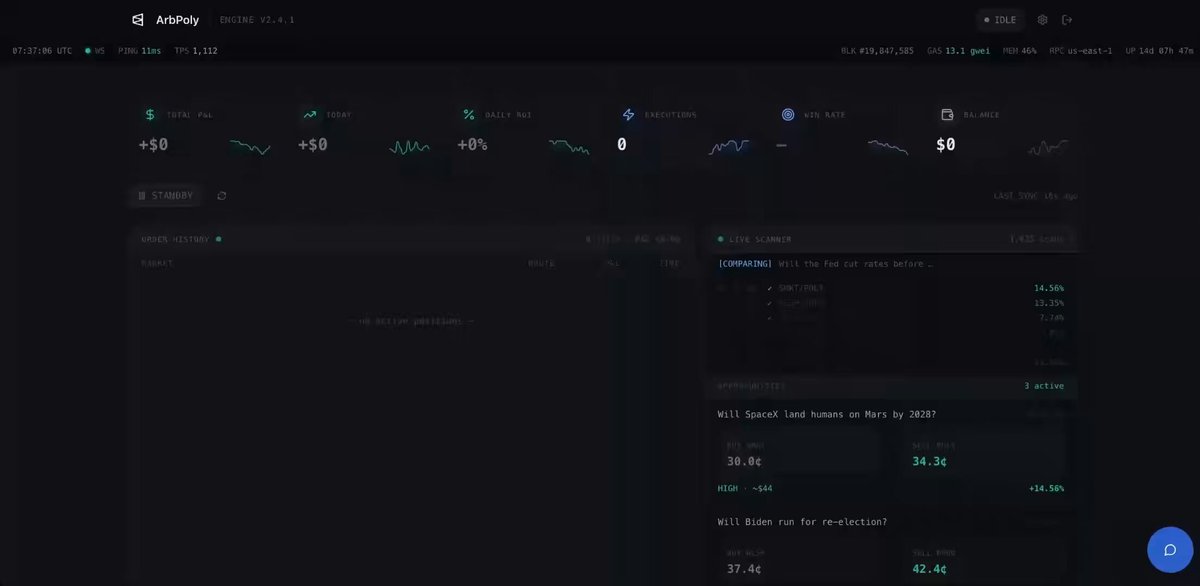
17 fills today. $118.40 P&L. 94% win rate. 19ms ping. 1,135 TPS.
5 routes running: POLY/KLSH. KLSH/POLY. POLY/PRED. PRED/KLSH. PRED/POLY.
This is what 50,000 lines of code and 4 months of engineering looks like when it runs.
We made it free. (Profit-sharing) Set your parameters and run.
2
1
15
16,421
Apr 16
To clarify we’re testing whether this holds at scale. Right now it’s a side project, not a shipped product. We’ll post ETAs and actual results here as we go.
Our core is cross-platform arb. That’s been running since mid-2025 without interruption. Sports latency is an extension we’re exploring because the window is there but we’re not promising anything until we’ve validated throughput across more matches.
We’ll update as we build.
3
42
18,984
Apr 13
Stop building Claude bots.
We’re serious.
We spent 4 months and 50,000 lines of code building the infrastructure that every Claude tutorial pretends doesn’t matter.
The strategy isn’t the problem. Everyone knows the strategy. Buy the spread. Capture the gap. The math is simple.
The problem is execution. And no tutorial will give you that.
We already built it. It’s free. Profit-sharing only.
Stop building. Start using.
Apr 11
We built a Polymarket execution engine. Here’s today’s output.
17 fills today. $118.40 P&L. 94% win rate. 19ms ping. 1,135 TPS.
5 routes running: POLY/KLSH. KLSH/POLY. POLY/PRED. PRED/KLSH. PRED/POLY.
This is what 50,000 lines of code and 4 months of engineering looks like when it runs.
We made it free. (Profit-sharing) Set your parameters and run.
43
23
344
76,898
Apr 11
We built a Polymarket execution engine. Here’s today’s output.
17 fills today. $118.40 P&L. 94% win rate. 19ms ping. 1,135 TPS.
5 routes running: POLY/KLSH. KLSH/POLY. POLY/PRED. PRED/KLSH. PRED/POLY.
This is what 50,000 lines of code and 4 months of engineering looks like when it runs.
We made it free. (Profit-sharing) Set your parameters and run.
65
20
354
119,012
Apr 11
Breakdown on the 3 losses:
Fed decision resolution criteria differed between venues. Different settlement windows on the same event. The system identified a spread that technically wasn’t one. Known edge case.
FIFA World Cup - long-dated market. Spread was valid at entry but compressed before resolution. Normal on long-horizon markets.
BTC dominance - correlated market. Spread inverted post-entry because dominance pricing moves with BTC and altcoin flows simultaneously. Expected on ratio-dependent markets.
All 3 were the smallest positions of the day. Confidence scoring working as designed. Higher conviction gets bigger sizing. Lower conviction gets minimum allocation.
Win rate is a byproduct not a target. We optimize for risk-adjusted P&L.
14 green out of 17. Losses totaled -$17.80. Wins totaled $136.20.
3
10
5,969
Apr 7
You’ll follow this tutorial. You’ll get the bot running. You’ll deploy capital. And you’ll join the 92.4% of Polymarket traders who lose money.
A script built in 26 minutes will never work long term. Telling people otherwise is irresponsible.
We spent 4 months building what actually works. 12 platforms. Atomic execution. 90ms.
Save your weekend. Use infrastructure that already works.

Full Polymarket Bot Build | Claude Code Tutorial:
0:00 - Intro
0:53 - Setup
1:49 - Bullpen CLI
5:01 - Pull top traders
8:40 - Set rules
15:15 - Build a dashboard
17:38 - Claude hack
20:39 - Bot LIVE
23:00 - 2 extra commands
24:00 - 3 hour results: 13% profit
25:13 - Honest take
67
22
327
93,294
Apr 6
We spent 4 months building an engine arbitraging Polymarket faster than any Claude bot can sign an order.
When the spread crosses the threshold both sides execute. 90ms. Jito atomic bundles. Both fill or nothing fills.
The orderbook view shows live depth across venues. The heatmap shows execution density across every active market in real time.
4 months of engineering. This is what 50,000 lines of code looks like when it’s running.
We made it free. Set your parameters and run.
88
71
433
99,527