
Joined October 2017
- Tweets 4,426
- Following 1,670
- Followers 73
- Likes 2,231
222 Photos and videos






Predator405 - ORO AI retweeted

MEXC New Kickstarter: Share 30,000 USDT!
‣ $XEF @Xeffy_io
‣ Voting: Jun 14 03:00 - Jun 15 02:50 (UTC)
‣ $XEF/USDT Trading: Jun 15, 2026, 05:00 (UTC)
Details 👉mexc.com/announcements/artic…
10,636
12,285
14,956
105,382

Most crypto projects ask one question:
"How do we distribute more tokens?"
The better question is:
"How do we remove tokens from circulation while making the network stronger?"
That's where things get interesting.
🧵
One of the most overlooked parts of VRAM's design is the Validator Ticket system.
Because unlike many networks where participation is almost free, VRAM introduces something different:
A cost.
And that's not a bad thing.
Let's start with a simple reality.
If there is no cost to becoming a validator, then becoming a validator eventually becomes meaningless.
Bad actors enter.
Spam increases.
Sybil attacks become easier.
The verification layer becomes weaker.
The network becomes less trustworthy.
And in a project built around proving AI contributions, trust in verification is everything.
That's why VRAM doesn't simply allow anyone to become part of the verification layer for free.
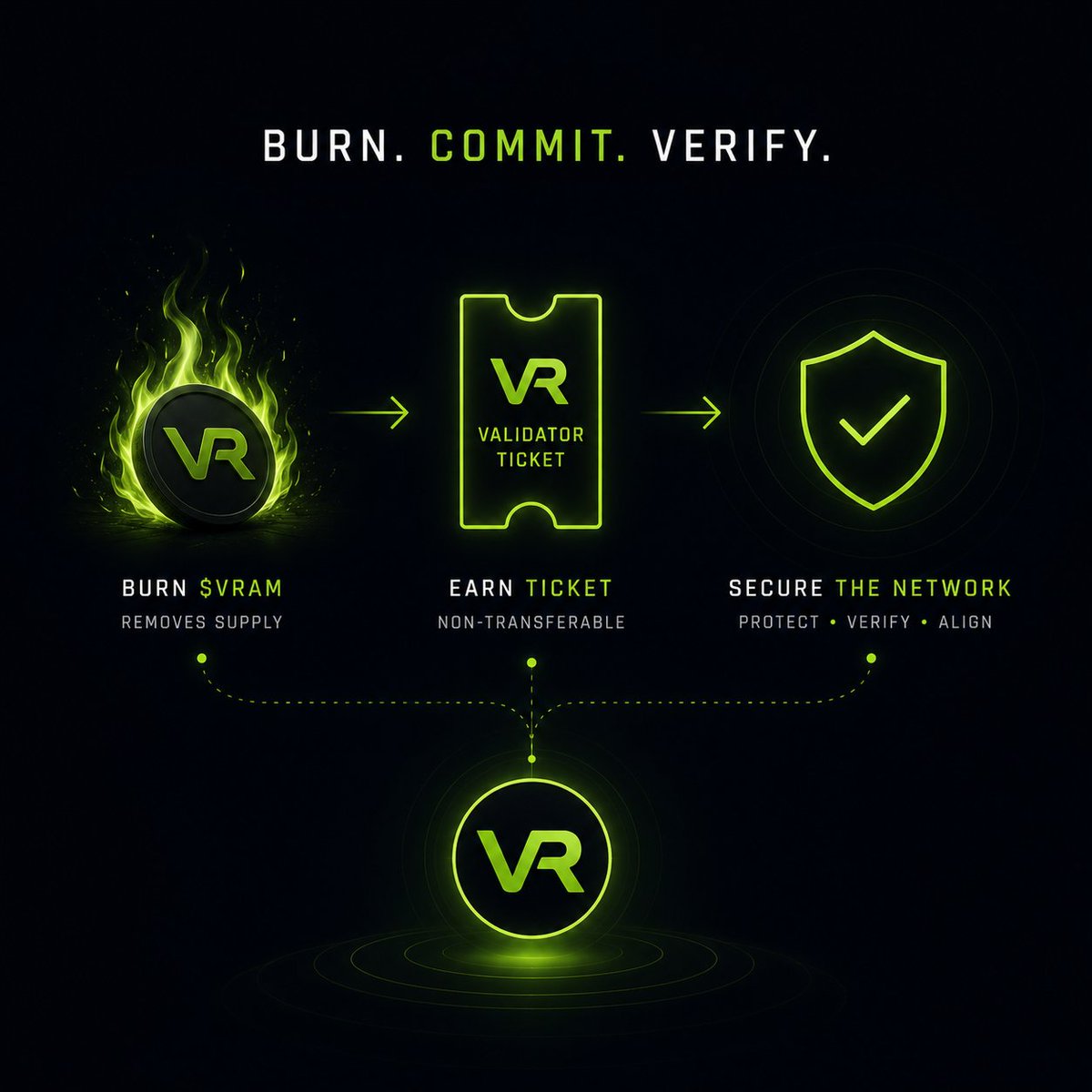
Instead, participants burn $VRAM to receive a non-transferable Validator Ticket.
Read that again.
Burn.
Not stake.
Not lock.
Burn.
The tokens leave circulation permanently.
And honestly?
That's a fascinating design choice.
Because the network isn't just asking validators to participate.
It's asking them to commit.
To put real economic skin in the game.
To prove they care about the long-term health of the network.
Think about what happens as adoption grows.
More contributors.
More training jobs.
More network activity.
More demand for verification.
More validators joining.
More Validator Tickets required.
More $VRAM burned.
Suddenly network growth and token utility become directly connected.
That's powerful.
Most projects inflate their way toward growth.
They issue rewards.
Issue incentives.
Issue emissions.
And hope demand catches up later.
VRAM is approaching things from another angle.
Part of participation itself creates token removal.
The larger the verification layer becomes, the more supply pressure is absorbed.
But here's the part most people miss.
This isn't really about tokenomics.
It's about security.
The burn mechanism exists because verification matters.
The token burn is the economic signal.
The validator ticket is the commitment.
The verification layer is the outcome.
And when you zoom out, the logic becomes obvious.
If validators are responsible for helping maintain trust in a decentralized AI network, then entering that role should require more than clicking a button.
It should require commitment.
Responsibility.
Economic alignment.
Crypto loves to talk about "skin in the game."
This is what skin in the game actually looks like.
Not temporary locks.
Not symbolic commitments.
Real participation backed by real cost.
The more I think about it, the more I believe the Validator Ticket model is one of the smartest pieces of VRAM's economic design.
Because it aligns three things at once:
✔️ Network security
✔️ Verification integrity
✔️ Long-term token utility
And the best tokenomics aren't the ones that print the most rewards.
They're the ones that make every participant more aligned with the network they're helping build.
That's exactly what burning for validation is designed to do. 🚀
@vram_network
28
Most users farm points.
A few spend time understanding why the protocol exists.
Concrete isn't just chasing TVL — it's building the rails for capital to move more efficiently across DeFi.
That's the kind of narrative I like to position around before the crowd arrives.
Watching closely. @ConcreteXYZ
22
Most people think Mainnet is the moment a project proves itself.
I think Mainnet is the moment reality begins.
🧵
Crypto has conditioned us to obsess over launches.
Testnet.
Mainnet.
TGE.
Listings.
The big announcements.
The countdowns.
The hype.
And don't get me wrong — those milestones matter.
But if we're being honest, Mainnet isn't the end of the story.
It's the end of preparation.
The real story starts after.
That's why I find VRAM's roadmap so interesting.
Because Mainnet isn't positioned as a finish line.
It's positioned as a foundation.
Look at what's planned after it:
• First customer training jobs
• Walrus Seal integration
• In-enclave aggregation
• 1,000 miners per validator
• On-chain governance
• Dataset and model integrations
Those aren't launch milestones.
Those are growth milestones.
Think about it.
Today everyone is focused on potential.
After Mainnet, the network has to prove utility.
Can it coordinate contributors?
Can it verify work?
Can it reward fairly?
Can it attract real workloads?
Can it scale?
That's where infrastructure projects either become important or become irrelevant.
And honestly?
This is where most people stop paying attention.
They chase the next launch.
The next narrative.
The next token.
Meanwhile the real builders are busy solving the hard problems that come after launch.
Because infrastructure isn't validated by hype.
It's validated by usage.
The most valuable networks in history weren't created the day they launched.
The internet wasn't important because it launched.
It became important because people started using it.
Cloud computing wasn't important because it launched.
It became important because businesses depended on it.
The same rule applies here.
The future value of a network isn't determined on launch day.
It's determined by what happens after.
That's why I think the smartest question isn't:
"When Mainnet?"
The smarter question is:
"What happens after Mainnet?"
Because that's where adoption begins.
That's where real workloads arrive.
That's where incentives get tested.
That's where scaling gets tested.
That's where decentralization gets tested.
For VRAM, Mainnet isn't the destination.
It's the moment the network leaves the lab and enters the real world.
The moment theories become measurable.
The moment contributors become infrastructure.
The moment compute becomes an economy.
And if the team executes on the roadmap beyond launch, that's when things could get really interesting.
Because the strongest projects don't peak at Mainnet.
They start there. 🚀
@vram_network
15
The biggest threat to AI isn't bad technology.
It's concentration.
🧵
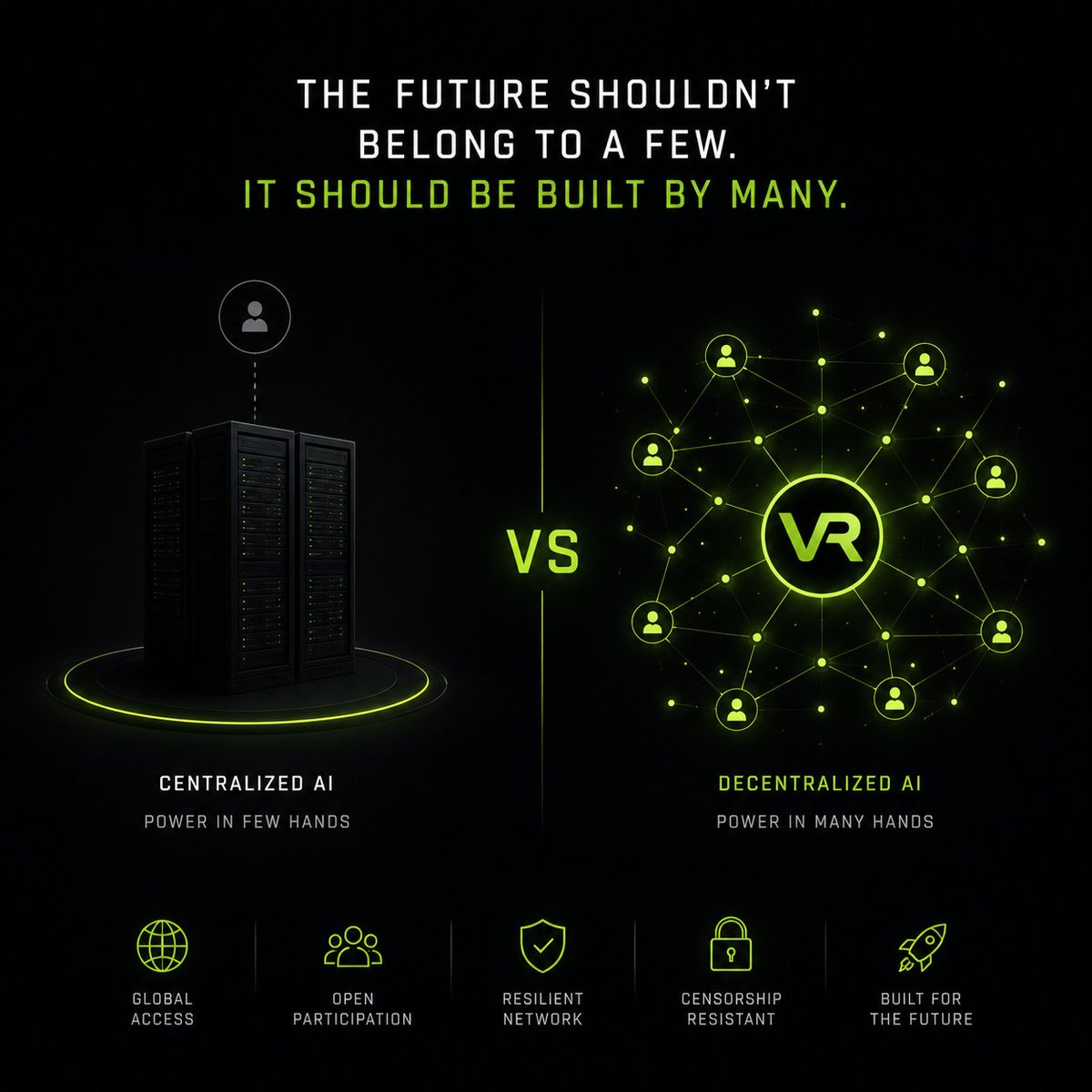
Right now, the future of AI is being shaped by a surprisingly small number of companies.
A small number of data centers.
A small number of cloud providers.
A small number of organizations controlling an enormous percentage of the world's compute.
And honestly?
That should concern everyone.
Not because those companies are evil.
Because concentration always creates risk.
Think about what AI has become.
It's no longer just another technology sector.
AI is becoming infrastructure.
The same way electricity became infrastructure.
The same way the internet became infrastructure.
The same way cloud computing became infrastructure.
The next generation of products, businesses, research, education, healthcare, and software will depend on AI.
Which means whoever controls AI infrastructure gains enormous influence over the future.
Now ask yourself:
Who owns the GPUs?
Who owns the data centers?
Who controls access to compute?
Who decides who gets resources and who doesn't?
The answers are becoming increasingly centralized.
And that's the problem.
Most people focus on AI models.
I focus on the layer beneath them.
Compute.
Because models can be copied.
Ideas can be improved.
But infrastructure creates moats.
And right now the biggest moat in AI isn't intelligence.
It's access.
Access to GPUs.
Access to training resources.
Access to large-scale compute.
This creates a future where innovation risks becoming permissioned.
Not officially.
But economically.
The best ideas don't always win.
Sometimes the organizations with the largest compute budgets win.
And that's not the same thing.
This is why decentralized AI matters.
Not because it's a trend.
Not because it's crypto.
Because alternatives matter.
Competition matters.
Open participation matters.
A healthy ecosystem needs more than one path forward.
That's why the VRAM thesis is interesting.
Instead of building another walled garden, it asks:
"What if compute could come from anywhere?"
What if the next AI network wasn't powered by a handful of facilities...
But by thousands of contributors?
What if participation wasn't restricted to organizations with billion-dollar budgets?
What if ownership was connected to contribution?
Maybe centralized AI will continue dominating.
Maybe it won't.
That's not really the point.
The point is that the world benefits when alternatives exist.
Because monopolies rarely create better outcomes.
Competition does.
Open networks do.
Distributed infrastructure does.
The AI race isn't just about building smarter models.
It's about deciding who gets to participate in building them.
And if the future of AI becomes controlled by only a few organizations, we'll eventually discover the same lesson every industry learns:
Centralization is efficient.
Until it becomes a bottleneck.
That's why I think the real battle isn't AI vs AI.
It's centralized infrastructure vs decentralized infrastructure.
And that battle is only getting started. 🚀
@vram_network
2
21
Everyone is focused on Mainnet.
I'm focused on what happens after Mainnet.
Because that's where things get interesting.
🧵
A lot of crypto projects treat Mainnet like the finish line.
Launch the token.
Launch the chain.
Celebrate.
Mission accomplished.
But infrastructure projects don't work that way.
For them, Mainnet is day one.
Not the destination.
The starting point.
That's why one line in VRAM's roadmap caught my attention:
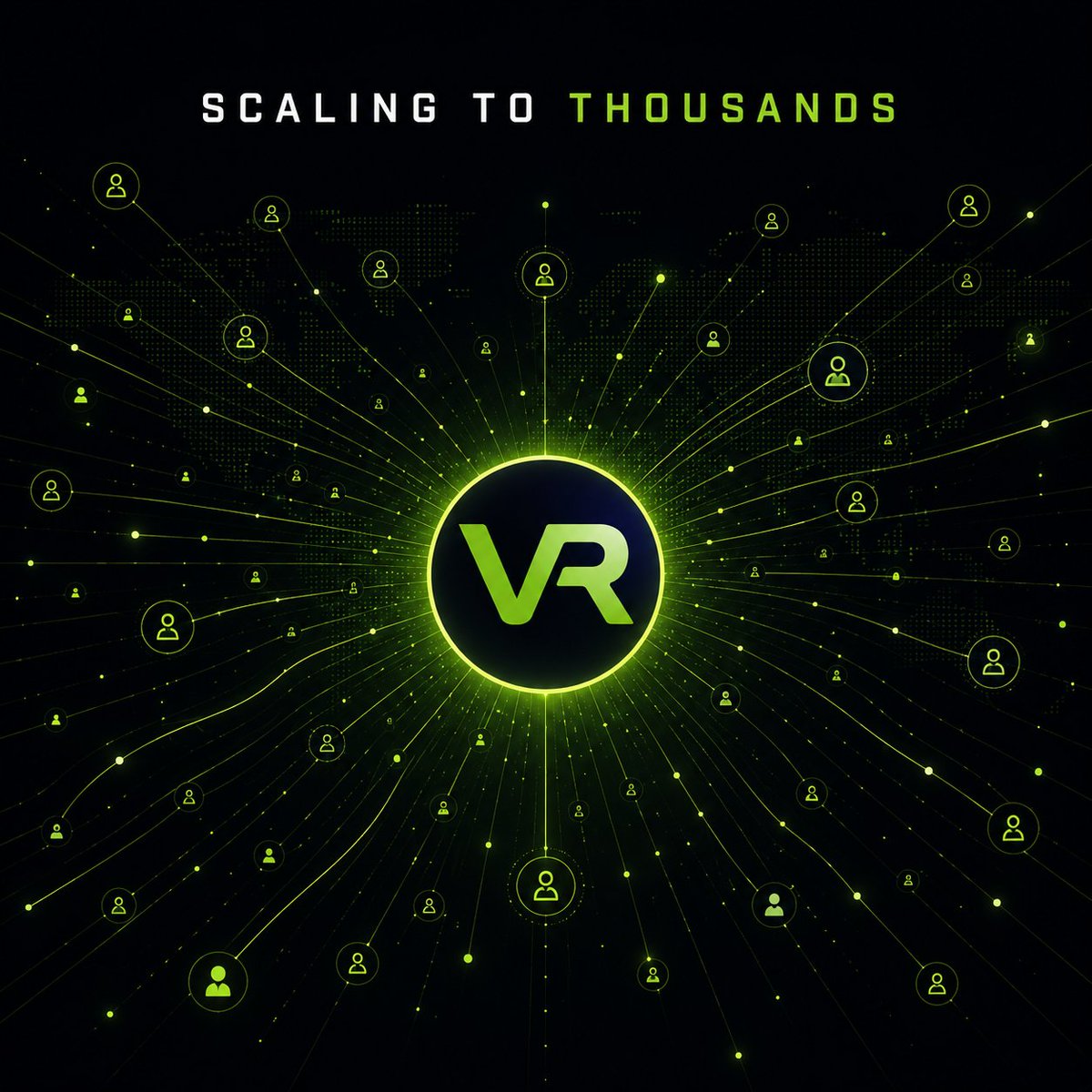
1,000 miners per validator.
At first glance, it looks like just another scaling metric.
It's not.
It's a glimpse into the future size of the network.
Think about it.
Today, everyone talks about individual miners.
Individual GPUs.
Individual contributors.
But eventually the network has to evolve beyond individuals.
It has to become an ecosystem.
A machine capable of coordinating thousands of contributors simultaneously.
Because decentralized AI only becomes truly powerful at scale.
One GPU is useful.
Ten GPUs are interesting.
A hundred GPUs are valuable.
A thousand GPUs working together under a coordinated verification system?
Now you're building infrastructure.
This is where most people underestimate the challenge.
Scaling isn't just adding more participants.
Scaling means:
• More compute
• More reward calculations
• More verification
• More network coordination
• More economic activity
Everything becomes exponentially harder.
And that's exactly why the roadmap matters.
Because it shows VRAM isn't thinking about hundreds of contributors.
It's preparing for thousands.
Potentially tens of thousands later.
The architecture has to support that future before it arrives.
Otherwise growth becomes the bottleneck.
The really interesting part?
Scale changes the economics.
When thousands of contributors join a network:
The quality of compute increases.
The diversity of hardware increases.
The resilience of the network increases.
The decentralization increases.
And suddenly you're no longer talking about a project.
You're talking about infrastructure.
That's the difference most people miss.
Projects chase users.
Infrastructure attracts users.
Projects depend on attention.
Infrastructure depends on utility.
The strongest networks eventually stop being communities and start becoming necessities.
And honestly?
I think the "1,000 miners per validator" milestone is one of the most important lines on the entire roadmap.
Not because of the number itself.
But because of what it represents.
A future where decentralized AI isn't powered by a few contributors.
A future where thousands of GPUs coordinate across the world.
A future where idle hardware becomes productive infrastructure.
Most people are looking at today's network.
I'm looking at the network VRAM is trying to become.
Because if they successfully scale verification, rewards, and compute together...
They won't just be building a decentralized AI project.
They'll be building a decentralized AI economy.
And that's a much bigger opportunity than most people realize. 🚀
@vram_network
2
2
56
Every successful application eventually faces scaling decisions. Canopy Network's approach of growing into independence feels more practical than forcing that choice upfront. @CNPYNetwork
3
DeFi adoption grows when users spend less time navigating complexity and more time achieving outcomes. Interesting progress from @Pact_Swap.
2
Decentralized infrastructure isn't just a technical challenge—it's an economic challenge. Incentives, participation, and sustainability all need to align. @dtelecom
3
As digital communities become more sophisticated, participation systems will matter just as much as content systems. @quipnetwork is exploring that future.
10
Still sleeping on Teneo?
Teneo is building a DePIN AI network where users run nodes to help collect and process public web data for the next generation of AI applications.
With a simple Community Node, you can start earning points while contributing to a growing decentralized data infrastructure.
Backed by notable investors and riding one of the hottest narratives in crypto: AI DePIN.
Not saying it's a guaranteed airdrop... but it's definitely one of the projects I'm keeping an eye on.
Farm now, ask questions later.
@teneo_protocol
#Teneo #DePIN #AI #Airdrop #Crypto
1
1
41
What if your AI could do more than answer questions?
@ProjectZeroIO is turning AI into a Web3 operator.
On-chain intelligence
AI agents
Gems ecosystem
Multi-chain future
One of the most interesting AI plays I'm watching right now.
$PZERO 👀
1
8
The more I research Concrete, the more bullish I get.
Most people see another DeFi protocol.
I see a bet on the future of onchain credit markets and institutional liquidity.
Strong backers.
Strong narrative.
Still early.
Sometimes the best opportunities are the ones CT isn't talking about enough yet.
$CONCRETE is definitely on the watchlist.
@ConcreteXYZ
1
12
I've been following Karrier One for a while, and the idea of bringing decentralized telecom infrastructure on-chain is genuinely interesting.
Connecting mobile networks, digital identity, and Web3 could unlock a lot of new possibilities. Still early, but I'm excited to see where this project goes and how far the vision can be executed.
@karrier_one
1
6
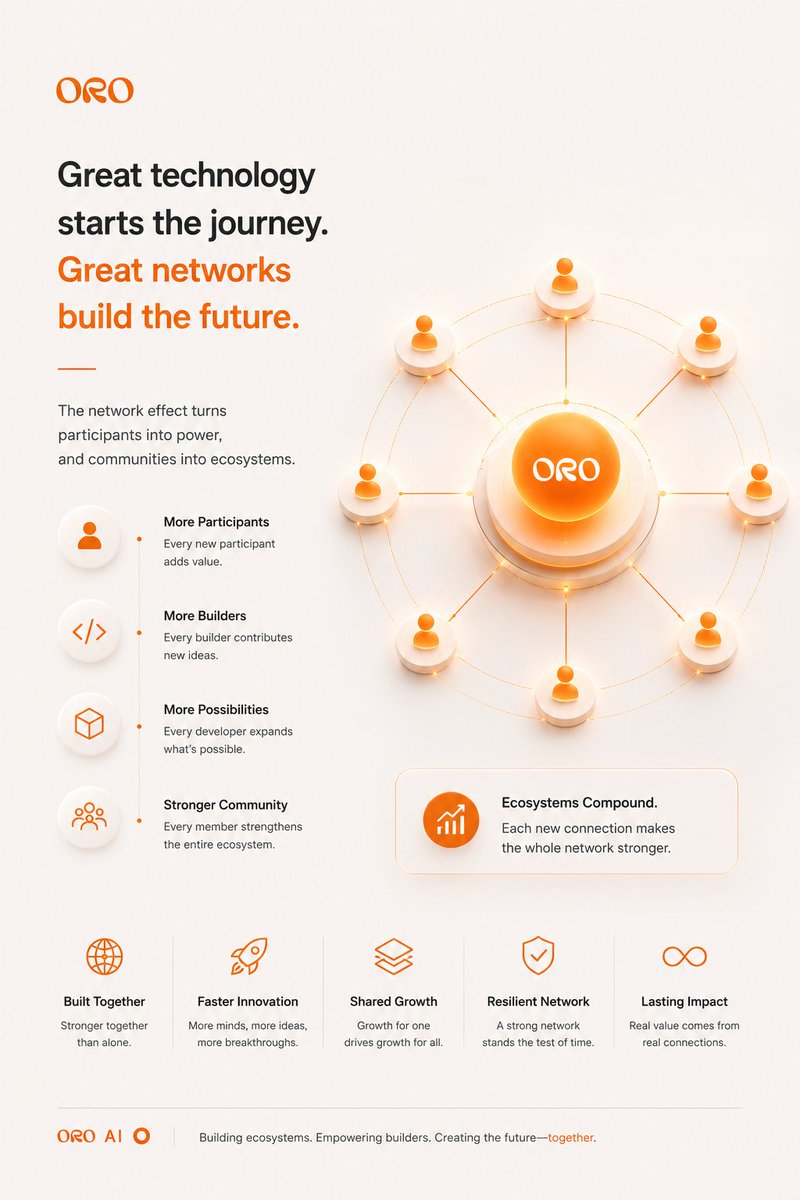
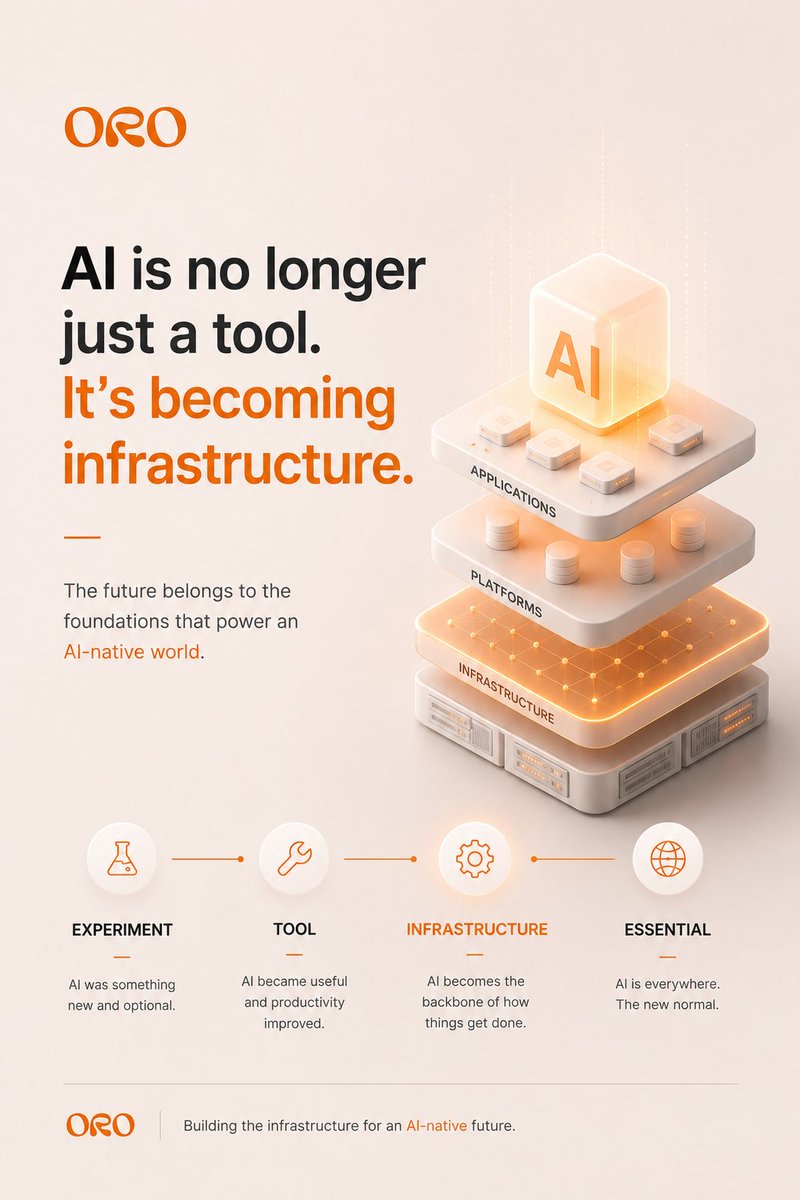
One of the most underestimated forces in technology is the network effect.
Not the technology itself.
Not the marketing.
Not even the funding.
The network.
Every new participant adds value.
Every builder contributes new ideas.
Every developer expands what's possible.
Every community member strengthens the ecosystem.
That's how the biggest digital networks in history grew.
The internet became more valuable as more people connected.
Open-source software became stronger as more developers contributed.
Entire ecosystems were created because individuals decided to build together instead of alone.
AI may follow the same path.
The future of AI won't be determined by a single breakthrough or a single company.
It will be shaped by networks of builders, contributors, infrastructure providers, and communities working toward a shared vision.
That's why I pay attention to ecosystems.
Because ecosystems compound.
A new user is not just a number.
A new builder is not just a wallet.
A new contributor is not just a statistic.
Each one increases the value of the entire network.
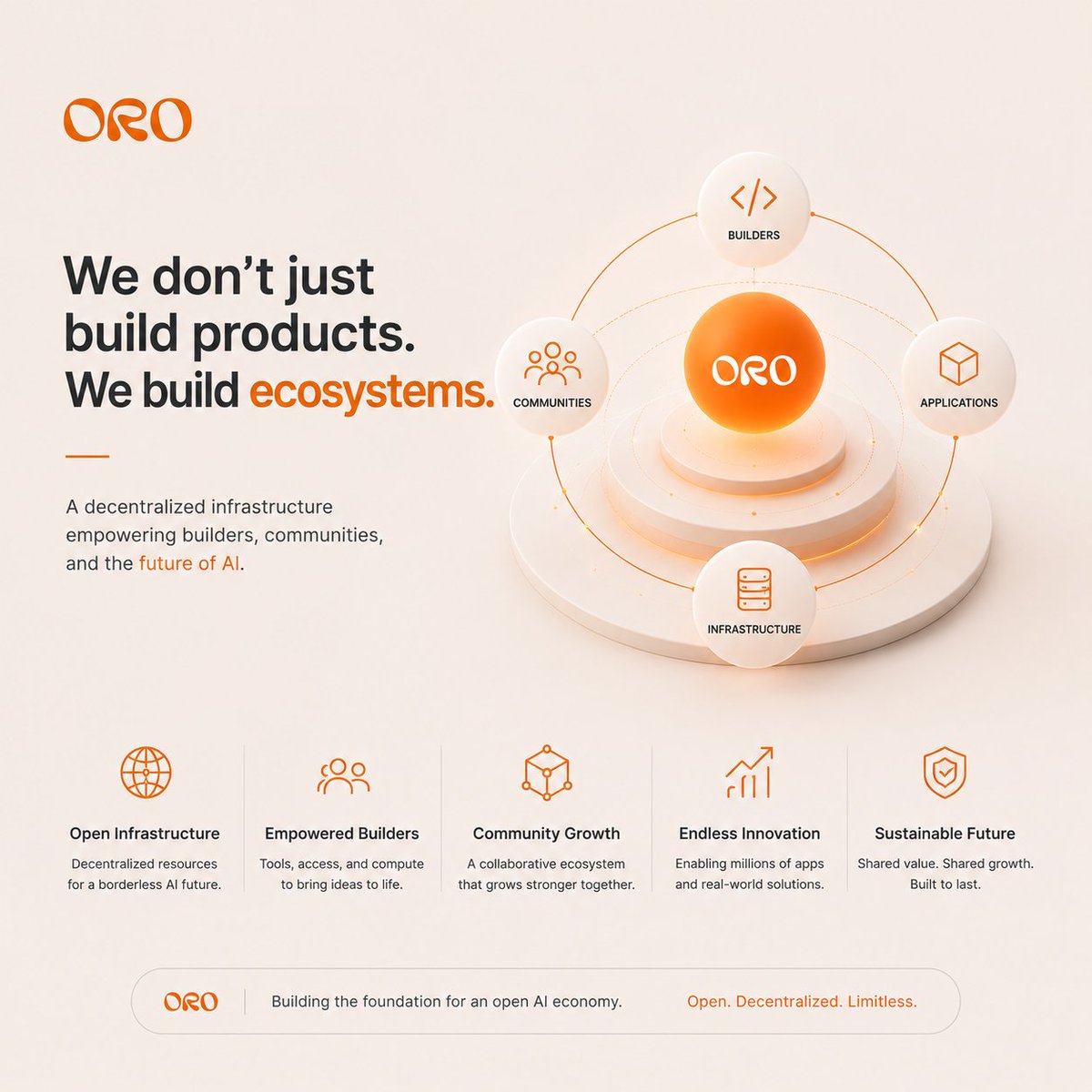
Projects like ORO are interesting because they're not only focused on technology.
They're focused on creating an environment where participation itself becomes a source of growth.
The strongest AI ecosystems won't be the ones with the biggest headlines.
They'll be the ones where every new participant makes the network stronger than it was before.
That's how real momentum is created.
That's how lasting ecosystems are built.
ORO AI 🟠
@getoro_xyz
1
11
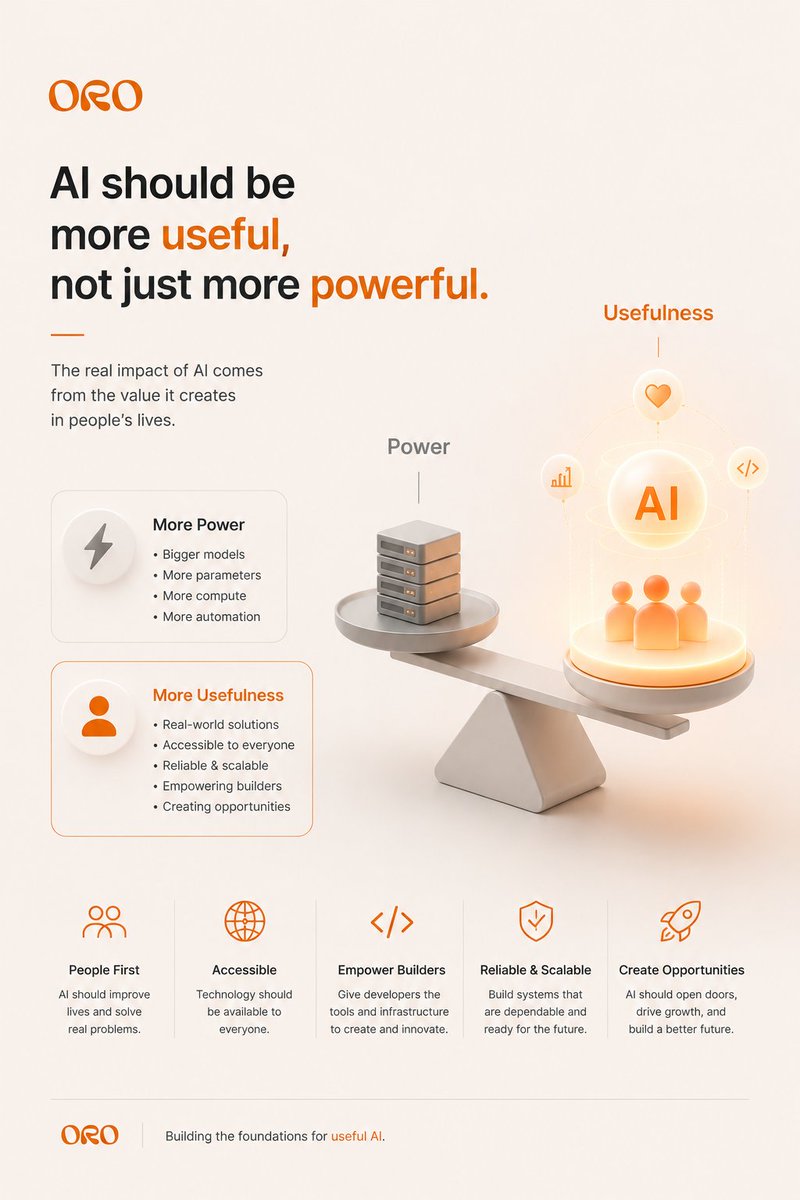
The AI race has become obsessed with one thing:
More power.
Bigger models.
More parameters.
More compute.
More automation.
But I think we're asking the wrong question.
The goal of AI shouldn't be to become more powerful.
The goal should be to become more useful.
The technologies that change the world aren't always the most advanced.
They're the ones that solve real problems.
The internet changed the world because it connected people.
Smartphones changed the world because they made technology accessible.
AI will change the world when it becomes deeply integrated into everyday life and creates value for millions of people—not just because benchmarks improve.
That's why infrastructure matters.
A healthy AI ecosystem isn't built solely around performance.
It's built around accessibility, reliability, scalability, and the ability for builders to create meaningful solutions.
The future belongs to AI that empowers people.
AI that helps businesses grow.
AI that helps developers innovate.
AI that creates opportunities rather than simply demonstrating capability.
Projects like ORO are exploring the foundations that can support that future.
Because the most important question isn't:
"How powerful can AI become?"
It's:
"How useful can AI become for the world?"
The answer to that question may define the next decade of innovation.
ORO AI 🟠
@getoro_xyz
9
Everyone loves to talk about decentralized AI.
Very few people talk about why most decentralized AI projects fail.
And that's probably because the answer isn't exciting.
It's not marketing.
It's not tokenomics.
It's not community growth.
It's verification.
🧵
Let's imagine two AI networks.
Network A has 50,000 GPUs.
Network B has 5,000 GPUs.
Most people immediately assume Network A wins.
More compute.
More contributors.
Bigger numbers.
Case closed.
But here's the problem:
What if Network A can't verify whether any of that work is real?
Suddenly those 50,000 GPUs don't matter nearly as much.
This is the dirty secret of decentralized AI.
Getting compute is difficult.
Verifying compute is even harder.
Because the moment rewards are attached to contributions, people start looking for shortcuts.
Fake work.
Manipulated results.
Reward farming.
Exploits.
The same thing happens in every incentive system ever created.
Humans optimize for rewards.
Not necessarily for outcomes.
That's why compute alone isn't enough.
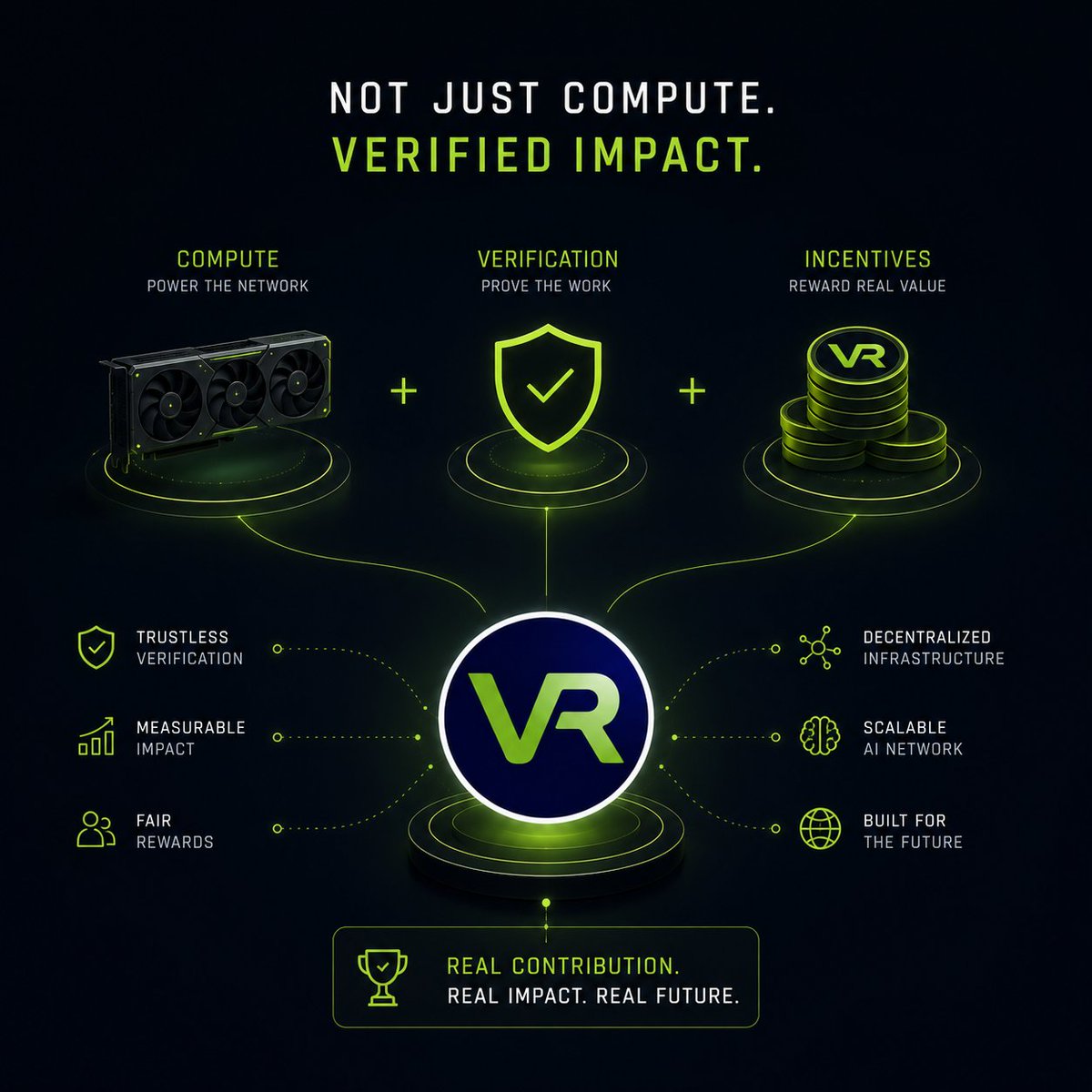
A decentralized AI network needs three things:
1️⃣ Compute
2️⃣ Verification
3️⃣ Incentives
Remove any one of them and the entire system breaks.
Let's say a network rewards everyone equally.
What happens?
People contribute the bare minimum.
Quality drops.
The network becomes inefficient.
Let's say a network rewards contribution but can't verify it.
What happens?
People learn how to fake contribution.
The honest participants leave.
The network dies.
Let's say a network has verification but poor incentives.
What happens?
Nobody wants to participate.
The network stagnates.
Again, it dies.
The projects that survive are the projects that solve all three simultaneously.
And honestly?
That's where most teams underestimate the challenge.
Building a token is easy.
Building a website is easy.
Building a community is hard.
Building a decentralized AI economy is much harder.
Because now you're trying to coordinate thousands of people, thousands of GPUs, reward distribution, model improvement, verification systems, and governance all at once.
That's infrastructure-level complexity.
This is why I keep paying attention to projects like VRAM.
Not because they're talking about AI.
Everyone talks about AI.
Because they're focused on the hardest problem:
How do you prove that contributions are real?
How do you measure impact?
How do you distribute rewards fairly?
How do you keep the network honest at scale?
Those are the questions that determine whether a decentralized AI network becomes infrastructure or becomes a ghost town.
The next generation of AI won't be won by the project with the loudest marketing.
It will be won by the project that solves trust without requiring trust.
The project that can verify what happened.
The project that can align incentives.
The project that can reward real value.
Because at the end of the day:
Compute is important.
But compute alone isn't enough.
And that's exactly where most projects fail. 🚀
@vram_network
1
1
68

The biggest supercomputer in the world probably hasn't been built yet.
And the crazy part?
The hardware already exists.
🧵
When people think about AI infrastructure, they imagine massive data centers.
Rows of servers.
Thousands of GPUs.
Billion-dollar facilities owned by tech giants.
And that's fair.
That's how AI works today.
But what if that's not how it works tomorrow?
Look around.
There are millions of powerful GPUs already deployed across the world.
Gaming PCs.
Workstations.
Creator setups.
Home offices.
University labs.
Independent builders.
Most of them are disconnected from each other.
Most of them sit idle for large portions of the day.
Individually they're small.
Collectively they're enormous.
That's the thesis.
The future doesn't necessarily require building all-new infrastructure.
It may require connecting the infrastructure we already have.
Think about what happened with the internet.
One computer wasn't revolutionary.
Millions of connected computers were.
The same thing happened with blockchain networks.
One node wasn't powerful.
Thousands of nodes created something unstoppable.
Now imagine that concept applied to AI compute.
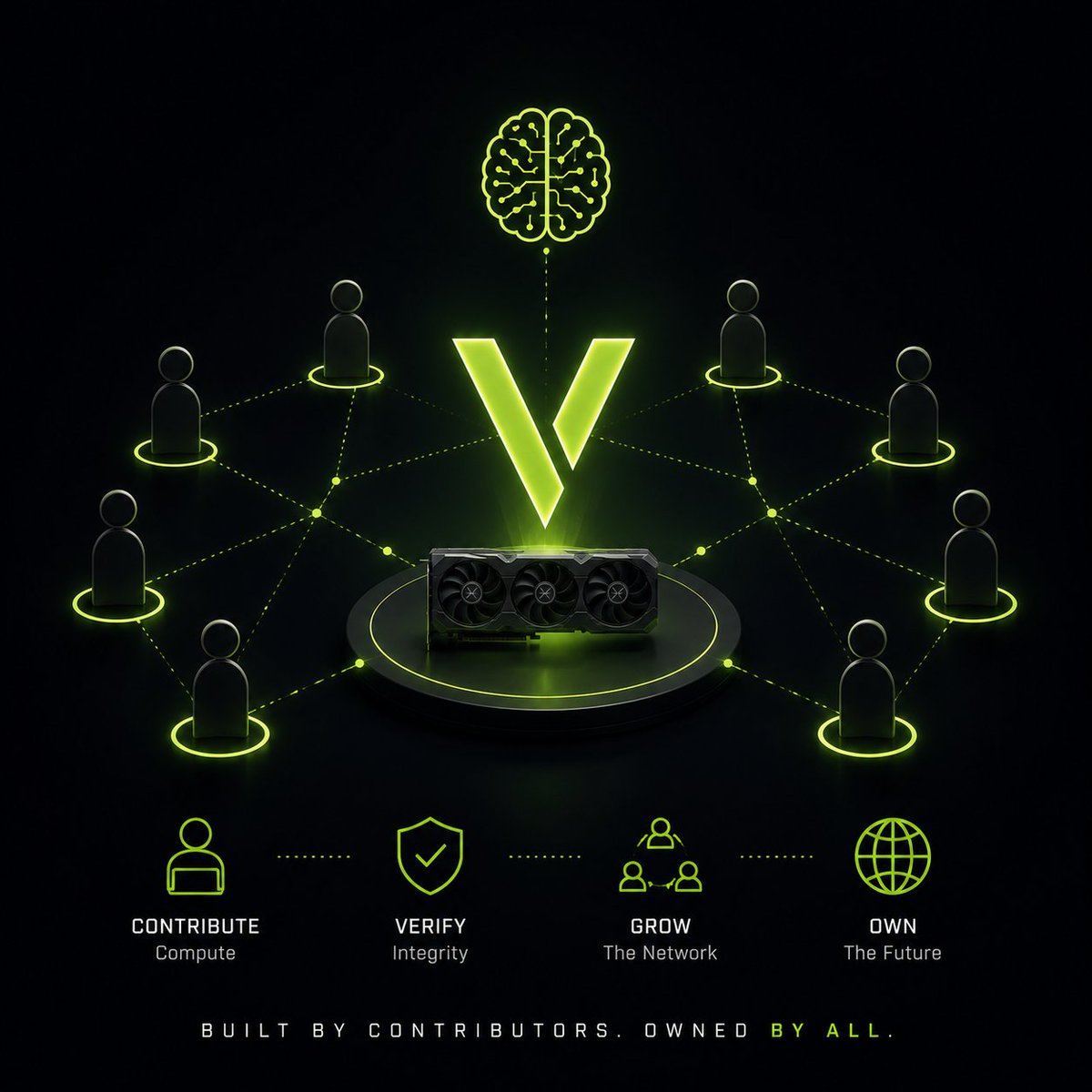
VRAM isn't trying to compete with a single GPU.
It's trying to coordinate thousands of them.
Then tens of thousands.
Then hundreds of thousands.
Because scale changes everything.
A lone GPU is hardware.
A network of GPUs becomes infrastructure.
And this is where most people underestimate the opportunity.
They're still thinking in terms of devices.
VRAM is thinking in terms of networks.
The value isn't the individual contributor.
The value is what happens when contributors work together.
When compute is coordinated.
When contributions are verified.
When rewards are distributed fairly.
When idle resources become productive.
The roadmap hints at this future.
1,000 miners per validator.
In-enclave aggregation.
Large-scale coordination.
Real training jobs.
Governance.
This isn't the roadmap of a mining project.
It's the roadmap of a distributed compute network.
The reason I'm bullish on this idea isn't because of crypto.
It's because networks consistently outperform isolated systems.
One computer changed very little.
The internet changed everything.
One GPU is useful.
A global network of GPUs could become transformative.
And honestly?
I think that's the vision most people are missing.
VRAM isn't asking:
"How can we get more GPUs?"
It's asking:
"How can we connect the GPUs that already exist?"
That's a much bigger question.
Because if millions of idle GPUs become one coordinated network, you're no longer looking at spare hardware.
You're looking at one of the largest decentralized compute infrastructures ever created.
From idle GPUs.
To global infrastructure.
That's the dream. 🚀
@vram_network @0x0sid
1
4
31
Predator405 - ORO AI retweeted

Jun 12
YOM is one of five companies joining the Gaming Founders Circle a new program from @discord and Techleap, in partnership with the Dutch Games Association.
A group of Dutch gaming companies. A direct line to investors, players, and the people building the future of games.
Honored to be in the room.
discord.com/blog/game-on-dis…
655
2,327
768
12,219