
Smart money follow smart money
Joined March 2020
- Tweets 487
- Following 3,516
- Followers 162
- Likes 653
33 Photos and videos















Shredder retweeted

Jun 4
Introduction: The Sovereigns
They don't race. They don't compete. They rule.
Long before the circuits were built and long before the first engines ignited, the Sovereigns established the laws that govern every track in the known Grid.
Hidden within forgotten sectors and unreachable networks, they observe every Racer, every victory, and every failure.
Most believe they are a myth.
A story told to new racerz.

319
428
2,922
35,960
Shredder retweeted

3 Dec 2025
Against all odds.
Polymarket’s U.S app is now being rolled out to those on the waitlist.
We’re launching with sports — followed by markets on everything.
1,124
1,030
6,769
48,472,970
Shredder retweeted

13 Nov 2025
I still believe this market was misresolved. Events like these are very unfortunate and could always have been prevented by better rule writing.
A bit of context for those that have missed it:
Polymarket had a market on what day the shutdown would end. I predicted November 12th, but Polymarket ruled November 13th. The rule writers argued only 1 specific page on OPM would be allowed to be used for resolution. (Announcement ended up being published on another page). 🤦
The government reopened on November 12, exactly as OPM announced in an official Memo on a different page, so resolving it against reality, simply because an OPM page wasn’t updated in time, feels extremely unfair.
I can keep complaining about wrong clarifications for ever. Somehow, my biggest losses are almost all because of clarifications, a total of -$100,000 now.
But this loss only sets me back two weeks, so I’ll take the L with pride.
Btw for the 2 people who care, I also stand by my previous tweet. I think buying 20ct shares was EV, simply because OPM did end up announcing it in time. I only deleted it because Polymarket issued a clarification three minutes later that invalidated my reasoning, which made the tweet completely irrelevant. It made no sense to keep it up, so I decided to just delete it. I have nothing to hide lmfao
13
1
72
7,894
Shredder retweeted

11 Jul 2025
The harsh reality of a 9 to 5 existence.
196
2,108
6,591
386,522

Shredder retweeted

2 Jul 2025
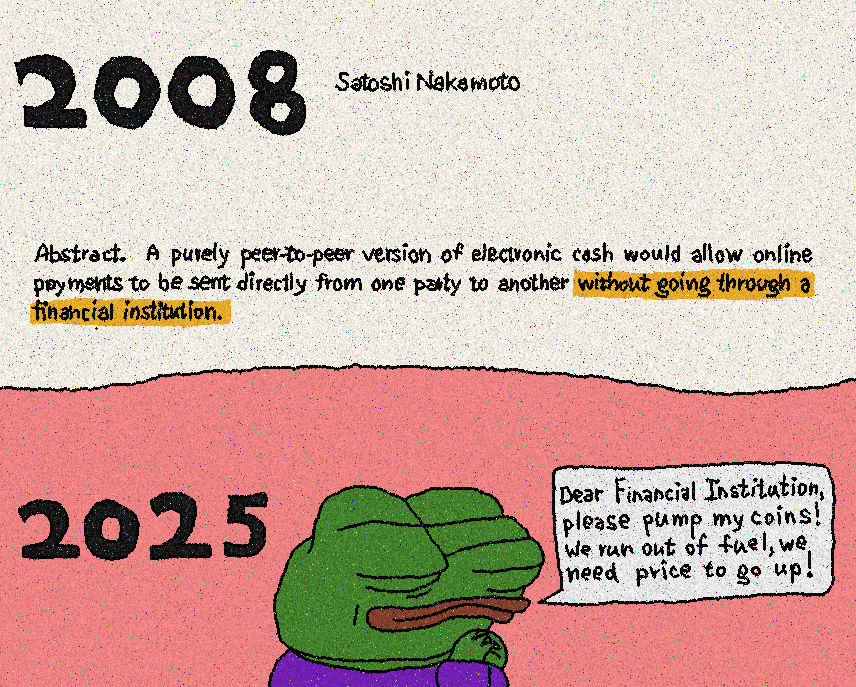
Everyone gets Bitcoin at the price they deserve.
897
3,696
19,906
1,014,784
Shredder retweeted

12 Jun 2025
There’s an 18% chance you’d be born in India.
468
369
10,477
858,678
Shredder retweeted

6 Jun 2025
👀🐸


37
53
327
21,008
Shredder retweeted

4 Jun 2025
I think a lot of people misunderstand why we built a CEX and not a DEX.
There's a lot of great people building DEXs. I don't think we need another one, and I'm happy to use and support other DEXs as we currently do in Backpack. However, there's not that many people building great CEXs, although there are some terrific ones I admire and respect. The nature of a CEX is the nature of traditional finance, making for a totally different problem with a totally different set of a challenges and a totally different strategy for achieving success.
I think a lot of people confuse DEXs and CEXs because of the trading component, but that's only one part of what a CEX does, and, in my view, is only important during the bootstrapping phase of a CEX--and will become less important over time.
In the limit, centralized exchanges aren't just trading apps. They're general financial services providers not only for speculation, but for managing your financial life. They will look more like fintechs than they will anything else--and that's because CEXs are companies, not protocols. It's not just about crypto. It's about all of finance.
Today, and for the foreseeable future, most of the world's value is off chain organized and controlled by the legal code that runs the world. And it's the folks that can assemble the legal code alongside actual code--e.g. with well built custody solutions--that are best positioned to bring that value on chain. Stablecoins are the best example of this dynamic. Circle for example is just a centralized exchange even though they don't call themselves that. Tokenized stocks are another great examle of this--see Kraken and its latest tokenized stock offering. Self custody is important, it's why we have a wallet and continue to invest heavily into it, but in the same way that DEXs are the back bone of the on chain world, custodians are the backbone of the real world--and this will become more and more important as the industry matures and the world comes on chain. Eventually, we won't have DeFi or CeFi. We won't have CEX or DEX--we will just have finance. And I think it's the regulated CEXs that need to do their part by not just building a great crypto product, but by bringing all of traditional finance on chain to grow the on chain economy.
And although bridging traditional finance on chain is important, there's so, so much more. We need to go beyond the degens that make up the space today and cross the chasm to the bigger world. How do we do that? Well, if I'm managing my life savings in a finance app, I need to be able to pick up the phone and call someone to get help. If I want to apply for a mortgage to buy a home, I need to be able to walk into my local bank branch and talk to my banker. If I want to prepare for retirement, I need to make a retirement plan with a financial advisor to manage my IRA. If I die, I need a contingency plan for my loved ones need to be taken care of when I'm gone. It's about building not only great product, great support, and great services--with many different problems to solve that are not only technical, but social, legal, compliance, and support. An on chain, crypto native financial institution that re-imagines your relationship with money.
That's why we're building a CEX.

I'm curious — if you could go back 2 years, would you start a CEX again or a DEX instead?
52
52
333
65,182

Shredder retweeted

21 Mar 2025
Me listening to a couple of normal people talk about cryptocurrency

292
1,223
12,222
548,098

I just bought a public company listed on the Hong Kong Stock Exchange through “Home Office Development Limited.”
I cannot share too much at the moment due to legal, compliance, and strategic reasons.
As always, do not invest money we cannot afford to lose.
----------
“Let us not become weary in doing good, for at the proper time we will reap a harvest if we do not give up.” (Galatians 6:9)
134
254
789
91,048


25 Jan 2025
henlo, check out my personal henlo card! @henlo is a dumb memecoin built by the biggest cult org in the berachain ecosystem. envisioned by Satoshi Nakamoto as cryptos Universal Greeting. 💸🐼🚀
7

v4 deployments will begin rolling out this week for builders to test hooks and integrations onchain
We expect all contracts to be deployed for a full launch next week
DeFi renaissance in progress, contract addresses will be shared soon
🦄🦄🦄🦄
195
250
1,493
328,770
Shredder retweeted

16 Jan 2025
The OG Room welcomes our first ꧁OG GUESTS꧂: @MadLads!
The community of Mad Lads are invited for their consistent support of Story, highlighted by our event with Backpack, their enthusiasm for the OG Room, and their shared commitment to advancing Web3 technology.
Who’s next?

1,036
479
1,724
280,080