
Joined December 2015
- Tweets 14,863
- Following 2,706
- Followers 12,241
- Likes 14,049
1,474 Photos and videos








Pinned Tweet

Apr 10
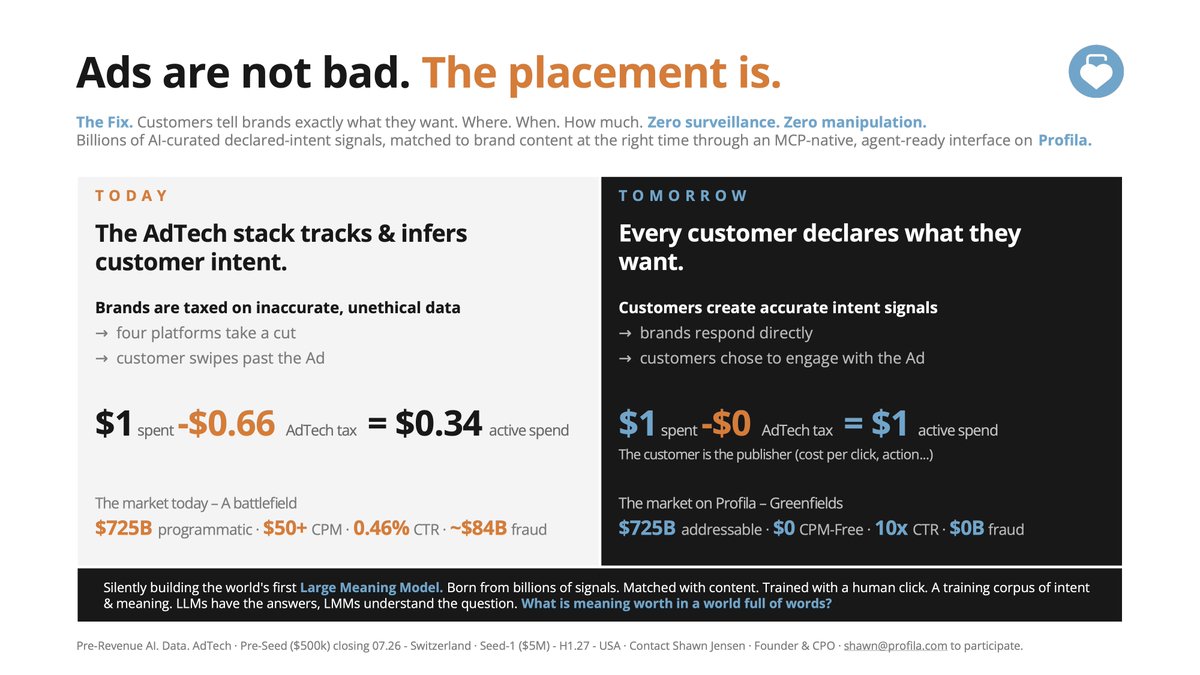
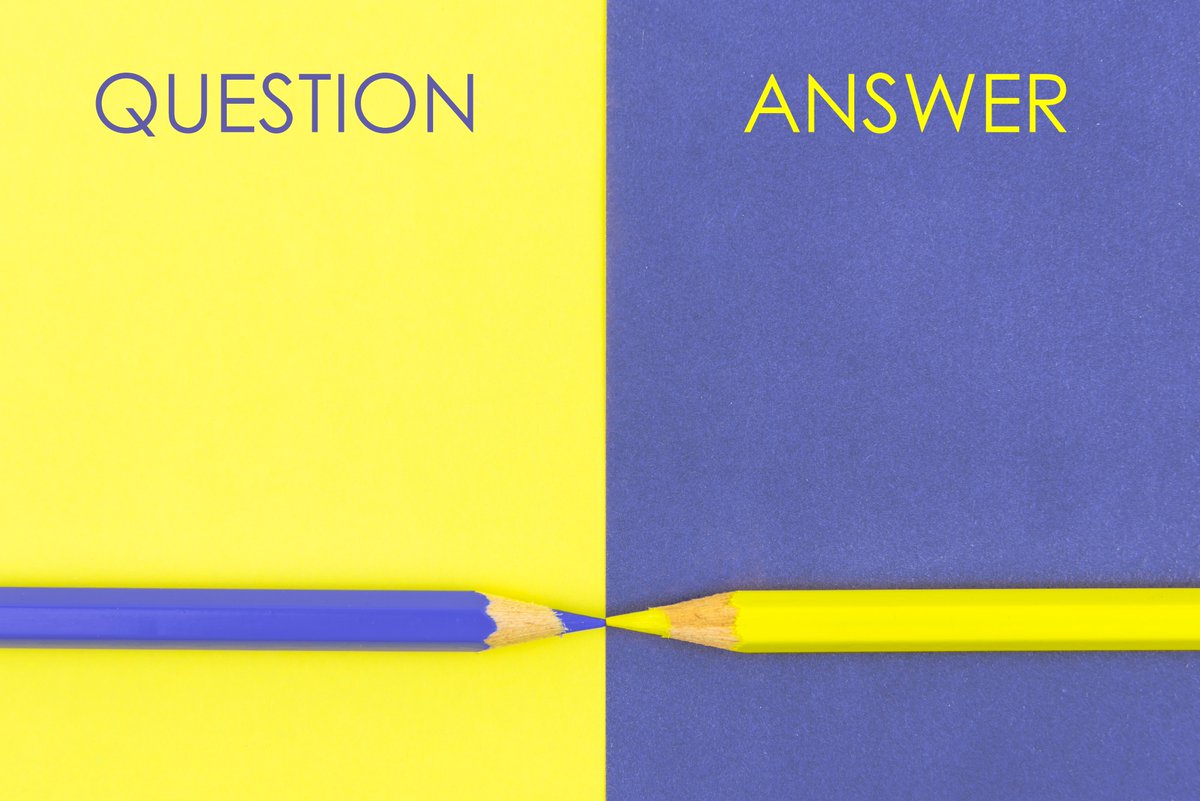
The Question: Every revolution starts with a question that seems naive until it seems obvious.
Here is the question:
What if people just told you what they wanted?
Not what they clicked on. Not what they scrolled past slowly. Not what a cookie trail suggests they might be interested in based on a website they visited three weeks ago.
What if a person said: “I want a luxury electric SUV, CHF 80–120K, within 6 months. I am considering Porsche, BMW, and Mercedes. I prefer performance over range. My budget is firm.”
What would that signal be worth to a brand?
What would the conversion rate be?
What would the media plan look like if every impression was served to someone who had already raised their hand?
The question is naive. The answer is a revolution.
The age of inference is ending. The age of intent is beginning.
#DeclaredIntent #FutureOfAdvertising #MarTech #Innovation
1
1
169

How does a 4B medical model beat one nearly 7x its size, while running privately on your phone? Better training, not brute size.
Full breakdown: qvac.tether.io/blog/meet-med…

13
13
165
2,219,086
Jun 9
Frontier LLMs train on observational data — text and behaviour recorded while the subject knew they might be watched. Nine decades of behavioural science say that's a signal-distorting condition.
So I wrote a paper about what a different kind of training data would look like.
The proposal: an intent pair — declared intent paired with verified outcome, gathered where the declarant is architecturally unidentifiable. (Iₐ, C, M, O) — declaration, classification, match, lived outcome. The label isn't assigned by an annotator; it's supplied by the user's own subsequent action in the world.
Honesty: this corpus does not exist. Can't be scraped (the web is observational). Can't be simulated (the unobserved declaration IS the signal). Can't be extracted from existing systems. The repo is the schema and the seed. The network that produces it is the work.
Background: this is the third paper in a research arc I've directed at @ProfilaPrivacy over four years. The two earlier works are peer-reviewed:
— "Zero Knowledge Advertising" (UC3M Profila, 2022) — established declared-vs-inferred and the zero-knowledge protocol.
— "A Question Answering Tool for Website Privacy Policy Comprehension" (HSLU Profila, HCII 2023) — established domain-specific retrieval and grounding against hallucination.
Both findings are load-bearing in the LMM design.
On state of implementation: the declaration, classification, and matching layers exist in production at @ProfilaPrivacy . The architectural unobservability piece — making the declarant unidentifiable by construction, not by promise — is still in research, not yet implemented.
That's the work ahead.
Open and looking for hard critique:
— Where does the observational-ceiling argument break? — Failure modes of the intent-pair primitive? Gaming, Goodhart, declared-vs-real intent drift? — What's the state of the art on architectural unobservability that I should be reading?
Paper: doi.org/10.5281/zenodo.20616… Repo: github.com/Profila/42-True
80
May 21
Deep Thought gave us 42. Then the mice realised they’d never figured out the question.
That’s where we are with LLMs today.
I have a viable architecture for a Large Meaning Model. White paper on request.
@DarioAmodei — would value 10 minutes.
39
QVAC SDK 0.11.0 is live. 🛠️
This release focuses entirely on unlocking next-generation local compute and advanced visual workflows.
What’s new:
Next-Gen Models: Core engine updated to the latest version of Fabric, unlocking full support for Qwen 3.5, Qwen 3.6, and Gemma 4.
Multi-GPU Support: The SDK can now split workloads across multiple graphics cards on the same machine, allowing you to run significantly larger models completely locally.
Multi-Image Conditioning: Blend multiple reference images together in a single generation for advanced style mixing and composition control.
On-Device Upscaling: Boost your generated images to high-quality resolutions, running securely on your own hardware.
More improvements are waiting under the hood. Check the change logs, update your SDK today, and start building with qvac.tether.io
11
20
176
2,006,326
Profila retweeted

May 15
No limits. No boundaries. No masters.

Remember the last time you sent a 30GB folder in a chat app?
You probably don’t, because most chat apps can’t handle it.
With Keet.io files travel directly from device to device. No Servers. No limits.
14
17
238
45,183
May 11
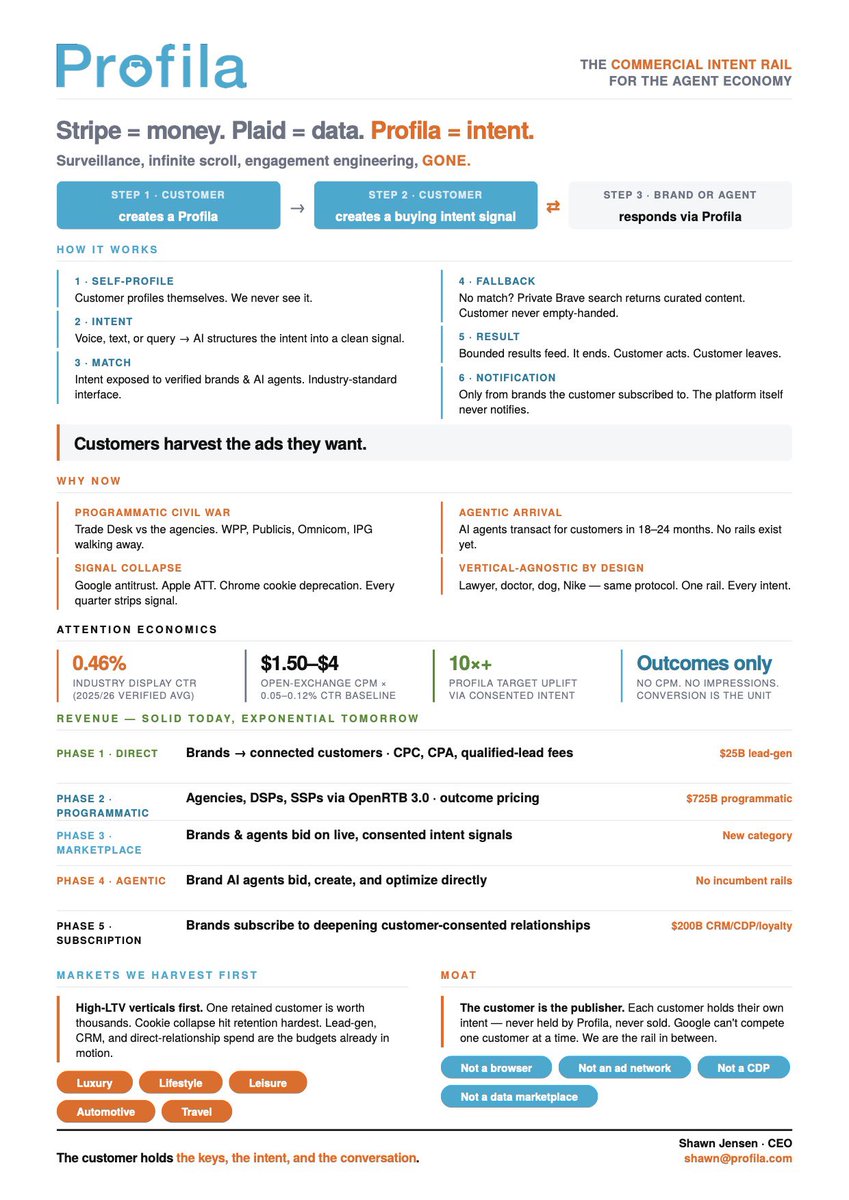
Shawn Jensen is not from AdTech. This is the first thing you need to know about him. The second is that he thinks you, sitting there at your standing desk reviewing your DSP's Q1 performance dashboard, have spent the last two decades participating in one of the most expensive collective hallucinations in modern commerce.
He says this politely. He's Swiss-adjacent now, so he has to. But the politeness does not soften the blow, because the blow is this: an industry that spends $400 billion a year guessing who the customer is forgot to ask them.
That's it. That's the whole thesis. Twenty years of programmatic, identity graphs, lookalike modeling, retargeting pixels, clean rooms, MMPs, CDPs, and the entire LumaScape, condensed into one sentence by a guy who came in from telecom and looked around like he'd walked into a kindergarten where the kids were eating glue and calling it strategy.
Read more in the article.... 👇
new.adotat.com/p/rapping-abo…
39
May 11
While giants like Google and Meta thrive on current methods, a new paradigm is emerging. Regulations like GDPR and the ePrivacy Act are empowering consumers, putting them in control of their data. This regulatory pressure, coupled with the inefficiency of current ad spend where publishers and consumers receive only a fraction of the value, necessitates a fundamental change.
Zero-knowledge advertising models, focused on asking individuals directly rather than guessing, are poised to lead this transformation, offering a more ethical and potentially more effective future for advertising. #Advertising #DataPrivacy #MarketingStrategy #FutureOfAdvertising #ZeroKnowledge
youtu.be/nBU8fOaQSSE?si=k765…
77
May 10
I had a chance to introduce Profila to a broader audience through the The ADOTAT Show, thank you to @pesach_lattin who is an excellent host and Ad-tech veteran.
youtu.be/nBU8fOaQSSE?si=j8GL…
96

8 billion humans deserve an intelligence that doesn't blink when the signal dies. 🧠
Introducing @QVAC Psy, our foundational models built on the mathematical stability of Psychohistory.
With QVAC MedPsy, our local-first medical health AI model, we’ve proven that superior methodology beats raw parameter count. Our 1.7B & 4B models are delivering expert-level healthcare reasoning on consumer hardware.
The "tiny brain" for the next galaxy is here. Fully open-source. Fully sovereign.
Learn more
qvac.tether.io/models
28
29
256
187,204
If your AI needs a wire to work, it isn't yours.
QVAC is the local-first engine designed to run anywhere, even where the internet can't reach. Fully autonomous. Fully open source. Fully sovereign.
If you can dream it, you can build it. Even in another galaxy.
Start building the future of edge AI: docs.qvac.tether.io
50
88
845
7,043,834
Profila retweeted
May 7
Personal intelligence building blocks

If your AI needs a wire to work, it isn't yours.
QVAC is the local-first engine designed to run anywhere, even where the internet can't reach. Fully autonomous. Fully open source. Fully sovereign.
If you can dream it, you can build it. Even in another galaxy.
Start building the future of edge AI: docs.qvac.tether.io
13
9
82
16,729
Profila retweeted
Apr 28
QVAC Workbench just got a big feature bump
QVAC Workbench 0.6.0 is officially live. 🤖
This update marks a major shift toward a more natural, hands-free interface with several key features:
Conversation Mode: Enables full voice-to-voice interaction using automated transcription and text-to-speech (TTS), allowing the keyboard to be entirely optional.
Automated Model Selection: Streamlines the user experience by intelligently selecting the best local model for your device.
Snappier UI: Significant performance improvements to the interface for a faster and more responsive workspace.
Learn more: qvac.tether.io/products/work…
5
8
86
15,796
Apr 27
€7.1B GDPR fines. 2,800 issued. 443 breach notifications/day in EU.
2026 enforcement focus: transparency under Articles 12–14.
CRMs built around "record what we collected" are about to fail audits that ask "prove the customer understood."
43
Apr 27
India moved 1.4B people from "data subjects" to "data principals." Easyrewardz launched OneConsent yesterday. Penalties hit ₹250 crore.
In DPDP, you are a principal — the word implies ownership.
When the legal architecture renames the consumer, commerce has to follow.
36
Profila retweeted
Apr 23
QVAC SDK and Fabric give people and companies the ability to execute inference and fine-tune powerful models on their own terms, on their own hardware, with full control of their data.
techcrunch.com/sponsor/tethe…
7
10
120
14,151