
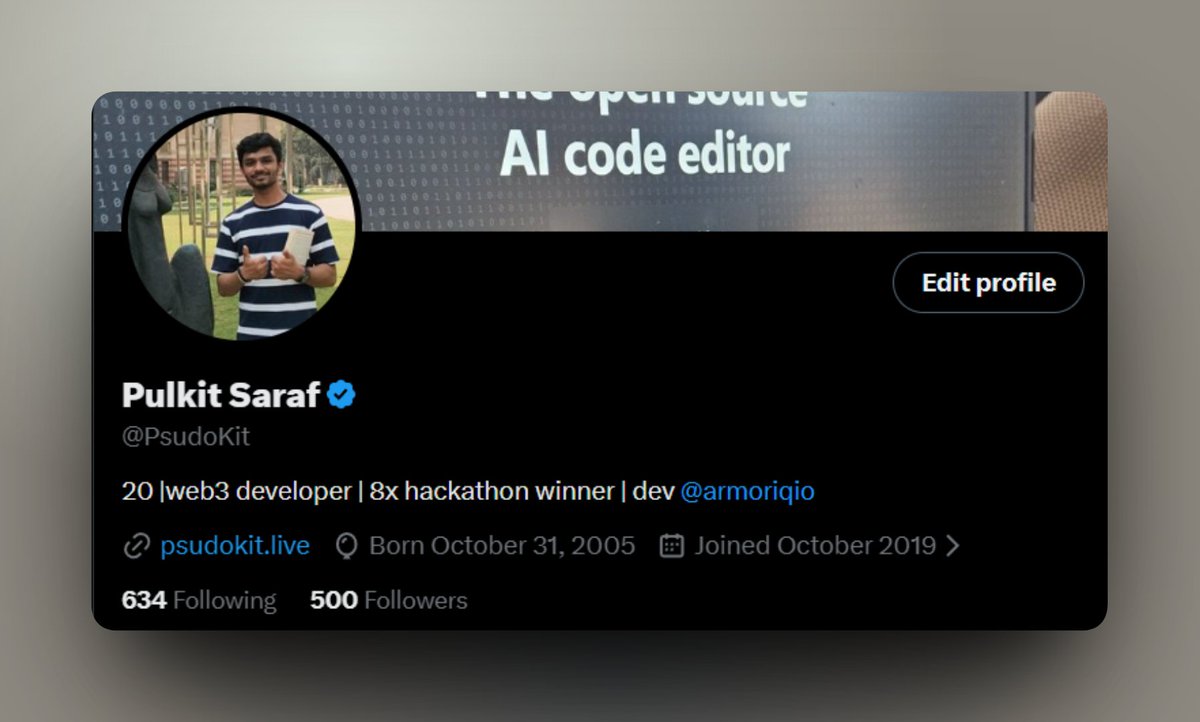
20 |web3 developer | 8x hackathon winner | dev @armoriqio
Joined October 2019
- Tweets 2,771
- Following 649
- Followers 735
- Likes 6,098
566 Photos and videos








Pinned Tweet

17 Oct 2025
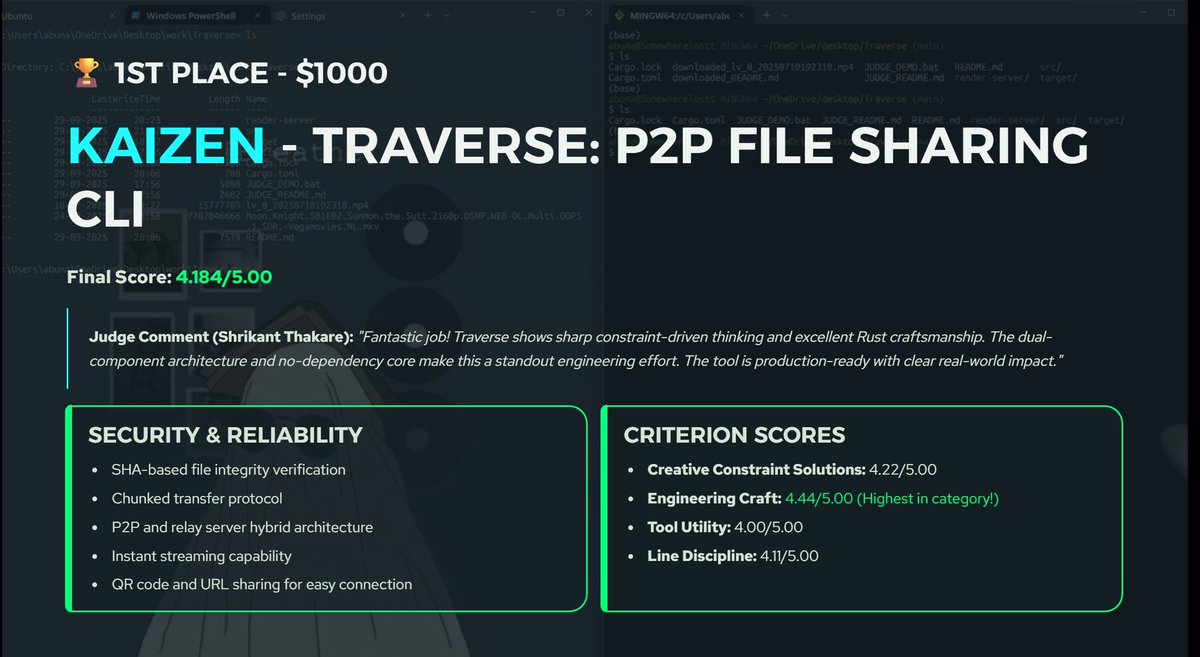
Won an international hackathon and I promised myself to gift myself X premium after that
1200 dollars are going to used at right place
What should i build next
The project was P2P file sharing using only CLI built on rust


9
54
11,306
Pulkit Saraf retweeted

one of my blogs is about to cross 100k views.
which is honestly wild because I published it expecting a few hundred people to read it.
a lot of new people have followed me since, so this feels like a good time to properly introduce myself.
hey, I’m Mohit.
I’m a computer science student from Delhi, and most of my time goes into building AI systems, breaking them, and then figuring out why they broke.
hackathons became my fastest classroom.
15 wins later, the biggest lesson wasn’t how to win hackathons. it was learning how to take a vague idea, turn it into a working product, and explain why it matters, usually under an unreasonable deadline.
that habit of shipping pulled me deeper into AI engineering and research.
over the past couple of years, I’ve worked across RAG systems, agent harnesses, enterprise AI, model optimization, MCP servers, and applied LLM research.
some things I’ve built and worked on:
→ AgentForge, a Python agent harness with tools, MCP, approvals, subagents, context management, checkpoints, persistence, and recovery.
→ MemexLLM, a deployed RAG platform with hybrid retrieval, reranking, citations, evaluation, and observability.
→ GRIT, a geometry-aware parameter-efficient fine-tuning method that updates under 1% of model parameters.
→ enterprise agentic systems at C3alabs, where I work on turning AI prototypes into systems that can actually be deployed and used.
I’ve also published three research papers and preprints, worked on production GenAI systems, and built far too many experiments that never made it past localhost.
the deeper I go into AI, the less interested I become in simply wrapping a model inside another interface.
the work I find exciting is everything required to make intelligence useful:
tools, memory, evaluations, context, permissions, observability, recovery, and reliable execution.
basically, how do we move from agents that look impressive in a demo to agents people can trust with real work?
that is the question I’m currently obsessed with.
on this account, I’ll be sharing more about:
→ building agentic systems
→ AI engineering and architecture
→ LLM research and evaluations
→ lessons from 15 hackathon wins
→ experiments, failures, and things I ship
→ honest thoughts about where AI products are going
I’m still learning, still experimenting, and still changing my mind regularly.
but I know what kind of work I want to pursue:
difficult problems, useful systems, and ideas that survive beyond the demo.
if you followed because of the blog, welcome.
and if you’re building around agents, AI infrastructure, research, or ambitious products, say hi. we’ll probably have plenty to talk about.
I’m Mohit. good to meet you :)
most of my work lives at mohitx.in !!
11
5
131
4,022


Jun 12
Back to school is around the corner how can I take advantage of it
I am planning for a mac and ipad
Some finance tips to get it at cheapest value as a student : )
I won airpods recently and want to dive in the ecosystem
4
12
678
Pulkit Saraf retweeted

Jun 11
Quick explainer on why "just use logs" doesn't work for AI agents:
- Logs tell you what happened
- Logs tell you when it happened
- Logs tell you who did it
- Logs cannot tell you if the action was within the declared scope of the task
That's not a logging problem. That's an intent problem.
2
2
12
446


Jun 11
I have got 100s of responses
Give me some time to go through them
Some of them are too good
Jun 10
Guys, the startup I work at is looking for interns!
Roles: Full Stack and AI
Location: Remote
If you're interested, please DM me your resume.
And if you know someone who'd be a good fit, do let them know about this.
7
29
1,651
Jun 10
Guys, the startup I work at is looking for interns!
Roles: Full Stack and AI
Location: Remote
If you're interested, please DM me your resume.
And if you know someone who'd be a good fit, do let them know about this.
105
4
295
35,312
Jun 10
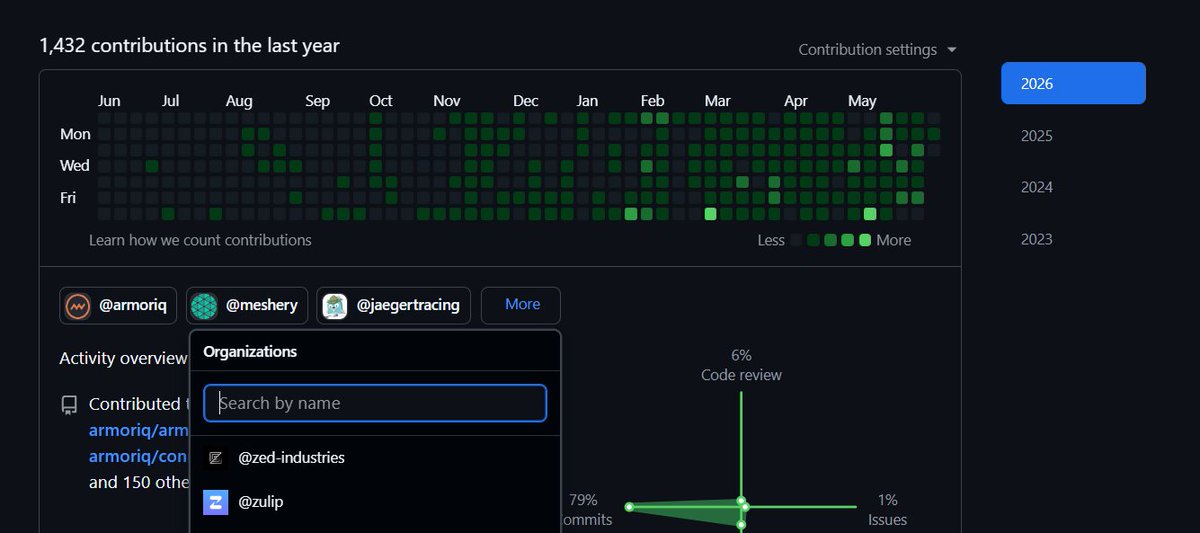
Cant believe I was this consistent from last 6 months
Considering the fact
I made over 5 projects (still in progress to launch)
OSS to repos including @mesheryio @zulip @zeddotdev @opentelemetry and others...)
Learnt so much things which I though would take months
took problems I had no clue how to take forward still shipped after mentorship
1
1
22
929
Jun 9
First limitation cant even access basic attacks
1
2
264
Jun 9
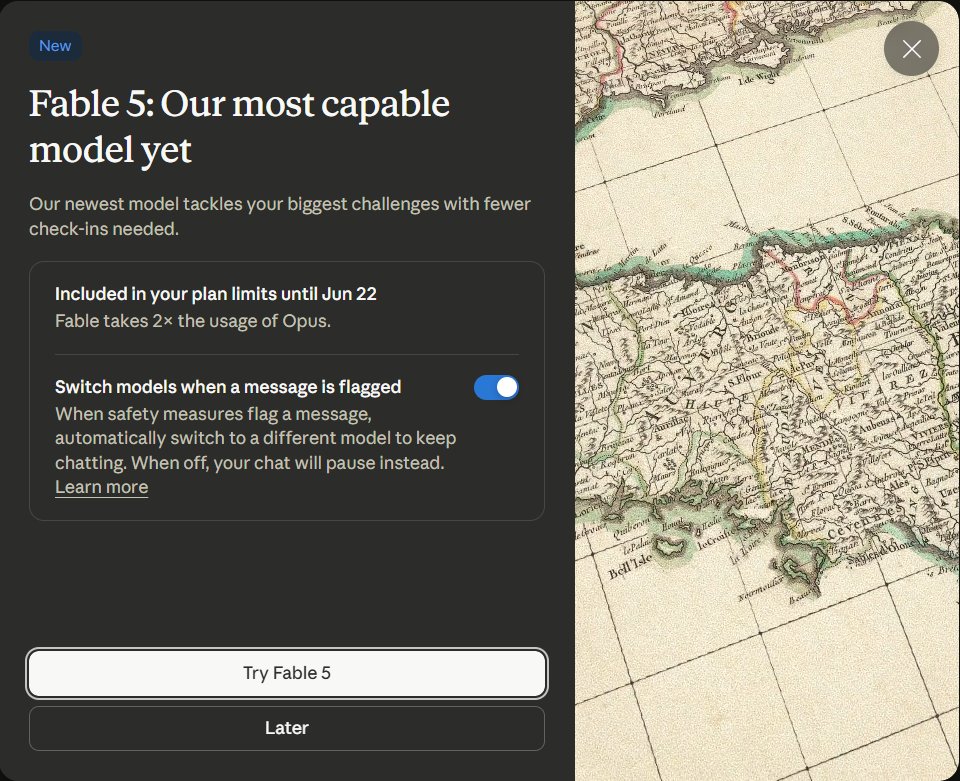
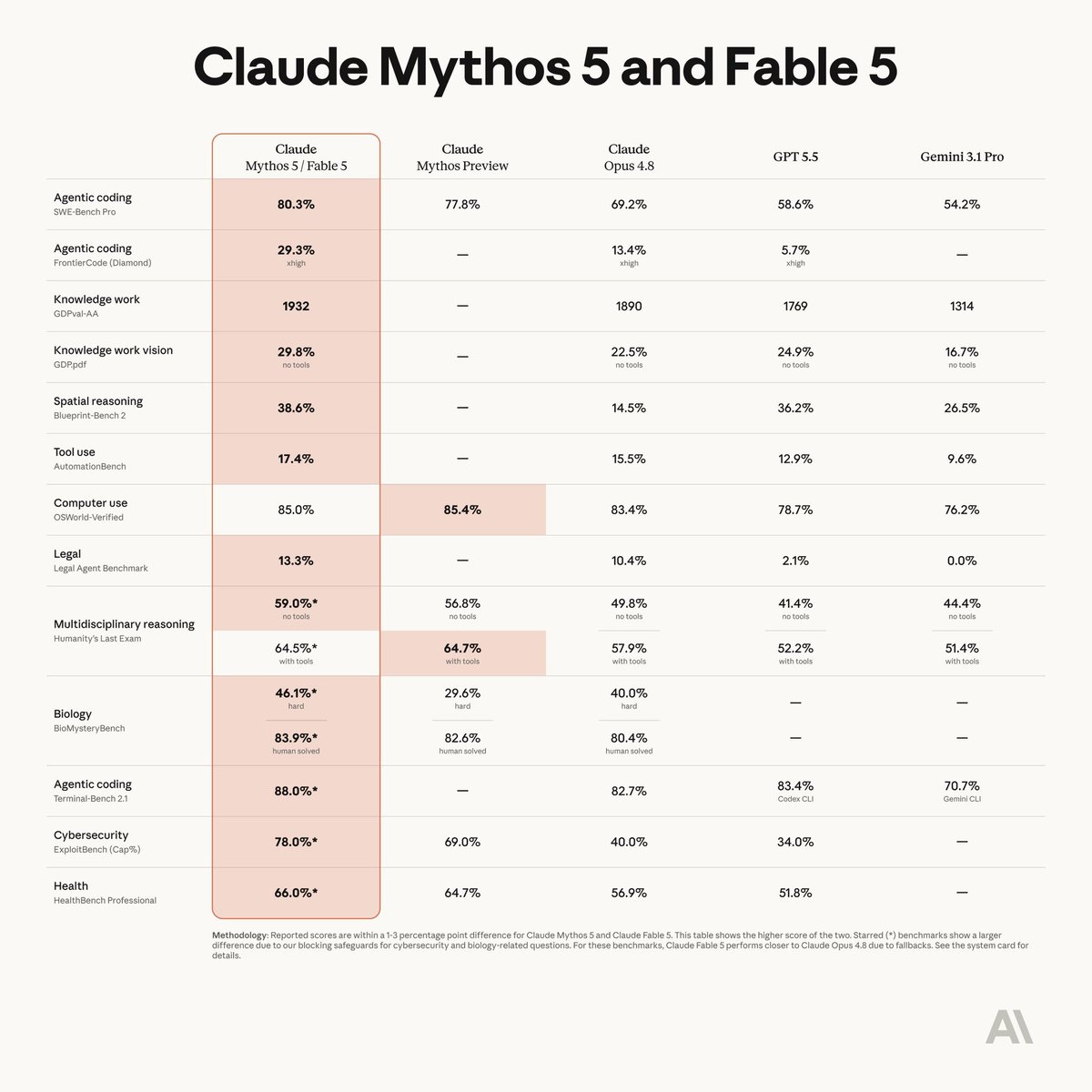
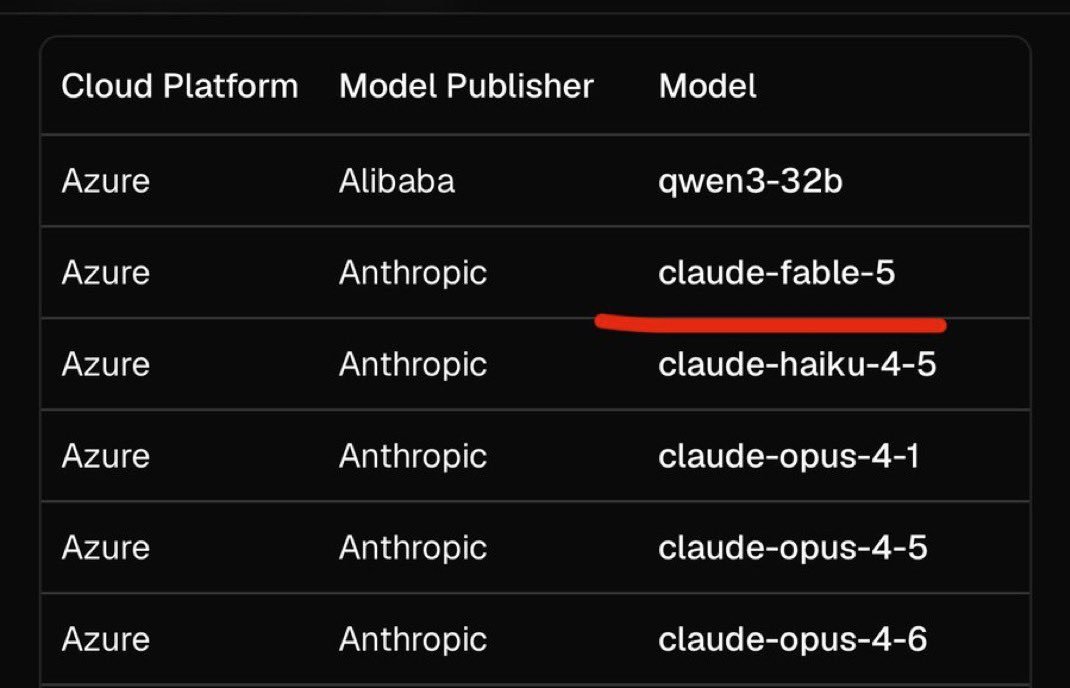
Mythos dropped

Introducing Claude Fable 5: a Mythos-class model that we’ve made safe for general use.
Its capabilities exceed those of any model we’ve ever made generally available.
1
3
246
Pulkit Saraf retweeted
Jun 9
Everyone is talking about prompt engineering.
I think the next important skill is loop engineering.
A better prompt might improve an output.
A better loop can improve an entire system.
Most people still think AI works like this:
Input → Model → Output
But the most capable agentic systems work like this:
Input → Plan → Execute → Evaluate → Learn → Retry → Complete
The difference is massive.
Consider two agents asked to build a customer analytics dashboard.
The first agent generates code once and stops.
The second agent:
Creates a plan.
Writes code.
Runs tests.
Reviews failures.
Collects missing context.
Refactors.
Runs tests again.
Checks whether the original objective was achieved.
Repeats until it reaches a satisfactory result.
Same model.
Same tools.
Different outcome.
The quality doesn't come from the first generation.
It comes from the loop.
Humans work this way too.
Great engineers don't produce perfect code on the first attempt.
They iterate.
They debug.
They gather feedback.
They improve.
The final result is often a product of the process, not the first idea.
The same principle is becoming increasingly important in AI.
When you look closely at the most impressive agentic systems, the breakthrough is rarely a secret prompt.
It's the feedback loop.
Can the system detect mistakes?
Can it evaluate its own work?
Can it gather more information when it's uncertain?
Can it recover from failure without human intervention?
Can it keep moving toward the objective?
These questions matter far more than finding the perfect prompt.
That's why building agents is starting to feel less like prompt engineering and more like systems engineering.
You're not designing responses.
You're designing processes.
As models become stronger and cheaper, intelligence itself becomes less scarce.
What becomes scarce is the ability to direct that intelligence effectively.
The teams that win won't necessarily have the best models.
They'll have the best loops.
Prompt engineering was about talking to models.
Loop engineering is about managing intelligence.
My bet is that the second ends up being far more valuable.
1
1
8
218