
ESRC-funded project aiming to (1) establish a consensus on how to quantify bilingual language experience & (2) to develop online tools for research and practice
Joined September 2019
- Tweets 76
- Following 86
- Followers 394
- Likes 70
5 Photos and videos

Pinned Tweet

4 Sep 2019
The project will be funded from October 2019 to September 2022
Our team includes Cécile De Cat (PI), Sharon Unsworth (Co-I), Ludovica Serratrice (Co-I), Philippe Prévost (Co-I), Laurie Tuller (Co-I), Arief Gusnanto (Co-I), Draško Kašćelan (PDRA)
2
7
25 Apr 2024
We created short videos on how to register on the Q-BEx platform, create, customise & distribute the questionnaire, & access the data. The videos aim to facilitate using Q-BEx in research/practice with #bilingual & #trilingual children. Check them out: q-bex.org/researchers/using-… 1/2
1
1
5
652
25 Apr 2024
More details on using the Q-BEx questionnaire can be found in the manual: q-bex.org/wp-content/uploads… 2/2
1
1
96
12 Mar 2024
The Q-BEx manual has been updated with new features of the questionnaire, such as a short version for exposure/use documentation, project cloning & a recommended version for SLTs and teachers. Check out the updated manual & supporting files here: q-bex.org/researchers/using-… 1/2
1
4
11
1,915
12 Mar 2024
The manual also contains updated information on all output files, including the reports for SLTs/teachers with a new score devised based on bi/multilingual milestones 2/2
81
1 Mar 2024
The individual child reports generated by the @QBExProject #bilingualism #questionnaire now include a section to identify children who would benefit from specialist language assessment.
4
12
4,007
1 Mar 2024
Version 11 of Q-BEx is now live, with lots of improvements to the administration interface and customisability of the questionnaire.
1
6
1,798
16 May 2023
The Harmonious Bilingualism Network @HaBilNet is generously funding Q-BEx for 3 years. From 2025, donations will be requested only from funded research, so that the tool can remain free to all other users.
1
4
420
8 Nov 2022
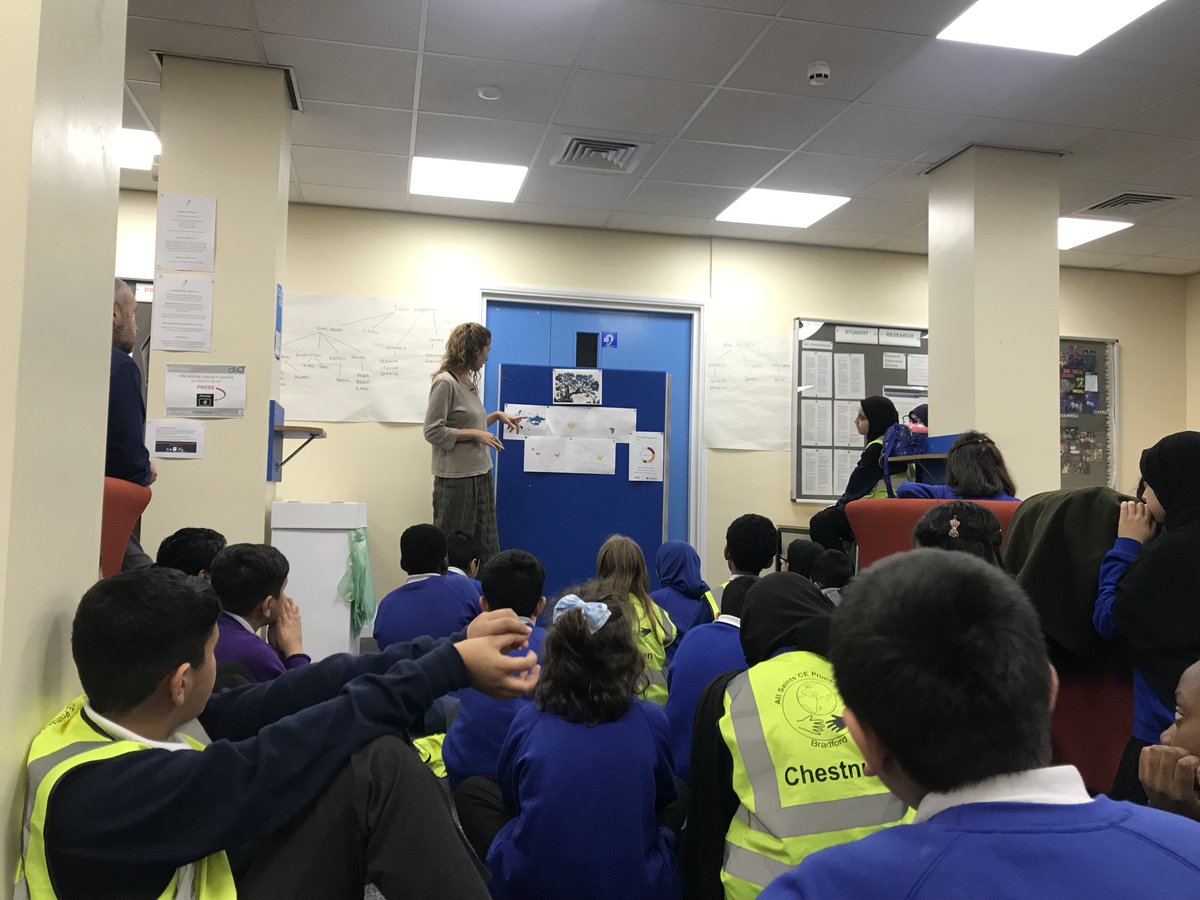
Today we had a visit from wonderful @AllSaintsBD5 pupils at @LCSLeeds, learning about languages of the world and multilingualism! We hope to see many of them join @UniversityLeeds in future as students and staff investigating different languages, cultures and other topics!
1
13
23 Sep 2022
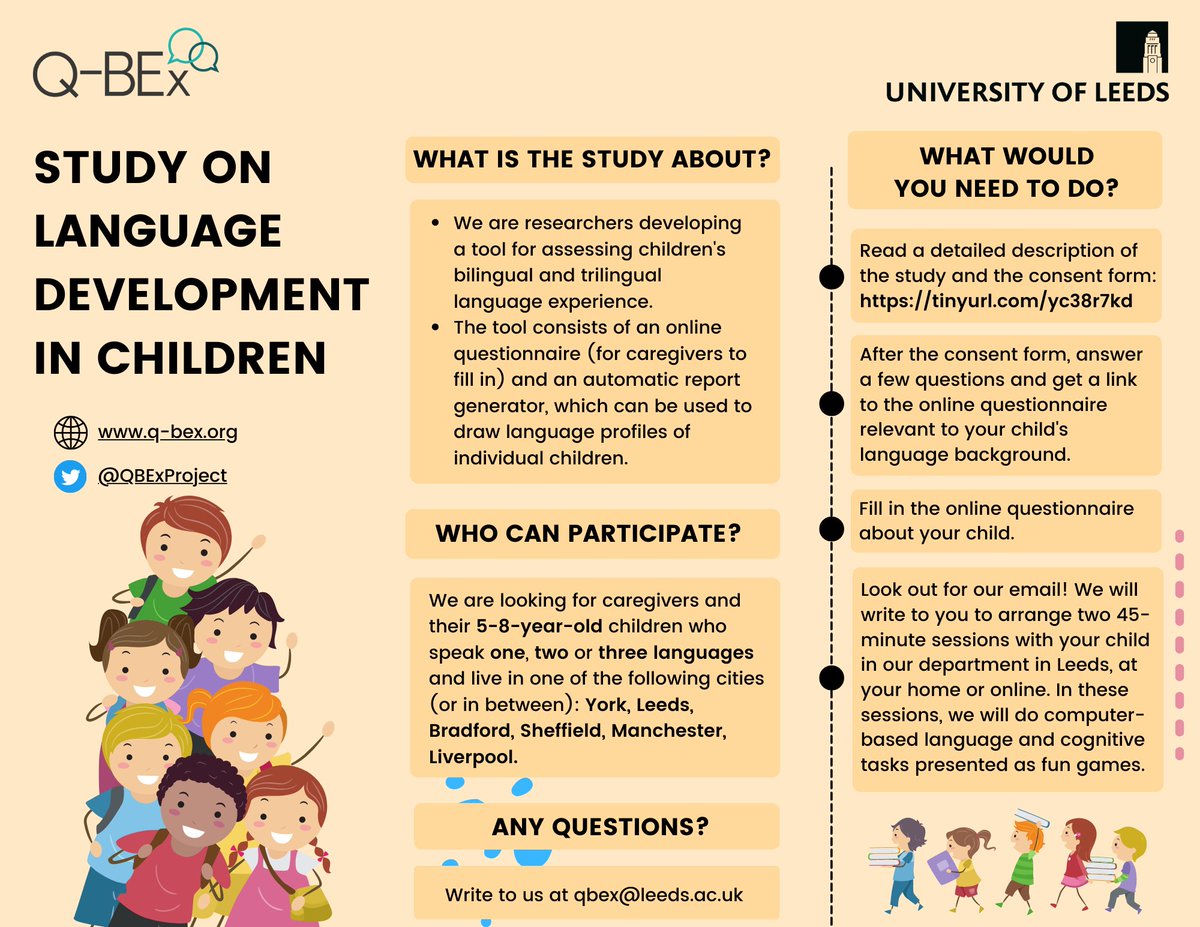
We are recruiting #monolingual #bilingual & #trilingual 5-8-year-old children from the north of England for our study on #LanguageDevelopment & #EAL. See more details about the study on the flyer or on this link: tinyurl.com/yc38r7kd
1
25
22
23 Sep 2022
Are you a parent of a 5-8-year-old who speaks 1, 2, or 3 languages? Do you live in York, Leeds, Bradford, Sheffield, Manchester, Liverpool or anywhere in between? If yes & if interested to participate in our study on language development, please get in touch at qbex@leeds.ac.uk
20
18
13 Jul 2022
Great to see #QBExProject featured at #ALC22 - a wonderful event launching the new Alliance for Life Chances @BradfordOppArea @CAER
2
7
QBEx retweeted

6 Jul 2022
We’re very keen for #teachers and #SLTs to try the questionnaire with #bilingual and #trilingual children and tell us what they think @RCSLTResearch @EAL_naldic.
You can find all the info https://www.q-bex.or and you can email us at qbex@leeds.ac.uk.
🙏🏻
4 Jul 2022

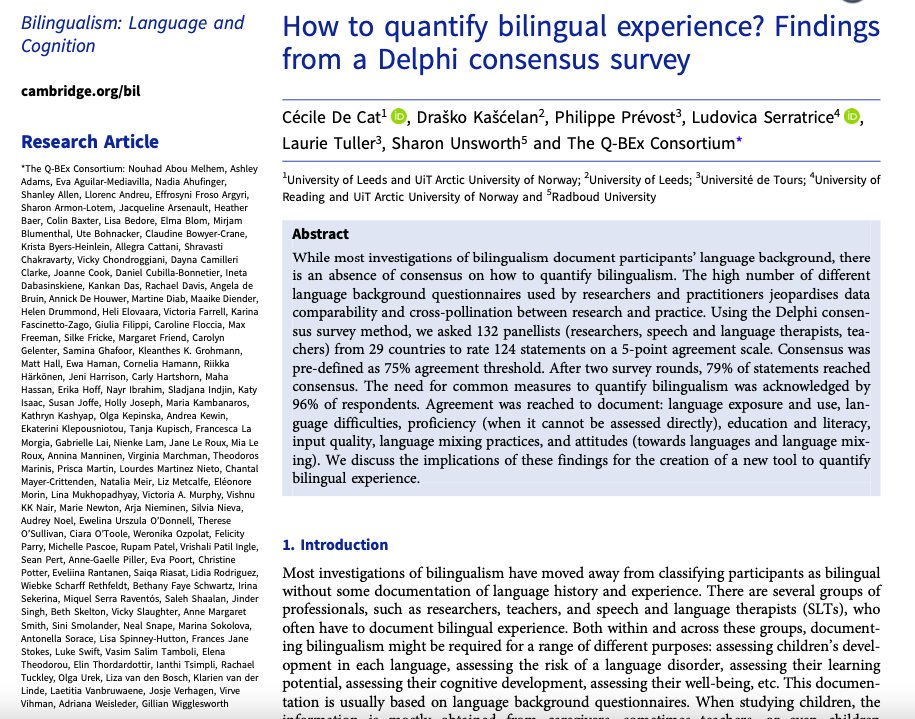
We're pleased to see our consensus study on quantifying #bilingual experience in children available online. This was a collaborative effort of 132 #researchers, #teachers and #SLTs from 29 countries. The paper is freely available here: doi.org/10.1017/S13667289220…
1
23
26
QBEx retweeted

4 Jul 2022
A study of 355k UK primary school students finds reading achievement in one year predicts maths achievement the next year more strongly than the other way round suggesting "acquiring good reading skills is highly relevant for developing mathematics skills" bit.ly/3OYL2I5
30
421
1,170
4 Jul 2022
We're pleased to see our consensus study on quantifying #bilingual experience in children available online. This was a collaborative effort of 132 #researchers, #teachers and #SLTs from 29 countries. The paper is freely available here: doi.org/10.1017/S13667289220…
91
253
15 Jun 2022
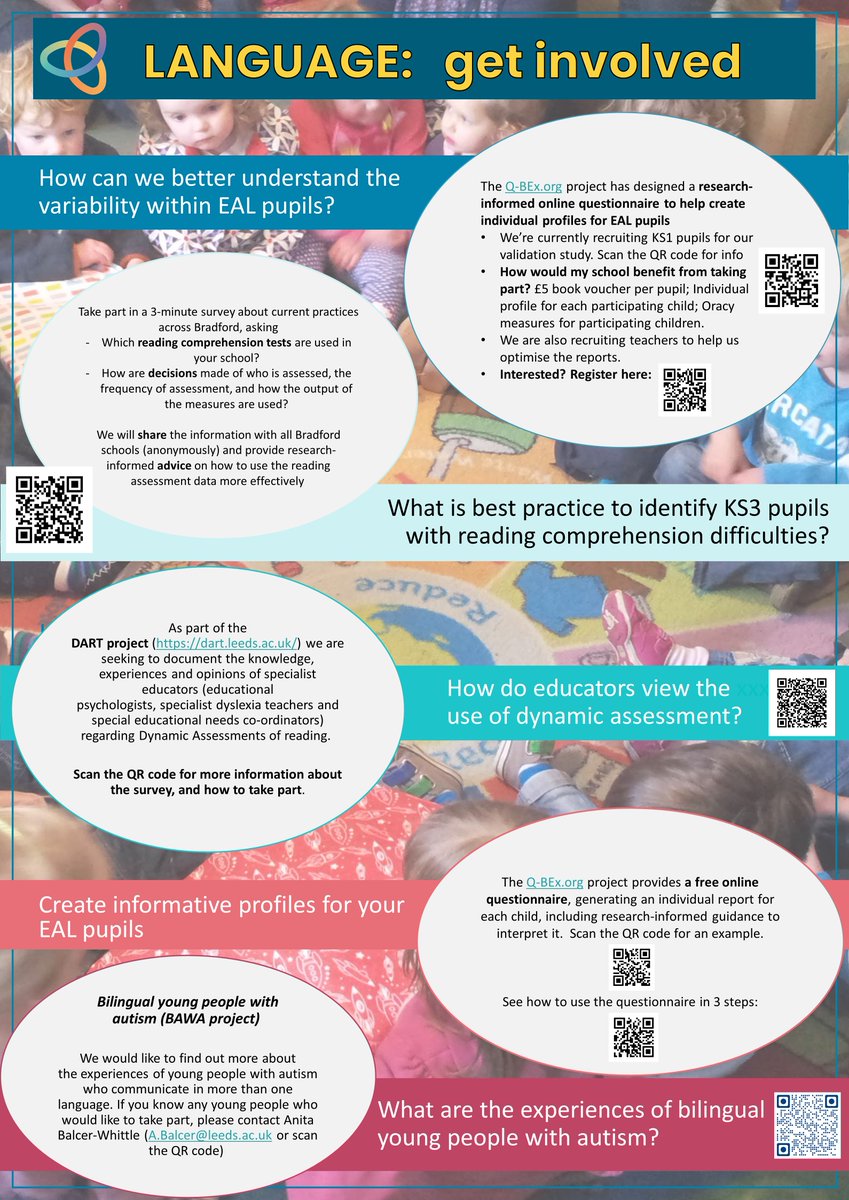
We've been busy in the past few months! Currently we are validating the #Q-BEx #questionnaire in 3 countries and working with #teachers and #SLTs on determining a school-optimised and SLT-optimised version of the tool. Read more here: q-bex.org/2022/06/14/q-bex-p…
2
11
12 May 2022
Are you a researcher/teacher/SLT who has used the Q-BEx questionnaire to collect language background data with multilingual families/children? Please give us your views via this 5-minute form: bit.ly/3uZvJGa
Your input to improve the Q-BEx is key! Thanks and please RT
3
4
6 May 2022
"How to quantify bilingual experience? Findings from a Delphi consensus survey" - accepted for publication in Bilingualism: Language & Cognition! Available as OSF preprint: osf.io/ebh3c
2
6
19
7 May 2022
We discuss the limitations of the Delphi approach and issues of bias, and the risks and limitations of standardised questionnaires.
1