Hyperstitious Syntropreneur, Resolutionary Technologist, Holons.io, Composting Capitalism, True North Project, Another World Is Possible🦋 *Join Us*
Joined October 2010
- Tweets 2,286
- Following 3,403
- Followers 511
- Likes 4,070
132 Photos and videos

Pinned Tweet

2 Jul 2025
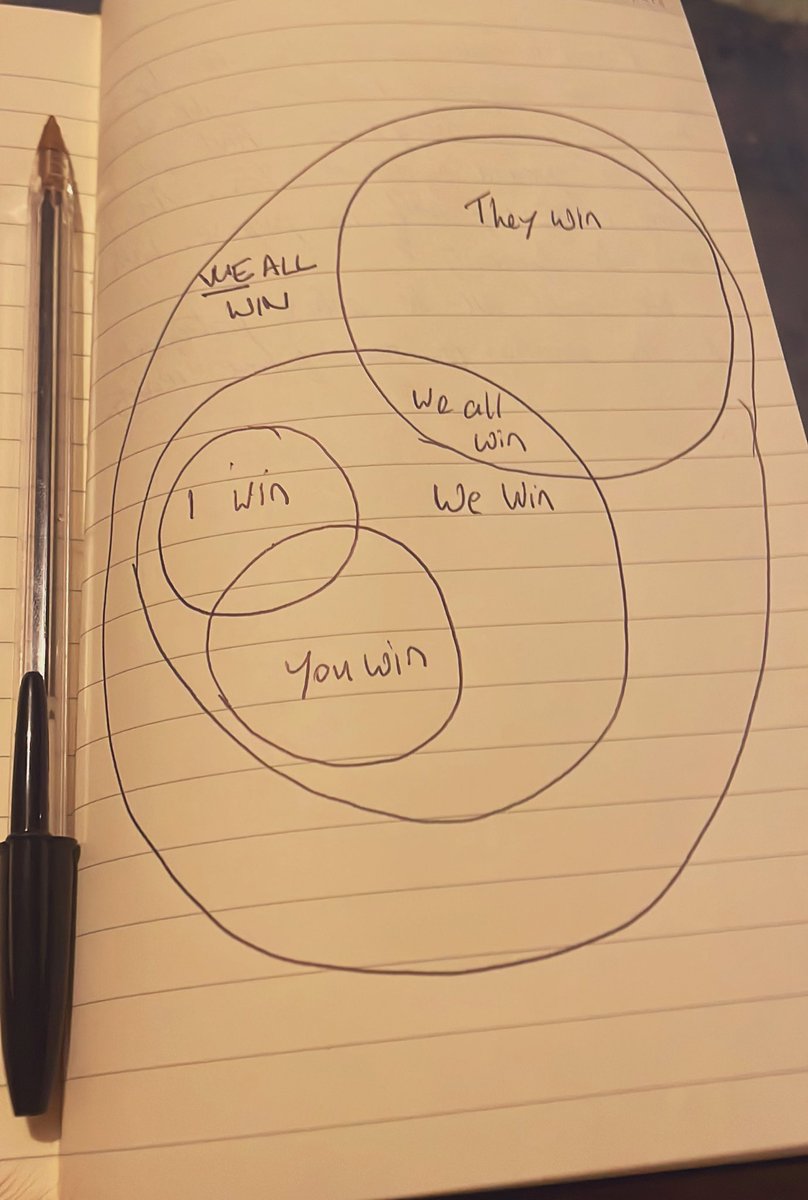
(3,3,3)
Win, Win, Win...
You win, We win, and We Generate Positive Externalities Together
And thats all we had to do
11
472
More time with friends and loved ones, but aside from that, a good recipe for life.
May 12

This is it.
Everything learned spending millions on longevity.
From: Your Immortal Unc and Auntie.
To: Our Immortal nieces and nephews.
0. Sleep is the world's most powerful drug.
1. Be in your bed for 8 hours
2. Same bedtime every night, any time before midnight
3. Don’t eat right before bed
4. Calm foods for dinner
5. No screens 1 hour before bed
6. Avoid added sugar (be aware it’s in everything)
7. Avoid all things in an American convenience store
8. Avoid fried foods
9. Shoes off at the door
10. Eat whole foods, particularly veggies fruits nuts legumes berries
11. Walk a little after meals or air squats
12. Get your heart rate high routinely
13. Lift heavy things
14. Stretch daily
15. Water pik, floss, brush, tongue scrape, morning and night
16. Make an effort to drink water
17. Get sunlight when you wake up (UV is low)
18. Protect skin in midday sun
19. Stand up straight
20. See at least one friend once a week
21. Avoid plastic where you can (in all things)
22. Circulate air in rooms
23. When stressed, breathe, learn to calm your body
24. Go to the dentist
25. Avoid sitting for long times
26. Protect your hearing, the world is too loud
27. Alcohol is bad for you
28. Finish coffee before noon
29. Avoid bright lights after sunset
30. If obese, look into a GLP
31. Sleep in a cold room
32. Texting while driving is dangerous
33. Turn off all notifications
34. Limit social media use
35. Don’t smoke anything
36. If you struggle to sleep, read a physical book before bed
37. 1 hour before bed have a calm wind down routine: bath, read, light walk, listen to music
38. The body is a clock and loves routine. Have a daily morning and evening schedule.
39. Avoid long distance travel where you can
40. Baby steps first: incorporate new things slowly
41. Do less… most things don’t work.
Bonus points if you get your blood checked.
Start here, it will change your life.
1
24
Simon Q (human, 3,3,3) retweeted
I've been quieter than usual the last few months. Here's why:
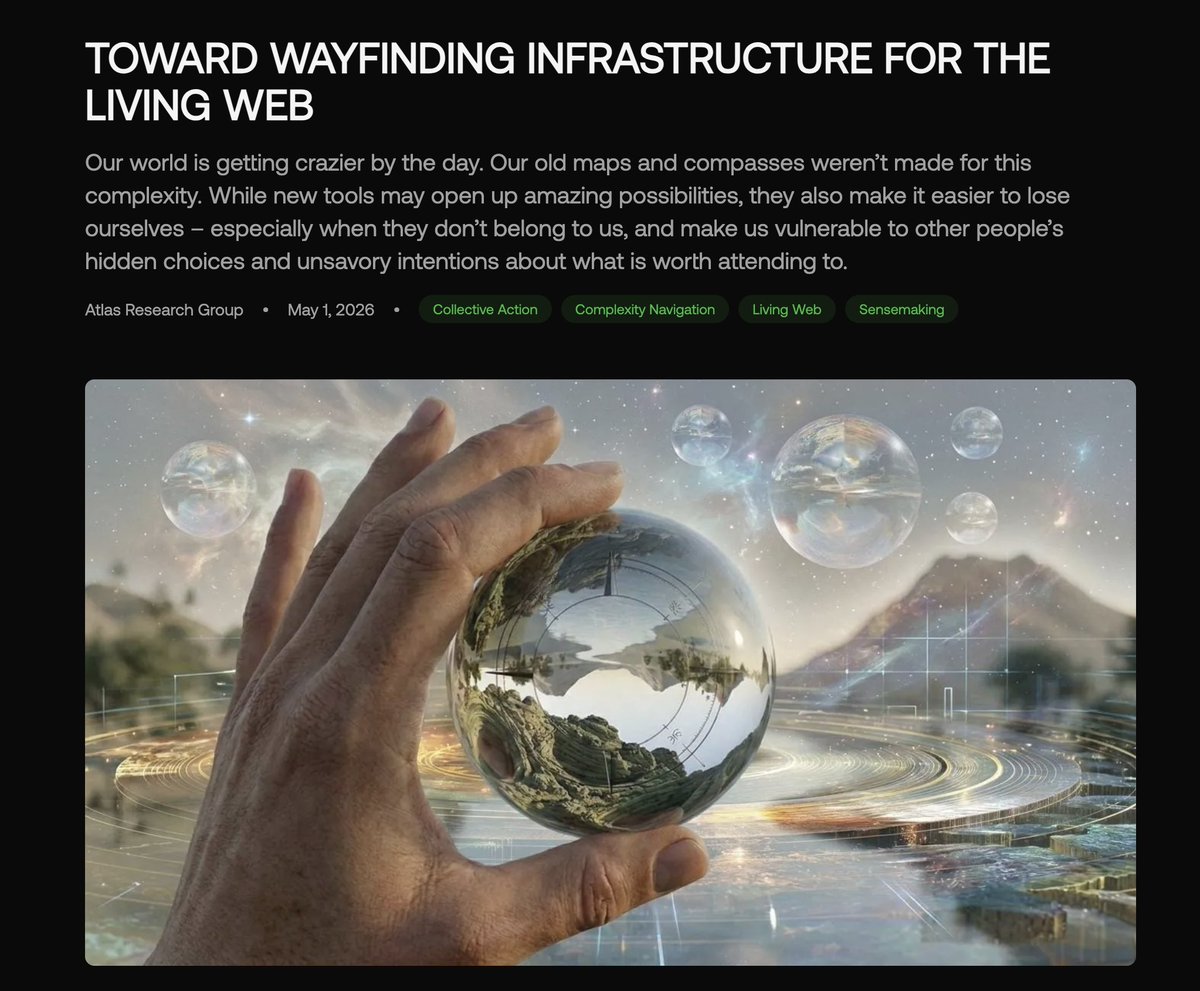
The hundreds of conversations on public record at Humans On The Loop were just the tip of an iceberg. Over the two years since leaving Mozilla, I've met more and more amazing people who share a dream of a future I actually want my kids to inherit: a flourishing world where narrative authorship is restored to the people, ecologically-grounded economic systems are built with care, and sovereign sensemaking infrastructure enables us to meet the wicked problems of our century with the creativity and collective intelligence they require.
Atlas Research Group, the team I've been working to help launch, is a kind of seed crystal for a federated commons of open source projects in service of this future. My colleagues on the core team — @dylantull, @coreygo, @csageland, @QBFrank, and @HexaField — are some of the most insightful and capable people I've ever had the pleasure to team up with. All of us were working toward this for years without realizing just how many of us there are. And now we're starting to fold in even more incredibly brilliant, caring, and talented people — all of us composting our projects into this bigger thing that finally feels like it's speaking itself into being.
I'll have much more to say about this later, but for now I'm just happy to announce our introductory article where we explain what we're about and extend your invitation.
You'll find a link to the whole thing and an especially juicy excerpt below:
4
4
20
706
Simon Q (human, 3,3,3) retweeted

Mar 3
71
69
404
81,000
Simon Q (human, 3,3,3) retweeted

Feb 21
The BBC just released a new adaptation of Lord of the Flies, the classic novel by William Golding. It's beautifully made, but it's still telling the wrong story.
A few years ago, I went looking for the *real* Lord of the Flies. I wanted to know: has it ever actually happened? Have kids ever been shipwrecked on a deserted island?
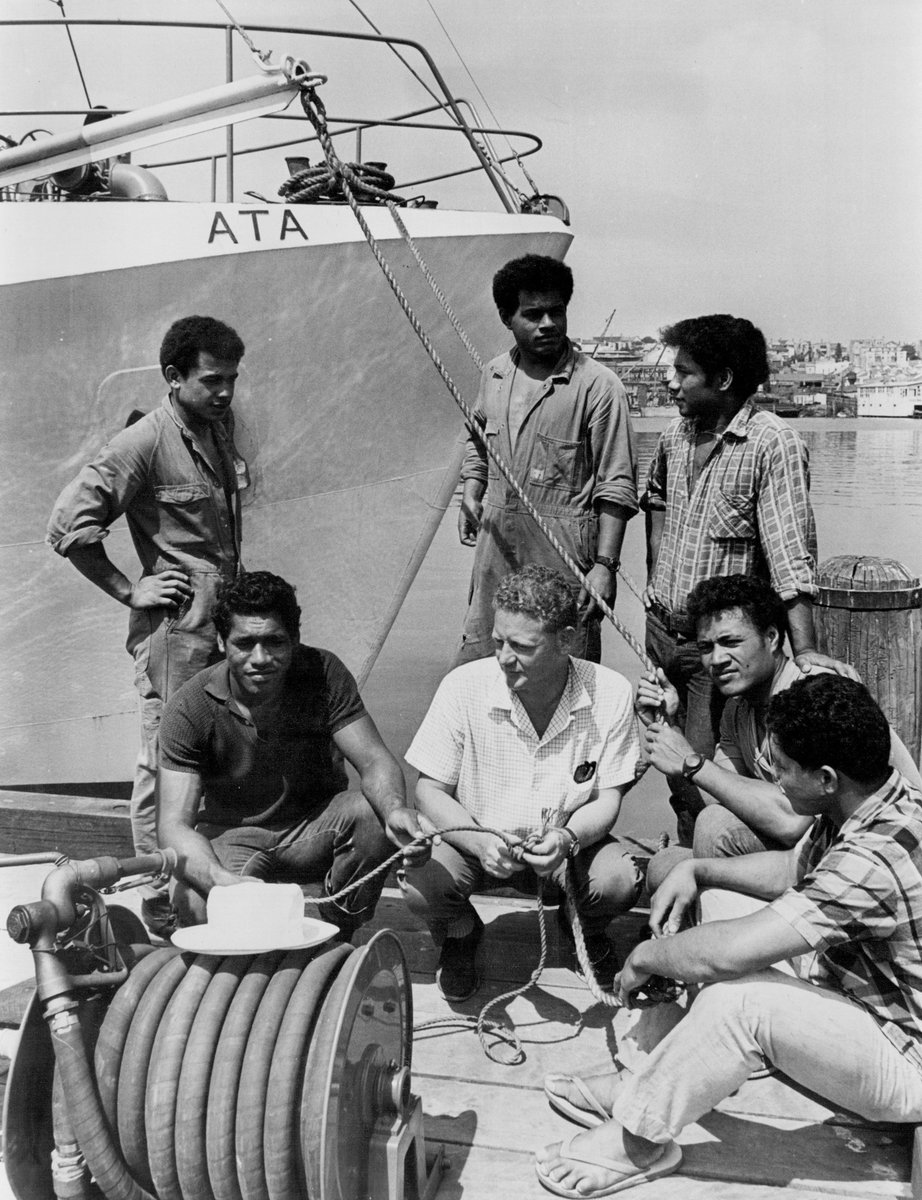
It took me a year of research, but I found it. In 1965, six boys from a boarding school in Tonga stole a boat, got caught in a storm, and drifted for eight days without food or water. They washed up on 'Ata, a remote, uninhabited island in the Pacific. They stayed there for 15 months, and what happened on that island was the exact opposite of William Golding's novel.
These boys set up a small commune. They built a food garden, stored rainwater in hollowed-out tree trunks, created a gym with improvised weights, and built a badminton court. One of them, Stephen (who would later become an engineer) managed to start a fire using two sticks. They kept it burning the entire time.
Of course they fought too. But then they argued, they had a rule: go to opposite ends of the island, cool down, then come back and apologize. As one of them told me: ‘That's how we stayed friends.’
Back home, everyone assumed that the boys – Luke, Stephen, Sione, David, Kolo and Mano — were dead. When they were finally discovered by an Australian captain named Peter Warner, he radioed their names to Tonga. After twenty minutes, a tearful response came back: ‘You found them! These boys have been given up for dead. Funerals have been held. If it's them, this is a miracle!’
Peter commissioned a new ship, hired all six boys as his crew, and named the boat the Ata, after the island where he found them. They remained friends for the rest of their lives – Peter and Mano even became soulmates. I tracked them down, and it became one of the central chapters of my book Humankind.
Here's what struck me most: William Golding (the author of Lord of the Flies) was a troubled man, an alcoholic who once said ‘I have always understood the Nazis, because I am of that sort by nature.’ I think he was projecting his own darkness onto children. And we turned it into a lesson about human nature that we teach to millions of kids around the world.
I think the real lesson is the opposite. When real children found themselves alone on a real island, they didn't descend into savagery. They cooperated, they took care of each other, they survived.
I'm not saying that the Tongan castaways were representative of all kids everywhere. But I am saying that every kid who has to read or watch the fictional Lord of the Flies also deserves to know what actually happened when it played out in real life.
Stories are never just stories. We become the stories that we tell ourselves.
648
4,875
14,291
528,233

r/acc (regenerative accelerationism) by @omniharmonic
r/acc says stop trying to fix capitalism and start building regenerative systems that compound toward life.
r/acc is basically regenerative recursion: each cycle feeds back into the living substrate, strengthening soil, trust, resilience, and local capacity, instead of extracting and abstracting.,
2 paragraph tldr:
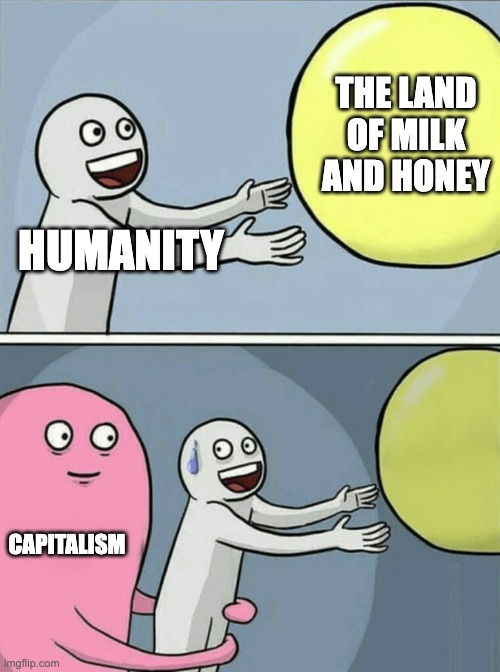
capitalism is an “egregore” (networked thought form) that extracts value by stripping things from their living context, turning them into commodities, and recentralizing wealth through finance. reform gets absorbed (carbon markets, esg, impact consulting), ai is basically gasoline on the fire of extraction and control.
the answer is r/acc: regenerative accelerationism, a strategy of redirecting compounding dynamics into regeneration by “forking civilization’s source code” and scaling alternatives that re-embed value into relationships and place.
1 page tldr:
r/acc is regenerative accelerationism. it starts from the claim that capitalism is not just “broken,” it is structurally extractive.
capitalism is an “egregore”: a force that possesses systems and pushes them to consume, abstract, and consolidate. in r/acc terms, it’s a machine that eats context and turns it into tradable symbols.
deterritorialization: things get torn out of relationship and turned into units of exchange. farms become line items. homes become rental yield. communities become market segments.
then comes reterritorialization: extracted value gets pulled into finance and concentrated upward. the “hollowing out” phase is where the packaging remains but the living substance is gone.
reform fails because the system metabolizes critique. carbon markets can become licenses to pollute. esg becomes a brand layer. “impact measurement” becomes a consulting industry that rarely changes outcomes.
this leads to the accelerationist wager: if reform can’t stop the machine, maybe pushing it into its contradictions faster is the only way out. this doesnt mean endorsing techno-capital accelerationism. r/acc is the alternative.
ai is gasoline on the fire: it scales extraction, persuasion, surveillance, and consolidation, and makes the future harder to predict and easier to weaponize.
r/acc contrasts itself with d/acc (defensive accelerationism). d/acc matters because it hardens the terrain: protecting agency, privacy, and decentralization from techno-capital capture. but r/acc says defense is only a holding action. if we don’t fill that protected space with regenerative institutions, capital will eventually move back in and colonize it anyway.
so r/acc proposes a positive program: fork civilization’s source code. don’t “tear down” capitalism or beg it to behave. build parallel systems that redirect energy, money, and coordination into living communities.
the key r/acc distinction is system dynamics. regeneration is what we do (gardens, wetlands, community care). r/acc is how we scale it so it compounds without being captured.
r/acc is basically regenerative recursion: each cycle feeds back into the living substrate, strengthening soil, trust, resilience, and local capacity, instead of extracting and abstracting.
practical r/acc mechanisms for “composting capital” are: alternative/local currencies that keep value circulating locally, land trusts that decommodify housing, worker co-ops that keep surplus with workers, and daos/tokenized ownership that encode rights and governance.
r/acc is an “ecology of alternatives.” the goal is networks of local systems. They reinforce each other, share templates, and spread through adaptation (cosmolocal), so the whole pattern gets stronger over time.
9
7
36
1,924
8 Dec 2025
Y-Federatoooor
8 Dec 2025

can someone please start y combinator for open source projects to accelerate builders who ship software that destroys big tech monopolies????
someone pls do this
1
48
7 Dec 2025
The story has long since been foretold.
It’s the federation vs the empire.
1
1
29
Simon Q (human, 3,3,3) retweeted

9 Jun 2023
Sure, but this is also why "value creation" is the EXPORT of entropy (and the production of externalities). Measuring and "reducing" entropy depends on isolating a system from everything else. Show me a case where ANY economic activity occurs on one side of a perfect air gap.
In other words, "cheaper, better, or faster" always comes at a cost to someone else. Responsibility (and long-term success) in an economy literate in and attentive to complex systems dynamics therefore depends on always asking, "Whose harm am I profiting FROM?"
Ask that question earnestly and answer it smartly and you not only protect your business from potential disastrous blowback — you also actively CREATE new opportunities for synergy and collaboration.
(And yes, that ultimately means pushing more entropy on whatever lies beyond the horizon of our ability to know and care...but at least you will have made the effort to act from the deepest wisdom and integrity accessible to you. The other option is to optimize for blind spots in your models, and that logic carried to extremes will undermine you.)
1
1
4
606
29 Nov 2025
Resources make the world go around. Money is an insufficient signal.
Allure resources.
Compost Capital.
Delegate your time.
Commit to a threshold.
Subscribe to a dream.
Build the future.
Your reward is the future you attract that makes the world better for all else.
3
63
Simon Q (human, 3,3,3) retweeted

27 Nov 2025
Do you see if now? Sacred geometry
37
271
1,195
35,477
Simon Q (human, 3,3,3) retweeted

15 Nov 2025
I translate complex systems theory into language that helps people see how change actually happens. Currently mapping movements to prove we might already have the 3.5% needed for transformation.
Seeking investment to scale:
75/500 subs | $1800/$3k sprint
1
1
1
92
Simon Q (human, 3,3,3) retweeted

11 Nov 2025
One reality absorbing another without being detected
197
2,269
20,988
1,555,408
Simon Q (human, 3,3,3) retweeted
11 Nov 2025
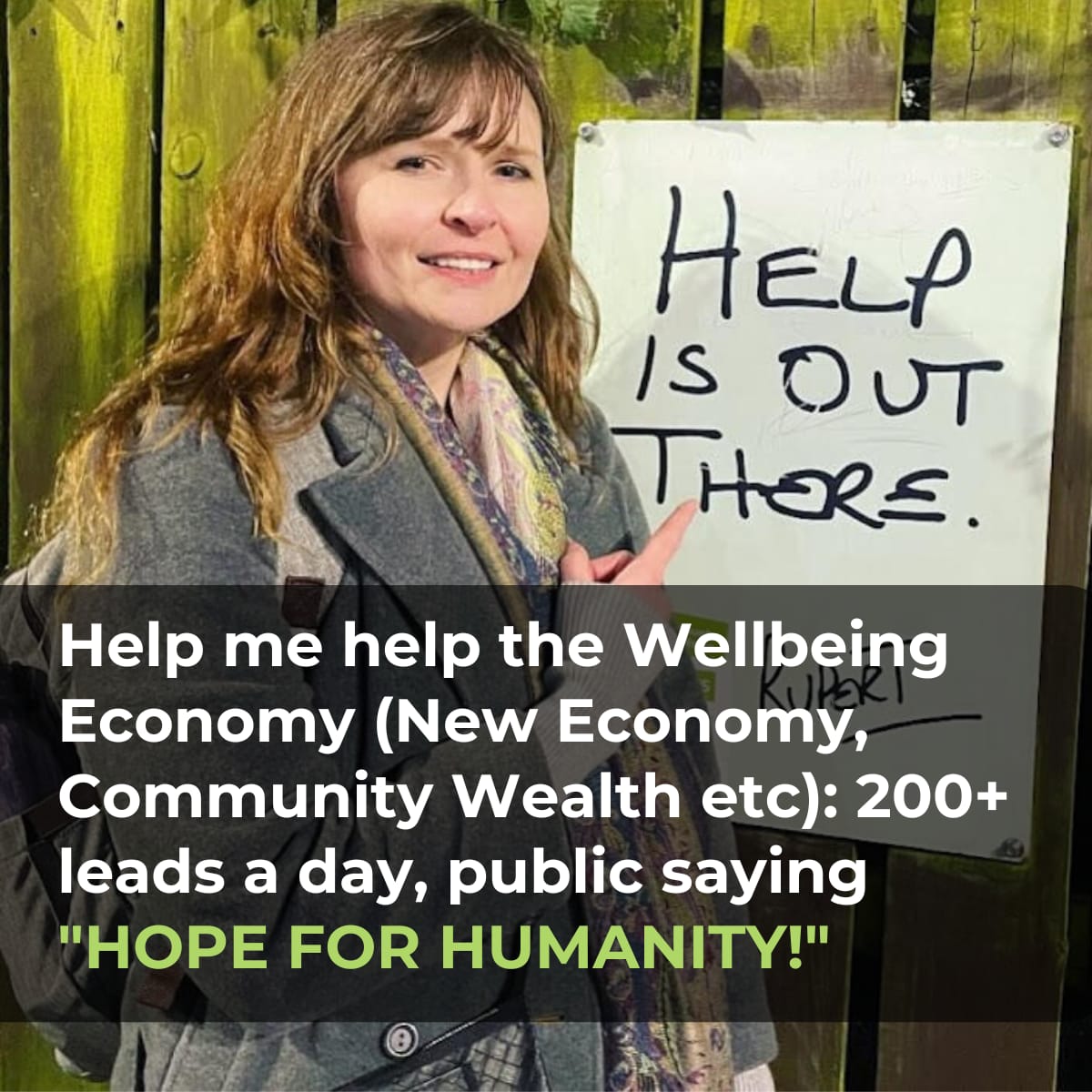
Mutual aid needed $0/3000 goal to get into safe housing
Wellbeing economist working for three years while homeless to solve the economic crisis and has people saying "hope for humanity" with her work
Details 👇
2
2
2
1,181
Simon Q (human, 3,3,3) retweeted

28 Oct 2025
Buying a Stewardship NFT gives you the right to visit a specific biocultural hub and see for yourself the way it’s working to restore nature. Your funds are used to fund both the growth of the NFT you’re supporting and new biocultural hubs that will help us grow the Corridor.
It's your passport to a global regenerative movement, and your membership is represented by a digital asset that includes lovely unique artworks created by the local artist Jeisson Castillo
A Web3 gateway for real-world impact. 🌍
Become a Global Steward: buff.ly/4P1AuTz
2
3
77
25 Oct 2025
Freedom of speech. Yes
Freedom of expression. Yes.
And.
Freedom of being heard.
Fuck the algorithm.
29
24 Oct 2025
Give them their own currency whilst we’re at it, and maybe the public accepts this currency in exchange for providing MPs with standard goods and services, if and only if their policies are coherent, resonant, and their actions are integral to their promises.
24 Oct 2025

All MPs should try digital ID out first for two years. No interactions with anybody unless they present digital ID. Probably wouldn’t last a month.
2
39