Protecting Freedom | Unfiltered News 🔥 | AmericaFirst🇺🇸
Joined November 2022
- Tweets 3,436
- Following 239
- Followers 117
- Likes 246
3,063 Photos and videos
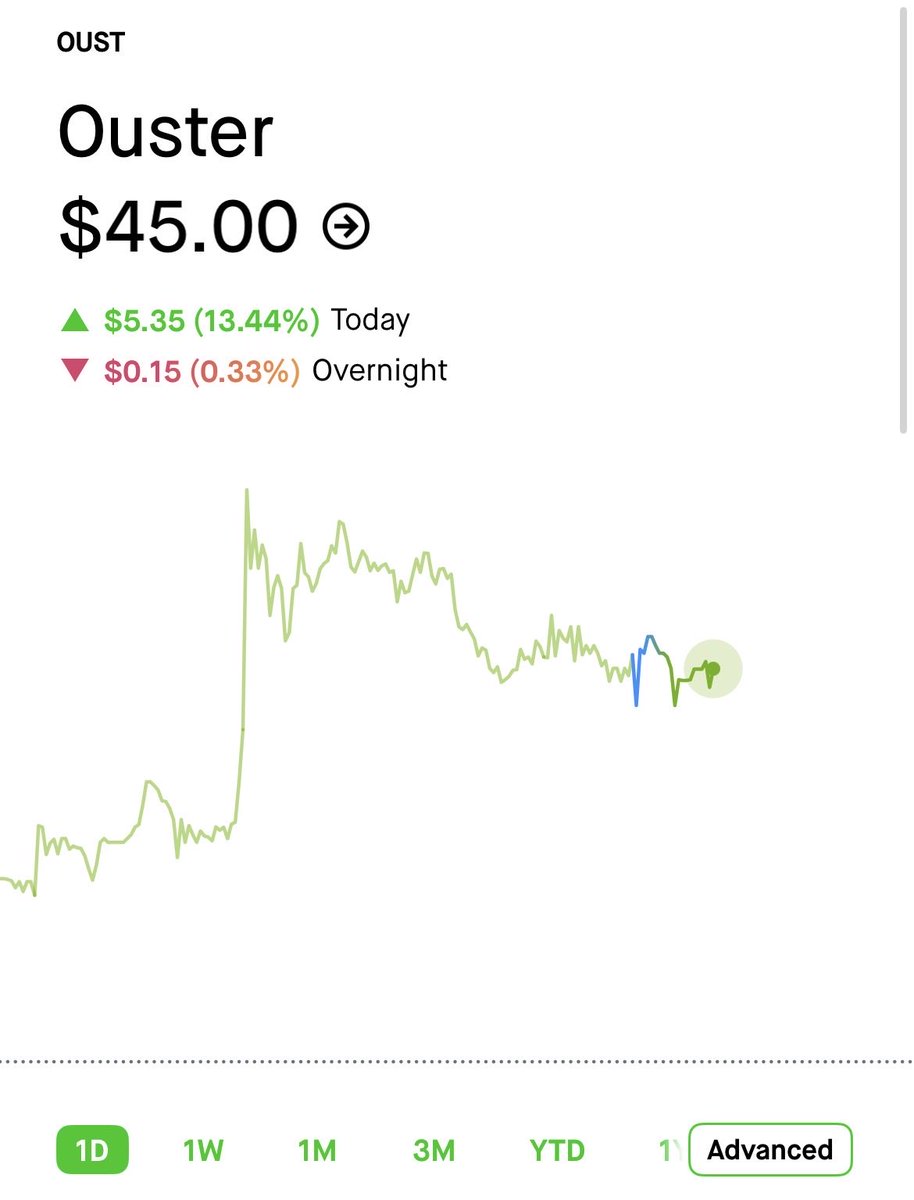
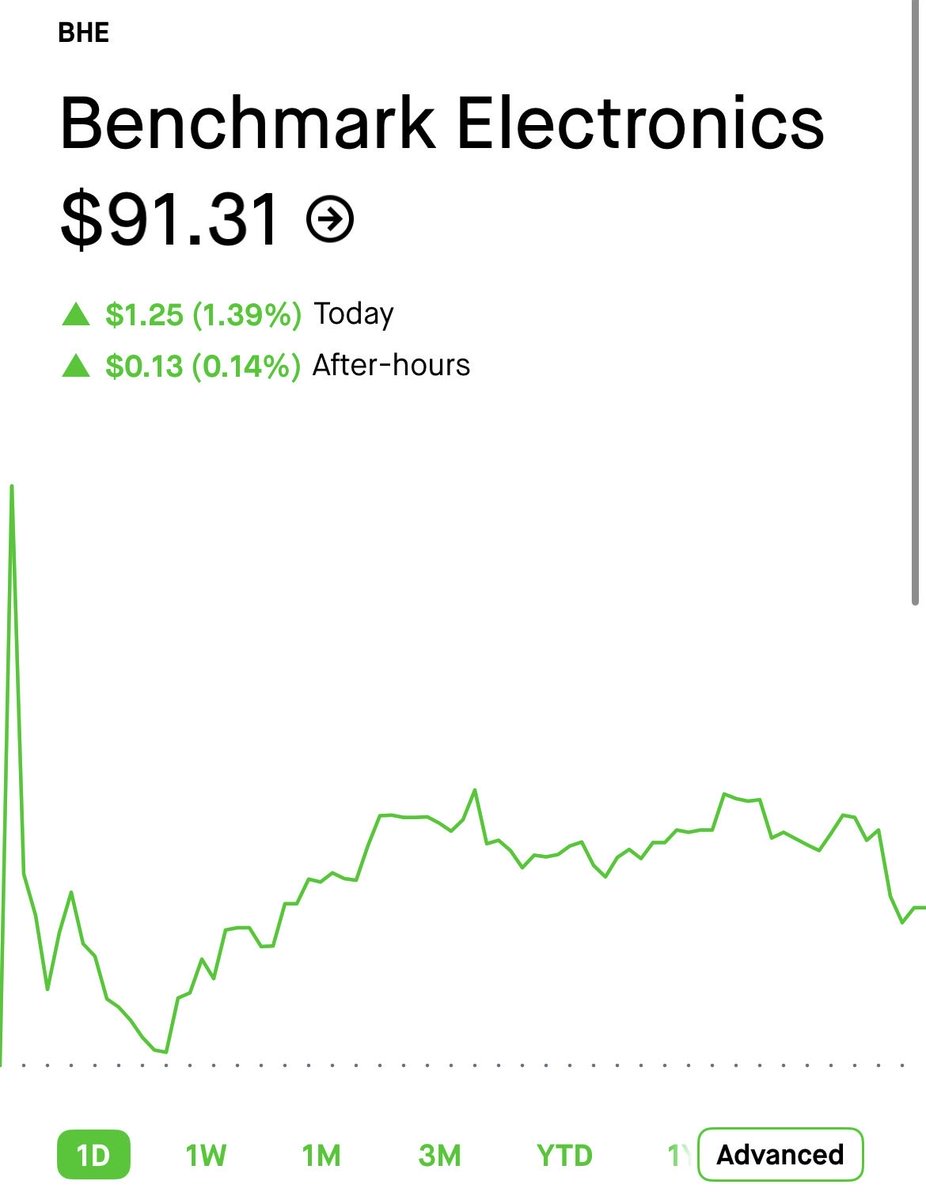
🚨 #BREAKING: Ouster $OUST and Benchmark Electronics $BHE Expanded Their Manufacturing Partnership to Scale Production of Ouster's Rev8 Lidar Sensors.
What was announced:
➜ Ouster $OUST and Benchmark Electronics $BHE announced an expansion of their existing long-term manufacturing partnership.
➜ The expanded partnership will support high-volume production of Ouster's Rev8 OS lidar sensor family.
➜ The sensors are targeted at industrial, robotics, automotive, and smart infrastructure applications.
➜ This is not a new relationship.
➜ Benchmark has served as Ouster's strategic manufacturing partner across previous product generations.
➜ Financial terms were not disclosed.
What Rev8 actually is:
➜ Rev8 is Ouster's next-generation OS lidar family
➜ The platform is powered by Ouster's fourth-generation L4 Ouster Silicon chip with embedded Fujifilm color science.
➜ Ouster describes Rev8 as the world's first patented native color lidar.
➜ The system captures color and 3D depth data directly at the silicon level.
➜ Rev8 does not require a separate camera.
➜ Rev8 does not require post-processing calibration to combine color and depth data.
➜ The platform delivers up to twice the range and resolution of the previous generation.
➜ Rev8 is designed to meet automotive-grade functional safety and cybersecurity standards.
➜ Early adopters include Google and Volvo Autonomous Solutions.
➜ Ouster says dozens of customers are evaluating or deploying the technology across its target markets.
The manufacturing structure:
➜ Manufacturing capacity currently exceeds 100,000 units per year.
➜ Rev8 is designed around a planned 10-year production life.
➜ The production timeline is intended to support long-term OEM program commitments.
➜ Benchmark's manufacturing network spans 20 facilities across eight countries.
➜ The company has a significant manufacturing presence in both the United States and Europe.
➜ The network gives Ouster flexibility to expand production capacity across multiple locations as demand grows.
➜ Benchmark is deploying a highly automated production line for Rev8.
➜ The production system is designed to support the sensor's ruggedized architecture, advanced microelectronics, and automated optical assembly requirements.
What both sides said:
➜ Darien Spencer, COO at Ouster, stated: "Benchmark has been a foundational partner in Ouster's growth story and the natural fit to scale manufacturing for our breakthrough Rev8 sensors. Through our well-honed supply chain ecosystem, our customers can be confident in our ability to reliably deliver the most advanced, cybersecure, and functionally safe native color lidar sensors at high volume to support their long-term programs."
➜ David Moezidis, President and CEO at Benchmark, stated: "Our team is uniquely equipped to scale the complex microelectronics and automated optical assembly required for this groundbreaking technology. We are proud to continue our journey with Ouster, providing a secure, reliable foundation for the next era of Physical AI."
50
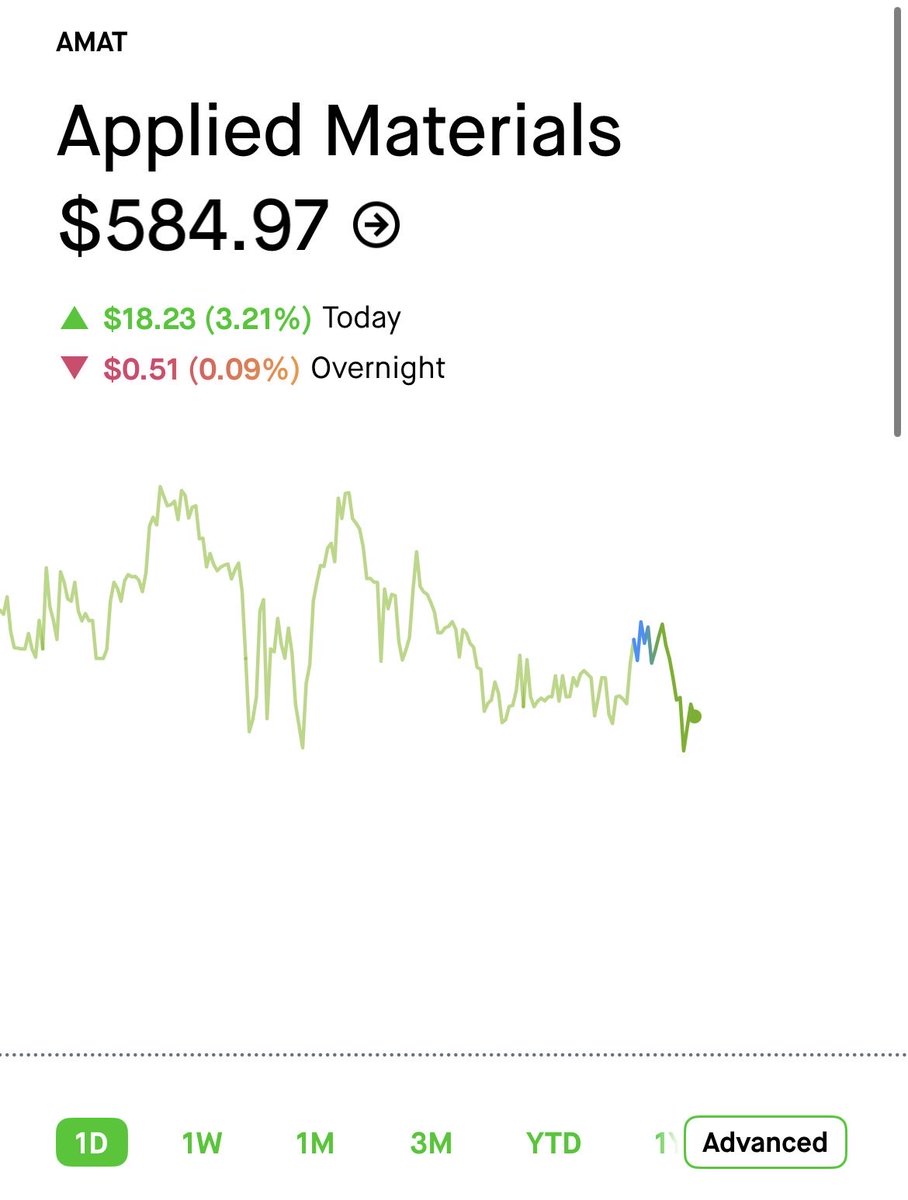
🚨 #BREAKING: Applied Materials $AMAT Introduced Two New Chipmaking Systems Designed to Solve One of the Biggest Challenges in Advanced Semiconductor Manufacturing.
What was announced:
➜ Applied Materials $AMAT introduced two new systems: the Centris Spectral SiN ALD and the Producer Selectra Mo Etch.
➜ Both systems were announced alongside the 2026 IEEE Symposium on VLSI Technology and Circuits.
The problem they solve:
➜ Modern AI chips increasingly rely on stacking structures vertically rather than simply shrinking them horizontally.
➜ As these structures become deeper and narrower, it becomes much harder to coat materials evenly or remove materials precisely throughout the entire structure.
➜ Existing manufacturing tools are increasingly challenged by these requirements.
➜ Variability in these processes can reduce electrical performance and lower manufacturing yields.
➜ Both new systems are designed to address this challenge from different angles.
Centris Spectral SiN ALD:
➜ Silicon nitride is a key insulating material used throughout the chip manufacturing process.
➜ It is used for surface protection, electrical isolation, and as a spacer during patterning.
➜ The material must be deposited at low temperatures while remaining durable enough to withstand later manufacturing steps.
➜ Conventional plasma-enhanced deposition struggles to uniformly coat high-aspect-ratio structures.
➜ The Centris Spectral SiN ALD uses high-density microwave plasma technology to deposit high-quality silicon nitride uniformly inside tall, narrow structures.
➜ The system is designed to achieve this at low temperatures while avoiding the tradeoff between plasma density and ion-induced damage.
➜ In gate-all-around transistors, the system can create high-quality liners for transistor contacts that reduce electrical resistance and capacitance.
➜ Lower resistance and capacitance can enable faster device performance.
➜ Applications extend across advanced logic and DRAM manufacturing.
➜ The system is part of Applied Materials' new Spectral ALD platform.
➜ The platform features a quad-reactor design, precision chemical delivery, and support for both temporal and spatial ALD operation.
➜ Applied Materials said the system is being adopted by leading chipmakers.
Producer Selectra Mo Etch:
➜ 3D NAND memory chips store data by stacking memory cells vertically, often across hundreds of layers.
➜ Molybdenum is increasingly being used for the wordlines that connect those memory cells.
➜ To prevent electrical shorts, the metal must be removed precisely from the spaces between adjacent wordlines.
➜ Conventional wet etch processes struggle to remove material evenly throughout the full depth of these structures.
➜ The Producer Selectra Mo Etch uses an engineered dry gas process to achieve uniform top-to-bottom molybdenum removal across the full stack.
➜ Applied Materials said the system has already been validated in high-volume manufacturing.
➜ The system reduces cell-to-cell variability.
➜ It lowers leakage current.
➜ It improves data retention.
➜ Applied Materials also said the technology creates opportunities beyond 3D NAND, including DRAM and foundry logic applications.
What Applied Materials says:
➜ Dr. Prabu Raja, President of the Semiconductor Products Group at Applied Materials, stated: "As the industry pushes the limits of AI computing, the biggest opportunities are increasingly found in materials engineering. From transistor structures to memory stacks, chipmakers need new ways to precisely deposit and selectively remove materials in extremely complex 3D architectures."
99
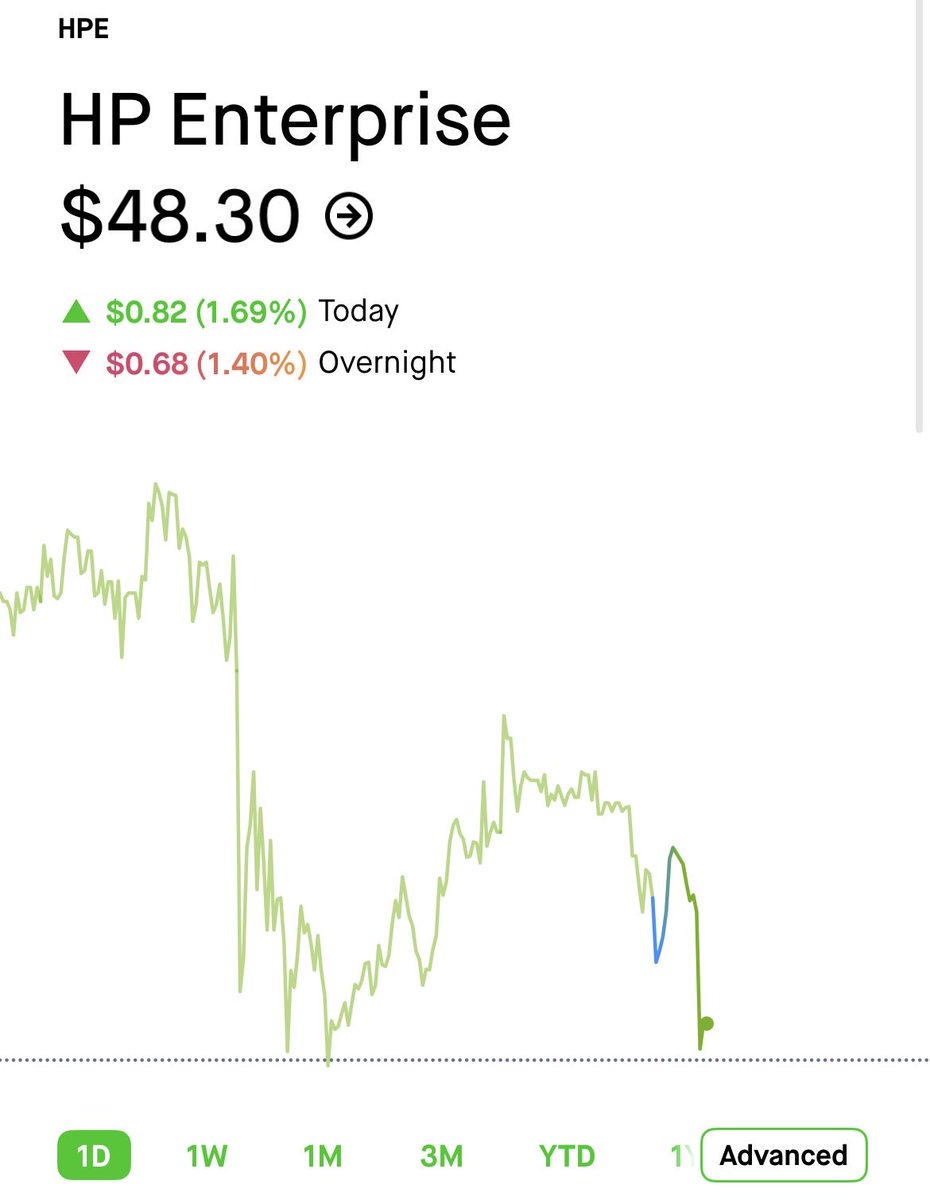
🚨 #BREAKING: HPE $HPE Just Expanded Research Partnerships With Eight Quantum Computing Companies to Build a Hybrid Quantum Supercomputing Platform.
What was announced:
➜ HPE $HPE announced on June 15, 2026, that it has expanded research relationships with eight quantum computing companies.
➜ The goal is to build a full-stack hybrid quantum supercomputing platform.
➜ The announcement was made at HPE Discover Las Vegas 2026.
The eight partners and what each brings:
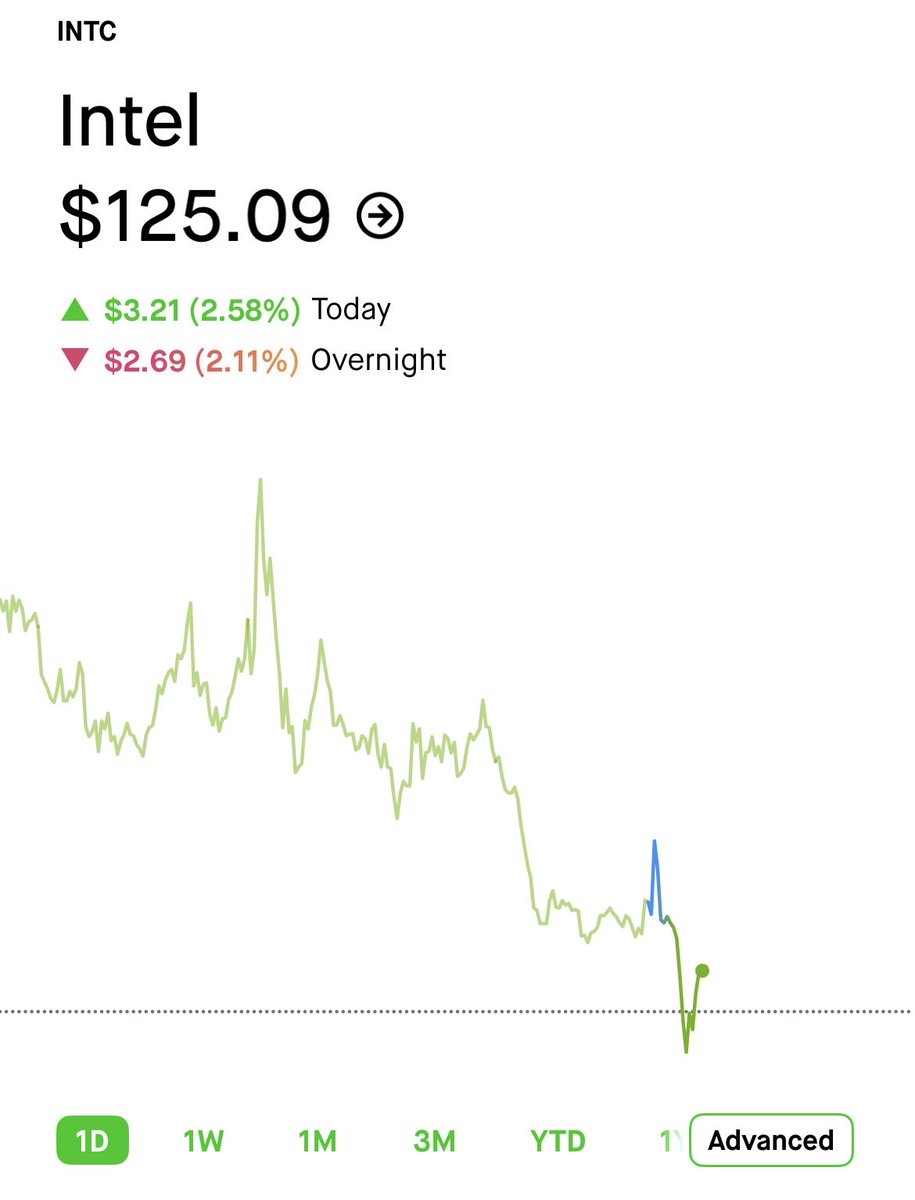
➜ Intel $INTC contributes silicon spin qubit technology.
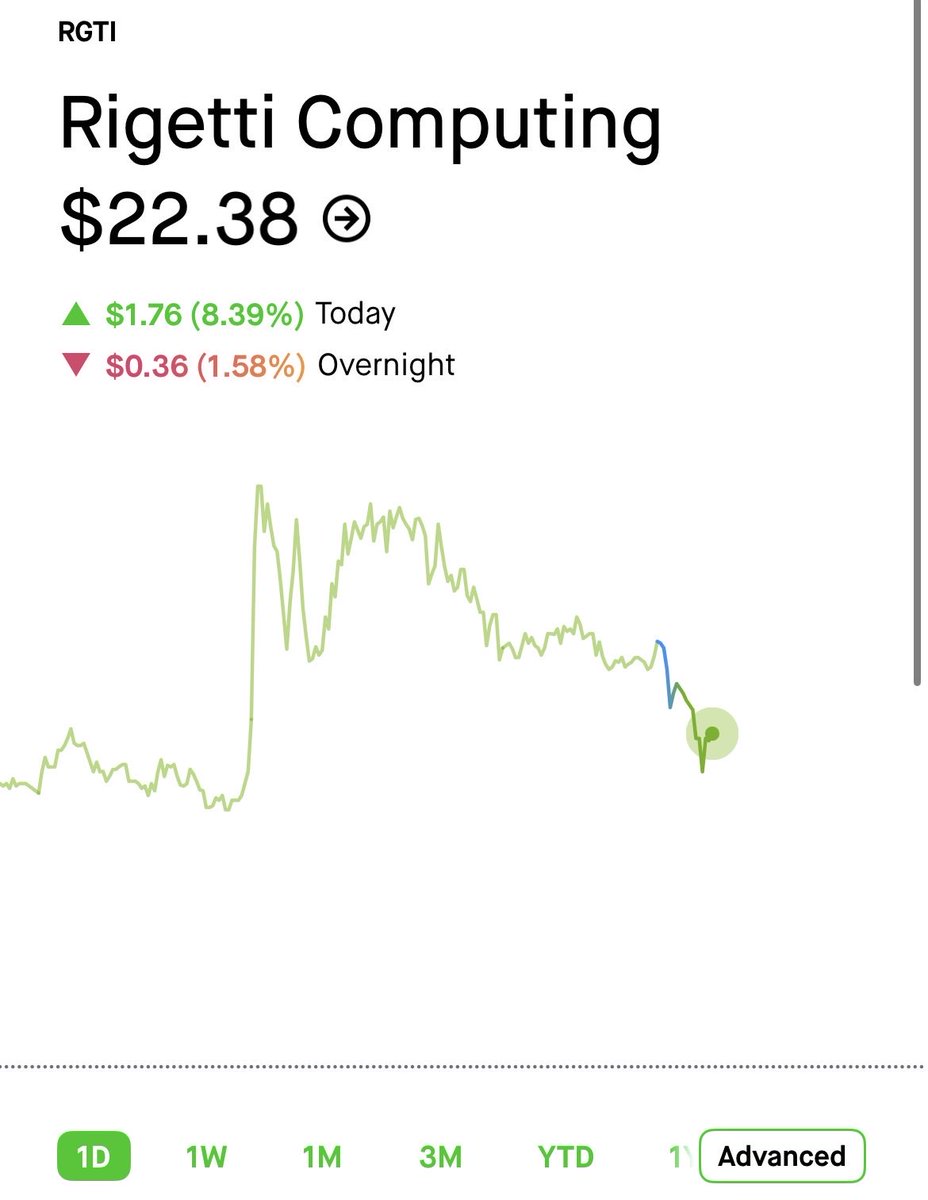
➜ Rigetti $RGTI contributes superconducting qubit processors.
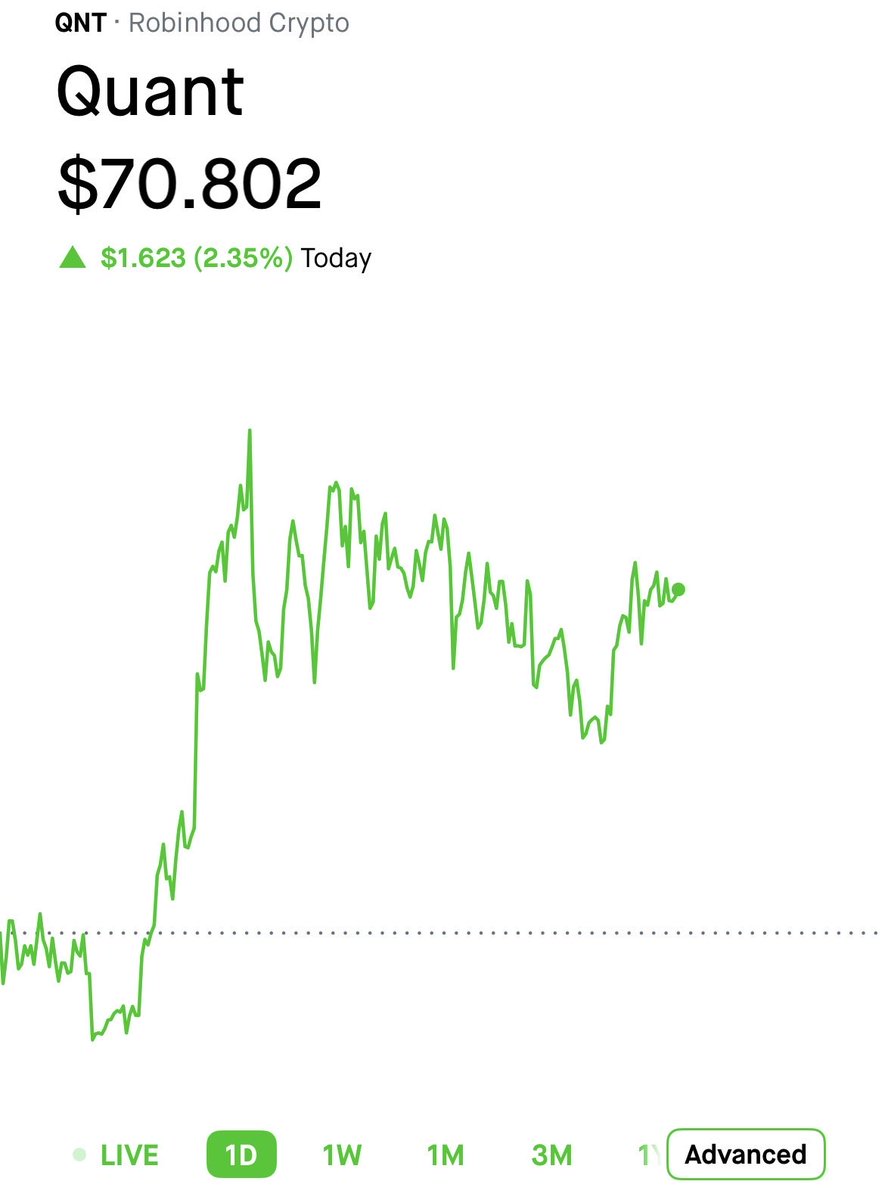
➜ Quantinuum $QNT contributes ion trap qubit systems using its trapped-ion QCCD architecture.
➜ IQM contributes superconducting qubit systems.
➜ QuEra Computing contributes neutral atom qubits.
➜ Qblox contributes quantum control systems.
➜ Quantum Machines contributes quantum control and orchestration.
➜ Riverlane contributes quantum error correction software.
➜ Together, the eight partners cover four quantum computing approaches: neutral atom, ion trap, superconducting, and silicon spin.
➜ The partnerships also include the control and error-correction technologies required to operate quantum systems at scale.
What the platform is designed to do:
➜ HPE is positioning its Cray supercomputing platform as the classical computing backbone that quantum processors connect into.
➜ HPE's Cray platform was verified as the builder of the three fastest exascale supercomputers in the world by the November 2025 TOP500 list.
➜ The collaborations will develop integrated testbeds for hybrid algorithm co-design, software interoperability, and system-level performance benchmarking.
➜ The work will span high-performance computing and AI environments.
➜ HPE's model is similar to how GPUs work alongside traditional supercomputers today.
➜ Under this approach, quantum processors act as specialized accelerators for specific workloads rather than replacing existing computing infrastructure.
➜ Trish Damkroger, SVP and General Manager of HPC and AI Infrastructure Solutions at HPE, stated: "By bringing supercomputing and quantum technologies together in a hybrid platform, we will accelerate the transition from research to real-world application. Our new strategic collaborations will extend world-class HPC infrastructure to make quantum accessible, scalable, and operational."
Target application areas:
➜ HPE identified scientific discovery as a key target area.
➜ HPE identified national security as a key target area.
➜ HPE identified industrial innovation as a key target area.
What is and is not confirmed:
➜ These are expanded research relationships, not product launches.
➜ These are not commercial agreements.
➜ HPE and its partners have not disclosed revenue figures tied to these collaborations.
➜ No commercial deployment timelines have been disclosed.
1
2
201
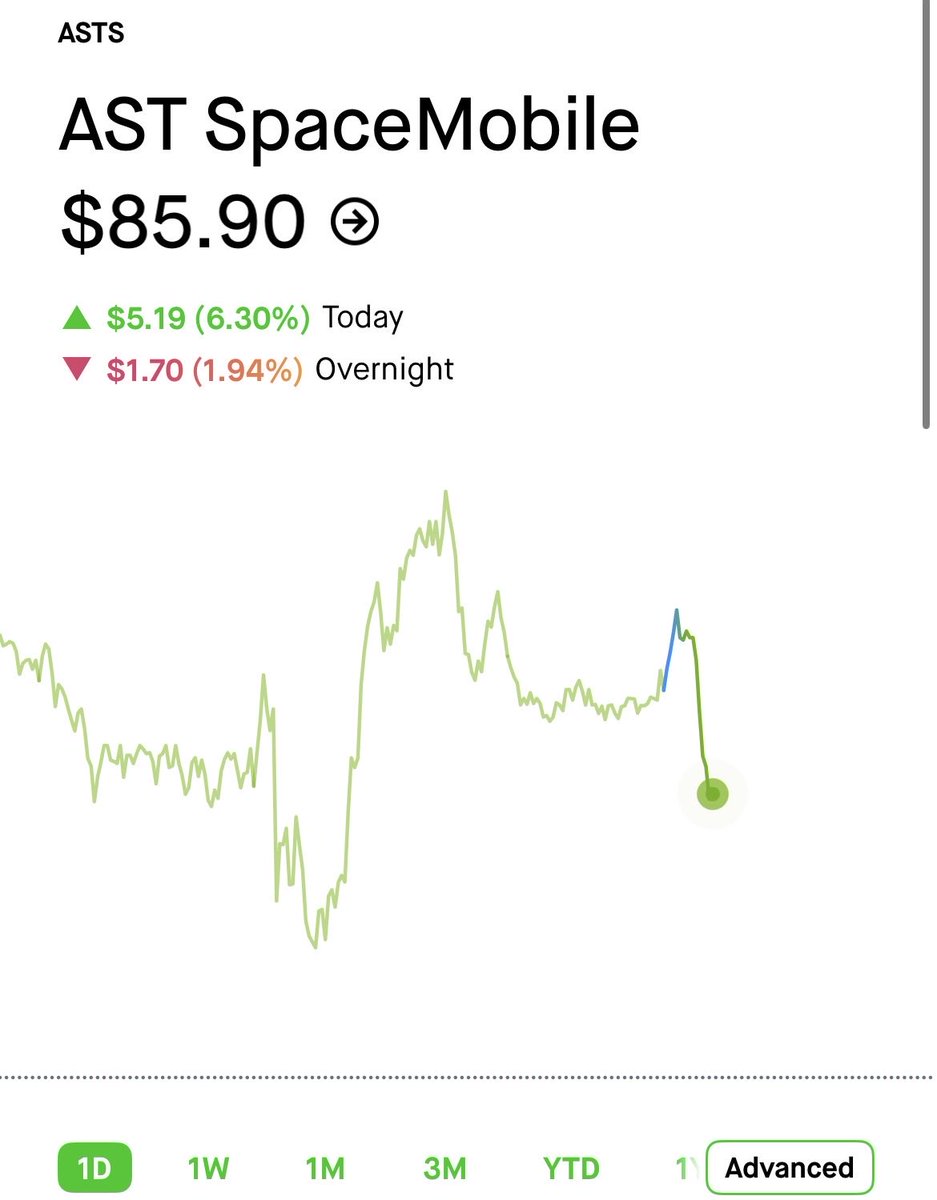
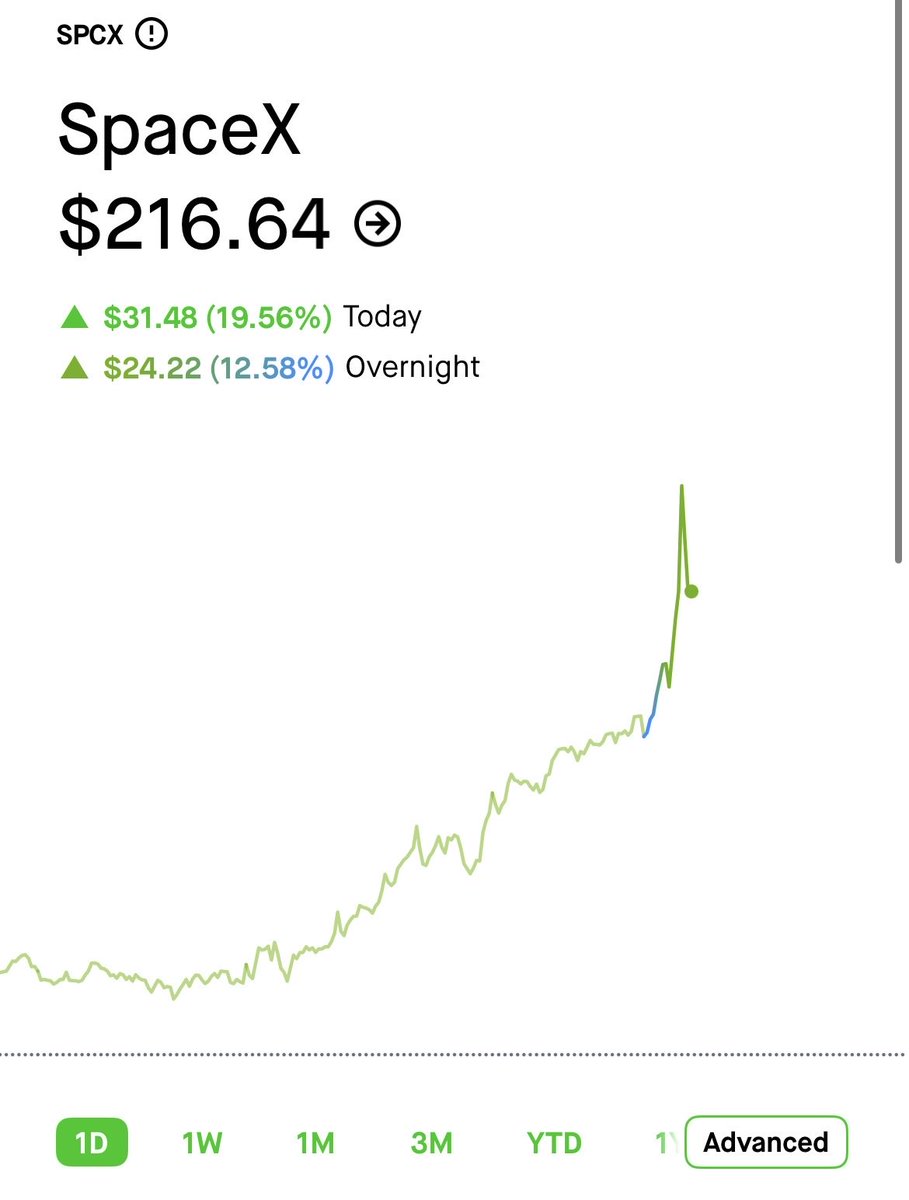
🚨 #BREAKING: AST SpaceMobile $ASTS BlueBirds 8, 9, and 10 Are Now Encapsulated Inside a SpaceX $SPCX Falcon 9 Fairing Ahead of Their Scheduled June 17 Launch.
What is happening:
➜ AST SpaceMobile $ASTS confirmed on June 9, 2026, that BlueBirds 8, 9, and 10 are stacked and secured inside the Falcon 9 fairing, ready for payload integration.
➜ Launch is scheduled for June 17, 2026, at 2:39 a.m. EDT from Cape Canaveral Space Force Station, Florida.
➜ The launch window remains open until 4:15 a.m. EDT.
➜ The company noted that launch timing remains subject to rocket readiness, weather, and other factors outside its control.
➜ The launch will be livestreamed on the company's YouTube channel.
What Block 2 BlueBirds actually are:
➜ BlueBirds 8, 9, and 10 are Block 2 next-generation satellites designed to expand AST SpaceMobile's direct-to-device network.
➜ Each satellite features a phased array antenna of nearly 2,400 square feet.
➜ AST SpaceMobile says this will make them the largest commercial communications arrays ever deployed in low Earth orbit.
➜ For comparison, Block 1 BlueBird satellites measured 693 square feet.
➜ The satellites are powered by AST SpaceMobile's proprietary AST5000 ASIC chip.
➜ The chip supports 10 GHz of processing bandwidth and peak data speeds of up to 120 Mbps per coverage cell.
➜ The satellites are designed to deliver voice, data, and video directly to standard, unmodified smartphones.
➜ A Block 1 BlueBird achieved a peak speed of 98.9 Mbps directly to an unmodified smartphone over international waters during Q1 2026.
➜ According to the company's SEC filing, Block 2 satellites are expected to nearly double the peak data speeds achieved by Block 1.
Why this launch matters:
➜ In April 2026, BlueBird 7 failed to reach the correct orbit after launching aboard Blue Origin's New Glenn rocket.
➜ The satellite was subsequently deorbited.
➜ This mission marks AST SpaceMobile's return to SpaceX's Falcon 9 following that setback.
➜ It is also the company's first multi-satellite cluster deployment since the BlueBird 7 mission.
➜ The FCC granted commercial authorization for SpaceMobile Service in the United States during Q1 2026.
➜ The authorization covers direct-to-device broadband connectivity across a network of up to 248 satellites.
➜ The company now has regulatory approval and is continuing to build out the satellite network needed to support the service.
The network and manufacturing picture:
➜ AST SpaceMobile is targeting approximately 45 BlueBird satellites in orbit by the end of 2026.
➜ The company plans to launch satellites every one to two months on average.
➜ BlueBirds 11 through 33 are already in advanced stages of production and assembly.
➜ Phased arrays have been completed through BlueBird 28.
➜ The company's Texas manufacturing facility is capable of producing up to six BlueBird satellites per month.
➜ AST SpaceMobile's commercial partner ecosystem has grown to nearly 60 mobile network operators.
➜ Those partners collectively cover more than 3 billion subscribers.
➜ Partners include Telus, Bell Canada, Vodacom, Orange, and MTN.
184
🚨 #BREAKING: Qualcomm $QCOM Is Reportedly in Advanced Talks to Acquire AI Chip Startup Tenstorrent for Between $8 Billion and $10 Billion.
The report:
➜ The Information reported on June 15, 2026, citing a person with direct knowledge of the negotiations, that Qualcomm $QCOM has been in talks to acquire Tenstorrent for between at least $8 billion and $10 billion.
➜ Reuters corroborated the report the same day.
➜ Neither Qualcomm nor Tenstorrent has confirmed the discussions on the record.
➜ Talks are ongoing, the price could change, and the deal could still fall apart.
➜ It is not yet clear whether the price would include performance-based milestone payments, which are commonly used in chip startup acquisitions.
The valuation math:
➜ Tenstorrent raised $693 million in a Series D round in December 2024 at a $2.6 billion post-money valuation.
➜ By November 2025, the company was in talks to raise another $800 million at a $3.2 billion pre-money valuation.
➜ Investors across its funding history include Bezos Expeditions, LG Electronics, Baillie Gifford, Hyundai, the Healthcare of Ontario Pension Plan, and Fidelity.
➜ The reported $8 billion to $10 billion acquisition price represents roughly a 2.5x to 3x premium over the $3.2 billion valuation figure.
➜ Tenstorrent also holds approximately $150 million in signed customer contracts.
➜ Those contracts include manufacturing arrangements with Samsung and automotive AI systems work with Hyundai.
What Tenstorrent actually is:
➜ Founded in 2016, Tenstorrent designs AI processors built on RISC-V architecture.
➜ The company uses its proprietary Ascalon CPU cores and Tensix AI cores for AI training and inference workloads.
➜ It sells both AI chips and licensable intellectual property, giving it revenue streams beyond chip sales.
➜ The company uses standard DDR memory rather than high-bandwidth memory as a deliberate cost and supply chain strategy.
➜ Jim Keller joined as CTO in 2020 and became CEO in 2025.
➜ His background includes Apple's A-series processors, AMD's Zen microarchitecture, Tesla's autopilot silicon, and Intel's CPU group.
How this deal has evolved:
➜ Bloomberg reported on May 18, 2026, that both Intel and Qualcomm $QCOM had held early-stage conversations with Tenstorrent.
➜ At the time, those discussions were described as "conversational rather than transactional."
➜ The new report from The Information includes a specific price range, suggesting Qualcomm's engagement has become substantially more concrete.
➜ Intel's interest was tied to strengthening its position in the AI training market after its Gaudi accelerator line underperformed.
➜ Qualcomm would be acquiring a licensable RISC-V IP portfolio, a non-ARM CPU roadmap, and an AI accelerator capability in a single transaction.
Qualcomm's strategic context:
➜ This would be Qualcomm's second major data center chip acquisition in six months.
➜ Qualcomm completed its $2.4 billion acquisition of Alphawave Semi in December 2025.
➜ The acquisition added high-speed connectivity and compute technology for data centers.
➜ CEO Cristiano Amon said during Q2 earnings that initial AI chip shipments to a leading hyperscaler remain on track for later this year.
➜ Wells Fargo cited AWS as the likely partner.
➜ Qualcomm Investor Day is scheduled for June 24, where additional details on the company's AI and data center roadmap are expected.
3
352

Jun 13
🚨 #BREAKING: The US Government Ordered Anthropic to Block Foreign Access to Its Two Newest AI Models.
What happened:
➜ On June 12, 2026, at 5:21pm ET, Commerce Secretary Howard Lutnick sent a letter to Anthropic CEO Dario Amodei placing Fable 5 and Mythos 5 under export controls.
➜ The directive bars access to both models by any foreign national, whether inside or outside the United States.
➜ The restrictions also apply to Anthropic’s own foreign national employees.
➜ Both models had launched just days earlier.
➜ Because verifying the nationality of every individual user in real time was not feasible, Anthropic disabled both models for all customers globally to ensure compliance.
➜ All other Claude models remain fully available.
The government’s reasoning:
➜ According to an administration official who spoke to Axios, the Commerce Department acted after another company claimed it was able to jailbreak Mythos.
➜ The administration had previously tried to get Anthropic to delay the launch of both models but was unsuccessful.
➜ The official said the models need to remain restricted until the government’s national security apparatus is hardened.
➜ The official added that could happen within weeks.
➜ Under Commerce’s letter, a license will be required for the export, re-export, or domestic transfer of the models.
➜ Individually validated license applications will also be required.
➜ Failure to comply would result in financial and civil penalties.
Anthropic’s position:
➜ Anthropic reviewed what it believes is the demonstration behind the directive.
➜ The company said the jailbreak technique involves asking the model to read a specific codebase and identify software flaws, producing a small number of previously known, minor vulnerabilities.
➜ Anthropic stated those vulnerabilities are also discoverable by other publicly available models, including OpenAI’s GPT-5.5.
➜ The company said no tester has found a universal jailbreak capable of broadly bypassing Fable 5’s protections across a wide range of capabilities.
➜ In the weeks before launch, Anthropic worked with the US government, the UK AI Safety Institute, multiple private third-party organizations, and internal teams to red-team Fable 5’s safeguards for thousands of hours.
➜ Fable 5 launched with a 30-day customer data retention policy to enable rapid detection and mitigation of jailbreaks.
➜ Anthropic stated: “We disagree that the finding of a narrow potential jailbreak should be cause for recalling a commercial model deployed to hundreds of millions of people. If this standard was applied across the industry, we believe it would essentially halt all new model deployments for all frontier model providers.”
➜ Anthropic also stated it believes the government should have the ability to block unsafe deployments, but only through a process that is “transparent, fair, clear, and grounded in technical facts.”
➜ The company said this action does not meet those standards.
➜ Anthropic says it is working to restore access as soon as possible but has not provided a timeline.
Jun 13

The US government, citing national security authorities, has issued an export control directive to suspend all access to Fable 5 and Mythos 5 by any foreign national, whether inside or outside the United States, including foreign national Anthropic employees.
The net effect of this order is that we must abruptly disable Fable 5 and Mythos 5 for all our customers to ensure compliance.
Access to all other Claude models is not affected.
We apologize for this disruption to our customers. We believe this is a misunderstanding and are working to restore access as soon as possible.
Read our full statement: anthropic.com/news/fable-myt…
176
Jun 11
🚨 #BREAKING: $NOW and $IBM Just Expanded Their Partnership to Tackle Two Major Enterprise AI Roadblocks.
The announcement:
➜ $IBM and ServiceNow $NOW announced an expanded multi-year collaboration on June 11, 2026.
➜ The partnership targets what both companies describe as the two biggest barriers to deploying AI at scale: unstructured, ungoverned data and deeply interconnected legacy systems.
➜ IBM and ServiceNow first partnered in May 2024 to integrate IBM watsonx models into the ServiceNow AI Platform.
➜ Today's expansion significantly broadens the scope of that partnership.
Why this matters:
➜ Most enterprise AI discussions focus on AI models and agent capabilities.
➜ The larger challenge is that many enterprises still run critical operations on legacy applications built decades ago.
➜ These systems often contain siloed, inconsistent, and poorly governed data.
➜ Even advanced AI models struggle to deliver results when the underlying systems and data are not prepared for AI.
➜ This collaboration is designed to address that gap.
What they said:
➜ John Aisien, SVP and General Manager of Central Product Management, Security and Risk at ServiceNow, said: "IBM brings the tooling to modernize the systems and extend ServiceNow's data capabilities. ServiceNow provides the platform to put that data to work across every workflow in the business. Together, we're helping enterprises move from AI ambition to real, scalable outcomes."
➜ Raj Datta, VP of ISV and AI Partnerships at IBM, said: "AI adoption at scale requires more than access to models. It requires rethinking the systems, data and workflows that support them."
The three joint solutions:
➜ Application modernization: IBM Bob and IBM watsonx.data scan and refactor legacy applications, helping aging systems become AI-ready without requiring a complete rebuild.
➜ Enterprise data governance: ServiceNow's Workflow Data Fabric is being extended with IBM watsonx.data, adding Data Quality, Observability, and Master Data Management through the ServiceNow Data Catalog.
➜ The goal is to keep enterprise data organized, governed, and ready for AI use.
➜ Autonomous infrastructure operations: Red Hat Ansible, IBM Bob, Instana, HashiCorp Terraform, and HashiCorp Vault are being integrated into ServiceNow IT workflows.
➜ These tools are designed to detect, remediate, and resolve infrastructure issues before they impact business operations.
1
1
102
Jun 10
🚨 #BREAKING: OpenAI Is Reportedly in Advanced Talks to Lease the Largest AI Compute Site Ever Proposed, a 10 Gigawatt Campus in Ohio Backed by $NVDA
The report:
➜ The Information reported that OpenAI is negotiating a lease for a proposed 10 gigawatt data center campus in Pike County, Ohio.
➜ The site would be located on Department of Energy land at the former Portsmouth Gaseous Diffusion Plant, a Cold War-era uranium enrichment facility that ceased operations in 2001.
➜ Nvidia $NVDA is expected to supply the hardware and provide a financial guarantee covering both OpenAI’s 20-year lease obligations and the developer’s financing.
➜ Payments would begin once the site starts operating.
➜ The first phase is expected to come online in 2028.
➜ Reuters could not independently verify the report, and neither OpenAI nor Nvidia commented.
To put 10 gigawatts in perspective:
➜ OpenAI’s Stargate project across seven US sites was planned at approximately 7 gigawatts of total capacity.
➜ This single Ohio campus would exceed that by roughly 40%.
➜ Based on current chip, labor, and power costs, the project is estimated to cost at least $500 billion.
➜ If completed, it would represent the largest concentration of AI computing capacity ever built on a single site.
Who is building it:
➜ The developer is SB Energy, a subsidiary of SoftBank.
➜ In March 2026, the Department of Energy announced a partnership with SoftBank, SB Energy, and American Electric Power Ohio to redevelop the Portsmouth site.
➜ The project includes 10 gigawatts of new power generation and $4.2 billion of transmission infrastructure upgrades.
➜ Of the planned generation capacity, 9.2 gigawatts would come from natural gas plants funded by $33.3 billion in Japanese capital tied to the US-Japan Strategic Trade and Investment Agreement.
➜ OpenAI and SoftBank each invested $500 million in SB Energy in January 2026 to support its data center pipeline.
Why Nvidia’s role matters:
➜ In September 2025, OpenAI and Nvidia signed a letter of intent for a 10 gigawatt strategic partnership.
➜ That proposal included Nvidia committing up to $100 billion in OpenAI as each gigawatt was deployed.
➜ While that arrangement never became a binding agreement, Nvidia later invested $30 billion in OpenAI’s February 2026 fundraising round.
➜ If finalized, the Ohio project would make Nvidia more than just a hardware supplier by positioning it as a financial backstop for both the lease and project financing.
➜ As one analyst noted: “When a chip supplier guarantees a customer’s lease and the developer’s financing, the relationship stops being vendor and customer. It becomes a sponsor and a tenant.”
The honest context:
➜ This remains an early-stage negotiation reported by The Information based on two sources.
➜ No completion timeline for the full 10 gigawatt campus has been disclosed.
➜ OpenAI paused its Stargate UK project earlier this year due to regulatory and energy-cost challenges.
➜ The September 2025 Nvidia-OpenAI infrastructure partnership did not ultimately result in a final agreement.
163
Jun 10
🚨 #BREAKING: Oracle Won the Contract to Replace Every HR System in the US Federal Government.
The report:
➜ The Office of Personnel Management (OPM) awarded Oracle $ORCL a 10-year contract to build and operate the first unified HR platform for the entire US federal government.
➜ The contract is worth approximately $396 million, according to contract documentation, though OPM did not formally disclose the value in its official announcement.
➜ OPM Director Scott Kupor announced the award on the same day Oracle released its Q4 FY2026 earnings.
What the contract actually does:
➜ The federal government currently operates more than 100 separate HR systems, with the original Request for Proposals identifying 119 systems across agencies.
➜ Oracle will replace those systems with a single cloud-based platform called the Core Human Capital Management system.
➜ The core system is targeted for readiness by Fall 2026, after which agencies will begin migrating onto the platform.
➜ OPM expects the consolidated platform to reduce HR technology costs to taxpayers by more than 90%.
Why this award is significant:
➜ The contract has been contested for more than a year.
➜ In May 2025, OPM awarded a sole-source contract to Workday before canceling the award and reopening the process through competitive bidding.
➜ The competitive award was originally expected in January 2026 but was delayed after bid protests from companies that did not reach the final stage.
➜ Oracle ultimately won through the competitive process on a best-value basis.
What happens next:
➜ Workday has 10 days following its formal debrief to decide whether to file a protest with the Government Accountability Office.
➜ Workday has not yet filed a protest.
➜ Any protest could further delay implementation.
Why it matters for Oracle:
➜ The US federal government employs approximately 2 million civilian workers.
➜ Oracle Cloud HCM will become the platform connecting HR functions across federal agencies.
➜ The system will support workforce management, payroll, benefits, security clearances, and related HR operations.
➜ Large federal software deployments have historically become long-term relationships because replacing deeply integrated systems is difficult and disruptive.
The honest context:
➜ The contract is relatively small compared to Oracle’s overall business, generating approximately $396 million over ten years.
➜ Federal News Network reports the original implementation timeline has already been pushed back by at least six months due to procurement delays.
160
Jun 10
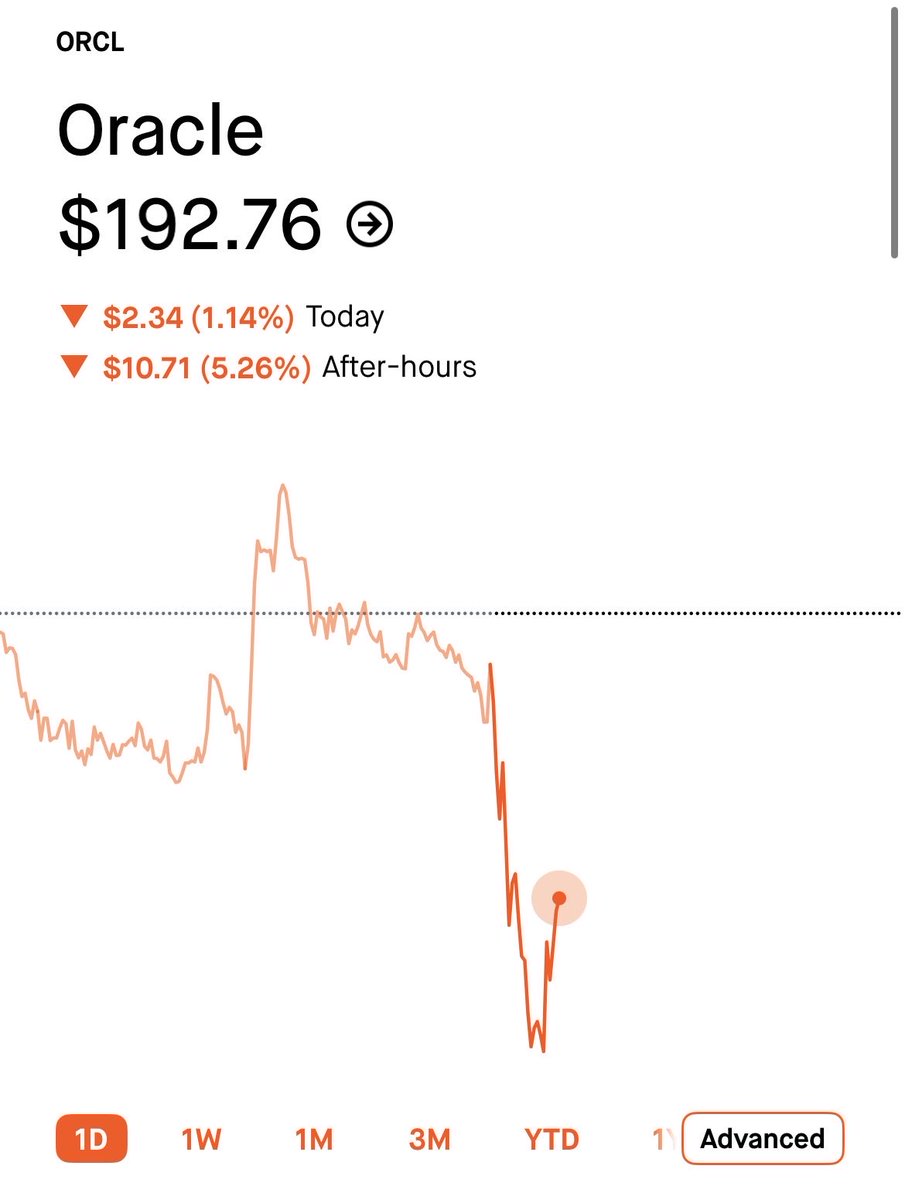
🚨 #BREAKING: Oracle $ORCL Reported Earnings, Revealed a $638 Billion Backlog, and Plans to Raise Another $40 Billion for AI Infrastructure.
The report:
➜ Oracle reported Q4 revenue of $19.2 billion, ahead of estimates for $19.1 billion.
➜ Adjusted EPS came in at $2.11 versus expectations of $1.96.
➜ Remaining Performance Obligations (RPO) reached $638 billion, above analyst estimates of $601.1 billion.
➜ Oracle Cloud Infrastructure revenue was $5.8 billion versus expectations of $5.7 billion.
➜ Capital expenditures totaled $55.7 billion, above expectations of $50.9 billion.
Why it matters:
➜ RPO represents contracted future revenue and remains one of the most closely watched metrics for Oracle’s AI infrastructure strategy.
➜ Oracle reiterated FY2027 revenue guidance of $90 billion and raised non-GAAP EPS guidance to $8.05.
➜ The company expects approximately $70 billion of capital expenditures next year as it continues expanding AI infrastructure capacity.
The funding plan:
➜ Oracle said it plans to raise a combined $40 billion through debt and equity in FY2027, including a previously announced $20 billion equity issuance.
➜ The company disclosed that prepaid and customer-supplied hardware commitments tied to large AI contracts now total $75 billion.
➜ Oracle said these commitments substantially reduce the amount of capital it must raise to build additional AI data centers.
The investor focus:
➜ Oracle generated negative $23.7 billion of free cash flow for the year as capital spending accelerated.
➜ The company continues to rely on long-term customer commitments and multi-cloud partnerships to support its expansion strategy.
➜ Investors remain focused on whether Oracle can scale capacity quickly enough to meet demand while managing the financial requirements of its buildout.
➜ Earlier in the day, Oracle also announced a contract with the Trump administration to provide HR software across U.S. agencies, though the news had little impact on the stock
223
Jun 10
🚨#BREAKING: $META Signed Its First AI Data Center Deal in India With Reliance. Here Is What Was Announced and Why It Matters.
What happened:
→ Meta $META and Reliance Industries agreed to develop Meta's first AI-enabled data center in India
→ Reliance will build a 168-megawatt facility in Jamnagar, Gujarat
→ Meta will lease the facility with options to expand capacity in the future
→ The project is expected to be delivered within two years
→ Financial terms of the agreement were not disclosed
Why Jamnagar was selected:
→ Jamnagar is home to Reliance's flagship refining and petrochemical complex
→ The location provides access to submarine cable landing stations that connect India to global internet infrastructure
→ The facility can connect directly to Jio's fiber optic network
→ Reliance can supply renewable energy from its nearby green energy projects
→ The site also has access to the Arabian Sea for desalinated seawater cooling
The cooling advantage:
→ The facility will use desalinated seawater as part of its cooling strategy
→ This reduces dependence on freshwater resources
→ The approach provides access to a large and consistent cooling source
How the partnership works:
→ Reliance will build, own, and operate the physical facility
→ Reliance will manage construction, power infrastructure, cooling systems, and operations
→ Meta will lease the AI compute capacity through a long-term agreement
→ The structure allows Meta to expand infrastructure in India through a local partner
Meta's renewable energy commitments:
→ Meta simultaneously announced approximately 925 megawatts of new renewable energy contracts across India
→ CleanMax will provide 837 megawatts of new solar and wind projects across Rajasthan and Karnataka
→ Fourth Partner Energy will provide 88 megawatts of solar and wind projects across Tamil Nadu, Karnataka, Maharashtra, and Uttar Pradesh
→ Combined, the agreements represent approximately 925 megawatts of renewable energy capacity
The connectivity piece:
→ The Jamnagar facility will connect to Meta's Project Waterworth subsea cable network
→ The project is designed to provide connectivity between Meta infrastructure and users across multiple regions
→ The proximity to cable landing infrastructure was cited as a strategic advantage for the location
What management said:
→ Mark Zuckerberg said the facility will help Meta expand its global AI infrastructure while increasing its long-term investment in India
→ Mukesh Ambani said the project demonstrates India's readiness to play a larger role in global AI infrastructure development
The broader partnership history:
→ Meta invested $5.7 billion in Jio Platforms in 2020
→ In August 2025, Meta and Reliance announced a $100 million joint venture called Reliance Intelligence focused on deploying Llama AI models for Indian enterprises
→ The new data center agreement expands the relationship into physical AI infrastructure
1
157
Jun 9
🚨#BREAKING: $APLD Signed Its Fifth AI Data Center Lease. Here Is What Was Announced and Why It Matters.
What happened:
→ Applied Digital $APLD announced a new 15-year lease agreement at its Delta Forge 2 AI Factory campus
→ The tenant is an unnamed U.S.-based investment-grade hyperscaler
→ The lease covers 210 megawatts of critical IT capacity under a take-or-pay structure
→ The agreement represents approximately $5.2 billion in base-term contracted revenue
→ If all renewal options are exercised, total contract value rises to approximately $12.7 billion over 30 years
→ Initial operations are targeted for Q1 2028
→ APLD shares rose approximately 9-10% in after-hours trading following the announcement
The detail that stands out:
→ This is the same hyperscaler's third lease with Applied Digital
→ One investment-grade U.S. technology company has now signed three separate long-term agreements across Applied Digital's campus portfolio
→ The repeat business reflects continued demand for Applied Digital's AI infrastructure platform
What Applied Digital does:
→ Applied Digital designs, builds, and operates AI-focused data center campuses, which it refers to as AI Factories
→ The company focuses on building in markets where land and power costs can be more favorable
→ Its operating model centers on replicating the same design, construction, and operations processes across multiple campuses
→ A key part of the company's infrastructure strategy is its waterless cooling technology
→ The cooling system is designed to eliminate dependence on large-scale water consumption while supporting high-density AI workloads
What the lease structure means:
→ The Delta Forge 2 agreement is structured as a take-or-pay lease
→ The customer is committed to paying for the contracted capacity regardless of actual utilization levels
→ This creates predictable long-term revenue tied to the facility
→ The structure also supports project financing by providing contracted future cash flows
→ For hyperscalers, securing capacity years in advance helps address growing demand for AI compute infrastructure
The broader portfolio:
→ Applied Digital has now contracted 1.4 gigawatts of critical IT load across five campuses
→ The portfolio is supported by 2.15 gigawatts of gross utility power connections
→ Total base-term contracted revenue across all five campuses stands at approximately $36 billion
→ If all renewal options across the portfolio are exercised, total contracted value rises to approximately $86 billion
→ Approximately 70% of contracted revenue is backed by U.S.-based investment-grade hyperscalers
What management said:
→ CEO Wes Cummins said the company intentionally built a model designed to scale across multiple campuses and markets
→ He described continued demand from leading hyperscalers across five campuses as validation of that approach
→ Cummins also emphasized the company's focus on partnering with local communities and creating long-term economic impact through its developments
Why this matters:
→ The Delta Forge 2 agreement expands Applied Digital's contracted AI infrastructure footprint
→ The lease adds another long-term hyperscaler commitment to the company's growing campus portfolio
→ The repeat customer element is notable because it marks the third separate lease signed by the same investment-grade hyperscaler
→ With 1.4 gigawatts now under contract and approximately $36 billion in base-term contracted revenue, Applied Digital continues to build out its position in the AI data center market
186
Jun 9
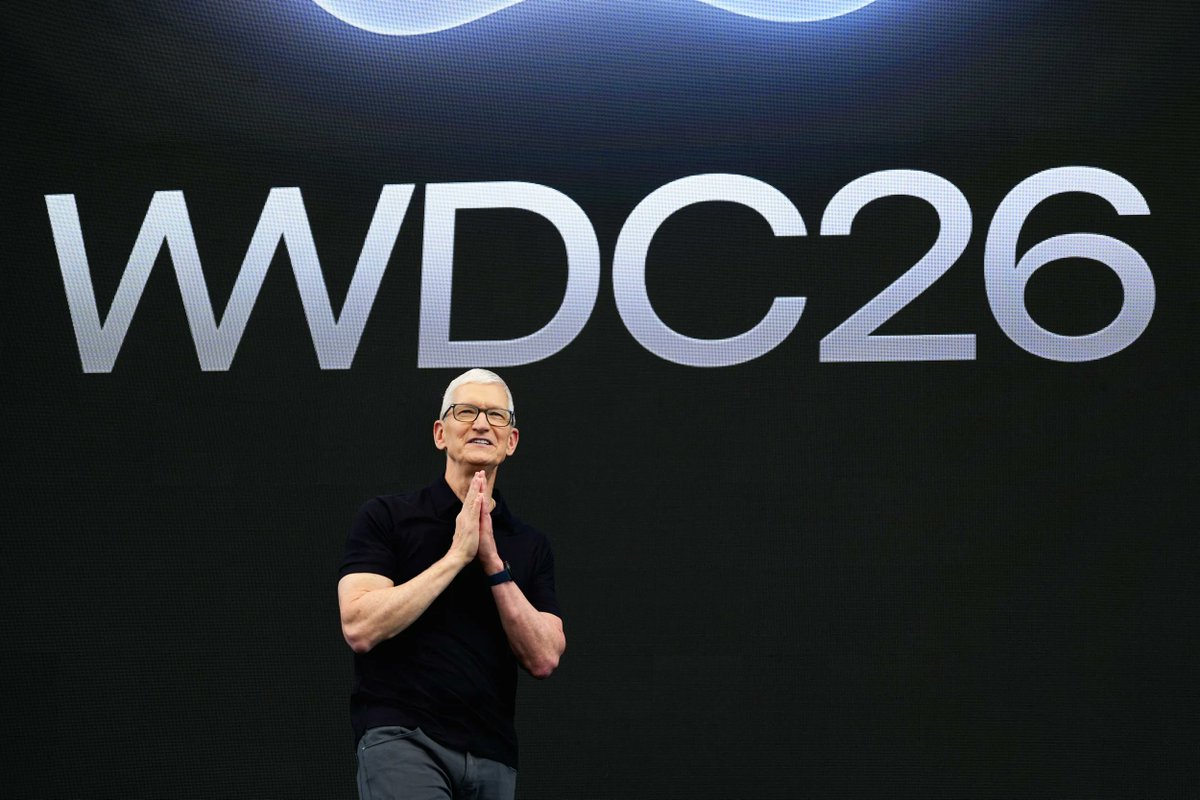
🚨#BREAKING: $AAPL Unveiled a Major AI Upgrade for Developers at WWDC 2026. Here Is What Was Announced and Why It Matters.
What happened:
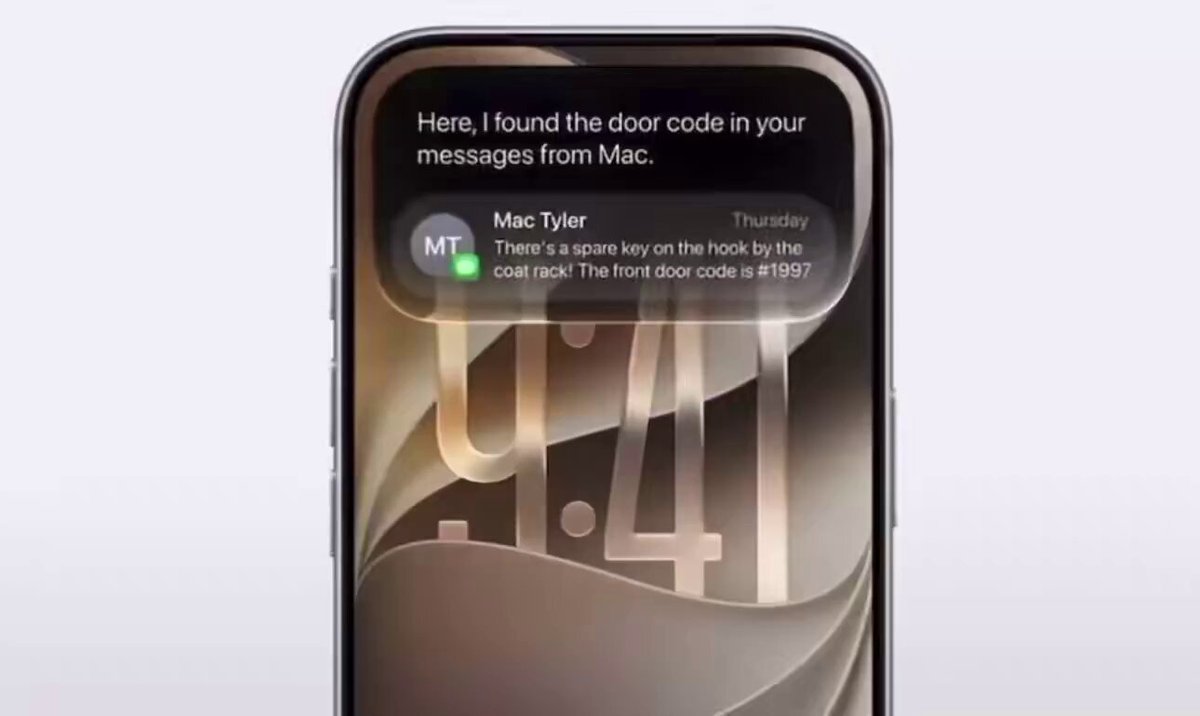
→ Apple $AAPL announced major developer-focused AI upgrades at WWDC 2026 centered around an expanded Foundation Models framework, a new Core AI framework, and agentic coding capabilities in Xcode 27
→ Developer betas for iOS 27, macOS 27, and Xcode 27 are available now
→ Apple says the goal is to give developers more powerful tools to build AI-powered applications across its ecosystem
Foundation Models framework gets a major upgrade:
→ Apple's Foundation Models framework now supports image input for on-device AI models
→ Developers can build applications that analyze photos and graphics directly on users' devices
→ The framework now also supports more powerful server-based AI models for complex workloads
→ Both on-device and cloud-based AI capabilities are now accessible through a single Swift API
→ The system automatically determines whether a task should run locally or in the cloud
Core AI replaces Core ML:
→ Apple is retiring Core ML and introducing a new framework called Core AI
→ Core AI is designed specifically for large language models and modern AI workloads
→ The framework is optimized for Apple silicon, unified memory architecture, and the Neural Engine
→ Developers can run AI models directly on iPhones, iPads, and Macs without sending data to external servers
→ Third-party models including Claude and Gemini can be integrated through a new language model protocol
Xcode 27 introduces agentic coding:
→ Xcode 27 adds AI agents that can plan, implement, test, and validate code autonomously
→ Supported AI providers include Anthropic's Claude, Google's Gemini, and OpenAI's ChatGPT/Codex
→ Developers can describe what they want to build and AI agents can generate implementation plans
→ Agents can create code, write tests, run those tests, and validate results
→ New features include interactive planning, multi-turn conversations, live code previews, automatic test generation, and self-validation workflows
→ Agents can interact with Apple's simulator through a new Device Hub to verify application behavior
→ Xcode 27 is now Apple silicon only and is 30% smaller than the previous version
Xcode Cloud improvements:
→ Xcode Cloud is now up to 2x faster
→ Support has been added for Metal and visionOS builds
→ Developers can build, test, and distribute a broader range of applications through Apple's cloud infrastructure
Apple expands MCP support:
→ Model Context Protocol (MCP) is now integrated system-wide across iOS 27 and macOS 27
→ Siri and Apple's Core AI layer can connect directly to MCP-compliant servers
→ Databases, APIs, and external tools hosted through MCP can be accessed by system AI without additional end-user configuration
→ This represents a significant expansion of AI interoperability at the operating system level
Additional benefit for smaller developers:
→ Developers enrolled in Apple's App Store Small Business Program can access Apple's next-generation Foundation Models running on Private Cloud Compute at no cost
→ The program applies to developers with fewer than 2 million total first-time downloads
→ This removes a major cost barrier for independent developers building AI-powered applications
Why this matters:
→ Apple is giving developers access to more capable AI models, autonomous coding tools, and deeper operating system integrations
→ The combination of Foundation Models, Core AI, Xcode 27, and system-wide MCP support expands the range of AI-powered applications that can be built across Apple's ecosystem
→ The updates also reduce the complexity of deploying AI by unifying on-device and cloud-based capabilities under a single development framework
1
1
340
Jun 5
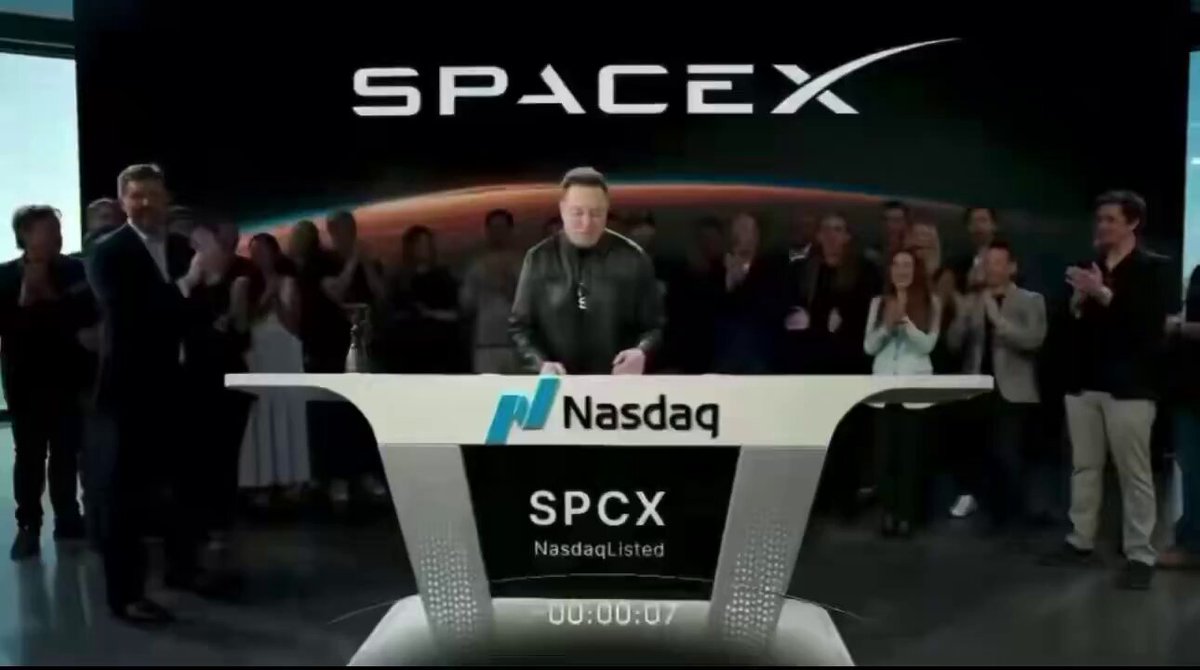
🚨#BREAKING: SpaceX $SPCX Just Disclosed a $920 Million Per Month Cloud Deal With Google $GOOG. Here Is What the Filing Says and Why It Matters.
The announcement:
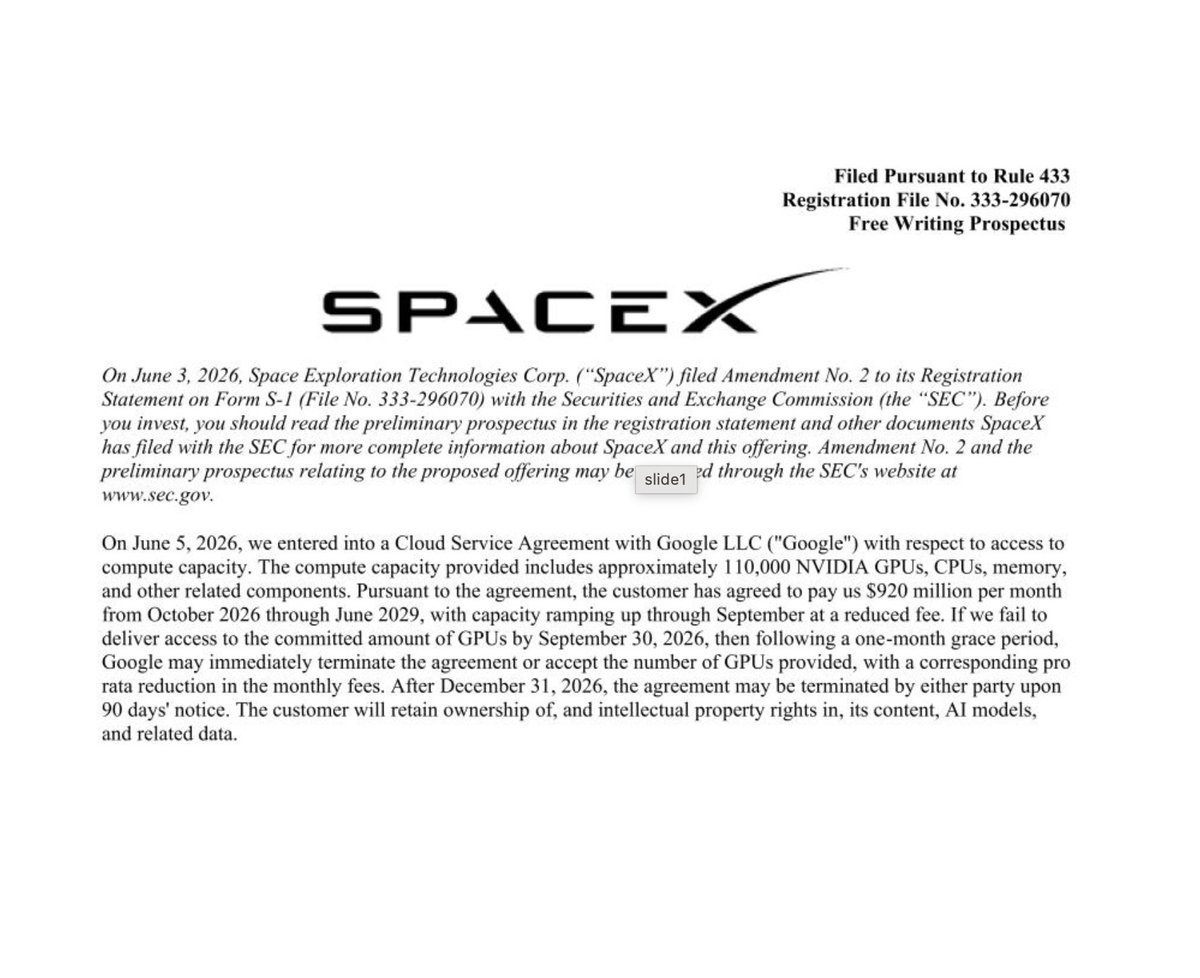
→ SpaceX disclosed in a regulatory filing on June 5, 2026 that it has signed a Cloud Service Agreement with Google LLC for access to AI compute capacity
→ The agreement was filed as part of Amendment No. 2 to SpaceX's Form S-1, one week before SpaceX's expected Nasdaq debut on June 12
→ Under the agreement, Google will pay SpaceX $920 million per month from October 2026 through June 2029, with capacity ramping up through September at a reduced fee
→ The compute capacity includes approximately 110,000 NVIDIA GPUs, along with CPUs, memory, and other related components
Why Google is doing this:
→ A Google Cloud spokesperson told CNBC that the company entered the agreement "to ensure we have bridge capacity to meet surging customer demand for our agent platform, Gemini Enterprise, which has been even higher than we expected"
→ Google says demand for Gemini Enterprise is growing faster than expected
→ SpaceX's xAI data centers provide available compute capacity while demand continues to increase
→ Google's recent partnerships with Palantir, Workday, and IBM all run on Gemini Enterprise
The financial scale:
→ $920 million per month from October 2026 through June 2029 spans 33 months at the full contracted rate
→ Total revenue at the full rate would be approximately $30.4 billion
→ This is from a single customer and a single data center relationship disclosed in one filing
→ At the full contracted rate, the agreement generates approximately $11 billion in annual revenue
→ SpaceX reported $18.67 billion of total revenue across rockets, Starlink, and xAI operations during 2025
→ The Google agreement at full rate generates approximately $11 billion annually
The terms that matter:
→ SpaceX must deliver access to the committed 110,000 GPUs by September 30, 2026
→ If it fails to do so, Google receives a one-month grace period and can then terminate the agreement or accept reduced capacity at a proportionally reduced fee
→ After December 31, 2026, either party can terminate the agreement with 90 days' notice
→ The customer retains ownership of its content, AI models, and related data
→ SpaceX did not identify which data center Google will use
The Google-SpaceX relationship:
→ Google is both a customer and a long-time investor in SpaceX
→ Google invested in SpaceX in 2015 when the company was valued at approximately $12 billion
→ SpaceX is targeting a $1.75 trillion valuation at its upcoming IPO
How this fits with the Anthropic deal:
→ Anthropic's agreement, disclosed in SpaceX's original S-1 filing, provides approximately $1.25 billion per month for all of Colossus 1's compute capacity, approximately 220,000 GPUs, through May 2029
→ Google's agreement provides approximately $920 million per month for approximately 110,000 GPUs
→ On a per-GPU basis, Google pays approximately $8,364 per GPU per month versus Anthropic's approximately $5,682
→ The filing notes that differences in GPU configurations, data center locations, or service tiers may explain the pricing difference
→ Combined, the two agreements generate approximately $2.17 billion in monthly contracted revenue at full rates
→ SpaceX's xAI data centers, originally built for Grok training, have now been substantially monetized through third-party customers
149