
Wealth • Wisdom • Willpower
Joined July 2016
- Tweets 3,241
- Following 146
- Followers 1,566
- Likes 3,367
1,395 Photos and videos









Pinned Tweet

31 Jan 2025
REequitiz community!
We’re here to simplify investing and empower you with knowledge, not to provide direct financial advice. Our focus is on learning, unlearning, and relearning, helping you think independently and make informed financial decisions.
Everything we share is for educational purposes only. We don’t recommend specific stocks or strategies; we share insights to help you understand markets better. Investing comes with risks, and past performance doesn’t guarantee future results, so always invest wisely based on your own goals and risk tolerance.
REequitiz operates with transparency and no hidden agendas. However, we may personally hold stocks we discuss, but that’s just part of our own investment journey; not a recommendation for you. Always do your own research before making decisions.
We integrate AI-driven insights to enhance financial education, but AI is a thinking tool, not a decision-maker. Your judgment, patience, and discipline matter most in investing. Before making any financial decision, it’s always best to consult a qualified financial advisor who understands your personal financial situation.
Markets evolve, and so does learning. We’re committed to growing, adapting, and sharing knowledge with you. By engaging with REequitiz, you acknowledge and accept this disclaimer as part of our responsible investing approach.
Let’s keep learning and investing wisely together!
#ReequitylonAnalytics
#HarmoniousIntegration
#REequitiz #LearnUnlearnRelearn #InvestingWisely #FinancialEducation #StockMarketInsights #EmpowerInvestors #TransparencyMatters #SmartInvesting #ThinkLongTerm
2
5,968
Jun 10
4,399 days....
From financial inclusion to digital transformation.
From infrastructure to innovation. From aspiration to execution.
A journey of building foundations, accelerating growth, and shaping the vision of Viksit Bharat 2047.
🇮🇳 Rashtra Pratham 🚩
#ViksitBharat2047 #NewIndia #AtmanirbharBharat #NDA #Development #Infrastructure #Innovation #IndiaRising #Bharat
#REequitiz #SeventhSenseCafe
92
Jun 8
Every highway needs workers.
Every port needs operators.
Every factory needs technicians.
Every trade agreement needs execution.
The world often celebrates policy announcements.
Markets reward execution.
India's infrastructure build-out and expanding FTA network are creating a powerful demand cycle for blue-collar and semi-skilled talent.
More projects.
More jobs.
More income.
More consumption.
More growth.
When infrastructure and human capital move together, economic momentum compounds.
This is not just employment generation.
This is nation-building in motion.
🇮🇳 Building Roads.
🇮🇳 Building Skills.
🇮🇳 Building India's Future.
#REequitiz #Infrastructure #FTA #EconomicGrowth #IndiaStory #SkillDevelopment #GCCJobs #NationBuilding #ViksitBharat
Jun 8

The traditional investor mindset has always been simple:
Protect principal in sovereign-backed assets.
Earn steady income.
Deploy that income into riskier assets to generate alpha.
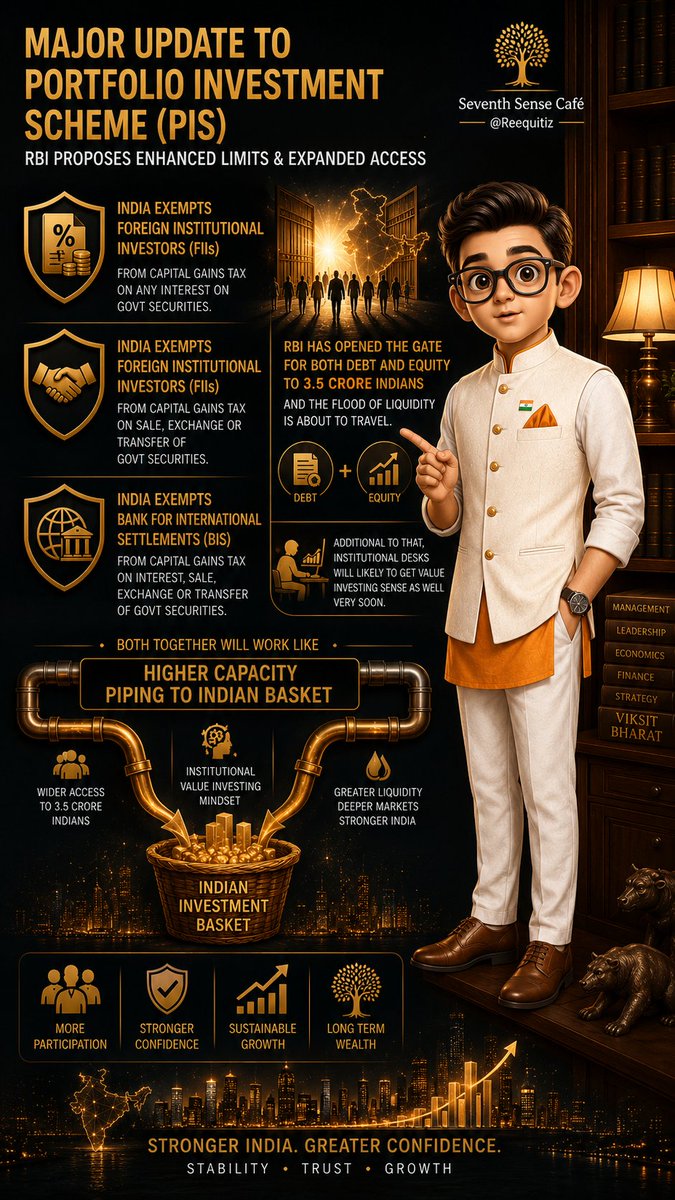
Now, RBI's proposed reforms are widening the gateway for both debt and equity participation, potentially opening access to nearly 3.5 crore Indians.
At the same time, institutional desks are gradually returning to a value-investing framework.
More participants more patient capital = a higher-capacity pipeline into India's investment basket.
Stronger liquidity.
Deeper markets.
Longer wealth cycles.
#India #Investing #CapitalMarkets #RBI #ValueInvesting #REequitiz
108
Jun 8
The traditional investor mindset has always been simple:
Protect principal in sovereign-backed assets.
Earn steady income.
Deploy that income into riskier assets to generate alpha.
Now, RBI's proposed reforms are widening the gateway for both debt and equity participation, potentially opening access to nearly 3.5 crore Indians.
At the same time, institutional desks are gradually returning to a value-investing framework.
More participants more patient capital = a higher-capacity pipeline into India's investment basket.
Stronger liquidity.
Deeper markets.
Longer wealth cycles.
#India #Investing #CapitalMarkets #RBI #ValueInvesting #REequitiz
Jun 5
India is quietly laying the foundation for deeper global participation in its capital markets.
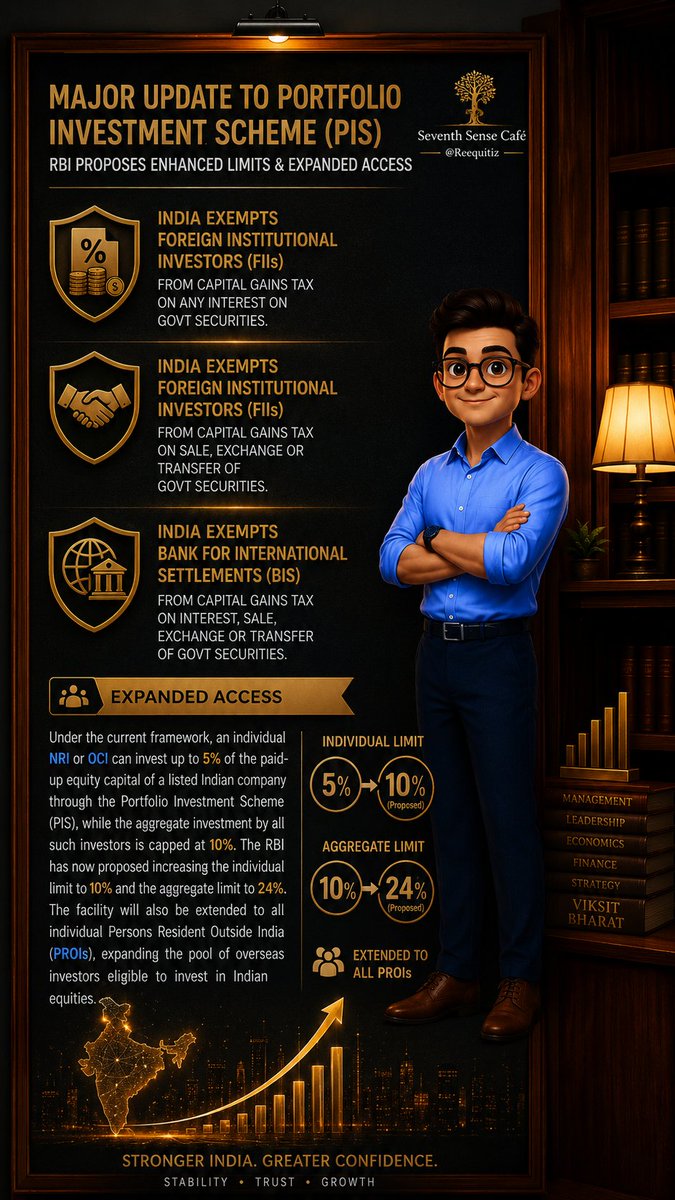
✅ FIIs exempted from capital gains tax on interest earned from Government Securities.
✅ FIIs exempted from capital gains tax on sale, exchange, or transfer of Government Securities.
✅ BIS (Bank for International Settlements) granted similar exemptions.
✅ RBI proposes increasing the individual investment limit for NRIs/OCIs from 5% to 10%.
✅ Aggregate investment limit proposed to rise from 10% to 24%.
✅ Investment access proposed to be extended to all Persons Resident Outside India (PROIs).
India is opening wider doors for global capital while strengthening confidence in its financial markets.
Stability. Trust. Growth.
#India #CapitalMarkets #FII #NRI #OCI #RBI #GovernmentSecurities #GlobalInvestors #Investment #FinancialMarkets #REequitiz #SeventhSenseCafe
223
Jun 5
India is quietly laying the foundation for deeper global participation in its capital markets.
✅ FIIs exempted from capital gains tax on interest earned from Government Securities.
✅ FIIs exempted from capital gains tax on sale, exchange, or transfer of Government Securities.
✅ BIS (Bank for International Settlements) granted similar exemptions.
✅ RBI proposes increasing the individual investment limit for NRIs/OCIs from 5% to 10%.
✅ Aggregate investment limit proposed to rise from 10% to 24%.
✅ Investment access proposed to be extended to all Persons Resident Outside India (PROIs).
India is opening wider doors for global capital while strengthening confidence in its financial markets.
Stability. Trust. Growth.
#India #CapitalMarkets #FII #NRI #OCI #RBI #GovernmentSecurities #GlobalInvestors #Investment #FinancialMarkets #REequitiz #SeventhSenseCafe
229
Jun 2
Beyond the noise lies the opportunity.
Markets move daily.
Nations build for decades.
Stay focused on what creates tomorrow:
Policy. Capital. Patience.
Different Horizons.
One Destination.
🇮🇳 A Stronger, Wealthier India.
#REequitiz #SeventhSenseCafe #IndiaGrowthStory #LongTermInvesting #LearnUnlearnRelearn #WealthCreation #PatientInvesting
130
May 27
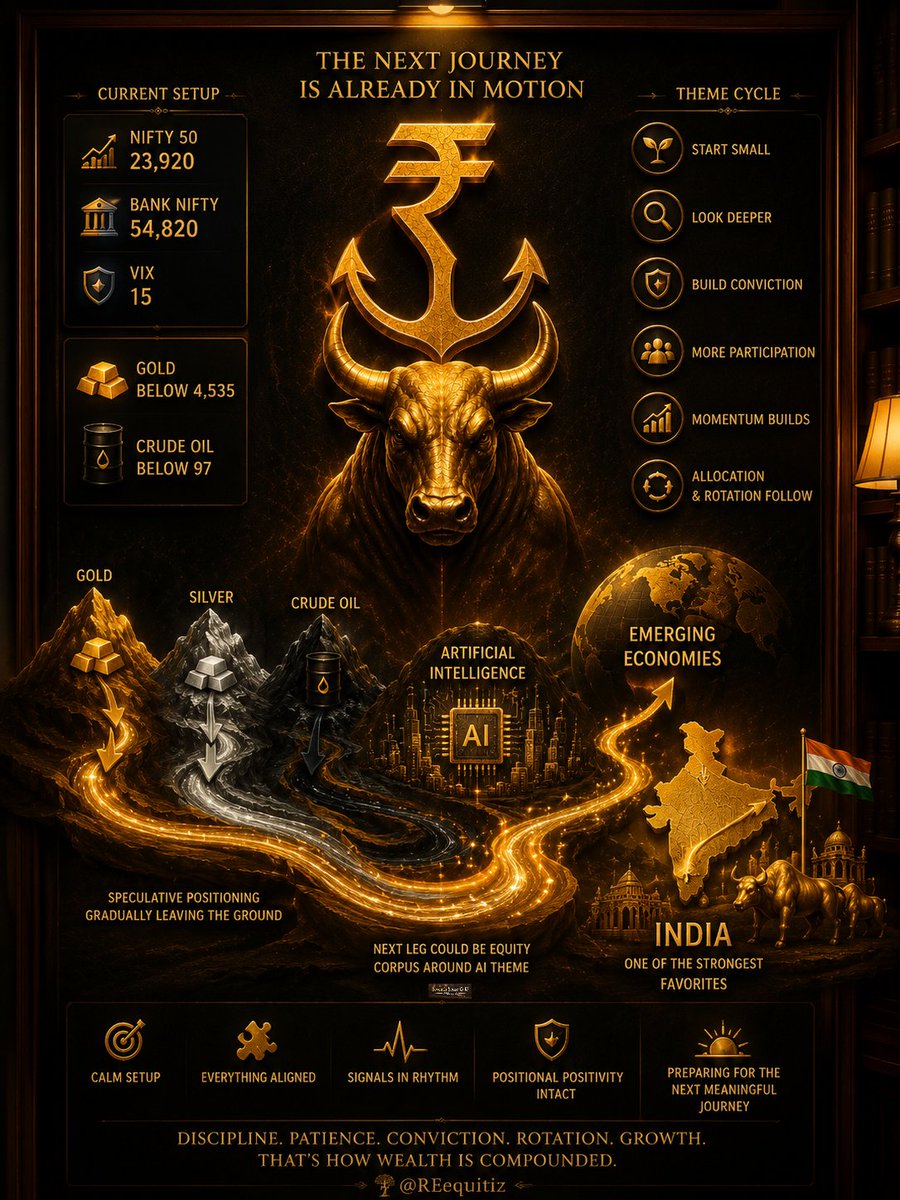
NIFTY & SENSEX expiry concluded on 27 May 2026 with NIFTY 50 closing at 23,920, BANK NIFTY at 54,820, and VIX holding near 15.
Alongside this, Gold stayed below 4,535 and Crude Oil remained below 97.
The overall mood feels like the beginning of a long weekend calm on the surface, yet meaningful underneath.
Global events are lined up, but positional positivity remains undisturbed. Signals across the board continue moving in rhythm, and the market structure still feels steady, constructive, and quietly aligned for the next phase.
Markets rarely announce a theme when it is born. In the early stages, most people either reject it or simply ignore it.
A few begin looking deeper and find value where the crowd sees none. They start with a small allocation, then gradually add as conviction strengthens.
Momentum gathers slowly.
Participation expands.
Conversations become louder. Eventually, capital rotation follows.
This is how most meaningful themes are built patiently, quietly, and often before broader acceptance arrives.
At present, Gold, Silver, and Crude Oil have already started correcting. That matters because it suggests speculative positioning is gradually leaving those grounds after an extended run.
When multiple safe-haven and commodity trades begin cooling together, the message is worth observing. Liquidity usually does not disappear. It rotates.
The next major pocket of attention could be the equity corpus built around the Artificial Intelligence theme, where a meaningful share of global momentum capital has remained concentrated over recent times.
If that segment also enters a phase of recalibration, the larger liquidity cycle may begin adjusting weightage toward emerging economies.
And among those destinations, India continues to stand firmly as one of the strongest favorites.
Structural growth, policy momentum, domestic participation, and improving global confidence continue supporting the long-term case.
Sometimes the biggest move begins without noise.
Capital quietly changing hands.
And by the time the crowd sees the theme clearly, the journey is already underway.
#REequitiz #SeventhSenseCafe
#Nifty50 #BankNifty #ArtificialIntelligence #Gold #Silver #CrudeOil #EmergingMarkets #InvestingIndia
176
May 22
Sometimes, the gates open before the growth flood arrives.
What looks like temporary outflow may actually be preparation for larger capacity, deeper participation, stronger reserves, and a bigger economic cycle ahead.
From 2008 to 2026, India’s story is not just about volatility… it is about structural evolution.
The reservoir is no longer the same.
#REequitiz #SeventhSenseCafe
#VikshitBharat #IndianEconomy #IndiaGrowthStory #StockMarket #Investing #Markets #EconomicGrowth #FII #DII #India #CapitalMarkets #Infrastructure #AI #Manufacturing
1
1
126
May 20
This Gurupushya, taking a small step with a larger purpose. 🇮🇳
Reducing 5% allocation from gold holdings and gradually shifting it toward 10-year long-term investing in Indian equities.
From preservation → toward productive participation.
As citizens, we are part of :
Economic Independence & Bharat Nirman.
Standing firmly with the leadership, we Millennials are not here to compete with Gen Z;
we are here to guide, build, and stand as companions to Gen Z carrying forward discipline, patience, responsibility, and a nation-building mindset together.
Collectively supporting Indian businesses, curtailing unnecessary gold and fuel dependence, encouraging local consumption, and investing in Bharat’s growth journey; we strengthen the economy collectively.
Small disciplined shifts by millions can become a national movement.
Invest in India.
Believe in India.
Build with India.
Grow with India.
#REequitiz #SeventhSenseCafe #EconomicIndependence #BharatNirman #InvestInIndia #LocalForVocal #IndianEquities #LongTermInvesting #WealthCreation #AtmanirbharBharat #MadeInIndia #GrowthJourney #FinancialWisdom #IndianMarkets #NationBuilding #REequitizThoughts
2
107
May 20
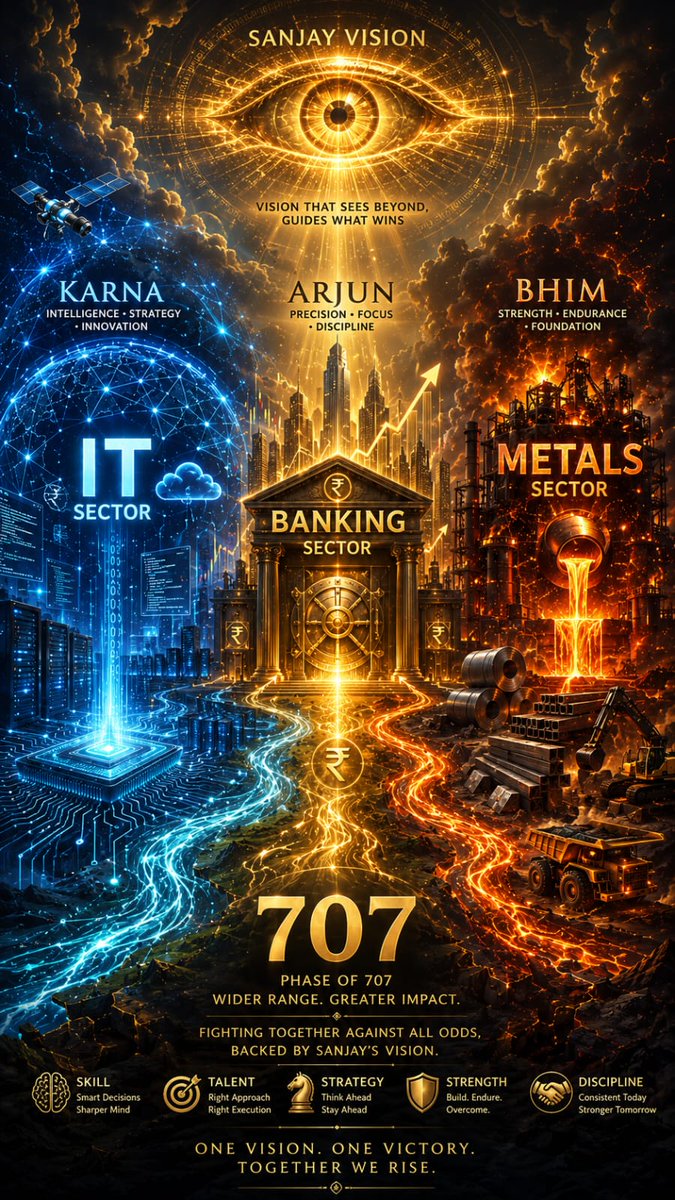
707 - Chapter 1:
When Titans March Together
707, now seems to have opened with a much wider range.
In this modern-day,
Maha-Bharat,
Karna, Arjun, and Bhim; all three now appear to be stepping onto the same battlefield with their respective strengths.
Interestingly, this trio seems to be fighting together against all odds, guided by the vision of Sanjay.
View on Market:
Every single gap-down in the market,
from 23,400 to even 22,800 at the extreme, should be viewed as an opportunity to participate in the next leg of the upside move.
The key is not to get over-leveraged.
Stay positioned strictly as per risk-management discipline.
Fasten your seatbelt and enjoy the ride.
Otherwise, the horse may still win the race… but the rider could miss it entirely. 😊
#KarnaIT #ArjunBanking
#BhimMetals #TrinityOfStrength
#REequitiz_707
#SeventhSenseCafe
Note:
Characters used in this article are purely symbolic and creative representations to simplify understanding and improve content recall.
This content is shared only for learning, storytelling, and educational purposes with full respect toward all beliefs, sentiments, and cultural values.
Jan 6
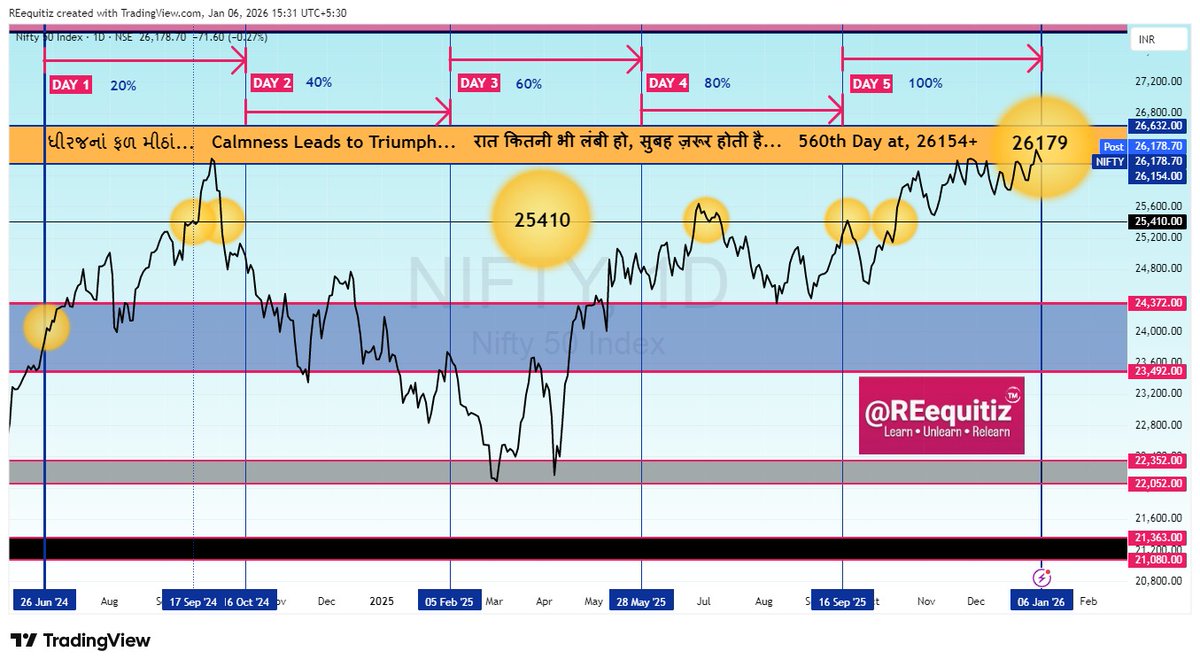
6th Jan 2026: 26179
560 days completed, a full-time framework respected.
This phase was never about prediction.
It was about allowing structure to develop, volatility to compress, and price to reveal its intent.
Time did the heavy lifting.
Price simply confirmed it.
Process at REequitiz:
(Fundamental Technical) × Commonsense) ^ Time
#REequitiz #MarketFormula #InvestingFramework #TimeEdge #CommonsenseInvesting #LearnUnlearnRelearn
1
4
159
May 19
हजारों वर्ष पुरानी सभ्यता के बल पर; भारत सिद्धांत, स्थिरता और सभ्यतागत मूल्यों के साथ दृढ़ता से खड़ा है, जिसे दुनिया सबसे विनम्र, शांतिप्रिय और सहिष्णु सभ्यताओं में गिनती है।
जब संकट आता है, भारत लोगों को सुरक्षित करता है। दुनिया बंटती है, तो भारत ही संतुलन बनाए रखता है।
भारतीय होने के नाते, ऐसी स्पष्टता, साहस और कूटनीति के साथ गर्व से खड़े हैं। जवाब इतने सटीक हैं कि, यह लोग उन्हें जीवनभर याद रखेंगे।
गर्व है भारतीय कूटनीति पर 🫡
@AmbSibiGeorge
भारत विश्वसनीय था, विश्वसनीय है… और विश्वसनीय रहेगा। 🇮🇳

#WATCH | Oslo, Norway | MEA Secretary (West) Sibi George responds to question by reporters from Norway - "Why should we trust you?" " Will the PM take critical questions from the Indian Press?"
1
97
May 18
Both Nifty and Bank Nifty have filled the opening gap, meaning the initial negativity has been wiped out.
However, VIX remains unchanged, which shows that risk perception is still alive.
The broader market is still not recovering, indicating that retail participation is weak or trapped.
Now, there is a high chance that retail traders may rush into the cash market high-beta stocks, MTF positions, and F&O ideas and may get trapped again.
Interest rate-sensitive sectors like Banks, Auto, and Real Estate remain under pressure, and the key reason behind this is the movement in Bond Yields and Currency.
Tomorrow is weekly expiry, and in recent times, derivatives have become a playground of excitement after good results.
Overjoyed retail participation is getting trapped, and this pain may continue for the rest of the month.
At the same time, long-term investors may gradually start buying fear over the next couple of weeks.
For Nifty, the important zone now appears around 23,000.
Overall, markets are showing emotional volatility more than structural clarity.
⚠️ Complicated screens.
Patience matters.
#REequitiz #SeventhSenseCafe
4
254
May 18
Result season almost over...
Banks, IT, Metals: Major trend drivers have largely played their part, and the market has already touched 23820.
Now the battlefield shifts toward positioning and gap psychology.
Shorts trap could stretch towards 24172.
Longs trap could drag towards 23150.
Interestingly, both sides are eyeing unfinished GAP zones waiting to be filled.
At present, the market stands right at the midpoint of the broader range: 23615.
A classic equilibrium zone, where patience matters the most.
Enjoy upcoming volatility.
#REequitiz #SeventhSenseCafe
3
155
Rushik Bhatt 🇮🇳 retweeted

May 15
This is totally false.
Not an iota of truth in this.
There is no question of putting such restrictions on foreign travel.
We remain committed to improving ‘Ease of Doing Business’ and ‘Ease of Living’ for our people.
5,799
17,611
66,918
7,727,441
May 15
पेट्रोल की कीमतों में बढ़ोतरी लगभग तय थी; केवल यह तय होना बाकी था कि वह आखिर कब सामने आएगी।
बाज़ार की सबसे बड़ी खूबसूरती यही है कि अंतरराष्ट्रीय कच्चे तेल की कीमतों, आयात मूल्य निर्धारण की जटिलताओं और ऊर्जा संकट के समय सरकारों की सीमित क्षमता से लगभग हर सहभागी परिचित होता है।
इसलिए बाज़ार अपनी सामूहिक समझ और विवेक के आधार पर इन वास्तविकताओं को वास्तविक घोषणा से बहुत पहले ही कीमतों में शामिल करना शुरू कर देता है।
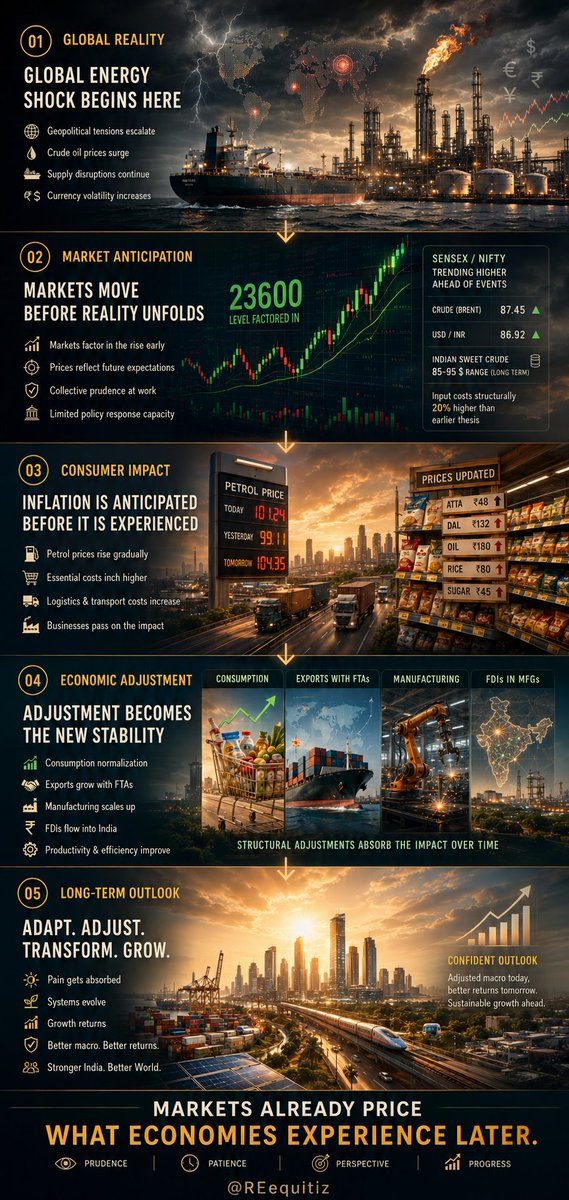
वीकेंड की ओर बढ़ते हुए यह स्पष्ट दिखाई देने लगा है कि बाज़ार ने 23600 के आसपास संभावित बढ़ोतरी को काफी हद तक पहले ही फैक्टर कर लिया है। यह वृद्धि अचानक नहीं, बल्कि धीरे-धीरे चरणबद्ध तरीके से दिखाई दे सकती है, जहाँ भावना और उपभोक्ता सहजता समय के साथ स्वयं को समायोजित करेगी।
यह बढ़ोतरी शायद केवल नई दुनिया के अनुरूप होने की शुरुआत भर हो, जबकि बड़ी उम्मीद यही है कि वैश्विक तनाव कम हों, शांति स्थापित हो और दुनिया आगे चलकर अधिक स्थिर दिशा में बढ़े।
ईंधन कीमतों में बढ़ोतरी की आशंका धीरे-धीरे उपभोग आधारित महंगाई में बदलने लगती है। वास्तव में कई कंपनियाँ और उत्पाद पहले ही अपनी कीमतों में बदलाव कर चुके थे, क्योंकि उन्होंने कच्चे तेल और पेट्रोल कीमतों में संभावित वृद्धि का अनुमान पहले ही लगा लिया था।
परिणामस्वरूप बाज़ार अंततः उस प्रभाव को अलग तरीके से अवशोषित करता है; कई बार इसलिए क्योंकि लोगों ने वास्तविक बढ़ोतरी से कहीं अधिक वृद्धि की उम्मीद कर ली होती है।
भविष्य में यदि अंतरराष्ट्रीय कच्चे तेल की कीमतों में कुछ नरमी भी आती है, तब भी घरेलू स्तर पर कीमतों में बड़ी कटौती की संभावना कम दिखाई देती है।
इसका कारण यह है कि कंपनियों और सरकारी खजानों पर जो दबाव पहले से पड़ा है, उसकी भरपाई और संतुलन भी समय के साथ करना आवश्यक होगा।
एक निवेशक के दृष्टिकोण से देखें तो अब व्यापक मैक्रो तस्वीर यह संकेत देती है कि भारतीय स्वीट क्रूड की दीर्घकालिक औसत कीमत 85–95 डॉलर के दायरे में रह सकती है, जबकि मुद्रा विनिमय दरें भी ऊँचे स्तर पर बनी रह सकती हैं।
इसका अर्थ यह है कि हमारी पुरानी लागत धारणाओं की तुलना में कुल इनपुट कॉस्ट स्ट्रक्चर लगभग 20% अधिक हो चुका है।
हालाँकि आने वाले वर्षों में यह समायोजन कई माध्यमों से धीरे-धीरे संतुलित हो सकता है:
• उपभोग आधारित सामान्यीकरण
• FTAs के माध्यम से निर्यात वृद्धि
• मैन्युफैक्चरिंग सेक्टर में बढ़ते FDIs
समय के साथ यही संरचनात्मक बदलाव महंगाई के दबाव को काफी हद तक अवशोषित कर सकते हैं। एक तरह से अध्ययन फिर वहीं लौटता है, उपभोग की मूल थीम पर लेकिन इस बार बढ़ी हुई लागत संरचना के साथ।
वर्तमान समायोजित मैक्रो परिस्थिति को देखते हुए यह विश्वास बना हुआ है कि अर्थव्यवस्था और बाज़ार दोनों आने वाले समय में बेहतर संतुलन, अनुकूलन और स्थायी रिटर्न की दिशा खोज लेंगे।
शायद यही बाज़ार की वास्तविक सुंदरता है, जहाँ सामूहिक अपेक्षाएँ, भय, विवेक, नीतिगत सीमाएँ और भविष्य की आशाएँ वास्तविक घटनाओं के स्क्रीन पर आने से बहुत पहले ही एक-दूसरे के साथ संवाद करना शुरू कर देती हैं।
और इसी संवाद के भीतर अध्ययन, व्याख्या, धैर्य और विश्वास की वह व्यक्तिगत कला छिपी होती है; जो अपने आप में एक बिल्कुल अलग विषय है।
#REequitiz #SeventhSenseCafe
1
111
May 11
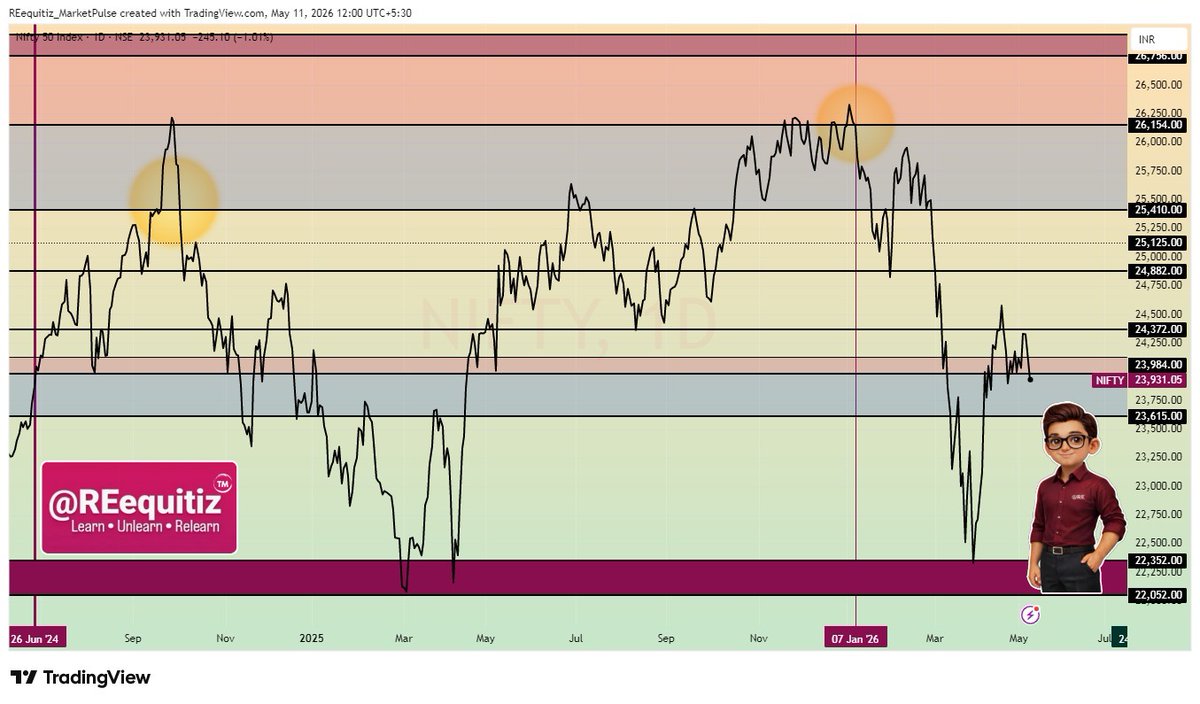
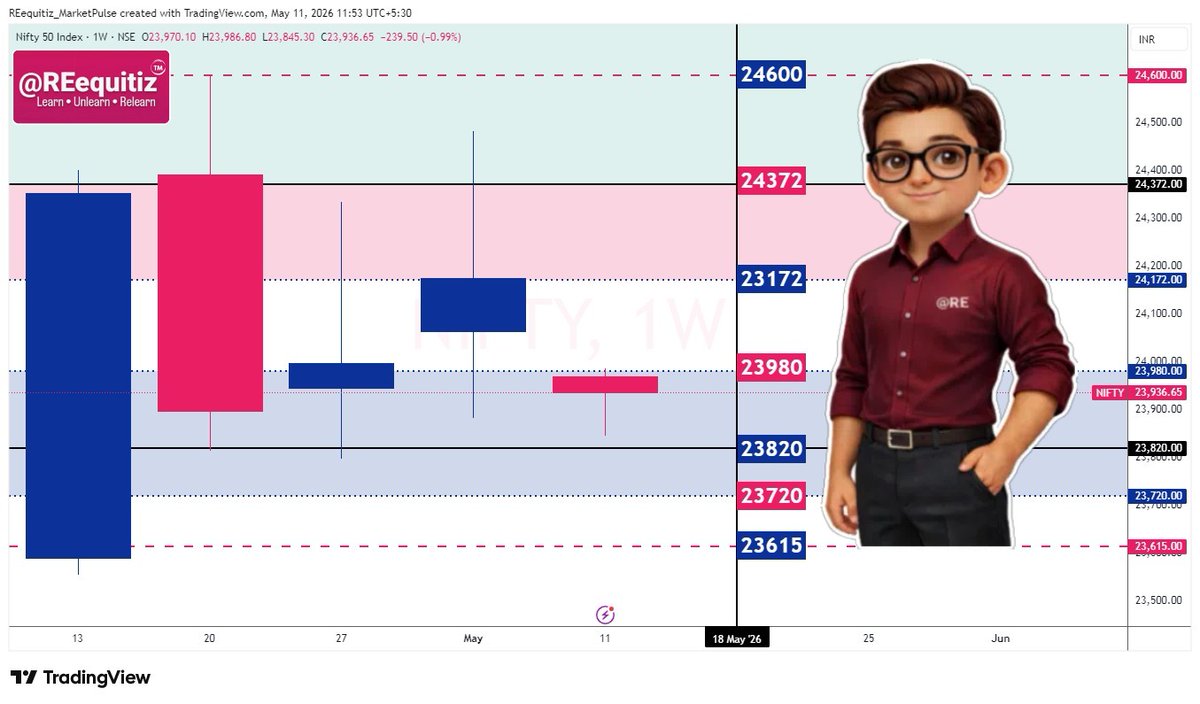
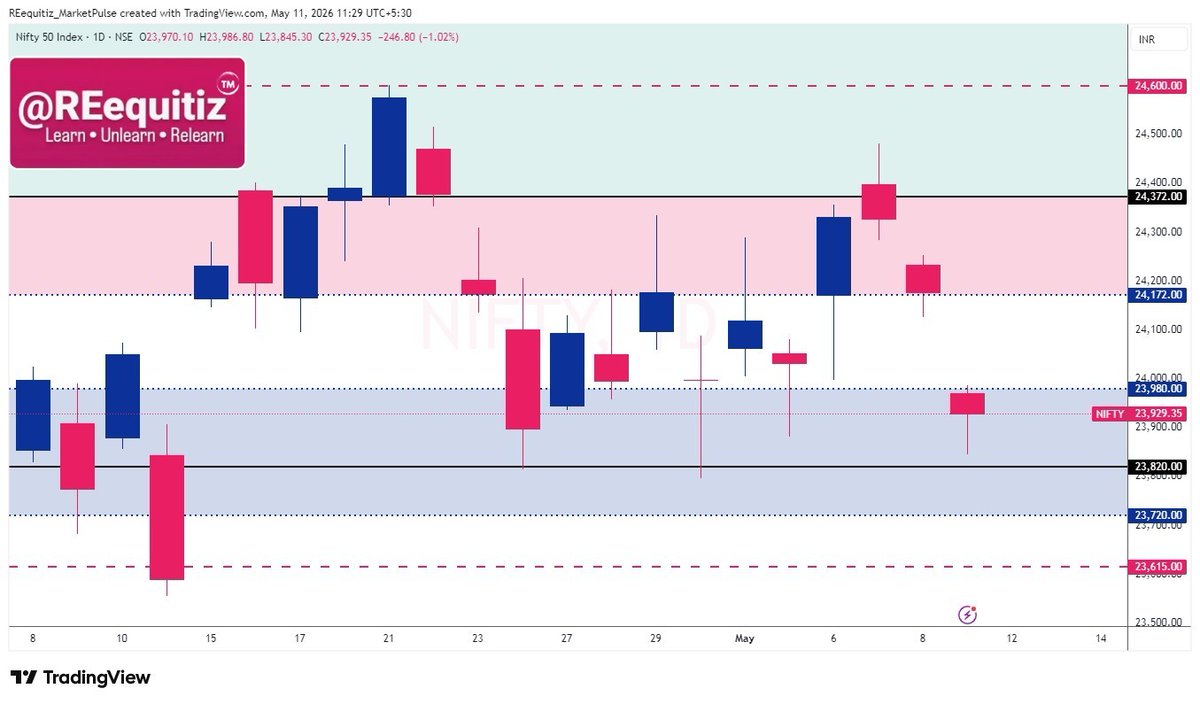
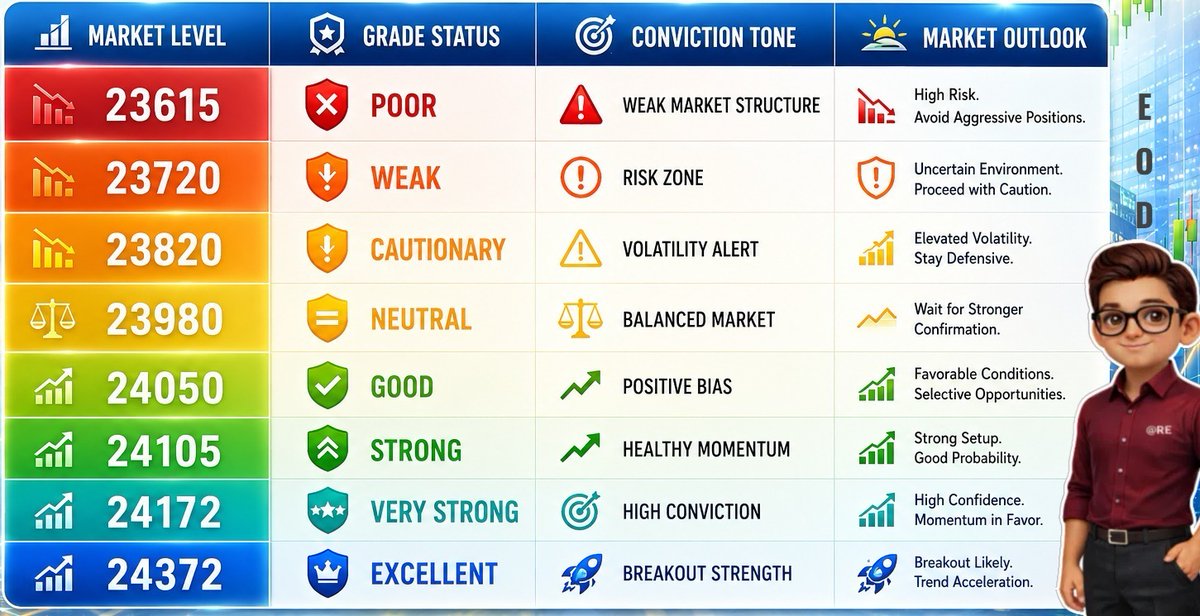
Market rewards conviction backed by discipline.
Every market level carries its own tone, risk profile, and probability structure.
The real skill is not forecasting every move, it is positioning according to market character.
🔴 Weak Structure → Capital Protection
🟠 Volatility Zone → Defensive Approach
🟡 Neutral Zone → Wait for Confirmation
🟢 Positive Bias → Selective Opportunities
🔵 High Conviction → Momentum Expansion
Trade less. Observe more.
Patience is also a position.
#REequitiz #MarketPulse #MarketStructure #RiskManagement #PositionalTrading #Nifty
3
191
May 4
🇮🇳भारत भाग्य विधाता
🇮🇳 ভারত ভাগ্য বিধাতা
🚩गंगोत्री से गंगासागर 🚩
🪷 @BJP4India
🪷 @BJP4Gujarat
🪷 @BJP4Bengal
111
Apr 25
When someone says, “Reading is the most wasteful use of time,” the instinctive reaction is to push back and fairly so.
But perhaps this line deserves a little more patience than dismissal.
Coming from someone like Ridham Desai, it is unlikely to be a rejection of knowledge; it feels more like a reflection shaped by years of reading, observing, and living through market cycles.
So, instead of reacting to the sentence, it may be more meaningful to sit with the intent behind it.
Maybe the statement is not against reading but against passive consumption. Information, by itself, is not a study.
Study, on its own, does not become experience. And experience, even then, does not guarantee success.
Each layer demands time, mistakes, and a certain quiet patience. Markets, much like life, rarely reward what is merely known they respond to what is understood and lived.
It is also a gentle reminder that learning does not belong to a single shelf.
Wisdom often arrives from unexpected places across disciplines, through lived moments, through reflection.
Consider the Bhagavad Gita; one does not always need to read it cover to cover; sometimes, a single verse encountered at the right moment carries enough clarity for that phase of life. Learning, then, is not linear it unfolds.
Of course, questioning such a statement is valid and even necessary.
But perhaps there is also room to view it as part of a larger learning curve where understanding evolves with time. What feels exaggerated today may reveal a different meaning after a few cycles of experience.
And at a personal level, one thought keeps things grounded:
"I know that I know nothing and even recognize that it is a meaningful place to begin."
@rndx1 @niraj_shah
#REequitiz #SeventhSenseCafe
166
Apr 23
एक छोटे से गाँव का नाम था अवनीपुर। बाहर से यह साधारण लगता था; खेत, चौपाल, और रोज़मर्रा की भागदौड़। लेकिन गाँव के बीच बैठता था एक चतुर मुखिया अमरेश भैया। उसकी खासियत यह थी कि वह सीधे टकराव कम करता था, मगर माहौल ऐसा बनाता था कि हर कोई अपने-अपने मसलों में उलझा रहे। जब सब व्यस्त हों, तो कोई भी पूरे गाँव की तस्वीर नहीं देखता और यही उसकी असली ताकत थी।
गाँव के पश्चिम में रूसवा काका और यूरा चाचा रहते थे। दोनों के बीच जमीन और पानी का पुराना झगड़ा था। अमरेश भैया ने बस उसे थोड़ा हवा दे दी। अब दोनों उसी में उलझे रहते कभी मेड़, कभी बंटवारा। खासकर यूरा चाचा, जो पहले अपने घर और खेती को सुधारने की सोचते थे, अब हर दिन उसी तनाव में थक जाते।
दक्षिण में ईरन मियाँ थे, तेज मिजाज, हर बात पर बहस। हालात ऐसे बने कि उनका ध्यान हमेशा किसी न किसी टकराव में ही लगा रहा। आगे बढ़ने की सोच पीछे छूट गई, और हर दिन बस प्रतिक्रिया देने में निकलने लगा।
पूरब में चीनू सेठ था; तेज, मेहनती और आगे बढ़ने वाला। उसका व्यापार बढ़ रहा था, लेकिन नियम बदलते रहे कभी टैक्स, कभी लेन-देन की शर्तें। वह रुका नहीं, मगर हर कदम सोच-समझकर रखना पड़ा। उसकी गति बनी रही, पर रास्ता आसान नहीं था।
गाँव के बीच में था इंदर, सबसे छोटा, सबसे ज्यादा ऊर्जा वाला। सपनों से भरा, करने की चाहत से भरा। मगर शुरुआत में उसका ध्यान बंटा हुआ था; कभी पंचायत की राजनीति, कभी बाजार की उठापटक, कभी इधर-उधर की बहस। वह हर जगह था, हर काम में लगा था, लेकिन उसकी दिशा साफ नहीं थी।
गाँव के बाकी लोग छोटे किसान, दुकानदार अपनी-अपनी समस्याओं में उलझे रहे। हर किसी की अपनी लड़ाई थी, अपना बोझ था।
इसी बीच, अमरेश भैया के घर में भी दबाव बढ़ रहा था खर्च, उधार, और व्यवस्था की चुनौतियाँ। लेकिन इन बातों को सामने आने देने के बजाय, उसने गाँव में एक नई चर्चा शुरू कर दी नई मशीनें, नई तकनीक, और “आने वाला भविष्य”। चौपाल पर अब हर कोई उसी की बात करता। ध्यान धीरे-धीरे असल समस्याओं से हटकर उम्मीद की कहानियों पर टिक गया।
गाँव में अनिश्चितता बढ़ने से सब सामान महंगा हुआ, उधार बढ़ा, और लोग और ज्यादा अमरेश भैया पर निर्भर होते गए। हर संकट के साथ उसका प्रभाव और मजबूत होता गया। हर कोई व्यस्त था, मगर कोई भी ठहरकर सोच नहीं रहा था।
इसी शोर और भागदौड़ के बीच, इंदर ने धीरे-धीरे कुछ समझना शुरू किया। उसे एहसास हुआ कि,
हर लड़ाई में कूदना ज़रूरी नहीं होता…
हर बहस में जवाब देना भी ज़रूरी नहीं होता…
उसने सबसे पहले अपना ध्यान घर की तरफ लगाया, परिवार और उनकी ज़रूरतें।
उसने तय किया कि अगर जड़ मजबूत नहीं होगी, तो पेड़ ऊँचा नहीं बढ़ेगा। फिर उसने अपने काम को व्यवस्थित करना शुरू किया; कम शोर, लेकिन साफ दिशा।
गाँव के लोग यह बदलाव देख रहे थे। धीरे-धीरे भरोसा बनने लगा। लोगों को लगा यह लड़का अलग है। यह सिर्फ भाग नहीं रहा, यह समझकर चल रहा है। अब एक नई स्थिति बनी।
रूसवा काका चाहते थे कि इंदर उनके साथ खड़ा हो।
यूरा चाचा चाहते थे कि वह उनका समर्थन करे।
चीनू सेठ उसे अपने व्यापार में शामिल करना चाहता था।
यहाँ तक कि अमरेश भैया भी उसे अपने करीब रखना चाहता था।
हर बड़ा व्यक्ति चाहता था कि इंदर उसकी तरफ झुके मगर अपनी शर्तों पर।
इंदर अब पहले जैसा नहीं था। उसने सीखा था सुनना, समझना, और फिर तय करना। वह किसी के खिलाफ नहीं गया, लेकिन वह किसी के दबाव में भी नहीं आया।
उसने अपनी जगह बनाई ऊपर की कतार में, मगर अपने तरीके से। अब वह सबसे छोटा होते हुए भी सबसे भरोसेमंद बन रहा था। समस्याएँ अभी भी थीं, दबाव भी था, मगर उसकी दिशा साफ थी।
गाँव के लोग अब उसे देखने लगे; एक उम्मीद की तरह। एक ऐसे इंसान की तरह, जो आगे चलकर सबको साथ लेकर चल सकता है।
चौपाल पर वही बूढ़ा आदमी फिर बोला,
“नेता वो नहीं जो हर लड़ाई में दिखे… नेता वो है जो सही समय पर सही जगह खड़ा हो।”
इंदर चुप था, मगर उसकी खामोशी में जवाब था। क्योंकि अब वह सिर्फ दौड़ नहीं रहा था…
वह समझकर आगे बढ़ रहा था।
और शायद…
यही एक असली नेता बनने की शुरुआत होती है।
#REequitiz #SeventhSenseCafe

2
152
Apr 22
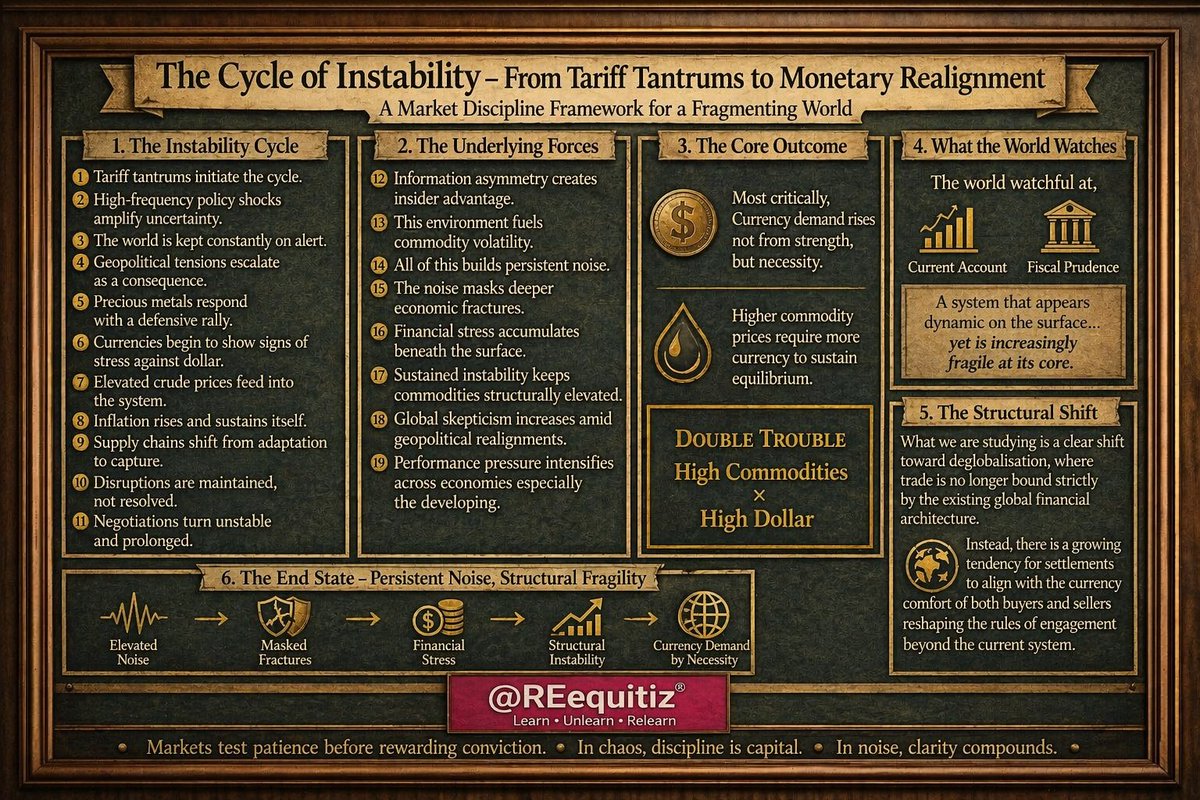
Under the Loudest Noise, the Deepest Shifts Unfold...
Tariff tantrums don’t stay tantrums… they trigger cycles.
Policy shocks → uncertainty
Uncertainty → geopolitical friction
Friction → commodity spikes
Commodity spikes → inflation persistence
Inflation → currency stress
And then it compounds…
Supply chains shift from efficiency → control
Disruptions become structural, not temporary
Negotiations stretch, clarity fades
Information gaps create an insider advantage
Result?
Noise everywhere.
But beneath the noise, financial stress builds silently.
Commodities stay elevated.
Dollar stays firm.
Economies especially developing ones face performance pressure.
Most critical shift:
Currency demand is rising not from strength… but from survival.
Higher commodity prices = higher currency requirement to sustain balance.
⚠️ Double Trouble:
High Commodities × High Dollar
The world is now watching:
Current Account discipline
Fiscal Prudence
Because what looks dynamic on the surface is structurally fragile underneath.
We are not just witnessing volatility
we are witnessing a shift.
Deglobalisation is rewriting the rulebook.
Trade is no longer bound by the old system.
Settlements are moving toward currency comfort between participants.
The system isn’t breaking loudly
it’s quietly evolving.
#REequitiz #SeventhSenseCafe
1
1
2
147
Apr 14
Is it the prudence of investors their ability to think independently, filter noise, and act with discipline?
Or
Is it the process itself, the frameworks, methodologies, and systems through which investment decisions are formed and validated?
If the challenge is directed at investor prudence, it implies that participants are increasingly reactive and guided more by narratives than by conviction. It reflects herd behaviour, compressed time horizons, and a dilution of independent thinking.
If the challenge is directed at the process, it runs deeper.
It questions whether research, valuation, and trend identification are entirely organic or partially influenced by those who shape narratives.
In this lens, markets are not merely reflecting reality; at times, they are participating in constructing it.
The truth, however, lies in balance.
Markets have always operated at the intersection of perception and reality. Narratives will emerge, cycles will amplify them, and participants will engage with varying degrees of awareness.
The process is not flawed, but it is not immune. Investor prudence is not absent, but it is constantly tested.
What is truly being challenged is the equilibrium between the two.
The integrity of outcomes depends on both the discipline of the investor and the robustness of the process. When either weakens, narratives gain disproportionate strength. When both align, clarity begins to emerge.
It is a system in motion.
A currency that adjusts yet sustains competitiveness.
An economy that consumes, yet increasingly produces.
A market that attracts capital yet competes for it globally.
A society that votes, invests, and evolves in understanding both.
Nothing here is accidental.
It is a progression.
And what we are reading today is only the outline. The full script, as always, will be written in real time.
#REequitiz #SeventhSenseCafe
Apr 14
Now, the axis is shifting again.
Manufacturing is emerging not merely as the next phase but as a strategic repositioning. It introduces capital intensity, execution discipline, and global competition.
More importantly, it marks a transition from participation to assertion.
India is beginning to challenge established players, both domestic incumbents and global leaders, through evolving capabilities supported by policy direction, supply chain realignment, and geopolitical shifts.
Beneath this economic transition lies a deeper societal shift.
The backbone of this evolution is the gradual transformation of voters into investors.
Financialization is no longer a theme; it is a behavioural shift.
Households are moving from passive savers to active market participants. Over time, these investors will return as more informed and influential voters, creating a powerful feedback loop between capital markets and democratic intent.
This shift is also redefining how narratives are formed.
They are no longer purely top-down. A broader base of informed participants is now contributing to analyzing, questioning, and refining the discourse. Information flows faster, perspectives are sharper, and market thinking is becoming increasingly participative and calculated.
At the same time, global capital is turning more selective.
Opportunities in areas such as artificial intelligence are attracting disproportionate institutional attention. Capital is not loyal it is rational. When risk-adjusted returns appear superior elsewhere, flows shift accordingly. This does not dilute India’s structural story, but it does test its relative attractiveness in a competitive global capital allocation framework.
Consumption will remain it is deeply embedded in India’s fabric. However, growth, in relative terms, may face phases of pressure not due to structural weakness but due to intensifying competition for capital.
And it is precisely at this intersection that a new layer of discourse is emerging.
Some of the sharpest minds are continuously interrogating investor sentiment.
They suggest that what appears as trend identification may, at times, be a carefully constructed narrative where industry participants are sophisticated enough to shape perception, creating layers of illusion around both the investing process and the promise of wealth creation through equities.
This brings us to a more fundamental question.
What exactly is being challenged?
To be continued....
141