A unified ensemble-allosteric framework reconciles gain- and loss-of-function disease mutations in the IP3 receptor
1. The study proposes a single ensemble-allosteric model to explain why nearby missense mutations in IP3R1 can cause opposite phenotypes (gain-of-function vs loss-of-function) while the N-terminal fold remains largely intact.
2. By combining in silico saturation mutagenesis with ProteinMPNN/ThermoMPNN and AlphaMissense, pathogenic substitutions are shown to cluster in a “stability-preserving but locally incompatible” regime: mutations tend to disrupt local sequence–structure compatibility without strongly destabilizing the global N-terminal architecture.
3. This reframes IP3R1 channelopathy: disease is driven less by unfolding or structural collapse, and more by corruption of conformational probabilities and allosteric information flow linking ligand recognition to gating.
4. Using BioEmu to sample 1,000 conformations per variant (filtered to retain native-like SD–IBC architecture), the IP3-binding pocket is shown to occupy a discrete multi-basin conformational landscape. Clustering in a pocket-local UMAP embedding identifies three reproducible pocket substates (A–C).
5. Loss-of-function variants tend to reweight these pre-existing pocket substates rather than creating entirely new structures. The LOF mutation R269W shows the strongest redistribution, markedly enriching a rare pocket substate and depleting the WT-dominant one.
6. Pocket physicochemistry explains the R269W LOF mechanism: replacing a cationic IP3-coordinating Arg with bulky Trp reduces pocket volume, lowers positive/charge character, and increases hydrophobicity—changes that are unfavorable for binding a highly phosphorylated ligand like IP3.
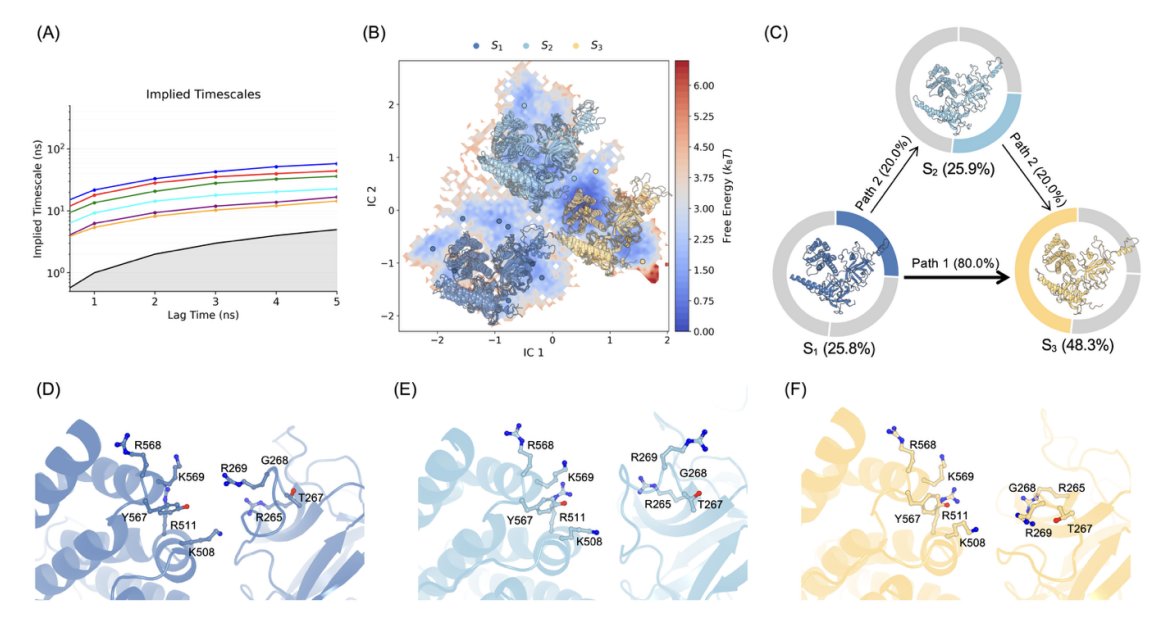
7. Adaptive MD (2 μs aggregate per system) plus Markov state models reveal that WT pocket dynamics form a connected three-state kinetic network with efficient exchange. R269W preserves three metastable states but reroutes transitions: exchange from a minor to dominant basin becomes predominantly intermediate-mediated, reducing direct kinetic connectivity between key pocket basins.
8. In contrast, the GOF suppressor-domain mutation R36C keeps a broadly WT-like pocket ensemble and more WT-like pocket kinetics, arguing that GOF does not require local pocket “activation” or collapse. Instead, its effect is distal and allosteric.
9. Contact-informed dynamical network analysis links R36C GOF to weakened suppressor-domain restraint: SD-to-pocket communication is redistributed onto longer, less efficient pathways (increased weighted shortest-path cost), with rewiring of residues/edges near pocket-adjacent loops and altered community organization—consistent with allosteric decoupling rather than pocket failure.
📜Paper:
biorxiv.org/content/10.64898…
#ComputationalBiology #MolecularDynamics #Allostery #ProteinEnsembles #MarkovStateModels #CalciumSignaling #Neurogenetics #IP3R #ITPR1 #VariantInterpretation