
not here for followers but I do follow back. Christ is my Savior, King of Kings and Lord of Lords✝️. Waiting to board the rocket!!!🐺💰🐺💰 #xrp #4chantoken
Joined October 2021
- Tweets 26,644
- Following 504
- Followers 599
- Likes 31,695
2,237 Photos and videos












RandoToTheMoon retweeted

Need prayers from this God-filled community tonight.
My wife is back at the hospital after giving birth to our Son last week. Her blood pressure is off the charts, they are monitoring her overnight and have prescribed medication to get it under control. Include her in your prayers please. 🙏
We know that we serve the Doctor above all Doctors & faith filled prayers WILL move mountains✝️
386
216
1,757
14,987
RandoToTheMoon retweeted

Our Father, who art in heaven,
hallowed be thy Name,
thy kingdom come,
thy will be done,
on earth as it is in heaven.
Give us this day our daily bread.
And forgive us our trespasses,
as we forgive those
who trespass against us.
And lead us not into temptation,
but deliver us from evil.
-------------------
For thine is the kingdom,
and the power, and the glory,
for ever and ever.
Amen.
182
717
3,512
26,915
RandoToTheMoon retweeted

Gets 1:1’d in the comments then limits comments. Typical.
Jun 13

I am not entitled to his money.
Accumulating more wealth than you can ever spend in a single lifetime (which he has done millions of times over) is bad for society. Money that could be moving through the economy and local communities to help improve lives is now removed.
1
1
20
RandoToTheMoon retweeted

Let’s get Jesus trending!
Can we get 3K people to unashamedly say Jesus is Lord!
322
369
1,907
21,553
RandoToTheMoon retweeted

House and riches are the inheritance of fathers. And a prudent wife is from the Lord. Proverbs 19:14🙏✝️📖🕊️😇 happy seventh month of anniversary my dearest soulmate hubby God always keep you happy with me 🙏🙏

2
1
21
112
RandoToTheMoon retweeted

Jun 13
🔻 THE SURVEILLANCE STATE DIED LAST NIGHT. AND NO ONE ON TELEVISION TOLD YOU WHY.
At 11:59 PM on June 12, 2026, FISA Section 702 expired. The most powerful domestic spying tool in American history — the same tool they used to wiretap a sitting president in 2016 — is DEAD.
198 to 218. That was the vote. Nineteen Republicans crossed the line. Not because they love privacy. Because they were told what comes next.
On the same day — the SAME DAY — Trump signed National Security Presidential Memorandum 12. It transfers control of ALL national security systems to a restructured military-intelligence command under NSA oversight. Every government server. Every classified network. Every intelligence node.
Read that again. The civilian surveillance apparatus is gone. The military now holds the keys.
This was not a failure of Congress. This was an execution.
A former signals intelligence officer — Ft. Meade, 2018-2025:
"FISA 702 was never about foreign threats. It was a domestic weapon disguised as national security. The FBI conducted over 278,000 warrantless queries on American citizens between 2020 and 2023 alone. Political figures. Journalists. Pastors. January 6 families. Anyone who questioned the system was in the database. The authority to conduct those queries died at midnight. And NSPM-12 ensures that what replaces it answers to military command — not the agencies that abused it."
THE HUNTERS BECAME THE HUNTED.
They spied on Trump in 2016. They queried patriots after January 6. They monitored churches. They tracked parents at school board meetings. They built a surveillance machine that would make the Stasi look primitive.
And last night, one man let it die. He could have pushed for renewal. He chose not to. He waited until the exact moment the military architecture was ready — then he pulled the plug on the old system and activated the new one.
June 12, 2026. The day the deep state lost its eyes.
They cannot query you anymore. They cannot listen without military authorization. They cannot use national security as a shield for political persecution. That era ended at midnight.
What comes next is not surveillance. It is accountability.
CODE: FISA-DEAD-0612 / NSPM12-ACTIVATED / NSA-COMMAND / 278K-QUERIES / MILITARY-KEYS / HUNTERS-HUNTED
⟁
The machine they built to destroy him — he just turned it off. And turned the lights on them.
316
3,017
8,184
180,631

RandoToTheMoon retweeted

Jun 12
Remember that time Elon offered $6B for ending world hunger so long as the money was transparently accounted for and got rebuffed?
5
144
3,552
21,280
RandoToTheMoon retweeted

Jun 12
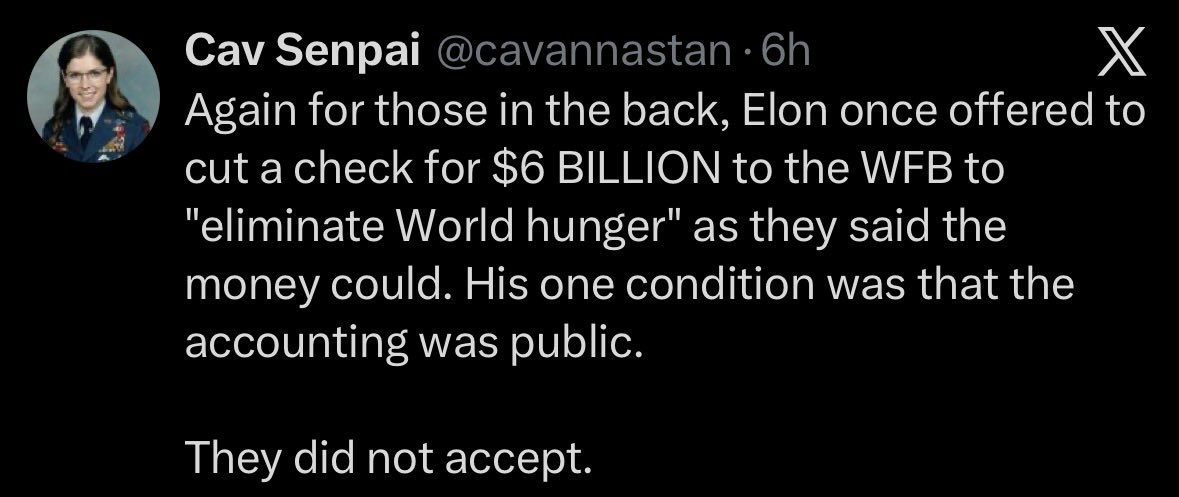
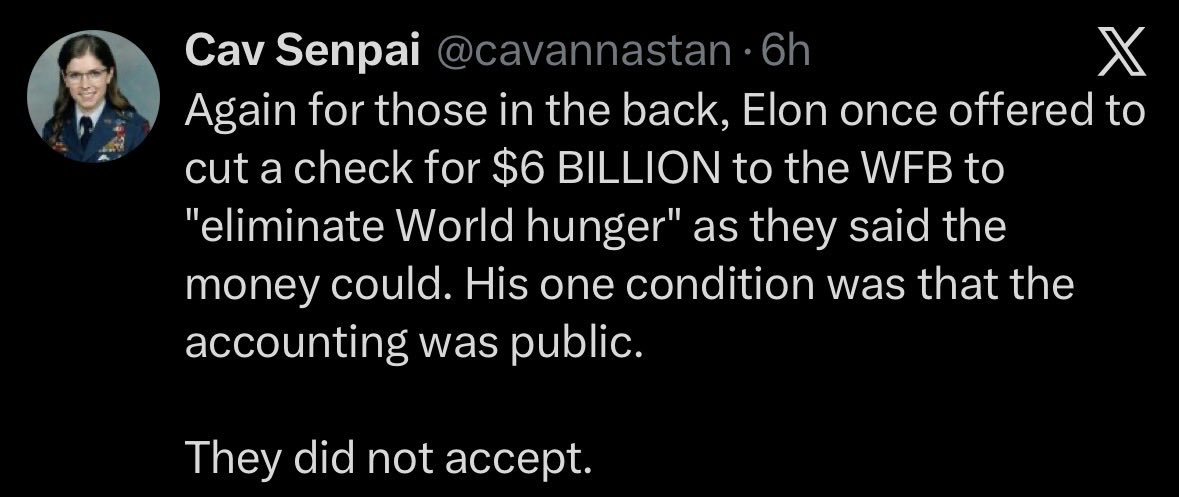
Again for those in the back, Elon once offered to cut a check for $6 BILLION to the WFB to "eliminate World hunger" as they said the money could. His one condition was that the accounting was public.
They did not accept.
Jun 12

Elon Musk dismantled USAID programs that provided lifesaving assistance to millions of the world’s poorest and most vulnerable people. The human cost was enormous, while DOGE’s net fiscal impact was inconsequential.
Now, as Musk approaches trillionaire status, he should commit/tithe at least $100 billion to a fund dedicated to combating extreme poverty, hunger, preventable disease, and humanitarian crises worldwide.
Money alone cannot undo the damage already done. But if this moment marks an unprecedented personal financial milestone, it should also be an opportunity for an unprecedented act of restitution. Musk has the resources to save and improve countless lives. He should use them.
523
15,786
78,935
1,565,129
RandoToTheMoon retweeted

Jun 13
Don’t worry about Elon becoming rich with his own money.
Worry about politicians becoming rich with your money.
1,861
32,724
140,232
1,127,295
RandoToTheMoon retweeted

Jun 12
This is CRAZY.
In all my 28 years of being a professional trader I have NEVER seen a more perfect launch than $SPCX.
Most people think this thing will pull back but DO NOT listen to them.
They are complete MORONS and they don't understand the value in having a monopoly of space.
There's no way anyone can price SpaceX properly.
Elon might be the first trillionaire SpaceX created but he will not be the last.
DO NOT FADE THIS COMPANY.
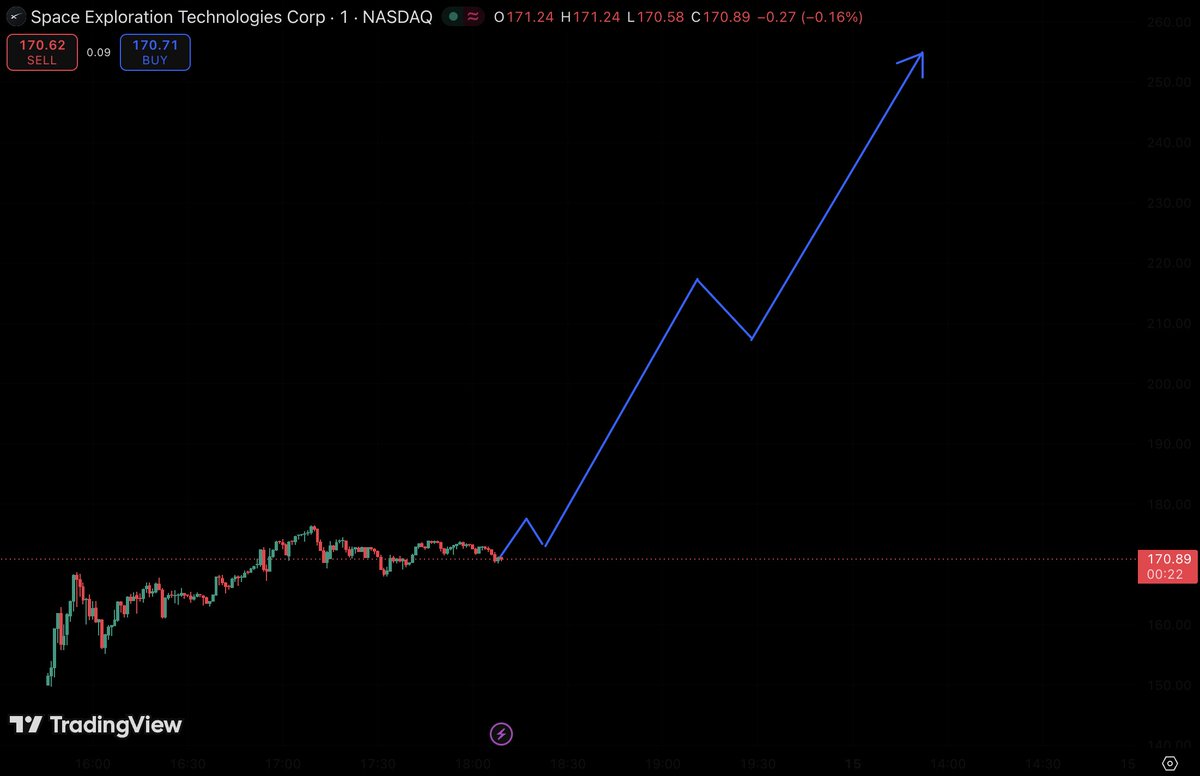
437
92
1,360
179,479
RandoToTheMoon retweeted

Jun 12
Do You All See How All Of This Is Being Done Before July 4th?
America 250 Celebration ✅️
Paramount & Warner Deal ✅️
The Iran Deal ✅️
The SpaceX IPO ✅️
The Clarity Act❓️
The Save America Act❓️
Translation:
New American Order
New Media Presentation
New Geopolitical Alliance
New Space Frontier
New Banking System
New National Citizen Initiative
-You have people out there trying to convince you that nothing is happening.
-You have people out there trying to mislead you that nothing is going to change.
-You have people out there attempting to undermine all of these advances in an American revolution to change this nation forever.
~Stop Being Lead By Your Nose And Look Beyond What You Can Smell
139
1,149
4,423
84,842
RandoToTheMoon retweeted

Jun 12
It is so weird to see a bunch of millionaire members of Congress whine because someone is a trillionaire.
These people are millionaires. If they want to “spread the wealth”, they can start by giving away their mansions and giving their own millions to the poor they claim to care about.
42
125
966
6,167
RandoToTheMoon retweeted

Jun 13
““For God so loved the world, that he gave his only Son, that whoever believes in him should not perish but have eternal life. For God did not send his Son into the world to condemn the world, but in order that the world might be saved through him. Whoever believes in him is not condemned, but whoever does not believe is condemned already, because he has not believed in the name of the only Son of God.”
John 3:16-18 ESV
2
10
157
1,509
RandoToTheMoon retweeted

Jun 12
What did everyone get for @SpaceX IPO share allocations?
3,210
61
2,446
1,089,799
🚀 🚀🚀🚀🚀🚀🚀🚀🚀🚀🚀🚀🚀
Jun 12

Today, @SpaceX (Nasdaq: SPCX) makes its public market debut with a $75Bn offering (pre-greenshoe) at $135 per share, marking the largest IPO in history.
Congratulations to the SpaceX team. We are honored to serve as joint lead bookrunner and sole stabilization agent.
8,649
16,906
136,856
13,620,962
RandoToTheMoon retweeted

Jun 12
Utility Based Pricing "XRP The KING"
If XRP hits the 150-300 dollar range one day, this will not happen due to the general upward trend "correlation, speculation, buying or selling pressure" in the crypto market.
XRP will easily surpass ETH, because:
It will be Utility Based Pricing. At this point, what determines XRP's price will not be the buyers on crypto exchanges, but the velocity and volume of the daily trillion dollar money flowing behind it (Velocity of Money).
When global financial infrastructure starts using XRPL pipes, XRP will completely decouple upwards, becoming entirely independent from the whole crypto market (including Bitcoin and Ethereum).
When XRP hits 3 digit numbers, Ethereum will already be grappling with the competition in its own smart contract market (under pressure from Solana, Sui, etc.).
When transitioning to Utility-Based Pricing, every asset that takes its place within the multi-chain will become highly valuable. But alongside this, many coins will cease to exist.
Not a financial advice
Jun 3

How XRP will reach $300 (324.22) *Part 5*
Mathematical and formulaic explanation
The reason I always set a $300 target is because my mathematical calculations explicitly point to $324.22. This price is the inevitable outcome of the liquidity velocity and institutional pool depth calculations behind the asset.
This number is not a randomly chosen, imaginary target, it is the exact mathematical intersection on the XRP Ledger between the Equation of Exchange (MV = PT) by the famous economist Irving Fisher, and the "Collateral Buffer" rules mandated by Basel III standards.
When conducting this calculation, we do not base our data on retail exchanges. Instead, we use the most concrete and solid global volume data that the institutional financial system is required to carry:
Liquid Available Supply (A): The free-floating supply ready to circulate within seconds at the exact moment of the "flip the switch" (after deducting locked structures) is roughly between 15 billion and 20 billion XRP. (The safest lower limit of 15 billion XRP has been used for this calculation).
Daily Targeted Institutional Volume (T): The daily total share flowing into the XRP tunnel from DTCC clearing operations, CME derivative collateral, and first-stage cross-border Nostro/Vostro liquidity flows: $1.2 Trillion / Day.
Regulatory Safety Buffer Multiplier (B): The mandatory depth multiplier required in the pool under Basel III and LCR (Liquidity Coverage Ratio) laws to prevent the system from locking up during instant, large-scale transfers is 4.
In the architecture of financial automation, the price (P) is found by the ratio of instantaneous transaction volume (PT) to the available liquid supply (M) in the system. However, since the system must flow uninterrupted, we must multiply the daily volume by the regulatory buffer coefficient.
FORMULA:
Price (P) = (Daily Volume * Regulatory Buffer Multiplier) / Liquid (Available) Supply
PLUGGING IN THE DATA:
Required Instantaneous Liquidity Pool Size: $1.2 Trillion * 4 (Buffer) = $4.8 Trillion
Available Liquid Supply (Mechanical Constraint): 15 Billion XRP
Price (P) = 4,800,000,000,000 / 15,000,000,000
Base Price (P) = $320
Every time a transfer occurs on the XRP Ledger, a very small amount of XRP is permanently destroyed (burned) as a transaction fee within a tenth of a second.
When we consider that global finance will enter this pipeline via tens of thousands of automated API orders per second,rotating millions of dollars in transfer volume every single moment, the factors of "supply contraction" and "slippage margin" on the network must be factored into the equation.
To maintain maximum depth efficiency and eliminate friction while institutional automated software (APIs) sweeps the order books, a network friction and depth margin of roughly 1.32% is added to the price:
$320 * 1.0132 = $324.22
XRP Velocity doesn't replace liquidity depth. You need to consider the "simultaneous" volume of global transactions
My posts are for informational purposes only.
Not a financial advice.
Everyone is responsible for themselves.
DYOR
18
85
568
39,416
RandoToTheMoon retweeted

Amen! Rich or poor God will always be where your peace comes from

2
8
132
979
RandoToTheMoon retweeted
Give us this day our daily bread 🙏✝️

3
2
54
470