
Made complete and defined in our Lord Jesus Christ ✝️ Watching and longing for our Blessed Hope ✝️ Simpleton ✝️ Happily married ❤️ God Bless Israel 🇮🇱
Joined January 2009
- Tweets 43,969
- Following 8,116
- Followers 10,559
- Likes 176,456
3,044 Photos and videos





Pinned Tweet

Apr 23
The Galilean Wedding of our Lord and Savior Jesus Christ is at the door.
3
5
36
565
Bonnie †🇮🇱 retweeted

Jun 12
The Lord is my Shepherd.
Psalm 23:1
All the way home.
1
15
119
897

Jun 12
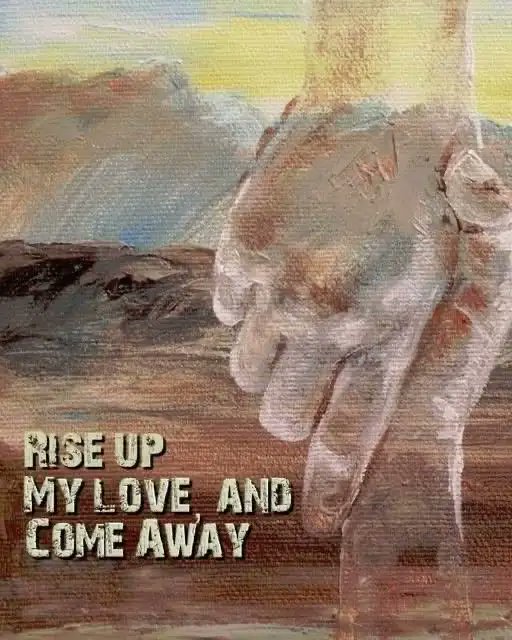
In order to not let your past define you – you must first be repentant over it.
I don’t make the rules.
1
1
6
81

Bonnie †🇮🇱 retweeted

Jun 10
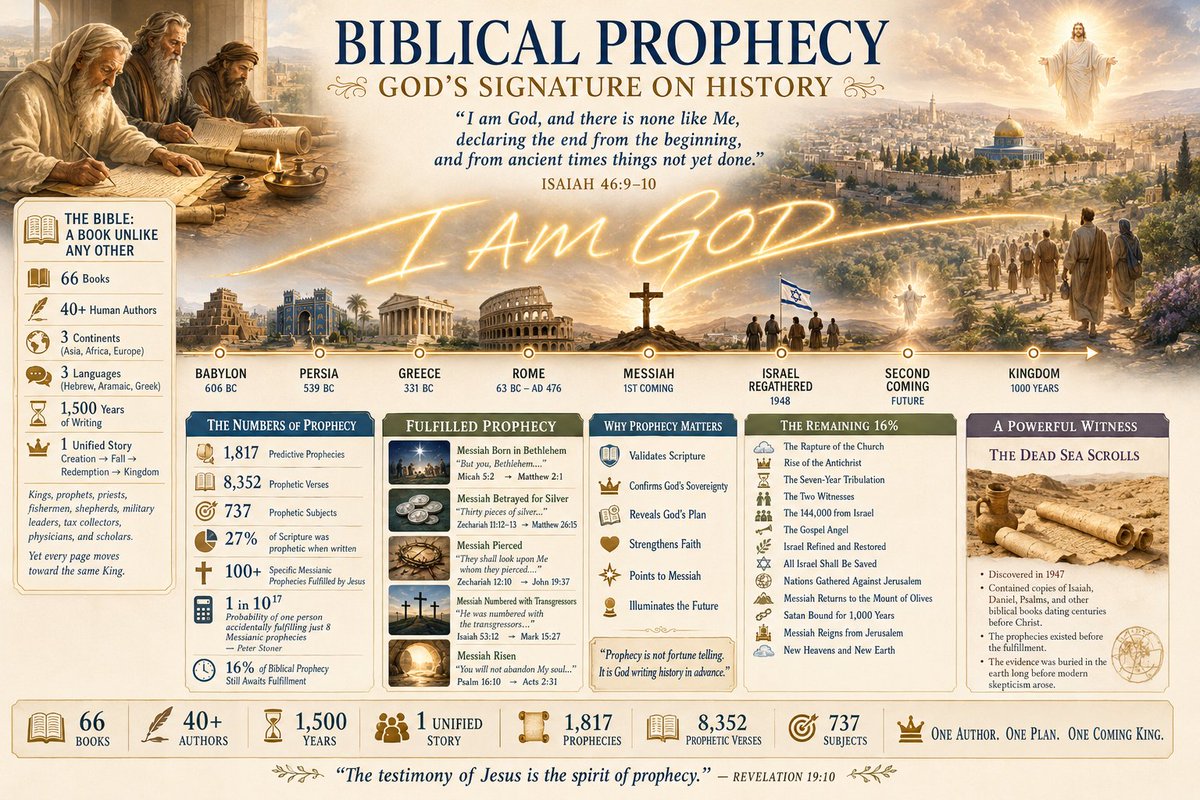
❖ Is Fulfilled Prophecy God's Signature on the Bible? 🔍
"For the testimony of Jesus is the spirit of prophecy." — Revelation 19:10
Every religion has teachings.
Many offer moral guidance.
Some contain profound philosophical insights.
But only the Bible repeatedly places its credibility on a test that no false god, idol, philosopher, king, or religious system can pass:
Predict the future accurately.
Not once.
Not vaguely.
Not after the fact.
But repeatedly, specifically, and centuries in advance.
God Himself issued this challenge:
"Declare to us the things to come... tell us what the future holds, so we may know that you are gods." — Isaiah 41:22-23
The God of Scripture does not fear investigation. In fact, He invites it.
❖ The Bible Is Unlike Any Other Book 📖
The Bible was written by approximately forty authors over roughly fifteen centuries.
Kings, shepherds, fishermen, prophets, priests, physicians, and scholars all contributed to its pages.
It was written on three continents, in multiple languages, across vastly different cultures.
Yet from Genesis to Revelation it tells one unified story.
Even more remarkable, nearly one-third of Scripture contains prophetic material.
The Bible does not merely explain the past.
It records future events before they occur.
"I am God, and there is none like Me, declaring the end from the beginning." — Isaiah 46:9-10
That is either an astonishing claim—or an astonishing fact.
❖ Daniel Saw Empires Before They Existed
One of the most remarkable examples appears in Daniel.
While Babylon ruled the world, Daniel revealed the future succession of Gentile empires.
Babylon.
Medo-Persia.
Greece.
Rome.
Daniel 2 and Daniel 7 describe this sequence centuries before history unfolded exactly that way.
Alexander the Great had not yet conquered the world.
Rome was not yet an empire.
Yet the prophetic script was already written.
History followed the outline God had revealed.
🕰️ The kingdoms changed.
The prophecy did not.
❖ The Messiah's First Coming Was Foretold
The Hebrew Scriptures contain dozens of specific prophecies concerning Messiah.
Born in Bethlehem (Micah 5:2).
Descended from David (Jeremiah 23:5).
Entering Jerusalem on a donkey (Zechariah 9:9).
Betrayed for thirty pieces of silver (Zechariah 11:12-13).
Pierced and rejected (Psalm 22; Isaiah 53).
Buried with the rich (Isaiah 53:9).
These were not written after the events.
They were recorded centuries beforehand.
Mathematician Peter Stoner famously calculated that the odds of one person accidentally fulfilling just eight Messianic prophecies are approximately 1 in 10¹⁷.
That is a number so large it stretches the imagination.
Yet Messiah fulfilled far more than eight.
❖ Israel: The Greatest Modern Prophetic Sign 🌿
Perhaps the most visible fulfilled prophecy in our generation is the existence of Israel itself.
Moses warned that Israel would be scattered among the nations (Deuteronomy 28:64).
The prophets declared that God would someday regather them from the ends of the earth (Isaiah 11:11-12; Ezekiel 36:24).
For nearly two thousand years the Jewish people lived dispersed across the globe.
Empires rose.
Empires fell.
Languages disappeared.
Nations vanished forever.
Yet the Jewish people remained.
Then, in 1948, the world witnessed something unprecedented.
A nation was reborn.
"Can a nation be born in a day?" — Isaiah 66:8
The Hebrew language was revived.
Exiles returned.
The deserts bloomed.
The Jewish state reappeared on the map.
No other people group in history has experienced anything remotely comparable.
Israel's survival is not merely a historical curiosity.
It is a prophetic monument standing before the world.
❖ The Skeptic's Dilemma
Critics often dismiss biblical prophecy as coincidence, symbolism, or clever editing after the fact.
Yet ancient manuscripts such as those found among the Dead Sea Scrolls demonstrate that many prophetic texts existed long before their fulfillment.
The evidence has only strengthened with time.
The skeptic must explain:
How did Daniel foresee future empires?
How did Micah identify Bethlehem?
How did Isaiah describe the suffering Messiah centuries beforehand?
How did Israel survive dispersion and return to nationhood?
The simplest explanation remains the biblical one:
God knows the future because God rules the future.
❖ The Story Is Not Finished
Many prophecy scholars estimate that roughly 16% of biblical prophecy remains future.
The rise of the Antichrist.
The future Tribulation.
The salvation of Israel's remnant (Zechariah 12:10; Romans 11:26).
The return of Messiah to the Mount of Olives (Zechariah 14:4).
The judgment of the nations.
The Millennial Kingdom.
The New Heavens and New Earth.
The same God who fulfilled the first hundreds of prophecies will fulfill the remaining ones with the same precision.
❖ Why This Matters
Prophecy is not given merely to satisfy curiosity about the future.
It is given to reveal the character of God.
To strengthen our confidence in His Word.
To remind us that history is not random.
The headlines may surprise us.
The future does not surprise Him.
The God who foretold Babylon, Persia, Greece, Rome, Bethlehem, Calvary, the scattering of Israel, and the rebirth of a nation has already declared how the story ends.
Every fulfilled prophecy points to the same conclusion:
The Bible is not merely a book about God.
It is God's revelation to mankind.
And fulfilled prophecy may be His signature written across its pages.
"Surely the Lord GOD does nothing unless He reveals His secret to His servants the prophets." — Amos 3:7
21
70
157
6,421
Jun 11
“And the light shineth in darkness; and the darkness comprehended it not.”
John 1:5
Jun 11

A cat discovered sunlight and didn't understand why it suddenly felt hotter
3
74
Jun 11
Again, ye have heard that it hath been said by them of old time, Thou shalt not forswear thyself, but shalt perform unto the Lord thine oaths: but I say unto you, Swear not at all; neither by heaven; for it is God's throne: nor by the earth; for it is his footstool: neither by Jerusalem; for it is the city of the great King. Neither shalt thou swear by thy head, because thou canst not make one hair white or black. But let your communication be, Yea, yea; Nay, nay: for whatsoever is more than these cometh of evil.
Matthew 5:33-37 KJV
Yes, or no. Pretty simple, no additives. Man, we tend to really complicate things, don’t we.
1
4
83
Bonnie †🇮🇱 retweeted

Jun 10
No lies detected. Future shepherds here.
83
681
3,033
64,333
Jun 11
Let’s see what word(s) I get to mute today. The list is beginning to bulge.
34
Bonnie †🇮🇱 retweeted

Jun 11
Gotta love Jerry Seinfeld for this one.
Random dude: “Can I get a Free Palestine”
Seinfeld: “Haha! It doesn’t exist”
370
719
8,352
903,798
Jun 10
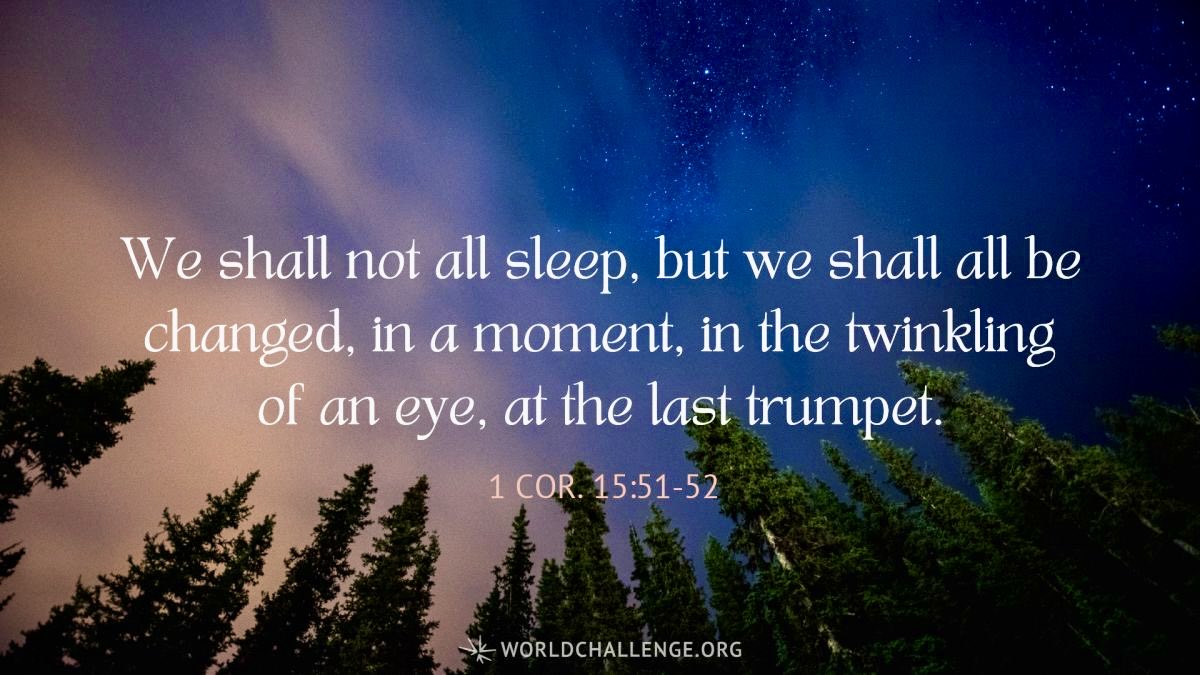
Now this I say, brethren, that flesh and blood cannot inherit the kingdom of God; nor does corruption inherit incorruption. Behold, I tell you a mystery: We shall not all sleep, but we shall all be changed— in a moment, in the twinkling of an eye, at the last trumpet. For the trumpet will sound, and the dead will be raised incorruptible, and we shall be changed. For this corruptible must put on incorruption, and this mortal must put on immortality. So when this corruptible has put on incorruption, and this mortal has put on immortality, then shall be brought to pass the saying that is written: “Death is swallowed up in victory.” “O Death, where is your sting? O Hades, where is your victory?” The sting of death is sin, and the strength of sin is the law. But thanks be to God, who gives us the victory through our Lord Jesus Christ.
I Corinthians 15:50-57
🪔❤️🔥
4
4
32
459
Bonnie †🇮🇱 retweeted

Think about it; we currently live in a time where many people around the world consider the Jewish people to be evil and Muslim terrorists get a free pass.
We are here :
👇🏻
“Woe unto them that call evil good, and good evil; that put darkness for light, and light for darkness; that put bitter for sweet, and sweet for bitter!”
Isaiah 5:20 KJV
29
33
149
2,717
Bonnie †🇮🇱 retweeted

Jun 9
And your eyes shall see, and ye shall say, the LORD will be magnified from the border of Israel.
—Malachi 1:5 KJV
4
15
80
1,100
Jun 10
I waited patiently for the Lord; And He inclined to me, And heard my cry. He also brought me up out of a horrible pit, Out of the miry clay, And set my feet upon a rock, And established my steps. He has put a new song in my mouth— Praise to our God; Many will see it and fear, And will trust in the Lord.
Psalms 40:1-3
~David
I, too, was stuck clear up to my nostrils in that thick muddy pit.
1
6
24
230
Bonnie †🇮🇱 retweeted

Jun 9
I think about the lost all the time. I ache to see everyone in the world come to a saving knowledge of Jesus Christ. I pray, silently and often, for eyes to open and ears to hear. I wouldn't wish hell on even the most depraved of criminals. And I mean that.
Then it occurs to me how deep our Father loves us, knowing that I have tasted only a fraction of His concern for our eternal souls.
His arms are open to anyone who will come...yet, sadly, most will not. This is a painful reality.
22
21
150
1,802
Jun 9
Matthew 5:10-12
“Blessed are they which are persecuted for righteousness' sake: for their's is the kingdom of heaven. Blessed are ye, when men shall revile you, and persecute you, and shall say all manner of evil against you falsely, for my sake. Rejoice, and be exceeding glad: for great is your reward in heaven: for so persecuted they the prophets which were before you.”
4
8
30
508
Bonnie †🇮🇱 retweeted

Because Your lovingkindness is better than life, My lips shall praise You. Thus I will bless You while I live; I will lift up my hands in Your name.
- Psalm 63:3-4 (NKJV)
4
26
100
724