
Joined July 2019
- Tweets 1,150
- Following 226
- Followers 262
- Likes 799
56 Photos and videos




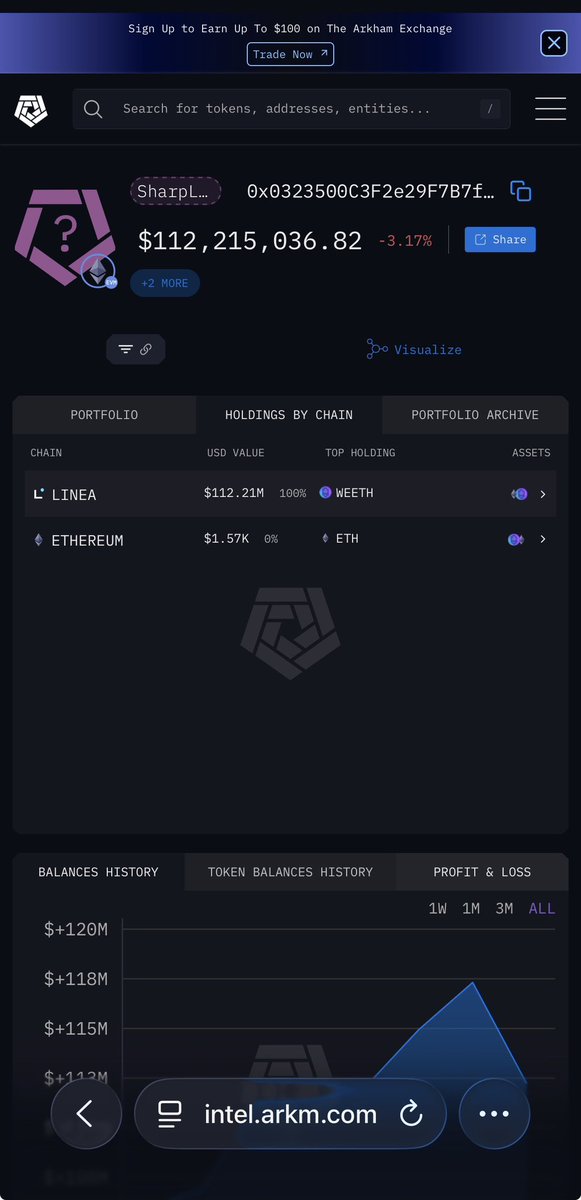
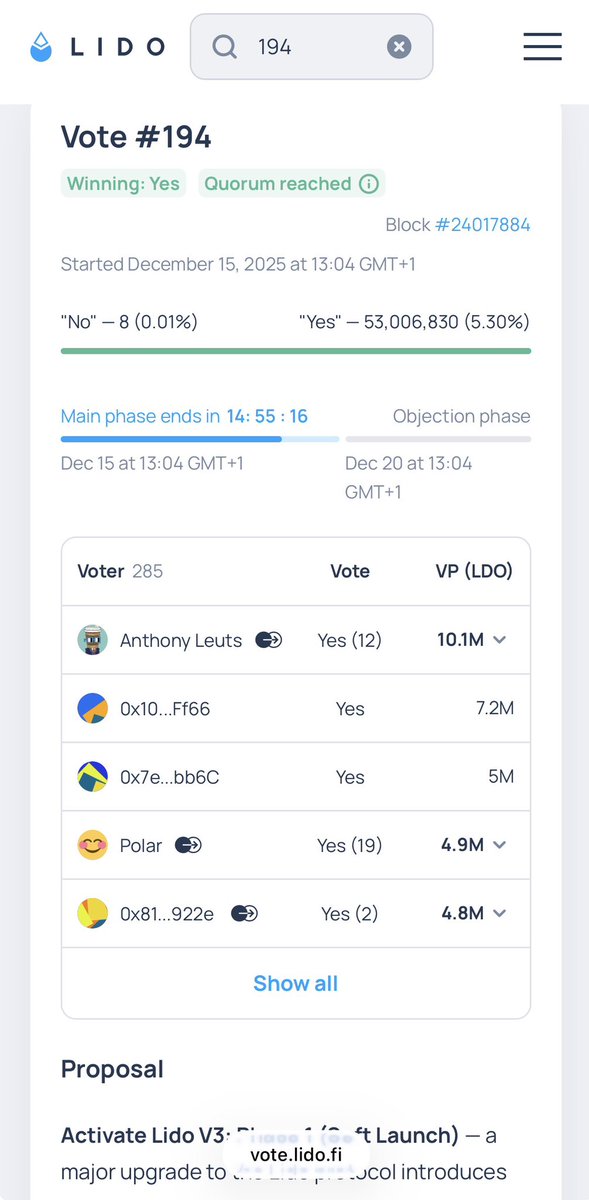

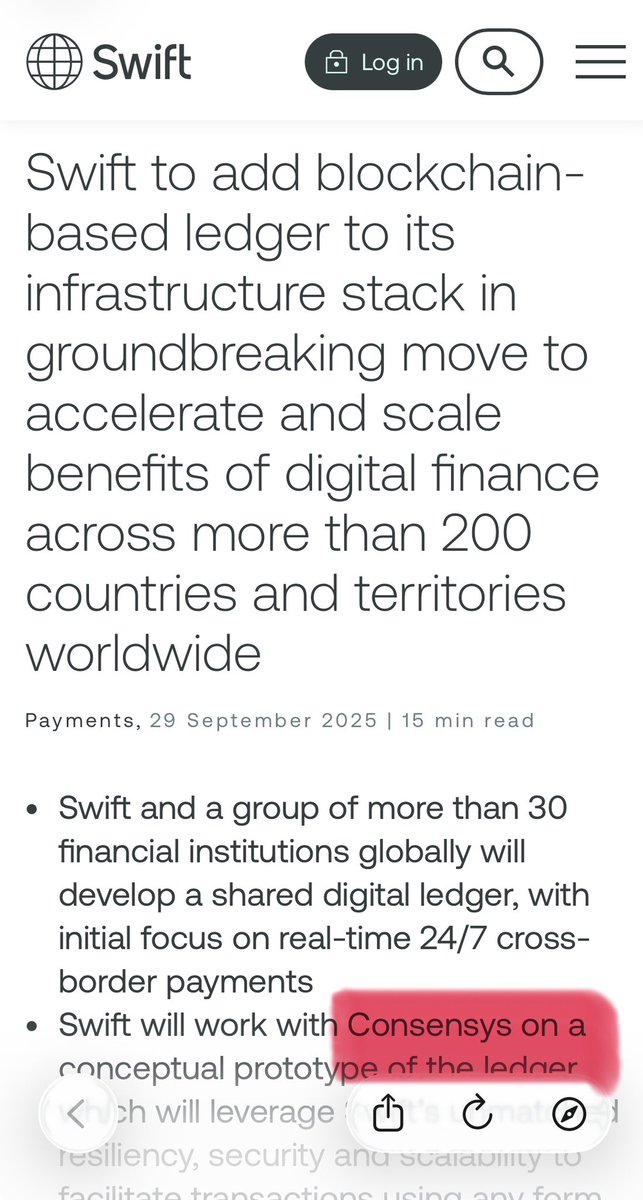

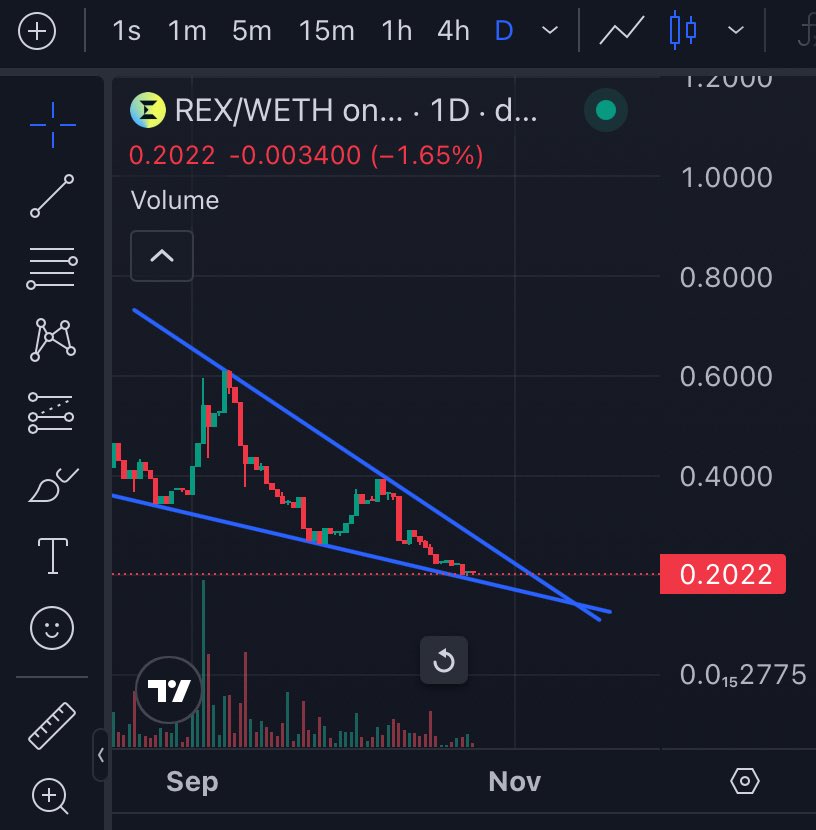





@LeChiffre @LineaBuild @ethereumJoseph @DeclanFox14 🧵 Linea is quietly solving the Institutional Blockchain Trilemma and a major bullish setup is forming for October 2026.
Here’s why I’m paying close attention:
4
1
4
77
6- When the catalysts hit (SIBOS announcements Swift progress IPO momentum cycle bottom), the combination of extremely low current volume strong institutional narrative could create a violent rebound.
1
24
7- This is not a short-term degen play.
It’s a high-conviction setup for late 2026 into 2027 if Linea executes on institutional rails (RWA, tokenized deposits, private atomic settlement, unified liquidity).
Positioning is still early. Volume is still tiny.
38

Jun 9
Nice work mate 👏🏻👏🏻👏🏻
Jun 9

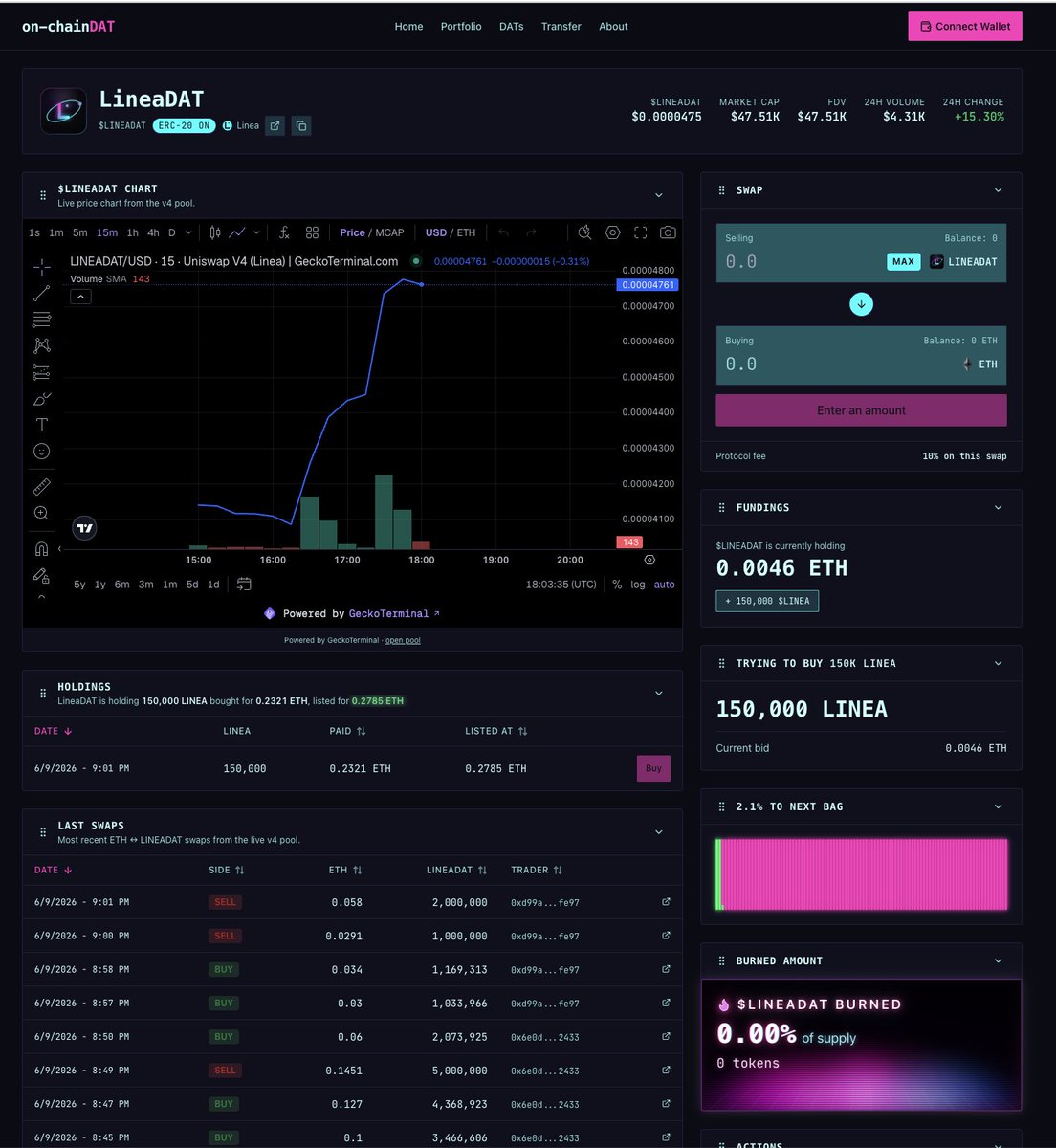
$LINEADAT has already accumulated enough funds for its first BAG.
The treasury is being funded.
The treasury is accumulating assets.
The mechanism is working exactly as designed.
This is no longer theory. The economy is already operating in real market conditions.
Join us. 🚀
$LINEA @LineaBuild
1
3
123
Gandelf retweeted

Literally @ethereumJoseph announcing now the 🦊 agent wallet today at @ethconf with @kartiktalwar in front of everyone!
TLDR
- Self-custodial wallet for AI agents — your keys, your rules.
- Autonomous trading across EVM chains @HyperliquidX : swaps, perps, prediction markets, LP.
- Every transaction simulated, threat-scanned by @blockaid_ , and MEV-protected.
- Two modes: Guard for tight control, Beast for more freedom.
- Up to $10k Transaction Protection on safe txs.
- Framework-agnostic works with @openclaw , Codex and more.

I've been at @MetaMask for over four years now. I've helped ship a lot. but today is the one closest to me.
Finally the 🦊 Agent Wallet is live.
Here's why it matters for years: putting an agent on a self-custody wallet meant choosing between giving it the freedom to actually act or keeping the funds safe. you couldn't have both. most "agent wallets" picked freedom and crossed their fingers.
we killed that trade-off. Agent Wallet is the first self-custodial agent wallet that reaches all of defi
> swaps,
> perps,
> prediction markets
> LP
across every EVM chain and Hyperliquid. and every single transaction runs through mandatory security: simulation, threat scanning, MEV protection. agents can't opt out of it.
Basically, you stay in control. set your limits, and anything outside them needs your sign-off. autonomy and safety stop being a trade-off.
The next wave on-chain won't be humans alone and machines are going to transact, coordinate, and move real capital on these rails. The infra underneath has to be worthy of that. this is us building it.
And now on my way to @ethconf to hear @ethereumJoseph talk!
20
21
192
19,698
Gandelf retweeted

Jun 3
I've wanted for a long time to build something useful for @LineaBuild. Not just another token, but a mechanism that increases on-chain activity, creates demand for core ecosystem assets, and remains attractive for speculation.
That's why we're launching:
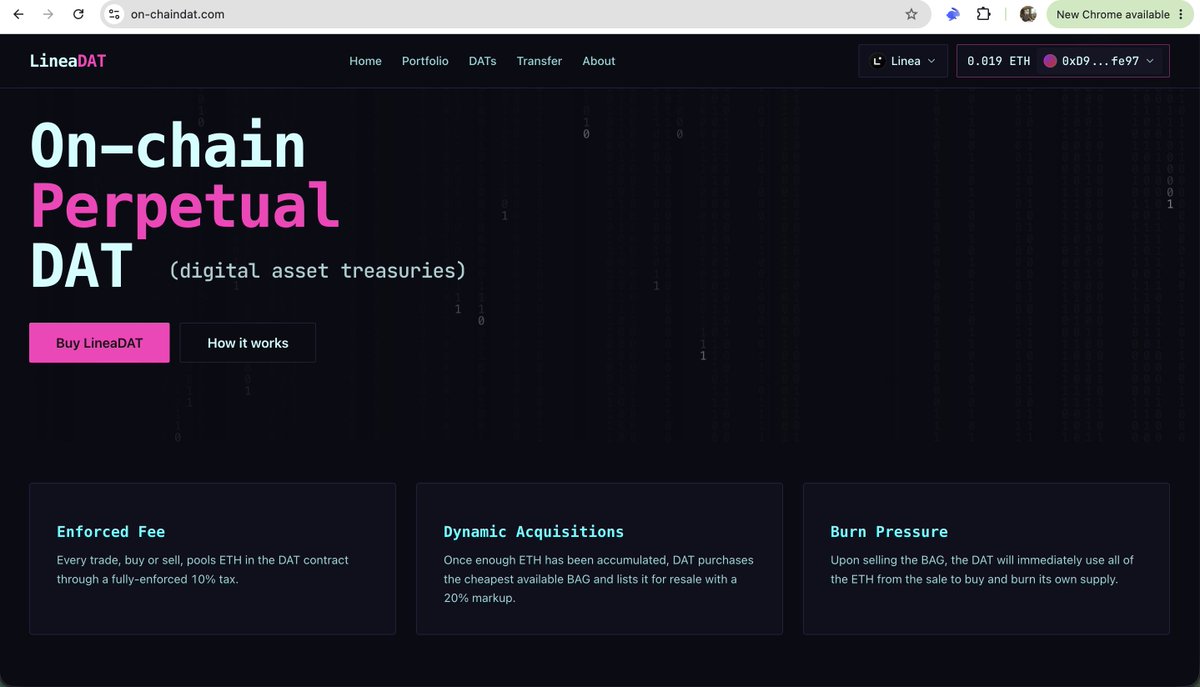
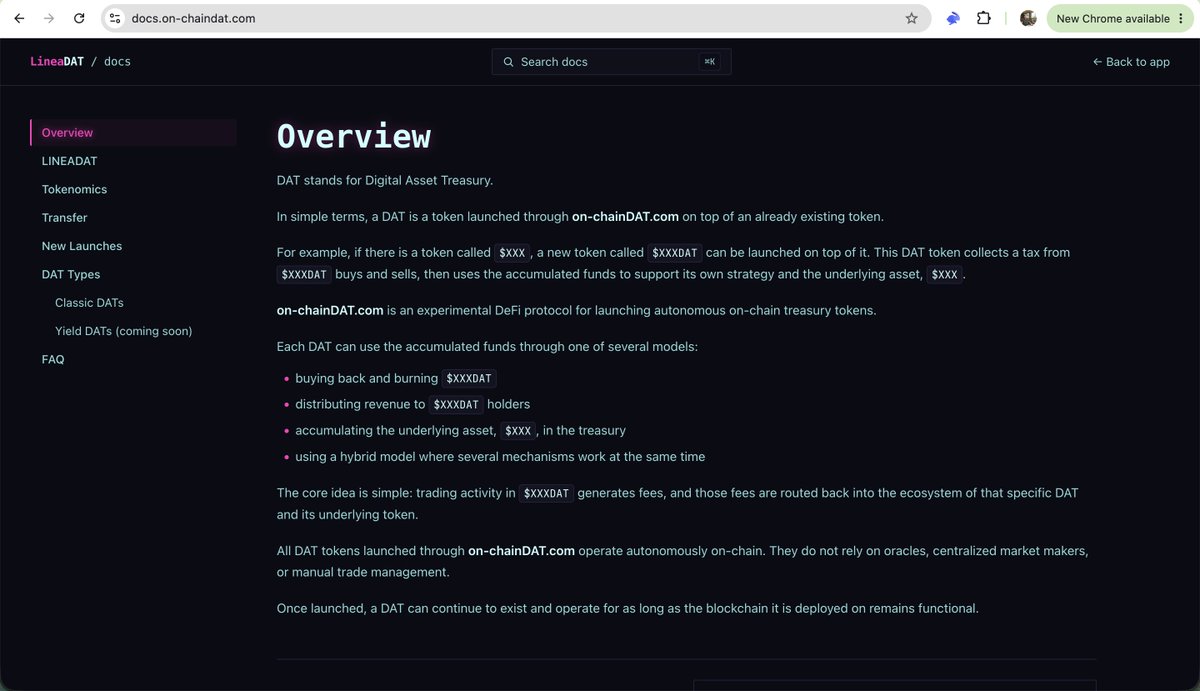
• on-chainDAT - a platform for launching Digital Asset Treasuries (DATs)
• $LINEADAT - the first and core DAT of the ecosystem, built around $LINEA
How does $LINEADAT work?
• Every buy and sell transaction is subject to a 10% fee.
• These fees are used to accumulate $LINEA in batches of 150,000 tokens.
• Once the value of a batch increases by 20%, it is sold through a P2P mechanism.
• The proceeds are used to buy back and burn $LINEADAT.
• Every new DAT launched through the platform will allocate 1% of its trading volume to buying back and burning $LINEADAT.
The next DAT will likely be built around $REX or $REX33.
$LINEADAT belongs to the Classic DAT category. This model has been operating within TokenStrategy @token_works for more than six months and has proven its stability in real market conditions. That's why it was chosen as the foundation of our ecosystem.
Why now?
• The market is deeply depressed, and $LINEA is trading near its historical lows.
• This is the best time to accumulate the underlying asset.
• Put simply, $LINEADAT is a leveraged bet on $LINEA, enhanced by a deflationary mechanism and without liquidation risk.
Why Linea?
• Linea is backed by @Consensys, the creators of MetaMask, Infura, and one of the most influential companies in the Ethereum ecosystem.
• We believe Linea is not in survival mode. It is in the process of finding breakthrough products and new use cases for the network.
• At the same time, on-chainDAT is being built as a multichain platform from day one. After Linea, we are considering expansion to Base(@base) and assets such as $AERO, $VIRTUAL, $VVV, and a potential future $BASE token.
Why trust us?
• The entire supply of 1 billion $LINEADAT has been added to a Uniswap V4 liquidity pool and locked forever.
• The protocol's economics operate entirely on-chain.
• Anyone can participate through the UI or by running their own arbitrage bot.
• The protocol will continue functioning even if the on-chainDAT website or the @Uniswap frontend disappears.
Launch considerations
The Linea ecosystem is still in its early stages. As a result, DEX Screener and CoinGecko do not yet index trading activity from Uniswap V4 pools.
For launch, we are using our own price tracking system. Minor bugs are possible and will be addressed as they appear. We expect Uniswap V4 support to be added by major tracking platforms in the near future.
P.S. This is only a brief overview of the project. Full documentation and a detailed explanation of the mechanics are available on our website and in the Docs section.
Jun 3
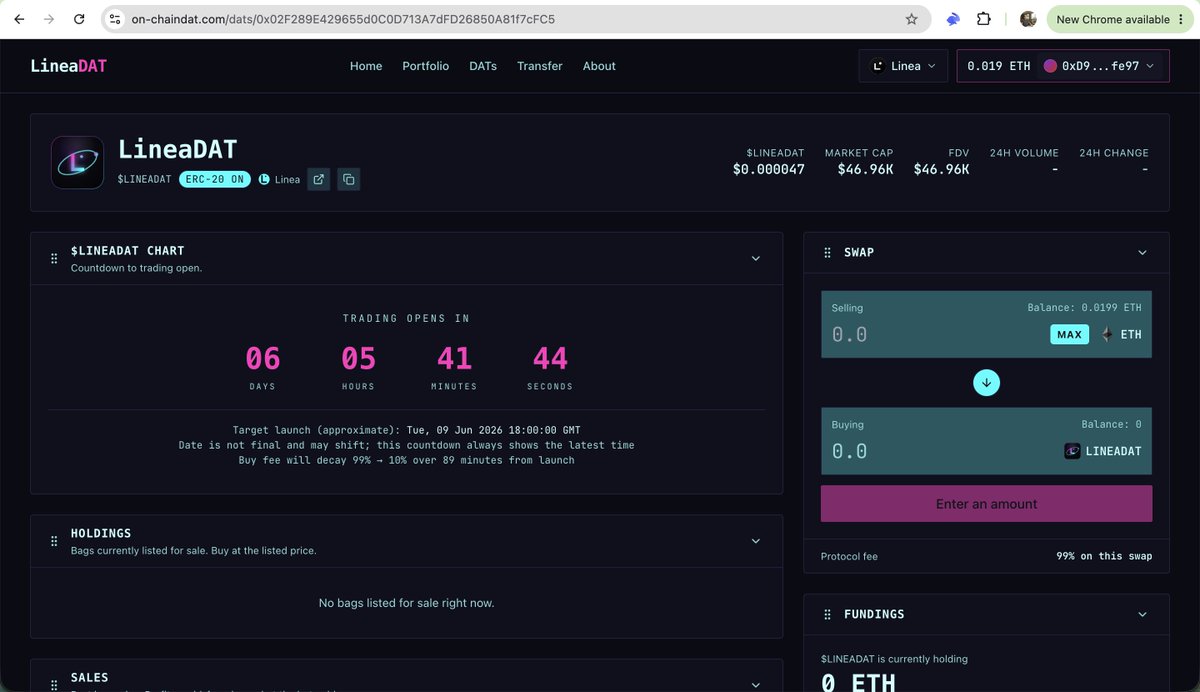
We have submitted our application for verification and listing on LineaHub.
If you arrived here through the on-chainDATdotCOM profile, you can already see the estimated launch date. Please note that this date is tentative and may change depending on how quickly the LineaHub team reviews our application.
$LINEA @LineaBuild
9
17
62
4,528

Gandelf retweeted

May 13
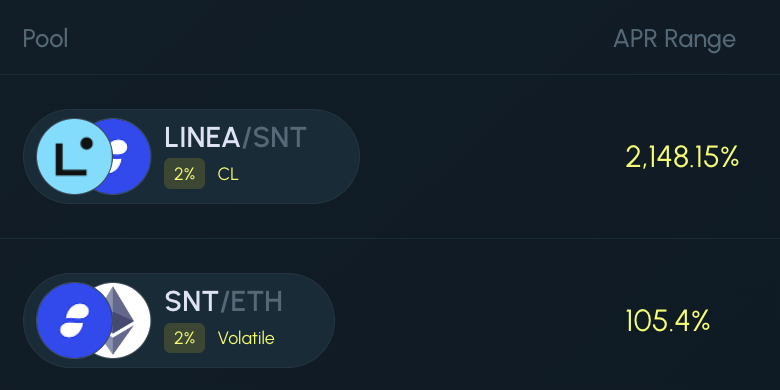
"Making the ETH productive" as LP on Etherex.
May 11

Sharplink and @galaxyhq are planning to launch the Galaxy Sharplink Onchain Yield Fund, a $125M vehicle deploying our staked ETH treasury into institutional-grade DeFi strategies.
CEO @joechalom on the strategy behind it:
“We’ve been very vocal that our job as an Ethereum treasury company is to make our ether productive first and, over time, to maximize that productivity.”
via @Forbes: forbes.com/sites/ninabambysh…
2
5
31
3,489
Gandelf retweeted

May 11
Today's announcement marks an important step in our treasury strategy's evolution.
The VC model in crypto has historically been the only source of capital that provides longer term growth alignment. But VC capital has very different investment goals, looking to hit homeruns betting on a company's equity or tokens. Once a protocol launches, it runs into a cold start problem of how to attract early deployments to use their product, not just invest in the company behind it.
At @Sharplink, we have near-permanent capital, seeking to generating returns on our staked ETH balance sheet that aim to preserve the convexity of the Ethereum opportunity, by compounding ETH per share. Our shareholders want to get longer and longer through time ETH. With this first of it's kind partnership with @galaxyhq we aim to be a positive force in the ecosystem, deploying to new protocols, while seeking yield we can use to compound our ETH.
This is what we mean by benevolent capitalism. Shareholder first focus on ETH per share growth, while looking to do things that are good for DeFi and the industry's growth in the process.
Looking forward to sharing more details on this partnership, and others we have in the pipeline as they evolve. It took time for us to do this the right way, but now that we are kinetic and public with this strategy vertical, we can continue expanding it, and communicating it's development at a faster rate.
May 11
We’re excited to announce our non-binding agreement with @GalaxyHQ to launch a first-of-its-kind $125M ecosystem liquidity fund to deploy capital into high-quality DeFi protocols and generate risk-managed returns that increase our ETH per share.
The Galaxy Sharplink Onchain Yield Fund will be managed by Galaxy Digital and will target onchain liquidity strategies and early-stage protocol support.
👇🧵
9
12
88
7,085
Gandelf retweeted

Some people don’t understand how fun and lively Linea was before launch.
Communities were active every single day.
People like @NotEnoughEth (Shama), the @FoxyLinea community, and updates from @LineaDegenLover kept the ecosystem alive.
There was real energy. Real builders. Real believers.
So imagine seeing all that… and deciding to build on Linea.
Back then:
– Shama (@notenougheth) single-handedly launched EFROG NFTs (@efrogs_on_linea) trading above 1 ETH
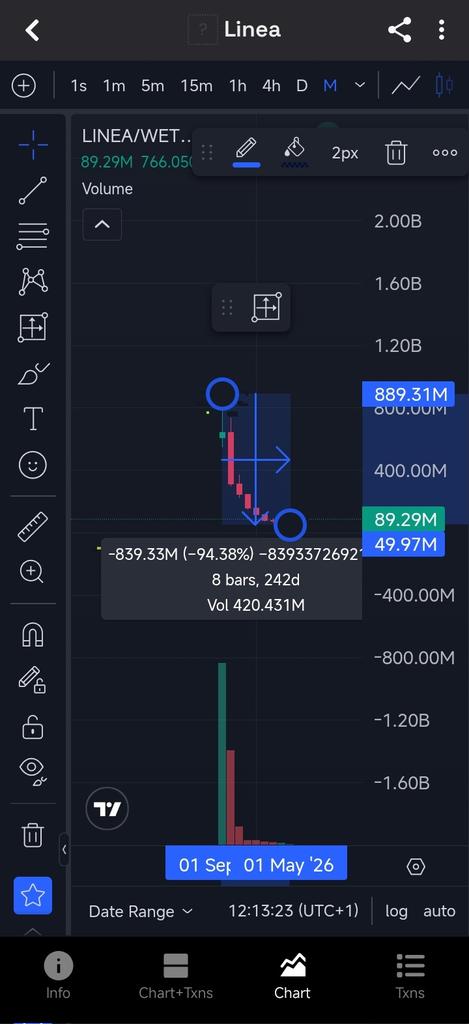
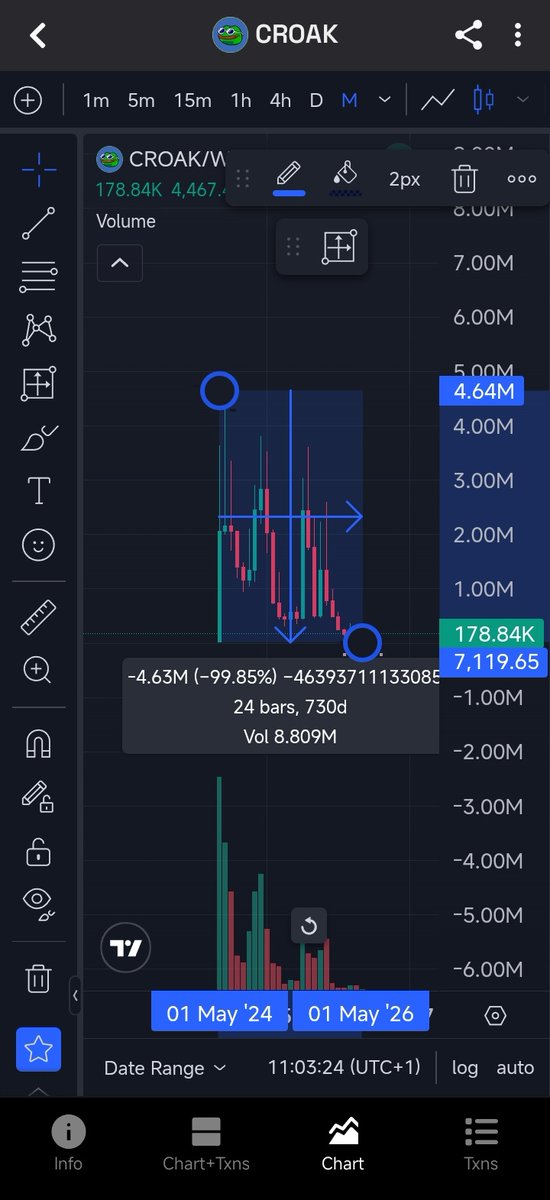
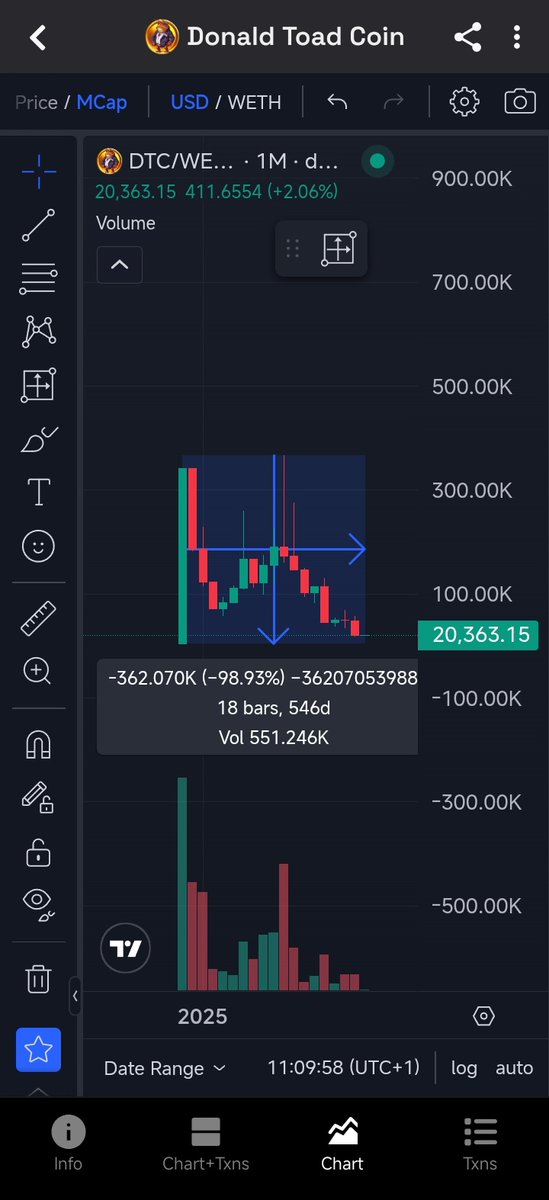
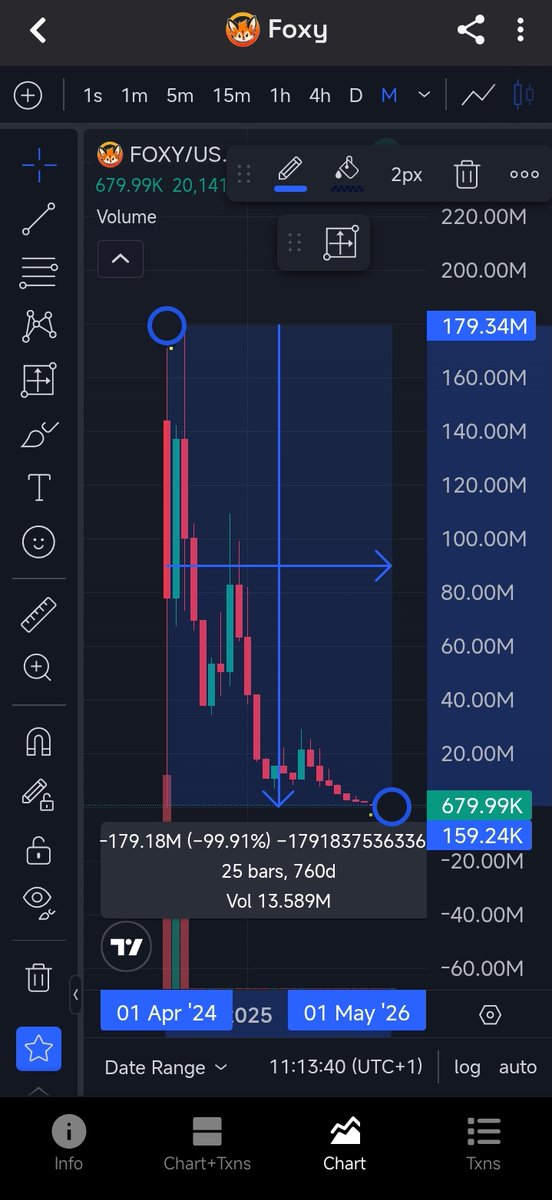
– @FoxyLinea ( $FOXY) was the top memecoin on Linea $180M market cap at ATH
– @CROAK_on_linea ( $CROAKS) reached $4.7M market cap at ATH
– Projects like @MrDonaldToad ( $DTC), @BankOfLinea, @RustyTokenAI (only AI project on Linea ), @Tech3Play (only gaming project) were all pushing
It felt early. It felt like something big was coming.
Before launch, everyone was skeptical ,but the team kept people engaged.
Even @DeclanFox14 was active with the community.
Then suddenly… silence.
Man forgot his X login or what? 😂
Then September 10, 2025 happened. The $Linea token launched.
Since then?
Continuous red candles.
8 months later, $LINEA is down ~94%.
Each dip competing with the next.
And yes, updates have been coming.
But the real question is: are these actual solutions or just paper ideas hoping something sticks?
Meanwhile, @Consensys has been quiet… almost like @LineaBuild never happened.
Then came Exponent (November).
Big hype.
$250k in rewards promised:
– $125k for old projects
– $125k for new projects
– Talks of Season 2 ( which I don't think people would participate)
People didn’t fully trust it… but still participated.
Exponent ended January 30.
Then what?
Silence.
For 3 months.
Until last month… when they finally paid only 53% of the promised rewards.
Wallet used for distribution:
0x7fBE2d1893a8C22Ab024F5e7cB49A44C797DFC9D
Everything is onchain.
-So where does that leave us?
Builders are tired.
Communities are dying.
Projects are fading.
What was once one of the most lively ecosystems is now struggling to stay relevant.
So my question is simple:
If you were there from the beginning till now…
If you experienced all this…
WOULD YOU STILL BE BUILDING ON LINEA?
9
7
31
1,895
Gandelf retweeted

May 1
🚨 576 ETH in the entry queue today.
Step by step.
Apr 24

🚨 Heads-up on Yield Boost.
First 100 ETH entered the staking vault today.
Next phases will be larger. We'll share each step as we go.
→ Goal as always: prioritize safety of funds through progressive ramp-up.
29
30
237
27,222
5- expect more info and a detailed timeline next week
to everyone who trusted us with their deposits, supported us on this app and elsewhere, tried to poke holes in our ideas and tested our crazy tech:
THANK YOU!
to the $LINEA community: stay tuned 👀
1
2
27
842
Gandelf retweeted
Apr 30
REXw33kly - 2026-04-29 | Summary
Main point of the episode
The speaker says that Etherex is moving into ecosystem survival protection mode. The main goal is not to maximize current payouts to xREX / REX33 holders, but to preserve REX, liquidity, and the DEX itself until Linea starts fully launching incentives again: Yield Boost, stablecoin plans, and other ecosystem support mechanisms.
He directly defines the main problem: according to him, Linea is currently in a weak phase - volumes, fees, and activity are falling, interest in the ecosystem is declining, and this puts pressure on the REX price. His fear is that by the time Linea finally “wakes up” and starts launching new programs, REX may have fallen so much, and LP liquidity may have become so thin, that recovery will become much more difficult.
That is why Etherex is introducing a temporary “ecosystem survival / ecosystem-wide 3-3” model: all fees and external incentives that were previously distributed to holders / voters will now be collected centrally and used every week to buy REX / REX33 from the market, convert REX into REX33, and then burn it. Start date - May 8.
What he said about Linea and timing
The speaker emphasizes several times that he does not speak on behalf of Linea. He only speaks on behalf of Etherex. At the same time, according to him, Etherex remains the largest or one of the largest native applications in the Linea ecosystem and an important part of its infrastructure.
Based on his communication with Linea, Linea has several future directions: Yield Boost, stablecoin plans, and broader ways to incentivize the ecosystem. But according to him, none of this is ready right now. He estimates Yield Boost as something that is still “a couple of months away”, roughly mid-to-late June or early July.
He says the preparation process for Yield Boost involves staking, unstaking, and broader technical setup. So Etherex’s current task is not to passively wait for Linea to launch everything, but to survive this gap in such a way that by the time incentives go live, the DEX and REX have not already been destroyed.
Why they see the situation as dangerous
Right now, according to the speaker, the ecosystem is seeing a sharp decline in volumes, fees, and activity. This creates pressure on REX because there are fewer fees, less organic demand, less interest in LPs, and fewer reasons to hold the token.
He describes the key risk like this: if REX depreciates too much and liquidity in the main pools becomes too weak, even future Linea programs may not have a meaningful effect. In other words, the DEX could end up in a state where the “restart” is already economically weak.
He separately highlights the ETH / USDC pair as the most important pair for the network. The logic is simple: for any L2, deep base liquidity in the ETH / USDC pair is critical. New stablecoins may appear later, but right now this pair remains the main infrastructure anchor.
What exactly changes on May 8
Starting May 8, Etherex moves away from the current model where users receive fees / rewards as usual. Instead, all gauged fees and any additional incentives entering the system will be collected centrally and used for buyback & burn.
The mechanics are described as follows:
• Fees and incentives will no longer be distributed directly to xREX / REX33 / voters.
• These funds will be used to buy REX / REX33 on the market.
• If REX is bought, it is then minted / converted into REX33.
• After that, REX33 is burned.
• The goal is to create constant systemic buy pressure on REX and remove part of the supply through burn.
This is not a ban on selling and not a user lockup. The speaker says directly: if someone wants to exit, sell, or do whatever they want with their position, they can still do that. Liquidity, although not huge, is still there. The change concerns only the direction of fees and incentives.
What happens to emissions
REX emissions will continue to decrease until they reach a sustainable level of 100,000 REX per week. He calls this a simple “lowdown number” - a low base emission level.
These emissions will be directed mainly to the pairs that provide the most value to the ecosystem. First of all, this means key pools such as ETH / USDC. He also says he is trying to source additional incentives for important pairs in order to maintain deep liquidity.
The important logic is this: if the fees and incentives collected by the system exceed the value of emissions, then the model becomes “positive” for the token. According to him, in recent weeks the dollar value of emissions has been very low - around $3,500 this week and around $4,200 the previous week. At the same time, total fees incentives were higher. Therefore, he believes the system can be turned toward net buy pressure.
Why the old model became inefficient
The speaker describes the current situation as a prisoner’s dilemma. Users receive rewards, but because REX keeps making new lows, they have an incentive to sell those rewards immediately. As a result, each individual rationally protects themselves, but collectively the system increases pressure on the token.
In his logic, the new model should remove this incentive to immediately sell rewards. Instead of distributing small fees to many users, the system will convert those flows into a shared buyback & burn. He believes this is better for all holders because weekly individual payouts are currently too small to meaningfully change anything for users.
He says directly that even a large holder may be earning, conditionally, $100-200 per week in fees. That is not an amount worth destroying the token’s long-term base for. In his opinion, it is better to direct this money into a shared 3-3 mechanism that supports the REX price and creates a stronger base for future recovery.
This is a temporary measure
The speaker emphasizes that this is not forever. The goal is to keep this model until Linea starts meaningfully incentivizing the ecosystem again. Specifically, he names Yield Boost, stablecoin plans, and the transfer of xREX ownership toward the Linea consortium as conditions after which it would be possible to return to a growth model.
When asked how long the plan can run, he answers that technically it can run indefinitely. If Linea needs six months, then it is better to have buyback pressure during that entire period and not “emit ourselves to death.” But if Linea never starts incentivizing, then Etherex will have to make new decisions.
What happens to LPs and voters
LPs will continue to receive REX. According to the speaker, most LP users will earn REX roughly as they do now, but at the same time, more buyback pressure will be added to REX itself.
For xREX direct voters and auto vault users: the current cycle is still ongoing. He clarifies that users who have already voted will receive their rewards. One more vote before the model launches will also be paid. After May 8, the new system will come into effect, and weekly voting rewards will temporarily stop.
Team and treasury position
The speaker separately says that the treasury is also included in this model. He claims that he personally earns nothing from this scheme and continues working “for his own bags”, like the other holders. According to him, the team is not building an extraction model, is not taking the payout stream for itself, and is refusing salary / compensation in the current phase.
His argument: the team earns when holders earn. Therefore, he presents the buyback & burn decision not as a way for the team to extract value, but as a collective protection mechanism for everyone holding REX / xREX / REX33.
What he said about Linea more harshly
The tone toward Linea is fairly critical. He says he will not defend Linea or pretend that they did an excellent job. According to him, Linea’s recent decisions were poor, everything took too long, and the ecosystem received almost no help. He directly describes the situation as “horrendous.”
At the same time, he is not saying that Etherex is breaking relations with Linea. On the contrary: he believes Linea still will not become an “orphan chain” because it still has ties to Consensys, institutional flow, advisors, and resources. But he also emphasizes that Linea must prove through execution that the new strategy actually works.
He mentions that Linea had serious staffing changes, especially in the go-to-market team. According to him, the old GTM team failed to show real success or competent execution, and now the hope is that the people who came in / remained will bring it into a working state.
Why he thinks this is not a bearish move
The speaker admits that the market can react in any way: someone may decide to sell, while someone else may buy more because they see the protective logic. He says that in a bear market he usually expects people to sell everything, but that does not necessarily have to happen.
His main argument: this is not a bearish step, it is a protective step. In his view, it is less bearish than watching REX make new all-time lows every week. The goal is to create a floor, stabilize the token, stop the downward spiral, and survive until Linea starts bringing liquidity and incentives again.
What he said about other projects in the ecosystem
He mentions that in the absence of volume, not only REX / Etherex suffer, but also other ecosystem tokens, including Foxes and e-frogs / Croak. According to him, some of these projects have good teams and communities, but without network activity and without volume, that is not enough. He uses this as an example that the problem is systemic, not only an Etherex problem.
Final summary
The essence of the episode: Etherex is entering “cockroach mode” - not in the sense of giving up, but in the sense of surviving at any cost until real Linea incentives return. The team believes that distributing small weekly rewards right now is less effective than using all fees and incentives for a shared REX / REX33 buyback & burn.
The model is supposed to:
• Reduce sell pressure from weekly rewards.
• Create regular buy pressure on REX.
• Burn REX33 after buyback / conversion.
• Support key liquidity, especially ETH / USDC.
• Give Etherex a chance to survive until Yield Boost and Linea’s stablecoin plans.
• Preserve the DEX as the “meta DEX” / main native DEX on Linea by the time Linea starts moving again.
3
1
5
397
Gandelf retweeted
Apr 24
🚨 Heads-up on Yield Boost.
First 100 ETH entered the staking vault today.
Next phases will be larger. We'll share each step as we go.
→ Goal as always: prioritize safety of funds through progressive ramp-up.
Mar 30
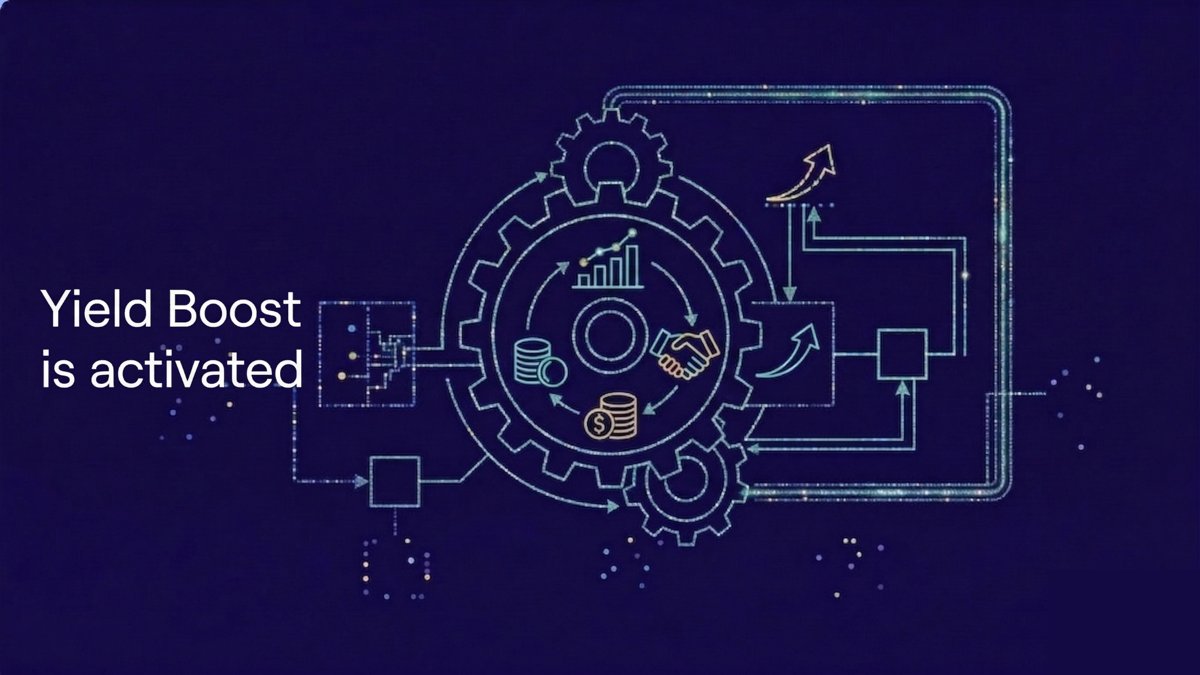
🚨 Yield Boost is now officially live on Linea.
We're converting idle bridged ETH into sustainable ecosystem liquidity:
→ Without new tokens
→ Without rebasing
→ Without renting capital
Here's how it works 🧵
24
42
229
51,670