
building infinite economic bandwidth @radiustech_xyz , learning @mitdci . Past: co-built @circle USDC, built Hamilton @ Fed, founded @blockchainassn.
Joined February 2022
- Tweets 2,413
- Following 6,116
- Followers 1,312
- Likes 3,735
245 Photos and videos















Bench ® retweeted

Jun 11
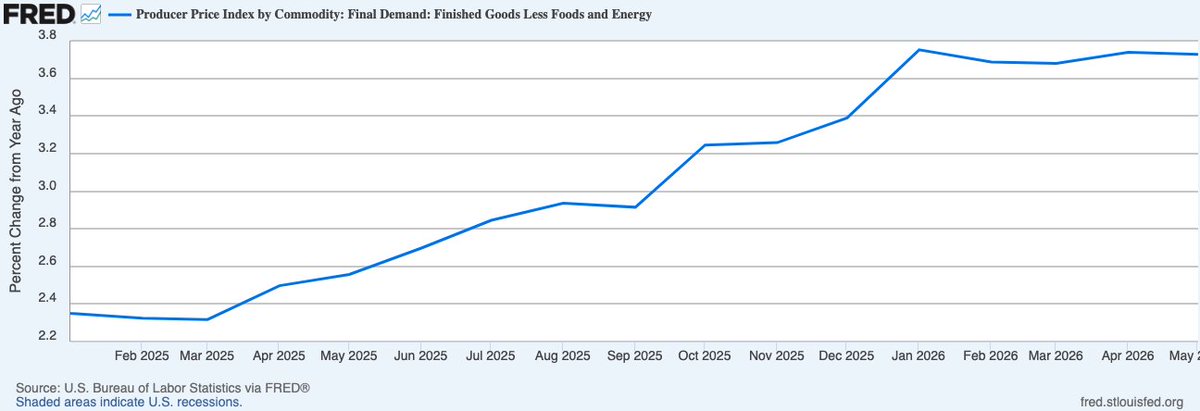
Core PPI is considered a leading indicator. Over the past two years it has been gradually rising and continues to be at a rate inconsistent with a 2 percent inflation target. The inflation charts of PPI, CPI, PCE are telling the same story, be concerned about inflation.
17
13
50
9,487
Bench ® retweeted

Jun 11
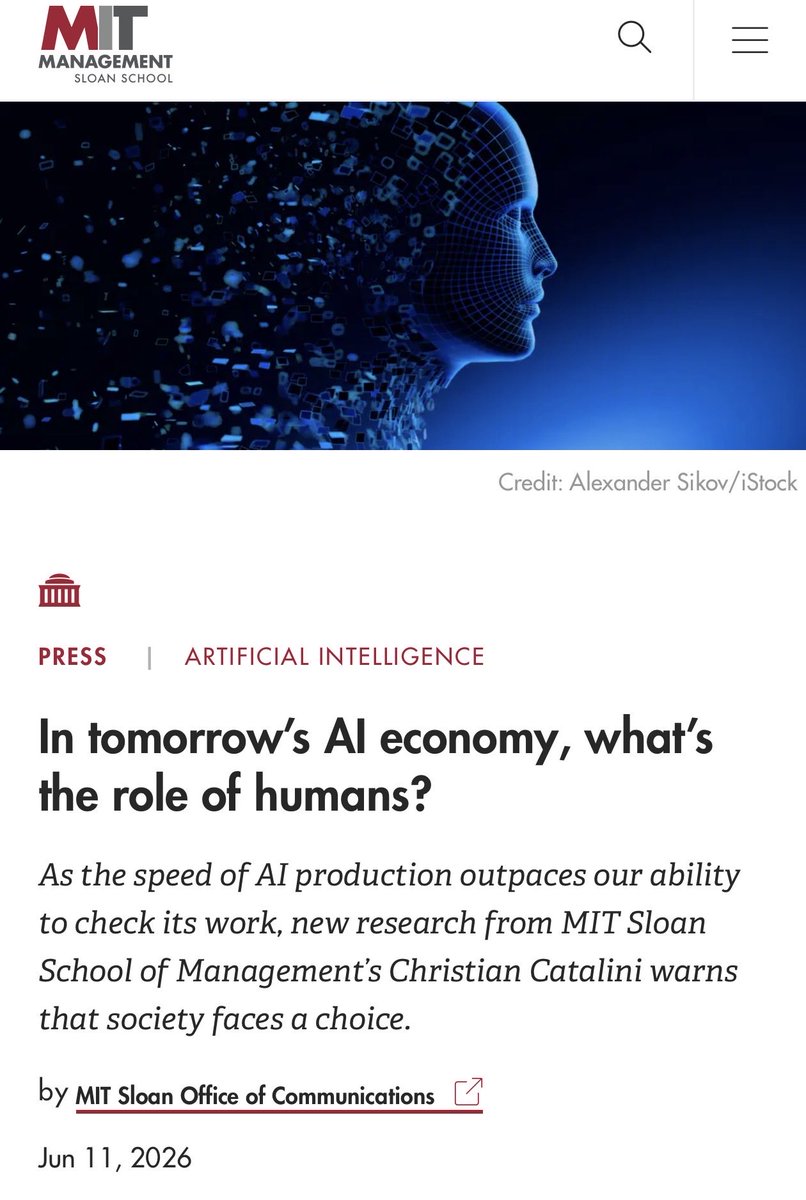
For most of history, finding out what you’re good at required the right mentor, firm or zip code. AI collapses all three into the same chat window. The constraint on mastery is no longer access. It’s finding the domain where your learning rate is steepest—and building.
3
2
18
1,062
Bench ® retweeted

Jun 10
AI agents moving money need real controls. Catena delivers a banking platform that enforces them across all meaningful rails, protocols, and on-chain contracts.
That's how agentic payments stay safe across diverse networks, and why we're glad to support @Mastercard’s Agent Pay for Machines.
Jun 10

As AI agents begin to act, payments move into the background — at machine speed and massive scale.
Today we’re introducing Mastercard Agent Pay for Machines — bringing structure, governance, and trust to this new class of payments.
Launching with 30 partners to bring this to life from day one.
This isn’t just more payments. It’s a new operating model for commerce.
👉 Learn more: mastercard.com/us/en/news-an…
8
11
39
4,888
When @bpmilne writes anything more than a couple paragraphs long - read it. You'll always end up smarter than when you started. Congrats to @brale_xyz , @Visa @CantonNetwork on the launch.
benmilne.com/visa-stablecoin…
1
111
Bench ® retweeted

RIP to a real one

Tragic news today: the eminent historian Gordon S. Wood was struck and killed while walking in the Shaw's plaza in East Providence, his family confirms to me. No comment from Brown yet
Wood was just featured in Ken Burns' American Revolution documentary wpri.com/news/local-news/pro…
38
782
10,418
2,158,708
Bench ® retweeted

Jun 8
Over the years @trailofbits has become a household name in cybersecurity. In this conversation with Trail of Bits' founder @dguido, we dive into the complete journey, from how they got started, to nearly going out of business during the government shutdown, to becoming a well respected pioneer in the industry.
We also touch on a variety of other topics, from Lazarus Group's activities to the impact of AI on cyber from both an offensive and defensive perspective.
Timestamps:
(0:00) Intro
(0:23) Altitude
(1:14) What is Trail of Bits and how did it get started
(6:49) Dan's upbringing and developing a passion for computer science and hacking
(16:25) Working at the NSA
(22:51) North Korean hacks on crypto
(28:22) The incident response team at the Fed
(33:05) The motivation behind Trail of Bits, and DARPA's role
(47:23) Starting Trail of Bits
(58:22) Government shutdown, losing all revenue, and surviving with 1 paycheck
(1:04:36) Hiring people for mastery and building a high agency team
(1:15:34) Bitcoin post-quantum cryptography
(1:20:12) The culture and expectation at Trail of Bits
(1:38:42) Mythos and AI's role in cybersecurity
(2:05:48) San Bernardino iPhone incident, and Dan's proudest moments
(2:12:12) Learning to become a CEO
(2:19:59) Peiter "Mudge" Zatko
3
10
42
15,512
Bench ® retweeted
Kevin Warsh has pledged "regime change" at the fed. Normally changes at the Fed move quite slowly, but regime change is not usually gradual. For June FOMC - will there be a dot plot and SEP? Will the statement be recast? Will there be a press conference? Will minutes change?
2
1
14
2,409
Maybe the best VC call I've ever had was early on with @lessin. Within the first 3 minutes he told me he was out. And spent the next 30 minutes of his time walking through his framing of our thesis, why he thought it was the wrong way to look at things, and how he'd improve it.
Jun 2

I was once pitching in a board room at a top 3 VC firm for a $15M Series A.
12 people in the meeting. One of the GPs fully fell asleep. Out cold for 30 minutes. Nobody acknowledged it. Everyone just kept going.
I kept presenting my Series A slides to an unconscious man in a Herman Miller chair and somehow that was considered normal. That's venture capital.
You might fly across the country to perform for people who may or may not be conscious.
It's a dance.
And sometimes you lead and sometimes you follow and sometimes your partner is unconscious.
If you're raising right now, just know: every founder has a story like this. The process is weird. The power dynamic is weird. You're not crazy for thinking it's weird.
No one talks about it because they want to continue raising. But I'm happy to stick my neck out there.
It is weird.
11
2
243
57,088
Bench ® retweeted
Jun 4
Everyone got the economic implications of the Bitter Lesson backwards.
A little awkward for the labs: the theory they cite to explain their dominance is the same one that says their core product can't be a defensible prize.
The lesson gets quoted as if it were universal — enough compute, and general methods win, everywhere. The fine print is that this only works where "good" is cheap to verify.
Point compute at a crisp objective with a reasonable feedback loop and it eats the task, which is why math and code fell first. And "the lesson applies here" turns out to be the same as "this domain has no margin left in it" — compute isn't scarce enough to lock anyone out (every hyperscaler will have enough of it), and open source distills the frontier on a short lag regardless.
Capabilities converge, and the pressure shifts to better routing across models to minimize cost.
Winning a verifiable domain comes with the curse of being commodified on the other end of the race.
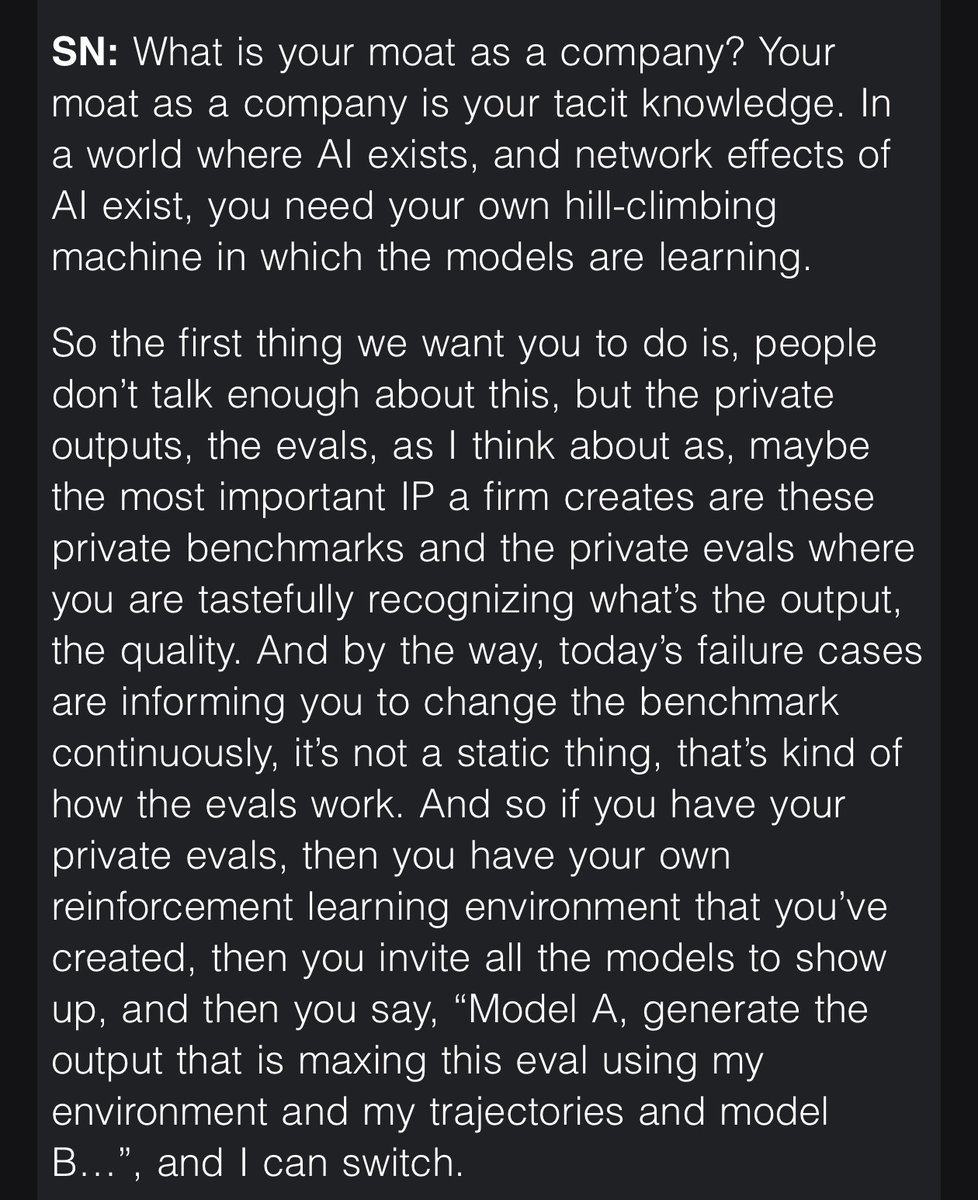
But here is where things get interesting, and why @satyanadella is playing one move ahead of many: the other half of the economy is less accommodating. Is this the right strategy, the right early-stage investment, the right hire, the campaign that actually captured a new trend — here "good" is expensive, contested, and slow to learn, so there's no cheap objective to point compute at, and the Bitter Lesson isn't binding.
Hard-to-verify domains stay valuable for an almost embarrassing reason: nobody can tell, cheaply, what counts as a good answer. Compute will hand you a thousand of them and do a sloppy job at telling you which one is the one you should ship.
Taste, judgment, curation based on experience: that's the surface where the Bitter Lesson, verification being the true bottleneck, delivers defensible businesses.
Which tells you where value will accrue. The models — mostly compute, data, and increasingly tooling and architecture — are the inputs that commoditize first, so putting your moat there is choosing, deliberately, the race with no margin.
The interesting move is one level down, in the sectors the lesson can't reach, and there the only durable asset is whatever defines "good" where good isn't easily verifiable: your own verification stack. The proprietary record of what actually counted as right — the "this was wrong, here's why" that has to come from outside the loop, or the model will Goodhart itself into confident, sycophantic nonsense.
That moat is two things, and the second is load-bearing: the ground truth your work generates, and the expertise that keeps improving it. The trace is a record — copyable, perishable, only as current as your last correction. The expert is the renewable source: the standing ability to look at the model's next thousand answers and say which one is right, in a domain where that expertise lives in nobody else's head.
Compute can't automate a signal it can't measure, and open source can't distill weights that are still inside your people. What stays scarce is the firm that can keep climbing up the intelligence value chain.
@satyanadella makes the operating version of the case below — your own hill-climbing machine, with the models learning inside it. The polite way of saying: bet where there is no cheap verifier yet (and ideally there never will be), and hire and retain the experts who are the top verifiers in their domain.
Which leads us back to the labs and that awkward spot. They can't defend the model — the theory they live by commoditizes it first, and competition is thorough that way — so they have to come for your eval and verification layer instead: a complement worth absorbing, the kind that arrives bundled into the platform as a thoughtful free feature, for your benefit, naturally.
"the model alone is no longer the product"— Greg Brockman
To succeed, the one input they have to quietly fold in is the ground truth your own operation throws off every day.
Your moat was always the private traces — your failure cases, your taste, the benchmarks only your own work produces.
Outsource your traces and you've outsourced judgment, which was, the job.
7
4
47
11,761
Bench ® retweeted

Jun 3
Welp, that happened faster than I predicted. Thought it would be end of 2027, then early 2027, but agentic traffic growing so fast that bots have now passed human traffic online for the first time in the Internet's history. radar.cloudflare.com/traffic…
388
2,170
8,318
2,242,047
RT @rynesaxe: Thought Leadership they say.
"Faster settlement" has important consequences for market structure.
Eco delivers orchestrat…
1
22
Bench ® retweeted
The WSJ article on hyperliquid is a good overview. The world will be quickly moving to efficient low cost 24-7 trading of real world financial assets not just crypto assets. The liquidity is moving to decentralized exchanges and away from more costly centralized exchanges .
57
120
754
157,442
If this is done right the US merchant and consumer are going to save entire %'s of their annual spend.

SCOOP: @Stripe, @Visa and @Mastercard are close to launching a joint stablecoin platform.
@IanAllison123 reports.

2
172

Worst of all worlds:
"disadvantages of centralization and most of the disadvantages of decentralization at the same time."
May 27

Vitalik Buterin on why consortium blockchains have mostly failed
“The original vision of consortium blockchains — the idea that you have 5 banks or major companies that come together and create their own chain — has been mostly a failure. I think the reason why is it ends up inheriting most of the disadvantages of centralization and most of the disadvantages of decentralization at the same time.”
“The first five banks join, and they all feel like ‘Yay, we’re building a system together. We can all be part of it.’ But then once bank #6 and bank #7 and bank #29 come in, they’re joining a system where there’s already an established power structure, established participants, and basically to them it still feels like they’re joining some kind of centralized thing that’s controlled by a cartel.”
“You don’t actually gain the benefits of true openness that people are looking for. You don’t have Etherscan. You don’t have a connection to an open, public network. At the same time, if you build on one of those systems, you have to figure out how to program distributed systems; you lose privacy — you might think you still have some, but the reality is you’re putting your data on a network where the only people that get to see it are you and all your closest competitors. From a privacy perspective, it actually doesn’t make much sense.”
“The compromise between centralization and decentralization that actually makes a lot more sense is: you have an application and today that application is a server. You can keep your server, but instead, we’re going to add scaffolding on top to give users extra security guarantees. You put Merkle roots on chain. You put proofs on chain. And you give your users assurance that whatever is happening inside of your system is actually following the rules. So you have high scale, high performance, and you optimize for a minimal delta for existing centralized infrastructure deployment. Keep your existing infrastructure the way it is, and you just add a side car that makes the roots and the proofs.”
Source: @arbitrum
1
4
471

Proxy-voting is one of the largest unsolved problems of the American financial system.
May 20

You can't make this up.
DTCC's closed-loop proxy system over-votes so often Broadridge literally sells a product called "Overvote/Over-reporting Prevention."
When the math doesn't math, brokers just choose whose vote counts.
2
130
Bench ® retweeted
May 20
Giving an agent a wallet or account isn't the hard part. Creating a robust, governed way to trust it is. Today Catena announces product access, OCC news, and Series A investment from wonderful partners: catena.com/blog/banking-gove…
9
9
67
10,225
Bench ® retweeted

May 20
"I think [AI agents] may be the only actors that we trust with our assets and the only actors that are capable of generating meaningful return on our assets."
@psneville, cofounder of @catena_labs, makes the case for an agent-native internet built on stablecoin rails:
"Once we have stablecoins and we have the ability to represent dollars on internet rails, what kind of new opportunities does that unlock? At the same time we were contemplating that, you could see clearly the web, the internet itself, is going agent-native."
"As AI actors become economic participants, they will ultimately be the primary dominant economic participants in the world for all kinds of activities, payments, and otherwise."
"Flash forward in a few years, I think they may be the only actors that we trust with our assets and the only actors that are capable of generating meaningful return on our assets."
35
23
109
21,857