Author of the new "Ways and Means" (Now in Paperback) and of Buffett, When Genius Failed, America's Bank. Newsletter @ rogerlowenstein.substack.com.
Joined September 2015
- Tweets 852
- Following 129
- Followers 4,276
- Likes 148
6 Photos and videos


He bought Amex in the 1960s. The evolution to “good businesses at a fair price” isn’t new to the last 25 yrs, and isn’t news.
May 27

The single greatest piece of investing misdirection in modern financial history is the canonization of late-stage Warren Buffett, the Buffett of Coca-Cola and American Express and Apple, the Buffett of the cardigan and the folksy quote and the moats-and-brands sermon, because that Buffett, the one the entire investing world has been taught to imitate for the last 25 years, was not the Buffett who actually built the fortune. The Buffett who built the fortune, who compounded at 50% a year in the partnership era of the 1950s and 1960s, who turned $9,800 into the foundation of what became one of the largest individual fortunes in American history, did not own a single company that the modern Buffett-imitator would consider investable. He owned tiny, illiquid, ignored, ugly, unloved microcap businesses that nobody on Wall Street had heard of and nobody at a modern Berkshire annual meeting would dream of buying.
He bought a windmill company. He bought a streetcar company. He bought a coal company in Philadelphia called Philadelphia and Reading. He bought a map company. He bought a New England textile mill called Berkshire Hathaway that was, by his own later admission, the worst investment decision of his career, and that he kept buying precisely because it was cheap, because the math worked, because the cigar butt had one more puff in it, and because the discipline that defined his early career was not "buy great businesses at fair prices" but "buy fair businesses, and bad businesses, and dying businesses, and businesses nobody understands, at prices so absurdly low that the math forgives almost any operational failure." He bought net-nets. He bought companies trading below the cash on the balance sheet. He bought 30 to 40 names at a time, in small position sizes, in a partnership structure that almost nobody outside Nebraska knew existed, and he held them until the math asserted itself, and then he sold and redeployed into the next batch, and he did this, mechanically, for 15 years, and the compounding from that 15-year period is the single largest contributor to his net worth as it exists today, larger than Coca-Cola, larger than Geico, larger than every single subsequent decision he made after he became too big to run the original strategy.
He himself has said this. Repeatedly. In interviews. In old shareholder letters that almost nobody bothers to read. He has said, more than once, that if he were running small money today, the kind of money a normal investor actually has, he would run the original strategy again, in whatever market still offered the kind of opportunity the American market offered him in 1957. The market that offers it today is Japan. The market that is beginning to offer it is Korea. The market that occasionally still offers it, in small pockets, is American pink sheets and OTC small caps. And the people who are running the original Buffett playbook in those markets, in 2026, with a fraction of his capital and the same patience he had at 26, are doing the closest thing in modern finance to actually being him in his prime, and almost nobody else is paying attention, because the late Buffett of the cardigan has been so thoroughly canonized that the early Buffett of the manuals has been almost entirely forgotten.
You can run the original strategy. You can ignore the modern Buffett-imitator framework that has produced an entire generation of investors who pay 80x revenue for stocks because they "have moats" while ignoring 4x earnings stocks because they "lack durable competitive advantages." You can buy the small, the cheap, the ignored, the unfashionable, the structurally mispriced, in baskets large enough to absorb the failures, held patiently enough for the math to work, and you can, in 2026, replicate the strategy that built the fortune of the most successful investor in modern history, in markets he himself has told you would be his hunting ground if he were starting over. The strategy is sitting there. The framework is freely available. The original Buffett did not need a moat. The original Buffett needed a price. Price was the entire edge, and price has always been the entire edge, and the people who continue to pay attention to price while everyone else chases the late-stage Buffett narrative are, quietly, in the background, building the kind of returns that the modern compounder-and-moat investing establishment refuses to take seriously, because taking it seriously would require admitting that 25 years of investment education has been built on the wrong half of the man's career.
3
42
24,736
The World Cup: all hype, all drama, all worth it “futbol is life” (until Alcaraz returns) mobileapp.bostonglobe.com/05…
315
Trump 101; create a crisis and “solve” it by retreating to status quo ante
May 20

Of course they are the idiots who closed it
2
474
And inflation has cut those 2000 dollars in half.
May 10

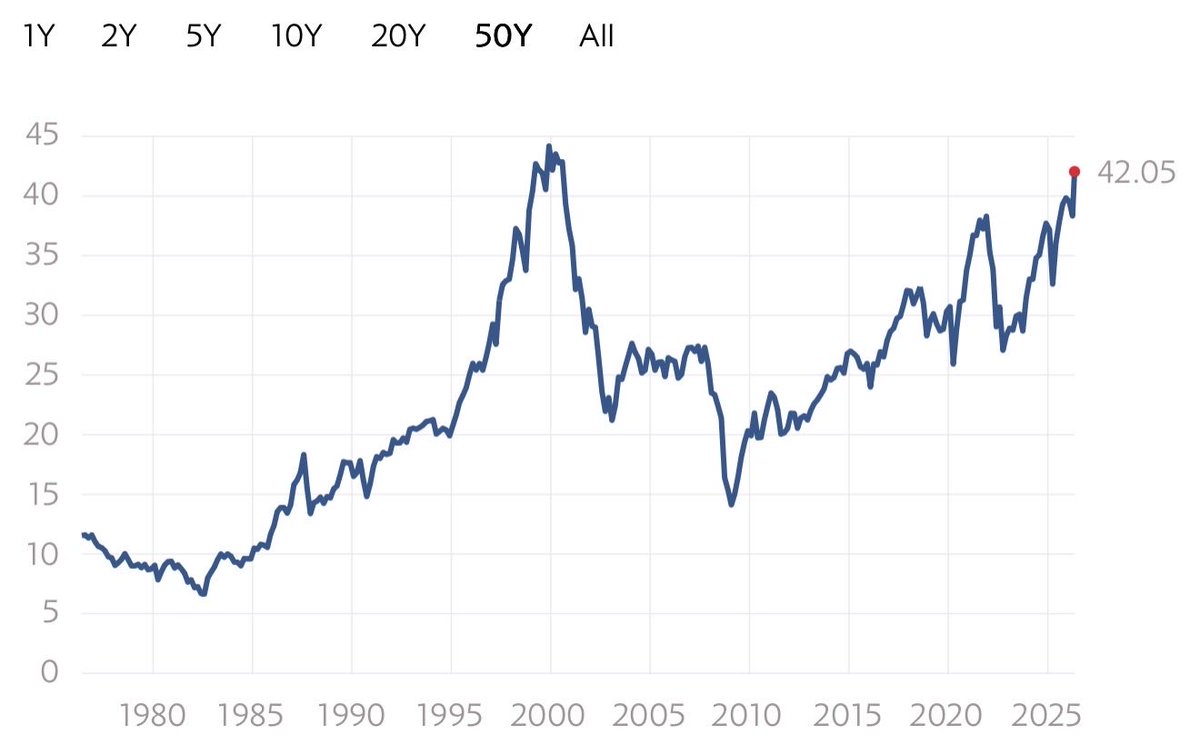
People see this chart and say "oh, it's a high valuation tech boom again". That's typically where their research stops. ¯\_(ツ)_/¯
Schiller CAPE Ratio:
2
578
Broad Nasdaq is up less—just over six times since March 00 5,000 peak. 8% compounded over 26 years would yield a 7.4 x gain.
May 10
People see this chart and say "oh, it's a high valuation tech boom again". That's typically where their research stops. ¯\_(ツ)_/¯
Schiller CAPE Ratio:
3
620
“The height” is indeed a fraught term but … the 70s were so so good
May 12

I consider myself a music optimist, in the sense that I hate people saying that the 70s were the height of music (gross). For example I think the early 2000s and early 2020s were extremely good. But even I have been tested by the last few years of music...
(I may be too old though)
2
510
Tying the S&P over 20 years ain’t chopped liver. It’s also what WB repeatedly predicted as a result of growing size.

I’m a Berkshire shareholder. Warren Buffet and Charlie Munger are all-time greats but they have tied the S&P 500 for 20 years to the day. I think people should be openminded that Greg Abel might be an upgrade in Management. I say that with no disrespect to Charlie and Warren but the scoreboard has slowed down scoring points. I sensed accountability of performance for the first time , in a longtime. Greg Abel might surprise people.
7
11
2,756
Obviously a good teacher
Apr 8
My former boss, sort of
966
His book on Harlan was terrific; Alito seems like his natural follow-up
Apr 7

Big day in books by journalists we admire. Starting with @PeterCanellos who today is publishing "Revenge for the Sixties," a new biography of Samuel Alito. If it's anything like Peter's "The Great Dissenter," it will be terrific.
politics-prose.com/book/9781…
amazon.com/Revenge-Sixties-T…
1
1
547
Roger Lowenstein retweeted

Mar 31
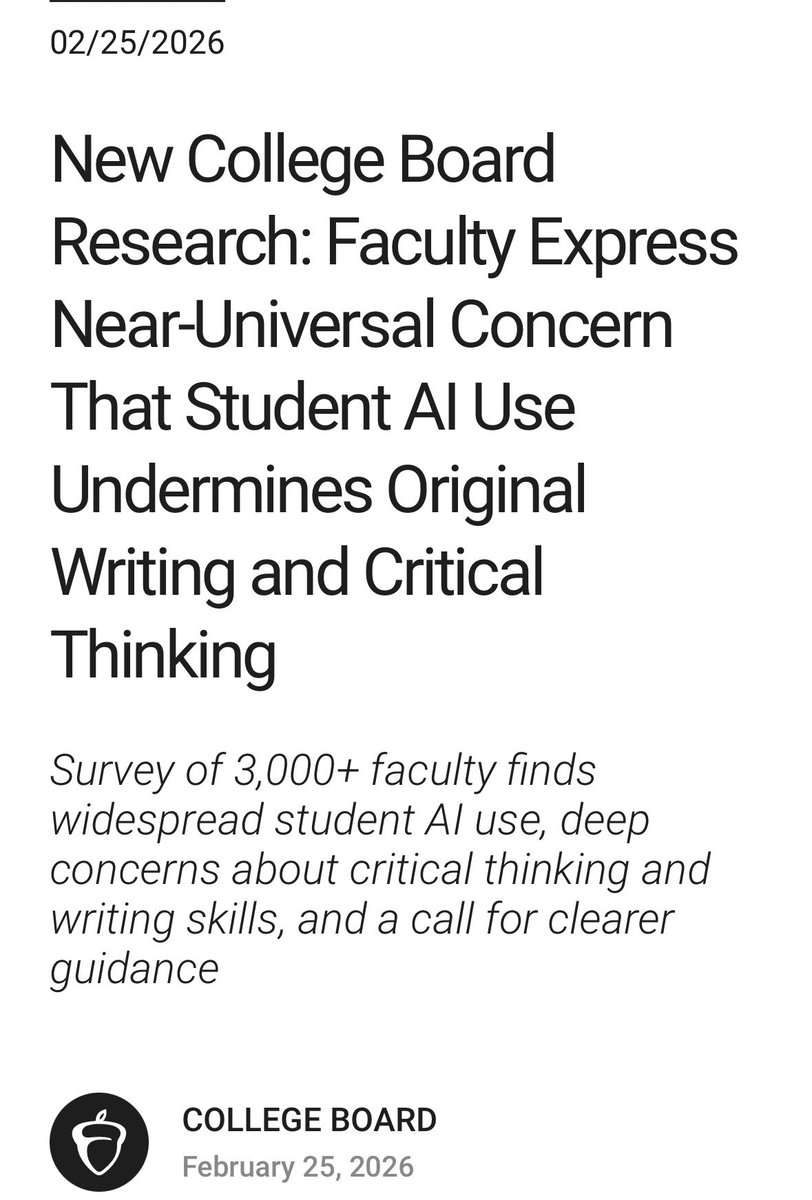
I recently heard someone equate college students using AI as equivalent to using calculators. I laughed. This is not what we’re seeing in the humanities and social sciences. Students are using AI to avoid learning and deep-think writing assignments. It’s not a “tool.”
66
194
882
44,219
Amen to that, RL ‘76
Mar 20

3
583
Boston Globe columnist Dan Shaughnessy wins 2026 Red Smith Award. I read red smith, devotedly, as a kid. He has no better heir. As a journalist, sports addict and hub transplant (from NY no less) I look forward to Shaughnessy”s every column. Kudos, Dan. bostonglobe.com/2026/03/19/s…
2
217
It’s true: Never meet your heroes. An excellent and thoughtful piece. No hero but how can you top “Send In The clowns?” bostonglobe.com/2026/03/13/o…
1
309
But they don’t have the Shame of being trumpers, do they bill?
Feb 25

It is a sad commentary on the state of politics to watch members of the Democratic Party stay seated and give insult to our country. They should be ashamed of themselves.
3
396
If you subscribe to the people who say “rotate” you are assuming that you will be able to rotate sooner than others (who have access to the same information And “advice.”) it’s all in Keynes.
Feb 5

Super Bowl LX is here! Get in on the NFL action with DraftKings Sportsbook. New customers can bet $5 and get $300 in Bonus Bets if your bet wins! 👑
120
Prosecutors Began Investigating Renee Good’s Killing. Washington Told Them to Stop. nytimes.com/2026/02/07/us/re… via @NYTimes isn’t this called obstruction of justice? John dean, judge sirica—where are you now that we really need you?
4
514
Good catch and “bizarre” would be generous.
Jan 31
Bizarre that he has to hide from the American people, living on some kind of military base. Never read abt other COS living like that. Gives pause, no?
3
778
Robert Louis Stevenson’s writing guide in four words: “War to the adjective.” This from Leo Damrosch’s splendid new biography: “Stoyteller.”
1
305
What’s the point of a football Hall of Fame if Bill Belichick doesn’t get in on the first ballot? Roger that, even a Jets fan outraged for Coach Bill. bostonglobe.com/2026/01/28/s…
1
5
467
Trump said he no longer feels an "obligation to think purely of Peace" after not winning the Nobel Prize and expressed desire to take control of Greenland to Norwegian PM Jonas Gahr Store. abcnews.link/nwG1PRY. Did he do it for peace or for the medal? share.google/B34tlpdGhSBRrIB…
1
590