Joined February 2017
- Tweets 15,531
- Following 731
- Followers 1,473
- Likes 15,426
75 Photos and videos








Pinned Tweet

11 Feb 2019
RtP was originally started to record my campaign to have @policescotland introduce active suicide intervention training for all custody staff. Now all police officers and staff are trained as to what to do when a person is found trying to take their own life in police cells.
10
7
70
Roger the Policeman retweeted

Why do so many UK rioters, who claim they want to defend women against attack from immigrants, keep attacking the women in their own lives?
222
427
2,635
60,844
Another example of anchoring. The police need to relearn ABC and check all claims made for accuracy and truthfulness and about the benefits of bottom up thinking, whereby conclusions are made only once all evidence has been obtained.
Jun 12

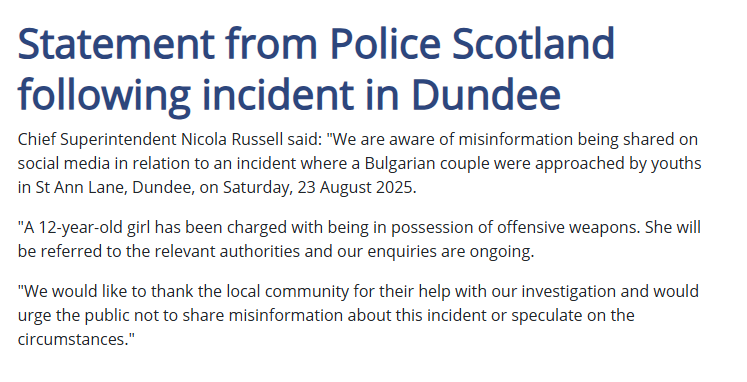
This was the statement released by Police Scotland after the footage of the incident in Dundee went viral last year. It seems that everything was done to give the impression that the young girl was the aggressor and the migrant couple the victims. A court decided yesterday that it was the other way round. Blatant disinformation. Police Scotland owe everyone an explanation.
1
2
379
Roger the Policeman retweeted

Jun 12
What if the most important safeguard against police error is another officer willing to speak up?
Following the Henry Nowak case, Graham Goulden examines the critical importance of peer intervention.
Read: policeprofessional.com/featu…
#Policing #PoliceLeadership

1
1
1
368
The murder of Henry Nowak has highlighted how the police can behave very unfairly, presuming guilt & showing a callous disregard for life.
But this has not happened in isolation. The police will also act that way to other police officers.
It has to stop.

In 2025 12 of 13 police officer suicides involved officers under investigation. More than 100 police officers and staff have died by suicide between 2022 and 2025 polfed.org/news/latest-news/…
2
2
12
1,307
Ten years retired.
With the passing of the Police Ethics, Conduct & Scrutiny (Scot) Act 1995, my role in that & helping to publicise flaws in the way the police handle complaints & misconduct investigations, it has ultimately been ten productive years.
3
1
10
1,071
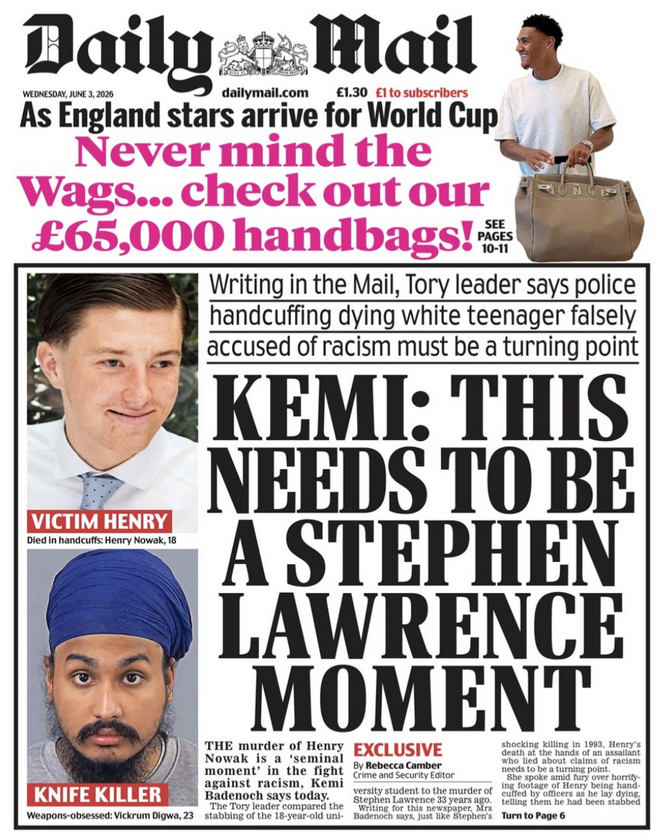
It is ironic that this is being called a Stephen Lawrence moment, since that was part of the raised emphasis on improving police response to racial violence, had helped to bring about the terrible response to the Henry Nowak murder.
Jun 6

The murder of Henry Nowak raises serious questions about the conduct of the first police officers on the scene. By the account accepted at trial, Henry was the victim of a fatal stabbing, yet officers initially handcuffed the dying teenager while giving credence to the perpetrator’s false allegations of racism.
Those events deserve careful scrutiny, and Henry’s family are entirely justified in seeking answers about the initial response in the form of a professional inquiry.
However, it is also important to distinguish between the initial response and everything that followed.
Following the conviction, Henry’s family drew a sharp distinction between the actions of the first responding officers and the subsequent murder investigation. They stated:
“Despite the shocking actions of the police on that fateful night, the murder investigation was very different.”
They went on to express their “heartfelt gratitude” to Senior Investigating Officer DCI Rebecca Bartholomew, the Serious Crime Team, officer in the case Claire Proctor, family liaison officers Sarah Page and Trudy May, the CPS, and prosecuting counsel for their professionalism and dedication in securing justice.
The family were equally clear about how they wanted Henry’s death to be understood. They stated:
“We do not want his death to be used to create further division, hatred, or tension. We want his story to make our streets safer for everyone.”
They also endorsed the prosecution’s characterisation of the case:
“This is not a case about Sikhism. This is not a case about racism. This is a case about murder. People should not be able to walk openly through the streets of Britain carrying a 21 cm blade.”
Those statements matter because they come from the people most directly affected by the tragedy. They neither ignored the apparent failures of the first officers nor sought to turn the case into a wider racial or communal conflict. Instead, they criticised what they believed had gone wrong, praised those they believed had acted professionally, and focused attention on the violent crime itself.
This is where comparison with Stephen Lawrence becomes particularly instructive. Both were young victims whose deaths became part of wider national debates about race, policing and justice. Both cases exposed failures that damaged public confidence. Both deserve to be remembered with dignity rather than deployed as symbols in partisan arguments.
Yet the experiences of the two families after the killings were markedly different. Stephen Lawrence’s family spent years fighting for accountability amid profound failures in the original investigation. The Macpherson Inquiry concluded that the investigation had been seriously mishandled and described the Metropolitan Police as institutionally racist. It took nineteen years before two members of the gang responsible were convicted.
By contrast, while Henry Nowak’s family strongly criticised the actions of the first officers on the scene, they publicly praised the detectives, investigators, family liaison officers, prosecutors and CPS responsible for securing a conviction. Rather than condemning the murder investigation, they commended it. Rather than spending decades seeking accountability for investigative failures, they saw a suspect charged within days and convicted within months.
This contrast should not be used to diminish either victim. The circumstances of the two murders were different, the evidential challenges were different, and the historical contexts were different. Nor does acknowledging the failures identified in the Lawrence case require denying the failures alleged in the Nowak case.
What the comparison does illustrate is that criticism of policing cannot be reduced to a simple left-right divide.
For decades, critics on the left have pointed to racial disparities in stop-and-search, arrests, use of force and criminal justice outcomes as evidence that policing is not always applied equally. More recently, critics on the right have argued that fears of racism allegations can sometimes distort institutional decision-making and lead to unequal treatment in other directions.
Both sets of arguments ultimately rest on the same principle: that the law should be applied fairly, consistently, and without regard to race/ethnicity, religion, politics, or public pressure.
Critics on the left may reasonably worry that any comparison risks understating the unique scale, duration, and historical significance of the institutional failures exposed by the Lawrence case and the Macpherson Inquiry. Critics on the right may reasonably argue that the initial police response to Henry Nowak, handcuffing a dying victim while initially crediting the perpetrator’s false allegations, raises serious and legitimate questions that deserve open scrutiny. Both observations have merit.
The lesson from both Stephen Lawrence and Henry Nowak is not that one political side has been proved right. It is that public confidence depends on an institution’s willingness to investigate failures wherever they occur, apply identical standards regardless of who the victim is, and follow the evidence rather than a pre-existing narrative.
The Lawrence family sought accountability for investigative failures and eventually obtained justice after an extraordinary struggle. The Nowak family sought accountability for the actions of the first officers while publicly praising the investigators and prosecutors who secured a swift conviction. Both positions are entirely consistent with a belief in equal justice.
Ultimately, public confidence cannot be built on institutional defensiveness or attempts to force fundamentally different tragedies into a single political frame.
True justice means having the courage to confront shortcomings honestly, recognise effective work without hesitation, and follow the evidence wherever it leads, thereby honouring both families rather than exploiting their pain for partisan ends.
2
2
506
Two-tier policing has always existed in the UK.
The police have repeatedly favoured some groups of people over others & not applied the law equally.
Police officers carry all sorts of prejudices, against ethnic minorities, women & even university students.
Jun 4

I see that #TwoTierPolicing is the top trending item this morning.
Let's make this very simple — it does not exist in the UK.
It is a racist dog whistle invented by the far-right, Reform UK.
8
3
22
2,508
Many of the people screaming the loudest about the injustice of two-tier policing, want two tier policing, that favours them over others.
116
12
122
8,415
Every police officer in the UK needs to learn;
- ABC.
- to prioritise a medical complaint over any other complaint.
- to be neutral evidence gatherers.
Police management need to ensure all officers are better trained in the above, than the officers who failed Henry Nowak.
Jun 2

The death of Henry Nowak is a tragedy in every sense, and the public reaction to the body‑worn video is completely understandable. It is painful to watch. It is painful for officers to watch. And it is painful for Henry’s family to know that his final moments were chaotic, confused and shaped by a lie told by the man who killed him.
But if we are going to talk about this case, and especially where/if politicians make highly charged statements, I believe it’s important to stay anchored to what was actually established in court.
The judge was clear that the responsibility for Henry’s death lies solely with the man who stabbed him. The fatal wound to his chest was described as “catastrophic” and “unsurvivable”, and the pathologist confirmed that no medical intervention, immediate or otherwise, could have saved Henry. That does not erase the distressing nature of the footage, it does not mitigate the seemingly dispassionate response of the officers in attendance, but it does matter when we are trying to understand what happened and what could or could not have changed the outcome.
It is also a matter of record that the officers were responding to a 999 call in which the offender falsely claimed he had been the victim of a racist attack and insisted no weapon had been used. That deception shaped the first few minutes on scene.
The IOPC has been involved from the outset, and the officers have remained as witnesses throughout. This is an important distinction, as those familiar with post incident procedures can tell you. If there was a shred of doubt or suspicion that the officers actions at the time, when balanced against the information known at the time and their reasonable held beliefs, amounted to potential misconduct, the IOPC must at the earliest opportunity review their status. The IOPC have confirmed that the officers status remains unchanged. That indicates that the officers initial decisions/actions have already been assessed against the information known at the time and is unlikely to now change and amount to misconduct.
None of this means the initial assessment was correct. It wasn’t. The officers misread the situation, and the body‑worn video shows that plainly. But policing is full of moments where decisions are made in seconds, under pressure, with incomplete or misleading information. Sometimes those decisions are right. Sometimes they are not. And sometimes…as in this case…the consequences are unbearably tragic even when the mistake does not change the final outcome.
What we cannot/should not do is turn this into a proxy battle in a wider culture war. Henry’s family have asked that his death is not used to fuel division, hate or to propagate political agendas.
It is possible to hold two truths at once:
that the initial response was flawed, sloppy even…and the investigation needs to establish how policy, procedure and relied information impacted those decisions and events; and that despite the officers clear mistakes and compassion fatigue, they did not cause Henry’s death, nor could they have prevented it.
Policing is at its worst when it becomes defensive, but it is also at its worst when it becomes a canvas onto which people project their own political battles and/or bitterness. This case, if it is to be a turning point, deserves better than that.
We can demand accountability without abandoning fairness. We can acknowledge mistakes without inventing motives. And we can talk honestly about the pressures and imperfections of frontline policing without turning every tragedy into a referendum on the entire profession.
That balance is difficult. But, to my mind, it is the only way we avoid repeating the same cycles of outrage, distortion, division and defensiveness that have done so much damage to public trust… and to the people who still turn up, every day, to do a job that is getting harder by the day.
16
1
25
5,804
Again, the internet will split between those who are sure they would have done a better job and those who think, there, for the grace of God go I.
I am in the latter camp & think it is important to remember, the final tragic outcome was not affected by the mistake made.
Jun 1

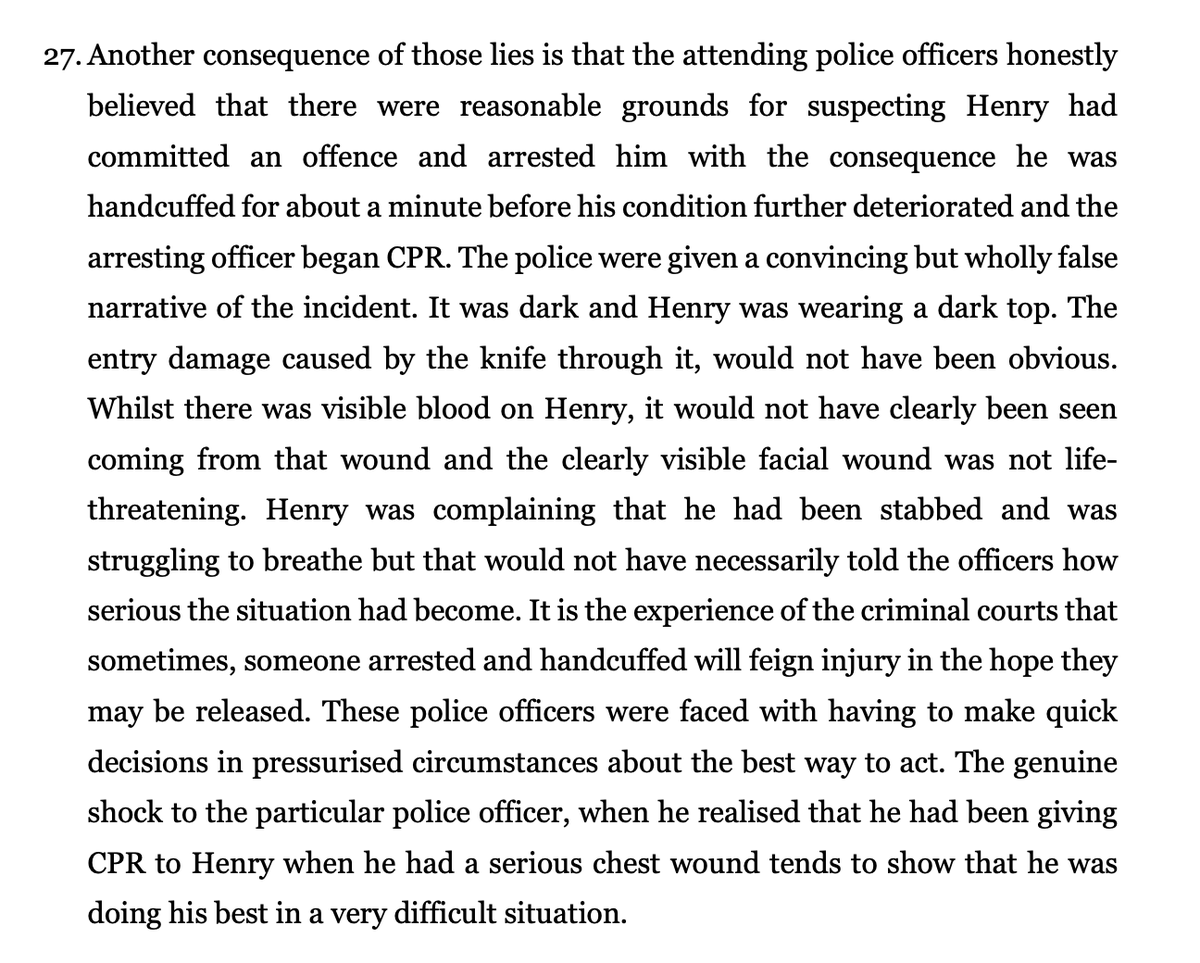
On the murder of Henry Nowak by Vickrum Singh Digwa, it is worth reading this paragraph, below, of Judge William Mousley KC's sentencing remarks.
While we await the investigation, the judge probably has the most complete view of what happened - and the impact of Digwa's lies:
132
7
79
27,399
1 - In 2024, in Aberfeldy, Police Scotland took 6 days to realise that a man had been shot dead. Someone was convicted of that murder.
The police in Southampton took minutes to realise a man had been stabbed. Someone has been convicted of that murder.
1
2
6
1,640
2 - Mistakes were made & what is most important with mistakes is that they are accepted & rectified, which is what has happened.
3
3
462
Who is head of Police Scotland's Professional Standards Department? Who else works there?
When will they all be investigated for corruption in covering up misconduct?
5
7
24
7,307
Yet again @PoliceScotland has been criticised for the way it investigates complaints.
The failures are deliberate, as they are needed to protect certain cops, in particular senior officers.
dailyrecord.co.uk/news/scott…
8
6
24
1,950
Link to the HMICS report here. Note that it references suicide ten times, as there is finally official, formal acknowledgement of this problem.
hmics.scot/media/wpnblz12/hm…
2
489
I have completed this survey. The more study on how trauma affects the police (& others), the more management will have to accept there is a huge problem they are not properly tackling.
May 16

Police and Soldiers
Mrs H is currently completing a comparison study between the police and soldiers and traumatic events.
If you fall into the bracket please complete her questionnaire. It will help her and hopefully others on completion.
Feel free to share.
Link below.
1
5
1,324
The problems with debates about police use of force are;
Apr 30

Zack Polanski getting told off by a policeman.
(This is first class)
1
3
1,613
4 - the result is a great mess, amongst people debating a topic few have anything relevant experience of, including many police officers, who rarely, if ever, experienced an angry man, capable of killing, during their career.
1
2
324
5 - I think the police & courts need to issue clearer guidelines on the use of force. For example, if you try to kill others with a knife & you get tasered & you still do not let go of the knife, expect a kick in the head. Or, if it is an armed cop, expect to be shot.
1
2
284