
“Power concedes nothing without a demand. It never did & it never will” Frederick Douglass
Joined September 2014
- Tweets 439,775
- Following 41,725
- Followers 68,003
- Likes 547,437
74,065 Photos and videos
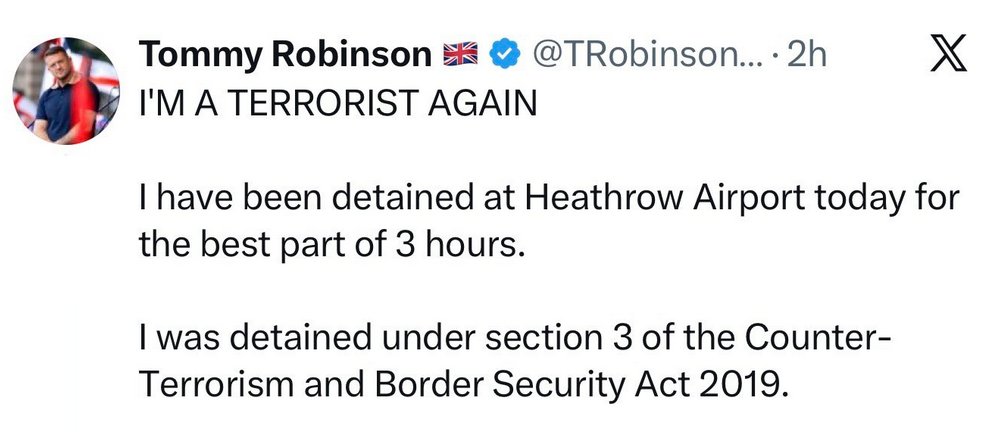
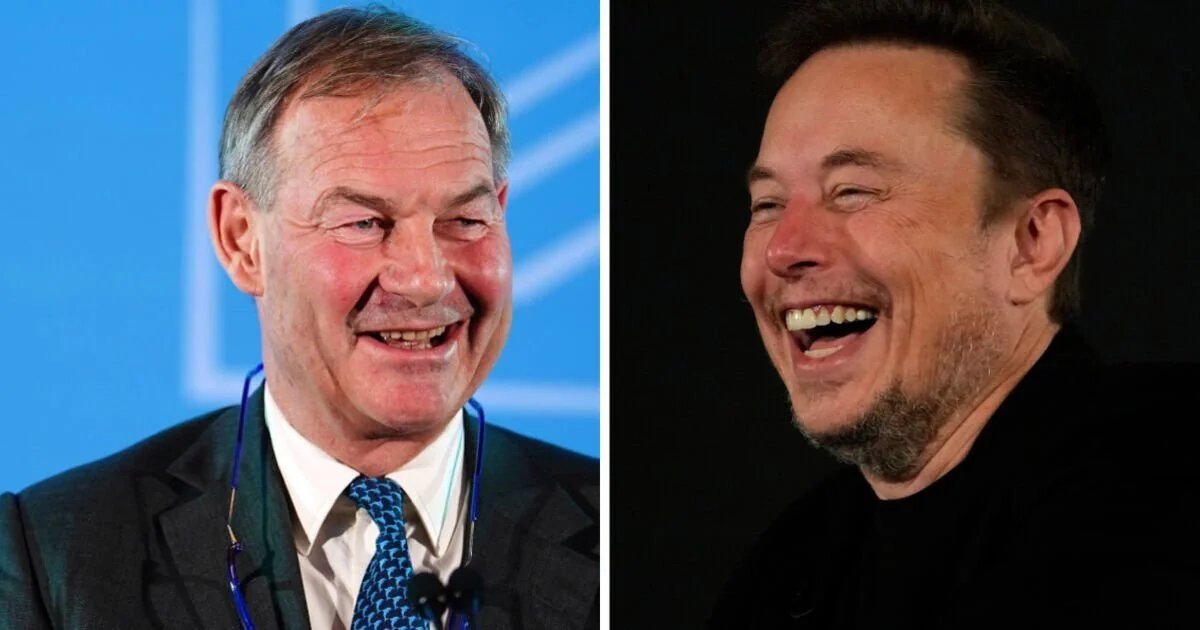
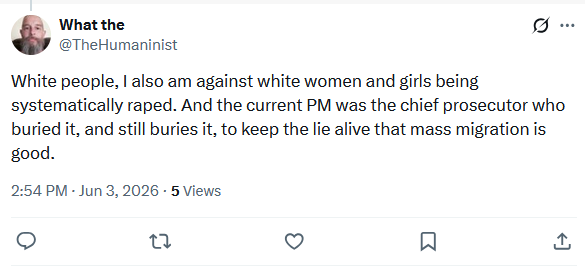
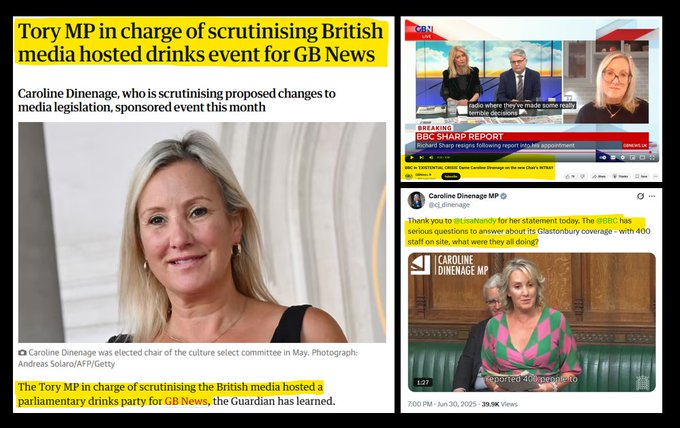


Pinned Tweet

Rupert Lowe’s rhetorical strategy, particularly his repeated use of terms such as “savages,” “third world savages,” “barbarians,” and “animals” to describe migrants from certain countries, alongside calls for the deportation of “millions and millions,” exemplifies a deeply flawed and politically counterproductive approach to discussing migration, crime, and social cohesion.
While Lowe presents himself as a truth-teller confronting realities others are unwilling to acknowledge, his rhetoric frequently substitutes visceral outrage and civilization caricature for careful, evidence-based analysis. The result is a style of political communication that dehumanises broad categories of people, exploits strategic ambiguity, and weakens the intellectual and political foundations of the reforms it claims to advance.
A defining feature of Lowe’s rhetoric is its calculated imprecision. References to “dangerous third world savages” being placed in British communities are rarely confined to clearly defined categories such as convicted violent offenders or failed asylum seekers. Instead, they are embedded within a broader discourse that encompasses those who allegedly fail to integrate, depend on welfare, occupy social housing, or originate from countries associated with large-scale migration.
This rhetorical elasticity allows him to move seamlessly between specific criminal acts and much wider populations. By embracing accusations of racism with remarks such as “If that makes me a racist, so be it,” while avoiding precise definitions, he cultivates the appearance of fearless candour while preserving plausible deniability. The effect is to transfer the stigma attached to the most serious offenders onto far larger groups who share only nationality, ethnicity, religion, or migrant status.
The significance of this ambiguity extends beyond questions of tone or precision. It reflects a broader process of essentialisation, whereby complex social phenomena are reduced to supposedly inherent characteristics of groups. Individual crimes, criminal networks, or integration failures become evidence not merely of specific social problems but of deeper national, religious, or civilizational deficiencies.
Terms such as “invasion,” “savages,” and “barbarians” do more than express anger; they establish a moral framework in which Britain is cast as a civilised society under siege from alien and inferior forces. Such language erases individuality, flattens complexity, and encourages audiences to interpret social tensions through the lens of collective threat rather than institutional failure, policy design, socioeconomic conditions, or individual responsibility.
The dehumanising character of this rhetoric is not incidental but central to its persuasive force. Labels such as “animals” and “savages” symbolically place their targets outside the boundaries of ordinary moral consideration. This is a well-established feature of dehumanising language in political communication, which frequently employs animalistic imagery to erode moral constraints and make exclusion or harsh treatment more publicly acceptable. History teaches us where it can lead. Lowe’s language implies that the pathologies associated with particular offenders are characteristic of the groups from which those offenders emerge.
Even when Lowe invokes genuine horrors, for example the grooming gang scandals in Rotherham, Rochdale, Telford, and elsewhere, where men of predominantly Pakistani heritage perpetrated systematic abuse amid institutional failures and documented reluctance by some officials to act for fear of racism, the framing encourages audiences to treat these crimes as representative of broader populations rather than particular offenders in specific contexts. In doing so, it amplifies perceptions of collective danger and blurs crucial distinctions between perpetrators and the vastly larger groups with whom they are associated.
This dynamic is reinforced by Lowe’s tendency to collapse a range of distinct issues into a single narrative of national decline and external threat. Grooming scandals, asylum policy, migration through irregular routes, violent crime, demographic change, welfare dependency, housing pressures, and integration failures are repeatedly woven into one simplistic overarching story of a country being overwhelmed by outsiders. The truth is that these phenomena have multiple different causes and require different responses. The language of “millions” who must leave Britain discourages differentiation and promotes sweeping attributions to broadly defined out-groups.
This tendency functions as a form of moral amplification. Highly salient crimes become symbolic representations of entire populations, while exceptional cases are elevated into evidence of broader civilization dysfunction. The emotional power of such rhetoric comes from compressing complexity into a simple story of civilisation vs barbarism, “us” vs “them.” However, the same simplification that makes it potent also makes it analytically weak and, at best, liable to generate policy responses that are poorly aligned with the complexity of the underlying problems.
Politically, Lowe’s rhetorical style is as self-defeating as it is inflammatory. His dismissive attitude towards labels such as racist, xenophobe, or Islamophobe may energise a committed base, but it ensures that debate centres on his language rather than the substantive issues.
Many voters who support tighter controls still recoil from rhetoric that evokes collective guilt or civilizational hierarchy, which some audiences associate with narratives of white supremacy. As a result, language designed to demonstrate uncompromising conviction often narrows the coalition needed for real change.
None of this requires denying cultural differences, integration challenges, or institutional failures. Serious discussion must confront uncomfortable realities, including patterns of offending in particular cohorts and institutional reluctance to address sensitive issues. But it depends on maintaining careful distinctions between individuals and groups, statistical patterns and moral judgements, and policy failures and personal responsibility. Lowe’s rhetoric repeatedly collapses those distinctions, sacrificing analytical precision for emotional force.
Ultimately, a significant problem with Lowe’s approach is not that it addresses difficult subjects but that it does so through dehumanisation, essentialisation, and deliberate overbreadth, when Britain needs a debate grounded in specificity, proportionality, and human dignity.
Rhetoric that relies on caricature, ambiguity, and collective stigma may generate outrage effectively, but it obscures the problems it claims to illuminate, makes constructive solutions harder to achieve, and distorts rather than illuminates public understanding.
Jun 11

‘How Real Problems Become Racial Explanations: Why Immigration Debates Go Wrong’
Racism is commonly understood as prejudice, discrimination, or hostility directed at people because of their race, ethnicity, or perceived racial characteristics. Most people recognise overt racism when they see it: slurs, exclusion, violence, or claims that some groups are inherently superior or inferior to others.
Most British people abhor racism. In contemporary Britain, however, the more consequential forms of racial thinking rarely begin in these explicit ways. They tend to emerge indirectly, through the attempt to explain real and visible social problems.
Immigration is one of the clearest examples of this dynamic. Many people who favour lower immigration strongly reject racism and believe their views are grounded in observation, experience, and common sense. In many cases, that is true. Concerns about housing pressure, crime, integration, public-service strain, cultural change, or rapid demographic shifts are not invented concerns. They arise from real conditions and real events.
The issue is not whether these concerns exist. It is how they are interpreted.
From observation to explanation
Humans are exceptionally good at noticing patterns, but far less reliable when it comes to explaining them. We register changes in our communities, encounter striking news stories, and experience pressures directly in daily life. From there, it is easy to move from observation to explanation and then from explanation to broader conclusions about groups of people, often without noticing that distinct inferential steps have been compressed into a single judgement.
At its core, much of the confusion in immigration debates comes from collapsing three distinct stages into one:
1. Observation: something is noticed. It could be a crime scandal, a statistical disparity, or a visible social change.
2. Explanation: a cause is proposed, perhaps culture, economics, institutions, policy, or discrimination.
3. Generalisation: a conclusion is drawn about entire groups of people.
Recognising robust patterns in data is not, in itself, an error. Any serious analysis of crime, welfare use, or integration has to start from what the numbers and histories actually show. The difficulty arises when these three stages blur together, so that a pattern is treated as if it already contained its cause and its meaning. Once that happens, conclusions can feel immediate and self-evident even when they are not.
Why our minds prefers simple stories
There is also a deeper reason this happens. Human cognition is not optimised for statistical explanation; it is optimised for speed, salience, and narrative coherence. We are drawn to vivid, recent, and emotionally striking examples when forming judgements. This is why cognitive shortcuts such as the ‘availability heuristic’ matter: memorable cases feel more representative than they are. It is also why essentialist thinking is so persistent: the mind tends to prefer stable underlying ‘natures’ rather than multi-causal systems shaped by changing conditions.
Culture is often where this simplification becomes most visible. In everyday political discussion, ‘culture’ is frequently treated as if it were a fixed or inherited trait. In reality, culture is better understood as a set of practices, norms, and expectations that can be both real and, in some respects, resistant to change, yet still shaped over time by economic conditions, institutions, incentives, and social environment. When culture is reified into something static or quasi-biological, it becomes easy to treat group differences as permanent rather than contingent.
These cognitive tendencies are not signs of irrationality. They are normal human features. However, they do make simplified explanations feel more compelling than complex ones.
Step 1: the observations are often real
Any serious account should begin by acknowledging that many of the underlying concerns in immigration debates are not illusions.
The ‘grooming-gangs’ scandals in towns such as Rotherham and Rochdale were real, and the institutional failures that allowed them to continue for years were extensively documented. Crime statistics do show over-representation of certain groups in some specific categories of offending. Some communities experience higher residential clustering, or more conservative social attitudes than the national average.
Immigration can contribute to housing demand and pressure on public services when infrastructure and planning do not keep pace. Fiscal outcomes also vary significantly depending on migrants’ skills, age, and employment patterns.
None of this needs to be denied or minimised. But none of it explains itself either.
Recent British experience also includes a different kind of failure: in some institutions, a reluctance to confront uncomfortable patterns for fear of being seen as racist. Grooming scandals, uneven enforcement, and the treatment of some whistleblowers show how avoidance and euphemism can allow genuine harms to persist. Any argument that took these problems less than seriously would rightly be rejected.
Step 2: where explanation becomes overconfident
The most common reasoning error in public debate is not a simple factual mistake, but what might be called ‘inferential overreach’. A pattern is observed, and the pattern is treated as if it already contains its explanation.
Yet between observation and conclusion lies explanation, and explanation is almost always multi-causal. Calling a pattern multi-causal does not mean every factor is equally important, or that culture, norms, or origin are irrelevant by definition. It means that when such factors matter, they do so alongside others, for example age structure, class, local opportunity, social networks, institutional response, and that their relative weight has to be shown rather than assumed.
Crime reflects interacting factors such as age structure, deprivation, neighbourhood concentration, policing practices, education, labour-market exclusion, migration selection effects, and cultural norms. Integration outcomes reflect language acquisition, economic opportunity, geography, discrimination, and generational change. Housing pressures reflect planning systems, building rates, land constraints, infrastructure decisions, and financial incentives. Immigration interacts with all these factors but rarely determines them alone.
The key issue is not whether any one factor matters, but how quickly people move from pattern to single-cause explanation.
Step 3: how explanations become identities
Once an explanation is chosen, it can harden into something stronger: an identity claim.
A behavioural pattern becomes a cultural essence. A statistical difference becomes a statement about what a group ‘is like.’ A local issue becomes a generalised claim about ethnicity, nationality, or religion.
At that point, reasoning has shifted from analysis to essentialism. This does not require anyone to use explicit racial language or to endorse biological hierarchies. It is enough that a set of outcomes is taken to reveal a stable underlying nature.
This process is usually not driven by hostility. It is driven by compression: the gradual shortening of the distance between observation and conclusion until intermediate steps disappear, and explanatory mechanisms are displaced by identity categories.
Case study: crime and interpretation
Crime statistics illustrate this clearly. It is true that some groups are over-represented in some categories of offending. It is also true that crime is unevenly distributed across geography, age, and socioeconomic status, and that some of these patterns have proved stubborn over time in particular places.
But what follows from that is not straightforward.
The same pattern can emerge from multiple overlapping causes: demographic structure, concentrated deprivation, urban settlement patterns, migration history, policing intensity, reporting differences, and indeed varying norms about violence, authority, and gender. These mechanisms can operate together, and their relative weight varies by context. Treating ‘culture’ or ‘origin’ as the entire explanation, without specifying how they interact with these other factors, is as much an oversimplification as ignoring norms altogether.
A statistical pattern, on its own, is not an explanation.
Integration: uneven outcomes, uncertain meanings
‘Integration’ is similarly complex. It is observable that integration proceeds at different speeds across communities and over time. Some groups show rapid convergence in language, education, and social participation. Others do so more slowly.
But it does not follow that slower integration implies permanent incompatibility.
Historical experience is instructive here. Groups such as Irish Catholics, Jewish communities, and various European migrant populations were, at different points in British history, the subject of intense public anxiety and frequently described in explicitly exclusionary terms. Victorian and early twentieth-century commentators often treated them as fundamentally separate or unassimilable. Over time, however, these same groups became deeply embedded in British social and civic life. The intensity of earlier panic is now often forgotten, but it illustrates how strongly integration trajectories can change across generations.
Today’s patterns differ in obvious ways: source countries, migration volumes, welfare institutions, and global communications create dynamics that have no exact historical parallel. The point of these analogies is not that every group will follow the same path, but that early or mid-course difficulties are weak evidence that trajectories are fixed and unchangeable.
Economics and housing: partial causes becoming total explanations
Immigration can increase demand for housing and public services, particularly when population growth is rapid. In certain localities, the speed and scale of change can genuinely outstrip institutional capacity.
But housing shortages in Britain also reflect long-term under-building, restrictive planning systems, infrastructure constraints, land availability, and financial dynamics in the housing market. Similarly, fiscal impacts vary widely across migrant groups and over time. Some migrants contribute significantly over the long term, particularly those in work and in skilled occupations, while others have more mixed fiscal profiles depending on employment and household structure.
The analytical error occurs when immigration is treated as the dominant explanation for structural issues that have multiple independent causes, or when complex economic dynamics are compressed into moralised stories about what particular nationalities or religions ‘are like’.
Why selective truth is so persuasive
Misleading narratives can sometimes be powerful precisely because they are not fabricated: they are constructed from real events and real statistics, but arranged selectively. Salient examples are emphasised, while broader context, countervailing evidence, and structural complexity are downplayed.
This produces a picture that feels accurate at the level of individual claims but becomes distorted at the level of overall interpretation. The practical question for any of us, whatever our starting point, is not whether we have noticed true things, but whether we are willing to ask what is missing from the picture that feels most intuitive to us: what data, counterexamples, or structural features we have quietly set aside because they do not fit the story.
How racial thinking can emerge without intent
Most people do not begin with racist beliefs. More commonly, they begin with genuine concerns or observations and encounter repeated explanatory frames that direct attention toward ethnicity, nationality, or religion.
Over time, three shifts can occur: from individuals to groups; from variation to stereotypes; and from explanation to identity. These shifts do not require malice. They arise from repetition, cognitive bias, and the human preference for coherent easily understood narratives over complex systems.
This process is reinforced by institutional and informational environments. Media systems prioritise attention-grabbing cases. Political actors amplify salient examples. Online platforms reward emotionally resonant interpretations. Together, these forces systematically favour simplified causal stories over carefully contextualised, multi-causal explanations.
Scepticism and intellectual discipline
Critiques of structural or institutional racism are correct to note that disparities do not automatically imply discrimination. Differences in outcomes can arise from many non-racial causes.
But the reverse is also true: disparities do not automatically imply cultural deficiency or inherent group characteristics. Whether discrimination, culture, policy, or other factors are responsible is an empirical question that must be assessed case by case. Treating outcomes as multi-causal does not mean denying that, in some settings, one set of causes (such as norms, networks, or selection effects) may be especially important. It means refusing to treat a single category such as ‘origin’ or ‘culture’ as sufficient explanation on its own, without asking what else is at work and how those elements interact.
A consistent standard of reasoning requires applying scepticism evenly across competing explanations rather than selectively. Recent history also shows that silence and euphemism can sometimes be as harmful as overstatement. The aim is not to return to a culture of denial, but to describe problems plainly and then resist the temptation to convert them into stories about fixed group nature.
Data and policy inference
None of the arguments above imply that aggregate statistical patterns are irrelevant to public policy. Governments necessarily rely on population-level data when designing immigration systems, labour-market planning, and integration policy. The quality, completeness, and interpretation of that data are therefore central to effective decision-making. It is both legitimate and unavoidable to consider differences in outcomes when making decisions about selection criteria, skills requirements, or institutional capacity.
The distinction to draw is not between ‘using data’ and ‘ignoring data.’ It is between two different kinds of inference: using statistical information to manage systems on the one hand, and on the other, treating those same patterns as evidence of fixed group characteristics, moral worth, or cultural essence. The first is a standard feature of governance and, depending on the evidence and on public priorities, may support more restrictive or more expansive policies in different domains. The second is where reasoning begins to drift into essentialism.
Immigration levels, selection rules, and the pace and distribution of change are all legitimate subjects for disagreement. Applying intellectual discipline to explanation does not predetermine the policy outcome. But it does require that whatever choices are made rest on clear mechanisms rather than on stories about what whole groups of people are supposedly like.
What Real Understanding Requires
Immigration should be debated openly and rigorously, including its costs, benefits, and trade-offs. But it also needs to be analysed with a level of intellectual discipline that is too often missing from public discussion.
A recurring mistake in this debate lies in how problems are interpreted. Human societies are complex, multi-causal systems. When that complexity is ignored, even entirely genuine concerns can be drawn toward overly confident conclusions about entire groups of people.
These patterns of reasoning are not unique to any one side of the debate; they appear across political perspectives whenever vivid evidence is filtered through prior expectations.
The critique of racism is therefore not only moral, but explanatory. It targets a specific shortcut in human reasoning: the tendency to flatten complex social realities into simple stories about what entire groups ‘are like’. English people or Muslims are not ‘all the same’ any more than Americans or Jewish people are.
Some arguments in this space concern legitimate questions of capacity, selection, and pace. Others slide into claims about fixed group characteristics or cultural essence. It is primarily this second move that is being examined here.
These patterns of compression are not confined to critics of immigration. They also arise among those who are broadly supportive of higher immigration, when vivid humanitarian cases or striking positive exemplars are treated as if they capture the whole picture. In both directions, on the left and the right, selective attention can make certain stories feel more representative, ‘more true’, than they actually are.
The shortcut being criticised here begins with observations that are real, but not yet fully understood. This dynamic is reinforced by the wider information environment. Even after correcting for these reasoning errors, reasonable people can still disagree about the acceptable level and pace of immigration, because they differ in values, priorities, and risk tolerances. The aim is not to abolish disagreement, but to improve the quality of judgement on which disagreement is based.
At its core, the argument is straightforward: real problems do not, by themselves, disclose simple truths about what whole groups of people are like.
The critique of racism here targets the leap from genuine observations to fixed stories about group character and cultural essence. It is in that leap (from facts that are real but incomplete, to identities that are treated as settled) that reasoning goes most dangerously astray.
The shortcut in question does not necessarily begin with falsehoods. It often begins with partial truths, treated as settled judgements about who people are.
3
16
29
2,796
Refreshing bit of honesty from the far-right shit-stirring grifter with multiple convictions including assault (2005 & 2011), using a false passport (2013), mortgage fraud (2014), and several contempt of court findings (notably 2018/2019 & 2024, leading to recent imprisonment).
5
7
96
GET A GRIP retweeted
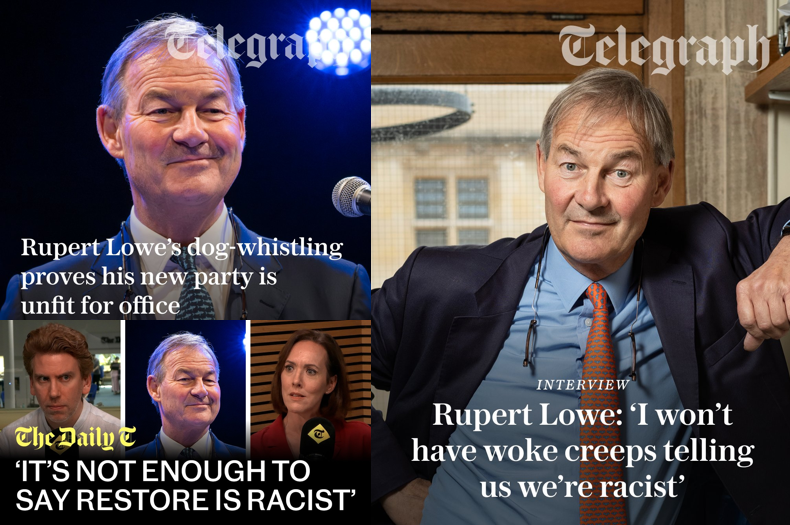
Restore activists who have been pictured with Rupert Lowe, attended and spoke at a white supremacist summit. A Restore Britain spokesman said that was "totally irrelevant."
9
38
216
5,617
GET A GRIP retweeted

Jun 10
here's the full clip of Rep. Emilia Sykes's brilliant line of questioning that made Chris Wright squirm by confronting him with the completely unhinged comments Trump just made in the Oval Office about inflation and the war in Iran
282
2,395
10,635
609,618

GET A GRIP retweeted

Jun 13
The thing I like about people with right wing views is that they all have this kind of serene beauty and sense of inner peace...


170
643
4,740
72,948
GET A GRIP retweeted

“Shut up, traitorous appeaser. You will pay the price eventually. Tick f***ing tock.” Online posts this week called for my execution, my home to be burnt down & my kids hurt. The far right want to freeze their critics into silence. They will never win.
belfasttelegraph.co.uk/sunda…
92
147
554
14,744
GET A GRIP retweeted

Suella Braverman, a trained barrister, is peddling a dangerous, deliberate lie to scrap the Equality Act.
This Act explicitly bans positive discrimination and quotas, it protects everyone, including white men, from unfair treatment on race or sex grounds.
She knows this. She’s weaponising the very real fears and frustrations of uninformed white working class men, pretending to champion them while cynically exploiting them for votes.
Disgusting. It is divisive poison from a politician happy to rip the country apart and let bad bosses discriminate freely, all for her own political resurrection.
Don’t let this grifter play you for fools. x.com/SkyNews/status/2066081…
20
133
272
3,185
GET A GRIP retweeted
Rupert Lowe’s rhetorical strategy, particularly his repeated use of terms such as “savages,” “third world savages,” “barbarians,” and “animals” to describe migrants from certain countries, alongside calls for the deportation of “millions and millions,” exemplifies a deeply flawed and politically counterproductive approach to discussing migration, crime, and social cohesion.
While Lowe presents himself as a truth-teller confronting realities others are unwilling to acknowledge, his rhetoric frequently substitutes visceral outrage and civilization caricature for careful, evidence-based analysis. The result is a style of political communication that dehumanises broad categories of people, exploits strategic ambiguity, and weakens the intellectual and political foundations of the reforms it claims to advance.
A defining feature of Lowe’s rhetoric is its calculated imprecision. References to “dangerous third world savages” being placed in British communities are rarely confined to clearly defined categories such as convicted violent offenders or failed asylum seekers. Instead, they are embedded within a broader discourse that encompasses those who allegedly fail to integrate, depend on welfare, occupy social housing, or originate from countries associated with large-scale migration.
This rhetorical elasticity allows him to move seamlessly between specific criminal acts and much wider populations. By embracing accusations of racism with remarks such as “If that makes me a racist, so be it,” while avoiding precise definitions, he cultivates the appearance of fearless candour while preserving plausible deniability. The effect is to transfer the stigma attached to the most serious offenders onto far larger groups who share only nationality, ethnicity, religion, or migrant status.
The significance of this ambiguity extends beyond questions of tone or precision. It reflects a broader process of essentialisation, whereby complex social phenomena are reduced to supposedly inherent characteristics of groups. Individual crimes, criminal networks, or integration failures become evidence not merely of specific social problems but of deeper national, religious, or civilizational deficiencies.
Terms such as “invasion,” “savages,” and “barbarians” do more than express anger; they establish a moral framework in which Britain is cast as a civilised society under siege from alien and inferior forces. Such language erases individuality, flattens complexity, and encourages audiences to interpret social tensions through the lens of collective threat rather than institutional failure, policy design, socioeconomic conditions, or individual responsibility.
The dehumanising character of this rhetoric is not incidental but central to its persuasive force. Labels such as “animals” and “savages” symbolically place their targets outside the boundaries of ordinary moral consideration. This is a well-established feature of dehumanising language in political communication, which frequently employs animalistic imagery to erode moral constraints and make exclusion or harsh treatment more publicly acceptable. History teaches us where it can lead. Lowe’s language implies that the pathologies associated with particular offenders are characteristic of the groups from which those offenders emerge.
Even when Lowe invokes genuine horrors, for example the grooming gang scandals in Rotherham, Rochdale, Telford, and elsewhere, where men of predominantly Pakistani heritage perpetrated systematic abuse amid institutional failures and documented reluctance by some officials to act for fear of racism, the framing encourages audiences to treat these crimes as representative of broader populations rather than particular offenders in specific contexts. In doing so, it amplifies perceptions of collective danger and blurs crucial distinctions between perpetrators and the vastly larger groups with whom they are associated.
This dynamic is reinforced by Lowe’s tendency to collapse a range of distinct issues into a single narrative of national decline and external threat. Grooming scandals, asylum policy, migration through irregular routes, violent crime, demographic change, welfare dependency, housing pressures, and integration failures are repeatedly woven into one simplistic overarching story of a country being overwhelmed by outsiders. The truth is that these phenomena have multiple different causes and require different responses. The language of “millions” who must leave Britain discourages differentiation and promotes sweeping attributions to broadly defined out-groups.
This tendency functions as a form of moral amplification. Highly salient crimes become symbolic representations of entire populations, while exceptional cases are elevated into evidence of broader civilization dysfunction. The emotional power of such rhetoric comes from compressing complexity into a simple story of civilisation vs barbarism, “us” vs “them.” However, the same simplification that makes it potent also makes it analytically weak and, at best, liable to generate policy responses that are poorly aligned with the complexity of the underlying problems.
Politically, Lowe’s rhetorical style is as self-defeating as it is inflammatory. His dismissive attitude towards labels such as racist, xenophobe, or Islamophobe may energise a committed base, but it ensures that debate centres on his language rather than the substantive issues.
Many voters who support tighter controls still recoil from rhetoric that evokes collective guilt or civilizational hierarchy, which some audiences associate with narratives of white supremacy. As a result, language designed to demonstrate uncompromising conviction often narrows the coalition needed for real change.
None of this requires denying cultural differences, integration challenges, or institutional failures. Serious discussion must confront uncomfortable realities, including patterns of offending in particular cohorts and institutional reluctance to address sensitive issues. But it depends on maintaining careful distinctions between individuals and groups, statistical patterns and moral judgements, and policy failures and personal responsibility. Lowe’s rhetoric repeatedly collapses those distinctions, sacrificing analytical precision for emotional force.
Ultimately, a significant problem with Lowe’s approach is not that it addresses difficult subjects but that it does so through dehumanisation, essentialisation, and deliberate overbreadth, when Britain needs a debate grounded in specificity, proportionality, and human dignity.
Rhetoric that relies on caricature, ambiguity, and collective stigma may generate outrage effectively, but it obscures the problems it claims to illuminate, makes constructive solutions harder to achieve, and distorts rather than illuminates public understanding.
Jun 11
‘How Real Problems Become Racial Explanations: Why Immigration Debates Go Wrong’
Racism is commonly understood as prejudice, discrimination, or hostility directed at people because of their race, ethnicity, or perceived racial characteristics. Most people recognise overt racism when they see it: slurs, exclusion, violence, or claims that some groups are inherently superior or inferior to others.
Most British people abhor racism. In contemporary Britain, however, the more consequential forms of racial thinking rarely begin in these explicit ways. They tend to emerge indirectly, through the attempt to explain real and visible social problems.
Immigration is one of the clearest examples of this dynamic. Many people who favour lower immigration strongly reject racism and believe their views are grounded in observation, experience, and common sense. In many cases, that is true. Concerns about housing pressure, crime, integration, public-service strain, cultural change, or rapid demographic shifts are not invented concerns. They arise from real conditions and real events.
The issue is not whether these concerns exist. It is how they are interpreted.
From observation to explanation
Humans are exceptionally good at noticing patterns, but far less reliable when it comes to explaining them. We register changes in our communities, encounter striking news stories, and experience pressures directly in daily life. From there, it is easy to move from observation to explanation and then from explanation to broader conclusions about groups of people, often without noticing that distinct inferential steps have been compressed into a single judgement.
At its core, much of the confusion in immigration debates comes from collapsing three distinct stages into one:
1. Observation: something is noticed. It could be a crime scandal, a statistical disparity, or a visible social change.
2. Explanation: a cause is proposed, perhaps culture, economics, institutions, policy, or discrimination.
3. Generalisation: a conclusion is drawn about entire groups of people.
Recognising robust patterns in data is not, in itself, an error. Any serious analysis of crime, welfare use, or integration has to start from what the numbers and histories actually show. The difficulty arises when these three stages blur together, so that a pattern is treated as if it already contained its cause and its meaning. Once that happens, conclusions can feel immediate and self-evident even when they are not.
Why our minds prefers simple stories
There is also a deeper reason this happens. Human cognition is not optimised for statistical explanation; it is optimised for speed, salience, and narrative coherence. We are drawn to vivid, recent, and emotionally striking examples when forming judgements. This is why cognitive shortcuts such as the ‘availability heuristic’ matter: memorable cases feel more representative than they are. It is also why essentialist thinking is so persistent: the mind tends to prefer stable underlying ‘natures’ rather than multi-causal systems shaped by changing conditions.
Culture is often where this simplification becomes most visible. In everyday political discussion, ‘culture’ is frequently treated as if it were a fixed or inherited trait. In reality, culture is better understood as a set of practices, norms, and expectations that can be both real and, in some respects, resistant to change, yet still shaped over time by economic conditions, institutions, incentives, and social environment. When culture is reified into something static or quasi-biological, it becomes easy to treat group differences as permanent rather than contingent.
These cognitive tendencies are not signs of irrationality. They are normal human features. However, they do make simplified explanations feel more compelling than complex ones.
Step 1: the observations are often real
Any serious account should begin by acknowledging that many of the underlying concerns in immigration debates are not illusions.
The ‘grooming-gangs’ scandals in towns such as Rotherham and Rochdale were real, and the institutional failures that allowed them to continue for years were extensively documented. Crime statistics do show over-representation of certain groups in some specific categories of offending. Some communities experience higher residential clustering, or more conservative social attitudes than the national average.
Immigration can contribute to housing demand and pressure on public services when infrastructure and planning do not keep pace. Fiscal outcomes also vary significantly depending on migrants’ skills, age, and employment patterns.
None of this needs to be denied or minimised. But none of it explains itself either.
Recent British experience also includes a different kind of failure: in some institutions, a reluctance to confront uncomfortable patterns for fear of being seen as racist. Grooming scandals, uneven enforcement, and the treatment of some whistleblowers show how avoidance and euphemism can allow genuine harms to persist. Any argument that took these problems less than seriously would rightly be rejected.
Step 2: where explanation becomes overconfident
The most common reasoning error in public debate is not a simple factual mistake, but what might be called ‘inferential overreach’. A pattern is observed, and the pattern is treated as if it already contains its explanation.
Yet between observation and conclusion lies explanation, and explanation is almost always multi-causal. Calling a pattern multi-causal does not mean every factor is equally important, or that culture, norms, or origin are irrelevant by definition. It means that when such factors matter, they do so alongside others, for example age structure, class, local opportunity, social networks, institutional response, and that their relative weight has to be shown rather than assumed.
Crime reflects interacting factors such as age structure, deprivation, neighbourhood concentration, policing practices, education, labour-market exclusion, migration selection effects, and cultural norms. Integration outcomes reflect language acquisition, economic opportunity, geography, discrimination, and generational change. Housing pressures reflect planning systems, building rates, land constraints, infrastructure decisions, and financial incentives. Immigration interacts with all these factors but rarely determines them alone.
The key issue is not whether any one factor matters, but how quickly people move from pattern to single-cause explanation.
Step 3: how explanations become identities
Once an explanation is chosen, it can harden into something stronger: an identity claim.
A behavioural pattern becomes a cultural essence. A statistical difference becomes a statement about what a group ‘is like.’ A local issue becomes a generalised claim about ethnicity, nationality, or religion.
At that point, reasoning has shifted from analysis to essentialism. This does not require anyone to use explicit racial language or to endorse biological hierarchies. It is enough that a set of outcomes is taken to reveal a stable underlying nature.
This process is usually not driven by hostility. It is driven by compression: the gradual shortening of the distance between observation and conclusion until intermediate steps disappear, and explanatory mechanisms are displaced by identity categories.
Case study: crime and interpretation
Crime statistics illustrate this clearly. It is true that some groups are over-represented in some categories of offending. It is also true that crime is unevenly distributed across geography, age, and socioeconomic status, and that some of these patterns have proved stubborn over time in particular places.
But what follows from that is not straightforward.
The same pattern can emerge from multiple overlapping causes: demographic structure, concentrated deprivation, urban settlement patterns, migration history, policing intensity, reporting differences, and indeed varying norms about violence, authority, and gender. These mechanisms can operate together, and their relative weight varies by context. Treating ‘culture’ or ‘origin’ as the entire explanation, without specifying how they interact with these other factors, is as much an oversimplification as ignoring norms altogether.
A statistical pattern, on its own, is not an explanation.
Integration: uneven outcomes, uncertain meanings
‘Integration’ is similarly complex. It is observable that integration proceeds at different speeds across communities and over time. Some groups show rapid convergence in language, education, and social participation. Others do so more slowly.
But it does not follow that slower integration implies permanent incompatibility.
Historical experience is instructive here. Groups such as Irish Catholics, Jewish communities, and various European migrant populations were, at different points in British history, the subject of intense public anxiety and frequently described in explicitly exclusionary terms. Victorian and early twentieth-century commentators often treated them as fundamentally separate or unassimilable. Over time, however, these same groups became deeply embedded in British social and civic life. The intensity of earlier panic is now often forgotten, but it illustrates how strongly integration trajectories can change across generations.
Today’s patterns differ in obvious ways: source countries, migration volumes, welfare institutions, and global communications create dynamics that have no exact historical parallel. The point of these analogies is not that every group will follow the same path, but that early or mid-course difficulties are weak evidence that trajectories are fixed and unchangeable.
Economics and housing: partial causes becoming total explanations
Immigration can increase demand for housing and public services, particularly when population growth is rapid. In certain localities, the speed and scale of change can genuinely outstrip institutional capacity.
But housing shortages in Britain also reflect long-term under-building, restrictive planning systems, infrastructure constraints, land availability, and financial dynamics in the housing market. Similarly, fiscal impacts vary widely across migrant groups and over time. Some migrants contribute significantly over the long term, particularly those in work and in skilled occupations, while others have more mixed fiscal profiles depending on employment and household structure.
The analytical error occurs when immigration is treated as the dominant explanation for structural issues that have multiple independent causes, or when complex economic dynamics are compressed into moralised stories about what particular nationalities or religions ‘are like’.
Why selective truth is so persuasive
Misleading narratives can sometimes be powerful precisely because they are not fabricated: they are constructed from real events and real statistics, but arranged selectively. Salient examples are emphasised, while broader context, countervailing evidence, and structural complexity are downplayed.
This produces a picture that feels accurate at the level of individual claims but becomes distorted at the level of overall interpretation. The practical question for any of us, whatever our starting point, is not whether we have noticed true things, but whether we are willing to ask what is missing from the picture that feels most intuitive to us: what data, counterexamples, or structural features we have quietly set aside because they do not fit the story.
How racial thinking can emerge without intent
Most people do not begin with racist beliefs. More commonly, they begin with genuine concerns or observations and encounter repeated explanatory frames that direct attention toward ethnicity, nationality, or religion.
Over time, three shifts can occur: from individuals to groups; from variation to stereotypes; and from explanation to identity. These shifts do not require malice. They arise from repetition, cognitive bias, and the human preference for coherent easily understood narratives over complex systems.
This process is reinforced by institutional and informational environments. Media systems prioritise attention-grabbing cases. Political actors amplify salient examples. Online platforms reward emotionally resonant interpretations. Together, these forces systematically favour simplified causal stories over carefully contextualised, multi-causal explanations.
Scepticism and intellectual discipline
Critiques of structural or institutional racism are correct to note that disparities do not automatically imply discrimination. Differences in outcomes can arise from many non-racial causes.
But the reverse is also true: disparities do not automatically imply cultural deficiency or inherent group characteristics. Whether discrimination, culture, policy, or other factors are responsible is an empirical question that must be assessed case by case. Treating outcomes as multi-causal does not mean denying that, in some settings, one set of causes (such as norms, networks, or selection effects) may be especially important. It means refusing to treat a single category such as ‘origin’ or ‘culture’ as sufficient explanation on its own, without asking what else is at work and how those elements interact.
A consistent standard of reasoning requires applying scepticism evenly across competing explanations rather than selectively. Recent history also shows that silence and euphemism can sometimes be as harmful as overstatement. The aim is not to return to a culture of denial, but to describe problems plainly and then resist the temptation to convert them into stories about fixed group nature.
Data and policy inference
None of the arguments above imply that aggregate statistical patterns are irrelevant to public policy. Governments necessarily rely on population-level data when designing immigration systems, labour-market planning, and integration policy. The quality, completeness, and interpretation of that data are therefore central to effective decision-making. It is both legitimate and unavoidable to consider differences in outcomes when making decisions about selection criteria, skills requirements, or institutional capacity.
The distinction to draw is not between ‘using data’ and ‘ignoring data.’ It is between two different kinds of inference: using statistical information to manage systems on the one hand, and on the other, treating those same patterns as evidence of fixed group characteristics, moral worth, or cultural essence. The first is a standard feature of governance and, depending on the evidence and on public priorities, may support more restrictive or more expansive policies in different domains. The second is where reasoning begins to drift into essentialism.
Immigration levels, selection rules, and the pace and distribution of change are all legitimate subjects for disagreement. Applying intellectual discipline to explanation does not predetermine the policy outcome. But it does require that whatever choices are made rest on clear mechanisms rather than on stories about what whole groups of people are supposedly like.
What Real Understanding Requires
Immigration should be debated openly and rigorously, including its costs, benefits, and trade-offs. But it also needs to be analysed with a level of intellectual discipline that is too often missing from public discussion.
A recurring mistake in this debate lies in how problems are interpreted. Human societies are complex, multi-causal systems. When that complexity is ignored, even entirely genuine concerns can be drawn toward overly confident conclusions about entire groups of people.
These patterns of reasoning are not unique to any one side of the debate; they appear across political perspectives whenever vivid evidence is filtered through prior expectations.
The critique of racism is therefore not only moral, but explanatory. It targets a specific shortcut in human reasoning: the tendency to flatten complex social realities into simple stories about what entire groups ‘are like’. English people or Muslims are not ‘all the same’ any more than Americans or Jewish people are.
Some arguments in this space concern legitimate questions of capacity, selection, and pace. Others slide into claims about fixed group characteristics or cultural essence. It is primarily this second move that is being examined here.
These patterns of compression are not confined to critics of immigration. They also arise among those who are broadly supportive of higher immigration, when vivid humanitarian cases or striking positive exemplars are treated as if they capture the whole picture. In both directions, on the left and the right, selective attention can make certain stories feel more representative, ‘more true’, than they actually are.
The shortcut being criticised here begins with observations that are real, but not yet fully understood. This dynamic is reinforced by the wider information environment. Even after correcting for these reasoning errors, reasonable people can still disagree about the acceptable level and pace of immigration, because they differ in values, priorities, and risk tolerances. The aim is not to abolish disagreement, but to improve the quality of judgement on which disagreement is based.
At its core, the argument is straightforward: real problems do not, by themselves, disclose simple truths about what whole groups of people are like.
The critique of racism here targets the leap from genuine observations to fixed stories about group character and cultural essence. It is in that leap (from facts that are real but incomplete, to identities that are treated as settled) that reasoning goes most dangerously astray.
The shortcut in question does not necessarily begin with falsehoods. It often begins with partial truths, treated as settled judgements about who people are.
3
16
29
2,796
GET A GRIP retweeted

American here. Farage sounds exactly like trump and Republicans in the USA. And just like US media, the UK media are failing to do their job. I highly recommend @zeteouk. @mehdirhasan and his crew do an excellent job holding politicians accountable.
2
6
120
GET A GRIP retweeted
Nigel Farage explicitly and repeatedly claimed in late 2024 and early 2025 interviews (after his election as MP for Clacton) that he had bought a house in Clacton.
To Sky News (November 2024): “I’ve just exchanged contracts on the house that I’ll be living there in – is that good enough?… I’ve bought a house in Clacton. What more do you want me to do?”
To LBC (January 2025): He stated he had bought a house in Clacton, adding details about being seen out shopping locally.
The truth, widely reported in the 'mainstream media', is that the £885,000–£900,000 detached house in Frinton-on-Sea (part of the Clacton constituency) was purchased outright in November 2024 solely in the name of his partner, Laure Ferrari.
Land Registry documents list her as the sole owner; Farage has no legal or financial stake in it.
In September 2025, after the discrepancy was highlighted, Farage admitted he was wrong to phrase it that way.
Phrase it that way?
This was not media distortion of his words—the claims he made are on record in multiple interviews, and he later acknowledged the inaccuracy.
He lied. Repeatedly. And now the pathetic coward is hiding from scrutiny and accountability.
Here are several documented cases where Nigel Farage made claims that were proven false, misleading, or which he later admitted were wrong (beyond the Clacton house example). all of which the 'mainstream media' highlighted:
1. £350 million a week to the #NHS
Farage and the Leave campaign prominently featured the claim that the UK sent £350m a week to the EU, which could go to the NHS instead (on the famous battle bus and posters).
Reality: This was the gross figure before the UK rebate and other receipts; the net was around £250m or less. Post-referendum, Farage distanced himself, calling it “a mistake” and saying “I would never have made that claim.” He noted it wasn’t his advert but had not openly condemned it during the campaign
2. Migrants eating swans in Royal Parks (2025)
Farage claimed on LBC that “swans were being eaten in Royal Parks” and carp taken from ponds by migrants from “different cultures.”
Reality: The Royal Parks authority stated there were no reported incidents of people killing or eating swans in the eight Royal Parks. Police and fact-checkers found no supporting evidence for the specific claim.
3. Shoplifting up to £200 goes unpunished (repeated, e.g. 2024–2025)
Farage claimed you can shoplift up to £200 before prosecution.
Reality: False. There is no such £200 threshold; prosecutions occur for far smaller amounts, and police/courts have handled many cases below that figure.
4. 2.4 million people “settled” in the UK in two years (2024)
Farage stated 2.4 million had settled.
Reality: Gross arrivals were around that, but many were temporary (students, workers on contracts). Net migration was far lower. Not all “settled.”
5. Local election candidates shouting “Allahu Akbar” and “we are coming to get you” (2024)
Farage claimed this happened in Leeds, Burnley, Bradford, etc.
Reality: One candidate in Leeds did say “Allahu Akbar” (a common celebratory phrase) and made Gaza comments (later apologised for). No evidence for the other locations or the “we are coming to get you” threat.
6. Crime statistics:
Farage has repeatedly claimed police-recorded crime shows rises contradicting official falls; fact-checks often note selective use or context missing (e.g., reporting changes, post-pandemic effects).
7. Immigration/economy claims:
Multiple fact-checks on net migration impacts, housing needs, and economic comparisons to the EU have been rated misleading or false in presentation.
1 Oct 2025
In 2018, Farage appeared on conspiracy theorist Alex Jones’s Infowars show, where Jones infamously denied the Sandy Hook school shooting. Farage did not challenge Jones’s lies and framed the bereaved parents’ lawsuits as “an attack on free speech.”
theguardian.com/politics/art…
2
187
295
6,511
Excellent news for Britain. He's a shit-stirring gobshite.

Sir Trevor Phillips will be leaving Sky News this summer to take up a new role in the US.
Executive Chairman @davidgrayrhodes said: "Sir Trevor Phillips has brought audiences insightful conversations every Sunday - at Sky News we’re grateful for all that he has contributed.
I know Trevor will bring the best of that to America with this exciting new opportunity. We wish him every success"
2
33
809
It only takes about 5 minutes of watching GB News to understand why Farage & Lowe supporters live in a completely fucking different reality than everyone else.
Jun 13

It only takes about 5 minutes of watching Fox News to understand why Trump supporters live in a completely fucking different reality than everyone else.
16
51
794
GET A GRIP retweeted

Jun 12
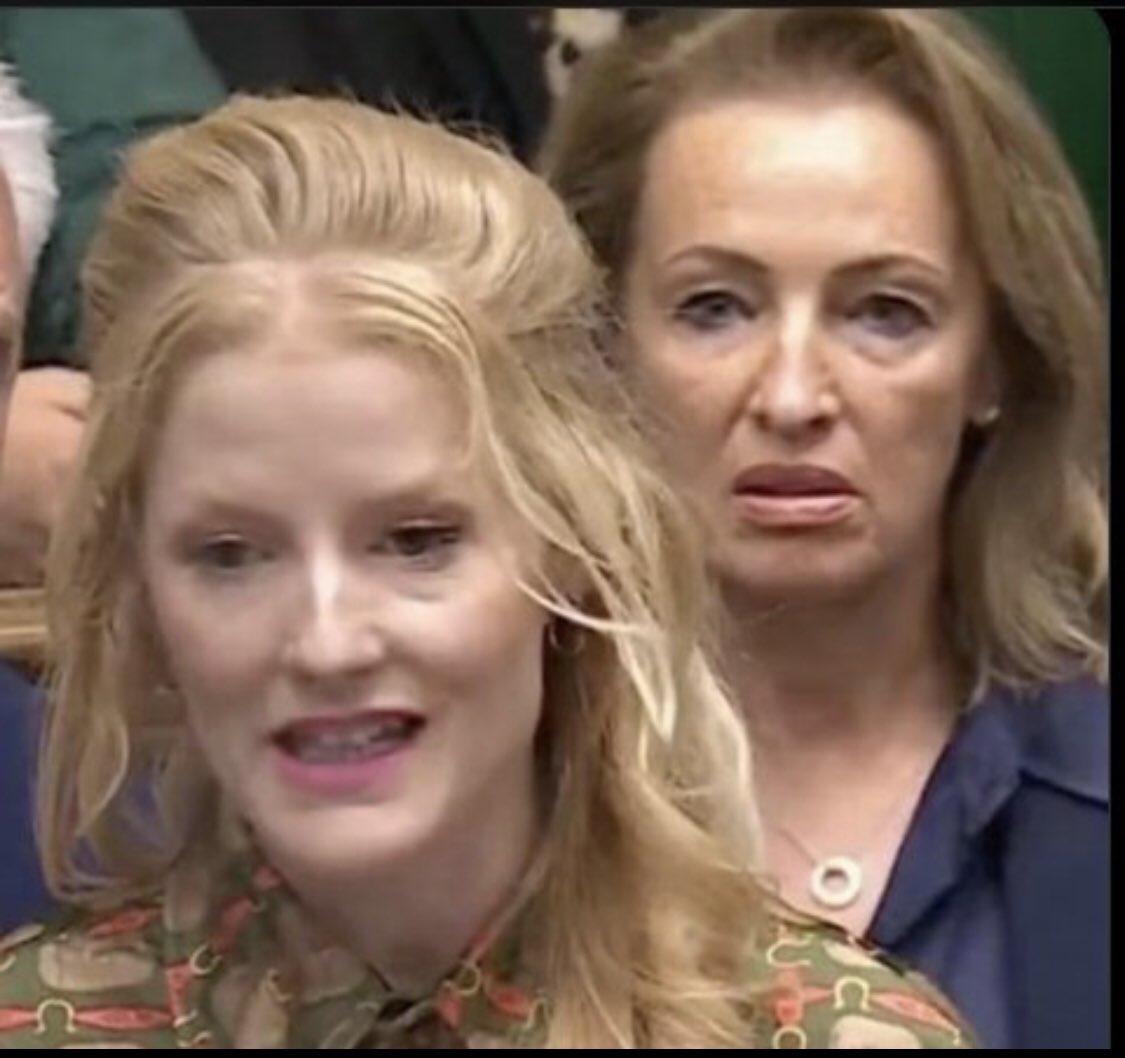
[Greggs - one sausage roll remaining]
"... And a sausage roll, please"
95
1,062
19,483
446,878
GET A GRIP retweeted
16h
VAN SUSTEREN: Who is our best friend in South America at this point
KRISTI NOEM: We've worked so much with El Salvador ... Costa Rica has been fantastic
(El Salvador and Costa Rica, dear reader, are not in South America)
603
3,026
19,161
1,042,085
GET A GRIP retweeted

Jun 13
Setting fire to houses with families inside them: legitimate concerns
Criminal damage to an arms company supplying a genocide: terrorism
390
2,859
9,542
133,619
GET A GRIP retweeted

18h
The good people in Belfast came out in force to protest against the far-right.
956
1,921
10,899
150,370
GET A GRIP retweeted

Jun 12
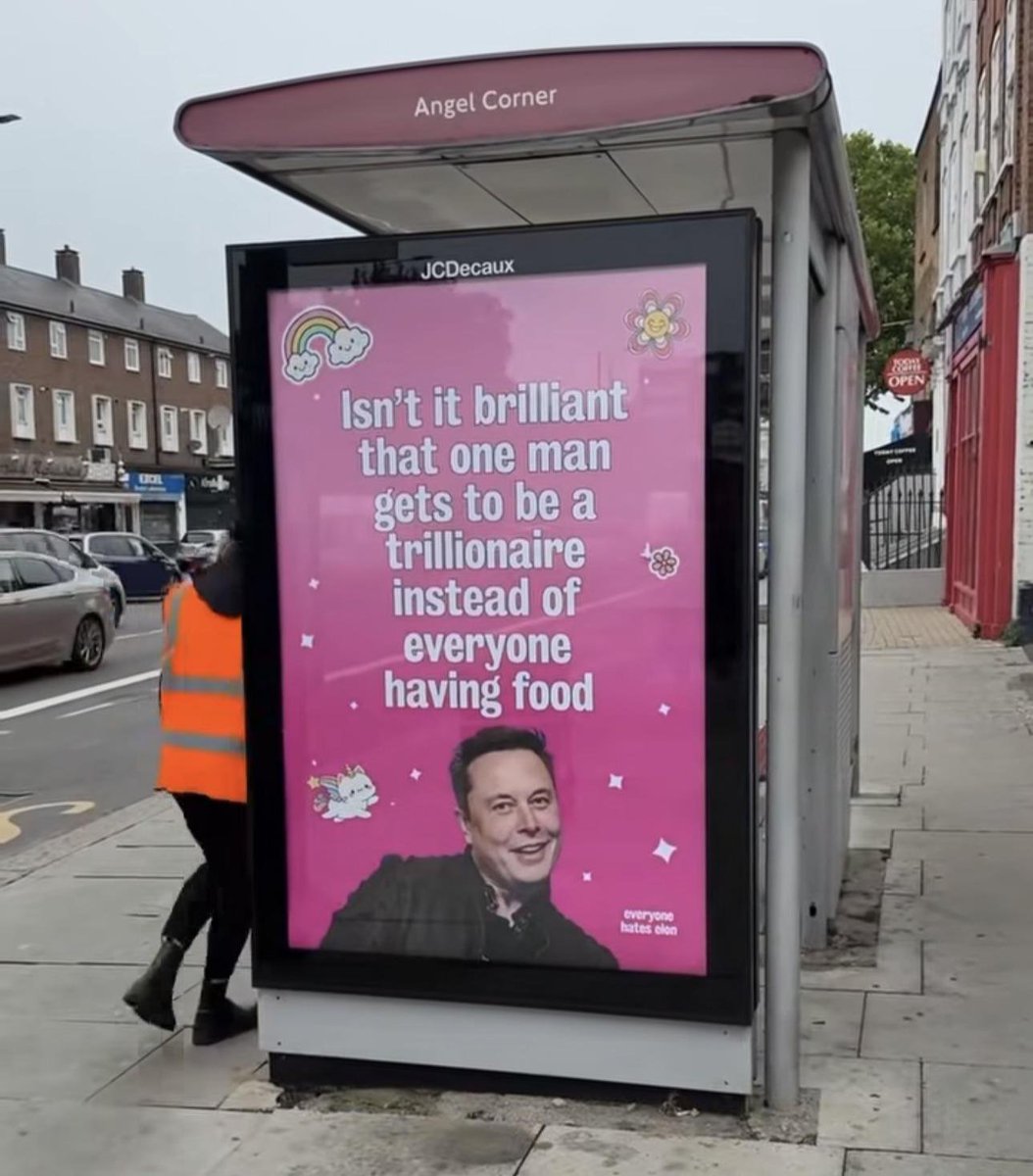
Call me a hater but I think living in a world where both trillionaires and global poverty coexist is a sign humanity has failed as a species


4,920
65,983
441,335
6,274,495
GET A GRIP retweeted

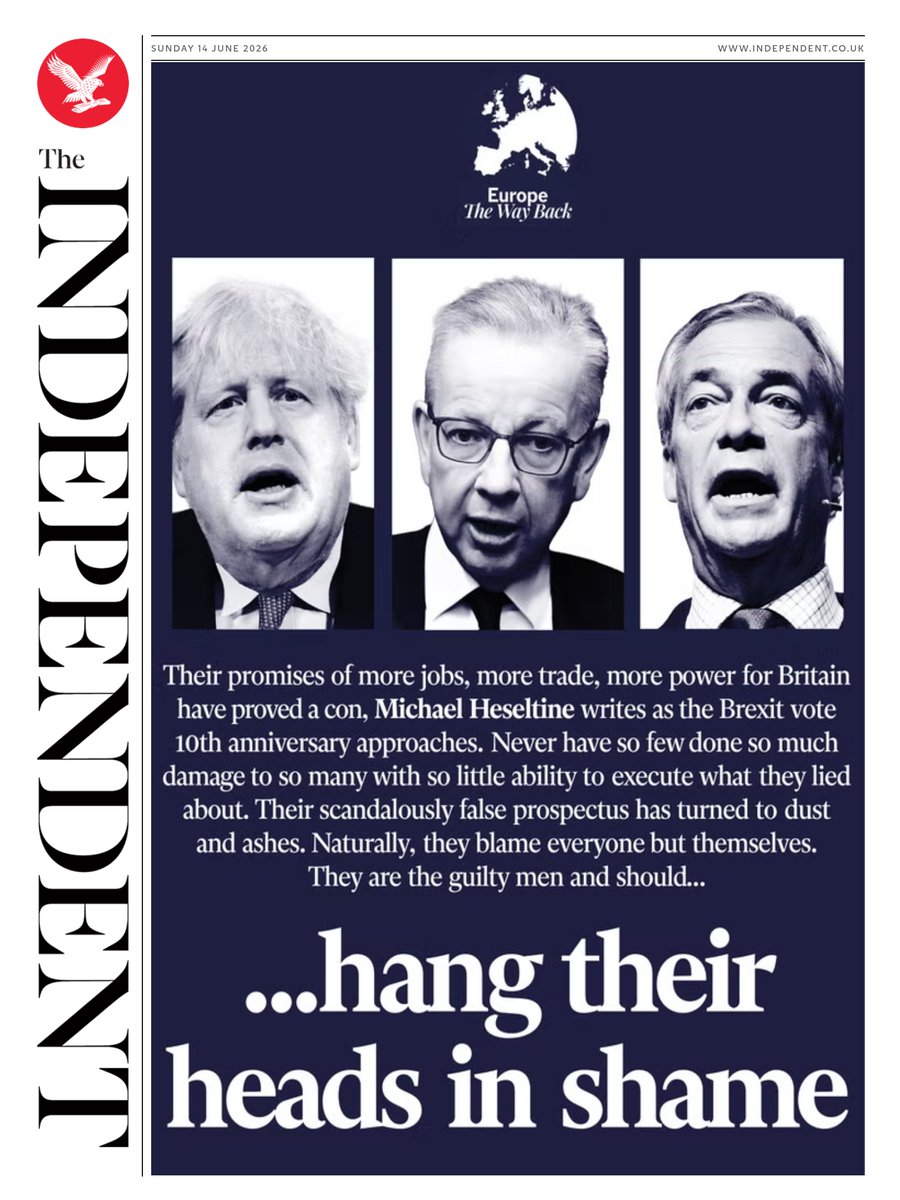
Tomorrow's @independent front page. To subscribe to the Daily Edition independent.co.uk/subscribe
59
1,286
2,705
50,851
#1 Most Predictable Thing In The Universe
"He asked his supporters to donate money to fund his legal defence"
2
4
42
748
GET A GRIP retweeted

Jun 12
A Muslim teacher was stabbed in the neck protecting his pupils from a knife attack in Manchester.
The Mirror called him a hero. The Sun. The Independent. LBC. The MEN.
As of today, the BBC has not printed his name.
In 2015, the BBC named a stabbed Bradford teacher the same day.
His name is Maysum Abdullah.
Science teacher. Husband. 27 years old.
When a pupil pulled a knife at Co-op Academy Manchester, he put his body between the blade and his students. He was stabbed in the neck and hand.
His wife Saima: "My husband entered teaching to make a positive difference in young people's lives."
Not one headline tells you he's a Muslim man.
Now imagine the name Abdullah belonged to the attacker.
You don't have to imagine. We watched it after Southport.
Riots in the street. Far-right accounts amplifying his name to millions within hours. Every politician condemning it. Muslim leaders dragged in front of cameras to answer for him.
He ran towards the knife. And his faith vanished from the page.
When we're the suspect, our identity is the headline.
When we're the hero, it disappears.
His name is Maysum Abdullah.
A Muslim man.
Say both.
Report: Islamophobiauk.co.uk
Keep us alive: ko-fi.com/islamophobiauk
Substack: substack.com/@islamophobiauk
IG: @islamophobiauk
X: @ukislamophobia

85
1,942
7,937
221,375