
A nonpartisan coalition of non-profit, academic, foundation & corporate leaders working to strengthen American science & technology.
Joined January 2021
- Tweets 739
- Following 128
- Followers 597
- Likes 78
175 Photos and videos
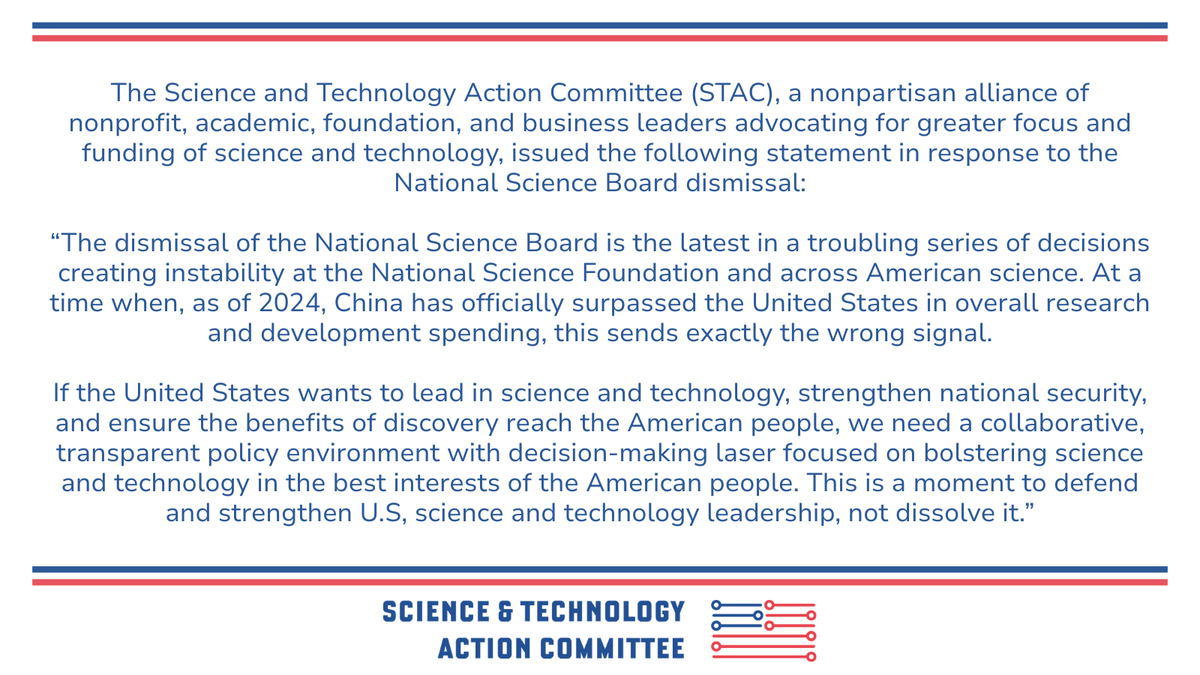

STAC’s Statement on the National Science Board Dismissal
1
2
289
Science & Technology Action Committee retweeted

American companies are already at the forefront of robotics innovation—from last-mile delivery to elder care and disaster response. As Chairman @RepBrianBabin highlighted earlier today, U.S. industry recognizes this opportunity and is working to build the future of robotics.
1
4
328
A new analysis shows American science is shrinking and the data is stark. NIH competitive grants are down >50% year-over-year and NIH-funded projects dropped 15% in FY25. Without sustained federal investment in our scientific enterprise, the U.S. risks losing its competitive edge

American science is shrinking.
A Post analysis found that, halfway through this fiscal year, the number of competitive grants awarded by the National Institutes of Health is down by more than half compared with the same period last year. wapo.st/3OgoHKV
3
3
488
As @NASA puts it, Artemis II is just the “opening act” for sustained exploration of the Moon and beyond. That future depends on decades of research and continued investment in S&T. Read about the historical mission and future of U.S. in space @SPACEdotcom tinyurl.com/ms9n3bfh
33
China has surpassed the US in total R&D investment ($1.03T in 2024), per @OECD. The implications for US policy are immediate. Public R&D is one of the highest-returning federal investments, yet proposed cuts move in the opposite direction.@AAUniversities⬇️ aau.edu/newsroom/leading-res…
1
2
52
A new op-ed from @ResearchAmerica grant recipient JP Flores explores why scientists must engage directly with communities, especially in an era where misinformation spreads fast.. Read more in @Sci_politic sciencepolitics.org/2026/03/…
34
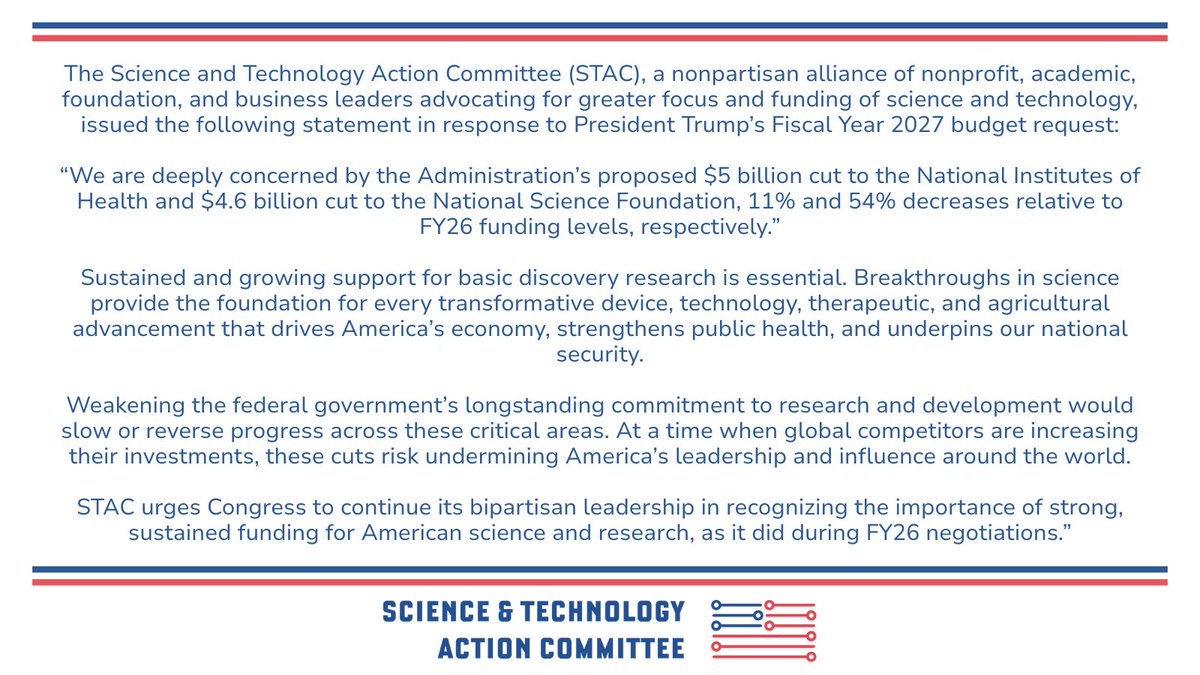
STAC Statement on the President’s FY2027 Budget Request
1
2
84
A piece from STAC member Harvey Fineberg in
@PNASNews offers a sharp look at what it will take to revive U.S. science leadership. Key point: flat funding isn’t enough. The U.S. needs to invest in talent, prioritize key technologies and rebuild public trust.pnas.org/doi/10.1073/pnas.25…
2
118
Science & Technology Action Committee retweeted

Mar 28
While U.S. research struggles, a different pattern is emerging overseas, @andersen writes. Is China on the verge of becoming the next scientific superpower? theatlantic.com/science/2026…
14
28
77
30,907
A new survey highlighted by @statnews shows many NIH-funded labs scaling back research, delaying projects, and struggling to retain talent. Sustained, predictable funding is critical to protecting the next generation of scientific discovery.
statnews.com/2026/03/19/nih-…
1
94
Science & Technology Action Committee retweeted
"China is fully committed to achieving its 'Space Dream' and will leverage all resources to achieve the goal of becoming a global leader in space."
- Mr. Dave Cavossa (@csf_space)
1
244
An analysis by STAC members highlights a turning point in global science leadership. China may soon lead in public R&D funding and could surpass the U.S. in basic science within a decade. The moment calls for renewed U.S. investment. From @Nature ⬇️ nature.com/articles/d41586-0…
1
43
Research funding from @NIH generated $94B in economic activity in 2025, a $2.57 return for every $1 invested, supporting nearly 391,000 jobs nationwide. Biomedical research fuels innovation and local economies. Read more from @Forbes ⬇️
forbes.com/sites/michaeltnie…
1
1
72
The next leap in scientific discovery won’t just come from AI, it will come from people. @DOE says the goal is to double the productivity of science R&D spending, alongside new university partnerships focused on hands-on training for the future workforce.

What's next for the Genesis Mission trib.al/Mfh8j4h
46
.@NASA is strengthening the Artemis program as America prepares to return astronauts to the Moon. This initiative underscores how sustained investment in S&T supports innovation, strengthens the research ecosystem, and helps maintain U.S. leadership.
🚀 nasa.gov/directorates/esdmd/…
31
The BIOTech Caucus announced its first-ever legislative endorsements, backing the National Biotechnology Initiative Act and the Biomanufacturing Excellence Act.
Momentum is building to strengthen U.S. biotech leadership. More from @RepHoulahan & @RepBice🔗houlahan.house.gov/news/docu…
46
America’s competitiveness in the global technology race is back on the congressional agenda. Last week, a bipartisan group of Senators reintroduced the Future of AI Innovation Act to expand @NIST’s AI standards work and strengthen R&D coordination. @axios⬇️axios.com/2026/02/26/senator…
31
STEM jobs are growing faster than non-STEM jobs in the U.S. Today, 36 million Americans—1 in 4 workers—are in STEM roles. Sustaining this momentum requires stronger education pathways and retention across the talent pipeline.
New analysis from @NSF_NSB ⬇️ ncses.nsf.gov/pubs/nsb20261/…
32
China’s 1999 higher ed expansion boosted U.S. STEM growth. International student flows are tightly tied to American innovation and economic competitiveness. In order to maintain its innovation edge, the U.S. needs a plan. More from @StanfordSCCEI👇
sccei.fsi.stanford.edu/china…
35
Europe, the UK, and China are actively recruiting U.S.-based scientists amid research funding cuts. For America, this is a competitiveness warning: sustained funding uncertainty risks driving top talent and future innovation abroad. More in @semafor semafor.com/article/02/12/20…
46