
Joined July 2021
- Tweets 1,037
- Following 523
- Followers 1,655
- Likes 522
62 Photos and videos


The Scroll retweeted

16 May 2025
If you read The Scroll, you still have TWO HOURS to sign up for a year's subscription to @tabletmag and @Scrollletter and get...
✅ 1 free gift subscription
✅ 18% off with coupon code CHAITABLET
Link here: bit.ly/subscribetablet
2
7
12,160
The Scroll retweeted

13 Feb 2025
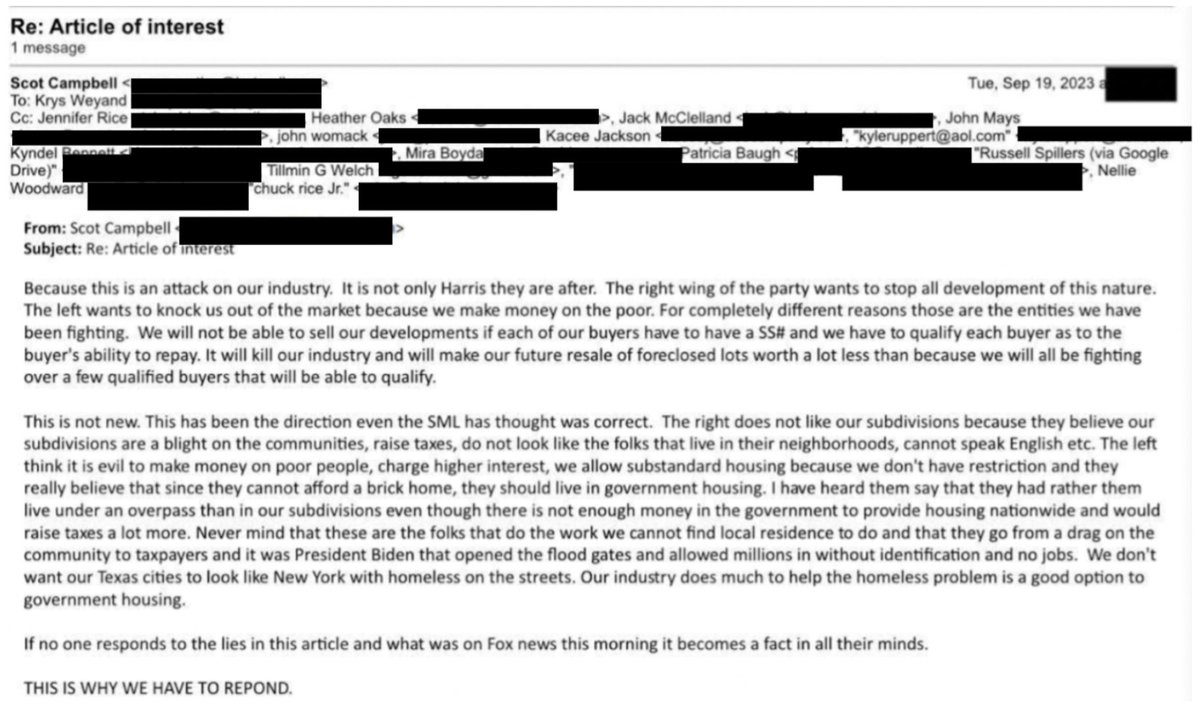
EXCLUSIVE: A Texas land developer admitted that the Colony Ridge business model relies on selling land to unqualified foreign buyers:
"We will not be able to sell our developments if each of our buyers have to have SS#’s."
I obtained his stunning admissions🧵
757
8,718
19,277
785,973

30 Jan 2025
From our Feb. 2, 2024 edition:
→In our Jan. 16 Big Story, we mentioned a 2014 initiative by the Federal Aviation Administration (FAA) to hire more minority air-traffic controllers (ATCs) by scrapping a standardized test, the AT-SAT, and replacing it with a non-validated “biographical assessment” that awarded candidates points for, among other things, earning poor grades in high-school science and having a recent history of unemployment. For the past two weeks, X user @TracingWoodgrains has been digging through court documents from Brigida v. U.S. Department of Transportation, a class-action lawsuit challenging the FAA’s use of the assessment. He’s confirmed our and others’ reporting about the case and also turned up some additional entertaining/alarming details:
* The biographical assessment was intentionally designed to fail 90% of applicants so that the FAA could “purge” graduates of the Air-Traffic-Collegiate Training Initiative, who were disproportionately white.
* Prior to the adoption of the biographical assessment, Shelton Snow, an FAA employee and president of the Washington Suburban chapter of the National Black Coalition of Federal Aviation Employees (NBCFAE), distributed a list of “buzzwords” to NBCFAE members that would “automatically push their résumés to the top of the file.”
* After the assessment was implemented at the urging of the NBCFAE, Snow organized a teleconference for NBCFAE applicants in which he gave them the correct answers to the test. The FAA later investigated Snow, confirming that he had helped NBCFAE members cheat on the test (which Snow initially denied) but clearing him of “doing anything wrong” because the charges did not “warrant a referral to a federal prosecutor.”
* According to one whistleblower, employees from the FAA’s Human Resources department organized a “résumé clinic” for NBCFAE applicants in which the FAA employees directly assisted the applicants in filling out the application and provided them with “buzzwords” to include on their résumés.
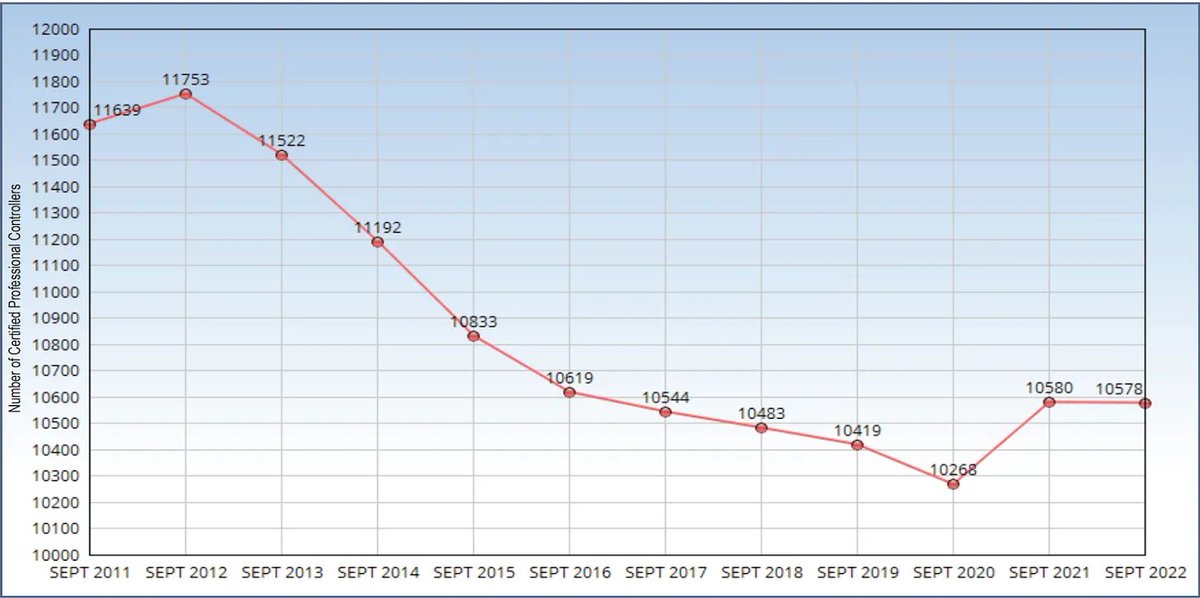
Congress passed a law banning the use of the biographical assessment in 2016, but ATC staffing has not recovered since the initial changes to the hiring process were announced in December 2013. Here’s a chart of the number of certified ATCs in the United States, from a 2023 report from the National Airspace System Safety Review Team, which warned that “there are 1,002 fewer fully certified air-traffic controllers in August 2023 than in August 2012”:
You can take the FAA’s biographical assessment yourself here: kaisoapbox.github.io/faa_bio…
3
73
29
3,152
15 Jan 2025
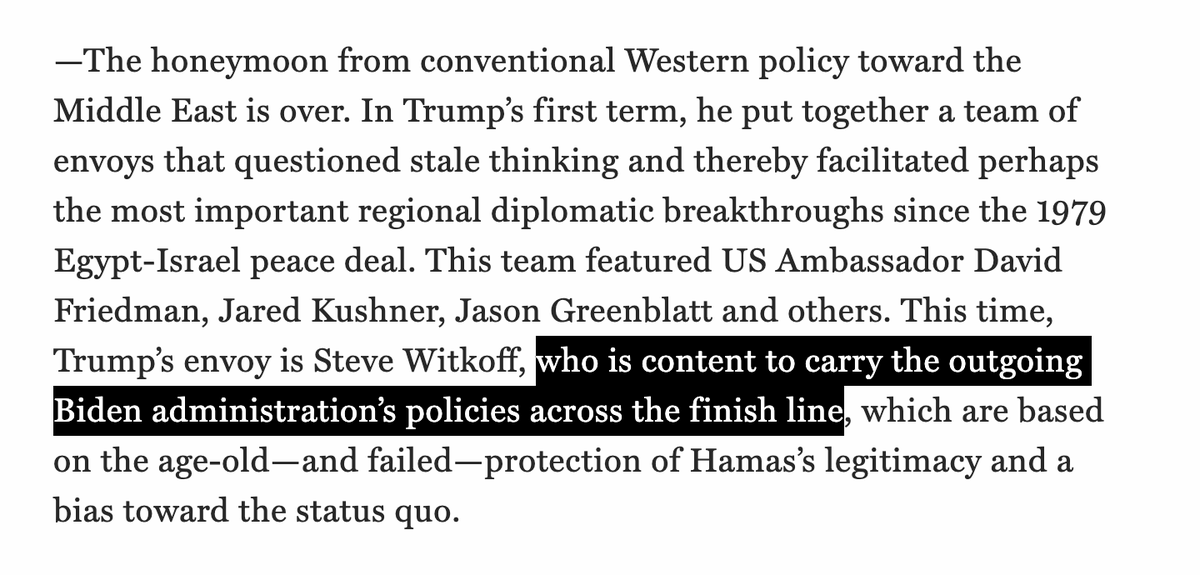
This is the key point. In order to deliver a "win" for the inauguration, incoming Trump team appears to be abandoning successful Trump 45 approach and embracing the failed Obama-Biden framework that led us to this point, as Trump himself has frequently observed
15 Jan 2025

The Deal: A Guide for the Perplexed - great @SethAMandel analysis. Not a win. It’s a life line for Hamas that accelerates Biden’s plan … commentary.org/seth-mandel/t… via @commentary
68
14
3,279
The Scroll retweeted

15 Jan 2025
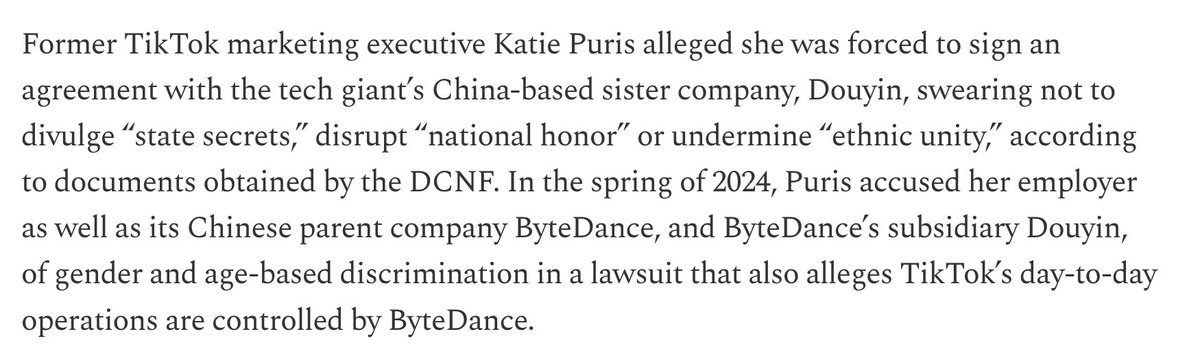
EXCLUSIVE: Documents And Recordings Reveal How TikTok Forced Staff To Swear Oaths To Uphold China’s ‘Socialist System’
dailycaller.com/2025/01/14/t…
5
120
132
14,536
The Scroll retweeted

14 Jan 2025
President-elect wants to start his term with a big win, but Hamas hostage deal can go wrong in a thousand different ways. Me, @Jacob__Siegel et al in "Trump Embraces Biden Ceasefire Deal" via @Scrollletter
thedailyscroll.substack.com/…
13
95
67
13,522
14 Jan 2025
→Quote of the Day:
I feel liberated. We can say ‘retard’ and ‘pussy’ without the fear of getting cancelled. … It’s a new dawn.
That’s a quote from a “top banker” on Wall Street in a Financial Times article on whether corporate America is “going MAGA,” citing, as evidence of the trend, Amazon’s recent $40 million acquisition of the rights to a documentary about Melania Trump, the recent rush by major corporations to scrap their DEI policies, and a series of moves by Meta, including ending the use of third-party fact-checkers and adding Trump ally and Ultimate Fighting Championship CEO Dana White to its board. But sometimes, as the above quote suggests, it’s the little things that matter to some people.
ft.com/content/cf876b19-8c69…
1
78
12
743
14 Jan 2025
→Trump is also providing plenty of business opportunities for lobbyists like Ballard Partners, the former firm of Trump chief of staff Susie Wiles and attorney general nominee Pam Bondi, which was hired by Harvard University to lobby on “advocacy supporting education and educational research,” according to a report by @ChuckRossDC in @FreeBeacon. Harvard President Alan Garber, Ross notes, has been attempting to warn his asylum inmates faculty that the school will have to take a more “diplomatic” approach to Trump during his second term, reportedly warning faculty in a closed-door meeting in December that they will need to listen to public criticism with “empathy and humility” following the “anti-elite repudiation” of the November election. Presumably, Garber hopes that such “empathy and humility” will protect him from congressional antisemitism hearings and from policies such as a 2023 bill introduced to the Senate by Vice President-elect J.D. Vance, which would have raised the tax rate on Harvard’s endowment from 1.4% to 35%. Garber has previously stated that such threats “keep me up at night.”
freebeacon.com/campus/harvar…
1
1
502
14 Jan 2025
Jan 14: Trump Embraces Biden Ceasefire Deal
THE BIG STORY
A cease-fire deal between Israel and Hamas is “on the brink of finalization,” according to The Times of Israel (TOI). Tuesday saw contradictory reports as to whether Hamas had accepted the deal, but officials from Israel, the United States, Egypt, and Qatar all seem to believe that the talks are “at the final stages,” in the words of the Qatari foreign ministry. As we noted yesterday, negotiations were apparently advanced by Trump Middle East envoy Steve Witkoff, who, according to reports in the Israeli press, bludgeoned Netanyahu into accepting the deal during a “tense” meeting in Jerusalem on Saturday. Haaretz reports that Bibi’s aides initially declined the meeting, saying the prime minister was observing the Sabbath, only for Witkoff to explain in “salty English” that “the Sabbath was of no interest to him.”
The deal appears to be a version of the deal proposed by Joe Biden in May, according to a draft obtained by the Associated Press, and would involve three stages:
1. The “gradual release” of 33 “humanitarian” hostages—“most” of whom are believed to be alive—in exchange for hundreds of Palestinian security prisoners. This will include five female Israeli soldiers, who will each be traded for 50 Palestinian prisoners. This first stage will last 42 days and will see the IDF withdraw from Gaza’s population centers, allow Palestinians to return to northern Gaza, and surge the delivery of humanitarian aid. The Israelis would also withdraw from the Netzarim Corridor, which divides northern from southern Gaza, but retain control of the Philadelphi Corridor (dividing Gaza from Egypt) during the first stage.
2. The second stage will be negotiated during the first stage and will involve the release of the remaining living captives, mostly male soldiers, for more Palestinian prisoners and a full Israeli withdrawal from Gaza.
3. The bodies of the remaining hostages will be returned in exchange for a “three-to-five-year reconstruction plan to be carried out in Gaza under international supervision.”
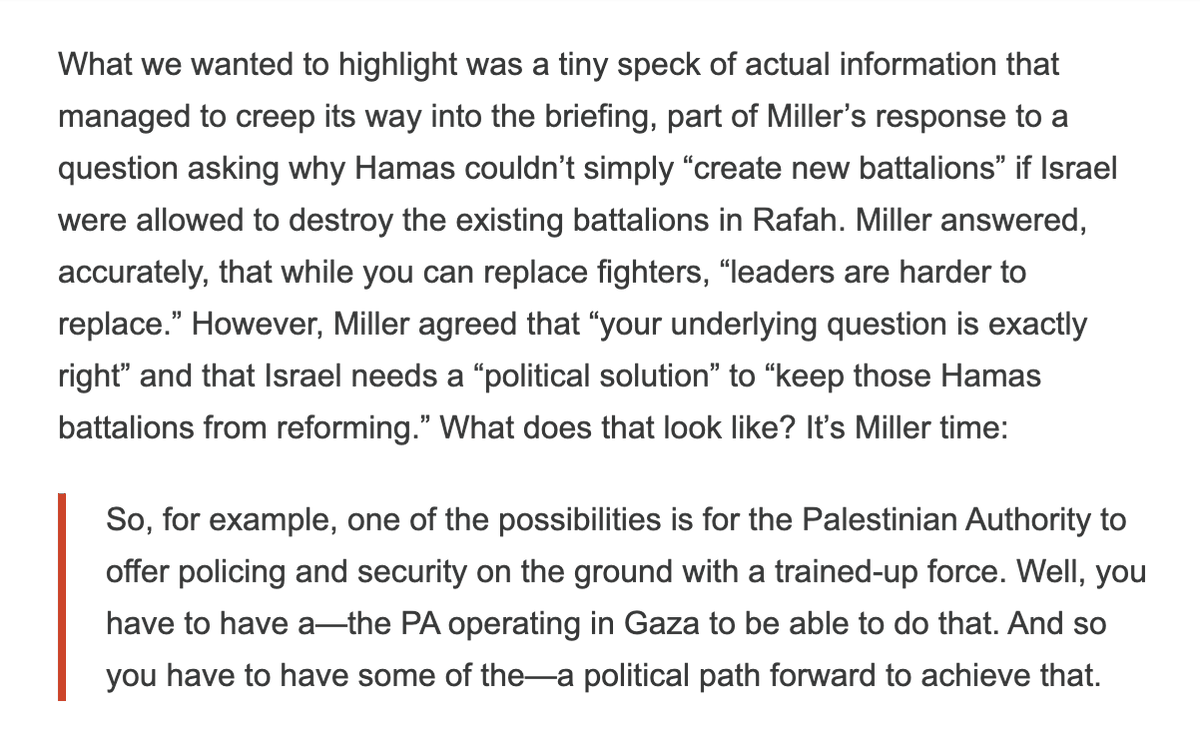
After all the drama of the past eight months, then, it would seem we’re back with the Team Obama-Biden plan, in which Hamas will not be releasing the hostages by inauguration day and Israel will be ceding de facto control of Gaza back to Hamas and then facilitating its “reconstruction.” To put the cherry on top, Secretary of State Antony Blinken said Tuesday that he expects the Palestinian Authority to regain a foothold in postwar Gaza, which will involve the PA “inviting international partners to help establish and run an interim administration responsible for running key civil sectors in Gaza such as banking, water, energy, health and civil coordination with Israel,” per TOI. Part of that administration, naturally, will be a U.S.-trained, -funded, and -equipped PA security force for Gaza—a version of the “PAF” mocked by Tablet’s @AcrossTheBay in his essay on “The Ottoman American Empire.”
So what the hell is going on? And if it’s what it looks like, why would Trump—or Bibi—agree to it? To help understand these and other questions, we reached out to some of the sharpest minds in Tablet’s extended universe.
Scroll founder @Jacob__Siegel argued that Trump’s adoption of Biden’s “failed framework” could represent a retreat from the successful foreign policy vision that guided his first term, but that Bibi is no fool and likely has reasons for accepting the deal:
Trump has consistently signaled that he wanted the war wrapped up when he took office. There was only one way to accomplish that while also improving America’s strategic position: publicly back Israel while exerting maximum pressure on Hamas and its sponsors, Qatar and Iran. By doing so he could have strengthened a U.S. ally while weakening adversaries and imposing a penalty for the taking of American hostages. Instead, it now appears that he has adopted the failed framework that the Biden administration has pushed for the past year, pressuring Israel to accept a cease-fire that would keep Hamas in power in Gaza. This suggests that 1) the strong foreign policy instincts that guided Trump’s first term may have been corrupted by the anti-Israel revisionists in his inner circle, and 2) Israel has an existential imperative to lessen its dependence on the United States. It is too soon to say anything definitively on the first count. The second point about Israel’s need for greater independence is true regardless of Trump’s approach in office.
On the other hand, it is unlikely that Netanyahu would agree to any deal that he did not see serving his strategic objectives of neutralizing Iran and strengthening Israel’s territorial position. Netanyahu’s talents have never lay in designing clever policy frameworks and strategies, but in exploiting opportunities and working the seams of formal agreements to Israel’s advantage. Netanyahu likely believes that the deal—which appears on paper to be a straightforward loser for Israel—offers a means to returning hostages still held by Hamas while aligning the United States behind one or both of his core objectives.
Tablet’s geopolitical analyst, however, was considerably more pessimistic:
The question here isn’t why Bibi agreed to the deal. The answer to that question is obvious: He agreed because Donald Trump, the incoming president of the United States and the most powerful man on the planet, demanded it of him. After fighting a seven-front war for nearly a year and a half—not counting the war he has been fighting against his opponents in the Biden White House or the one against his foes at home—and achieving a number of large successes, Bibi can't keep fighting alone. He needs allies. And if Trump isn’t going to be his ally, then both Bibi and Israel are in pretty deep shit. There isn’t really a universe where Bibi can say no to Trump right now, and Trump and Bibi both know that. The best Bibi can hope for is therefore to say yes to whatever Trump asks and then work around the edges to carve out the best reality for Israel that he can in the midst of the chaos storm that will predictably follow.
The real question is why is this Trump’s ask? If Trump had a magic genie that came to grant him one wish from Israel’s prime minister, would it really be “make Bibi surrender to Hamas, so Joe Biden can snatch a final victory from the jaws of defeat?” Why not “give America new technology that allows us to defeat China in the semiconductor wars,” or “send a boatload of those exploding pagers to Putin’s inner circle,” or “conduct a risky campaign of industrial espionage that lets us get inside China’s major digital and electronic systems the way they are apparently getting inside ours” or “take out Iran’s nuclear program” or “help broker an end to the Russia-Ukraine war so I can win the Nobel Prize.”
How did freeing the Nukhba Force terrorists who perpetrated the Oct. 7 atrocities become a U.S. foreign policy objective? Why is it Trump’s instinct to embed the United States deeper in the thankless morass of “rebuilding Gaza” under the aegis of Hamas, the Palestinian Authority, Turkey, the UAE, Saudi Arabia, and whoever else Tony Blinken has lined up to build oceanfront palaces with state-of-the-art torture dungeons for the surviving members of the Sinwar clan? These are questions that deserve answers, since no one on planet Earth can reasonably imagine that effort is going to end well—especially after Israel is forced to withdraw its forces from the Philadelphi Corridor, which is the only true impediment to Hamas rebuilding its arsenal.
Sure, it’s possible that this deal is the prelude to a U.S.-backed Israeli strike on Iran’s nuclear facilities—or at least the credible threat of one, intended to force Iran to the table to negotiate JCPOA 2: The Art of the Deal. Given the rise of antisemitism in the United States over the past five years on both the left and the right, I fear that what we are looking at here may be something much uglier, though: the replacement of the pro-Israel leanings embodied by Jared and Ivanka during Trump’s first term with the “populist” antisemitism of Tucker Carlson and his allies, who use sectarian manipulation to promote “Deep State” policies like the Iran deal to the MAGA faithful. Antisemitism will also clearly have its uses as a means to deflect MAGA anger away from Trump-supporting oligarchs and companies who rely on China for markets and suppliers and India for workers. In an age of widening contradictions on the right, the Jews may well resume their traditional role as scapegoats.
@LeeSmithDC is worried that (a) the deal could backfire on Trump and (b) that Witkoff’s connections to the Qataris made him ill-suited for the envoy role to begin with:
Let’s set aside strategy for a moment and talk about optics. Clearly the president-elect wants to start his term with a big win, but it seems to me this can go wrong in a thousand different ways. For instance, let’s say there are children who aren’t part of the first group of hostages released. That means they’re probably not alive. Obviously I don’t know the condition of anyone still in captivity; I’m just saying that if some of the most recognizable and most vulnerable hostages are dead, that’s one scenario in which the rumored deal doesn’t end up looking like a win. Trump can get pretty emotional when it comes to children. Remember—he wanted to kill Bashar al-Assad after he saw pictures of children the Syrian dictator gassed. So if it becomes clear that Hamas killed the children it was holding, it’s possible Trump himself won’t like the deal. And we already know another way in which this won’t look like a win: Trump said he wanted all of the hostages released by the time of his inauguration, but according to the details released, Hamas would be giving up only 33 hostages. Moreover, there will still be Americans held by Hamas, since one of the Americans, Edan Alexander, is in the IDF, and soldiers are not part of the first group to be freed. If the deal means that an American is still held by Hamas after Trump takes office, it’s going to be hard to message that as a win.
Sticking with the optics, let’s talk about Middle East envoy Steve Witkoff. I wrote in Tablet about Obama’s Middle East envoy Martin Indyk about a decade ago. When Indyk was head of the Brookings Institution’s Center for Middle East Policy, he accepted a nearly $15 million donation from Qatar. That sort of money is bound to influence any think tank’s research and analysis, but the more fundamental point was that as the Middle East envoy, Indyk was tasked to negotiate between Israel and the Palestinian Authority, both of which considered Qatar’s Palestinian client, Hamas, an adversary. How can the parties be expected to trust an interlocutor who has been paid by a third party that represents another client hostile to their interests? Obama aides and Indyk’s colleagues said it was absurd, and vicious, to suggest that Indyk was compromised by Doha’s money. I answered that it doesn’t matter whether his work will actually be influenced by the relationship between Qatar and the think tank he led and was certain to return to after his time in office. The issue is how it looks.
Same thing with Witkoff. He may turn out to be the greatest Middle East envoy ever, but the fact that he sold the Qataris a hotel for more than $600 million means he shouldn’t be in the same room with them on this issue. As I’ve written in Tablet, when it comes to hostage situations, Qatar’s motives and methods are dubious, at best. So, it puts a very bad spin on reports that Witkoff was not just involved, but allegedly strong-arming Netanyahu over the deal. Politics, especially foreign politics, is hardly a neat and tidy affair, but the core MAGA message is to prioritize American interests, protect our peace, and advance our prosperity. So, if the deal is meant to secure American interests, let someone else rough up a top American ally—if for no other reason than how it looks.
5
83
52
17,012
14 Jan 2025
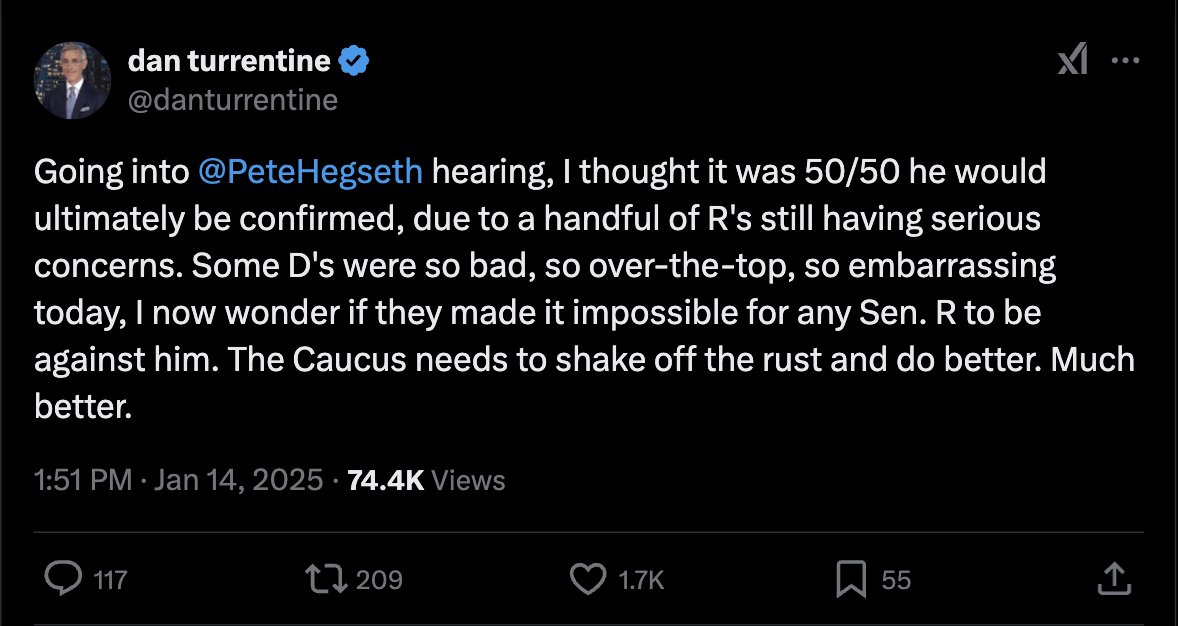
→The Senate Armed Services Committee on Tuesday held its first day of confirmation hearings for Pete Hegseth, Trump’s nominee for secretary of defense. Hegseth performed well, if not spectacularly, and repeated his previous pledges to bring an emphasis on “lethality” and “meritocracy” back to the Pentagon. He also delivered some excellent lines, telling Sen. Tom Cotton (R-AR) that “I support Israel destroying and killing every last member of Hamas,” promising Sen. Kevin Cramer (R-ND) to reinstate all service members discharged for refusing the Pentagon’s vaccine mandate, and (our favorite) telling the committee that we “won World War II with seven 4-star generals; today we have 44.” Democrats, meanwhile, worked themselves into high dudgeon over Hegseth’s messy personal life, which has involved fanciful allegations of rape and credible allegations of noncriminal boozing and womanizing—behaviors that we’re sure are completely alien to the U.S. Senate. Former Democratic lobbyist @danturrentine, for one, was unimpressed:
1
1
603
14 Jan 2025
THE REST
→The prime minister of Greenland said Monday that the Danish territory is seeking closer cooperation with the United States on mining and defense, Axios reports. Incoming president Donald Trump has repeatedly expressed his desire to acquire the Arctic territory, which is rich in largely undeveloped mineral resources including rare earths, graphite, copper, nickel, and zinc and is likely to assume growing importance for shipping if rising temperatures open up Arctic waterways. “We do not want to be Danes, and we do not want to be Americans,” Prime Minister Múte Egede said in a Monday press briefing, but he added that he was seeking “opportunities for cooperation” with Trump on mining trade. The prime minister of Denmark, which owns Greenland, said Monday that his team was entering into a “detailed dialogue” with the incoming administration to address U.S. “concerns about the security situation in the Arctic, which we share.” Among those concerns is that the Arctic is now the “weakest link in homeland defense,” as Jahara Matisek of the U.S. Naval War College told Radio Free Europe in a Monday article.
axios.com/2025/01/14/greenla…
1
86
13
793
10 Dec 2024
Last Friday, the office of Manhattan District Attorney Alvin Bragg appeared to be playing a dirty trick to avoid a mistrial in the Daniel Penny case. Penny is, of course, the former Marine who put Jordan Neely, a crazed homeless man who was threatening violence on a subway car, into a headlock; Neely died, evidently from being subdued. The jury claimed it was deadlocked over the most serious charge, second-degree manslaughter, and the prosecution moved to drop that charge to allow the jurors to consider a lesser charge of criminally negligent homicide. By averting a mistrial, it seemed, the prosecution was hoping to nail Penny on the secondary charge, which could only be dealt with following a verdict on the manslaughter charge. It was widely expected that the jurors would reach a compromise among themselves—deadlocked on the top charge and guilty on the lesser charge.
But the jury came back Monday and acquitted Penny entirely, finding him not culpable in the death of Neely. Some courtroom observers wonder if the jury, annoyed by protesters outside baying for a guilty verdict, returned a not-guilty verdict out of spite. Certainly, passions were running high. The case reminded observers of the Kyle Rittenhouse trial in Kenosha, Wisconsin, in which the teenage Rittenhouse shot three rioters who were directly threatening him, killing two. He, too, was accused of vigilantism. Others with longer memories recalled the 1984 case of Bernhard Goetz, the spectacled white subway rider who was accosted by a gang of Black muggers and shot all of them. He, too, was acquitted by a Manhattan jury all too familiar with the parlous state of mass transit at the time.
Leftists went predictably ballistic, at least rhetorically, following the verdict. The New York Working Families Party called it “a modern-day lynching,” as did socialist Queens council member Tiffany Cabán—a former public defender who came extremely close to being elected Queens district attorney in 2019. The NAACP posted, “The acquittal of Daniel Penny in the death of Jordan Neely has effectively given license for vigilante justice to be waged on the Black community without consequence.” Hawk Newsome, a Bronx rabble-rouser who fashions himself the leader of the local Black Lives Matter movement, shouted threats at Penny after his acquittal and called openly for “Black vigilantes” to answer the “white supremacist” jury that freed him.
Other less fiery but no less meretricious officials mouthed sad words about how the system “failed” Neely. Public Advocate Jumaane Williams—who unaccountably lives on an Army base in Brooklyn—wrote, “Jordan Neely needed aid—and intervention would have meant food, or shelter, or mental health support. … Instead he was met with violence. Jordan Neely is dead, and Daniel Penny is being celebrated, and that is neither safety nor justice.” City Comptroller Brad Lander, a candidate for mayor, called the death of Neely “an indictment of our system.” Neely was, according to Lander, “crying out for mental health care.” New York City, said Lander, “cannot be a city where there is no consequence for killing someone.”
But of course, there was both “justice” and “consequence” for Penny after his actions resulted in the death of Neely. He was put on trial for manslaughter and could have faced decades in prison. If he had not been arrested, one could argue that he would have faced no consequences or justice, but what Williams and Lander mean is that they don’t like the verdict. This is common among those who see the justice system as a quantum-level phenomenon: We only know if the trial was fair when the jury returns the correct verdict.
Moreover, the idea that Neely was denied “intervention” in the form of mental health treatment, housing, or food is nonsense. New York spends billions of dollars on social services—including many hundreds of millions of dollars spread across multiple city and state agencies addressing housing, mental health and food assistance—and it is a certainty that Neely had hundreds of interactions with its vast human-services network: He was arrested dozens of times and frequently “diverted” into treatment. According to The New York Times, Neely was on the “Top 50” list of “the homeless people living on the street whom officials consider most urgently in need of assistance and treatment.” In 2021, Neely was arrested for beating up an old woman and breaking her nose; he was ordered to reside at a treatment center, which he abandoned after two weeks, and a warrant was issued for his arrest. Social workers approached Penny in a subway car a few weeks before his death, and he attempted to pee on them. “An outreach worker noted that he was aggressive and incoherent. ‘He could be a harm to others or himself if left untreated,’ the worker wrote,” reports the Times.
Far from “being denied access to stable housing and health care, and then dehumanized for it,” in the words of Cabán, Neely received extensive care from the human-services network, which poured untold hours and dollars trying to help him. New York State has one of the most robust laws in the country for mandating treatment for the seriously mentally ill who pose a threat to themselves or others, but Kendra’s Law is woefully underutilized because it is essentially coercive and ultimately has carceral implications. It’s true that the system failed Neely, but not in the sense meant by anti-law-enforcement politicians, whose answer to the problem is always to add funding to the human-services complex, preferably at the expense of policing. The system that failed him is precisely the system they designed, which includes the convenient excuse that its gravest malfunctions are always the fault of a heartless, racist society that has starved it of adequate funding.
—@SethBarronNYC
4
107
34
3,883
The Scroll retweeted

2 Dec 2024
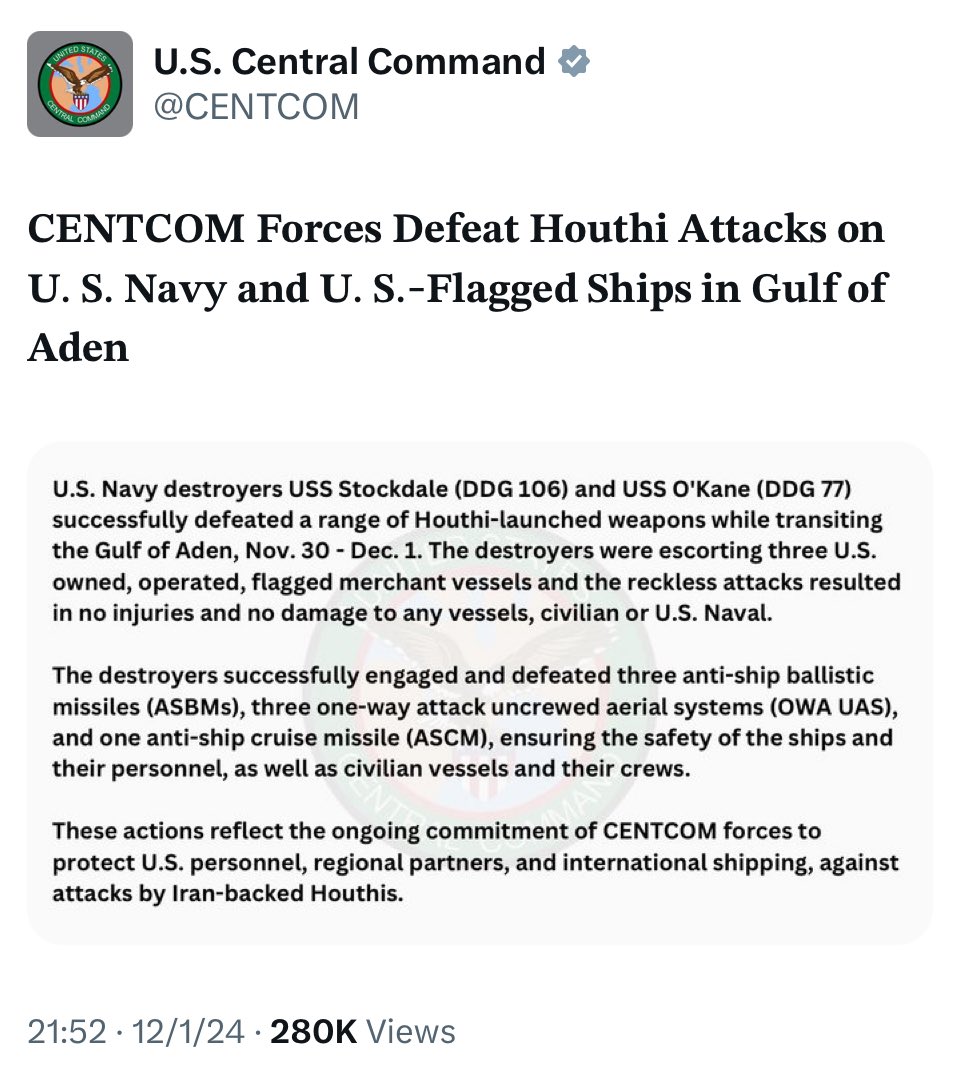
Notice the language. The US Navy defeated weapons that attacked it. But the navy defeated neither the Houthis pulling the trigger nor the Iranians standing behind them. Iran has never been weaker. It’s a puffer fish. There’s no reason why the US must tolerate these attacks.
7
130
183
10,339
The Scroll retweeted

2 Dec 2024
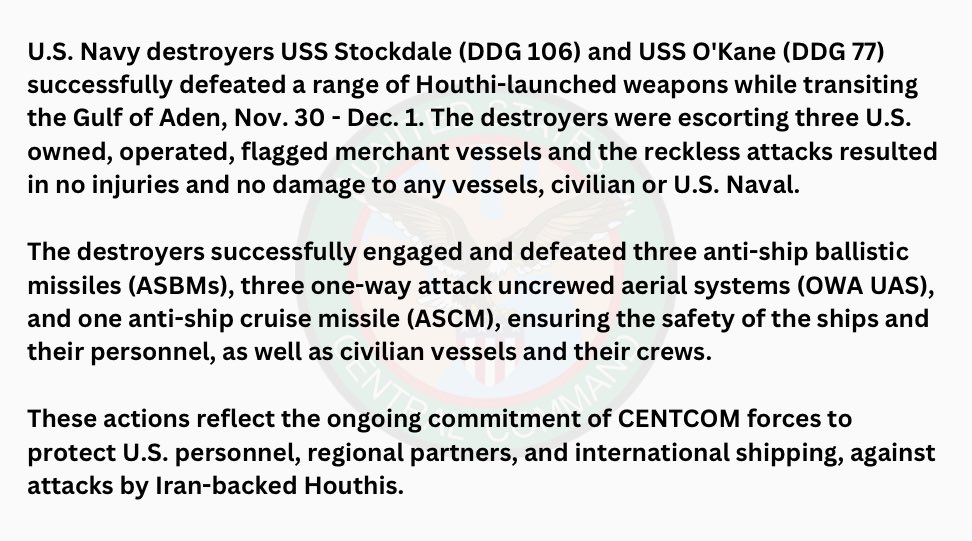
Periodic reminder that as part of appeasing the Iranian regime, the Biden admin ceded global freedom of navigation to Iranian terror groups. Meanwhile they're firing off missile defense interceptors designed to protect US assets in a major war, which will take decades to replace
2 Dec 2024

𝐂𝐄𝐍𝐓𝐂𝐎𝐌 𝐅𝐨𝐫𝐜𝐞𝐬 𝐃𝐞𝐟𝐞𝐚𝐭 𝐇𝐨𝐮𝐭𝐡𝐢 𝐀𝐭𝐭𝐚𝐜𝐤𝐬 𝐨𝐧 𝐔. 𝐒. 𝐍𝐚𝐯𝐲 𝐚𝐧𝐝 𝐔. 𝐒.-𝐅𝐥𝐚𝐠𝐠𝐞𝐝 𝐒𝐡𝐢𝐩𝐬 𝐢𝐧 𝐆𝐮𝐥𝐟 𝐨𝐟 𝐀𝐝𝐞𝐧
18
235
476
208,174
6 Nov 2024
Here's how we summed up our Oct. 30 election preview:
"Again, anything could happen, so don’t bet the house. But as we read headline and X post after headline and X post this morning, suggesting the closest election of our lifetime, we thought it might be helpful to at least offer an opposing view: Trump is doing extremely well right now, and the final result may not even be that close."
Our only regret is telling you not to bet the house—you would have made a fortune.
6 Nov 2024

I think my October 30 Scroll—"This Election Might Not Be Close"—holds up pretty well:
thedailyscroll.substack.com/…
95
14
8,888
The Scroll retweeted
6 Nov 2024
I think my October 30 Scroll—"This Election Might Not Be Close"—holds up pretty well:
thedailyscroll.substack.com/…
1
90
24
10,479
The Scroll retweeted

22 Oct 2024
I recommend this article on the violent nature of the anti-Israel protest groups. There are many important details such as key groups getting designated as terrorist entities & the open support for terrorism. We’re not talking expressions of anti-Zionism. timesofisrael.com/anti-israe…
3
100
64
3,864