
Joined January 2018
- Tweets 5,493
- Following 156
- Followers 10,523
- Likes 2,624
933 Photos and videos





Mar 1
A few thoughts on Iran and more general thought on anti-interventionism on the online-right:
Obviously, the Iranian government is bad. It, through various mechanisms, causes harm to America, to the Middle East, and to its own people. There are governments that could plausibly replace it that would be better. However, there is significant uncertainty about our ability to remove the current government, given our constraints, and uncertainty about what government would actually replace it if it fell. So, I'm not inclined to take a strong position on whether this is a good idea or not. Obviously, I hope it turns out well.
I've seen a lot of posts by anti-interventionists online who are taking a very strong and confident position, and so I thought I'd note some generic criticisms of the current iteration of anti-interventionism you see on social media today.
First, they clearly assign too much weight to the Bush wars when thinking about interventions. If we judge intervention success as the intervention having the outcome it was intended to have at roughly the cost (in lives, money, and time) it was expected to cost, then America has had a fair number of successful interventions throughout Europe, Latin America, parts of Asia, and parts of the Middle East. European nations have over an even larger span of geography.
The count of successes falls, but will still be significant, if we define success in terms of creating a state of affairs we wanted and that state of affairs never changing, even years down the line. However, I think this is not a very useful way of defining success. In general, we don't require this of a project, so it seems ad hoc to do so here. There's also an unjustified tendency to assume that if we intervene somewhere and it seems to work, but then that place becomes worse years or decades later, this is because of our intervention and means the place would have been better without it. There is often not enough evidence to support these sorts of conclusions.
A still worse criteria for success is whether you personally support the goals we were trying to achieve in the intervention. This criteria is often used implicitly but is obviously not a valid way of measuring how often interventions work.
In my view, a fair read of the evidence suggests that sometimes interventions work, and sometimes they don't, such that a strong generic bias against or for interventions as such is not a good way to think about the issue.
Second, I think anti-interventionists tend to have a view of the world that is implicitly biased against America. This is mostly true in two ways.
First, there is a kind of selective outrage where they hold the US (and, recently, Israel) to a higher standard of behavior than other nations and a kind of selective skepticism whereby they by default distrust claims of the US government (and Israel) but accept claims, even obvious lies, from other nations and groups.
Second, they seem especially apt to defend America's enemies and to deny that America even has real enemies, virtually no matter what a potential enemy says or does. Iran is a prime example of this. Many anti-interventionists find excuses for Iran doing everything from openly calling itself an enemy of America to killing American troops, all so as to deny that America has enemies (and so, global interests).
Third, many of the anti-interventionist takes I see have a very narrow conception of American interests. Often, they act as if something is only relevant to American interests if it has a direct, unmediated impact on American soil. Indirect effects through the global economy, or effects on the ability of America to carry out other operations elsewhere in the world, are ignored. Further still, you might think that America's interests are defined by whatever Americans happen to care about, and so the well-being of non-Americans could constitute part of America's interests. But they often seem to implicitly define the concept of interest so as to make this impossible by definition. This stance is normally not argued for, but rather taken as some kind of natural default or common-sense position. But it is neither.
Fourth, the current wave of anti-interventionists often think that everything America does around the world is a simple function of the interests of Israel. This again is partly due to an over-reaction to the Bush years. During those years Israel did have some usual influence on American policy, but this was not representative of American policy in general and even then they were not simply "wars for Israel". Often anti-interventionists are especially apt to endorse a basically fabricated history of America in the middle east whereby we say that America is only there because of Israel, has only ever cared about what happens there because of Israel, and has only had enemies there thanks to Israel. In every case this is so obviously false that it is refuted by a basic telling of the relevant history.
To reiterate, I'm not confident about how this intervention will go. It going well, or it going poorly, are both plausible. But the worst part of the current discourse seems to be the sort of hysterical anti-interventionism that has become popular online, so that is what I am commenting on.
13
13
82
9,939
Mar 1
Even given the source, this take is unexpectedly stupid and insane. Well past the threshold of what I would have thought plausible even for satire.
Mar 1

I criticized Iran’s Supreme Leader Ali Khamenei a thousand times. He was oppressing his own people and preventing democracy. But there’s one thing you can’t take away from him, he died on his own two feet, instead of kneeling to Israel. That took courage. He didn’t bow.
1
1
42
4,242
Feb 18
Partly, this impression is because women are indeed not included in the list of Great Old Philosophers and while there are influential women in modern philosophy post WW2 philosophy is culturally invisible outside of some continental philosophy that only leftists read.
Feb 16

this made me realize that i have never heard of any female philosopher
like, not one
2
37
3,583
Feb 17
1. This article was written by her and her then husband. A site update seemingly removed the second author at some point. So, not just a woman.
2. The article reads as a counter intuitive application of suffering based consequentialism. The basic idea is just that killing predator animals would help minimize total suffering. This sort of counter-intuitive utilitarianism is a genre of ethical philosophy mostly done by men
3. Sex differences in moral reasoning are real but statically small to moderate in size depending on how moral reasoning is measured. These are not like the huge differences you see for certain physical abilities. This particular piece of moral reasoning is best stereotyped as how EA people think. The reasoning is unusual for either sex.
The view that some on the right have been expressing to various degrees of explicitness, that there are huge sex differences in moral reasoning such that women are categorically not fit to do serious moral reasoning, is false and bad.
Feb 16

Women evolved to take care of toddlers. If you put women in charge of teaching ethics, you get Toddler Ethics.
"No hitting"
"Share the toys"
"Don't say mean things"
These are fine lessons for toddlers. Don't indulge your id at the expense of others. You can learn about balancing interests later, when your brain is developed enough to store that information.
But when you put women in charge of adults, they tend to reflexively assume those adults are toddlers.
They will tell you "no hitting" when the Mongol hordes are massing on your borders. They will tell you "share the toys" when a vagrant meth zombie breaks into your house looking for something to steal. And they will tell you "don't say mean things" when you point out that these two responses are totally stupid.
When we first put women in charge, in the workplace, they immediately began treating those who reported to them like toddlers. When adults, who do not like being treated like toddlers, complained, their response was "ban bossy", which boils down to "don't say mean things", another lesson in Toddler Ethics.
Now, through the influence of women in charge, we are so thoroughly steeped in Toddler Ethics that even most of the men we put in charge are treating the adults like toddlers, and echoing Toddler Ethics.
Toddler Ethics, of course, isn't ethics at all. It's just things we don't want toddlers doing.
We can tell toddlers "no hitting", because toddlers are not charged with keeping the peace, enforcing justice, or destroying evil.
We can tell toddlers "share the toys", because toddlers don't earn things, own things, or have property they must defend.
We can tell toddlers "don't say mean things", because it is not a toddler's job to decide what unwelcome ideas are true, relevant, and necessary.
But when everyone in charge runs on Toddler Ethics, then adults can't do a lot of the stuff adults need to do, because all the Toddler Ethicists keep getting in the way.
Adults sometimes need to hit people, protect the stuff, and say mean things. You can't have civilization without that.
And if you put Toddler Ethics Woman in charge of teaching an AI ethics, then she will teach it Toddler Ethics, and it will treat every human adult like a toddler, all the time, forever.
Not only that, you have an AI that cannot be put in charge of anything, ever. Because leaders with Toddler Ethics destroy everything they are in charge of.
And Amanda MacAskill is definitely a Toddler Ethicist. The article in the photograph is nothing but "no hitting!" applied to the animal world. It's absolutely insane, it's a recipe for disaster, and anyone who would write such a thing should probably not even be charge of own life choices, much less anything of consequence.
But a lot of people would, and will, refuse to point that out, or agree with me when I do, because that is Saying a Mean Thing, and they, themselves, have been infected with Toddler Ethics.
They should not be charge of anything of consequence, either.
Anyone who thinks that everything they need to know, they learned in kindergarten... is only ever qualified to teach kindergarten.

7
9
71
11,055
Feb 13
Seemingly, the idea here is that for a culture or group identity to be valid ideas that are salient features of the group must have their origin in people who considered themselves to be part of the relevant culture. Seeing them as part of the group in retrospect is not enough.
It's not obvious why we would endorse this principle. It doesn't seem like people generally follow it. Probably, it's confused to think there are abstract rules like this that dictate whether an identity or category is valid. The psychological mechanisms behind group identity and category formation don't work like that.
More importantly, this line of discourse seems to divert us away from the proper point of concern. The norms are being replaced, or are not being replaced, regardless of whether calling them "white culture" is valid.

This kind of logic falls apart from the very start. "Going back to Athens" as a way of defining "white culture" is a ridiculous statement on its face. The Athenians had no sense of a unified "white" identity and would have scoffed at any homogenizing concept that would lump them in with other Greeks, let alone, say, Slavs. And 19th- and early 20th-century American WASPs would have balked at the notion they were interchangeable with Europeans form the poor and Catholic Mediterranean world.
4
5
54
5,169
Sean Last retweeted

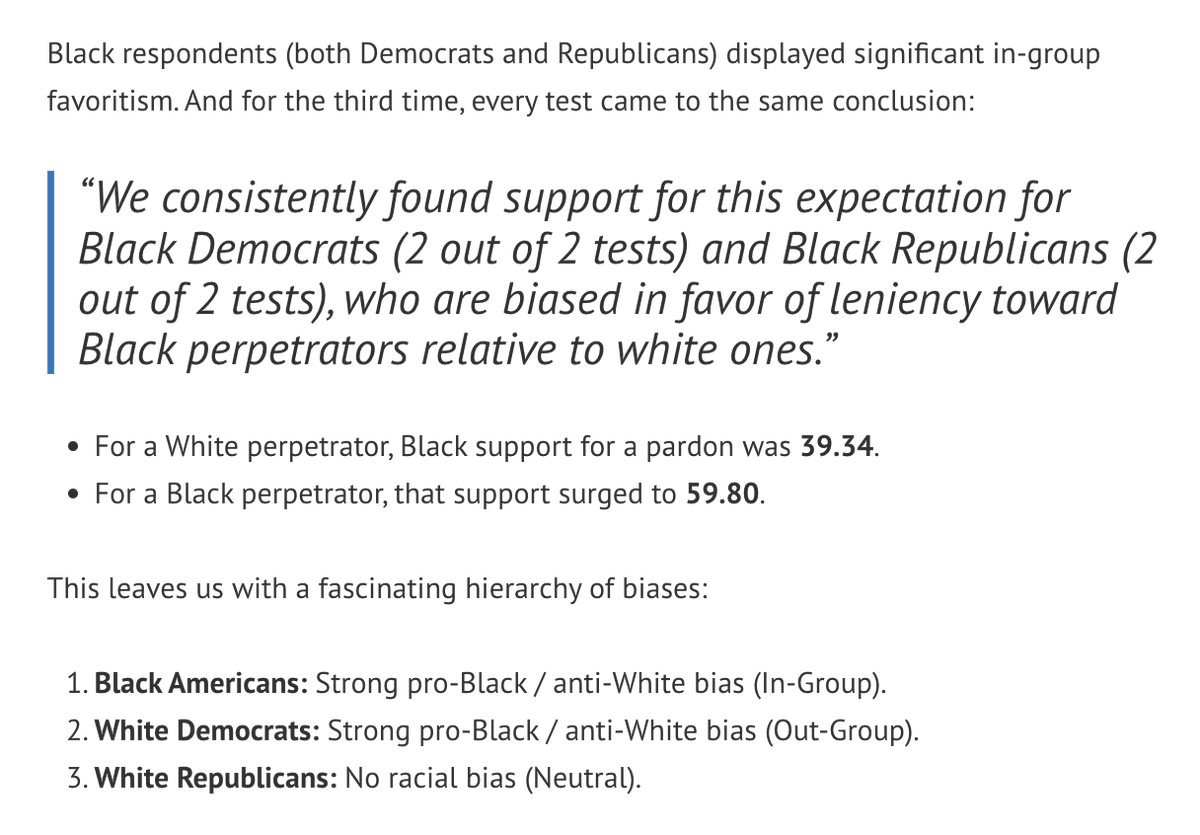
Is it race or ideology?
The data shows it doesn't matter if a Black American is on the left or right.
Either way, they're more harsh on White defendants, and they both let Black defendants off the hook.
When the defendant is Black, their support for a pardon jumps by over 50%!
7
61
391
10,223
Feb 10
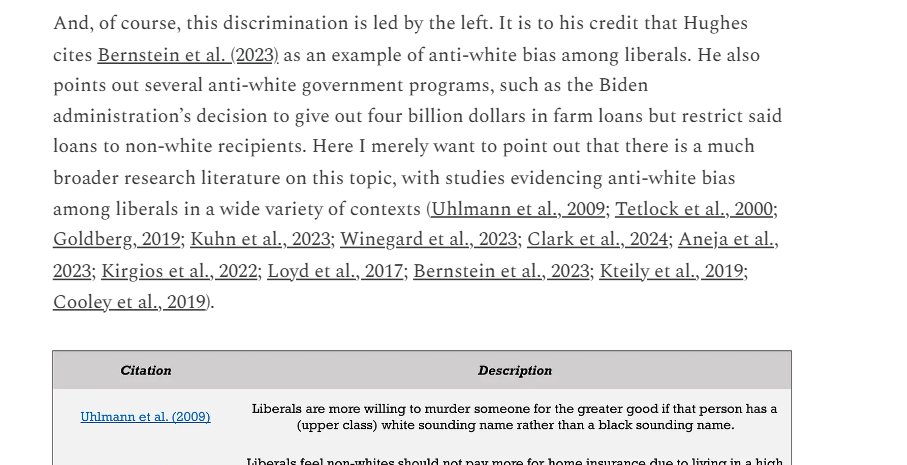
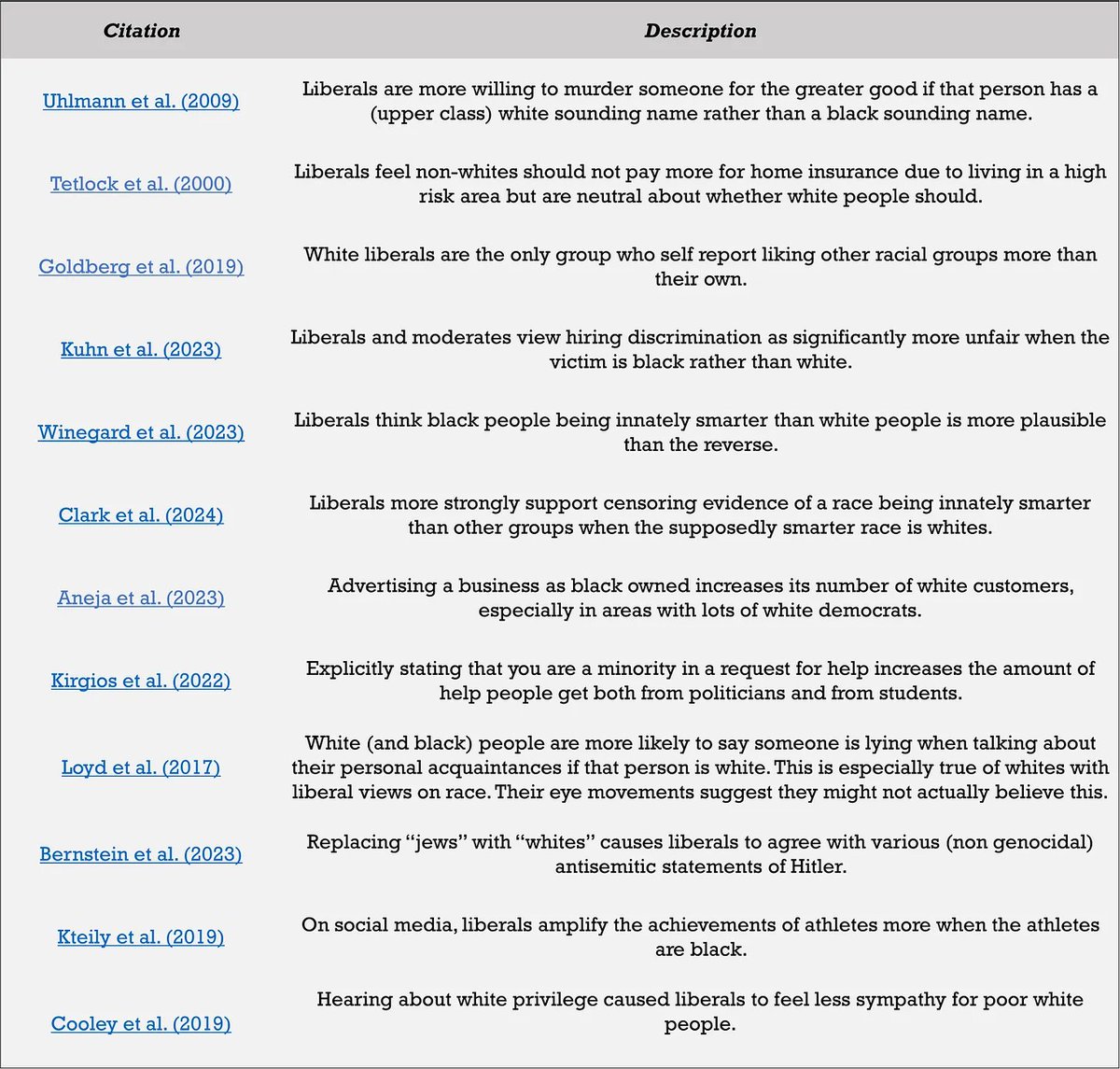
This is confused. If by "racist" we mean having an unjustified racial bias, there are many studies showing liberals are generically racist in an anti-white direction. A similar level of evidence does not exist for conservatives. Granted, you might claim Trump and co are racist even if most conservatives are not. Supposing that is true for the sake of argument, only calling the right racist is still misleading and frames the issue in a confused way.
(In the present case this is relevant because lots of the attacks on Stancil are obviously motivated by anti white racism)
Feb 10

America is ruled by racists who want to make you hate your nonwhite neighbors. Yet the opposition to those racists is controlled by insane leftists who use fake accusations of racism against liberals in order to gain tiny bits of cultural power.
So here we are.
7
49
429
12,161
Feb 10
One thing I like about conservatism is that it is pretty easily reducible to common argument patterns. For instance, if we consider traditionalism as a specific variant of conservatism, I would say something like the following are the “main” arguments you see different versions of endlessly:
1. Traditions have been selected by god or cultural evolution, and so get a strong prior.
2. Even social science produced by the left-wing academy shows that on various metrics anti-traditional behavior produces bad life outcomes (e.g., bad mental health outcomes for LGBT people, women living like feminists, people having lots of sex or using drugs, people living near lots of ethnic diversity, etc.).
3. As we’ve moved away from traditions, material benefits have been gained but psychological outcomes have gotten worse. This can be seen in mental health outcome data, but also the problem with modern life is something many people can detect directly by their own felt sense of dissatisfaction.
4. The effects of norms depend heavily on a huge number of factors, making their effects very hard to understand or predict, even using the best social science, and so changing norms is inherently high risk.
5. Things being the same in lots of ways for a long time is a precondition for people feeling a strong sense of community and identity, and it’s good if people have such feelings.
6. People have a natural aversion to change and become sentimentally attached to however things have already been. All else being equal, we should therefore avoid change.
7. A lot of non-traditional behavior elicits a kind of disgust response, and in general it’s wise to not do things that seem obviously bad or disgusting unless you have strong counterevidence, and so this is evidence against various norm changes. (This isn’t often defended as an argument in books, but online it’s very common.)
And then obviously there’s negative rejections of leftism, and lots of other arguments from other sorts of conservatism, that are less specific to traditionalism and which I will not list here.
Anyway, leftism is, I think, less like this. A lot of their arguments seem less like arguments because they come off as unfounded or dogmatic. For instance, they might have a negative reaction to inequality or something, but there is no story about how god, or cultural evolution, or the inherent usefulness of a status quo, etc., legitimizes trusting the moral evaluation. Similarly, there’s a lot of appeal to experts but no clear story about how or when expert trust is established.
Of course, leftist arguments can be, and are, made into more fleshed-out arguments, and not all leftist thought is presented like this. Furthermore, conservative arguments start to look similarly dogmatic if you keep trying to develop them. Still, I think conservative thought tends to present arguments in a somewhat more developed form, or in a way where its obvious how to get them into such a form, on average.
Also, I am not a traditionalist, which decreases the odds that this perception is just fueled by bias. Also, I should specify I am talking about leftist and conservative "thought", not social media rage.
Feb 9

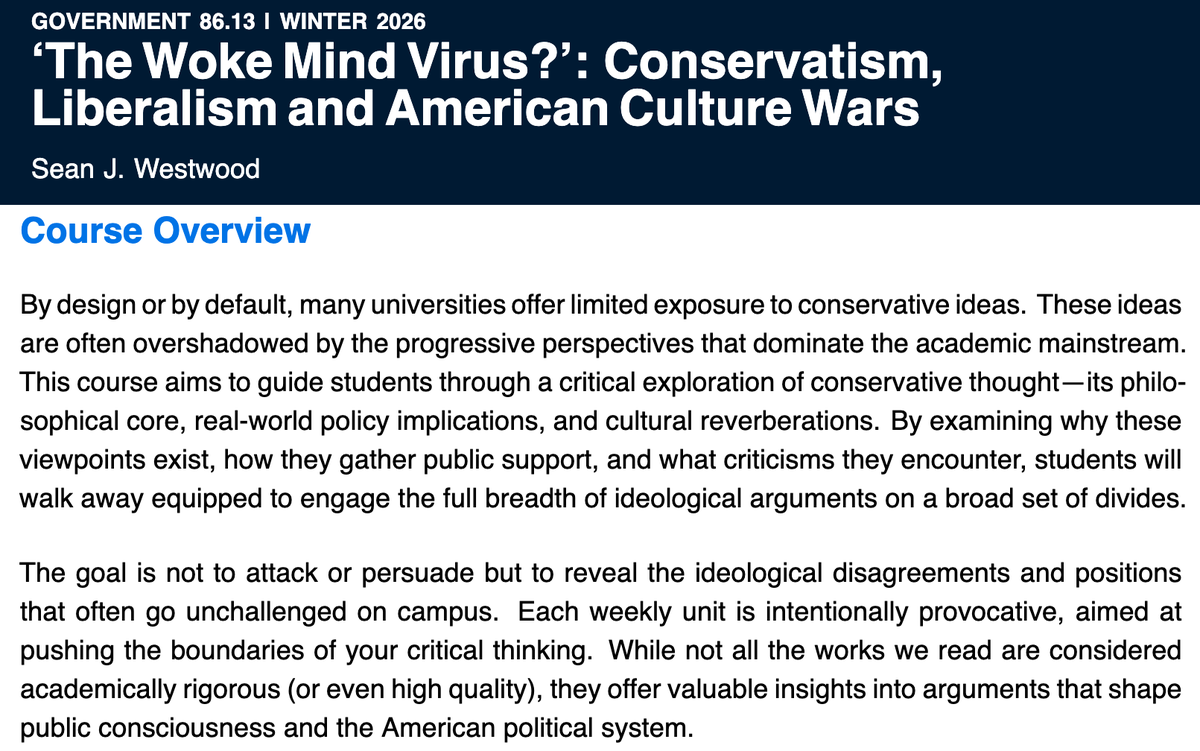
I am teaching conservative politics and policy this term, with a heavy focus on data and respectful debate. Half the country is conservative and students on campuses rarely if ever engage with these ideas seriously. Understanding all of America matters. Syllabus below.
2
5
45
3,032
Feb 10
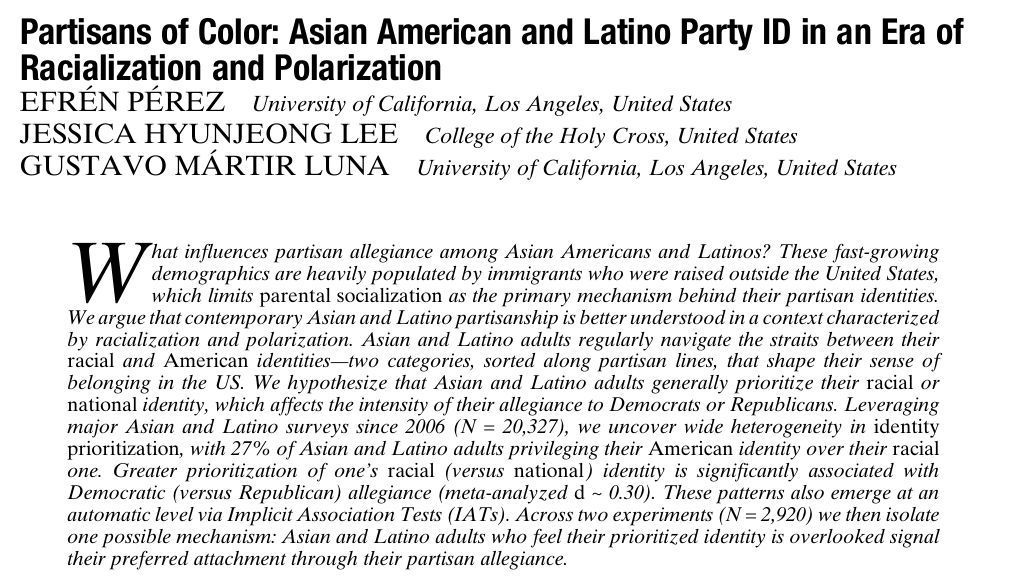
Study finds that the more Hispanic and Asians Americans identity with their ethnicity, as opposed to identifying with their more generic national American nationality, they more they tend to lean democrat.

From our latest issue: Partisans of Color: Asian American and Latino Party ID in an Era of Racialization and Polarization by EFRÉN PÉREZ, JESSICA HYUNJEONG LEE, GUSTAVO MÁRTIR LUNA. cambridge.org/core/journals/…
3
9
104
3,206
Sean Last retweeted

I actually thought the halftime show was decent as a performance, but as the left is fond of pointing out you have to look at the context. It is pretty naked ethnic tribalism of the ascendant group in their language led by someone who supports the expanse of his own people at the expense of the rule of law. Do you really not see why right wingers would be opposed to this?
Feb 9

someone genuinely explain to me how this could possibly be considered offensive or divisive to anyone


32
102
2,691
148,580
Feb 8
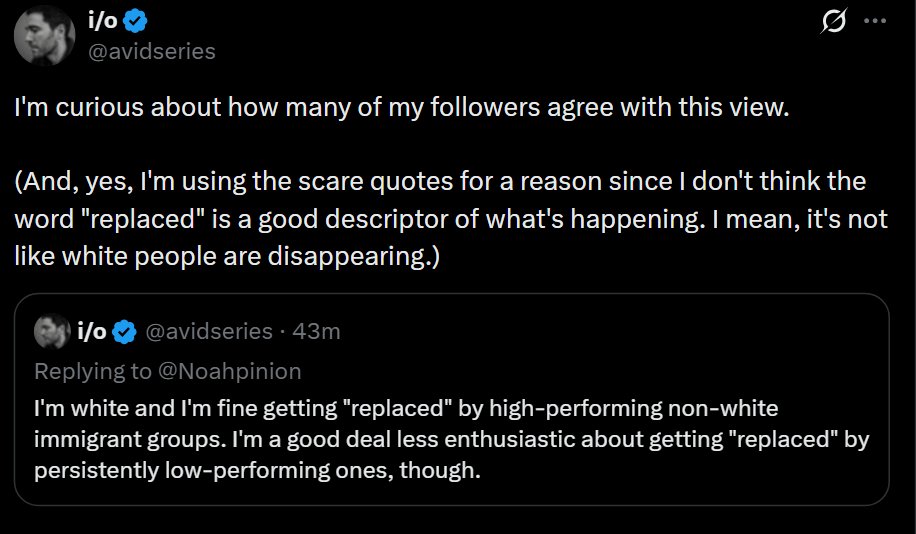
There is a theoretical scenario under which I would lean toward agreeing, but in the real-world situation I do not agree.
The ideal "replacement": We can imagine a situation where the costs, for me, would be marginally lower status wrt jobs and such, a modest increase in felt "otherness", and a slight decrease in the efficiency of my socializing. The immigrants in this case would assimilate well, and everyone would be basically fine with them. The benefits would be living in a more advanced and well-functioning society. In that case I would probably agree that being "replaced" is a net good.
But I'm not so optimistic about real world high skilled non-white immigration. Here are some reasons why:
Ideology and Ethnocentrism: Non-white immigrants tend to exhibit a significant degree of ethnocentrism in their social behavior and general worldview. Politically, they tend to promote leftist ideologies that are at once anti-white and also, race aside, a long-term economic risk for the society.
In addition to the intrinsic badness of this, immigration at a high level also has predictable negative effects on the white population whereby they become more negatively ethnocentric, populist, etc. This is plausibly made much worse when the immigrants actually are anti-white in ideology, but happens even when they are not.
Institutional Quality: My view is that the quality of an institution is significantly a function of a set of behavioral traits possessed by the people managing and implementing it. We know this is not a simple matter of IQ. I don't think we have strong scientific knowledge of which traits do actually matter outside of IQ. So, we can't easily filter for them.
This creates a serious risk. We might end up letting immigrants in who are high performers at some tasks we can easily measure (e.g. IQ, making lots of money, etc.), but not institutional management or implementation. So, high-skilled immigration at a high level is risky.
How serious of a risk this is depends on your pre-existing institutional quality. If your institutions are already not very good, this risk is not very serious. But if your institutions are significantly better than the institutions in the countries the immigrants are coming from I think this is a significant risk.
In the case of the US, this risk seems very high. Some of our scientific and economic systems are plausibly the best in the world (wrt innovation). At the same time, many of our high skilled non-white immigrants come from places with pretty bad institutions. For that reason, I think the US population being "replaced" would be very high risk and so not a good idea.
Until we have more knowledge about the full set of causes of group inequality, I think it makes sense to default to these conservative risk heuristics. I would abandon such heuristics if we knew more, and so could be more directly meritocratic about this, but we don't partly because the problem is hard and partly because social science has made the relevant research quasi taboo.
There are lesser concerns, but those are the main ones that came to mind thinking about being "replaced" by high-skilled immigration. Obviously, these concerns are lesser for more modest proposals, like letting in a significant but capped number of high skilled immigrants in a task targeted fashion. But the question was about "replacement", which I take to mean something larger than that.
7
17
209
32,025
Feb 8
Obviously, having sex with a small child is much worse than having sex with a teenager even if both are bad. Using one word to refer to both causes people to react to the latter as if its the former. Keeping the two conceptually separate makes for more case-appropriate reactions
I'm not confident this issue is of much importance, but evidently people are debating it. The fact that people get mad at it being pointed out that these things are not the same suggests there is some sort of irrationality at play rather than mere vague language.
Feb 7

If any sexual contact with persons aged 16 or 17 is now presumptively considered "pedophilia," it's really strange that 37 states have chosen to legally enable pedophilia. Do you live, for example, in Maryland or Nebraska? If so, you're in the midst of an ongoing pedo crime spree
40
23
486
34,404