
It's time - the book that shows the way: SecessionWABook.shop
Joined December 2025
- Tweets 469
- Following 695
- Followers 696
- Likes 379
53 Photos and videos


Pinned Tweet

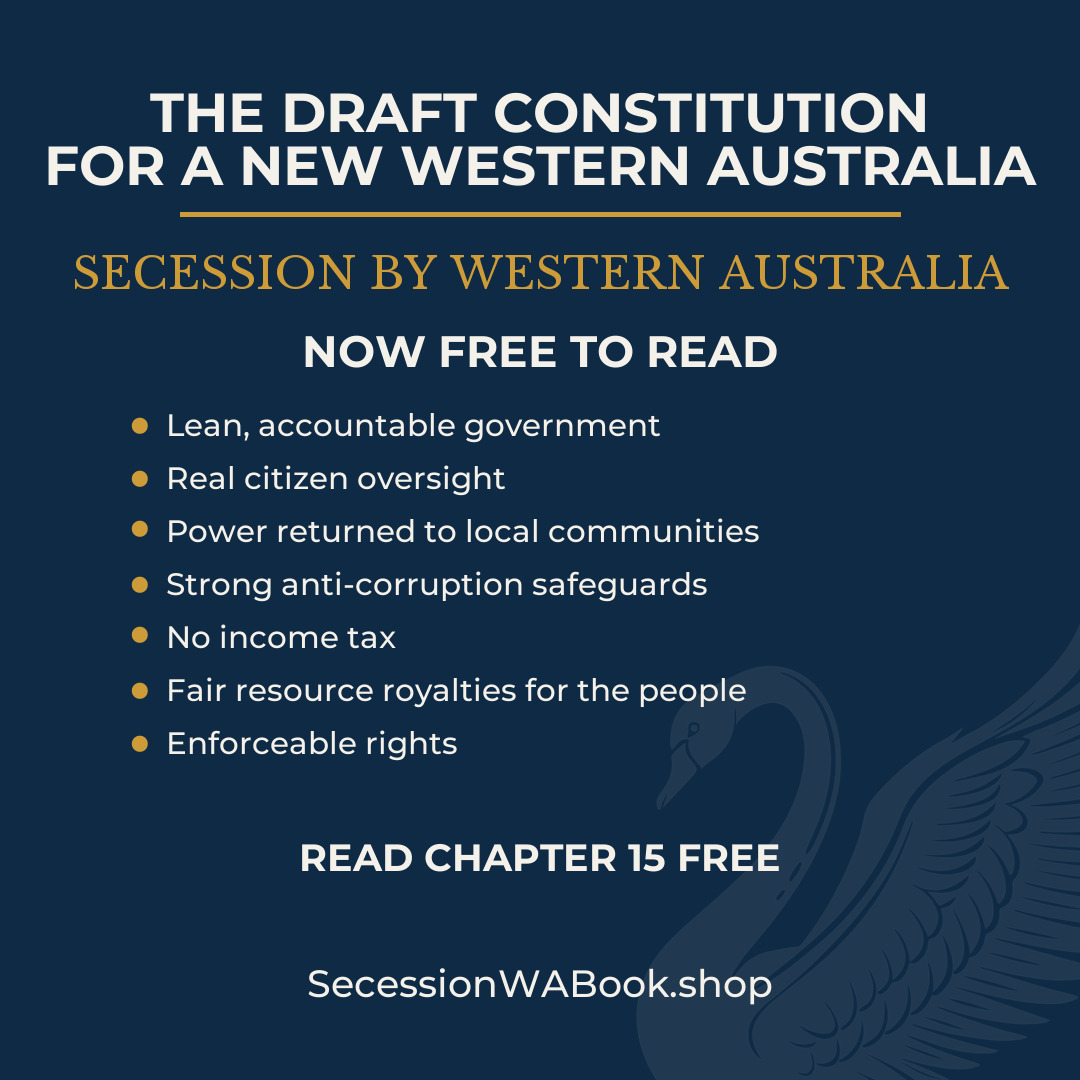
Chapter 15 is now free: the full draft Constitution for a new Western Australia.
Lean government. Local power. Citizen oversight. Strong anti-corruption. Resource royalties for the people. Enforceable rights.
No slogans — just the blueprint.
Read it. Critique it. Share it.
111
135
576
752,203
Secession by Western Australia retweeted
The black swan doesn’t ask permission.
3
6
22
651
Secession by Western Australia retweeted
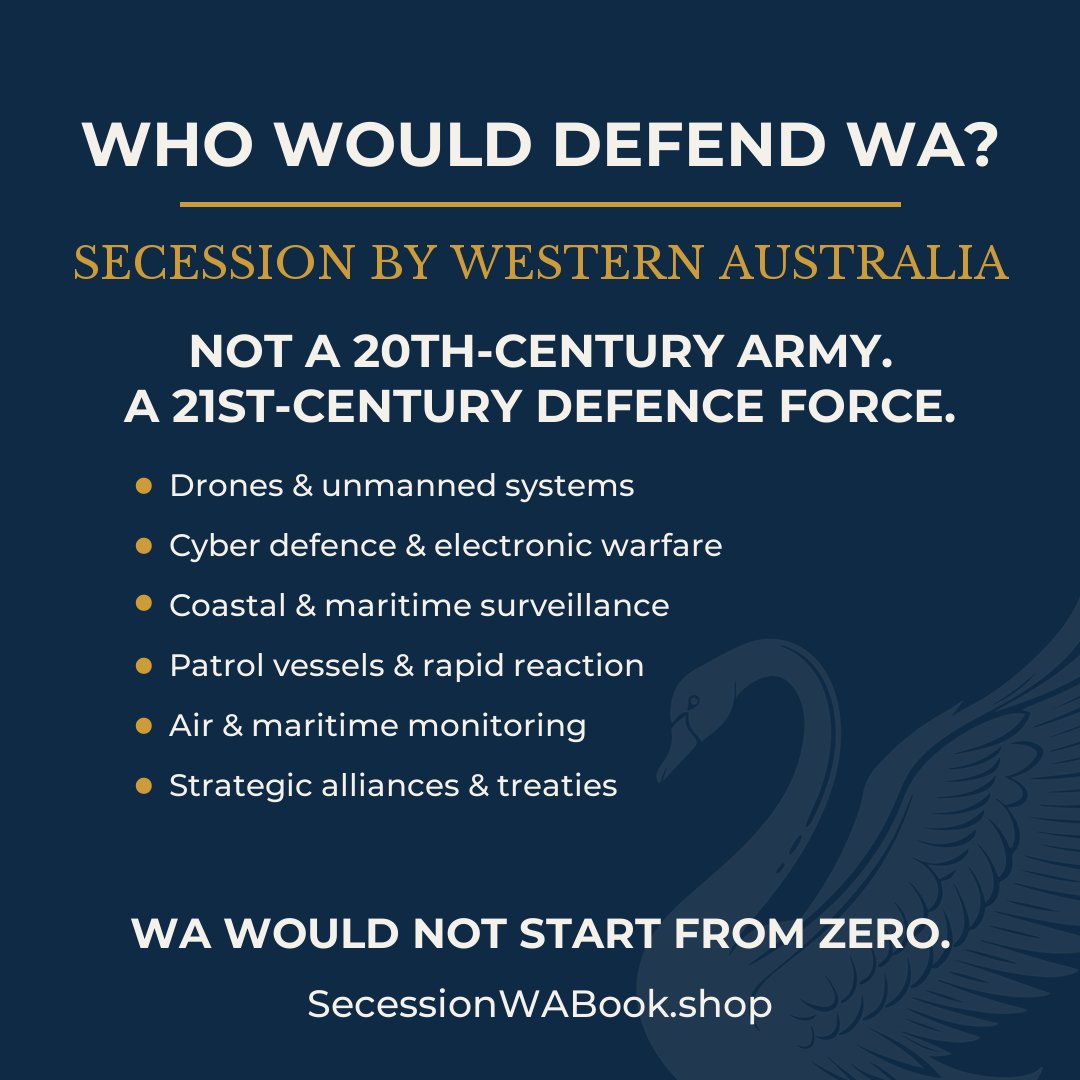
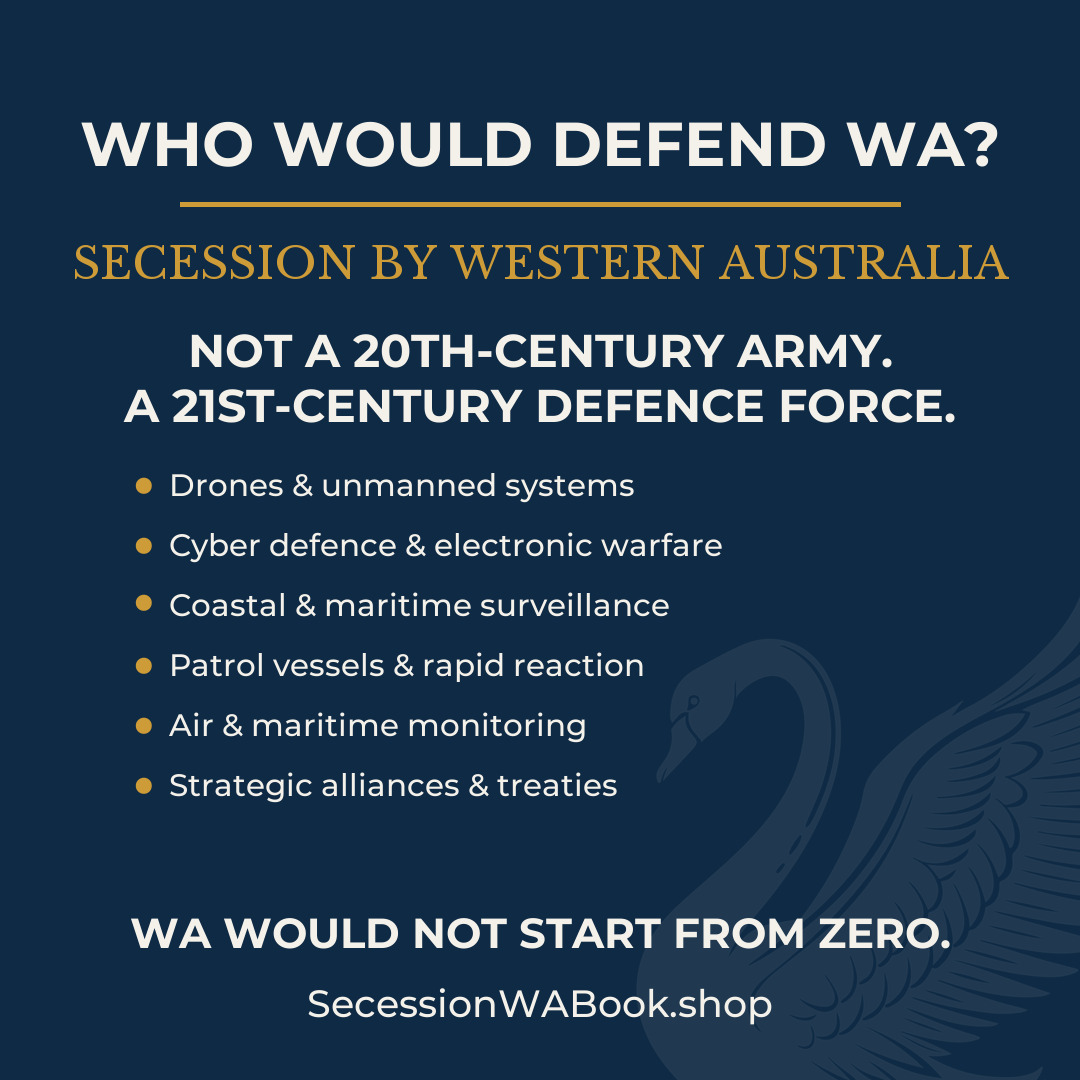
"Who would defend WA?
The people asking assume we start from zero and copy Canberra’s old model.
We don’t.
WA builds a lean, tech-first defence force quickly.
Chapter 8 shows how.
The real risk isn’t secession — it’s staying trapped in a system that’s weakening us daily.
93
51
333
410,062
Secession by Western Australia retweeted
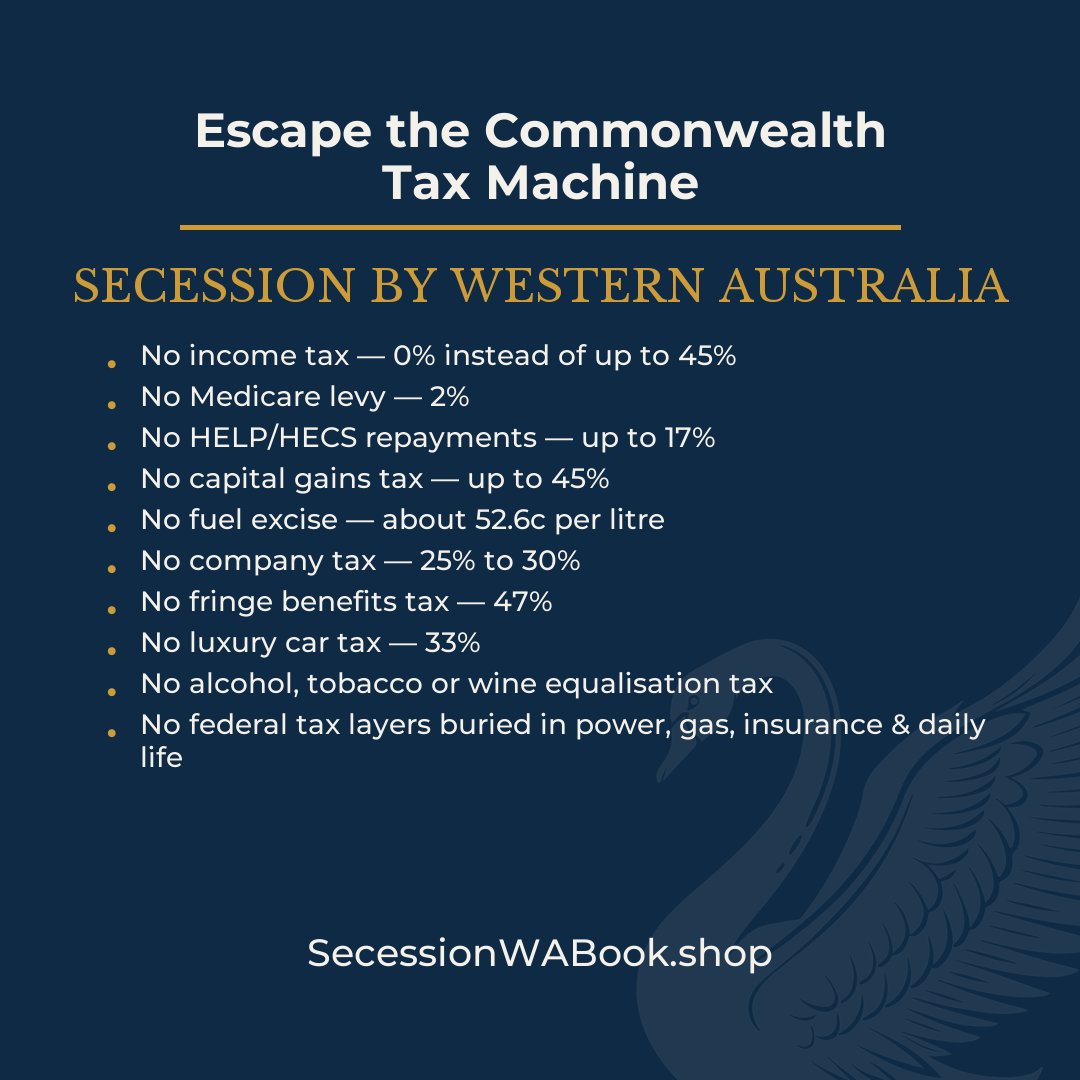
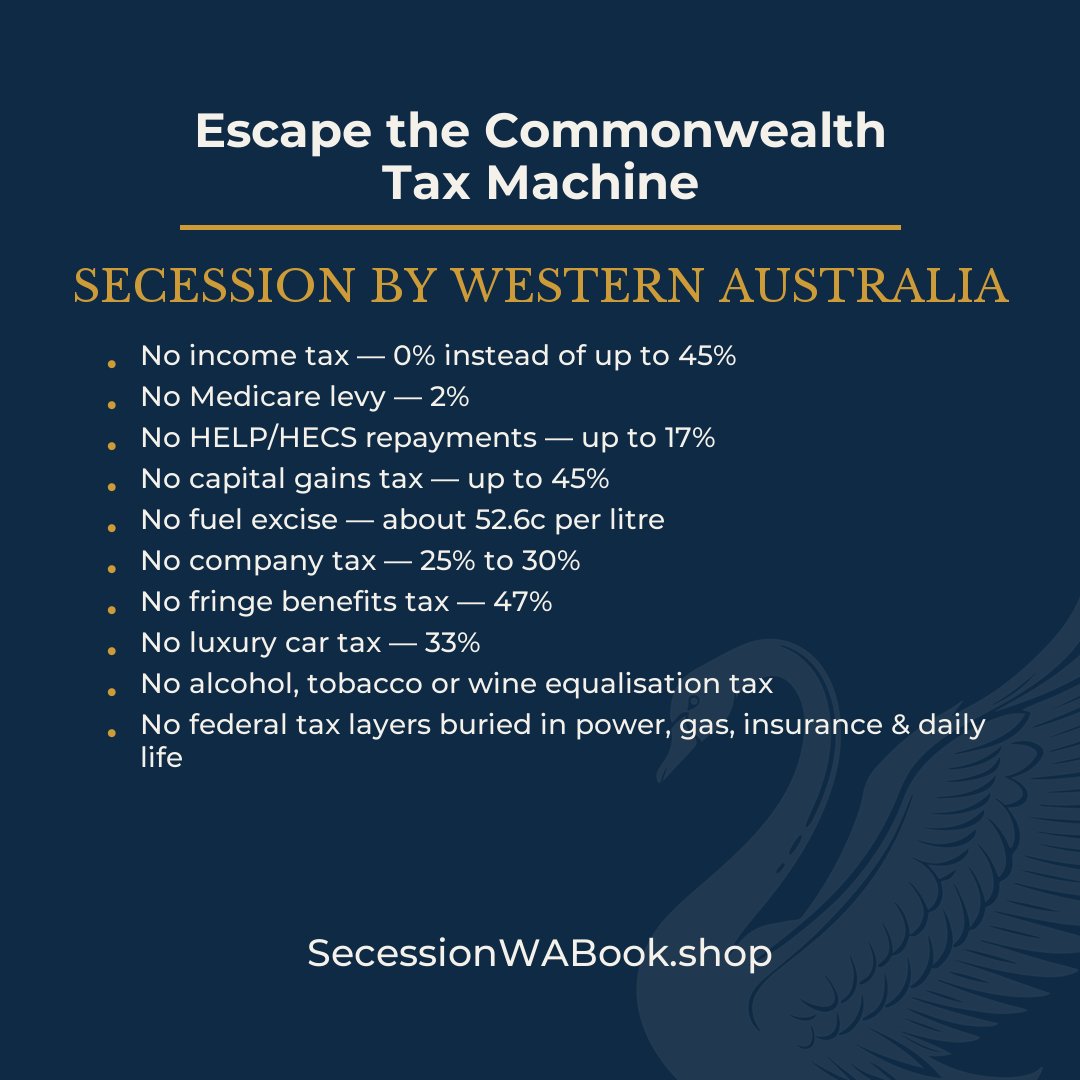
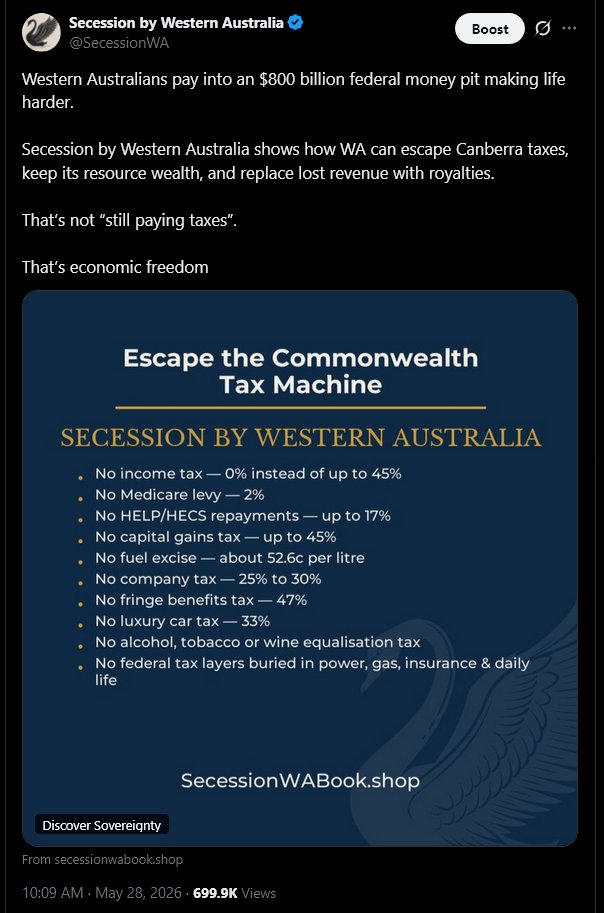
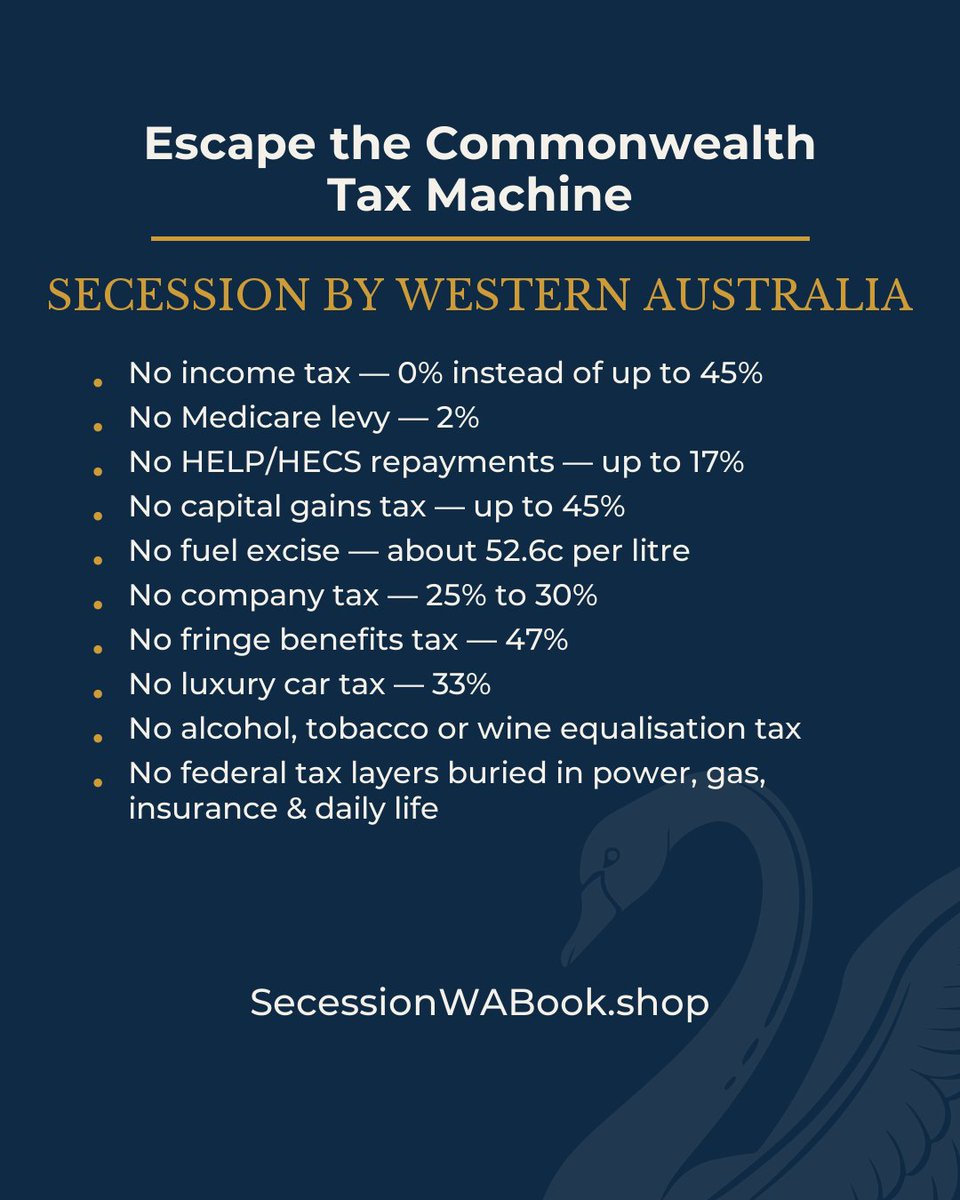
Western Australians pay into an $800 billion federal money pit making life harder.
Secession by Western Australia shows how WA can escape Canberra taxes, keep its resource wealth, and replace lost revenue with royalties.
That’s not “still paying taxes”.
That’s economic freedom
116
90
540
401,389
Secession by Western Australia retweeted
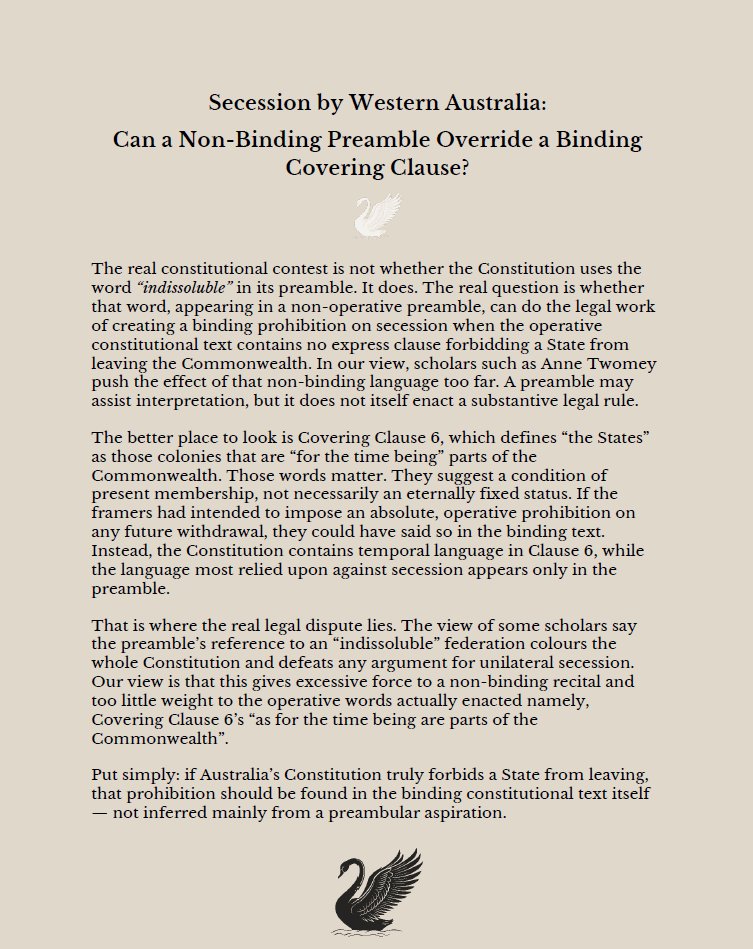
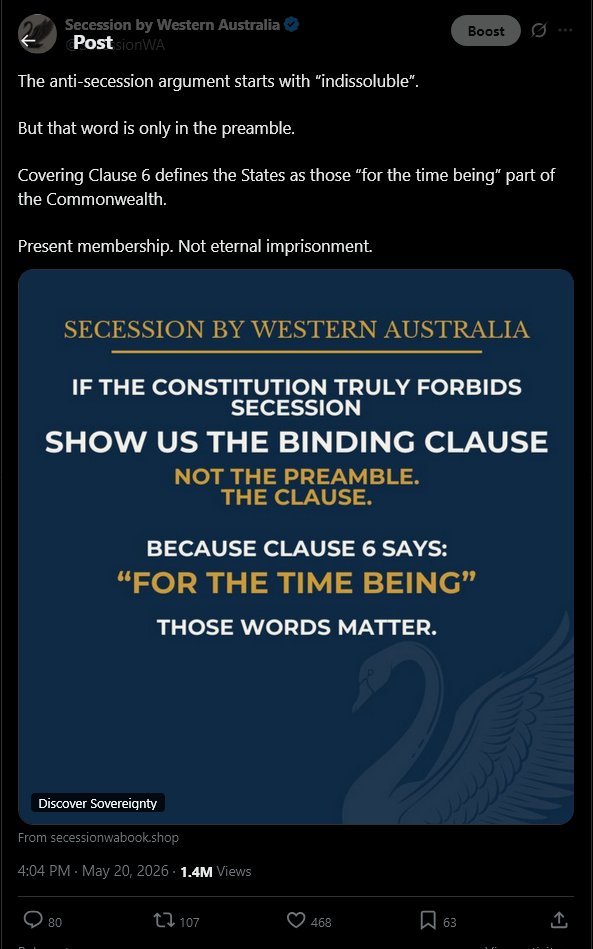
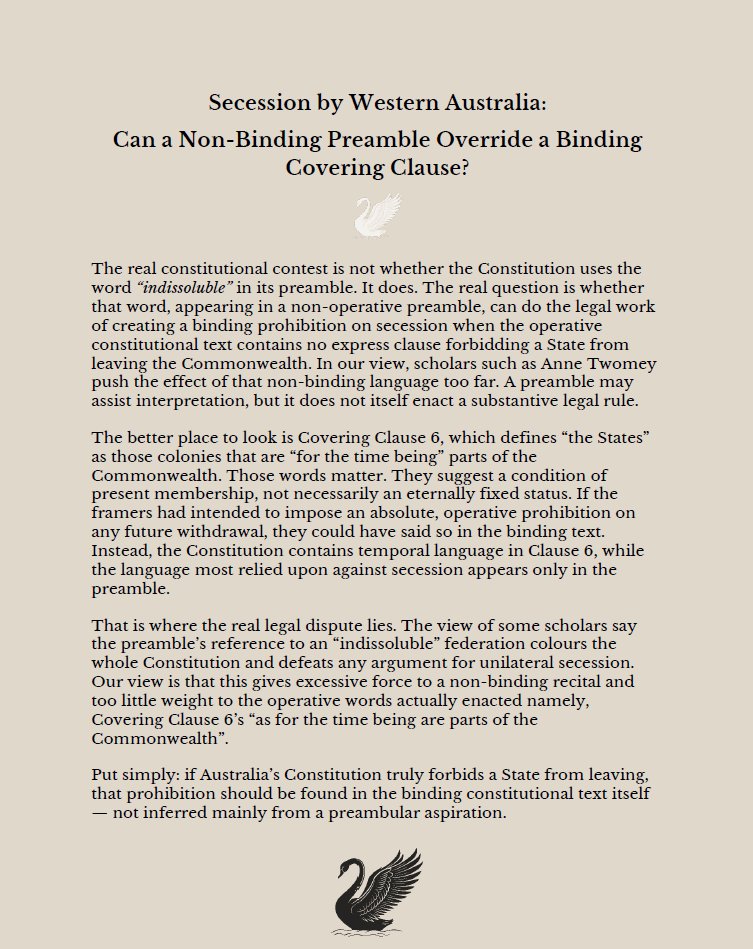
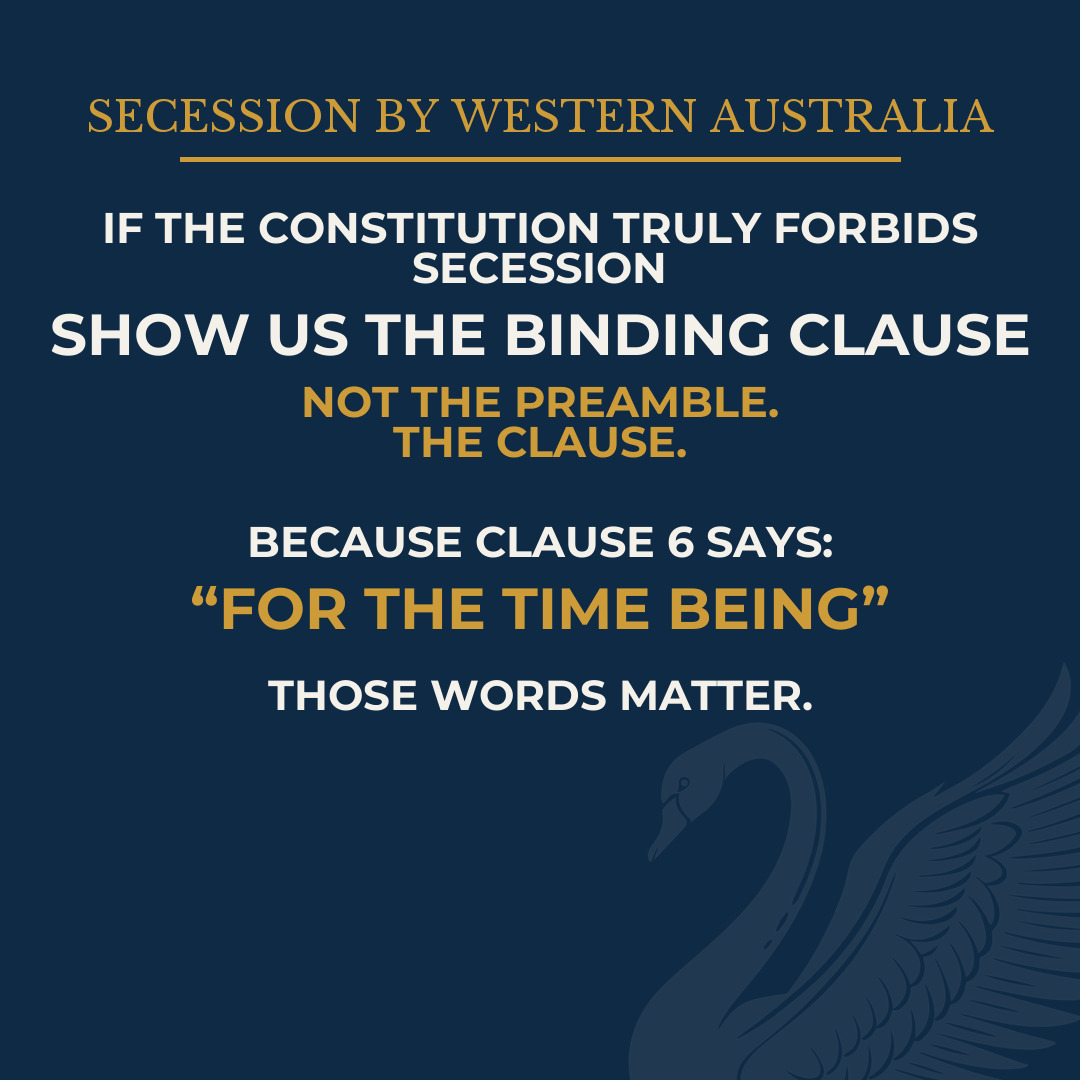
The anti-secession argument starts with “indissoluble”.
But that word is only in the preamble.
Covering Clause 6 defines the States as those “for the time being” part of the Commonwealth.
Present membership. Not eternal imprisonment.
81
92
467
1,511,004
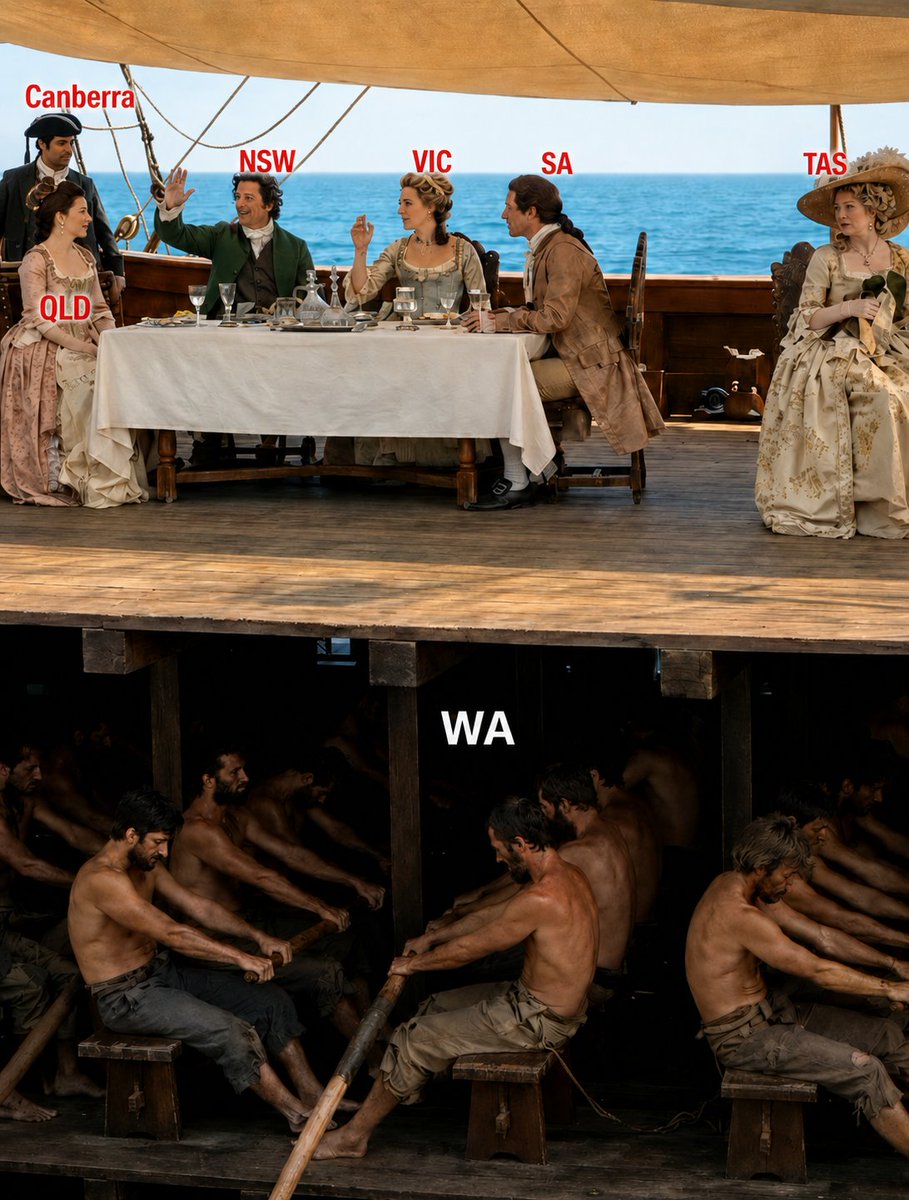
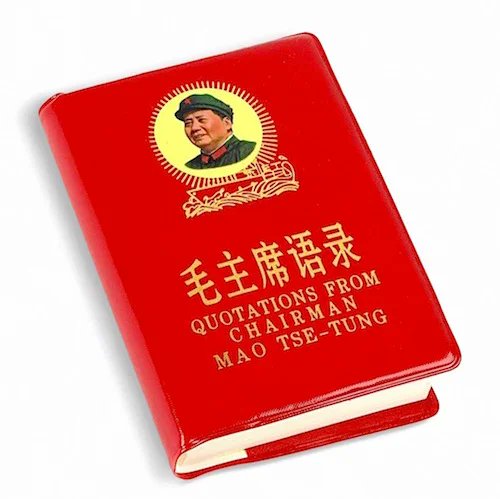
When they say:
“We’re all in the same boat”
“We’re all Australians”
…remember this picture.
WA rows.
Everyone else dines.
13
5
38
2,802
Secession by Western Australia retweeted
Carole, you’re right — recent polling does show support for secession sitting between 28–36%.
That’s not overwhelming support today.
This is exactly why the book Secession by Western Australia was written.
For generations, the history of the 1933 referendum — where nearly 68% of Western Australians voted to leave the Commonwealth — has been quietly buried.
It is not taught in schools.
The constitutional arguments, the economic modelling, and the simple fact that the States existed as independent, self-governing entities long before 1901 and were generally prospering, have been kept out of the curriculum.
Instead, Australians are taught that the current federal structure is permanent and unquestionable. The result is exactly what we see now: low awareness and support that sits in the 20–30% range because most people have never been given the full picture.
They have especially not been informed they have a real choice for changing the country.
The book exists to correct that.
It brings together the legal history (including the “for the time being” language in the Constitution), the fiscal reality (Western Australia has been a net contributor of roughly $412 billion since 1986–87, including $39 billion in 2023–24 alone), and a detailed blueprint for how an independent Western Australia could operate with far lower taxes while still delivering core services.
The current federal layer costs Australians nearly $800 billion a year. It did not exist before 1901.
All states — not just Western Australia — are now struggling under its weight. The book simply asks whether there might be a better way, and lays out the evidence so people can make an informed choice.
That’s why current polling sits where it does. Informed discussion like this should change the numbers.
4
4
12
1,187
Andrew, this is the intellectual equivalent of walking into a library, seeing one book open on the table, and declaring the entire building a bad idea.
“Are the other States allowed to invade and take over your resources? Pretty weak defence forces you'd have. Be careful what you wish for.”
Mate, the draft Constitution you clearly haven’t bothered reading past the first couple of pages contains an entire Defence Title and Chapter 8, which sets out exactly how a sovereign Western Australia would build and fund a modern, lean defence force tailored to its needs. But why let facts get in the way of a good panic post?
You’re not here to discuss anything. You’re here to drop the same tired invasion fantasy that every other lazy troll is currently copy-pasting, in the hope that scaring people will keep the current gravy train running.
Here’s some free advice: the Chapter 15 draft is literally free to read. Next time, try getting past the preamble before offering your “devastating critique.”
Until then, do us all a favour and fuck off until you learn how to engage like an adult instead of a fear-mongering shitposter.
And to any other keyboard warriors thinking of dropping the same low-effort “China/India/other states will invade” line — this is what you’ll get. Read the document or stay quiet.

Are the other States allowed to invade and take over your resources. Pretty weak defence forces you'd have. Be careful what you wish for
1
2
5
424
Peter, you’re back with the same low-grade, fear-mongering rubbish.
Claiming an independent Western Australia would be carved up into “colonies of China, India, Indonesia” is not clever commentary. It’s the exact style of gutter politics the worst operators in federal Labor and Liberal specialise in — stoke racist fears, avoid the actual arguments, and try to scare people out of even discussing change.
The draft Constitution (Chapter 15, now free) sets out a sovereign nation with strong anti-corruption measures, citizen oversight, and resource wealth directed to Western Australians. It is deliberately built to protect WA from external capture and internal failure.
Yet here you are again, recycling colonial-era panic instead of engaging with any of it.
One has to ask: whose interests are you actually serving? Because it doesn’t look like the interests of Western Australians who want to keep more of what they generate.
If you have a serious point to make, make it. Otherwise, stop acting like a Canberra-aligned disruptor trying to derail a legitimate conversation about WA’s future.
Jun 11

Yes, the constitution must be changed. If secession gets up a proper head of steam, WA will either be broken into colonies of China, India, Indonesia or a territory of Australia
2
1
4
270
Secession by Western Australia retweeted

Jun 10
3
4
345
Secession by Western Australia retweeted
@GregLucas07
Fair question, Greg — and one that gets to the heart of why we’re proposing this path for Western Australia specifically.
The short answer is: Canberra has no incentive to allow real reform, and the two major parties plus the federal bureaucracy have every incentive to block it.
Both Liberal and Labor (and the senior ministry bureaucrats who benefit from the current system) make their careers and fortunes out of the existing Commonwealth structure. They extract hundreds of billions through taxation, redistribution, grants, and the massive federal apparatus. A far-reaching document like this draft WA Constitution — which would dramatically shrink central government, return power and resources to the people and the states, and impose real anti-corruption and citizen oversight mechanisms — would directly threaten that golden goose. They have no vested interest in supporting something that takes power and money away from them.
That’s why Australians will never be given a genuine opportunity by either Liberal or Labor to even seriously discuss reforming the Australian Constitution in any meaningful way. Any real reform would remove their ability to milk the Commonwealth for political and financial advantage. The system is designed to protect itself.
Now, look closely at this draft new WA Constitution. It is tailor-made for Western Australia. Its fiscal design is built on the bedrock of WA’s extraordinary natural resources — resources that belong to the people of Western Australia. The 20% Universal Royalty Rate, combined with lean government, subsidiarity, strong citizen oversight, and the prohibition on income and company tax, creates a model that can deliver near-zero taxation while still funding essential services and building a sovereign wealth fund.
This is not achievable across Australia as a whole, nor in the other states in the same way. Other states simply don’t have WA’s combination of resource wealth and diversity (iron ore, critical minerals, and major offshore oil and gas that would come fully under WA jurisdiction).
What works here — because of what WA has — doesn’t translate to a national model. WA can do this, but only by doing it alone.
That’s why we’re putting the blueprint in front of Western Australians directly. Read the draft Constitution (it’s free at the link in the post). Critique it. See if it speaks to the WA situation specifically.
Would be interested in your thoughts after you’ve had a proper look.
Jun 10

It's interesting...why not propose similar changes for Australia rather than advocating separation?
2
3
768
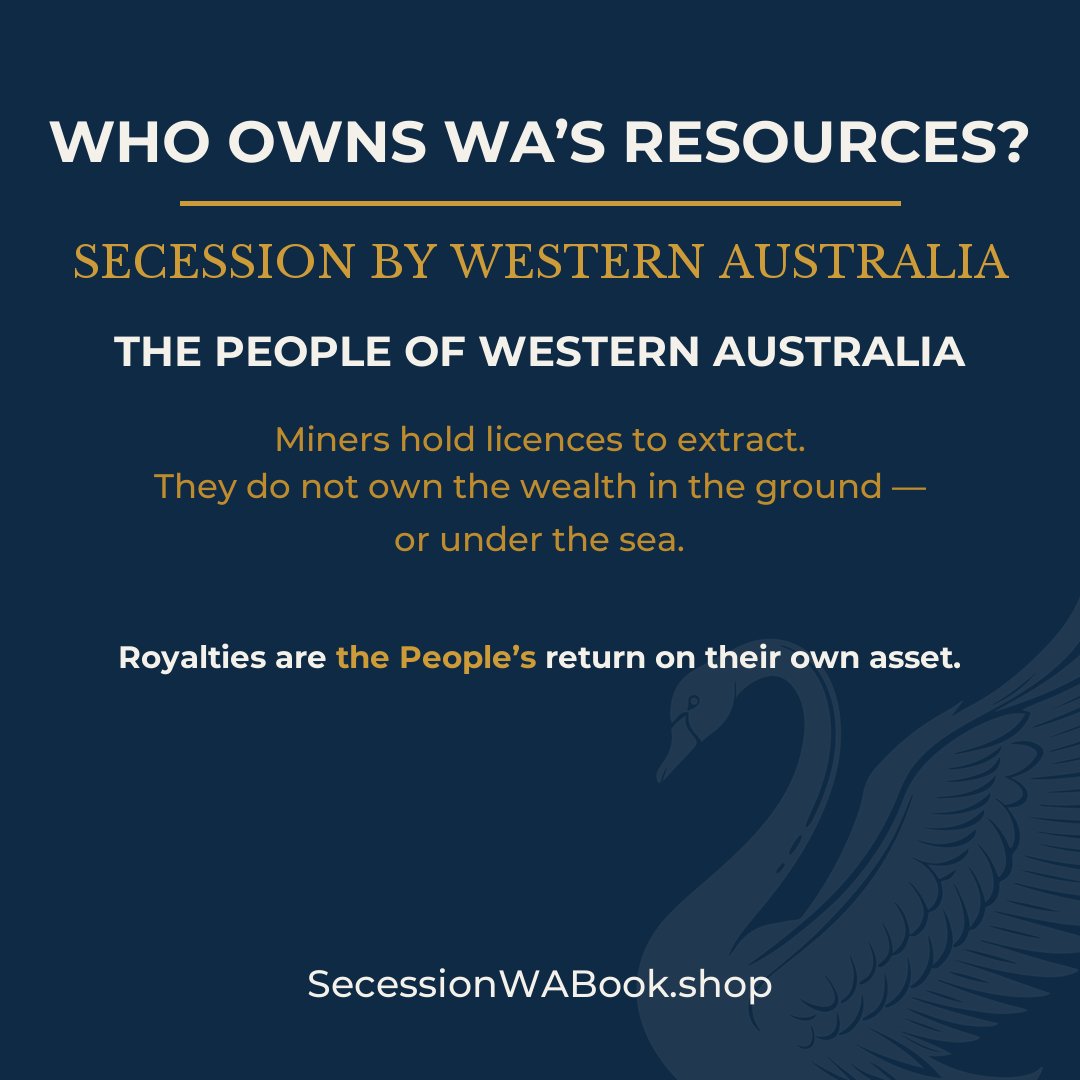
WA’s resources belong to WA citizens.
A 20% Universal Royalty Rate ensures the People receive a fair return — while miners lose company tax, payroll tax and the full Commonwealth tax machine.
Miners end up with simpler operations and higher profits.
Full details in the book → SecessionWABook.shop
2
4
13
428
Secession by Western Australia retweeted
@Dave_Low
D.Lo, this is an old talking point that doesn’t survive proper scrutiny.
Yes, Western Australia received some special grants and transitional support in the early decades after Federation — as did other smaller or developing states at the time.
That support was largely compensation for the disadvantages imposed on WA by federal tariff policies and the centralisation of power, not some generous handout from the eastern states.
However, that early period has long since been overtaken by reality.
Since the mid-1980s, Western Australia has been a massive net contributor to the Federation — to the tune of roughly $412 billion in nominal terms. In 2023–24 alone, WA’s net contribution was $39 billion (around $13,324 per Western Australian). Victoria and Queensland have been net recipients in recent years, and the smaller states and territories remain significant net recipients.
When you do the full sums — early support versus decades of very large net transfers out of WA — the ledger shows Western Australia has been heavily subsidising the rest of the country for a very long time.
The “WA was carried for the first 100 years” line is routinely trotted out to avoid addressing the current situation: WA is now one of the Federation’s biggest fiscal underwriters, while still being told it needs permission from everyone else to leave.

1
3
5
394
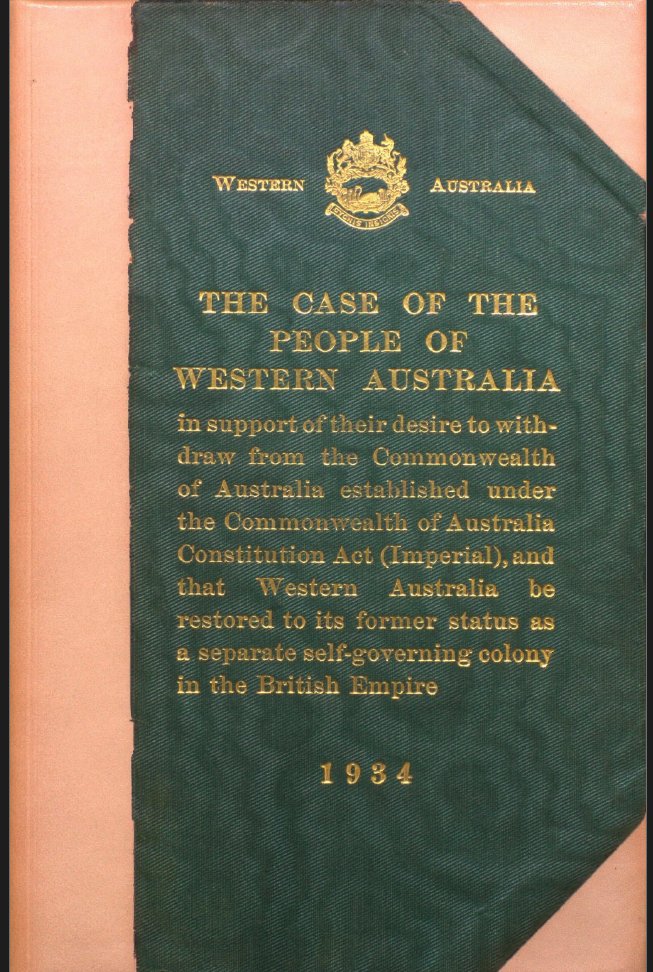
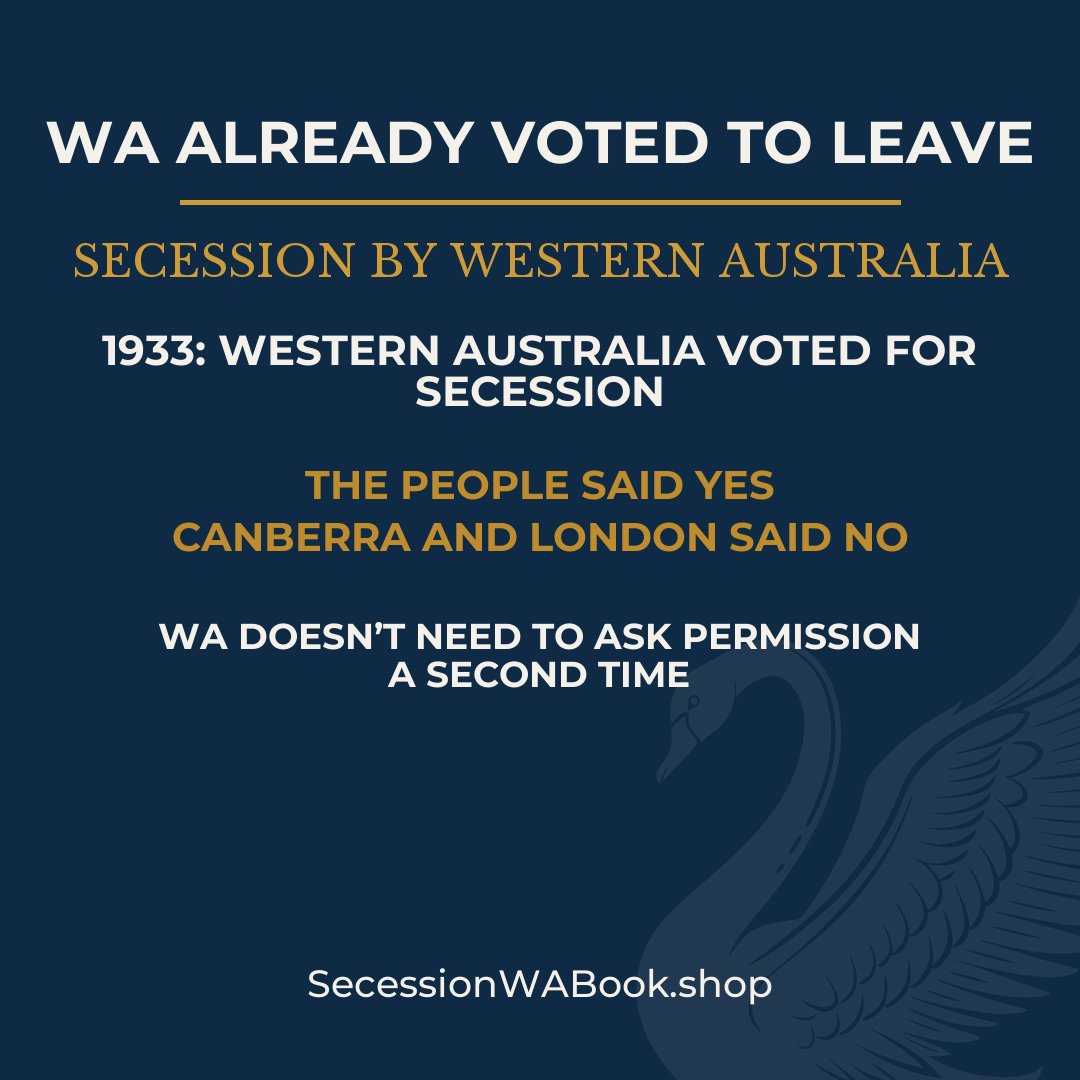
In 1933, nearly 68% of Western Australians voted to secede.
The people gave a clear mandate.
Canberra and London blocked it by claiming WA needed permission from the rest of the country.
That same illusion is still being pushed today.
The full story is in the book → SecessionWABook.shop
6
7
19
444
Western Australians are constantly told we’re being kept afloat by the eastern states.
The data says the opposite.
According to the WA State Budget 2025–26 (Appendix 11, page 354), in 2023–24 Western Australia made a net contribution of $39.022 billion to the Federation — around $13,324 per Western Australian — every WA man, woman, child, and baby.
For comparison:
NSW: $5.997 billion (~$712 per capita)
Victoria: –$0.529 billion (net recipient)
Queensland: –$16.776 billion (net recipient)
SA, TAS, NT and the ACT: all significant net recipients.
Western Australians aren’t being subsidised.
We’re paying the bills for everyone else.
Full table here: ourstatebudget.wa.gov.au/202…
This level of net contribution is not sustainable.
It is Western Australians’ own wealth being drained away — reducing our quality of life and making everyday living more expensive than it should be.
The book explains how Western Australians can stop this drain and keep far more of what we generate — moving to near-zero taxation as a new nation.
No core services lost — in fact, many improved.
Government significantly reduced in size and brought much closer to local communities instead of being centralised in Perth.
A new nation focused on building the infrastructure we need to become self-sufficient and a major net exporter.
Future generations of Western Australian kids growing up among the wealthiest in the world.
Full details here:
SecessionWABook.shop
4
4
13
832
Secession by Western Australia retweeted
@OzLori89
Thanks for engaging, Lori — and for recognising that all states should be asking these questions.
The trouble is, Canberra loves when people say “just kick Labor out next election.” That’s exactly the revolving-door theatre the two major parties rely on to stay in power.
Labor and Liberal take turns at the helm, each blaming the other for the mess, while the underlying system — a bloated, extractive Commonwealth that milks the states and gives away our natural resources — keeps growing regardless of who wins.
Whether it’s Labor or Liberal in charge, Canberra’s spending has exploded, its bureaucracy has ballooned, and ordinary Australians are paying more for less. The major parties have turned federal government into a protected duopoly that serves itself and its connected interests far more than it serves the people or the states.
Western Australia’s situation didn’t suddenly appear under one of these parties. It’s the predictable result of a federal layer that didn’t exist before 1901 — a layer that has become redundant, parasitic, and extraordinarily expensive (nearly $800 billion a year). Swapping one party for the other won’t fix that. It just resets the clock on the same broken machine.
The real solution lies with the states themselves.
Prior to 1901, every Australian colony stood as an independent, self-governing entity. Western Australia — and the other states — do not need anyone to return sovereignty to them. They simply need to withdraw from the Commonwealth and once again stand on their own, as they did before Federation. WA secession would serve as a powerful example that other states could follow.
If you’re interested in the deeper argument, I’d encourage you to read the Introduction to the book. It lays out why the current two-party federal system has failed and what a better path forward could look like:
secessionwabook.shop/introdu…
Thanks again for commenting — these conversations matter.
Jun 7

With this terrible govt in Canberra, all states should be asking this question.
Or we can just kick Labor out next election.
3
3
10
509
Secession by Western Australia retweeted
@JimDean31126390
That’s a fair and thoughtful question.
It is true that on the same day Western Australians voted overwhelmingly for secession (nearly 68%), they also elected a Labor government under Premier Philip Collier that had campaigned against secession. Collier’s government was not enthusiastic about the result.
However, even that anti-secessionist government recognised the strength of the democratic mandate. Collier publicly stated that his administration would take “all necessary steps to give effect to the majority decision of the people.” The new government proceeded with the formal petition to the Imperial Parliament in London, led by Sir Hal Colebatch, seeking to have Western Australia re-established as an independent self-governing dominion within the British Empire.
The 1933 vote was not simply a knee-jerk reaction to the hardships of the Great Depression. As detailed in the Foreword to the book by Professor Augusto Zimmermann, Western Australian dissatisfaction with Federation had been building for decades. Grievances over tariff policy, loss of revenue, centralisation of power in Canberra, and the High Court’s expansion of Commonwealth authority were long-standing. These issues were already being debated seriously in the 1920s, well before the Depression hit hardest.
William Coleman’s Foreword in the same book goes further, arguing that Western Australia’s original accession to Federation in 1900 was itself deeply flawed — “tainted in provenance, illegitimate in process, harmful in consequence, and soon regretted” even by some of its early supporters. Prominent former federationists, such as Walter James (a former Premier), had by the early 1930s become disillusioned with how the federal compact had played out for Western Australia.
While the economic pressures of the Depression undoubtedly amplified discontent in 1933, the underlying secessionist sentiment reflected a deeper and more enduring sense that the federal arrangement had not delivered fairness or prosperity to the West — a view that has never entirely disappeared.
The book Secession by Western Australia examines both the historical context of the 1933 referendum and the continuing constitutional and economic case today.
It was written precisely because these important chapters of our history and the serious arguments surrounding them have largely been airbrushed from public discussion and school curricula.
1
2
2
869
Secession by Western Australia retweeted
@4mambo
A former press gallery journalist calling serious political discussion “looney” and “madness” is genuinely embarrassing.
Western Australians have been debating secession for over a century. In 1933, nearly 68% of them voted in favour of leaving the Commonwealth in a properly conducted referendum. That was not “madness” — it was a legitimate democratic expression of deep and long-standing grievances. The issue was taken seriously enough that a delegation was sent to petition the British Parliament.
Yet here you are, a former member of the Canberra press gallery, resorting to back-of-the-classroom slurs to try and shut down discussion.
No engagement with the constitutional arguments. No engagement with the economic modelling. No engagement with the historical record. Just the lazy, juvenile Australian habit of dismissing anything that challenges the status quo as “looney.”
It raises a very obvious question about your motivations, Geoff.
When a former journalist’s first instinct is to smear and delegitimise rather than examine the arguments, it looks less like independent analysis and more like carrying water for the very vested interests (Liberal and Labor) that have the most to lose if this conversation gains serious traction.
If you actually believe the case for Western Australian independence is weak, then make the case. Engage with the material. Argue the law. Argue the economics. Argue the history.
Otherwise, your contribution here is just another example of why so many Western Australians have lost respect for the Canberra class you once rubbed shoulders with.
Jun 7

So another looney joins the madness that this site revels in. If the X ever comes to represent general public opinion, we are on the road to ruin!
3
9
370
Secession by Western Australia retweeted
@k1rab0shi
A democratic decision by the people of Western Australia does not require the consent of the rest of Australia, because Western Australia is a sovereign State with its own plenary powers.
If every major decision by WA required the approval of the other States or the federal government, then Western Australia would not be sovereign at all — it would be a subordinate territory. That is not the constitutional position.
Covering Clause 6 of the Australian Constitution defines the States as those colonies that are “for the time being” part of the Commonwealth. That language is deliberately conditional and temporal. The Constitution contains no provision requiring a State to obtain permission from the rest of the country before it can leave.
The sovereignty of the States is also recognised by the High Court. Requiring the consent of the “full demos” (the rest of Australia) before WA could exercise its sovereign choice would directly undermine that sovereignty.
The 1933 referendum showed what actually happened in practice: the people of Western Australia voted clearly, but were told they needed permission from others. That political barrier does not equal a constitutional requirement.
The full legal argument is set out in Chapter 2 of the book.

Why wouldn't a democratic decision require consent of the full demos?
1
3
5
1,698
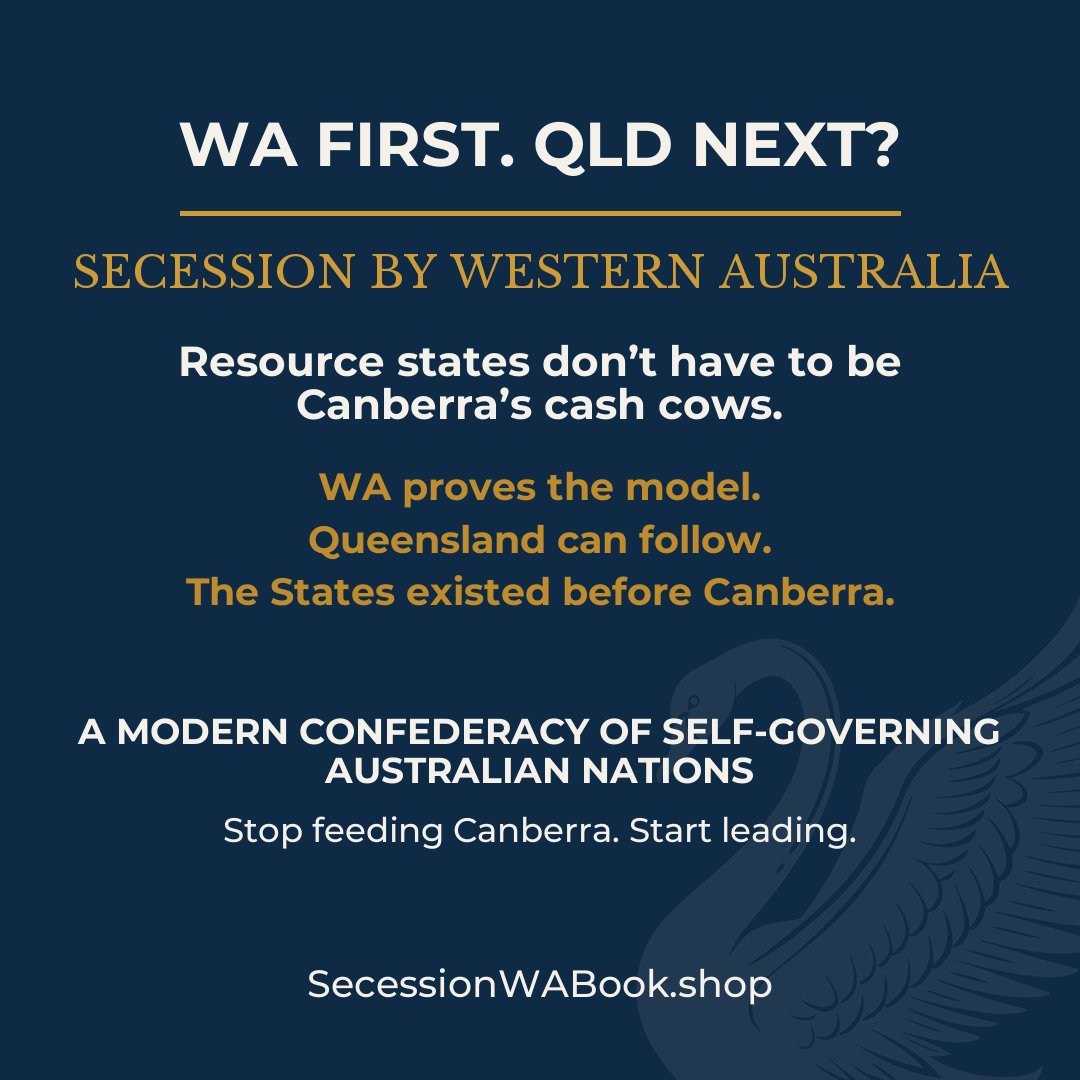
WA secession isn’t isolation.
It’s proof of concept.
If WA can keep its resource wealth, slash taxes and prosper, Queenslanders will ask the obvious question: why not us?
The States existed before Canberra.
They can exist again — as mature, self-governing nations.
5
10
26
1,428