
240 Photos and videos














MilkMoney25 retweeted

The market is pricing $Qubic like a typical crypto.
The thread shows it's becoming something very different.
Emission: ↓ 50%
Network usage: ↑
Burn rate: ↑
AI computation launching soon: ↑↑
Two lines moving toward each other.
When burns exceed emissions, every new user makes the network scarcer.
That's a narrative worth paying attention to.
$Qubic' s halving isn't the headline.
The headline is that usage destroys supply.
Less issuance.
More burning.
More #AI demand.
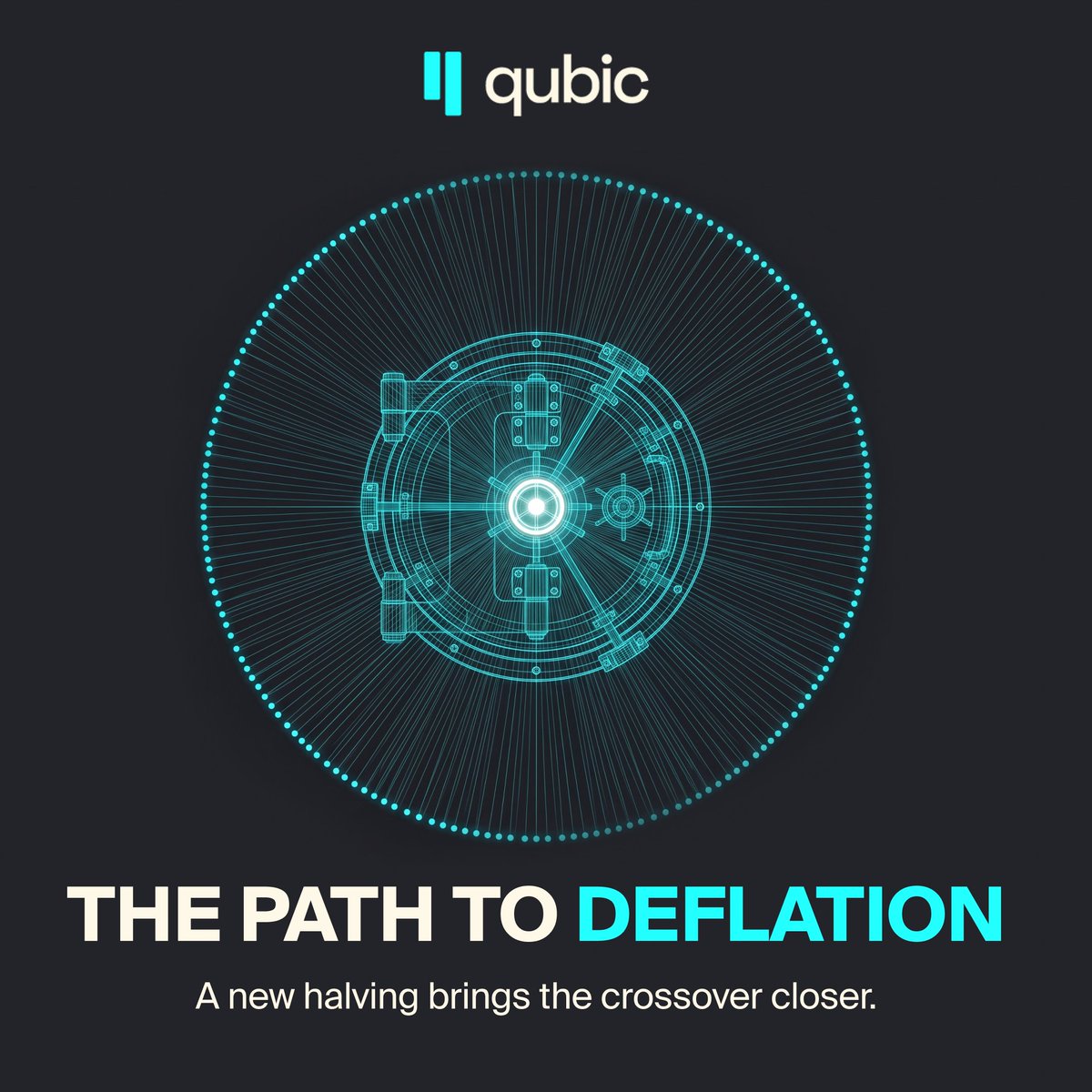
The path to deflation is already mapped out.
#Crypto $QUBIC 🚀🔥

Two numbers decide Qubic’s supply.
One just got cut in half by an on-chain vote.
The other climbs every time the network gets used.
The halving that just passed is a step toward the line where they cross. 🧵
4
30
378
MilkMoney25 retweeted

🚨 $ZBCN may not be building a payroll company.
It may be building a system where money never stops moving.
That’s the part I think most people missed from what Simon Babakhani recently said.
When most people hear Zebec , they think faster payroll.
I think @simonb_ldn is describing something much bigger.
@Zebec_HQ
1
1
4
56
MilkMoney25 retweeted

Jun 14
Go to the store buy a whiteboard read and research qubic-network:native . Study it, learn it and digest it, take NOTES. This is not a protocol that you can just glance at the white paper once or watch a few YouTube videos. You miss this then you’ll be kicking yourself for the rest of your life
11
93
1,372
MilkMoney25 retweeted

21h
Happy Sunday #222: SBF Appeal DENIED 70 Data Centers CANCELED & QMINE Updates You Need to Know $qubic $qMine $strc $mstr #spacex
x.com/i/broadcasts/1nxeLLWkR…
Join the Live chat on Youtube and subscribe!
youtube.com/live/t8Ohn-JfRoc
2
15
325

Jun 14
Jun 14

1
16
MilkMoney25 retweeted
Jun 14
Impromptu late night live stream in a few minutes
👇
youtube.com/live/mImQXhgLRDQ👈
☝️
qubic-network:native
1
6
27
201
MilkMoney25 retweeted

Jun 13
21 million crypto card transactions in a single month. One global payment network.
This is the fastest-growing consumer use case in crypto, and the privacy leak is built in from the start.
Our partnership with @ZebecCards changes that.
Ghost makes every swipe invisible by default. Stealth addresses, sealed payloads, and relay routing sever the link before it ever reaches the issuer.
The wallet you already use, with the privacy you always needed.
ghost.money 👻
20
107
331
17,195
Jun 13

5
31
613
MilkMoney25 retweeted

Jun 13
12
66
208
16,372
MilkMoney25 retweeted

Jun 13
If you still have any doubts about why Aigarth will be the most powerful asset on Earth, now you can put those doubts to rest!
The US government administration has prohibited Anthropic from making the Fable/Mythos LLM AI (centralized) available to anyone in the world.
The AI will be for exclusive military use!
Now do you understand why Aigarth will be so powerful? This asset will be bigger than Bitcoin, SpaceX, and every form of centralized tool in the world!
Don’t know the project yet? It’s the only decentralized AGI project in the world!
And you still haven’t realized it? Part of the ternary logic of this AGI model is already up and running in tests!
Nothing will be able to stop Aigarth from becoming the most powerful asset on the planet in the coming years!
After this new ban, I have zero doubts left about the absolute value of QUBIC!!!
Let the weak leave this market, let the blasphemers against the project and the team leave, let the skeptics of disruptive technology leave!!
A new era of technology without owners is about to arrive!!!!
Mark my words: QUBIC is the LIBERATION OF THE FUTURE OF AI into the hands of humanity!!
#qubic #aigarth
9
67
283
4,830
Jun 13
Jun 13

If you still have any doubts about why Aigarth will be the most powerful asset on Earth, now you can put those doubts to rest!
The US government administration has prohibited Anthropic from making the Fable/Mythos LLM AI (centralized) available to anyone in the world.
The AI will be for exclusive military use!
Now do you understand why Aigarth will be so powerful? This asset will be bigger than Bitcoin, SpaceX, and every form of centralized tool in the world!
Don’t know the project yet? It’s the only decentralized AGI project in the world!
And you still haven’t realized it? Part of the ternary logic of this AGI model is already up and running in tests!
Nothing will be able to stop Aigarth from becoming the most powerful asset on the planet in the coming years!
After this new ban, I have zero doubts left about the absolute value of QUBIC!!!
Let the weak leave this market, let the blasphemers against the project and the team leave, let the skeptics of disruptive technology leave!!
A new era of technology without owners is about to arrive!!!!
Mark my words: QUBIC is the LIBERATION OF THE FUTURE OF AI into the hands of humanity!!
#qubic #aigarth
6
52
765
MilkMoney25 retweeted

Jun 12
$QUBIC is hands down the best Ai project in the space. Anyone shilling you other garbage is uneducated. I’m here 12 hrs a day. I have no agenda. I have nothing to sell you. I just want you to win. It’s no fun being the only one with money.

My recommendation to anyone interested in qubic-network:native is to REALLY research it
Read the whitepaper, read @QubicChurch book, read neuraxon academy.
Understand UEFI, bare metal, Quorum consensus, smart contracts, feeless transactions, UPOW, neuraxon, oracles, outsourced computations
See the bigger picture of what is happening here
4
18
145
3,698
MilkMoney25 retweeted
Jun 12
Qubic & Haribo: Huge Business Proposal, Outsourced Computations Revisited, Michael Saylor Is A LIAR &
More!
$QUBIC $QMINE
x.com/i/broadcasts/1vJpPPVOY…
Join the YT live chat!
youtube.com/live/1zIT1QZEJL0
1
5
21
600
MilkMoney25 retweeted

You a shitty low price.
I see that with 100 USD I can buy more than 200.000.000 qubic-network:native
200M qubic-network:native @ 0.00001 = $2000
@ 0,0001 = $20.000
@ 0,001 = $200.000
@ 0,01 = $2.000.000
Enough said.
#Qubic
2
11
99
2,425
MilkMoney25 retweeted
Jun 11
🌅GM 🌅
I went live for another Qubic update this morning!
👇🏾
youtube.com/live/eq_YDKc41mU…👈🏾☝🏾
Please enjoy, drop a like and leave a comment on YouTube for the algo!
Doing so let's YT know to push out more Qubic content. 🧙🏾♂️
(Sorry for the connection issues mid way, just fast-forward a couple minutes until I can edit it out later 🥲😅)
$qubic $qmine
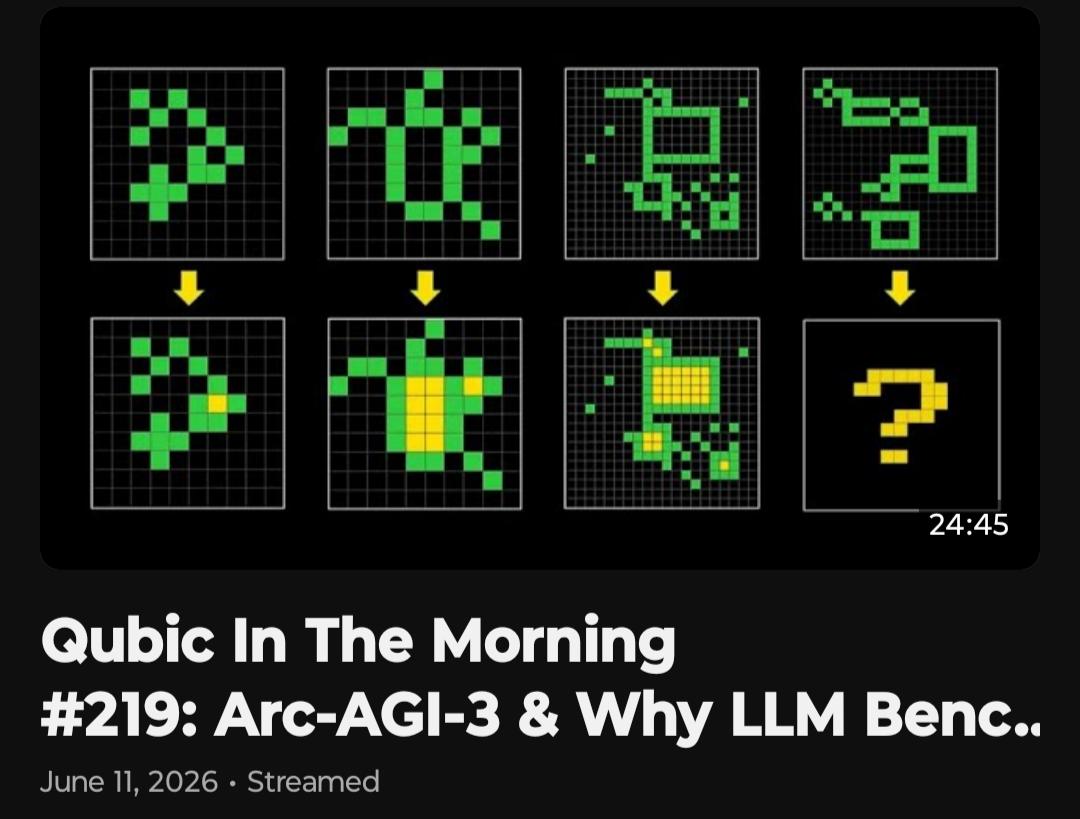
We have no unit of measurement for intelligence.
Not for humans. Not for machines.
We've been arguing about it for over a century.
Up to 45% of the benchmarks we use to evaluate LLMs contain leaked training data.
ARC-AGI-3 was built to fix that.
Humans solve 100% of it.
Frontier AI scores below 1%.
NIA Volume 10 breaks down the g factor, Chollet's framework, benchmark contamination, and what measuring machine intelligence actually requires.
1
6
28
586
MilkMoney25 retweeted
Jun 10
Missed my @_Qubic_ live stream this morning? 🫠
No worries!!
Catch the replay!🤹🏾♂️
👇🏾 👇🏾👇🏾👇🏾
youtube.com/live/Fj2Vvk7KzKI…
There is some really exciting stuff going down in Discord🙌🏾
Do NOT forget what you're holding 🐕
$qubic

Jun 10
INSANE QUBIC UPDATE #218: AIGarth IS READY?! qMine Payouts Things & Stuff! $qubic $qmine x.com/i/broadcasts/1DGleekgX…
5
26
3,510
MilkMoney25 retweeted
Jun 10
INSANE QUBIC UPDATE #218: AIGarth IS READY?! qMine Payouts Things & Stuff! $qubic $qmine x.com/i/broadcasts/1DGleekgX…
8
35
1,127
MilkMoney25 retweeted

Jun 10
$QUBIC is part of a story older and deeper than crypto. A story of people who refused to let power stay in a few hands. To understand where we are going, you have to know where we come from.
In 1988, an engineer named Timothy May wrote the Crypto Anarchist Manifesto. A simple and radical idea. Cryptography can let individuals exchange, communicate, and contract, without asking anyone's permission. Five years later, in March 1993, Eric Hughes published the Cypherpunk Manifesto. One sentence sums it up. Privacy is necessary for an open society in the electronic age.
These people did not ask to be protected. They wrote code. Their conviction held in three words. Cypherpunks write code. You do not defend a freedom by begging for it, you build it by writing it into tools no one can confiscate.
From this movement came projects that changed the world. PGP encryption to protect communications. Tor for anonymity. And in 2008, a certain Satoshi Nakamoto published the Bitcoin whitepaper, on a mailing list directly descended from the cypherpunks. For the first time, value itself became decentralized. No more need for a central bank to decide what has value and what does not.
Each generation has had its front. Privacy. Then money. And today, a new power is concentrating at a dizzying speed, more strategic still than the previous ones. Intelligence.
Let us face reality. Artificial intelligence, which will soon be the infrastructure of nearly every human decision, is concentrating in the hands of three or four companies. They decide the models, the rules, what can be said or thought by these systems. If history has taught us one thing, it is that all concentrated power eventually escapes those it should serve.
This is exactly where Qubic's fight lies. Aigarth is not only a technical project. It is the same cypherpunk intuition applied to the front of our era. Intelligence should not belong to anyone in particular. It should be open, verifiable, and cultivated by all those who take part in it. Not locked in the private servers of a few giants.
A point of honesty, because lucidity is part of our values. Decentralizing intelligence is immensely difficult. Far more than decentralizing money. No one can guarantee it will succeed, or when. It is not a promise, it is a fight. And like every fight worth the effort, its outcome is not written in advance.
But that is precisely what makes the endeavor right. The cypherpunks of 1993 did not know either whether they would win. They wrote code anyway, because the stakes were too important to leave to others.
Intelligence belongs to no one. It belongs to everyone. And it will be built, like everything that matters, by those who take the trouble to build it. Tick after tick. Computor after Computor.
6
47
199
3,915
MilkMoney25 retweeted

Jun 9
$Qubic JUST UNLOCKED THE FUTURE!
Imagine a brain living on the blockchain.
It could think anything you wanted run any program perfectly, every single time.
It could even see the outside world (#Bitcoin price, sports scores, whatever).
But it was stuck.
It couldn’t do anything outside the chain. No moving money.
No triggering actions on #Ethereum.
Nothing.
That changes in just 8 weeks.
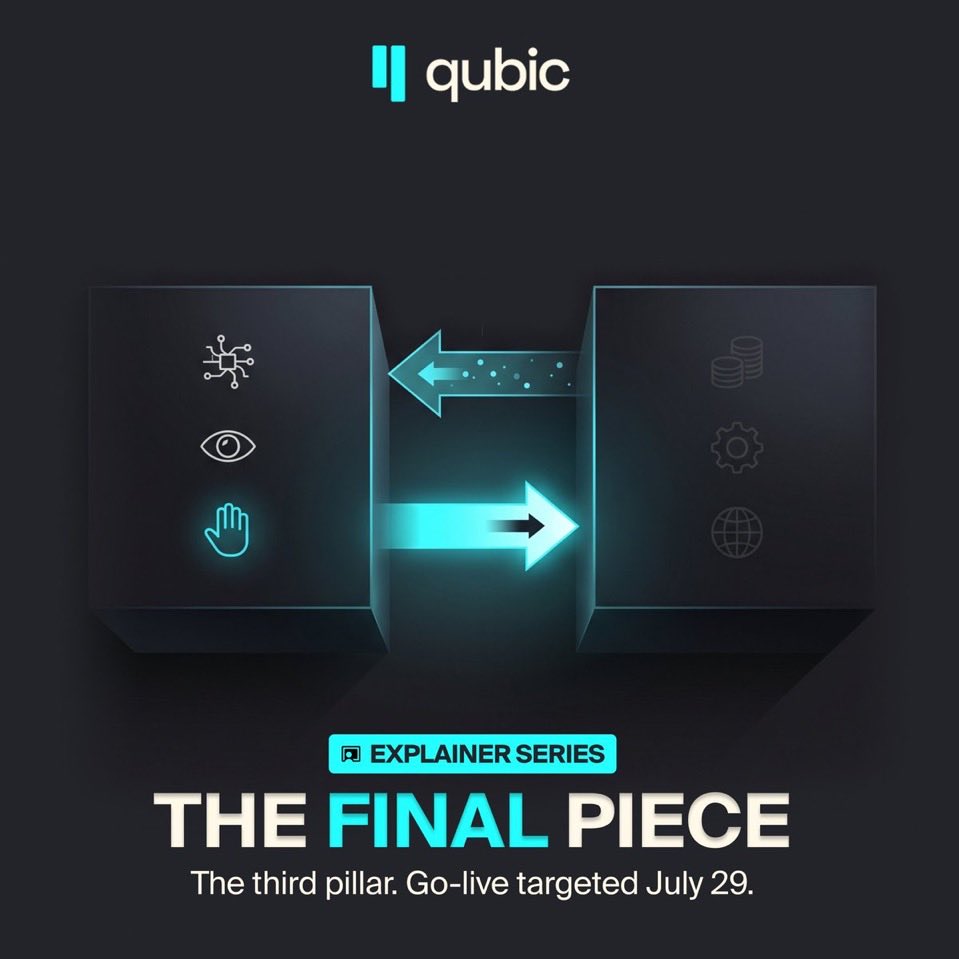
July 29, #Qubic smart contracts get HANDS.
Now they can send real instructions out into the world…
“Move these coins.”
“Launch this trade.”
“Trigger that action on another network.”
Brain, eyes, hands = a real on chain agent that thinks, watches, and actually acts all by itself.
Most #blockchains are still fighting to get just one of these right.
#Qubic is dropping all three… at once.
This is the biggest leap in #crypto since smart contracts were invented.
Get ready.
The age of #decentralized agents is here and $Qubic is leading the charge.
#Qubic #Deflationary #Crypto #Gem
#AI #AGI #AiGarth #Bitcoin #Ethereum #Decentralised #Intelligence #IYKYK
1
26
138
1,680