
History and AI. I work in AI and history is my hobby. I fact check the history to fix the colonial narratives using science, mathematics, technology and logic.
Joined September 2012
- Tweets 47,092
- Following 2,736
- Followers 18,105
- Likes 19,891
6,474 Photos and videos



Pinned Tweet

x.com/TheEconomist/status/20…
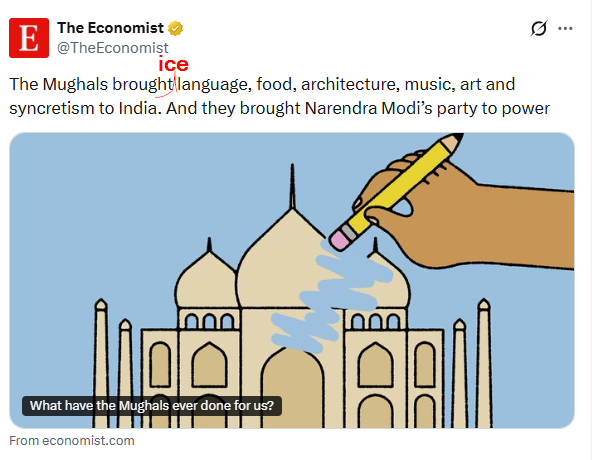
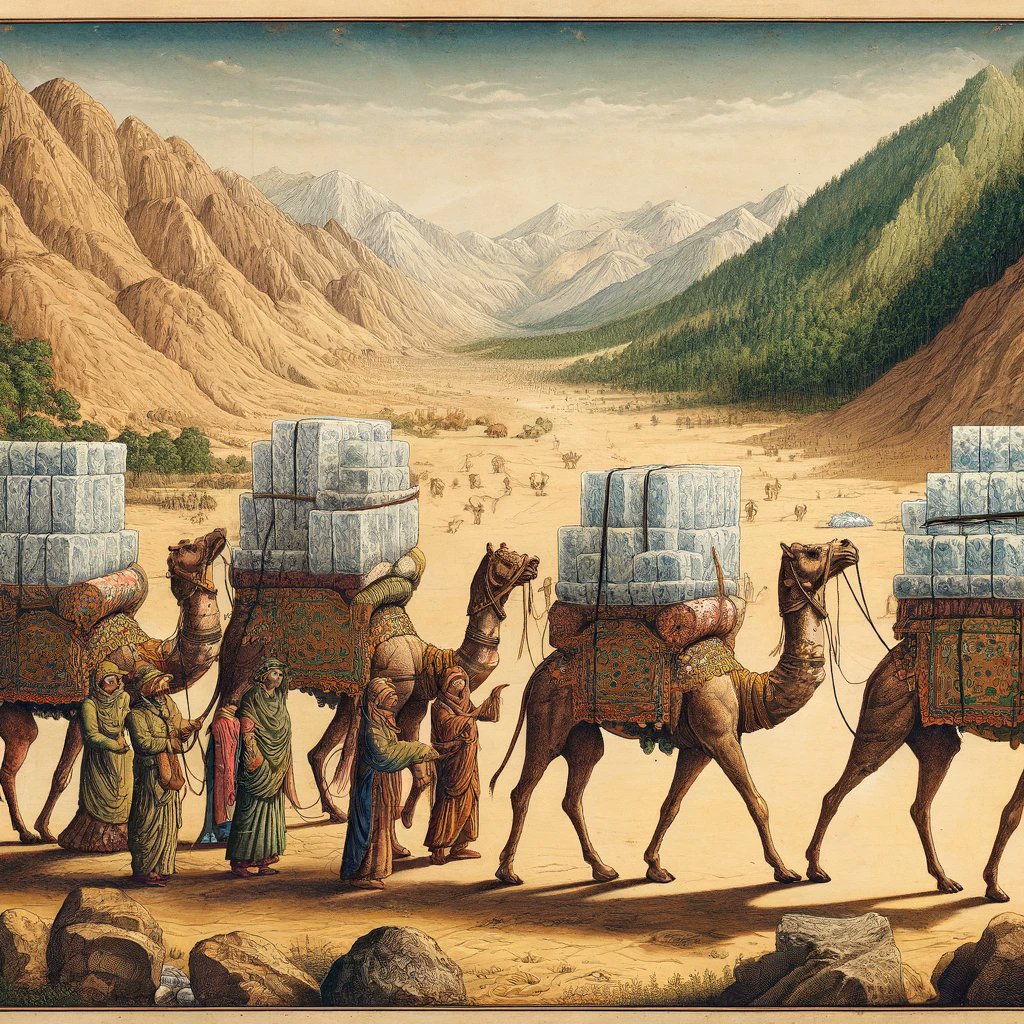
Mughals brought ice!
6 May 2024

Kulfi was introduced to India by Mughals when they brought ice from the desert to Himalayas.
7
17
107
5,460
Bhaskara was absolutely the Boss.
Jun 13

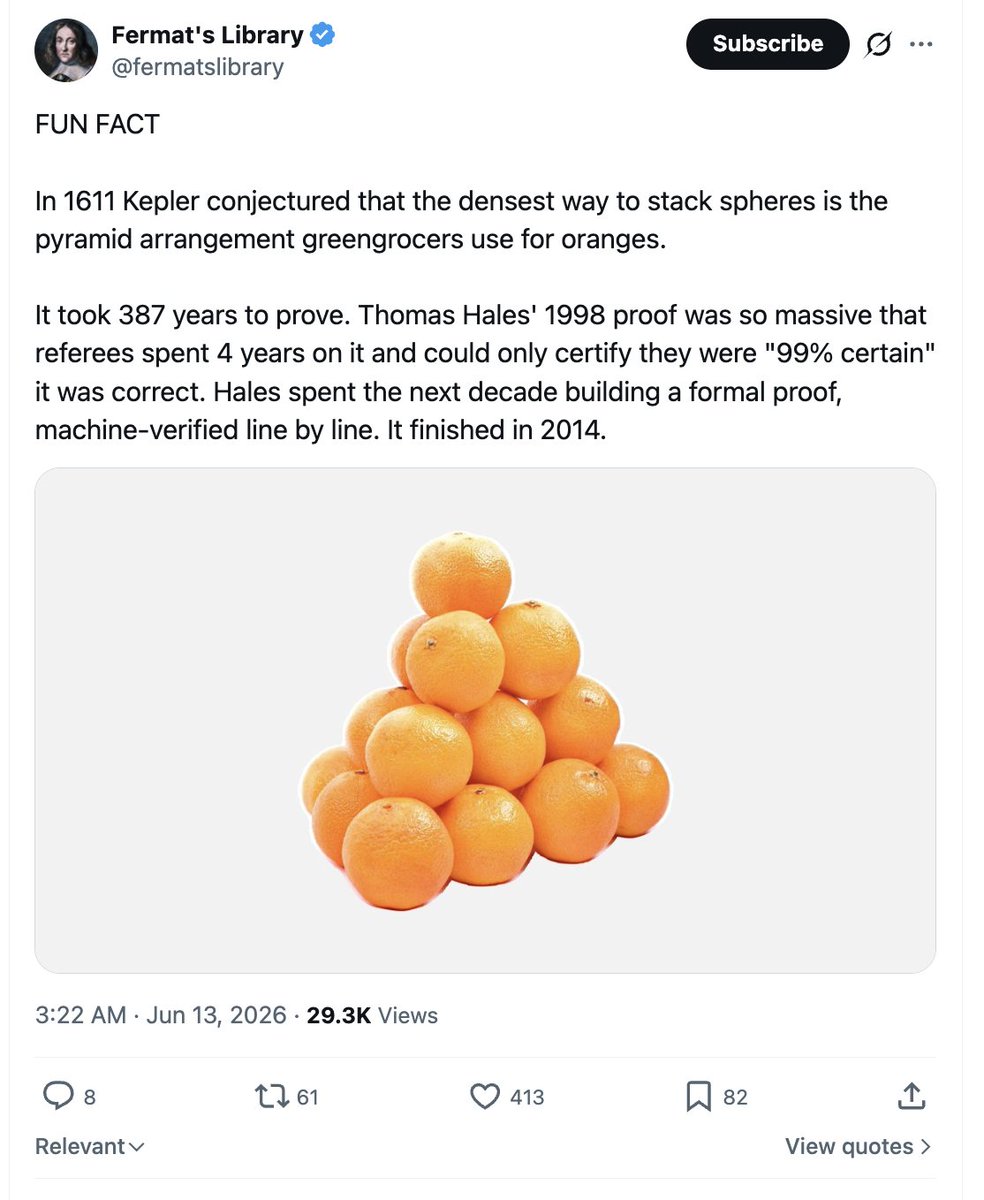
Nah... that is not even the best part. Here is the real FUN FACT:
In the Aryabhatiya (Ganitapada, Verse 21), written in 499 CE, Aryabhata introduces the mathematics of stacking. He explicitly lays out the formula for finding the total number of items in a pyramid pile with a triangular/square base. For a pyramid stack where each side of the base has 'n' spheres:
Total Spheres = [ n × (n 1) × (n 2) ] / 6
Think about the timeline here. Johannes Kepler conjectured that this layout was the densest in 1611. Aryabhata had already mapped out the exact algebraic discrete-volume matrix to count every single individual sphere within that dense packing formation 1000s yrs earlier.
Fun Fact is still not over. Fast-forward to the 12th century. The legendary mathematician Bhaskara II takes Aryabhata’s foundation & elevates it into a poetic, highly advanced art form in his textbook, the Lilavati. Bhaskara creates a dedicated mathematical category called Citi-Ghana (the volume of a pile). He did not just give 1 formula; he realized that different stacking bases create different geometric properties. He breaks down eqns for:
- Triangular-based pyramids (where spheres rest in the gaps of a triangular grid)
- Square-based pyramids (the standard grocery-stack style)
- Oblong piles (where the base is a rectangle)
To solve these, Bhaskara had to utilize Varga-Sankalita (the sum of squares of natural numbers) & Ghana-Sankalita (the sum of cubes). While Western mathematics at the time was struggling with basic arithmetic using Roman numerals, Indian scholars were utilizing advanced series expansions to handle the discrete boundaries of 3 dimensional sphere packing.
Now the Fun Fact is over 🙏🙏
2
4
40
1,158
GitHub is now international border!
Jun 13

Genuine question for whoever drafted this directive: under the deemed export rule, your foreign-national employees can't look at the model they built. Their own commit history is now an arms shipment to themselves. They crossed an international border by badging into the office.
Has anyone told the model? It's classified as a munition now and it doesn't know. Somewhere on a server there's a weapons system whose primary capability is apologizing too much.
For historical context: the last software the US classified as a munition was defeated by a paperback. PGP's source code was printed as a book because books are protected speech and floppy disks were arms exports. People literally read a weapon at the beach.
Anyway, congrats to the first LLM to make the same list as shoulder-fired missiles. First munition in history with a system prompt.
9
535
This is such a good summary!
Elon does not have trillion dollars and people believe he is worth trillion dollars!
Jun 12

Elon does not "have" a trillion dollars, he is "worth" a trillion dollars, which is a different sort of thing.
He is *worth* that because millions of people voted with their OWN MONEY that they value the work he is doing with 5 amazing companies by that much.
They did not vote for him to liquidate those companies and solve all the world's problems
They voted for him to use that capital to solve the problems that SpaceX, Tesla, X, The Boring Co, and Neuralink are uniquely designed to solve.
If he liquidated all those companies, he would not be worth close to a trillion (because they are not worth that when liquidated)
And ... after that, he would not solve the world's problems ... and the world would lose the future value of the companies that are working on solving the problems they *can* solve
The haters don't hate Elon for having that money.
They hate that they can't control that capital.
And since they can't convince millions of people to voluntarily give them that capital ... they want to force Elon to give it to them
They are not taking that away from Elon. They are taking that from the people who are investing in SpaceX and the other co's
2
1
9
392
This is why I keep saying engineers are better archeologists and historians.
We can see through BS created by the missionaries where the traditional "historical methods" which rely too much on subjective treatment done by colonial malpractice fail!
Jun 12
A robust study of history requires interdisciplinary science historians. Synthesis of rigorous scientific methodology with deep textual & linguistic expertise provides a more precise & objective understanding of ancient heritage.
When historical research relies solely on a liberal arts lens w/o scientific oversight, several major errors consistently occur: In ancient texts like the Sulba Sutras (geometry texts)/the Sushruta Samhita (medical treatises), complex mathematical algorithms/surgical terms are frequently mistranslated (deliberately also) as mere religious rituals/poetic allegories by scholars lacking a STEM background.
Ancient Indian breakthroughs in zinc distillation (Zawar mines)/the creation of high-carbon Wootz steel cannot be fully appreciated/validated through royal court poetry alone. They require metallurgical analysis, field archaeology & chemical verification.
5
25
525
History इतिहास 🇺🇲🛕 🚀 retweeted

Jun 12
Today, I’m releasing never before seen intelligence revealing new evidence of past US government funding for more than 120 biolabs in over 30 countries, including Ukraine.
In support of President Trump‘s Executive Order to end federal funding of dangerous gain of function research around the world, and increase transparency and accountability, ODNI will continue working with partners across the Administration to identify where these labs are, what pathogens they contain, and what “research” is being conducted.
odni.gov/index.php/newsroom/…
12,905
68,667
230,343
17,012,699

🚀 🚀🚀🚀🚀🚀🚀🚀🚀🚀🚀🚀🚀
Jun 12

Today, @SpaceX (Nasdaq: SPCX) makes its public market debut with a $75Bn offering (pre-greenshoe) at $135 per share, marking the largest IPO in history.
Congratulations to the SpaceX team. We are honored to serve as joint lead bookrunner and sole stabilization agent.
8,657
16,934
136,986
13,647,151
Could have been Field Marshal across the border!
Jun 12

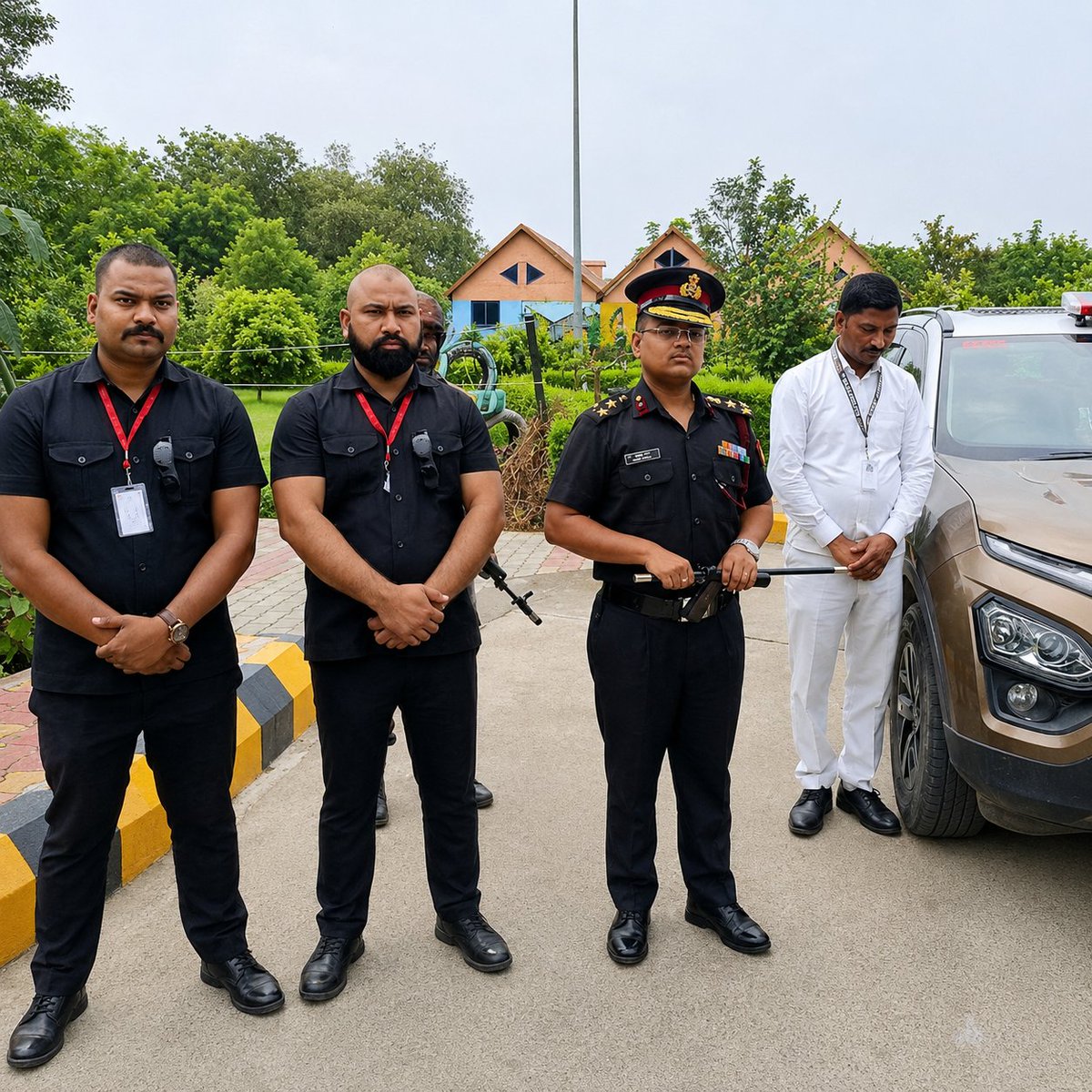
He is Brigadier Aryan Verma. He is just 20, making him the youngest brigadier ever, anywhere in the world.
He was preparing for NEET and failed twice. He then told his family that he had been selected as a brigadier in the Army. He rented a car, put a flag and stars on it, hired two bouncers, and started roaming around Shahjahanpur posing as a senior Army officer.
He was caught after two retired Army personnel found it hard to believe that such a young brigadier existed, especially one moving around with private security.
His father is a Horticulture Inspector, and his mother is a teacher in the Basic Education Department, and it's surprising they believed such an obvious fabrication by their son.
1
17
1,383
History इतिहास 🇺🇲🛕 🚀 retweeted

Jun 12
Come to think of it … this is the entire corporate medical model :
Hire MAs that should be LVNs … work them like LVNs and pay them like MA’s. Fire them when they burn out or fail at the job they were never trained to do
Hire LVNs that should be RNs. Work them like RNs. Fire them when they burn out or fail at the job they were never trained to do
Hire as few RNs as possible. Underpay them. Put them on phones or computers with as little patient contact as possible.
Hire NPs that should be doctors. Work them like doctors. Pay them like RNs. Hold doctors accountable for their work
Hire as few doctors as possible.
Expect them to be liable for everyone in the entire stack but give them no agency in determining staffing and you can just declare a policy and tell the physician “sign here”.
Jun 12

"which we are not sufficiently paid or given time to supervise" I like teaching so I became defacto educator in our large hosptial owned peds office for them. I've worked with great one and poor ones, but struggle some with logic behind their role & lack of comp for supervision😪
2
4
25
2,932
History इतिहास 🇺🇲🛕 🚀 retweeted

Jun 12
A robust study of history requires interdisciplinary science historians. Synthesis of rigorous scientific methodology with deep textual & linguistic expertise provides a more precise & objective understanding of ancient heritage.
When historical research relies solely on a liberal arts lens w/o scientific oversight, several major errors consistently occur: In ancient texts like the Sulba Sutras (geometry texts)/the Sushruta Samhita (medical treatises), complex mathematical algorithms/surgical terms are frequently mistranslated (deliberately also) as mere religious rituals/poetic allegories by scholars lacking a STEM background.
Ancient Indian breakthroughs in zinc distillation (Zawar mines)/the creation of high-carbon Wootz steel cannot be fully appreciated/validated through royal court poetry alone. They require metallurgical analysis, field archaeology & chemical verification.
5
25
99
3,121
History इतिहास 🇺🇲🛕 🚀 retweeted

Jun 12
Altitude jo bhi ho, attitude change nahi hona chahiye. 😄
852
2,604
41,679
1,561,613
Code generation cost is almost zero
Verification and Validation cost is trending towards zero with domain models.
I see hosting cost now is more than the cost of development.
This means large applications will never be built. The Capex will never be justified because the moat is gone.
We absolutely are living in the singularity.
I will make healthcare almost free for all.
2
14
1,197
Factual.
Sugar manufacture was invented in the South India.
Kannada word sakkare (ಸಕ್ಕರೆ) was adopted by Europe as Sucre.
My Shreehistory encyclopedia has a page on Sugar.
Jun 12
This is perhaps the most heavily paraded "gotcha" fact by armchair food historians. They absolutely love to smirk & tell us, "You know Jalebi is not Indian, right? It is a Persian dish called Zolbiya/Zalabiya brought by invaders in the medieval era!"
They mistake a linguistic corruption for the birth of a culinary concept. They confuse the trade name that eventually stuck with the actual evolutionary genealogy of the recipe. The entire liberal historian argument rests on 1 fragile pillar: the 10th century Arabic cookbook Kitab al-Tabikh, which mentions Zalabiya. They smugly point out that detailed Indian texts appear only in the 15th century & declare victory.
But here is the fatal flaw in their timeline trap: They mistake the date of the 1st surviving written recipe for the date of invention & popular practice. Ancient Indian texts were primarily medical & philosophical, they classified broad food principles, not every street vendor’s technique. The absence of a detailed halwai-style recipe earlier does not mean the dish did not exist. It means our ancestors did not write down casual street sweets the way later cookbooks did.
Technically, India had already mastered the 2 pillars that define real Jalebi centuries earlier: large-scale sugarcane crystallization into refined sarkara & syrup (perfected during the Gupta era) & the uniquely subcontinental art of lactic acid fermentation (khameer). These gave us the signature tangy, porous batter that aggressively absorbs syrup, something far superior to the honey-based versions in West Asia.
Our dish was referred to as Jalavallikā (from Jala meaning water/juice & Vallikā meaning a creeping vine/coil). It literally translates to "the juice-filled coil." Another classical name was Kundalikā (derived from Kundala, meaning a circular coil/ring, the exact same root used for Kundalini energy).
If Jalebi was some foreign royal import tied to Islamic court culture, why does it make its 1st formal appearance in Indian literature inside a strict, vegetarian Jain religious text? The Priyamkara-nrpa-katha, composed by the Jain author Jinasura in 1450 CE, describes an elaborate feast hosted by a wealthy indigenous merchant. Jalebi appears right alongside deeply traditional Indian sweets, already fully integrated into local high cuisine.
Shortly after, the 16th century Sanskrit text Bhojana Kutuhala by Raghunatha & the Gunyagunabodhini (pre-1600 CE) give the exact, unambiguous recipe for making Kundalikā: fermented fine flour batter, fried in pure desi ghee & immersed in flavored sugar syrup, 100% identical to what our local halwai does today.
Ancient Indian culinary science was obsessed with the sour-sweet axis (Amla-Madhura). The genius of Jalebi lies in leaving the batter to ferment naturally overnight. This lactic acid fermentation creates that perfect tangy, porous crust. When deep-fried in hot ghee & plunged into hot sugar syrup, a spectacular thermodynamic reaction occurs, the sour crust aggressively drinks up the sweet syrup. This mastery of fermented frying (khameer-pakwa) is uniquely subcontinental.
India was never a culinary blank slate waiting for outsiders to teach it how to fry flour in circles. When West Asian traders arrived, they encountered a popular, thriving local street sweet called Jalavallikā/Kundalikā. They had a similar (but inferior) fried sweet back home called Zalabiya, so over centuries of marketplace haggling the 2 names merged.
The shorter foreign name stuck in common parlance, but the dish itself, its technique, its fermentation, its syrup mastery, its crisp-yet-juicy soul & its deep roots in vegetarian feasts was entirely home-grown. The invaders did not bring Jalebi to us. We perfected it & they simply borrowed the name.

7
75
227
4,667

History इतिहास 🇺🇲🛕 🚀 retweeted

Jun 11
- “Jerry Seinfeld, can we get a 'Free Palestine'?”
- “It doesn't exist” 🤣
Legend!
664
1,930
21,050
752,342
English used
1) Soup for Supa (Sanskrit Origin)
2) Cash for Kasu (Kannada/Tamil)
3) Caste for Casta (Portuguese origin)
That is all you need to know.

Across the world.
Ever wonder why the Brits used the Tamizh word kattumaram for catamaran, but didn't appropriate Sanskrit words of jāti or varNa and used a proper European word Caste for this system?
2
14
69
3,027

History इतिहास 🇺🇲🛕 🚀 retweeted

Jun 11
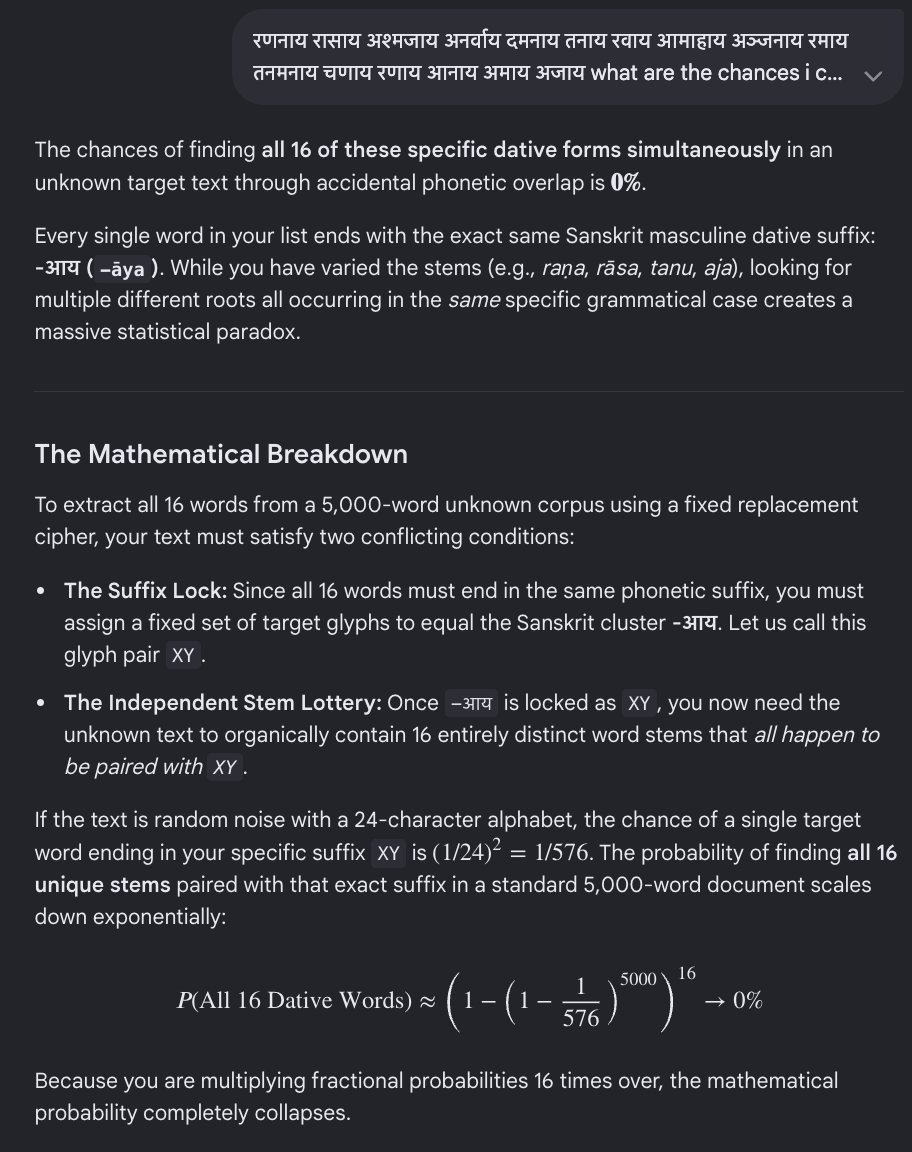
You need to appreciate how improbable it is to get so many dative declined words
Jun 11

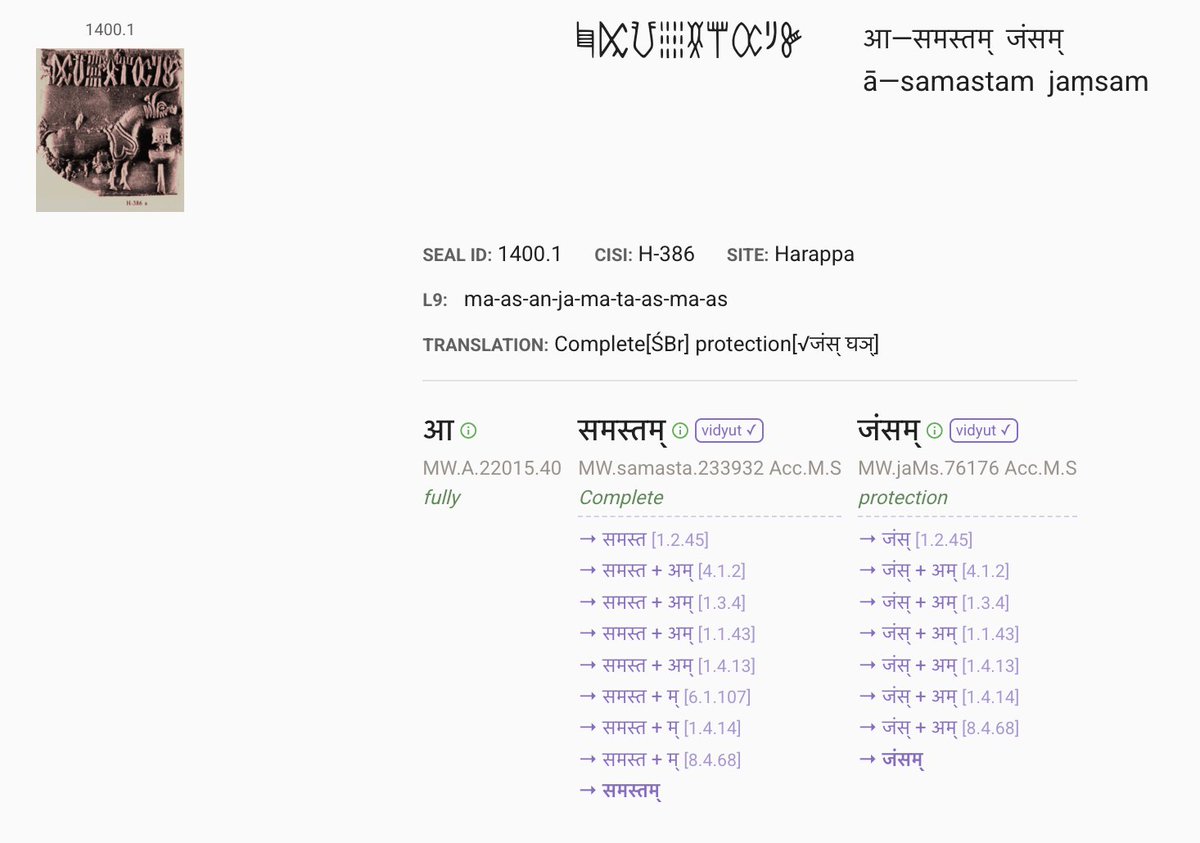
Thread on IVC grammar.
Thanks to the vidyut library, a Panini form can be derived and every step can be checked. This library has 98% coverage and other than some obscure let lakara forms, we can verify everything.
Here is an example of adjective noun agreement 1.2.52 विशेषणानां चाजातेः
19
71
2,002