
Blockchains without Borders
Joined February 2025
- Tweets 1,215
- Following 53
- Followers 422
- Likes 2,470
63 Photos and videos



Sig Network retweeted
Looking at all the different approaches that people are taking, ZKs, Permissioned Networks, TEEs, Homomorphic Encryption, by 2030 there aren't going to be any public transactions left on Blockchains.
@Sig_Network will give you access to all of these techniques everywhere.
1
2
69

May 20
Sig Network mentioned.
Check out @Yieldy_io, getting your stablecoins to work for you!
May 19

3/ At the beginning of this year, we held a private pre-seed to build @Yieldy_io , an intent-based liquidity router featuring 1-click, cross-chain execution matching stablecoins with top-tier yield.
Yieldy's MVP will feature one-click Ethereum USDC deposit into @solana DeFi vaults.
Powered by @circle 's CCTP v2 and @Sig_Network 's intents.
1
6
157
May 20
Congratulations temple, exciting things being built there

7
133
Jan 27
Stop thinking about chains as complete ecosystems and start thinking of them as layers.
Ethereum has the best capital markets so use it.
Polkadot has the best identity solutions, so use it.
Midnight has the best privacy, so use it.
Canton has the matching engine so use it.
6
328
Sig Network retweeted
First week back looking at @CantonNetwork and DAML with the team after a brief 8-year hiatus. A few things stick out:
Canton is super weird. It feels like a completely different evolutionary path from everything post-Bitcoin, but it's highly purpose-built. This makes some things bafflingly complex (AMMs!) but others incredibly simple (intents, RWAs).
If it's your first time, prepare for contracts that are themselves UTXOs(!), written in Haskell, and worrying a lot about who actually owns a contract.
So many successful Defi products right now are off-chain matching engines with on-chain settlement (@CoWSwap, @Polymarket, @near_intents). Canton makes this architecture native "on-chain" with exactly the right level of privacy and global atomicity. This makes sense, at its heart it’s a settlement language and that's the thing it excels at. If they can get the cross-chain story working (hint @Sig_Network), this is absolutely where I'd build that kind of infra in the future.
The divide between what's running on your local infra and what's running globally is also beautifully blurry. The contracts are the same, it's just a matter of who has the right to see what.
There is also a bit of a cult of KYC in their DeFi apps. The vibe is "licensed entities dabbling in permissionless DeFi," whereas on most other chains it's, "I might geoblock North Korea once men with guns show up at my house." I think the happy medium here is more progressive onboarding ala CEXs.
Finally, I realize I had absolutely no idea what I was working on when I was at @digitalasset. Thinking about it now is like remembering being lost in a city that’s now familiar.
Definitely the most unique chain I've dived into in a while.
1
2
575
Jan 26
For those unfamiliar with @CantonNetwork and where it's going.
Acting across chains only works with Sig Network.
Jan 23
Read The Canton Thesis: Our thoughts on Canton, institutional networks, and digital assets.
templedigitalgroup.com/thesi…
2
282
Jan 19
✋

2
181
Sig Network retweeted

15 Dec 2025
The stablecoin with the best reach will win
axelar.network/blog/circle-i…
1
1
236

Soon everybody will have access to Bitcoin, Ethereum, Solana, Hyperliquid and Zcash just by connecting to Polkadot.
Is that clear? Can you understand the reach of this?
@Polkadot x @Sig_Network
2
19
553
Sig Network retweeted

8 Dec 2025
Interoperability is becoming the base layer serious teams build on.
Sig Network choosing @Polkadot for their next chain is a clear signal of where multichain is heading. Proud to support them as they expand their work on Polkadot.
Big things ahead.
5 Dec 2025

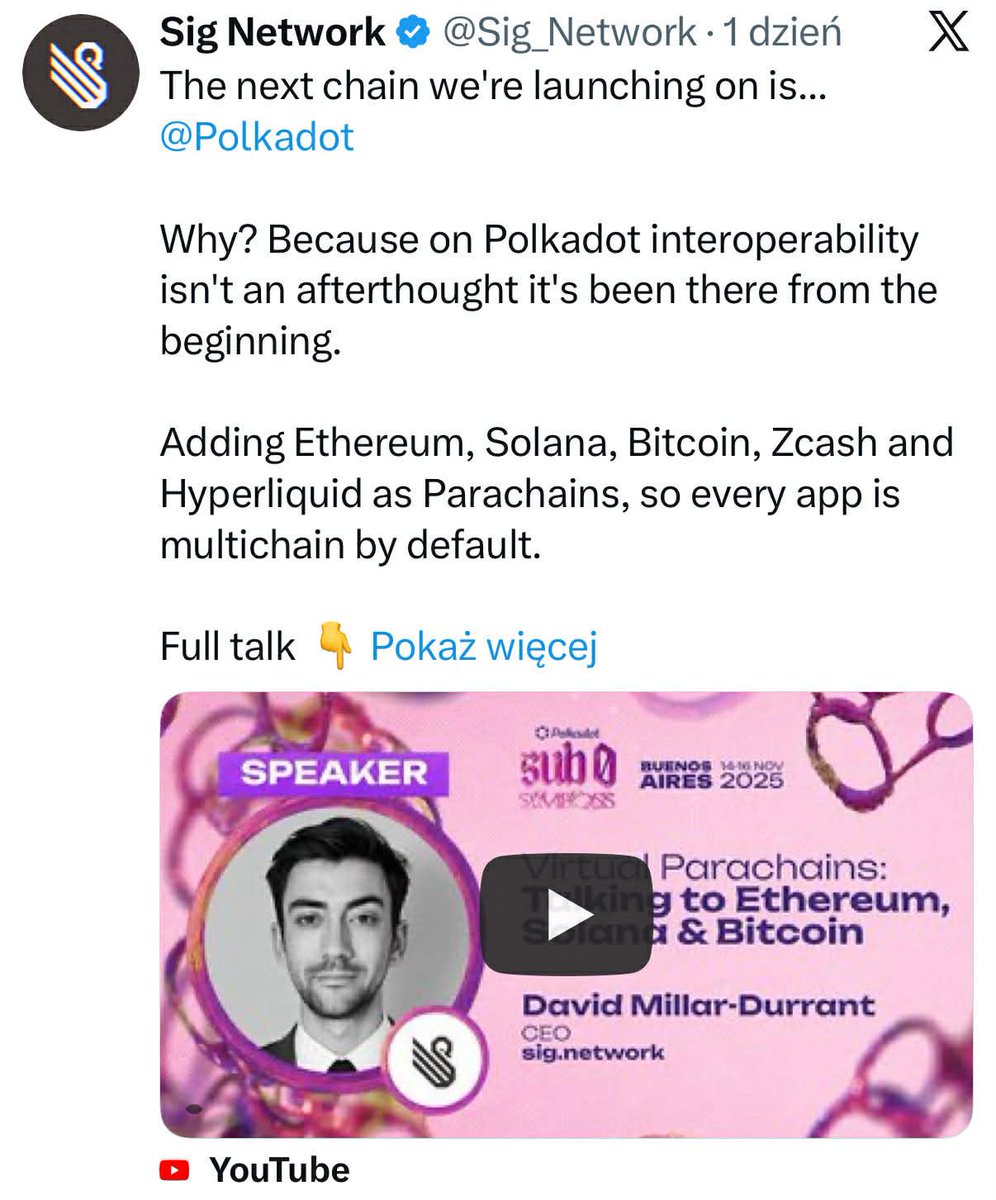
The next chain we're launching on is... @Polkadot
Why? Because on Polkadot interoperability isn't an afterthought it's been there from the beginning.
Adding Ethereum, Solana, Bitcoin, Zcash and Hyperliquid as Parachains, so every app is multichain by default.
Full talk 👇
youtube.com/watch?v=R8a74ucK…
3
7
57
4,424
Sig Network retweeted

7 Dec 2025
Watch the @Polkadotsub0 video from Sig Network X.
And then this one on @TheKusamarian.
The new projects joining the Polkadot eco are really sophisticated & real-problem solving. 🫡

S P A C E M O N K E Y S ˄͎ Podcast
Solving Cross-chain?
→ Sig Network on Polkadot!
feat. @DMillarDurrant
w/ @GldnCalf
Show Notes:
David Millar-Durant (@Sig_Network CEO) dropped a wild interop idea at Sub0: give every smart contract its own private key so dApps can natively touch Bitcoin, Ethereum, Solana, Hyperliquid - whatever - without wrappers or sketchy bridges.
If you’re tired of blockchain silos, this is the interview to give you hope for that full-interop future.
Dive in ↯
0:00 What is Sig Network
2:26 Virtual Parachains
6:15 Native BTC
7:21 Trust Assumptions
9:58 Selling BTC on the Street
13:12 Deploying on Polkadot
15:59 Bringing Industry to Polkadot
19:58 Roadmap
4
9
55
4,181

S P A C E M O N K E Y S ˄͎ Podcast
Solving Cross-chain?
→ Sig Network on Polkadot!
feat. @DMillarDurrant
w/ @GldnCalf
Show Notes:
David Millar-Durant (@Sig_Network CEO) dropped a wild interop idea at Sub0: give every smart contract its own private key so dApps can natively touch Bitcoin, Ethereum, Solana, Hyperliquid - whatever - without wrappers or sketchy bridges.
If you’re tired of blockchain silos, this is the interview to give you hope for that full-interop future.
Dive in ↯
0:00 What is Sig Network
2:26 Virtual Parachains
6:15 Native BTC
7:21 Trust Assumptions
9:58 Selling BTC on the Street
13:12 Deploying on Polkadot
15:59 Bringing Industry to Polkadot
19:58 Roadmap
13
39
181
20,218
5 Dec 2025
The next chain we're launching on is... @Polkadot
Why? Because on Polkadot interoperability isn't an afterthought it's been there from the beginning.
Adding Ethereum, Solana, Bitcoin, Zcash and Hyperliquid as Parachains, so every app is multichain by default.
Full talk 👇
youtube.com/watch?v=R8a74ucK…
4
14
124
45,329
5 Dec 2025
If we stole @inversion_cap's business model, which single chain products should we buy and make multichain?
1
1
257
5 Dec 2025
There's so many defi products out there eking out single digits BPs of fees in crowded markets, who'd be the only product in the category if they were operating between Bitcoin and Zcash.
229