
Revolutionize compute markets through unparalleled data transparency, financial product innovation and market intelligence
Joined May 2024
- Tweets 11
- Following 11
- Followers 2,175
- Likes 29
4 Photos and videos

Pinned Tweet

Jun 1
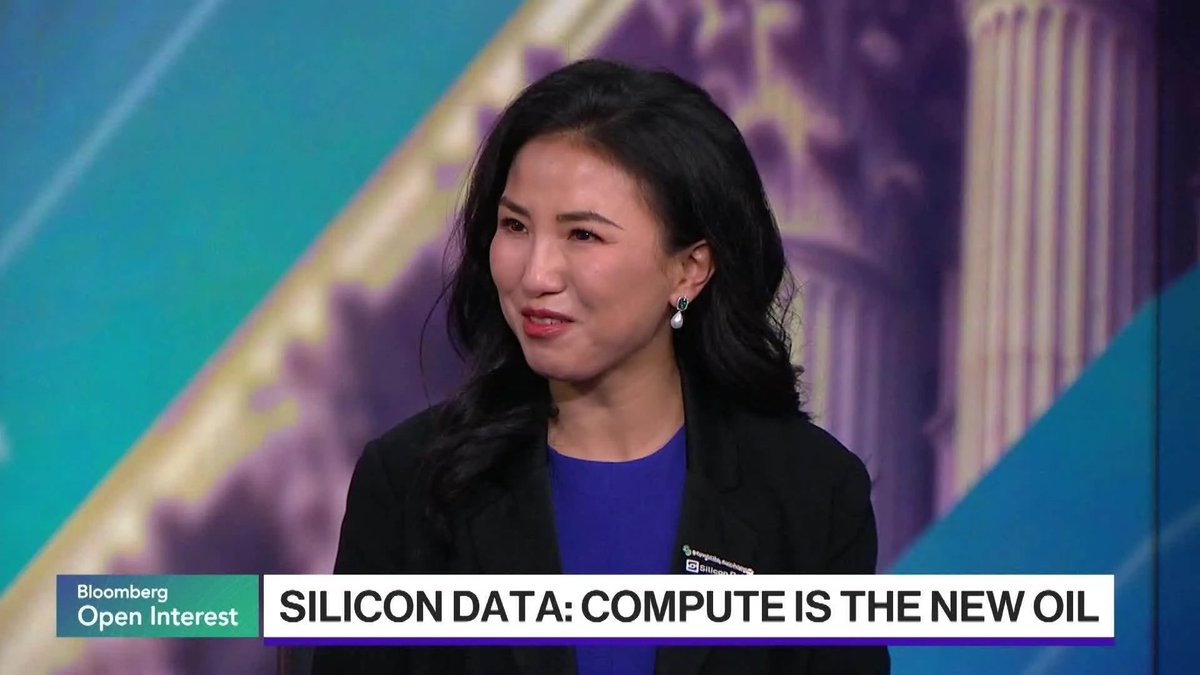
Our CEO @carmenli joined @daniburgz and @mattmiller1973 on @BloombergTV Open Interest today to discuss why we think it's time to bring GPU index futures to the physical AI compute market and the signal value of our newly launched Token Expenditures Index!
bloomberg.com/news/videos/20…
1
4
2,259

👀
Jun 5

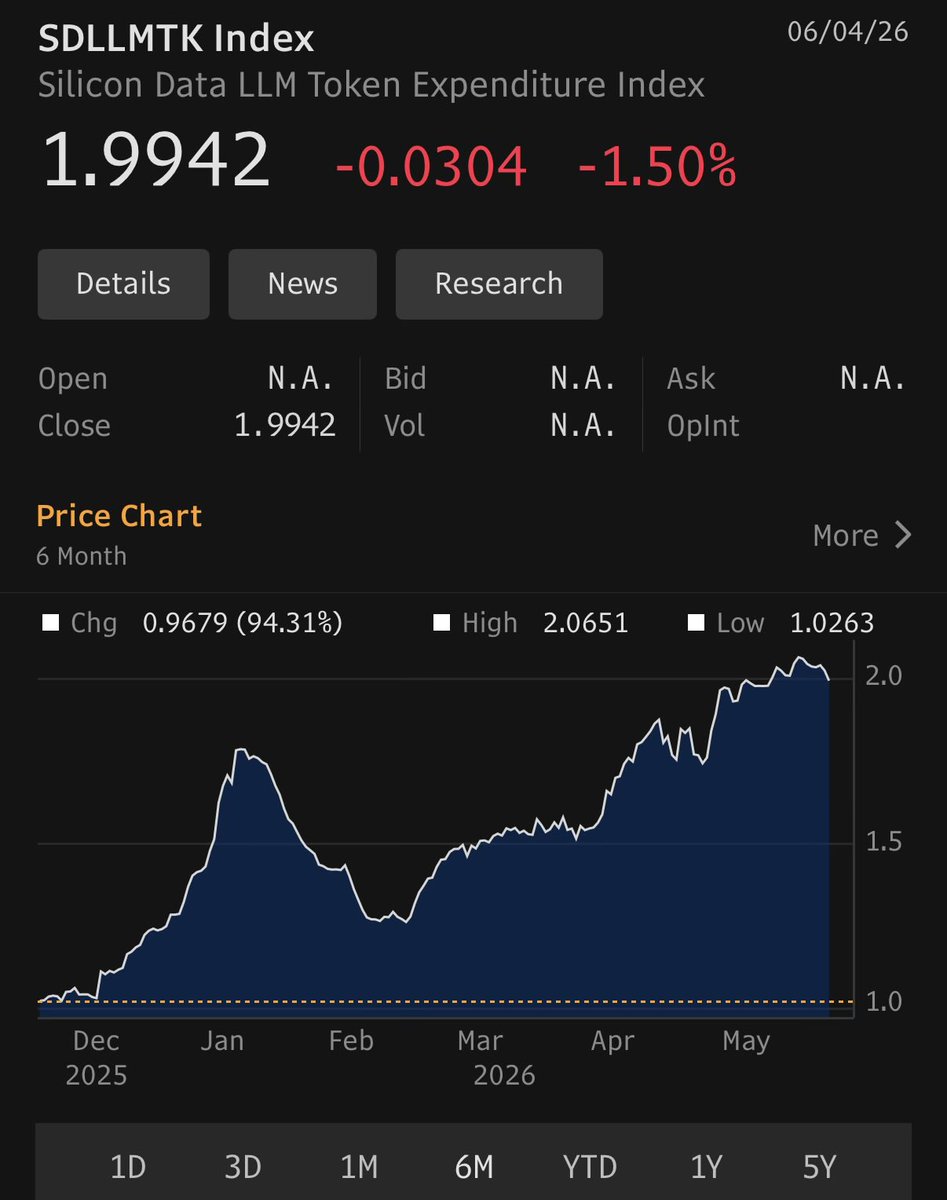
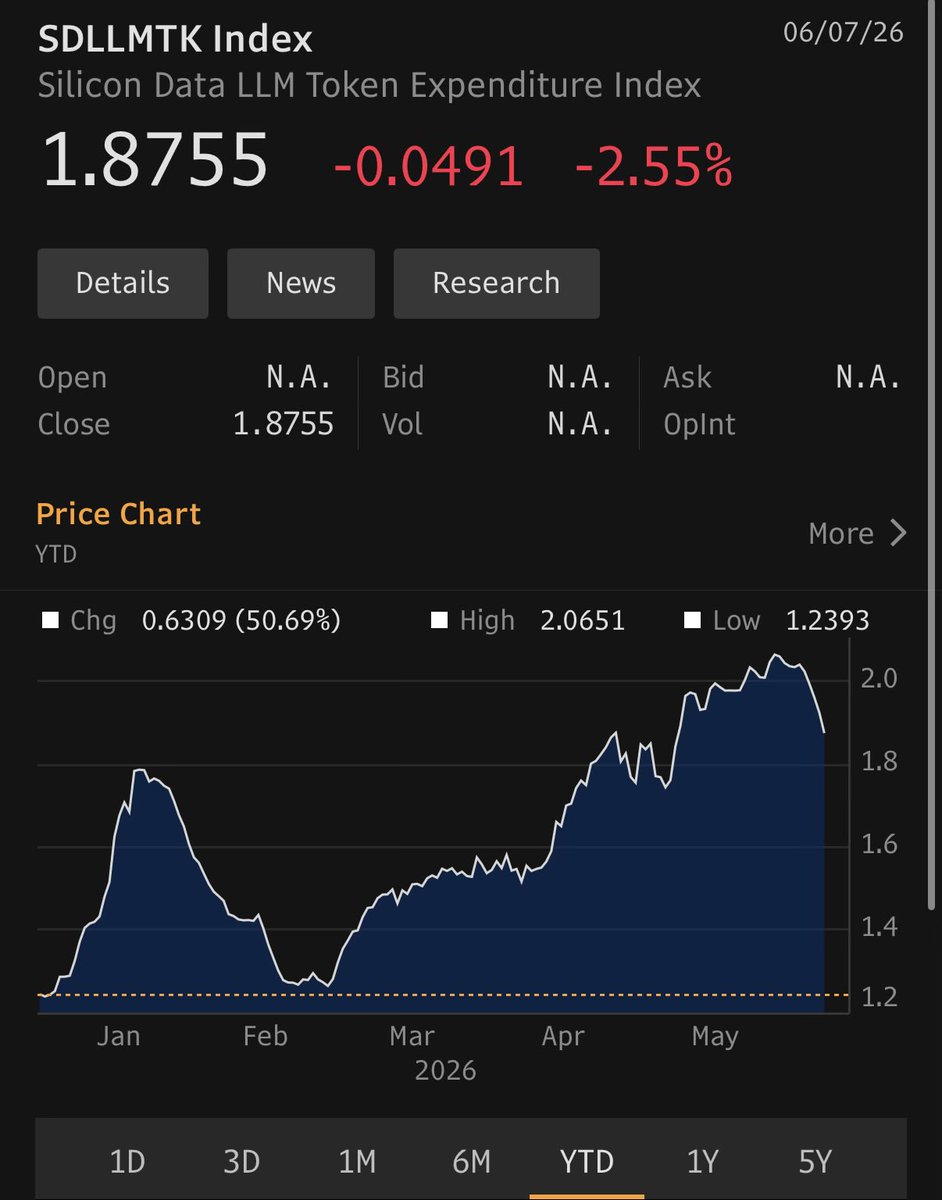
Our LLM Token Expenditure Index should really have been named the “Token Expenditure Price Index” bc it’s an expenditure or usage-weighted average token price index. It tells you how much currently the entire market AI is paying for a million LLM tokens irrespective of models.
The naming might’ve led to some misinterpretations as some seem to have interpreted the index as either the total volume of token used or the average price of tokens. In reality, the index captures something more subtle than either interpretation: it tells us the marginal willingness to pay for LLM models.
Over the course of the year, while model token prices haven’t moved that much, the usage patterns have moved dramatically leading to the token index movement down and then up sharply as AI users moved en masse into using cheap open weight models and then en masse to the much more expensive frontier closed source models. From consumers to enterprises, everyone is Claude-maxxing!
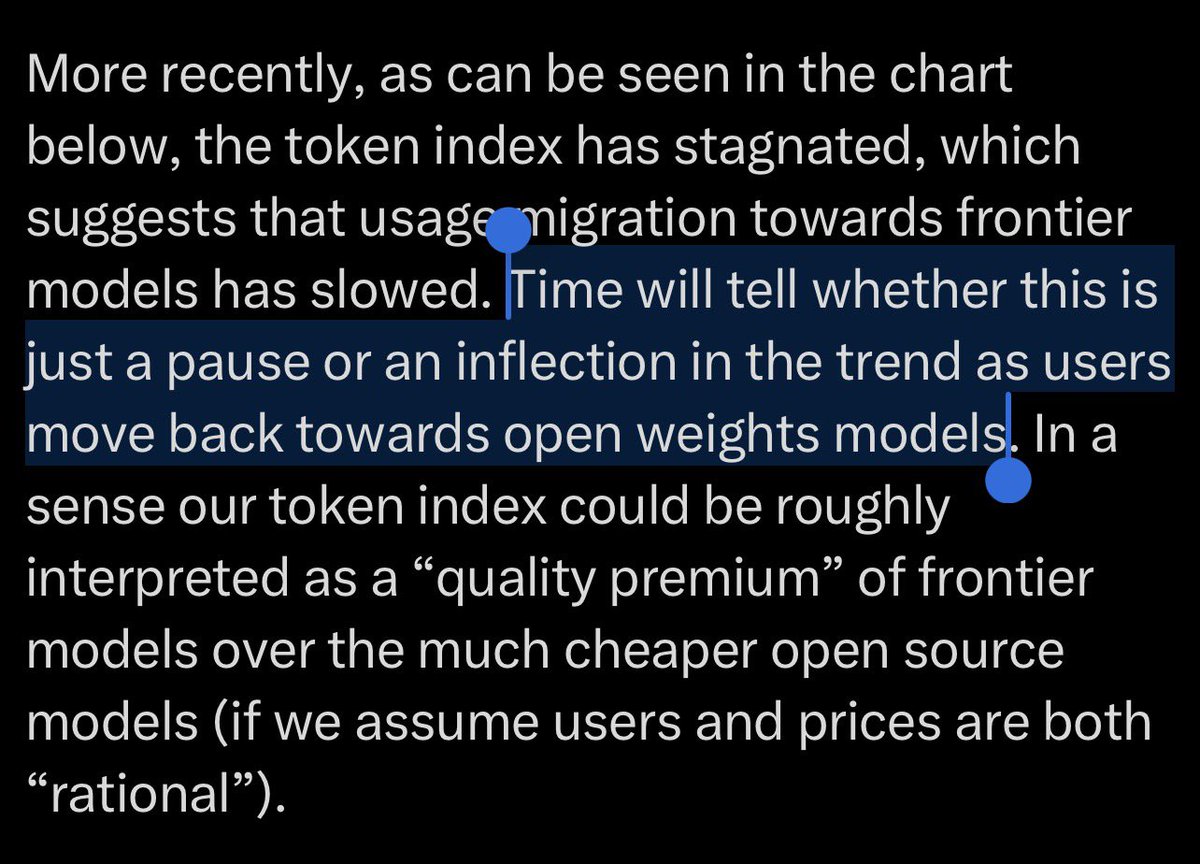
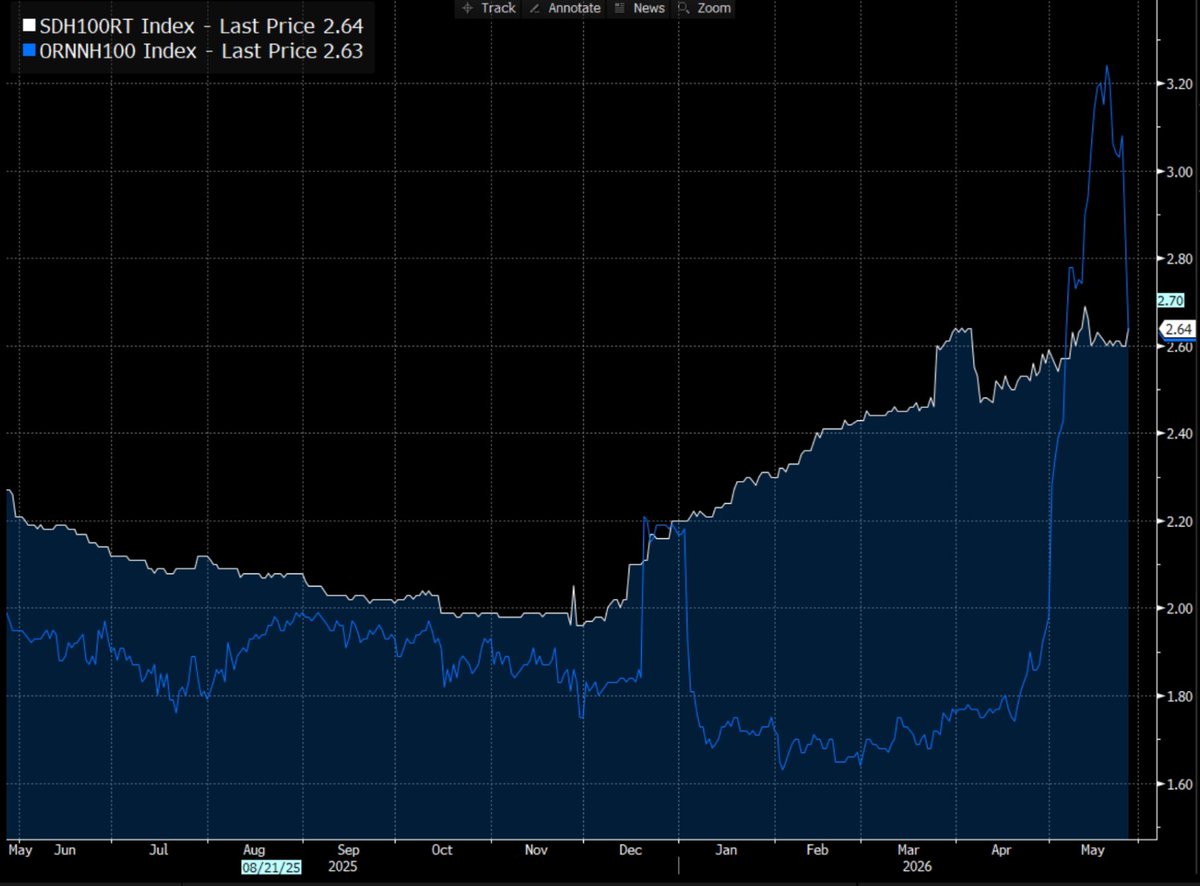
More recently, as can be seen in the chart below, the token index has stagnated, which suggests that usage migration towards frontier models has slowed. Time will tell whether this is just a pause or an inflection in the trend as users move back towards open weights models. In a sense our token index could be roughly interpreted as a “quality premium” of frontier models over the much cheaper open source models (if we assume users and prices are both “rational”).
For more details on what we offer beyond the few indices we’ve listed on the Bloomberg Terminal, check us out at silicondata.com and give us a holler! 😊
6
13
113
41,798

It is pretty cool to be cited in @nikkei nikkei.com/article/DGXZQOGN2… can’t say I understand the whole article 😂
1
9
1,796
Silicon Data retweeted

No doubt @Silicon_Data has a way better grasp on this than me. But I don’t get why usage is always framed as “expensive SOTA models vs cheaper open weight ones.” What about cheaper, closed, non-SOTA models, which keep getting better and can ably handle many tasks?
Jun 5
Our LLM Token Expenditure Index should really have been named the “Token Expenditure Price Index” bc it’s an expenditure or usage-weighted average token price index. It tells you how much currently the entire market AI is paying for a million LLM tokens irrespective of models.
The naming might’ve led to some misinterpretations as some seem to have interpreted the index as either the total volume of token used or the average price of tokens. In reality, the index captures something more subtle than either interpretation: it tells us the marginal willingness to pay for LLM models.
Over the course of the year, while model token prices haven’t moved that much, the usage patterns have moved dramatically leading to the token index movement down and then up sharply as AI users moved en masse into using cheap open weight models and then en masse to the much more expensive frontier closed source models. From consumers to enterprises, everyone is Claude-maxxing!
More recently, as can be seen in the chart below, the token index has stagnated, which suggests that usage migration towards frontier models has slowed. Time will tell whether this is just a pause or an inflection in the trend as users move back towards open weights models. In a sense our token index could be roughly interpreted as a “quality premium” of frontier models over the much cheaper open source models (if we assume users and prices are both “rational”).
For more details on what we offer beyond the few indices we’ve listed on the Bloomberg Terminal, check us out at silicondata.com and give us a holler! 😊
16
11
77
46,926
Jun 5
Our LLM Token Expenditure Index should really have been named the “Token Expenditure Price Index” bc it’s an expenditure or usage-weighted average token price index. It tells you how much currently the entire market AI is paying for a million LLM tokens irrespective of models.
The naming might’ve led to some misinterpretations as some seem to have interpreted the index as either the total volume of token used or the average price of tokens. In reality, the index captures something more subtle than either interpretation: it tells us the marginal willingness to pay for LLM models.
Over the course of the year, while model token prices haven’t moved that much, the usage patterns have moved dramatically leading to the token index movement down and then up sharply as AI users moved en masse into using cheap open weight models and then en masse to the much more expensive frontier closed source models. From consumers to enterprises, everyone is Claude-maxxing!
More recently, as can be seen in the chart below, the token index has stagnated, which suggests that usage migration towards frontier models has slowed. Time will tell whether this is just a pause or an inflection in the trend as users move back towards open weights models. In a sense our token index could be roughly interpreted as a “quality premium” of frontier models over the much cheaper open source models (if we assume users and prices are both “rational”).
For more details on what we offer beyond the few indices we’ve listed on the Bloomberg Terminal, check us out at silicondata.com and give us a holler! 😊
8
39
237
153,207
May 29
Interview of @carmenli CEO of @Silicon_Data and @computeexchange at Odd Lots Live with @tracyalloway and @TheStalwart. 🚀🔥
2
4
14
19,204
May 28
💯👏 You cannot make a clearer case for GPU futures and other compute-linked financial derivatives. Great interview! We are glad that someone has articulated so clearly why we saw the timely need for compute-linked new financial instruments, for which GPU futures are just the beginning!
“You have an entire ecosystem (venture capital) that has never been capital intensive. Now, for the first time, not only is it capital intensive, but it’s going to be on a scale that’s unimaginable because the amount of money that is going to be put into data centers, into chips, into robotics, into manufacturing, into defense, is every dollar since the invention of fire. That’s not going to be financed with equity, entirely, because it’s not efficient and the scale of it is not achievable. It’s going to have to be parceled out into various risks. That’s what we are seeing happen right now. If I look at the drivers of our business this year, it is data centers, it’s a massive amount of chip financing. And what we are doing is parceling out the risks. On the venture side, there’s the fundamental business underwrite. And then on the infrastructure side, things that are reusable, things that have hard asset value, are being offloaded through the credit markets, at the appropriate return and at the appropriate risk rating."
May 27

"Every dollar since the invention of fire" is going into this AI capex build out — and equity can’t fund it all.
Marc Rowan anticipates Wall Street & Silicon Valley teaming up much more frequently to fund this next tech supercycle.
1
3
2
3,538
May 28
There's a second quote from this interview we liked. We couldn't agree more! Our goal is exactly to become that new class of "financial entrepreneurs" to help bring about new and useful financial instrument that can help manage, appropriately distribute the risks and foster more optimal capital allocation, when the stakes are becoming so enormous and consequential at the national and global levels.
"But I believe we are approaching a really interesting time. We’ve never really talked about the quantum of money. I think that’s where we are right now. 2025 was just the proof of concept that data centers, energy and chips were all needed. In 2026 the market is starting to recognize that if this continues, $800B of capex from just the four large public companies, not to mention the private, that everyone who’s an investor is going to be concentrated in certain names, and we are gonna actually hit concentration limits. We are seeing this across the board, I think the spreads are gonna widen. I think really good entrepreneurs are going to end up in partnership with entrepreneurs of another type, those that are financial entrepreneurs, who help to democratize credit assets, hybrid equity and other types of things. I don’t think the imagination is going to stop at chips, data and energy."
1
3
668
Different data sources and methodologies are allowed to naturally disagree. Based on the 10s of thousands data points @Silicon_Data tracks and our methodology, we don't see any dramatic swings in GPU rental prices, which continue to modestly move upwards. Scarcity is the theme.
7
21
141
33,098