
Give me all the data!
Joined April 2009
- Tweets 2,033
- Following 506
- Followers 220
- Likes 761
251 Photos and videos







Simeon B retweeted

19 Jan 2025
I didn't like the two calls but acting like they are primarily responsible for the Texans losing and not the Chiefs playing better, mistake-free football is absurd.
Additionally, both calls were apparently by the letter of the law, correct.
Source: Walt Anderson
You can not like the rules, not like how they are enforced or think they should be changed (I'd agree) but calls are not made in the Chiefs' favor because it is the Chiefs. It's been disproven a billion times by actual facts. Not overall, not in key moments.
Great example here: x.com/RPatrickAllen/status/1…
It's confirmation bias, sour grapes and it diminishes the incredible accomplishments of this run. People did the same thing to the Patriots and it was dumb then, too.
18
4
167
7,288
Simeon B retweeted

12 Sep 2024
The proper handshaking technique, according to Richard Nixon:
42
274
2,085
268,540
Simeon B retweeted

11 Sep 2024
Gotta hand it to Kamala: she knows how to distract him by attacking his vanity. It always throws him.
21
41
623
40,676
Simeon B retweeted

11 Sep 2024
Moderators are “fact checking” Trump on his tone of voice but they let Kamala spew “bloodbath” and “fine people” lies without daring to say anything. This is egregious.
5
37
1,425
Simeon B retweeted

11 Sep 2024
We need a fact check just of the moderators who apparently believe an insane number of things that aren't true.
-Crime is down
-Economy is great
-IVF is banned somewhere (?)
-Abortions aren't legal up to birth anywhere
-"I didn't detect any sarcasm"
30
515
1,671
49,659
Simeon B retweeted

25 Aug 2024
Thank you to Lt. Governor and current GOP gubernatorial candidate to Mike Kehoe, for speaking out so strongly against the radical and dangerous proposed amendment 3 in MO!
@LtGovMikeKehoe @MikeLKehoe
For those who don’t know, proposed amendment 3 would:
👉Ab0rtion through all 9 months
👉Abolish required parental consent for a minor to obtain an aborti0n
👉Remove oversight of the aborti0n industry
👉Remove any civil or legal recourse for a woman who was harmed in a botched ab0rtion
👉Force taxpayer funding of elective ab0rtions.
👉Open the door for the courts to enshrine into our state constitution the RIGHT to “gender affirming care” through the amendment’s used of the term “reproductive freedom”.
Amendment 3 is DANGEROUS for babies, women, children, and families.
It is a radical amendment that is counter to Missourian’s values.
Vote NO on amendment 3!
3
16
42
2,265
Simeon B retweeted

22 Aug 2024
A list of times taxes on the rich became taxes on nearly everyone, and why you shouldn't believe the main stream media lies about the unrealized capital gains tax only being on people who make over $100m:
- When the federal income tax was introduced in 1913 under the 16th Amendment, it was intended to target only the wealthiest Americans. The initial tax rates ranged from 1% to 7%, and only about 3% of the population was subject to it.
- The AMT was introduced in 1969 to prevent high-income individuals from using deductions and loopholes to avoid paying any federal income tax.
Expansion: The AMT was not initially indexed for inflation, so over time, more middle-income taxpayers were affected. Eventually, Congress had to adjust the thresholds to prevent the AMT from applying to even more middle-income earners, but it still affects a significant number of taxpayers.
- Luxury taxes, such as those on high-end items like yachts, private jets, and expensive cars, were introduced to tax the wealthy who could afford such items. While many luxury taxes have been repealed or reduced, similar taxes have sometimes shifted to broader goods and services, or the thresholds have been lowered, affecting a wider range of consumers.
- The federal estate tax was introduced in 1916, targeting only the wealthiest estates to redistribute wealth. Although estate tax thresholds remain high, over time, more estates became subject to the tax due to inflation and changing laws. The threshold has fluctuated, and while fewer people are affected today, the tax has occasionally impacted a broader range of estates during certain periods.
- Capital gains taxes were initially low and primarily affected the wealthy who had significant investments.
Expansion: Over time, the capital gains tax rate has increased, and as more Americans began to invest in stocks, real estate, and retirement accounts, the tax has affected a larger segment of the population.
- Regulations requiring financial disclosures were often targeted at wealthy individuals and large corporations to ensure transparency and prevent fraud. These regulations expanded to affect smaller businesses, nonprofits, and eventually even individuals with modest investment portfolios who must comply with various reporting requirements, such as the Foreign Account Tax Compliance Act (FATCA).
- The ACA (Obamacare) imposed a mandate that required individuals to have health insurance or pay a penalty, which initially seemed to target wealthier individuals who were opting out of coverage. The mandate and associated taxes, like the "Cadillac tax" on high-cost employer health plans, ended up affecting a broad range of income levels, particularly as insurance premiums increased and more people were compelled to purchase insurance.
21 Aug 2024

One thing @Cernovich leaves out: The Biden-Harris plan he's referring to only would tax unrealized capital gains *for people with more than $100 million in net assets*
Seems like an important caveat but what do I know I'm just a reporter
17
124
359
23,476
Simeon B retweeted

20 Aug 2024
How would Kamala’s tax on unrealized gains even work? Let’s say you buy $1000 worth of stock in 2025. In 2026, the value of that stock is $1100 so you owe Kamala $25 (25% of the $100 unrealized gain). Now say the value of that investment drops back to $1000 in 2027. Does Kamala give you your $25 bucks back? What if the stock goes even lower?
What if you have $100k in assets in 2025 and in 2026 the value of your portfolio grows to $110k. Now you owe Kamala $2500. You either pay that from your income or cash savings or you have to sell enough assets to cover a tax on an investment you haven’t even taken profits on yet. Let’s say you don’t have the free cash on hand so you have to sell enough assets to cover the tax. Is the sale on those assets you sold to pay taxes on unrealized gains in 2026 now subject to the 44.6% capital gains tax in 2027? If so, that’s another $1115 dollars you owe Kamala.
Communism sucks.
29
46
223
7,736
Simeon B retweeted

5 Aug 2024
Thoughts on the NFL 100 and @PatrickMahomes being ranked # 4.
35
113
949
123,194
Simeon B retweeted

3 Aug 2024
Kamala has crafted a contrived persona and identity to advance her career, portraying herself as “marginalized.” The logic is something like: If she is perceived as part of a victim class (spoiler: she’s not) based on her race, few, if any, will press her on her politics. 🧵
110
947
3,600
337,388
Simeon B retweeted

2 Aug 2024
Missouri Secretary of State and gubernatorial candidate @JayAshcroftMo sat down with @ChrisStigall to discuss his campaign for Missouri's highest office and his top priorities. #MOGov #MOLeg
7
7
12
1,837
Simeon B retweeted

1 Aug 2024
🚨GIVEAWAY🚨
With football season around the corner and Pacheco about to go CRAZY, I wanted to give away this signed Pacheco jersey from Chiefs Bids. Just make sure you’re following me and repost this. I’ll select the winner tomorrow night (Aug. 1st). #ChiefsKingdom



146
1,685
1,244
141,641

Simeon B retweeted

17 Jul 2024
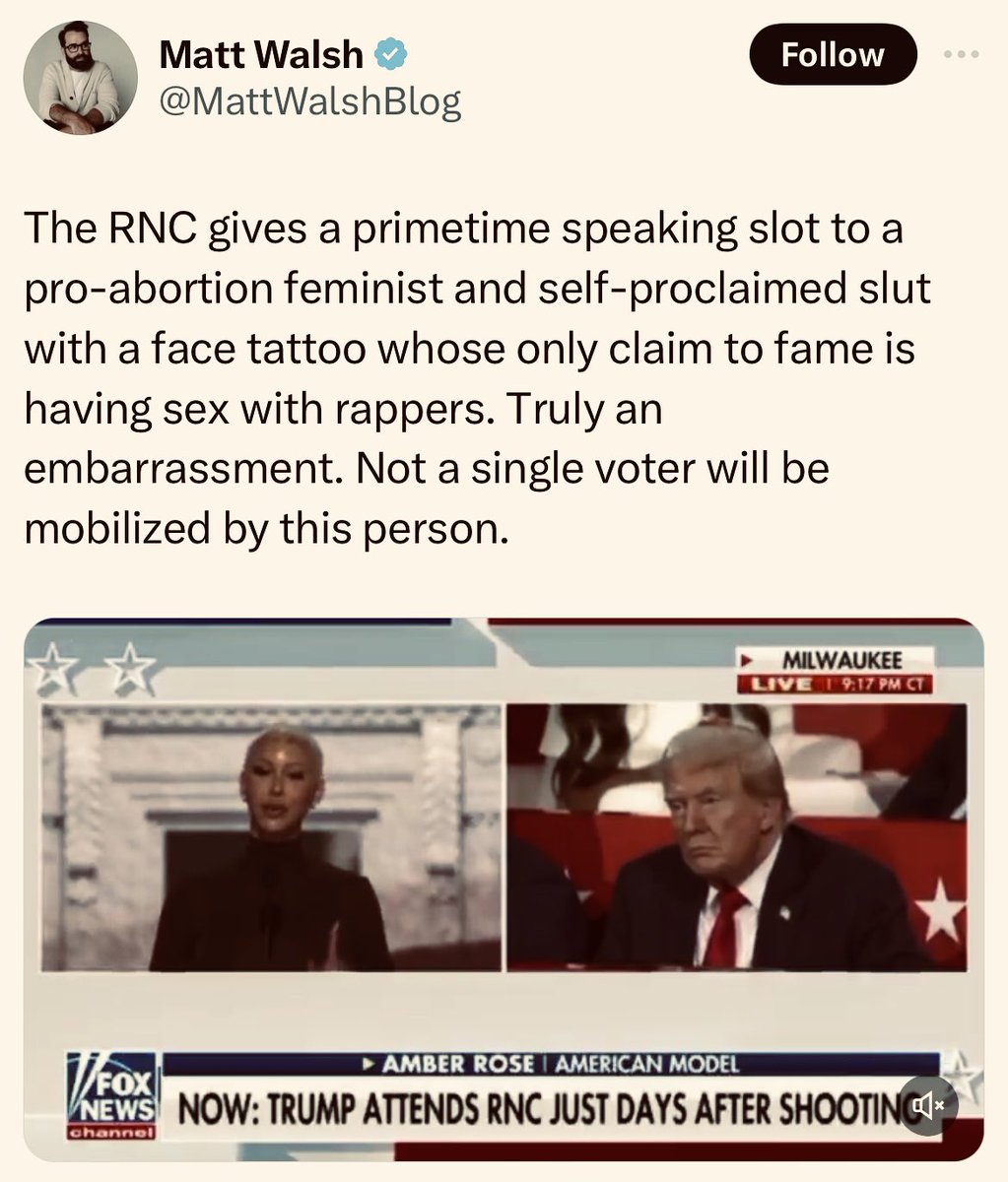
MATT WALSH & AMBER ROSE:🧵
Yesterday @MattWalshBlog got dragged across Twitter concrete for his take on the #RNC platforming #AmberRose.
Judging from the responses, his critics didn’t read what he said, but instead read highly emotional takes on his tweet.
Let’s take a look:
39
40
190
25,638
Simeon B retweeted

16 Jul 2024
Topics I want to hear more about re: policy platforms:
-Decentralizing our food system.
-Making fresh food accessible through vertical farming (multi-trophic aquaculture as well), especially in urban areas.
-Protecting our water supply from foreign adversaries
-Decreasing the regulations that make it difficult to buy local meat (see PRIME Act)
-Establishing a US framework for sustainable open ocean aquaculture and stock fortification.
-Decreasing our reliance on foreign seafood (considering we have the most plentiful fisheries).
-Privatizing school food so kids aren't obese and sick (thereby reducing healthcare costs).
-Streamlining and restructuring the FDA.
-Eliminating farm subsidies for massive food corps.
-Incentivizing regenerative beef farming.
-Transfering power from USDA to states (cut the feds)
191
602
3,120
90,436


5 Jan 2024
That @HauntedCosmos_ has been so successful to destroy the materialist worldview of so many is really impressive.
2
32
Simeon B retweeted

23 Aug 2023
The COVID lie that started it all!
466
4,641
10,404
2,077,550
Simeon B retweeted

24 Aug 2023
See, I completely disagree with this analysis. They don't fear Vivek, they despise him. It's the Republican version of Mayor Pete. Someone who hasn't done jack, studied for 10 minutes, and thinks he understands everything.
24 Aug 2023

Interesting that more candidates sparring with Vivek than DeSantis -- says something about where they think the race is going
4
6
15
1,838
Simeon B retweeted

18 Jul 2023
I’m making fun of the Trump campaign because on a day when you’d expect them to be normal and call for a little unity, they’re instead exploiting Republican anger at the Jack Smith news to fabricate an attack story by deliberately misconstruing something DeSantis said about Jan. 6 during a grassroots event to make him look like part of a deep state plot. It’s actually that stupid.
Normal people who aren’t vicious and cynical would certainly appreciate some unity today. But that’s not who is working the Trump campaign. These people will exploit the legitimate concerns of Republican voters and redirect them into the dumbest, most self-serving pursuits, i.e. keeping themselves employed.
It’s not even about DeSantis—it’s about a “movement” led by people who are so low and venal that they’re actually incapable of being or doing anything serious. You’re not going to challenge a corrupt political system with them at the helm.
15
33
215
18,715