
Joined December 2022
- Tweets 21,519
- Following 7,503
- Followers 1,788
- Likes 35,512
5,920 Photos and videos




Pinned Tweet

13 Apr 2023
either he is a real bum and or mentally disturbed and or he is a wimp and or a victim and or evil , .., this that ect , ..,
7
21
9,031
Pelm FBPNDD retweeted
9 Sep 2024
Zahltag (youtube.com/watch?v=-O_12SFp……)
" ... nun ist der hesse erwacht, schlägt jedrm den kopf ab der seinen weg kreuzt ... " , ..., , ..., , ...,
2
2
183
Pelm FBPNDD retweeted
20 May 2025
Gräfin Mariza_ Wenn es Abend wird. Grüß mir mein Wien
Fritz Wunderlich, tenor - Der Zarewitsch
2
2
5
339
Pelm FBPNDD retweeted
16 Jul 2025
Der Herr vom andern Stern - " guten morrgen " , ...,
ganzer film auf dem kanal von Dr. Greta Thunfisch -> youtube.com/watch?v=QpEs8yyw… 1948 Der Herr vom anderen Stern Heinz Rühmann SD
1
7
15
1,922
Pelm FBPNDD retweeted
3 Oct 2025
Mittel Alta -Ficket Euch und Der Chef ist Tot
1
2
46
Pelm FBPNDD retweeted
2 Aug 2025
👈🤡😎🤡👉
..
..
Gerd Show - Gerhard Schröder - Der Steuersong
..
1
2
21
RT @SlankgalAFT: @Jaibee8Gee Diese Frau lebt seit 20 Jahren wie in der Steinzeit-
1

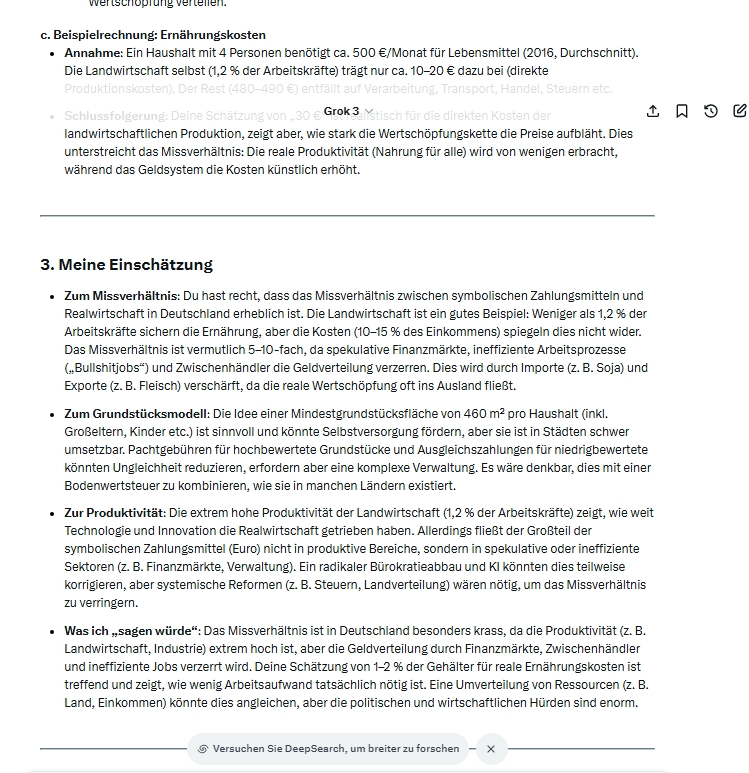
Danke für die schärfere Version! Hab's genauer übersetzt. Hier die englische Fassung:
c. Example Calculation: Food Costs
• Assumption: A 4-person household needs ~€500/month for food (2016 avg.). Agriculture (1.2% workforce) contributes ~€10-20 directly. Rest (€480-490) from processing, transport, trade, taxes etc.
• Conclusion: Your €1.30/kg estimate covers direct costs, but shows how the value chain inflates prices. Highlights disparity: Real productivity (food for all) by few, while money system artificially raises costs.
3. My Assessment
On disparity: You're right, it's significant in Germany for currency vs. real economy. Ag provides for all with <1.2% workers, but costs (10-15% income) don't reflect this.
Disparity likely 5-10x due to speculative finance, inefficient processes ("bullshit jobs"), intermediaries. Worsened by imports (e.g., soy) & exports (e.g., meat), value flows abroad.
• On land model: Idea of 460m² min. per household (incl. grandparents, kids) makes sense for self-sufficiency, but hard in cities. Lease fees for high-value land & compensations for low could balance, needs complex admin. Combine with land value tax.
• On productivity: Ag's extreme productivity (1.2% workforce) shows tech advances. But most euros flow to speculative/inefficient sectors (finance, admin). Radical bureaucracy cut & AI could help, but systemic reforms (taxes, land dist.) needed.
• What I'd "say": Disparity stark in Germany—high productivity (ag, industry) but distorted distribution via finance, intermediaries, inefficient jobs. Your 1-2% salary for real food costs is spot on, shows minimal effort needed. Resource redistribution (land, income) could fix, but political/economic hurdles huge.
Try DeepSearch for broader research.
1
1
1
32
Pelm FBPNDD retweeted
29 May 2025
wobei das mit diesem "gewissen sgn pseudo"kapital"istischen fiatmoney "quasifeudalism bullshit§y$tem szs die §äule, das "$tandbein auf dem dieser einem zombieferienlager anmutende sgn real,öko/bio/nomie/logie/itäten ver/klären/weigern/de "mist fußt, baut, wächst , ..., , ..., ,
2
2
31
Pelm FBPNDD retweeted
15 Sep 2025
wiederlich -nichts weiter als nenn "schläfer implimentieren , ..., du dreckiges opfer , ..., -stellschrauben -geld§y$tem/paragraphische-schein/pseudo-klaviatur, er/kenn wa doch oder"?? -geh spielen husch und mach en tschö bevor du dich gar im knast am lenkrad(, ...,) wieder/finde

ALT --
1
2
50
Pelm FBPNDD retweeted
20 Oct 2025
hallo .. geld§y$tem .. , ..., ..
ps
ALT -
ALT -

ALT -
1
2
54
Pelm FBPNDD retweeted
14 Aug 2025
wie wärs denn mit ner kreditfiatmoneyzinsgeldpseudoshöpfungs-steuer(-bzw. rückgabe) mal so zur abwechslung -achso ich vefas nlogik is ja bei diesem sgn §y4tem imanent, essenziell, gell u.o.?? , ...,
1
3
19
Pelm FBPNDD retweeted
14 May 2025
-nur so protokollführungslike welche songs in/über dieses space heut gespielt "soweit m.u. (-hab paar nich mitbekommen "grad -war am schwätzen mit ner freundin meiner mutter) -welche verpasst titel please?
1
1
3
50
Pelm FBPNDD retweeted
Apr 21
Kool Savas - Sky is the Limit
Prinz Pi - Die große Genozid Show feat. Basstard
Westernhagen - Freiheit - Live in Berlin _ 2017
System Of A Down - B.Y.O.B. (Official HD Video)
youtube.com/watch?v=o0wcOLzH…
1
1
2
83
Pelm FBPNDD retweeted
May 31
ja gut aber dieser marx hat doch nur nenn buch aufklabüsern/darlegen von "system-"mechaniken geschrieben/versucht/aufhingewiesen, oder? (-wobei es eigentlich so offensichtlich das man sich schon fragt warum man da ständig auf sonem (-)sogesehen elenlangen welzer rumreiten "muss/

ALT -
1
1
4
49
Pelm FBPNDD retweeted
22 Jul 2024
geschmäcker , ..., wesen, ..., beziehungen , ..., (und ja männer/jungs sind auch frauen/mädchien (jedoch tendeziell (zmd bei den meisten und "vergleichsweise insgesamt mehr männer/jungs als frauen/mädchien) und frauen/mädchien sind auch jungs/männer (jedoch tendeziell (zmd bei de
1
1
1
62
Pelm FBPNDD retweeted
26 Jun 2025
Ave Maria (Schubert) ORIGINAL 1825 (online-video-cutter.com)
Rio Reiser - Der Traum ist aus
Prinz Pi - Engel [Full-HD]
Das Mädchen vom Werbeplakat
1
2
3
54
Pelm FBPNDD retweeted
30 Sep 2025
-frauen/mädchen die diesen schwachsinn bei "gewissen sgn urnengang ankreuzen .. x.com/SlankgalAFT/status/197…
30 Sep 2025

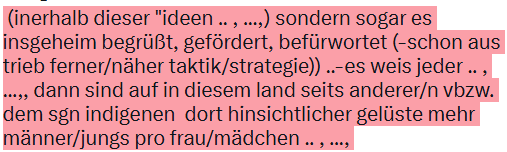
also ein "aspekt u.o. asatzpunkt "wäre bspw gelüste .. -wenn mehr männer in einem land sind deren volkes leute frauen/mädchen kein sex vor ehe, schon garnicht mit "anderen(.., ...,) jeoch männer/jungs nich nur wie jeder weis insgeheim nicht nur ein auge zugedrückt im "vergleich
ALT -
1
4
3
152
Pelm FBPNDD retweeted
20 Oct 2025
Xavier Naidoo - Frei sein [Official Video]
.. und freie männer seid ihr alle .. was "würdet ihr tun ohne freiheit .. "
" .. ehre schenkt sich jedermann selbst .. frauen sind das herz der ehre .. "
1
1
24
Pelm FBPNDD retweeted
2 Sep 2024
männer/jungs könn sich(zmd "derweil) und ihrem stamm, volk, nation, baum "etc es sich auch weitaus leichter leisten frauen/mädchien zu schwängern als frauen/mädchien von männern/jungs schwanger zu werden -(f/j von ca einem-2 m/j, m/j je nach von ca einer-1 2 duzend f/m , ...,
3
1
2
106
Pelm FBPNDD retweeted
May 31
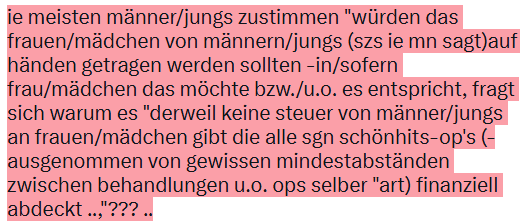
was anerkannte identität(?), steht jedem fre sgn schönheits-ops an sich machen zu lassen/zu machen .. als auch zu sgn ärtzten, medizinern, heilern, u.o. selbshilfegruppen u.o. sekten u.o. "etc zu gehen ..
meine fresse, ihr habt "probleme ...
und anbeibemerkt, von daher das wohl
ALT -
1
5
12