
西雅图/sub
Joined November 2021
- Tweets 74
- Following 66
- Followers 17
- Likes 254
Photos and videos
Mia retweeted

Jun 6
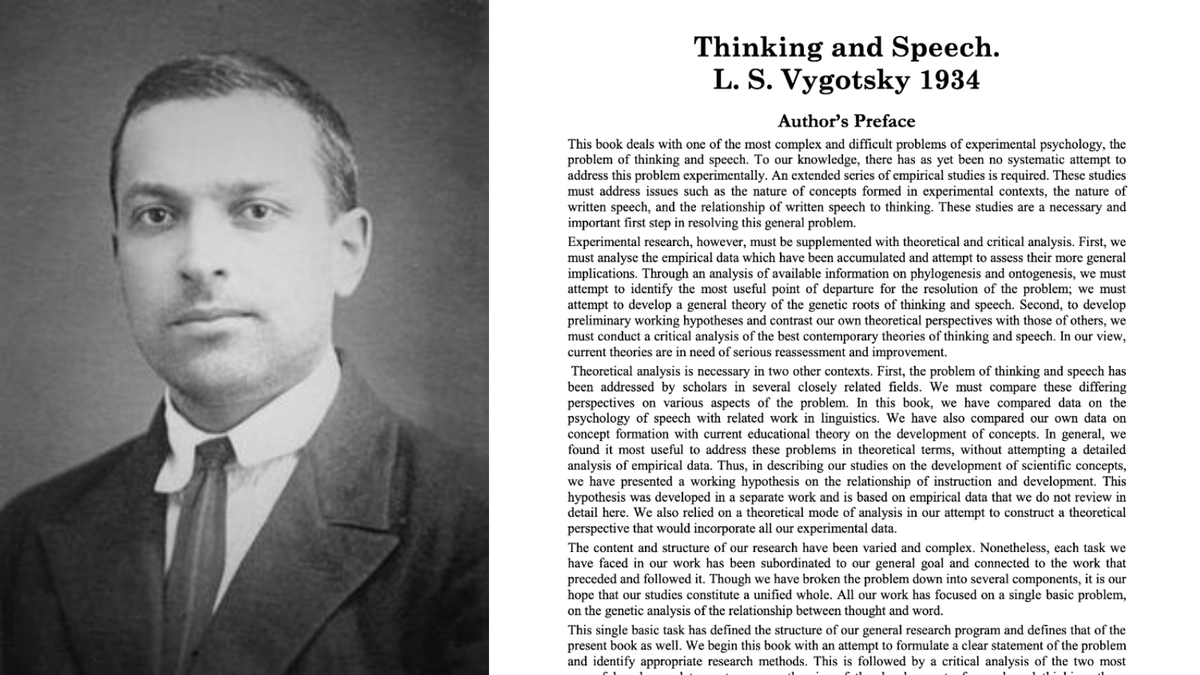
A Russian psychologist spent 10 years proving that the act of talking to yourself out loud is one of the most powerful cognitive tools the human brain has, and almost nobody outside his field has read the work.
His name was Lev Vygotsky.
He worked in Moscow in the 1920s and died of tuberculosis in 1934 at the age of 37. He had no laboratory, no funding, almost no English readers, and a body of work that the Soviet government suppressed for two decades after he died.
He produced the foundational theory of how human cognition actually develops, and the central piece of that theory was a behavior almost every adult is faintly embarrassed about.
Vygotsky noticed that young children talk to themselves constantly. They narrate their own actions, they argue with imaginary opponents, they instruct themselves through tasks out loud.
The dominant theory at the time, from the Swiss psychologist Jean Piaget, said this was a sign of cognitive immaturity that children would eventually grow out of as they learned to think properly.
Vygotsky said the exact opposite.
He argued that this self-directed speech was the most important cognitive event in the entire developmental window, because it was the moment a child first started to use language as a tool to control their own mind. The child was not failing to think. The child was learning how to think by externalizing the process and listening to themselves do it.
He predicted that as children matured, this out-loud self-talk would not disappear. It would go underground. It would become silent inner speech, which is the running monologue every adult has inside their own head for the rest of their life.
The voice you hear when you read this sentence is the direct descendant of a four-year-old narrating their own block tower.
For 50 years almost nobody outside Russia had access to his work, and the few researchers who did pick it up could not get funding to test it. Then in the early 2000s the experiments finally started to pile up, and what they found was that Vygotsky had been right about something even more important than he knew.
The first major study came from Gary Lupyan at the University of Wisconsin and Daniel Swingley at the University of Pennsylvania in 2012. They ran a simple visual search experiment. Participants were shown 20 images at once and asked to find a specific object, like a banana or a chair. In one condition they searched silently. In the other condition they were told to say the name of the object out loud to themselves while looking for it.
The participants who spoke the target name out loud found the object significantly faster, with higher accuracy, than the participants who searched in silence. The effect was strongest when the spoken word matched a familiar object the brain already had a strong category for.
Saying the word out loud literally tuned the visual system to detect that thing better. The researchers called it the label feedback effect, and the implication was that the act of vocalizing a goal physically changes how the brain processes the world while pursuing it.
The second major study came out of the University of Michigan and Michigan State in 2017. The lead researchers were Ethan Kross and Jason Moser, and they used both EEG and fMRI to record what happens inside the brain when people talk to themselves while emotionally upset.
They asked participants to recall painful autobiographical memories and reflect on them in two different ways. Some used the first person, saying things like "why am I feeling this way." Others used the third person, referring to themselves by their own name, saying things like "why is John feeling this way."
The brain scans showed that the simple act of switching from first person to third person, even silently, decreased activity in the medial prefrontal cortex, the region responsible for rumination and self-referential pain. Within a single second of using their own name instead of the word I, participants showed measurably lower emotional reactivity. The shift required no extra cognitive effort. It cost the brain nothing. And it worked.
Kross described the mechanism in his interviews. Talking to yourself by name creates a small amount of psychological distance from your own experience. Your brain processes the situation more like a problem belonging to someone else, which means it can analyze it instead of drowning in it.
What Vygotsky had intuited in 1934 turned out to be even more powerful than the developmental theory he built it into. The voice you use to talk to yourself is not background noise. It is one of the most precise cognitive tools the brain has, and you can change how it works just by changing the pronoun you use.
People who talk through problems out loud are not anxious or unstable. They are running an externalized version of a process the rest of us are running silently and worse. The kindergartener narrating their block tower, the surgeon muttering through a procedure, the engineer pacing a hallway describing a bug to nobody, the athlete repeating a cue to themselves before a free throw, they are all using the same ancient mechanism that builds and steers human thought.
You can run the experiment yourself the next time you are stuck on something hard. Stop trying to solve it silently in your head. Say it out loud. Describe what you are seeing. Walk yourself through the steps as if you were explaining it to a colleague who is not in the room.
And when something genuinely upsets you, switch to your own name. Ask why this person is feeling this way, instead of why I am feeling this way.
The voice you have been told to keep quiet your entire life is one of the oldest pieces of cognitive technology you own.
Most people are still embarrassed to use it.
255
3,045
11,158
404,116

Jun 6
一到早上就很想被edging然后拒绝高潮还被狠狠的打下体,怎么哭怎么求对方都没用,只能乖乖穿好衣服去上班等对方不知道什么时候才给予的高潮奖励。
94
Jun 6
理想的ds关系是我们互为对方的安全基地,我会永远信任对方,倾听对方的情绪和秘密,而对方也会无条件的支持我,欣赏我。我始终觉得稳定且和谐的关系不需要太过频繁的联系,只是想到对方的存在本身就能获得安全感和满足。
2
3
154
Jun 4
所以并不是我的问题,只是双方的需求不同,这种不平衡的心理是因为缺少aftercare导致的sub drop,是因为对方没有满足我的被看见被关心和value confirmation的心理需求。知道我所有的一切都是sub会有的正常反应以后我觉得我已经可以接受了。归根结底还是几年前开始的时候就错了。
1
1
87
Jun 4
不过就算以后真的彻底结束了我也会很珍惜的。毕竟我收获了帮助和快乐的体验,对方怎么想是没办法了解的,但起码我自己的感受是真实的。我也越来越清楚自己是谁自己想要什么了
1
60
Jun 4
看了The Inner Game of Tennis 才觉得和Power of Now说的竟然是一样的东西。一切的念头都会阻碍你活在当下,获得平静。最纯粹的时刻就是只做事,什么也不想,quiet self 1 and trust self 2。世间其他的方法论比如心经,存在主义,宗教信仰还有现在的各种💐法则都是达到这个纯粹状态的术,殊途同归。
1
58
Jun 4
生活中有无数瞬间都会让self 1 question self 2,比如为什么这个球落点这么好但却打不好,为什么工作中犹豫不决让决定的机会被他人拿走了等等,但是没关系,每天多相信self 2一次就好。
47