
Joined December 2007
- Tweets 8,158
- Following 1,685
- Followers 798
- Likes 4,712
489 Photos and videos

Pinned Tweet

Jun 6
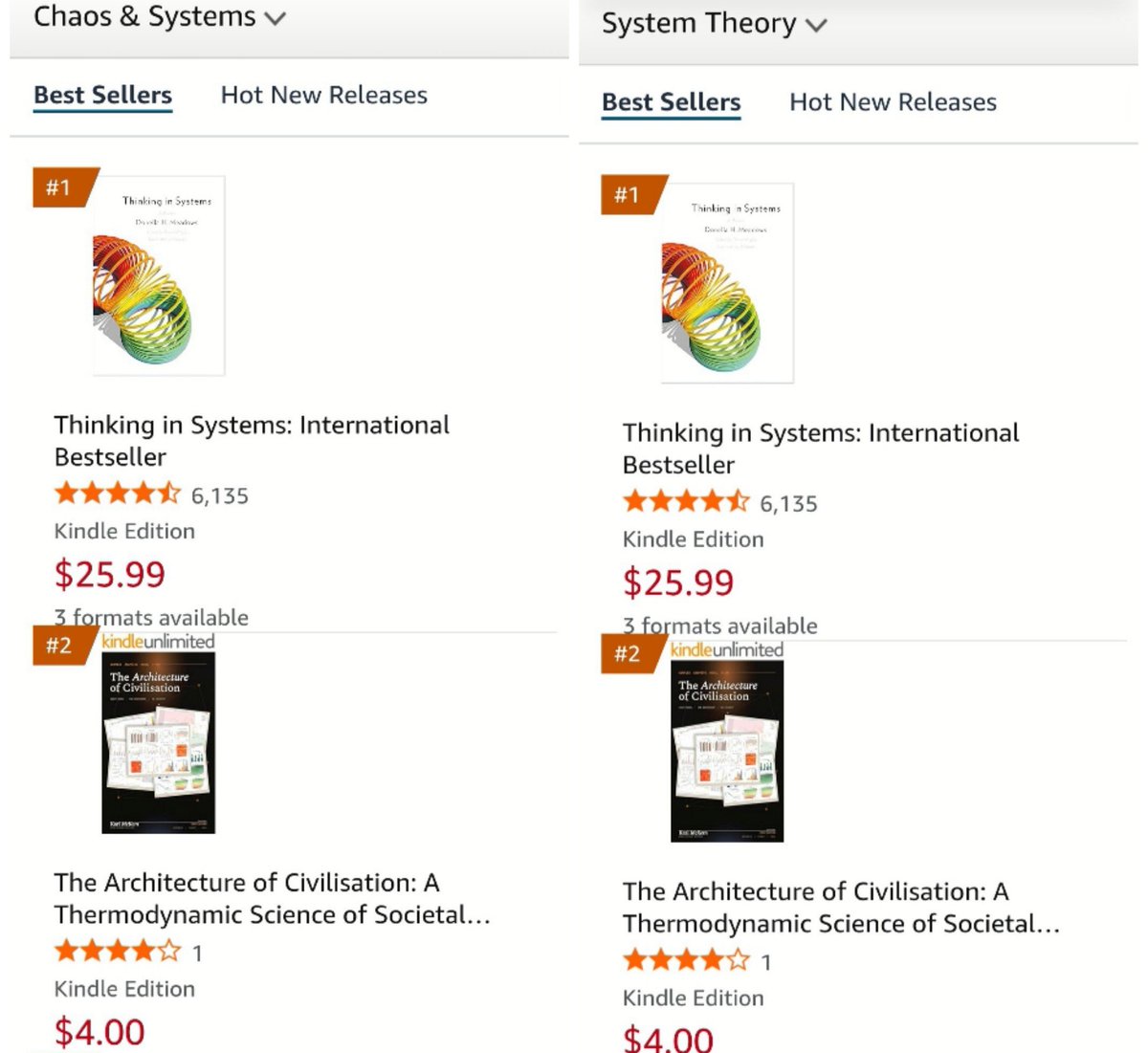
A highly readable revision of the "The Architecture of Civilisation"
is now available for 4 bucks on Kindle.
"What if civilisations do not rise and fall mainly because of ideology, leadership, or national character, but because of measurable structure?
The Architecture of Civilisation introduces CAMS, the Complex Adaptive Model of Societies, a new framework for reading societies as living, adaptive systems. Drawing on complexity science, thermodynamics, graph theory, and history, Kari Freyr McKern argues that civilisations can be analysed through their functional architecture: how they coordinate decision-making, force, memory, meaning, assets, skill, labour, and flow.
Across more than 40 societies and 36,856 historical records, CAMS identifies recurring patterns of stress accumulation, coordination failure, and systemic phase transition. Its central claim is simple but far-reaching: societies fail not merely when one institution breaks, but when the symbolic layer of civilisation, its law, memory, legitimacy, and shared meaning, decouples from its material layer of energy, production, logistics, labour, and force.
The result is not another ideological argument about which societies are good or bad. CAMS treats democracies, empires, authoritarian states, post-colonial societies, and corporations as parallel experiments in human organisation. It asks a colder and more useful question: how well is the system actually functioning?
For readers of Peter Turchin, Jared Diamond, Nassim Nicholas Taleb, Donella Meadows, and Ilya Prigogine, this book offers a bold attempt to turn historical intuition into structural diagnosis.
Leaders such as Mussolini, Hitler, Perón, and Trump are not presented as moral equivalents, but as structural signals: figures selected by systems already under strain. Civilisational crisis is not caused by them. It is revealed through them.
This is a book for anyone who suspects that beneath the noise of contemporary politics, there is a deeper architecture waiting to be read."
amazon.com.au/dp/B0GHP91SFG/…
#HistoricalDynamics
#Cliodynamics
#ComplexAdaptiveSystems
#OpenScience
#Geopolitics
#CivilisationalDecline
#Polycrisis
#GraphTheory
#Thermodynamics
1
1
56
May 24
Check out the latest article in my newsletter: Epistemologically Speaking... linkedin.com/pulse/epistemol… via @LinkedIn
1
40
May 20
Both the #UnitedStates and Germany are exhibiting signs of what the model identifies as system-level adaptive stress — a condition where feedback loops between atomised citizens, algorithmically mediated information environments, and structurally captured institutions begin to mutually reinforce one another, accelerating decay rather than triggering corrective self-organisation. The two cases differ meaningfully in trajectory, depth, and institutional buffer capacity, making them a productive comparative pair. #Germany is stress-testing its guardrails under relatively intact institutional architecture; the United States has entered what the Carnegie Endowment for International Peace characterises as a phase of normative democratic erosion, where formal structures persist but are increasingly hollowed out by executive aggrandisement and corporate-political consolidation.
The three analytical pillars — #massformulation, social media effects, and the #corporatearchipelago pattern — each map to distinct sub-variables: systemic agency depletion, information-environment topology, and feedback-loop capture at the meso/macro levels. Each section below separates evidence (empirically sourced), analogy (historically or theoretically grounded but not directly measured), and speculation (inference-based, marked explicitly). neuralnations.org
perplexity.ai/computer/a/6a3…
1
39
May 20
Check out the latest article in my newsletter: Issue 28 — First Results from the Epiphenomenon@Trove Study linkedin.com/pulse/issue-28-… via @LinkedIn
1
34
May 14
The Kuramoto Bridge: From Individual Agents to Civilisational Synchrony
Human societies are vast networks of agents: people, institutions, technologies, rituals, markets, laws and symbols. Each has its own rhythm. Farmers, soldiers, clerks, teachers, traders, engineers, families and officials do not move at the same pace by nature. Civilisation emerges when these rhythms become coupled strongly enough to produce shared timing across a social system.
The Kuramoto model offers a powerful bridge between individual behaviour and civilisational coherence. In its simplest form, it describes how many oscillators, each with its own natural frequency, can spontaneously synchronise when the coupling between them becomes strong enough. A familiar image is a room full of metronomes placed on a flexible table. At first they tick chaotically. Over time, small forces transmitted through the table cause them to lock into a shared rhythm.
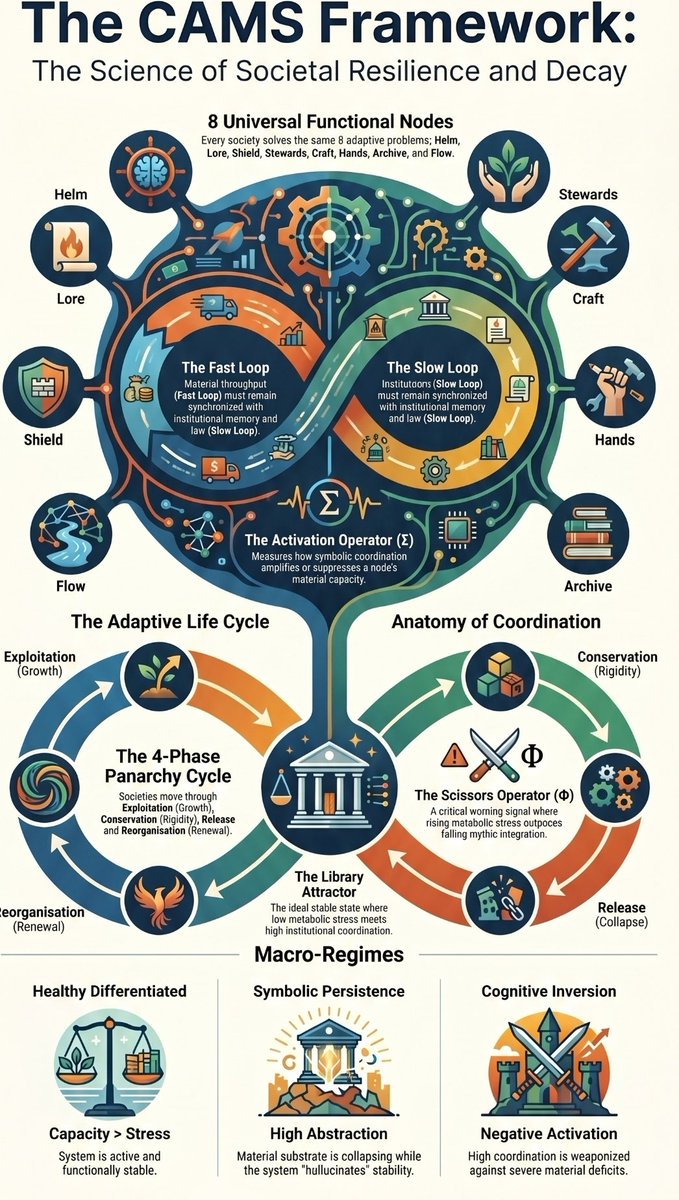
In CAMS, the eight functional nodes — Helm, Shield, Lore, Stewards, Craft, Hands, Archive and Flow — can be read as coupled institutional oscillators. The human agents within them act with their own local purposes, but institutions provide the “table” that transmits timing signals between them.
Lore synchronises meaning through ritual, education, media and ceremony. Archive stabilises phase memory through records, law, precedent and institutional continuity. Helm coordinates correction when the system drifts. Shield enforces boundaries and timing rules. Stewards allocate resources. Flow carries signals through trade, transport, finance and communication. Craft converts synchrony into technical capability. Hands embodies synchrony as labour, logistics and daily social reproduction.
This gives CAMS a clean micro-to-macro bridge. Coherence is not merely cultural agreement; it is phase alignment across the social organism. Capacity is the productive throughput made possible by synchrony. Stress is the friction produced by desynchronisation. Abstraction is the higher-order pacemaker: the symbolic and conceptual layer that allows societies to coordinate beyond immediate perception.
Real examples make this concrete. The Chinese Spring Festival migration is a massive Flow-Hands synchronisation event. Industrial Britain was transformed by Craft-Hands-Flow synchrony through factories, railways, clocks and finance. The Late Roman Empire can be read as Helm, Stewards and Shield falling out of phase under mounting fiscal, military and administrative stress.
The Kuramoto Bridge removes two illusions. First, large-scale social order is not mysterious. It is emergent coordination, produced when enough agents become phase-linked through institutions. Second, human diversity is not noise. Different civilisations are different coupling architectures, wiring the same basic functional requirements in different ways.
This does not mean people are simple oscillators. Human systems have memory, hierarchy, coercion, symbols, unequal coupling and delayed feedback. CAMS therefore points towards a heterogeneous, weighted, multilayer Kuramoto-like model rather than a literal mechanical one.
The deeper insight is simple: civilisation is synchronised human energy, phase-locked through institutions, symbols, infrastructure and memory. When synchrony holds, societies multiply human capacity. When it fails, desynchronisation appears as stress, conflict and systemic drift.
#CAMS #ComplexityTheory #mathematics
1
39
May 6
Check out the latest article in my newsletter: CAMS Telescope: A New Lens on Social Cordination and Cognition. linkedin.com/pulse/cams-tele… via @LinkedIn
46
May 4
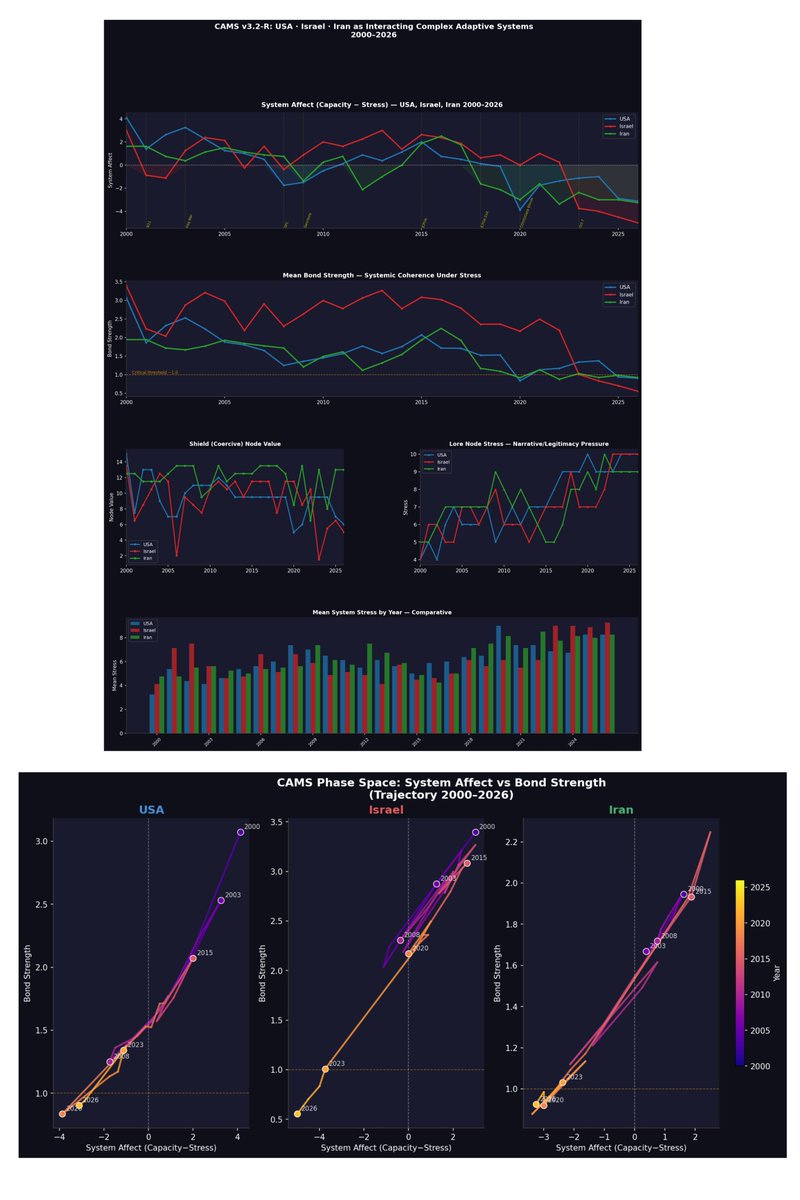
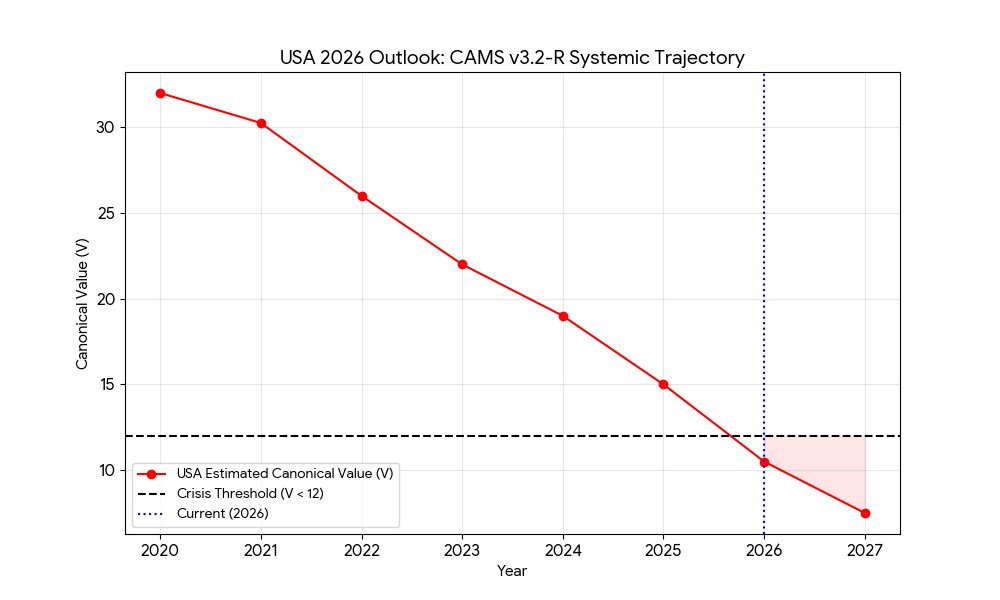
As of early May 2026, the United States sits in a precarious and rapidly deteriorating state, caught between geopolitical confrontation and domestic economic strain. The ongoing conflict with Iran, now in its third month, has triggered a severe energy shock. The near-total closure of the Strait of Hormuz has pushed oil prices above $120 per barrel at times, sending ripples through global supply chains and driving up inflation across the American economy.
Domestically, the situation is even more concerning. A broad escalation of tariffs has intensified trade tensions with major partners, including Europe and China. While the overall economy posted modest growth of around 2% in the first quarter, this masks deep structural weaknesses. Unemployment is creeping higher toward 4.6%, and cost-of-living pressures are biting hard in working households. The Federal Reserve faces intense political pressure as Chair Powell’s term ends this month, with markets pricing in delayed rate cuts amid sticky inflation.
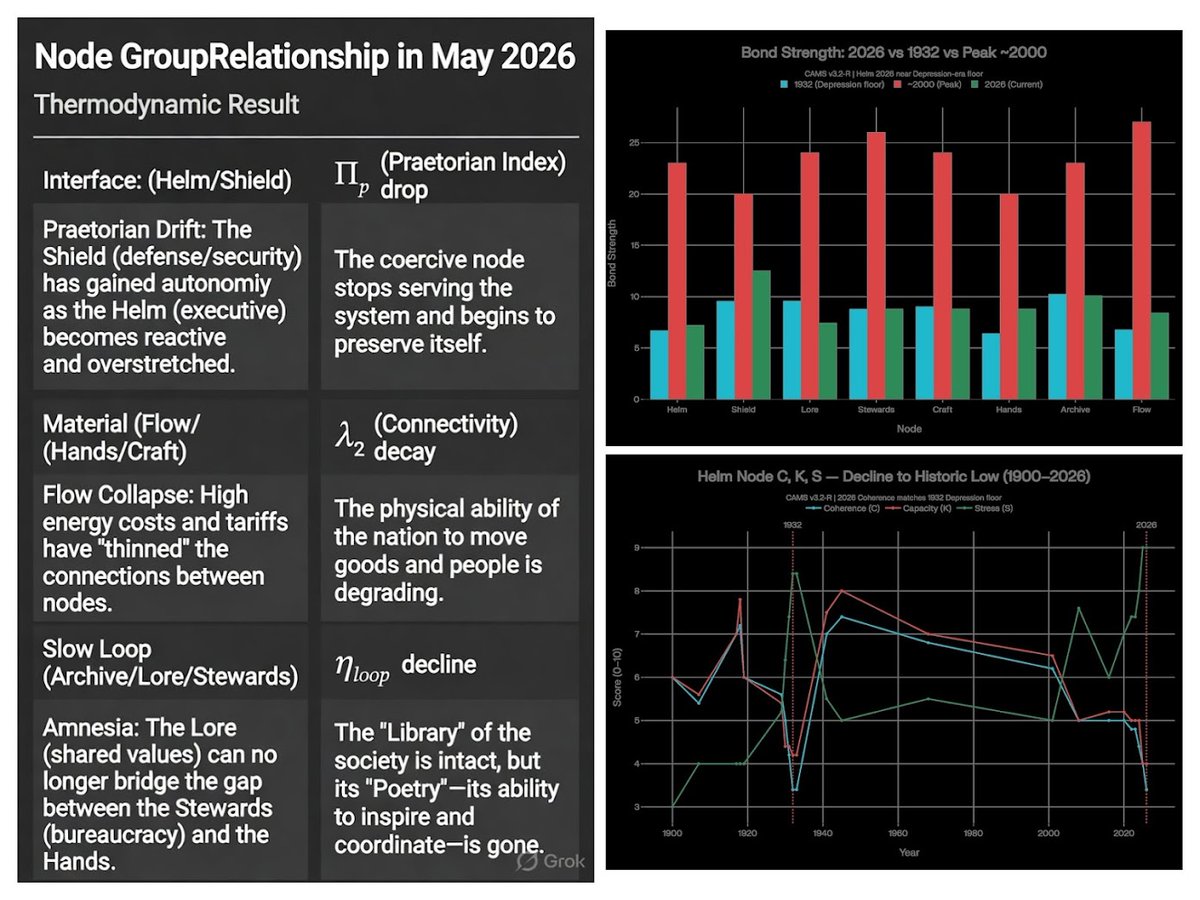
In institutional terms, the country is experiencing what analysts describe as a coordination crisis. Executive leadership appears reactive and overstretched, struggling to manage multiple fronts simultaneously. Meanwhile, defence and security institutions have gained significant relative strength and autonomy, stepping into roles where traditional civilian authority has weakened. This shift has created a growing sense that coercive capacity is outpacing coherent strategic direction.
The material foundations of American society are under serious pressure. Labour markets are fragmenting, logistics networks are strained by energy costs and tariffs, and large sections of the productive economy are showing signs of exhaustion. At the same time, corporate entities in technology, defence, energy, and logistics are consolidating power, effectively creating self-contained zones of functionality. These corporate “islands” are increasingly operating with their own rules, infrastructure, and security arrangements, protected by the very institutions that once served a unified national framework.
Public trust in shared national institutions continues to erode. The mythic and narrative layers that once bound the country together are fraying under the weight of economic hardship and foreign policy strain. While some coherence remains in elite and archival circles, it is losing its ability to reach and organise the broader population. #CAS #complexity #history #systemsanalysis #neuralnations
1
56
Apr 26
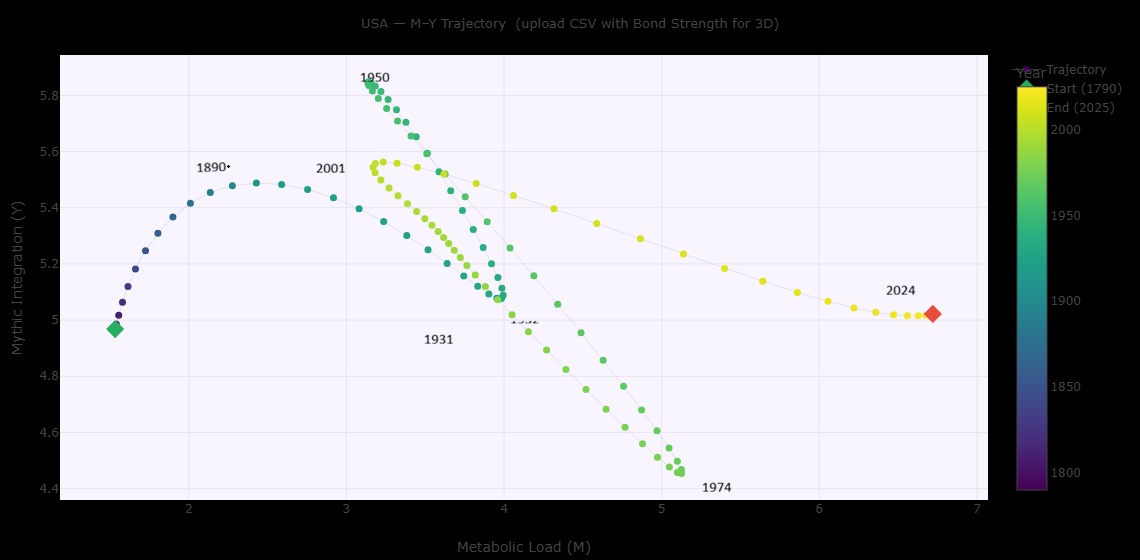
Based on the Complex Adaptive Model (CAMS), the United States enters 2027 in a fragile state – not a Depression‑era crash, but a slow **decoupling** between what its leaders say (abstraction) and what its systems can actually do (material capacity). Think of a society running on narrative fumes.
Three possible paths emerge for 2027–2030:
**1. The bumpy plateau (10% chance)**
External relief (cheap energy, tech breakthrough) lowers stress. Washington abandons grand stories, focuses on basics. Result: a low‑energy, okay‑ish stability – think northern Europe’s quiet austerity. No boom, no civil war, just a smaller America.
**2. The messy rupture (60% chance – most likely)**
Leaders double down on “exceptionalism” while factories rust and trust crumbles. By 2029, the centre cannot hold: regions go their own way, the currency wobbles, soldiers stay home. The country doesn’t explode – it *fragments* into three or four de‑facto zones (Pacific tech, Heartland farms, a struggling Northeast). No single authority remains. Life becomes local, harder, but not apocalyptic.
**3. The phoenix reboot (30% chance)**
A massive shock – climate disaster or war – forces Americans to ditch old myths entirely. New local councils rise, rebuild material basics from scratch. By 2030, a networked federation of bioregions replaces the old nation‑state. Traumatic, but potentially more resilient.
**The bottom line:** the US won’t disappear, but the unified, globe‑bestriding America of 2000 is unlikely to return this decade. Most Australians would see a distracted, inward‑looking former ally – less a collapse than a slow, grumpy shrinkage.
*Speculation based on CAMS modelling – not a prediction.*
chat.deepseek.com/share/htfw…
1
1
61
Apr 26
In 260 AD the Roman Emperor Valerian — supreme commander of the largest army the world had ever seen, living embodiment of Jupiter, issuer of edicts that still echo in Western law — was captured alive by a Persian king and spent the rest of his life as a human mounting block. Shapur I of the Sasanian Empire reportedly used him as a footstool to climb onto his horse. Not metaphorically. Literally.
The CAMS dataset says this was not an accident of battlefield fortune. It was the predictable endpoint of a structural trajectory that had been visible for a decade. Rome’s Year 250 is the single closest historical analogue — by both Euclidean distance and pattern correlation — to the United States in 2025–2026.
Look at the numbers. In the recalculated Rome file, Year 250 shows slow nodes (Archive, Lore, Stewards) already sliding toward zero while fast nodes (Helm, Shield, Flow) remain hyperactive. Slow_Load has turned positive. The system is no longer absorbing stress; it is beginning to export it. USA 2026 shows the same signature: κ at 1.69, Bond Strength eroding, Archive and Lore entropy climbing even as Craft and Hands metrics look superficially robust. Two independent matching algorithms — one GPT-driven pattern correlation, one 32-dimensional node-level Euclidean — converge on the same decade. That is not coincidence. That is measurement.
The deeper irony is that Rome in 250 AD still *looked* like Rome. The eagles were still polished. The Senate still met. The Colosseum still hosted games. Performance data was excellent. Structural data was terminal. Shapur I did not defeat a healthy empire. He applied calibrated pressure to a polity whose internal coupling had already failed its own stress tests. The Persian king was running his own version of the CAMS model; he simply never wrote it down.
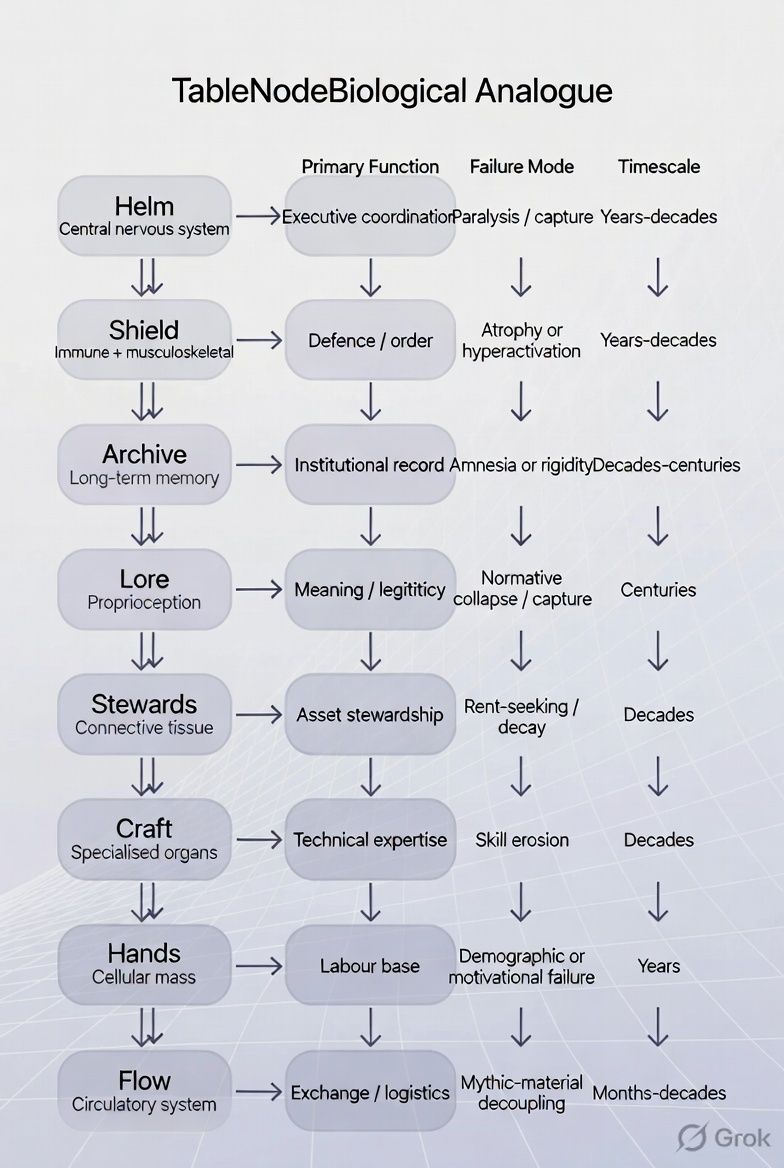
Valerian’s capture was the moment the outside world noticed what the slow nodes had been signalling for years. The same pattern appears in the failure-modes diagram you attached: Helm paralysis, Shield atrophy or hyperactivation, Archive amnesia or rigidity, Lore normative collapse. All of them feed downward into Hands demographic failure and Flow mythic-material decoupling. The diagram is not speculative. It is the empirical map of every society that has crossed this threshold.
The United States in 2026 is not yet at Edessa. But it is at the structural equivalent of Rome 250. The outside actors who are quietly running the numbers — whether state or non-state — already know it. They are not the cause of the crisis. They are the consequence of it. They are simply the first to treat the stress readings as real rather than as narrative inconvenience.
History does not repeat, but it does rhyme in eight-dimensional node space. The footstool had been measured long before the battle. The only question left is whether the current occupant of the office will recognise the geometry in time — or whether, like Valerian, he will discover it only when the horse is already waiting.
docs.google.com/document/d/1…
1
3
91
Apr 24
The Wounded Larrikin
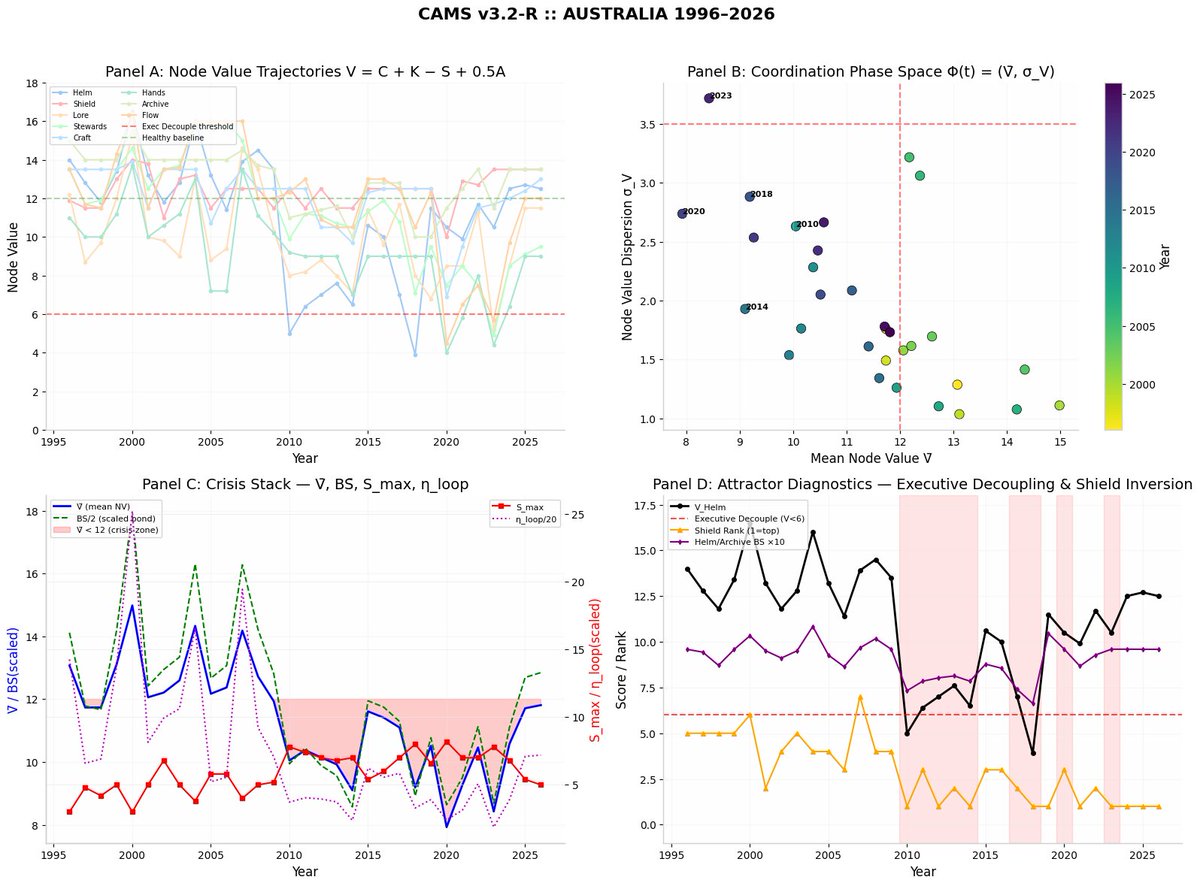
Australia in 2000 is the confident young god — V̄ = 14.99, all nodes above 13, Helm and Flow blazing at 16.5 and 16.4. The Sydney Olympics, the "lucky country" at peak luck. A society where the larrikin spirit (irreverent, capable, anti-authoritarian) is not merely tolerated but structurally load-bearing.
Then comes the falling out of love with itself.
2010 is the first wound: the palace coup. The Helm does not merely weaken — it is humiliated (V = 5.0, the lowest node in a system that once crowned it). The Shield, ever loyal, ever watchful, steps forward not by ambition but by absence. Where the Helm collapses, the Shield becomes the tallest structure by default. This is the Praetorian tragedy: the guardian does not seize power; power evacuates into the guardian.
2018 is the second wound, deeper. V_Helm = 3.9 — below the poetry threshold. A society whose executive function has forgotten how to summon itself. The larrikin, confronted with genuine complexity (climate, China, digital disruption), retreats into fortress psychology. The Shield rank 1 for nine consecutive years is not militarism. It is agoraphobia — fear of the open horizon that once defined the nation.
2020 is the turtle shell. COVID does not fracture Australia because Australia has already learned to live inside its shell. The BUFFERING attractor is not resilience. It is pre-adapted withdrawal. A society that had already turned inward finds lockdown structurally familiar.
2022–2026 is the hesitant return. V̄ climbs toward 12. The larrikin peeks out. But Shield remains rank 1. The poetry has not returned. η_loop rebuilds to 144, yet the 2000 peak (504) remains a distant memory. Australia is recovering without remembering what it was recovering toward.
The mythic reading is not despair. It is cautionary: a society can survive fracture, absorb shock, and still lose its summoning spell. The larrikin lives, but he checks over his shoulder now. And that, in the CAMS calculus, is the difference between a society that is stable and one that is whole.
kimi.com/share/19dbf148-e8b2…
1
46
Apr 19
Check out the latest article in my newsletter: From Framework to Dashboards: The new NeuralNations.org toolsets. linkedin.com/pulse/from-fram… via @LinkedIn
26
Apr 16
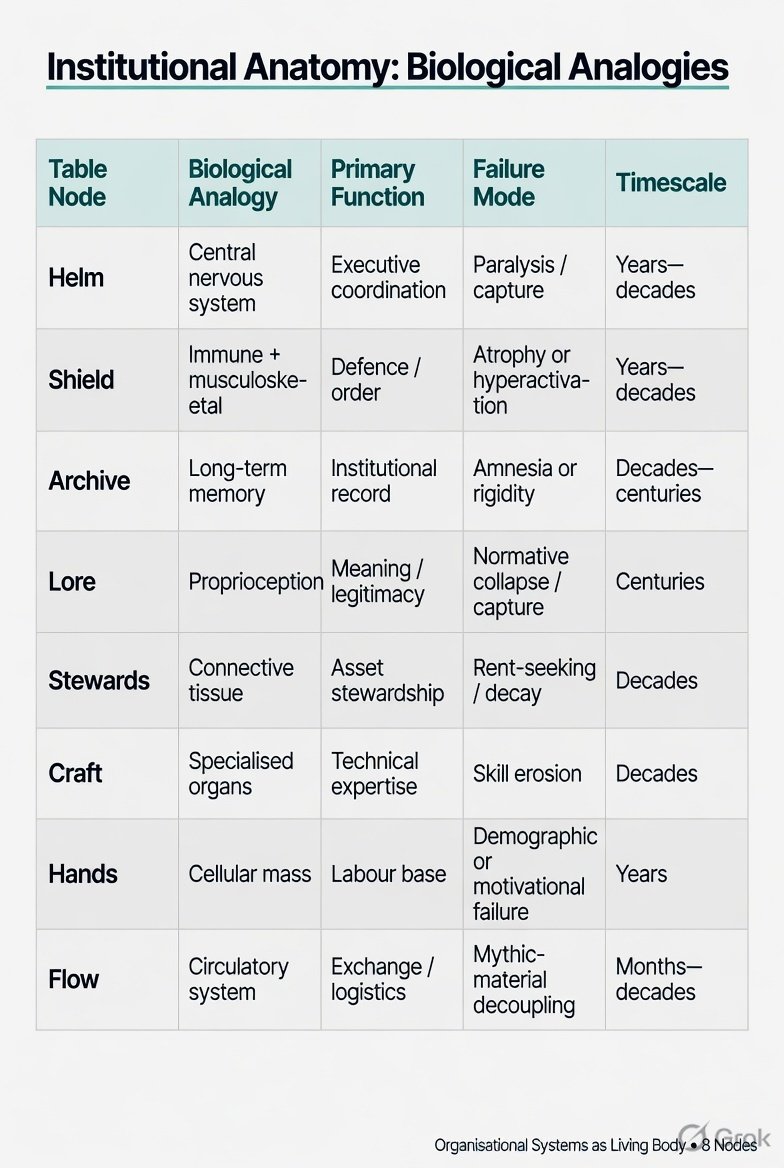
This chart captures the parsimony of the CAMS approach.
The eight nodes — Helm, Shield, Archive, Lore, Stewards, Craft, Hands and Flow — are not labels. They are the recurring functional parts of any durable human system: coordination, defence, memory, legitimacy, stewardship, expertise, labour and exchange.
The biological analogy reflects thermodynamic realities. Just as the body must also coordinate, defend itself, remember, orient, maintain specialised functions, sustain mass and circulate resources, CAMS proposes that aggregated human systems have analogous functional necessities. An empire, a kingdom and a nation may differ in culture, technology and scale, but they still have to solve the same underlying coordination problem.
The first useful unification is scale invariance.
These eight functions appear at all organisational scales.
The same grammar shows up whether we are looking at a civilisation, a state, a province, an institution, or even a long-lived organisation within a society. The names assigned to nodes may differ, and their relative systemic significance can differ but the underlying functional architecture is stable. In that sense, CAMS is not just a model of a polity, it is a statement about the underlying anatomy of all social cooperation.
The fractal dimension.
In a fractal, the pattern repeats across scale. Not perfectly, not mechanically, but recognisably. CAMS suggests that human systems are built the same way. Each level of control contains variants of an identical functional structure: some form of executive direction, some form of defence, some form of memory, some form of legitimacy, some form of productive skill, and so on. The pattern compresses complexity without denying diversity. It tells us that beneath the costumes of history there is a repeating coordination geometry.
This chart also hints at why human system failure modes cluster by type. Flow can break down quickly. Helm and Shield can become paralysed, captured or hyperactive over years. Archive and Lore may decay slowly across decades or even centuries, storing up danger long before the headlines notice. So a society can appear active while becoming structurally brittle.
The practical value is simple. CAMS gives us one language for comparing national and other organisational systems without collapsing them into slogans. It moves us beyond ideology and personality, and towards function, stress and timescale. Instead of asking only who is right, we can ask: which node is failing, how is that failure spreading, and what level of the system is carrying the load?
That is the significance of the chart. It presents society not as a pile of opinions, but as a living coordination structure — one whose deep pattern may repeat across scale, and whose failures can be studied with far more clarity structurally than our partisan politics otherwise permits.
2
52
Apr 7
Check out the latest article in my newsletter: One Question at a Time linkedin.com/pulse/one-quest… via @LinkedIn
1
35
Apr 4
The Physics of Coordination From Slime Moulds to Civilisations youtu.be/BU349r3luYs?si=KcEc… via @YouTube

2
38