
Beyond Prediction: Why Learning Speed Determines Survival in Complex Systems medium.com/@tarifabeach/beyo… #ComplexityScience, #ComplexAdaptiveSystems, #OrganizationalLearning, #SystemsThinking, #ComplexityTheory, #AdaptiveLeadership, #StrategicManagement
16


May 30
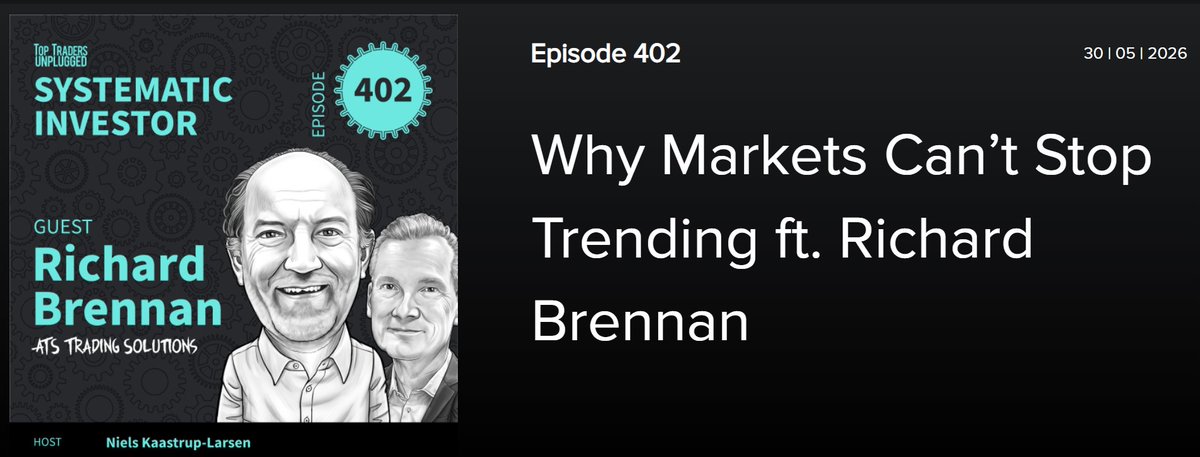
What if markets aren't equilibrium machines at all, but something closer to a flock of starlings?
That's where Niels Kaastrup-Larsen and I went on this week's Systematic Investor episode. We unpack why markets trend, why they can't seem to stop, and why the rise of passive investing is quietly making those trends stronger, not weaker.
From the endogenous engine that drives most price movement, to the inelasticity that turns a dollar of flow into five, to a feedback fingerprint that shows up across 68 markets and 40 years of data. The evidence points one way: markets can't stop trending.
Thanks Niels for another great conversation. Have a listen, link below.
atstradingsolutions.com/top-…
#TrendFollowing #SystematicInvesting #ComplexAdaptiveSystems #PassiveInvesting
3
23
873
May 27
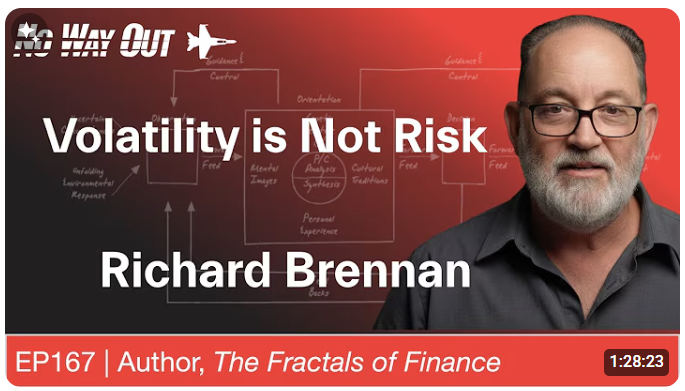
Most investors lose because they're running a predictive model in a system that punishes prediction.
I joined Ponch Rivera and Moose McGrath on the No Way Out podcast to talk about what the alternative actually looks like. Align with price instead of forecasting it. Cut losses to protect the compounding base. Spread the net wide enough to be present when the outliers arrive, because a handful of tail events will dominate the entire track record.
Underneath the mechanics sits a stranger idea. Structure in markets is not generated. It is carved. What we see is the residue of countless agents acting under constraint, the survivors of an ongoing test against a fitness landscape. Fractals are the natural geometry of what survives.
Grateful to Ponch and Moose for the conversation, and to Jerry Parker for the introduction.
Full post and video atstradingsolutions.com/foll…
#TrendFollowing #ComplexAdaptiveSystems #OODALoop #FreeEnergyPrinciple
1
5
24
1,063
May 23
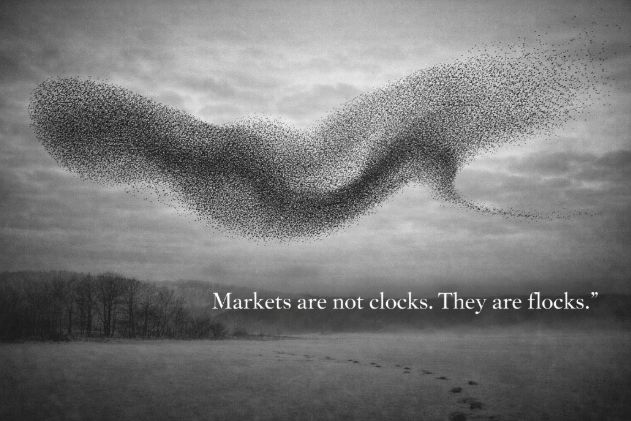
Markets don't trend because of news. They trend because they can't help it.
Watch a murmuration of starlings. Thousands of birds, no conductor, no blueprint. Each follows three local rules. The collective produces structure no individual planned.
Markets work the same way.
Equilibrium theory says prices reflect fundamentals and deviations are random noise. The evidence says something else entirely. The vast majority of price movement cannot be attributed to identifiable news. The largest moves in market history have frequently occurred without any catalyst of equivalent magnitude.
So what's actually driving price?
Feedback.
A breakout lifts price. The lift draws in momentum systems. Those systems alter volatility. Volatility adjustments trigger rebalancing. Rebalancing shifts positioning. The original spark becomes irrelevant. The cascade is what matters.
We tested this with a controlled experiment. Strip feedback out of a simulated market and you get exactly what efficient market theory predicts: Gaussian tails, no memory, no clustering. A world that has never existed.
Add feedback back in and every signature of real markets reappears simultaneously. Fat tails. Volatility clustering. Directional persistence. Statistically indistinguishable from 68 real futures markets across 8 asset classes and 41 years of data.
The phase transition happens at roughly 25% price-sensitive participants. In real markets, with 70% of volume now algorithmic, we are nowhere near that threshold. We have blown straight through it.
This is why trend following has worked across every decade, every continent, every asset class. It is not exploiting a temporary inefficiency. It is harvesting the structural output of a complex adaptive system.
The agents change. The engine does not.
Episode 5 of The Geometry of Wealth is live.
atstradingsolutions.com/the-…
#TrendFollowing #SystematicInvesting #ComplexAdaptiveSystems #MarketStructure
2
10
59
11,951
Apr 24
Why Markets Evolve the Way They Do
Episode 002 of Dispatches from The Outpost is live.
Episode 001 made the case that markets are Complex Adaptive Systems. Dynamic, evolving, driven by processes and feedback loops. But it left a question open. If systems evolve through processes, what drives those processes?
This Dispatch walks through the answer. Six parts, one sustained argument. The mechanics of market behaviour follow from first principles that apply to every complex system in the universe.
Boundaries that shape what can evolve. Symmetry breaking that creates new structure. Feedback loops that produce trends and corrections. Computational irreducibility that makes prediction structurally impossible. And entropy, not as decay, but as the engine that powers every system forward.
Entropy is not the enemy of markets. It is their engine. Every trend, every cycle, every collapse is entropy at work.
Trend following is not a bet on direction. It is a bet on the feedback structure of markets persisting, and on entropy doing its work.
Watch the full Dispatch and read the original six-part series here: atstradingsolutions.com/the-…
#TrendFollowing #ComplexAdaptiveSystems #SystematicTrading #OutlierHunter

2
7
536
Apr 13
Dispatches from The Outpost is now live. Episode 001: The Power of Process.
A video series exploring the deeper structure of markets, trend following, and the ideas that sit beneath robust systematic trading.
Episode 001 begins with first principles.
Most traders are not simply working with an incomplete model of markets. They are working with the wrong model entirely.
The dominant assumption is that markets are random.
The evidence disagrees.
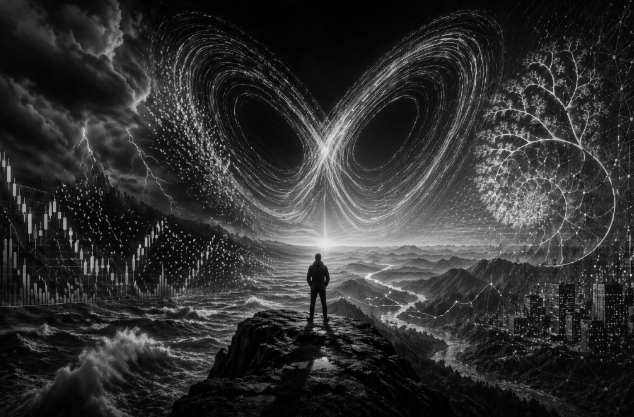
Markets are chaotic. They are fractal. They behave as complex adaptive systems. And that changes everything, from how we think about strategy design to position sizing, diversification, and survival.
Trend following is not just a method for buying strength or selling weakness. It is a response to something deeper: the persistence of feedback structures in financial markets.
If the foundation changes, everything built on top of it must change too.
Start with Episode 001.
atstradingsolutions.com/disp…
#DispatchesFromTheOutpost #SystematicTrading #TrendFollowing #ComplexAdaptiveSystems
1
3
14
821


Base Derived Reality (BDR): A Constraint-First Framework for Understanding Physical Reality
Base Derived Reality (BDR) reframes the nature of the physical universe. Rather than treating reality as either a random aggregation of material objects or as a fabricated “simulation,” BDR proposes that the observable world is the lawful output of deeper informational processes operating under strict constraints.
Reality is not pre-built and static. It is continuously derived—moment by moment—from an underlying informational substrate.
Physical existence therefore represents the stable result of constrained informational dynamics, not the primitive starting point of the system.
Information Precedes Matter
At the most fundamental level, the universe is not composed of solid “things.”
It is composed of information, relationships, and potential states.
Matter arises when informational structures stabilize into persistent geometric configurations. In this sense, physical objects are derived structures—patterns that emerge when information becomes sufficiently organized to maintain coherence across time.
Information is primary
Matter is an emergent stabilization of informational geometry
This perspective aligns with a growing body of work in physics and information theory that treats physical states as manifestations of underlying informational structure.
Consciousness as a Local Observer Process
Within this framework, human consciousness functions as a localized observer process.
Rather than being an accidental byproduct of biology, consciousness can be understood as a bounded informational system capable of interacting with the broader field of potential states.
Operationally, a human mind behaves like a virtual machine operating on biological hardware, continuously interpreting and organizing incoming information.
This observer function forms what can be described as a Local Coherence Envelope—a region in which information is stabilized into meaningful patterns through perception, cognition, and decision.
In other words, consciousness does not create reality, but it participates in selecting which possibilities become realized.
The Just-In-Time Rendering of Reality
BDR suggests that the universe behaves similarly to an efficient computational system.
Rather than rendering every possible state simultaneously, reality is generated on demand, through interaction.
When an observer interacts with the environment, attention performs an act of indexing—selecting one configuration from a field of possible states and stabilizing it into an observable outcome.
Regions that are not being directly interacted with remain in a compressed probabilistic state, conserving informational bandwidth.
This does not imply that reality is unreal. Rather, it reflects the efficiency of a system that resolves detail only where interaction requires it.
In this sense:
Observed reality is a resolved informational state
Unobserved regions remain potential configurations
Matter itself may be understood as stabilized energy patterns—geometry that has achieved sufficient coherence to persist.
The Entropic Cost of Reality
Creating and maintaining order within any system requires effort.
BDR therefore recognizes an unavoidable entropic cost associated with stabilizing coherent structures. Every system—whether a biological organism, an institution, or a civilization—must maintain a minimum level of structural coherence to remain viable.
This threshold can be described as a solvency floor: a minimum level of stability required to sustain ordered outcomes.
When systems fall below this threshold—through misinformation, unresolved internal conflict, or structural instability—they lose the ability to produce stable results.
The consequence is progressive disorder and eventual collapse of the system’s ability to maintain coherent structure.
Zeno Traps and Recursive Failure
When coherence falls too low, systems often enter a pathological state that BDR describes as a Zeno Trap.
In a Zeno Trap, a system repeatedly re-generates the same dysfunctional pattern because repeating an existing state requires less informational work than creating a new one.
This phenomenon appears in many domains:
psychological trauma loops
institutional dysfunction
repeating historical cycles
Escaping such traps requires an increase in informational awareness and a deliberate re-selection of possible trajectories.
In practical terms, the system must re-index its path through possibility space.
Time and Space as Emergent Processing Structures
Within BDR, time and space are not treated as primitive substances but as emergent properties of the derivation process.
Time corresponds to the sequential updating of system states—the cadence at which reality resolves new information.
Space represents the relational separation required for distinct informational structures to interact without collapsing into contradiction.
Thus:
Time is the update rhythm of the system
Space is the structural separation enabling interaction
Both arise naturally from the mechanics of maintaining coherent informational relationships.
Conclusion
Base Derived Reality presents a constraint-first view of existence.
The universe is not a random mechanical system, nor an arbitrary simulation controlled by external agents. Instead, it is a lawful process of continuous derivation governed by informational structure and coherence constraints.
Within this system:
the universe supplies the space of possibilities
physical laws provide the structural boundaries
observers participate in selecting realized outcomes
Reality is therefore neither predetermined nor freely invented.
It is the stable consequence of coherent interaction within a constrained informational system.
#BaseDerivedReality #InformationPhysics #ObserverParticipation #ConstraintBasedReality #EmergentReality #InformationOntology #ComputationalReality #ObserverDependentReality #SelfReferentialSystems #CoherenceTheory #EntropyConstraint #ComplexAdaptiveSystems #DynamicalSystemsTheory #InformationField #ConsciousnessPhysics #RealityRendering #ParticipatoryCosmology #ProcessPhilosophy #EmergentTime #ComputationalSpacetime #ProbabilisticReality #InformationCosmology #ObserverTheory #CoherenceDynamics #ConstraintPhysics
2
53
Feb 16
A New Gold Field Has Been Discovered at The Trader's Outpost
The site has been rebuilt from the ground up. Faster. Cleaner. And stacked with new content on Diversified Systematic Trend Following, Fractals of Finance, and Complex Adaptive Systems.
New books. New essays. A new way of reading the terrain.
The rush is on. Stake your claim. Check out our promo video.
🔗 atstradingsolutions.com/a-ne…
#SystematicTrading #TrendFollowing #ComplexAdaptiveSystems #FractalsOfFinance

2
3
17
4,854

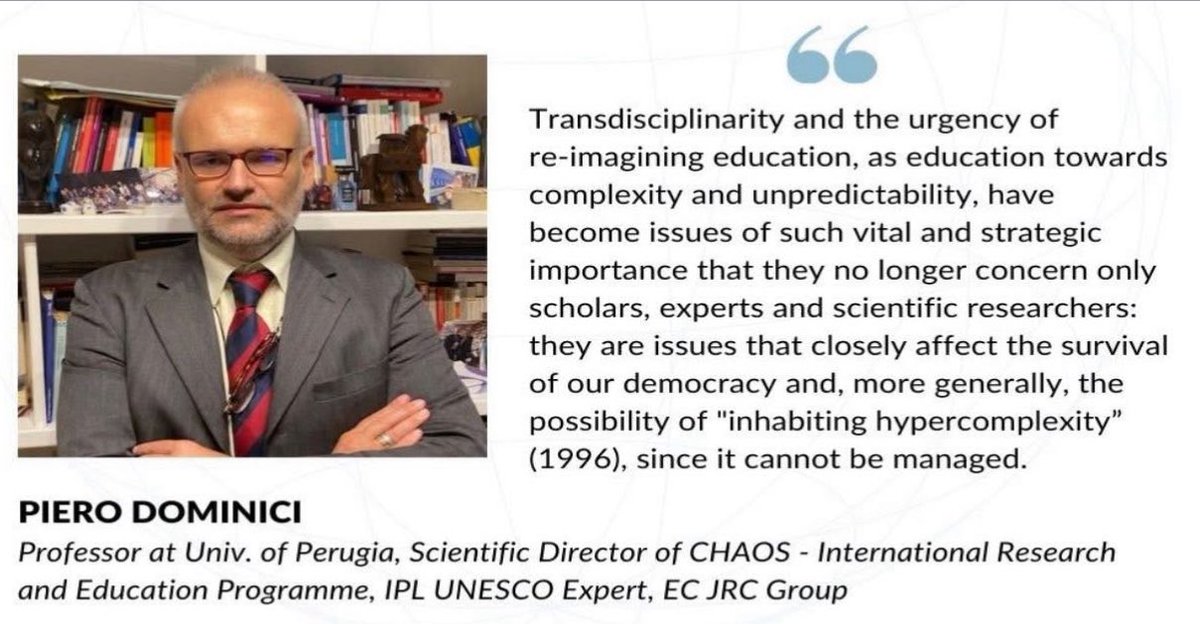
Via @UniperugiaNews 🏛️🎓🌐
#News #research #HigherEducation #ComplexAdaptiveSystems #AI #ComplexitySciences #Method #Epistemology #ScientificAwards #International #ScientificPartnerships #SystemicChange #SDGs
#ScientificAwards
🌐🔬🎓 @UNESCO @bridges_science @_WAAS_ @IML_UCM @necsi @ipsa_aisp @UNGeneva @MIsocialTW @edgarmorinparis @EUScienceInnov
🌐🌍🌱🌎📚🔬🇺🇳🏛️🎓
@research_chaos



1
4
56

3 Sep 2025
History as System, the CAMS story.
History is a palimpsest of forgotten warnings. In ancient Greece, philosophers wrestled with sophistry not as an academic parlour game but as a matter of survival: could reasoned argument anchor a polis against chaos? Millennia later, the question has returned in another guise. Our politics rehearses certainty while our institutions fray. Beneath the slogans, something deeper is at stake: how societies adapt, how they endure, how they collapse.
It was in the middle of reflecting on this long arc-from Greek reason to our own brittle present-that I stumbled on a realisation. What if we treated societies not as metaphors, not as "like" living things, but as living systems themselves-complex adaptive systems (CAS) governed by the same logic that shapes ecosystems and organisms?
That thought was the seed of CAMS: the Complex Adaptive Model State.
From Metaphor to Method
The leap felt reckless at first. But once tested, it revealed patterns as clear as a pulse. CAMS frames society as a sybond -a network of functional nodes: the executive (government), shield (army), lore (knowledge institutions), stewards (property owners), craft (professions), hands (proletariat), archive (memory), and flow (commerce).
Each node is measured across four traits:
Coherence: alignment and trust.
Capacity: resources and skills.
Stress: pressures and strains.
Abstraction: the symbolic and systemic complexity a society can carry.
Together, these metrics produce a health score. When applied retrospectively, the model predicted civilisational turning points with striking accuracy-83% reliable a decade out. Rome's third-century crisis, Qing China's failure to adapt, Denmark's occupation in 1940, Singapore's engineered recovery after 1965-all map onto CAMS thresholds.
The model is falsifiable, quantitative, and universal. In other words: science.
Historical Echoes
Australia's own story illustrates the logic. From the 19th-century "Russian scares" to the "yellow peril" panic over Japan, to Cold War anti-communism, and today's China alarms, leaders have invoked external threats to generate coherence at home. But this coherence is brittle-exclusive rather than inclusive, forged in fear, quick to fracture when the excluded push back.
Contrast this with our democratic inheritance. The Eureka Stockade, trade union strikes, women's suffrage-all were episodes of stress that looked dangerous in the moment but produced adaptation and reform. Stress harnessed became resilience. Stress suppressed became rigidity. CAMS captures that distinction.
Human Machine
CAMS was not the product of one mind alone. It emerged through collaboration: my own structured curiosity, the grounding influence of my partner Julie, and the brute computational capacity of Al.
Al sorted chaotic datasets, calculated thresholds, and tested equations. I supplied the evolutionary logic and civilisational memory. Julie ensured the work remained tethered to people's dignity and to lived consequences, not just elegant numbers.
The result was a synergy neither human nor machine could have achieved alone. Not metaphor but method. Not prediction by punditry but by pattern recognition across centuries.
The Philosophical Charge
The implications reach beyond policy analysis. CAMS suggests that societies think and feel at a systemic level. They think through Coherence and Abstraction-how they align, how they model the world. They feel through Capacity and Stress-what resources they command, what burdens they bear.
This raises unsettling questions. If a society has a psyche, can it mislead itself? Can it lose coherence the way a mind loses memory? What responsibility do we carry when the signals of stress are ignored, and collapse follows?
The Greeks asked whether reason could steady the polis. CAMS reframes the question: can we see soceities as organism before entropy overtakes coherence?
#cams #Complexity #ComplexAdaptiveSystems #Entropy
1
1
4
221

PS. The notion of an "escalation ladder" simplistic.
We are better off seeing it as a "conflict network from which escalation can emerge."
#complexity #ComplexAdaptiveSystems
1
3
1,488

9 May 2025
by @dominicipi @UniperugiaNews, scientific article - via @_WAAS_ World Academy of Art and Science #PeerReviewed #research #CriticalThinking #AI #ComplexAdaptiveSystems
9 May 2025

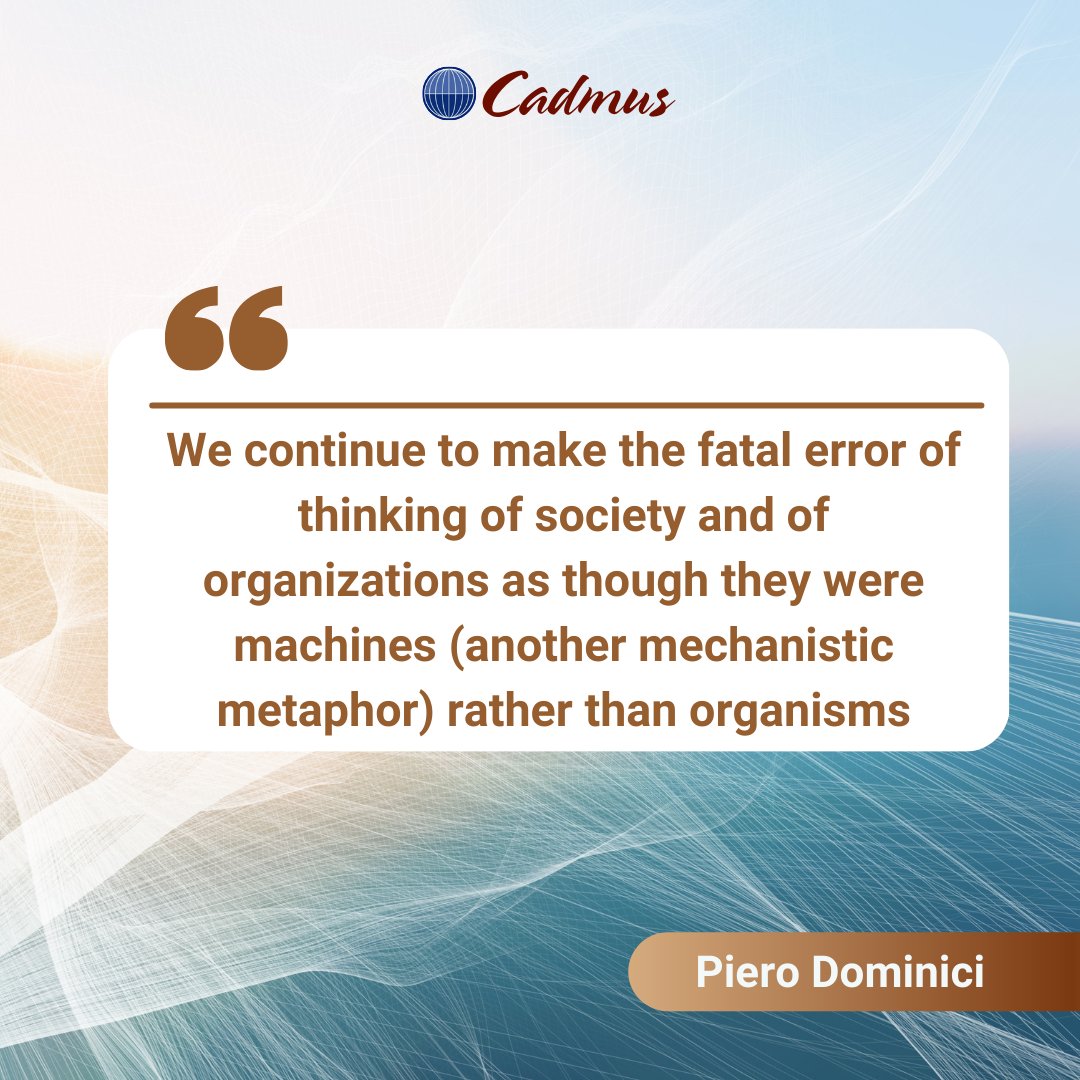
🧠 Why are today's hard times also a thinking crisis?
In Cadmus Journal, Piero Dominici explores how fragmented thinking deepens global challenges — and why new, integrated approaches are essential for real solutions.
🔍 Read more: cadmusjournal.org/article/vo…
1
2
3
168
🌐🌎🌱🔬📚🖋️🏛️🎓 #conoscenza #ricerca #metodo #epistemologie #Paradigmi #PensieroSistemico #AI #generativeAI #ComplexSystems #complessità #complejidad #complexadaptivesystems #education #emergenza #errore
🛑Ciclo di #webinar “Il Lessico dell’Intelligenza Artificiale”, ideato dal Prof. Giovanni Tridente, che ringrazio per l’invito e il coinvolgimento. Tratterò e dibatteremo la voce 💡👉“CONOSCENZA”.
🖋️➡️ Per registrarsi: eventbrite.it/e/biglietti-co…
Un approccio e percorsi di ricerca dal 1995

1
5
92